anaheim-gazette 1909-04-01
Scanned page
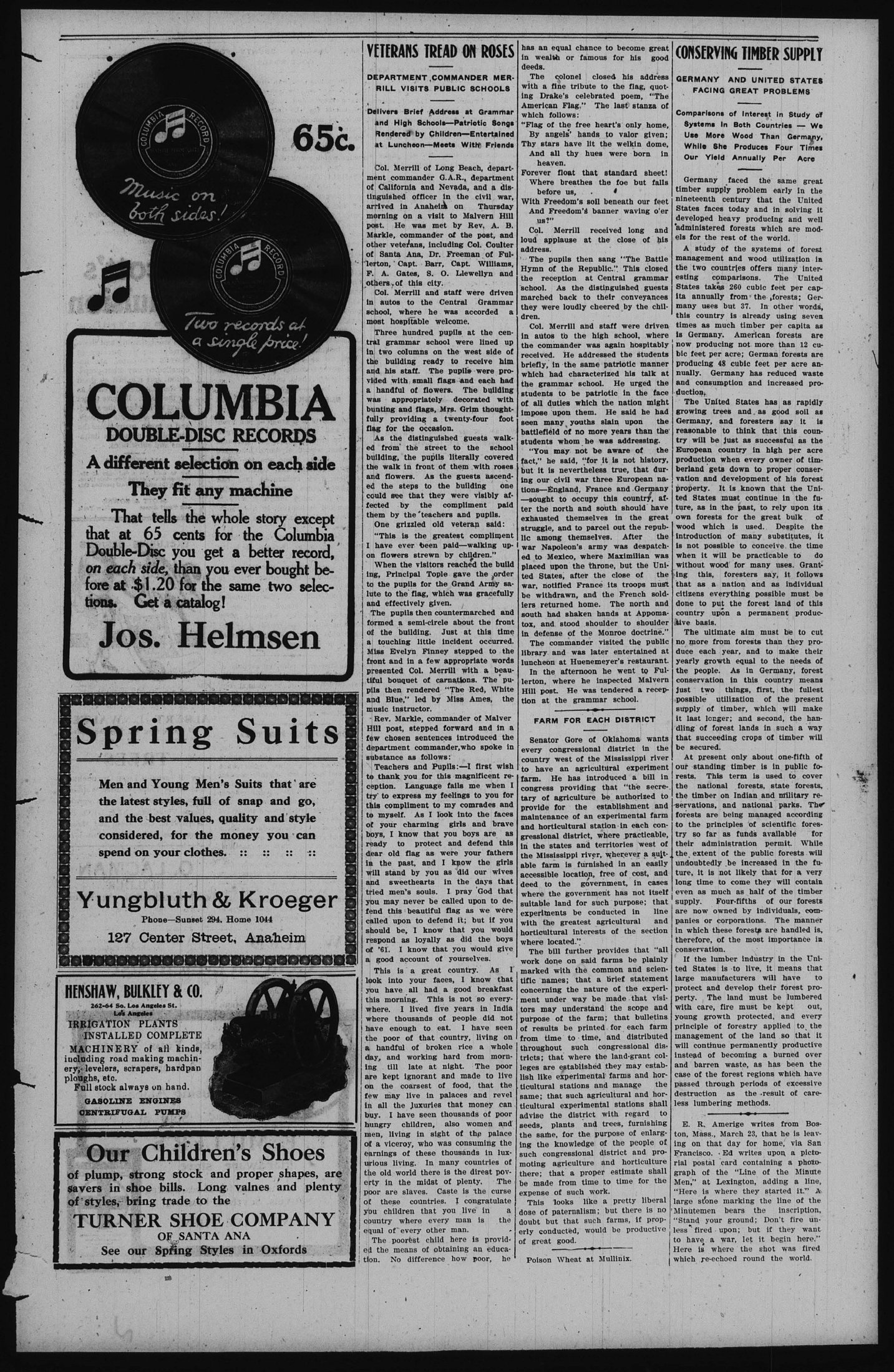
Searchable text
COLUMBIA RECORD
Music on both sides!
COLUMBIA RECORD
Two records at a single price!
COLUMBIA
DOUBLE-DISC RECORDS
A different selection on each side
They fit any machine
COLUMBIA
DOUBLE-DISC RECORDS
A different selection on each side
They fit any machine
That tells the whole story except that at 65 cents for the Columbia Double-Disc you get a better record, on each side, than you ever bought before at $1.20 for the same two selections. Get a catalog!
Jos. Helmsen
Spring Suits
Men and Young Men's Suits that are the latest styles, full of snap and go, and the best values, quality and style considered, for the money you can spend on your clothes.
Yungbluth & Kroeger
Phone—Sunset 294, Home 1044
127 Center Street, Anaheim
Yungbluth & Kroeger
Phone—Sunset 294, Home 1044
127 Center Street, Anaheim
HENSHAW, BULKLEY & CO.
262-64 So. Los Angeles St.
Los Angeles
IRRIGATION PLANTS
INSTALLED COMPLETE
MACHINERY of all kinds,
including road making machinery,
levelers, scrapers, hardpan ploughs, etc.
Full stock always on hand.
GASOLINE ENGINES
CENTRIFUGAL PUMPS
Our Children's Shoes
of plump, strong stock and proper shapes, and savers in shoe bills. Long valnes and plenty of styles, bring trade to the
TURNER SHOE COMPANY
OF SANTA ANA
See our Spring Styles in Oxford
VETERANS TREAD ON ROSES
DEPARTMENT COMMANDER MERRILL VISITS PUBLIC SCHOOLS
Delivers Brief Address at Grammar and High Schools—Patriotic Songs Rendered by Children—Entertained at Luncheon—Meets With Friends
Col. Merrill of Long Beach, department commander G.A.R., department of California and Nevada, and a distinguished officer in the civil war, arrived in Anaheim on Thursday morning on a visit to Malvern Hill post. He was met by Rev. A. B. Markle, commander of the post, and other veterans, including Col. Coulter of Santa Ana, Dr. Freeman of Fullerton, Capt. Barr, Capt. Williams, F. A. Gates, S. O. Llewellyn and others of this city.
Col. Merrill and staff were driven in autos to the Central Grammar school, where he was accorded a most hospitable welcome.
Three hundred pupils at the central grammar school were lined up in two columns on the west side of the building ready to receive him and his staff. The pupils were provided with small flags and each had a handful of flowers. The building was appropriately decorated with bunting and flags, Mrs. Grim thoughtfully providing a twenty-four foot flag for the occasion.
As the distinguished guests walked from the street to the school building, the pupils literally covered the walk in front of them with roses and flowers. As the guests ascended the steps to the building one could see that they were visibly affected by the compliment paid has an equal chance to become in wealth or famous for deeds.
The colonel closed his with a fine tribute to the firing Drake's celebrated poem American Flag." The last which follows:
"Flag of the free heart's on By angels' hands to valde Thy stars have lit the well And all thy hues were heaven.
Forever float that standard Where breathes the foe before us,
With Freedom's soil beneath And Freedom's banner wa us?"
Col. Merrill received loud applause at the close address.
The pupils then sang "The Hymn of the Republic." Then the reception at Central School. As the distinguished marched back to their cone they were loudly cheered by children.
Col. Merrill and staff wein autos to the high school the commander was again received. He addressed them briefly, in the same patriotic which had characterized his grammar school. He students to be patriotic in all duties which the nation impose upon them. He said seen many youths slain up battlefield of no more years students whom he was addi
"You may not be aware fact," he said, "for it is no but it is nevertheless true, ing our civil war three Eur octions—England, France and sought to occupy this co ter the north and south sho
As the distinguished guests walked from the street to the school building, the pupils literally covered the walk in front of them with roses and flowers. As the guests ascended the steps to the building one could see that they were visibly affected by the compliment paid them by the teachers and pupils.
One grizzled old veteran said:
“This is the greatest compliment I have ever been paid—walking upon flowers strewn by children.”
When the visitors reached the building, Principal Tople gave the order to the pupils for the Grand Army salute to the flag, which was gracefully and effectively given.
The pupils then countermarched and formed a semi-circle about the front of the building. Just at this time a touching little incident occurred. Miss Evelyn Finney stepped to the front and in a few appropriate words presented Col. Merrill with a beautiful bouquet of carnations. The pupils then rendered “The Red, White and Blue,” led by Miss Ames, the music instructor.
Rev. Markle, commander of Malver Hill post, stepped forward and in a few chosen sentences introduced the department commander, who spoke in substance as follows:
Teachers and Pupils:—I first wish to thank you for this magnificent reception. Language fails me when I try to express my feelings to you for this compliment to my comrades and to myself. As I look into the faces of your charming girls and brave boys, I know that you boys are as ready to protect and defend this dear old flag as were your fathers in the past, and I know the girls will stand by you as did our wives and sweethearts in the days that tried men’s souls. I pray God that you may never be called upon to defend this beautiful flag as we were called upon to defend it; but if you should be, I know that you would respond as loyally as did the boys of '61. I know that you would give a good account of yourselves.
“You may not be aware of fact,” he said, “for it is no doubt but it is nevertheless true, ing our civil war three Eurorations—England, France and—sought to occupy this corner the north and south shore exhausted themselves in the struggle, and to parcel out the public among themselves. After war Napoleon’s army was ordered to Mexico, where Maximilian placed upon the throne, but United States, after the close war, notified France its troops be withdrawn, and the Frenchers returned home. The south had shaken hands at tox, and stood shoulder to shoulder in defense of the Monroe.
The commander visited the library and was later entered luncheon at Huenemeyer’s room.
In the afternoon he went lerton, where he inspected Hill post. He was tendered tion at the grammar school.
FARM FOR EACH DISTRICT
Senator Gore of Oklahoma every congressional district country west of the Mississippi to have an agricultural farm. He has introduced congress providing that “the tary of agriculture be authi provide for the establishment of an experiment and horticultural station in gressional district, where pr in the states and territories the Mississippi river, where able farm is furnished in accessible location, free of deed to the government, where the government has suitable land for such purp experiments be conducted with the greatest agriculturial interests of tha where located.”
The bill further provides work done on said farms barked with the common a
in the past, and I know the girls will stand by you as did our wives and sweethearts in the days that tried men's souls. I pray God that you may never be called upon to defend this beautiful flag as we were called upon to defend it; but if you should be, I know that you would respond as loyally as did the boys of '61. I know that you would give a good account of yourselves.
This is a great country. As I look into your faces, I know that you have all had a good breakfast this morning. This is not so everywhere. I lived five years in India where thousands of people did not have enough to eat. I have seen the poor of that country, living on a handful of broken rice a whole day, and working hard from morning till late at night. The poor are kept ignorant and made to live on the coarsest of food, that the few may live in palaces and revel in all the luxuries that money can buy. I have seen thousands of poor hungry children, also women and men, living in sight of the palace of a viceroy, who was consuming the earnings of these thousands in luxurious living. In many countries of the old world there is the direst poverty in the midst of plenty. The poor are slaves. Caste is the curse of these countries. I congratulate you children that you live in a country where every man is the equal of every other man.
The poorest child here is provided the means of obtaining an education. No difference how poor, he able farm is furnished in accessible location, free of deed to the government, where the government has suitable land for such purpure experiments be conducted with the greatest agricultural horticultural interests of the where located."
The bill further provides work done on said farms marked with the common scientific names; that a brief concerning the nature of the ment under way be made toors may understand the purpose of the farm; that of results be printed for each from time to time, and d throughout such congressi tricts; that where the land-gleges are established they mollish like experimental farms; ticultural stations and mana same; that such agricultural ticultural experimental station advise the district with re seeds, plants and trees, f the same, for the purpose o ing the knowledge of the p such congressional district moting agriculture and ho there; that a proper estimate be made from time to time expense of such work.
This looks like a pretty dose of paternalism; but the doubt but that such farms, erly conducted, would be pr of great good.
Poison Wheat at Mullinix.
CONSERVING TIMBER SUPPLY
GERMANY AND UNITED STATES FACING GREAT PROBLEMS
Comparisons of Interest in Study of Systems in Both Countries — We Use More Wood Than Germany, While She Produces Four Times Our Yield Annually Per Acre
Germany faced the same great timber supply problem early in the nineteenth century that the United States faces today and in solving it developed heavy producing and well administered forests which are models for the rest of the world.
A study of the systems of forest management and wood utilization in the two countries offers many interesting comparisons. The United States takes 260 cubic feet per capita annually from the forests; Germany uses but 37. In other words, this country is already using seven times as much timber per capita as is Germany. American forests are now producing not more than 12 cubic feet per acre; German forests are producing 48 cubic feet per acre annually. Germany has reduced waste and consumption and increased production.
The United States has as rapidly growing trees and as good soil as Germany, and foresters say it is reasonable to think that this country will be just as successful as the European country in high per acre production when every owner of timberland gets down to proper conservation and development of his forest property. It is known that the United States must continue in the future, as in the past, to rely upon its
Gore of Oklahoma wants congressional district in the west of the Mississippi river to conduct agricultural experiment. He has introduced a bill providing that "the secrecy agriculture be authorized to be the establishment and place of an experimental farm cultural station in each district, where practicable, states and territories west of Mississippi river, wherever a suit is furnished in an easily located, free of cost, and the government, in cases where government has not itself land for such purpose; that tests be conducted in line with greatest agricultural and social interests of the section regulated."
Further provides that "all on said farms be plainly with the common and scientific growing trees and as good soil as Germany, and foresters say it is reasonable to think that this country will be just as successful as the European country in high per acre production when every owner of timberland gets down to proper conservation and development of his forest property. It is known that the United States must continue in the future, as in the past, to rely upon its own forests for the great bulk of wood which is used. Despite the introduction of many substitutes, it is not possible to conceive the time when it will be practicable to do without wood for many uses. Granting this, foresters say, it follows that as a nation and as individual citizens everything possible must be done to put the forest land of this country upon a permanent productive basis.
The ultimate aim must be to cut no more from forests than they produce each year, and to make their yearly growth equal to the needs of the people. As in Germany, forest conservation in this country means just two things, first, the fullest possible utilization of the present supply of timber, which will make it last longer; and second, the handling of forest lands in such a way that succeeding crops of timber will be secured.
At present only about one-fifth of our standing timber is in public forests. This term is used to cover the national forests, state forests, the timber on Indian and military reservations, and national parks. The forests are being managed according to the principles of scientific forestry so far as funds available for their administration permit. While the extent of the public forests will undoubtedly be increased in the future, it is not likely that for a very long time to come they will contain even as much as half of the timber supply. Four-fifths of our forests are now owned by individuals, companies or corporations. The manner in which these forests are handled is, therefore, of the most importance in conservation.
If the lumber industry in the United States is to live it means that
is furnished in an easily accessible location, free of cost, and the government, in cases where the government has not itself found for such purpose; that tests be conducted in line with greatest agricultural and social interests of the section indicated."
Further provides that "all these on said farms be plainly with the common and scientific; that a brief statement of the nature of the experimenter way be made that visitors understand the scope and limits of the farm; that bulletins can be printed for each farm due to time, and distributed at such congressional district where the land-grant colostablished they may establish experimental farms and horstations and manage the most such agricultural and horst experimental stations shall be district with regard to plants and trees, furnishing for the purpose of enlarging knowledge of the people of professional district and pro-agriculture and horticulture that a proper estimate shall be from time to time for the relief such work.
Books like a pretty liberal externalism; but there is no need that such farms, if propacted, would be productive good.
Wheat at Mullinix.
E. R. Amerige writes from Boston, Mass., March 23, that he is leaving on that day for home, via San Francisco. Ed writes upon a pictorial postal card containing a photograph of the "Line of the Minute Men," at Lexington, adding a line, "Here is where they started it." A large stone marking the line of the Minutemen bears the inscription, "Stand your ground; Don't fire unless fired upon; but if they want to have a war, let it begin here." Here is where the shot was fired which re-echoed round the world.