anaheim-gazette 1909-04-01
Scanned page
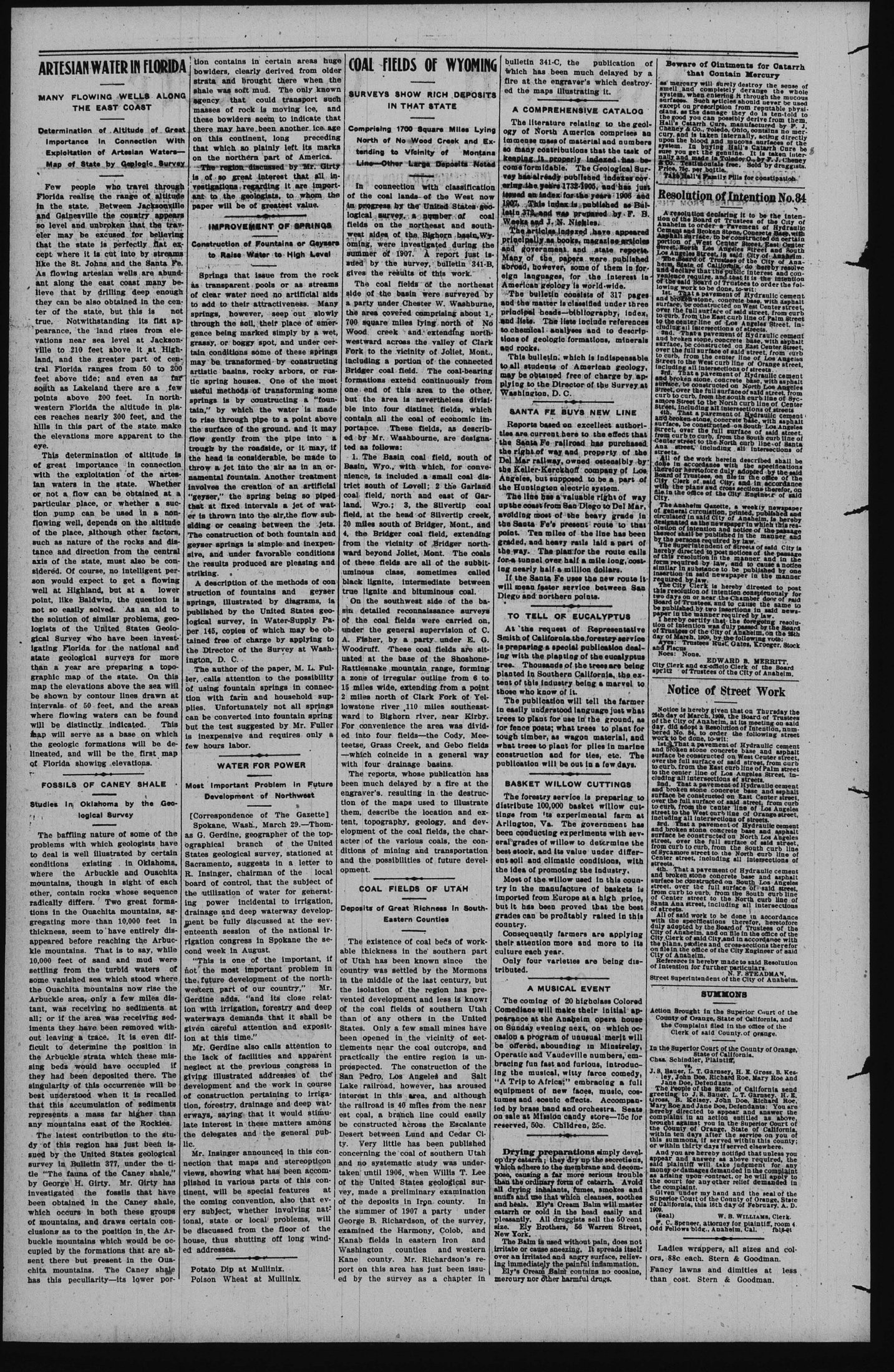
Searchable text
ARTESIAN WATER IN FLORIDA
MANY FLOWING WELLS ALONG THE EAST COAST
Determination of Altitude of Great Importance in Connection With Exploitation of Artesian Waters—Map of State by Geologic Survey
Few people who travel through Florida realize the range of altitude in the state. Between Jacksonville and Gainesville the country appears so level and unbroken that the traveler may be excused for believing that the state is perfectly flat except where it is cut into by streams like the St. Johns and the Santa Fe. As flowing artesian wells are abundant along the east coast many believe that by drilling deep enough they can be also obtained in the center of the state, but this is not true. Notwithstanding its flat appearance, the land rises from elevations near sea level at Jacksonville to 210 feet above it at Highland, and the greater part of central Florida ranges from 50 to 200 feet above tide; and even as far south as Lakeland there are a few points above 200 feet. In northwestern Florida the altitude in places reaches nearly 300 feet, and the hills in this part of the state make the elevations more apparent to the eye.
This determination of altitude is of great importance in connection with the exploitation of the artesian waters in the state. Whether or not a flow can be obtained at a particular place, or whether a suction pump can be used in a tank contains in certain areas huge bowlders, clearly derived from old strata and brought there when the shale was soft mud. The only known agency that could transport such masses of rock is moving ice, and these bowlders seem to indicate that there may have been another ice age on this continent, long preceding that which so plainly left its mark on the northern part of America.
The region discussed by Mr. Girts is of so great interest that all investigations regarding it are important to the geologists, to whom the paper will be of greatest value.
IMPROVEMENT OF SPRINGS
Construction of Fountains or Geyseres to Raise Water to High Level
Springs that issue from the rocks as transparent pools or as streams of clear water need no artificial aid to add to their attractiveness. Many springs, however, seep out slowly through the soil, their place of emergence being marked simply by a weed grassy, or boggy spot, and under certain conditions some of these springs may be transformed by constructing artistic basins, rocky arbors, or rustic spring houses. One of the most useful methods of transforming some springs is by constructing a "foundation," by which the water is made to rise through pipe to a point above the surface of the ground. And it may flow gently from the pipe into a trough by the roadside, or it may, if the head is considerable, be made to throw a jet into the air as in an ornamental fountain. Another treatment involves the creation of an artificial "geyser," the spring being so piped that at fixed intervals a jet of water
western Florida the altitude in places reaches nearly 300 feet, and the hills in this part of the state make the elevations more apparent to the eye.
This determination of altitude is of great importance in connection with the exploitation of the artesian waters in the state. Whether or not a flow can be obtained at a particular place, or whether a suction pump can be used in a nonflowing well, depends on the altitude of the place, although other factors, such as nature of the rocks and distance and direction from the central axis of the state, must also be considered. Of course, no intelligent person would expect to get a flowing well at Highland, but at a lower point, like Baldwin, the question is not so easily solved. As an aid to the solution of similar problems, geologists of the United States Geological Survey who have been investigating Florida for the national and state geological surveys for more than a year are preparing a topographic map of the state. On this map the elevations above the sea will be shown by contour lines drawn at intervals of 50 feet, and the areas where flowing waters can be found will be distinctly indicated. This map will serve as a base on which the geologic formations will be delineated, and will be the first map of Florida showing elevations.
FOSSILS OF CANEY SHALE
Studies in Oklahoma by the Geological Survey
The baffling nature of some of the problems with which geologists have to deal is well illustrated by certain conditions existing in Oklahoma, where the Arbuckle and Ouachita mountains, though in sight of each other, contain rocks whose sequence radically differs. Two great formations in the Ouachita mountains, aggregating more than 10,000 feet in thickness, seem to have entirely disappeared before reaching the Arbuckle mountains. That is to say, while 10,000 feet of sand and mud were settling from the turbid waters of western Florida the altitude in places reaches nearly 300 feet, and the hills in this part of the state make the elevations more apparent to the eye.
A description of the methods of construction of fountains and geyser springs, illustrated by diagrams, is published by the United States geological survey, in Water-Supply Paper 145, copies of which may be obtained free of charge by applying to the Director of the Survey at Washington, D.C.
The author of the paper, M. L. Fuller, calls attention to the possibility of using fountain springs in connection with farm and household supplies. Unfortunately not all springs can be converted into fountain spring but the test suggested by Mr. Fuller is inexpensive and requires only a few hours labor.
WATER FOR POWER
Most Important Problem in Future Development of Northwest
[Correspondence of The Gazette]
Spokane, Wash., March 29.—Thomas G. Gerdine, geographer of the topographical branch of the United States geological survey, stationed at Sacramento, suggests in a letter to R. Insinger, chairman of the local board of control, that the subject of the utilization of water for generating power incidental to irrigation, drainage and deep waterway development be fully discussed at the seventeenth session of the national irrigation congress in Spokane the second week in August.
“This is one of the important, if just the most important problem in...
conditions existing in Oklahoma, where the Arbuckle and Ouachita mountains, though in sight of each other, contain rocks whose sequence radically differs. Two great formations in the Ouachita mountains, aggregating more than 10,000 feet in thickness, seem to have entirely disappeared before reaching the Arbuckle mountains. That is to say, while 10,000 feet of sand and mud were settling from the turbid waters of some vanished sea which stood where the Ouachita mountains now rise the Arbuckle area, only a few miles distant, was receiving no sediments at all; or if the area was receiving sediments they have been removed without leaving a trace. It is even difficult to determine the position in the Arbuckle strata which these missing beds would have occupied if they had been deposited there. The singularity of this occurrence will be best understood when it is recalled that this accumulation of sediments represents a mass far higher than any mountains east of the Rockies.
The latest contribution to the study of this region has just been issued by the United States geological survey in Bulletin 377, under the title "The fauna of the Caney shale," by George H. Girty. Mr. Girty has investigated the fossils that have been obtained in the Caney shale, which occurs in both these groups of mountains, and draws certain conclusions as to the position in the Arbuckle mountains which would be occupied by the formations that are absent there but present in the Ouachita mountains. The Caney shale has this peculiarity—its lower por-
Sacramento, suggests in a letter to R. Insinger, chairman of the local board of control, that the subject of the utilization of water for generating power incidental to irrigation, drainage and deep waterway development be fully discussed at the seventeenth session of the national irrigation congress in Spokane the second week in August.
"This is one of the important, if not the most important problem in the future development of the northwestern part of our country," Mr. Gerdine adds, "and its close relation with irrigation, forestry and deep waterways demands that it shall be given careful attention and exposition at this time."
Mr. Gerdine also calls attention to the lack of facilities and apparent neglect at the previous congress in giving illustrated addresses of the development and the work in course of construction pertaining to irrigation, forestry, drainage and deep waterways, saying that it would stimulate interest in these matters among the delegates and the general public.
Mr. Insinger announced in this connection that maps and stereopticon views, showing what has been accomplished in various parts of this continent, will be special features at the coming convention, also that every subject, whether involving national, state or local problems, will be discussed from the floor of the house, thus shutting off long winded addresses.
Potato Dip at Mullinix.
Poison Wheat at Mullinix.
COAL FIELDS OF WYOMING
SURVEYS SHOW RICH DEPOSITS IN THAT STATE
Comprising 1700 Square Miles Lying North of No Wood Creek and Extending to Vieinity of Montana Line—Other Large Deposits Noted
In connection with classification of the coal lands of the West now in progress by the United States geological survey, a number of coal fields on the northeast and southwest sides of the Bighorn basin Wyoming, were investigated during the summer of 1907. A report just issued by the survey, bulletin 341-B, gives the results of this work.
The coal fields of the northeast side of the basin were surveyed by a party under Chester W. Washburne, the area covered comprising about 1,700 square miles lying north of No Wood creek and extending north-westward across the valley of Clark Fork to the vicinity of Joliet, Mont., including a portion of the connected Bridger coal field. The coal-bearing formations extend continuously from one end of this area to the other, but the area is nevertheless divisible into four distinct fields, which contain all the coal of economic importance. These fields, as described by Mr. Washbourne, are designated as follows:
1. The Basin coal field, south of Basin, Wyo., with which, for convenience, is included a small coal district south of Lovell; 2 the Garland coal field, north and east of Garland, Wyo.; 3, the Silvertip coal bulletin 341-C, the publication which has been much delayed fire at the engraver's which designed the maps illustrating it.
A COMPREHENSIVE CATALOG
The literature relating to theology of North America comprises immense mass of material and numb so many contributions that the task keeping it properly indexed has come formidable. The Geologicalvey has already published indexes during the years 1732-1905, and has issued an index for the years 1906-1907. This index is published as bulletin 372, and was prepared by F. Weeks and J. N. Nichols.
The articles indexed have appeared principally as books, magazine art and government and state reports. Many of the papers were published abroad, however, some of them ineign languages, for the interest American geology is world-wide.
The bulletin consists of 317 pages and the matter is classified under principal heads—bibliography, in and lists. The lists include references to chemical analyses and to descriptions of geologic formations, mines and rocks.
This bulletin, which is indispensable to all students of American geology may be obtained free of charge by plying to the Director of the Survey Washington, D.C.
SANTA FE BUYS NEW LINES
Reports based on excellent authities are current here to the effect that the Santa Fe railroad has purchased the right of way and property of Del Mar railway, owned ostensibly the Keller-Kerckhoff company of Angeles, but supposed to be a part the Huntington electric system.
The line has a valuable right of up the coast from San Diego to Del M
The water is made above to a point above ground, and it may be the pipe into a wellside, or it may, if desirable, be made to the air as in an ornament of an artificial spring being so piped that a jet of water the air,the flow subbetween the jets. Of both fountain and simple and inexpen-avorable conditions are pleasing and the methods of concains and geyser by diagrams, is United States geoWater-Supply Park which may be obgaged by applying to the Survey at Washthe paper, M. L. Fulto the possibility springs in connechouse supply not all springs to fountain spring located by Mr. Fuller it requires only a
FOR POWER
Problem in Future of Northwest
of The Gazette] March 29.—Thomographer of the topof the United Survey, stationed at its in a letter to man of the local that the subject of water for generat- tional to irrigation, waterway develop- ussed at the sev- ef of the national ir- Spokane the se- st.
the important, if important problem in able into four distinct fields, which contain all the coal of economic im- portance. These fields, as describ- ed by Mr. Washbourne, are designated as follows:
1. The Basin coal field, south of Basin, Wyo., with which, for convenience, is included a small coal district south of Lovell; 2 the Garland coal field, north and east of Garland. Wyo.; 3, the Silvertip coal field, at the head of Silvertip creek, 20 miles south of Bridger, Mont., and 4, the Bridger coal field, extending from the vicinity of Bridger northward beyond Joliet, Mont. The coals of these fields are all of the subbituminous class, sometimes called black lignite, intermediate between true lignite and bituminous coal.
On the southwest side of the basin detailed reconnaissance surveys of the coal fields were carried on, under the general supervision of C. A. Fisher, by a party under E. G. Woodruff. These coal fields are situated at the base of the Shoshone-Rattlesnake mountain range, forming a zone of irregular outline from 6 to 15 miles wide, extending from a point 2 miles north of Clark Fork of Yellowstone river 110 miles southeastward to Bighorn river, near Kirby. For convenience the area was divided into four fields—the Cody, Meeteetse, Grass Creek, and Gebo fields—which coincide in a general way with four drainage basins.
The reports, whose publication has been much delayed by a fire at the engraver's, resulting in the destruction of the maps used to illustrate them, describe the location and extent, topography, geology, and development of the coal fields, the character of the various coals, the conditions of mining and transportation and the possibilities of future development.
COAL FIELDS OF UTAH
Deposits of Great Richness In South-Eastern Counties
The existence of coal beds of workable thickness in the southern part of Utah has been known since the country was settled by the Mormons.
SANTA FE BUYS NEW LINES
Reports based on excellent auth- tories are current here to the effect that the Santa Fe railroad has purchased the right of way and property of Del Mar railway, owned ostensibly by the Keller-Kerckhoff company of Angeles, but supposed to be a part of the Huntington electric system.
The line has a valuable right of up the coast from San Diego to Del Mauvoiding most of the heavy grade of the Santa Fe's present route to this point. Ten miles of the line has been graded, and heavy rails laid a part of the way. The plan for the route can for-a tunnel over half a mile long, owing nearly half a million dollars.
If the Santa Fe uses the new route will mean faster service between San Diego and northern points.
TO TELL OF EUCALYPTUS
At 'the request of Representative Smith of California,the forestry service is preparing a special publication dealing with the planting of the eucalypt tree. Thousands of the trees are be- planted in Southern California,the tent of this industry being a marvel those who know of it.
The publication will tell the farm in easily understood language just what trees to plant for use in the ground for fence posts; what trees to plant tough timber, as wagon material; what trees to plant for piles in marmal construction and for ties, etc. The publication will be out in a few days.
BASKET WILLOW CUTTINGS
The forestry service is preparing distribute 100,000 basket willow cottings from its experimental farm Arlington, Va. The government has been conducting experiments with several grades of willow to determine best stock,and its value under different soil and climatic conditions,with the idea of promoting the industry.
Most of the willow used in this country in the manufacture of baskets imported from Europe at a high price but it has been proved that the bgrades can be profitably raised in this country.
Consequently farmers are applying their attention more and more to culture each year.
Only four varieties are being dributed.
COAL FIELDS OF UTAH
Deposits of Great Richness in South-Eastern Counties
The existence of coal beds of workable thickness in the southern part of Utah has been known since the country was settled by the Mormons in the middle of the last century, but the isolation of the region has prevented development and less is known of the coal fields of southern Utah than of any others in the United States. Only a few small mines have been opened in the vicinity of settlements near the coal outcrops, and practically the entire region is unprospected. The construction of the San Pedro, Los Angeles and Salt Lake railroad, however, has aroused interest in this area, and although the railroad is 40 miles from the nearest coal, a branch line could easily be constructed across the Escalante Desert between Lund and Cedar City. Very little has been published concerning the coal of southern Utah and no systematic study was undertaken until 1906, when Willis T. Lee of the United States geological survey, made a preliminary examination of the deposits in Iron county. In the summer of 1907 a party under George B. Richardson, of the survey, examined the Harmony, Colob, and Kanab fields in eastern Iron and Washington counties and western Kane county. Mr. Richardson's report on this area has just been issued by the survey as a chapter in
A MUSICAL EVENT
The coming of 20 highclass Comedians will make their initial appearance at the Anageim opera house on Sunday evening next, on which occasion a program of unusual merit will be offered, abounding in Minstrel Operatic and Vaudeville numbers, enriched fun fast and furious, introducing the musical, witty farce comedy "A Trip to Africa;" embracing a fine equipment of new faces, music, costumes and scenic effects. Accompanied by brass band and orchestra. Seen on sale at Mission candy store—75c reserved, 50c. Children, 25c.
Drying preparations simply devise dry catarrh; they dry up the secretion which adheres to the membrane and deep pose, causing a far more serious trouser than the ordinary form of catarrh. All drying inhalants, fumes, smokes and snuffs and use that which cleanses, soothes and heals. Ely's Cream Balm will mass catarrh or cold in the head easily and pleasantly. All druggists sell the 50cc size. Ely Brothers, 56 Warren Street New York.
The Balm is used without pain, does not irritate or cause sneezing. It spreads its over an irritated and angry surface, relating immediately to painful inflammation. Ely's Cream Balm contains no cocaine or mercury nor other harmful drugs.
Beware of Ointments for Catarrh that Contain Mercury
as mercury will surely destroy the sense of smell and completely derange the whole system, when entering it through the mucous surfaces. Such articles should never be used except on prescription from reputable physicians, as the damage they do is ten-told to the good you can possibly derive from them.
Hall's Catarrh Cure, manufactured by F. J. Chaney & Co., Toledo, Ohio, contains no mercury, and is taken internally, acting directly upon the blood and mucous surfaces of the system. In buying Hall's Catarrh Cure be sure you get the genuine. It is taken internally and made in Toledo, O., by F. J. Chaney & Co. Testimonials free. Sold by druggists.
Price, 75c. per bottle.
Take Hall's Family Pills for constipation.
Resolution of Intention No.84
A resolution declaring it to be the intention of the Board of Trustees of the City of Anaheim to order a Pavement of Hydraulic Cement and Broken Stone, Concrete Base, with Asphalt Surface, to be constructed on certain portion of West Center Street, East Center Street, North Los Angeles Street and South Los Angeles Street, in said City of Anaheim.
The Board of Trustees of the City of Anaheim State of California, do hereby resolve and declare that the public interest and convenience require, and that it is the intention of the said Board of Trustees to order the following work to be done, to-wit:
1st. That a pavement of Hydraulic cement and broken stone, concrete base, with asphalt surface, be constructed on West Center street, over the full surface of said street, from curb to curb, from the East curb line of Palm Street to the center line of Los Angeles Street, including all intersections of streets.
2nd. That a pavement of Hydraulic cement and broken stone, concrete base, with asphalt surface, be constructed on East Center street, over the full surface of said street, from curb to curb, from the center line of Los Angeles Street to the West curb line of Orange street, including all intersections of streets.
3rd. That a pavement of Hydraulic cement and broken stone, concrete base, with asphalt surface, be constructed on North Los Angeles Street, over the full surface of said street, from curb to curb, from the south curb line of Sycamore Street to the North curb line of Center Street, including all intersections of streets.
4th. That a pavement of Hydraulic cement and broken stone, concrete base, with asphalt surface, be constructed on South Los Angeles Street, over the full surface of said street, from curb to curb, from the South curb line of Center street to the North curb line of Santa Ana street, including all intersections of streets.
All of the work herein described shall be done in accordance with the specifications therefor heretofore duly adopted by the said Board of Trustees, on file in the office of the City Clerk of said City, and in accordance with the plans and cross sections thereof, on file in the office of the City Engineer of said City.
The Anaheim Gazette, a weekly newspaper of general circulation.
Notice of Street Work
Notice is hereby given that on Thursday the 25th day of March, 1909, the Board of Trustees of the City of Anaheim, at its meeting on said day, did adopt a Resolution of Intention, numbered No. 84, to order the following street work to be done, to-wit:
1st. That a pavement of Hydraulic cement and broken stone concrete base and asphalt surface be constructed on West Center street, over the full surface of said street, from curb to curb, from the East curb line of Palm street to the center line of Los Angeles Street, including all intersections of streets.
2nd. That a pavement of Hydraulic cement and broken stone concrete base and asphalt surface be constructed on East Center street, over the full surface of said street, from curb to curb, from the center line of Los Angeles street to the West curb line of Orange street, including all intersections of streets.
3rd. That a pavement of Hydraulic cement and broken stone concrete base and asphalt surface be constructed on North Los Angeles street, over the full surface of said street, from curb to curb, from the South curb line of Center street to the North curb line of Santa Ana street, including all intersections of streets.
All of said work to be done in accordance with the specifications therefor, heretofore duly adopted by the Board of Trustees of the City of Anaheim, and on file in the office of the City Clerk of said City, and in accordance with the plans and cross sections thereof on file in the office of the City Engineer of said City.
Reference is hereby made to said Resolution of Intention for further particulars.
LOCAL EVENT
20 highclass Colored make their initial apnageim opera house next, on which occident of unusual merit will
heading in Minstrelsy,
deville numbers, emand furious, introducwitty farce comedy,
embracing a full
new faces, music, coseffects. Accompanand orchestra. Seats
candy store—75c for
children, 25c.
arations simply develly dry up the secretions,
membrane and decommore serious trouble
form of catarrh. Avoid
stems, fumes, smokes and
which cleanses, soothes
Cream Balm will master
the head easily and
truggists sell the 50 cent
ers, 56 Warren Street,
without pain, does not
freezing. It spreads itself
and angry surface, relievthe painful inflammation.
contains no cocaine,
harmful drugs.
4th. That a pavement of Hydraulic cement
and broken stone concrete base and asphalt
surface be constructed on South Los Angeles
street, over the full surface of said street,
from curb to curb, from the South curb line
of Center street to the North curb line of
Santa Ana street, including all intersections
of streets.
All of said work to be done in accordance
with the specifications therefor, heretofore
duly adopted by the Board of Trustees of the
City of Anaheim, and on file in the office of the
City Clerk of said City, and in accordance with
the plans, profiles and cross-sections thereof
on file in the office of the City Engineer of said
City of Anaheim.
Reference is hereby made to said Resolution
of Intention for further particulars.
N. F. STEADMAN,
Street Superintendent of the City of Anaheim.
SUMMONS
Action Brought in the Superior Court of the
County of Orange, State of California, and
the Complaint filed in the office of the
Clerk of said County of Orange.
In the Superior Court of the County of Orange,
State of California.
Chas. Schindler, Plaintiff,
vs.
J. S. Bauer, L. T. Garnsey, H. E. Gross, B. Kesley, John Doe, Richard Roe, Mary Roe and
Jane Doe, Defendants.
The People of the State of California send
greeting to J. S. Bauer, L. T. Garnsey, H. E.
Gross, B. Kelsey, John Doe, Richard Roe,
Mary Roe and Jane Doe, Defendants: You are
hereby directed to appear and answer the
complaint in an action entitled as above,
brought against you in the Superior Court of
the County of Orange, State of California,
within ten days after the service on you of
this summons, if served within this county;
or within thirty days if served elsewhere.
And you are hereby notified that unless you
appear and answer as above required, the
said plaintiff will take judgment for any
money or damages demanded in the complaint
as arising upon contract, or he will apply to
the court for any other relief demanded in the complaint.
Given under my hand and the seal of the
Superior Court of the County of Orange, State
of California, this 16th day of February, A. D.
1909.
(Seal)
W. B. WILLIAMS, Clerk.
F. C. Spenceer, attorney for plaintiff, room 4
Odd Fellows bldg., Anaheim, Cal.
Ladies wrappers, all sizes and colors, 88c each. Stern & Goodman.
Fancy lawns and dimities at less than cost. Stern & Goodman.