anaheim-gazette 1909-03-18
Scanned page
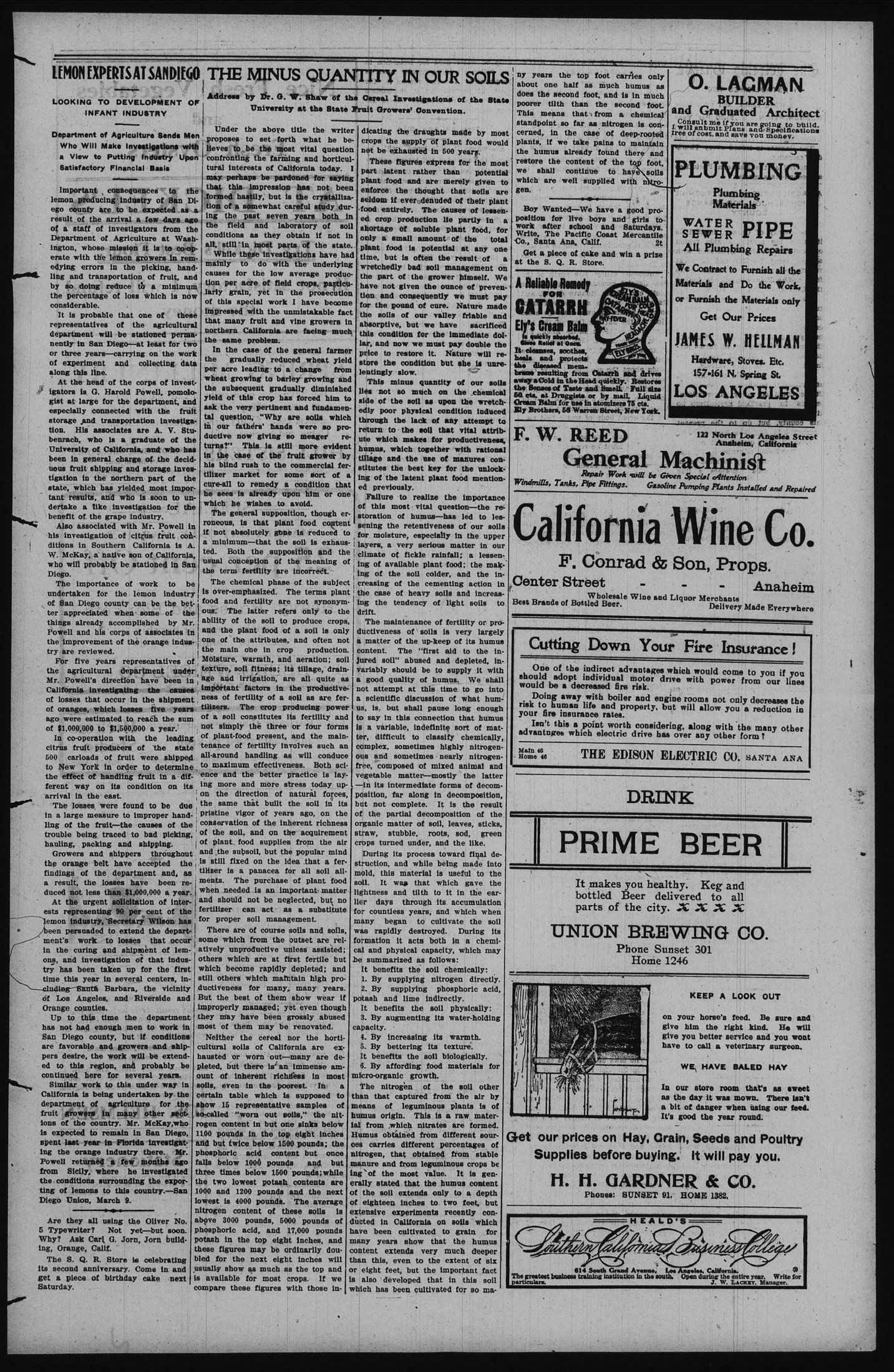
Searchable text
LEMON EXPERTS AT SANDIEGO
LOOKING TO DEVELOPMENT OF INFANT INDUSTRY
Department of Agriculture Sends Men Who Will Make Investigations with a View to Putting Industry Upon Satisfactory Financial Basis
Important consequences to the lemon producing industry of San Diego county are to be expected as a result of the arrival a few days ago of a staff of investigators from the Department of Agriculture at Washington, whose mission it is to co-operate with the lemon growers in remedying errors in the picking, handling and transportation of fruit, and by so doing reduce to a minimum the percentage of loss which is now considerable.
It is probable that one of these representatives of the agricultural department will be stationed permanently in San Diego—at least for two or three years—carrying on the work of experiment and collecting data along this line.
At the head of the corps of investigators is G. Harold Powell, pomologist at large for the department, and especially connected with the fruit storage and transportation investigation. His associates are A. V. Stubenrach, who is a graduate of the University of California, and who has been in general charge of the deciduous fruit shipping and storage investigation in the northern part of the state, which has yielded most important results, and who is soon to undertake a like investigation for the
Address by Dr. G. W. Shaw University at the St
Under the above title the proposes to set forth what he believes to be the most vital question confronting the farming and humoral interests of California today may perhaps be pardoned for such that this impression has not formed hastily, but is the crystallization of a somewhat careful study ing the past seven years both the field and laboratory of conditions as they obtain if not all, still in most parts of the
While these investigations have mainly to do with the undercauses for the low average production per acre of field crops, particularly grain, yet in the prosecution of this special work I have been impressed with the unmistakable that many fruit and vine growers northern California are facing in the same problem.
In the case of the general fact the gradually reduced wheat per acre leading to a change wheat growing to barley growing the subsequent gradually diminishing yield of this crop has forced him ask the very pertinent fundamental question, "Why are soils wilt in our fathers' hands were so ductive now giving so meager turns?" This is still more evident in the case of the fruit grower his blind rush to the commercial tiller market for some sort of cure-all to remedy a condition he sees is already upon him or which he wishes to avoid.
especially connected with the fruit storage and transportation investigation. His associates are A. V. Stubenrach, who is a graduate of the University of California, and who has been in general charge of the deciduous fruit shipping and storage investigation in the northern part of the state, which has yielded most important results, and who is soon to undertake a like investigation for the benefit of the grape industry.
Also associated with Mr. Powell in his investigation of citrus fruit conditions in Southern California is A. W. McKay, a native son of California, who will probably be stationed in San Diego.
The importance of work to be undertaken for the lemon industry of San Diego county can be the better appreciated when some of the things already accomplished by Mr. Powell and his corps of associates in the improvement of the orange industry are reviewed.
For five years representatives of the agricultural department under Mr. Powell's direction have been in California investigating the causes of losses that occur in the shipment of oranges, which losses five years ago were estimated to reach the sum of $1,000,000 to $1,500,000 a year.
In co-operation with the leading citrus fruit producers of the state 500 carloads of fruit were shipped to New York in order to determine the effect of handling fruit in a different way on its condition on its arrival in the east.
The losses were found to be due in a large measure to improper handling of the fruit—the causes of the trouble being traced to bad picking, hauling, packing and shipping.
Growers and shippers throughout the orange belt have accepted the findings of the department and, as a result, the losses have been reduced not less than $1,000,000 a year.
At the urgent solicitation of interests representing 90 per cent of the lemon industry, Secretary Wilson has been persuaded to extend the department's work to losses that occur in the curing and shipment of lemons, and investigation of that industry has been taken up for the first ask the very pertinent and fundamental question, "Why are soils weak in our fathers' hands were so ductive now giving so meager returns?" This is still more evident in the case of the fruit grower his blind rush to the commercial tiller market for some sort of cure-all to remedy a condition he sees is already upon him or which he wishes to avoid.
The general supposition, though roneous, is that plant food content if not absolutely gone is reduced a minimum—that the soil is exhibited. Both the supposition and usual conception of the meaning the term fertility are incorrect.
The chemical phase of the subsoil is over-emphasized. The terms food and fertility are not synonymous. The latter refers only to ability of the soil to produce crop and the plant food of a soil is one of the attributes, and often the main one in crop products Moisture, warmth, and aeration; texture, soil fitness; its tillage, drainage and irrigation, are all quite important factors in the productivity of fertility of a soil as are tillizers. The crop producing power of a soil constitutes its fertility not simply the three or four foot of plant-food present, and the maintenance of fertility involves such all-around handling as will conduceto maximum effectiveness. Bothence and the better practice is doing more and more stress today on the direction of natural forces that built the soil in pristine vigor of years ago, on conservation of the inherent richness of the soil, and on the acquiremof plant food supplies from the earth and the subsoil, but the popular method is still fixed on the idea that a tillizer is a panacea for all soil materials. The purchase of plant fertilizer when needed is an important manand should not be neglected, but fertilizer can act as a substitute for proper soil management.
There are of course soils and soils some which from the outset are actively unproductive unless assist others which are at first fertile which become rapidly depleted:
the orange belt have accepted the findings of the department and, as a result, the losses have been reduced not less than $1,000,000 a year.
At the urgent solicitation of interests representing 90 per cent of the lemon industry, Secretary Wilson has been persuaded to extend the department's work to losses that occur in the curing and shipment of lemons, and investigation of that industry has been taken up for the first time this year in several centers, including Santa Barbara, the vicinity of Los Angeles, and Riverside and Orange counties.
Up to this time the department has not had enough men to work in San Diego county, but if conditions are favorable and growers and shippers desire, the work will be extended to this region, and probably be continued here for several years.
Similar work to this under way in California is being undertaken by the department of agriculture for the fruit growers in many other sections of the country. Mr. McKay, who is expected to remain in San Diego, spent last year in Florida investigating the orange industry there. Mr. Powell returned a few months ago from Sicily, where he investigated the conditions surrounding the exporting of lemons to this country.—San Diego Union, March 9.
Are they all using the Oliver No. 5 Typewriter? Not yet—but soon. Why? Ask Carl G. Jorn, Jorn building, Orange, Calif.
The S. Q. R. Store is celebrating its second anniversary. Come in and get a piece of birthday cake next Saturday.
MINUS QUANTITY IN OUR SOILS
Dr. G. W. Shaw of the Cereal Investigations of the State University at the State Fruit Growers' Convention.
aboye title the writer set forth what he be- the most vital question in farming and horticul- of California today. I be pardoned for saying depression has not been but is the crystalliza- what careful study dur- seven years both in and laboratory of soil they obtain if not in most parts of the state. investigations have had to with the underlying low average produc- of field crops, particu- get in the prosecution work I have become in the unmistakable fact it and vine growers in california are facing much problem. of the general farmer reduced wheat yield to a change from to barley growing and gradually diminished crop has forced him to pertinent and fundamen- Why are soils which hands were so pro-iving so meager re- is still more evident of the fruit grower by into the commercial fer- for some sort of a remedy a condition that ready upon him or one does to avoid.
dicating the draughts made by most crops the supply of plant food would not be exhausted in 500 years.
These figures express for the most part latent rather than potential plant food and are merely given to enforce the thought that soils are seldom if ever denuded of their plant food entirely. The causes of lessen-ed crop production lie partly in a shortage of soluble plant food, for only a small amount of the total plant food is potential at any one time, but is often the result of a wretchedly bad soil management on the part of the grower himself. We have not given the ounce of prevention and consequently we must pay for the pound of cure. Nature made the soils of our valley friable and absorptive, but we have sacrificed this condition for the immediate dollar, and now we must pay double the price to restore it. Nature will restore the condition but she is unrelentingly slow.
This minus quantity of our soils lies not so much on the chemical side of the soil as upon the wretchedly poor physical condition induced through the lack of any attempt to return to the soil that vital attribute which makes for productiveness, humus, which together with rational tillage and the use of manures constitutes the best key for the unlocking of the latent plant food mentioned previously.
Failure to realize the importance of this most vital question—the ny years the top foot carries about one half as much hu- does the second foot, and is poorer tilth than the second. This means that from a standpoint so far as nitrogen cerned, in the case of dee plants, if we take pains to rthe humus already found thre restore the content of the twe shall continue to hawhich are well supplied witgen.
Boy Wanted—We have a good position for live boys and work after school and S Write, The Pacific Coast Me Co., Santa Ana, Calif.
Get a piece of cake and win at the S. Q. R. Store.
A Reliable Remedy FOR CATARRH Ely's Cream Balm Is quickly absorbed. Given Relief at Once. It cleanses, soothes, heals and protects the diseased membrane resulting from Catarrh and away a Cold in the Head quickly. The Senses of Taste and Smell. N 50 ets. at Druggists or by mail. Cream Balm for use in stomizers T Ely Brothers, 56 Warren Street, Ne
F. W. REED Genera Repair Work Windmills, Tanks, Pipe Fittings.
Why are soils which hands were so proving so meager relied still more evident of the fruit grower by to the commercial fertility for some sort of a remedy a condition that already upon him or one goes to avoid.
Supposition, though erased, plant food content usually gone is reduced to what the soil is exhausted supposition and the notion of the meaning of fertility are incorrect.
The phase of the subject varied. The terms plant fertility are not synonymy refers only to the soil to produce crops, food of a soil is only attributes, and often not in crop production. With, and aeration; soilness; its tillage, drainage, are all quite as parts in the productivity of a soil as are ferricrop producing power institutes its fertility and three or four forms present, and the main utility involves such anilling as will conduce effectiveness. Both sci- better practice is lay-more stress today up on of natural forces, built the soil in its of years ago, on the inherent richness on the acquirement supplies from the air but the popular mind the idea that a feracea for all soil all-purchase of plant food an important matter be neglected, but no act as a substitute for management.
Course soils and soils, from the outset are relative unless assisted; be at first fertile but rapidly depleted; and edly poor physical condition induced through the lack of any attempt to return to the soil that vital attribute which makes for productiveness, humus, which together with rational tillage and the use of manures constitutes the best key for the unlocking of the latent plant food mentioned previously.
Failure to realize the importance of this most vital question—the restoration of humus—has led to lessening the retentiveness of our soils for moisture, especially in the upper layers, a very serious matter in our climate of fickle rainfall; a lessening of available plant food; the making of the soil colder, and the increasing of the cementing action in the case of heavy soils and increasing the tendency of light soils to drift.
The maintenance of fertility or productiveness of soils is very largely a matter of the up-keep of its humus content. The "first aid to the injured soil" abused and depleted, invariably should be to supply it with a good quality of humus. We shall not attempt at this time to go into a scientific discussion of what humus, is, but shall pause long enough to say in this connection that humus is a variable, indefinite sort of matter, difficult to classify chemically, complex, sometimes highly nitrogenous and sometimes nearly nitrogen-free, composed of mixed animal and vegetable matter—mostly the latter—in its intermediate forms of decomposition, far along in decomposition, but not complete. It is the result of the partial decomposition of the organic matter of soil, leaves, sticks, straw, stubble, roots, sod, green crops turned under, and the like.
During its process toward final destruction, and while being made into mold, this material is useful to the soil. It was that which gave the lightness and tilth to it in the earlier days through its accumulation for countless years, and which when many began to cultivate the soil was rapidly destroyed. During its formation it acts both in a chemical and physical capacity, which may be summarized as follows:
It benefits the soil chemically:
the idea that a fertile place for all soil all-purchase of plant food is an important matter to be neglected, but no act as a substitute for management.
course soils and soils, from the outset are relative unless assisted; we at first fertile but rapidly depleted; and both maintain high promany, many years. In them show wear if aged; yet even though been grossly abused may be renovated.
ereal nor the hortiCalifornia are exout—many are deis an immense amt richness in most the poorest. In a which is supposed to tentative samples of out soils," the nitbut one sinks below the top eight inches low 1500 pounds; the content but once pounds and but low 1500 pounds; while potash contents are pounds and the next pounds. The average of these soils is acids, 5000 pounds of and 17,000 pounds up eight inches, and may be ordinarily doubt eight inches will much as the top and most crops. If we gures with those in-
construction, and while being made into mold, this material is useful to the soil. It was that which gave the lightness and tilth to it in the earlier days through its accumulation for countless years, and which when many began to cultivate the soil was rapidly destroyed. During its formation it acts both in a chemical and physical capacity, which may be summarized as follows:
It benefits the soil chemically:
1. By supplying nitrogen directly.
2. By supplying phosphoric acid, potash and lime indirectly.
It benefits the soil physically:
3. By augmenting its water-holding capacity.
4. By increasing its warmth.
5. By bettering its texture.
It benefits the soil biologically.
6. By affording food materials for micro-organic growth.
The nitrogen of the soil other than that captured from the air by means of leguminous plants is of humus origin. This is a raw material from which nitrates are formed. Humus obtained from different sources carries different percentages of nitrogen, that obtained from stable manure and from leguminous crops being of the most value. It is generally stated that the humus content of the soil extends only to a depth of eighteen inches to two feet, but extensive experiments recently conducted in California on soils which have been cultivated to grain for many years show that the humus content extends very much deeper than this, even to the extent of six or eight feet, but the important fact is also developed that in this soil which has been cultivated for so ma-
the top foot carries only half as much humus as second foot, and is in much than the second foot. It is that from a chemical so far as nitrogen is con- the case of deep-rooted we take pains to maintain already found there and content of the top foot, continue to have soils well supplied with nitroted—We have a good pro- live boys and girls to school and Saturdays. Pacific Coast Mercantile Ana, Calif. 2t ce of cake and win a prize g. R. Store.
O. LAGMAN BUILDER and Graduated Architect
Consult me if you are going to build. I will submit Plans and Specifications free of cost, and save you money.
PLUMBING
Plumbing Materials
WATER PIPE
All Plumbing Repairs
We Contract to Furnish all the Materials and Do the Work, or Furnish the Materials only
Get Our Prices
JAMES W. HELLMAN
Hardware, Stoves. Etc.
157-161 N. Spring St.
LOS ANGELES
REED
122 North Los Angeles Street Anaheim, California
General Machinist
Repair Work will be Given Special Attention
Hanks, Pipe Fittings. Gasoline Pumping Plants Installed and Repaired
REED
122 North Los Angeles Street
Anaheim, California
General Machinist
Repair Work will be Given Special Attention
Hanks, Pipe Fittings. Gasoline Pumping Plants Installed and Repaired
California Wine Co.
F. Conrad & Son, Props.
Street Anaheim
Wholesale Wine and Liquor Merchants
of Bottled Beer. Delivery Made Everywhere
Giving Down Your Fire Insurance!
If the indirect advantages which would come to you if you adopt individual motor drive with power from our lines is a decreased fire risk.
Away with boiler and engine rooms not only decreases the human life and property, but will allow you a reduction in insurance rates.
This a point worth considering, along with the many other reasons which electric drive has over any other form?
THE EDISON ELECTRIC CO. SANTA ANA
DRINK
PRIME BEER
It makes you healthy. Keg and bottled Beer delivered to all parts of the city.
UNION BREWING CO.
Phone Sunset 301
Home 1246
It makes you healthy. Keg and bottled Beer delivered to all parts of the city.
UNION BREWING CO.
Phone Sunset 301
Home 1246
KEEP A LOOK OUT
on your horse's feed. Be sure and give him the right kind. He will give you better service and you wont have to call a veterinary surgeon.
WE HAVE BALED HAY
In our store room that's as sweet as the day it was mown. There isn't a bit of danger when using our feed. It's good the year round.
prices on Hay, Grain, Seeds and Poultry supplies before buying. It will pay you.
I. H. GARDNER & CO.
Phones: SUNSET 91. HOME 1382.
HEALD'S
Northern California Business College
614 South Grand Avenue, Los Angeles, California.
Business training institution in the south. Open during the entire year. Write for J. W. LACKEY, Manager.