anaheim-gazette 1909-01-14
Scanned page
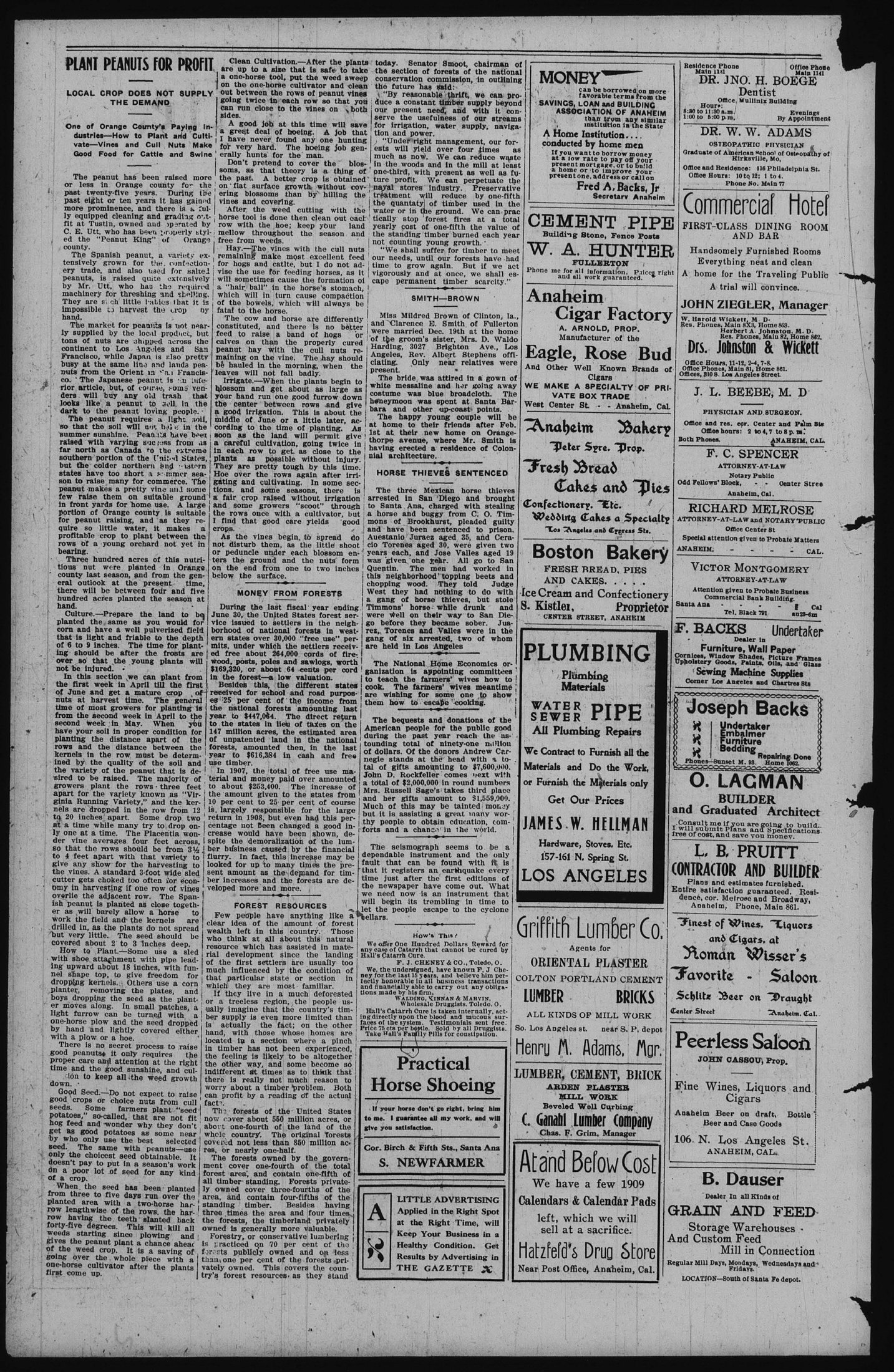
Searchable text
PLANT PEANUTS FOR PROFIT
LOCAL CROP DOES NOT SUPPLY THE DEMAND
One of Orange County's Paying Industries—How to Plant and Cultivate—Vines and Cull Nuts Make Good Food for Cattle and Swine
The peanut has been raised more or less in Orange county for the past twenty-five years. During the past eight or ten years it has gained more prominence, and there is a fully equipped cleaning and grading outfit at Tustin, owned and operated by C. E. Utt, who has been properly styled the "Peanut King" of Orange county.
The Spanish peanut, a variety extensively grown for the confectionery trade, and also used for salted peanuts, is raised quite extensively by Mr. Utt, who has the required machinery for threshing and shelling. They are such little babies that it is impossible to harvest the crop by hand.
The market for peanuts is not nearly supplied by the local product, but tons of nuts are shipped across the continent to Los Angeles and San Francisco, while Japan is also pretty busy at the same line and lands peanuts from the Orient in San Francisco. The Japanese peanut is an inferior article, but, of course, some vendors will buy any old trash that looks like a peanut to sell in the dark to the peanut loving people.
The peanut requires a light soil, so that the soil will not be in the summer sunshine. Peanuts have been raised with varying success from as far north as Canada to the extreme southern portion of the United States, but the colder northern and eastern states have too short a summer season to raise many for commerce. The peanut makes a pretty vine and some few raise them on suitable ground in front yards for home use. A large portion of Orange county is suitable for clean cultivation. After they are up to a size that is safe, a one-horse tool, put the weed on the one-horse cultivator and out between the rows of peanuts going twice in each row so can run close to the vines on sides.
A good job at this time was a great deal of hoeing. A I have never found any one for very hard. The hoeing erally hunts for the man.
Don't pretend to cover the soms, as that theory is a the past. A better crop is on flat surface growth with ering blossoms than by hill vines and covering.
After the weed cutting we horse tool is done then clean row with the hoe; keep your mellow throughout the season free from weeds.
Hay.—The vines with the cow remaining make most excellent for hogs and catte, but I do vise the use for feeding horses will sometimes cause the form a "hair ball" in the horse's saddle which will in turn cause damage of the bowels, which will always fatal to the horse.
The cow and horse are difficult constituted, and there is no feed to raise a band of hooves calves on than the properly peanut hay with the cull maining on the vine. The hay be hauled in the morning, while leaves will not fall badly.
Irrigate.—When the plants be blossom and get about as late your hand run one good furrow the center between rows and a good irrigation. This is about middle of June or a little later according to the time of planting soon as the land will permit a careful cultivation, going twice in each row to get as close as plants as possible without they are pretty tough by this Hoe over the rows again after gating and cultivating. In some tions, and some seasons, there a fair crop raised without irrigation and some growers "scoot" to
The peanut requires a light soil, so that the soil will not be in the summer sunshine. Peanuts have been raised with varying success from as far north as Canada to the extreme southern portion of the United States, but the colder northern and eastern states have too short a summer season to raise many for commerce. The peanut makes a pretty vine and some few raise them on suitable ground in front yards for home use. A large portion of Orange county is suitable for peanut raising, and as they require so little water, it makes a profitable crop to plant between the rows of a young orchard not yet in bearing.
Three hundred acres of this nutritious nut were planted in Orange county last season, and from the general outlook at the present time, there will be between four and five hundred acres planted the season at hand.
Culture.—Prepare the land to be planted the same as you would for corn and have a well pulverized field that is light and friable to the depth of 6 to 9 inches. The time for planting should be after the frosts are over so that the young plants will not be injured.
In this section we can plant from the first week in April till the first of June and get a mature crop of nuts at harvest time. The general time of most growers for planting is from the second week in April to the second week in May. When you have your soil in proper condition for planting the distance apart of the rows and the distance between the kernels in the row must be determined by the quality of the soil and the variety of the peanut that is desired to be raised. The majority of growers plant the rows three feet apart for the variety known as "Virginia Running Variety," and the kernels are dropped in the row from 12 to 20 inches apart. Some drop two at a time while many try to drop only one at a time. The Placentia wonder vine averages four feet across, so that the rows should be from 3½ to 4 feet apart with that variety to give any show for the harvesting to the vines. A standard 3-foot wide sled cutter gets choked too often for economy in harvesting if one row of vines overlie the adjacent row. The Spanish peanut is planted as close together as will barely allow a horse to work the field and the kernels are drilled in, as the plants do not spread but very little. The seed should be covered about 2 to 3 inches deep.
How to Plant.—Some use a sled with shoe attachment with pipe leading upward about 18 inches, with fun
the center between rows and a good irrigation. This is about middle of June or a little later, cording to the time of planting soon as the land will permit a careful cultivation, going twice in each row to get as close as possible without damage. They are pretty tough by this Hoe over the rows again after gating and cultivating. In some situations, and some seasons, they a fair crop raised without irrigation and some growers "scoot" to the rows once with a cultivation. I find that good care yields crops.
As the vines begin, to spread not disturb them, as the little or peduncle under each blossom ters the ground and the nuts on the end from one to two below the surface.
MONEY FROM FOREST
During the last fiscal year of June 30, the United States forest service issued to settlers in theborhood of national forests in certain states over 30,000 "free use mits, under which the settlers ed free about 264,000 cords of wood, posts, poles and sawlogs, $169,320, or about 64 cents per inch in the forest—a low valuation.
Besides this, the different received for school and road piles 25 per cent of the income; the national forests amounting year to $447,064. The direct tax to the states in lieu of taxes on 147 million acres, the estimated of unpatented land in the national forests, amounted then, in the year to $616,384 in cash and use timber.
In 1907, the total of free use material and money paid over amot to about $253,400. The increase in the amount given to the states 10 per cent to 25 per cent of ores is largely responsible for the return in 1908, but even had this percentage not been changed a good crease would have been shown spite the demoralization of their business caused by the final flurry. In fact, this increase may looked for up to many times than sent amount as the demand for ber increases and the forests are developed more and more.
FOREST RESOURCES
Few people have anything like clear idea of the amount of fecal wealth left in this country. They who think at all about this natural resource which has assisted in rural development since the land of the first settlers are usually much influenced by the conditions
give any show for the harvesting to the vines. A standard 3-foot wide sled cutter gets choked too often for economy in harvesting if one row of vines overlie the adjacent row. The Spanish peanut is planted as close together as will barely allow a horse to work the field and the kernels are drilled in, as the plants do not spread but very little. The seed should be covered about 2 to 3 inches deep.
How to Plant.—Some use a sled with shoe attachment with pipe leading upward about 18 inches, with funnel shape top, to give freedom for dropping kernels. Others use a corn planter, removing the plates, and boys dropping the seed as the planter moves along. In small patches, a light furrow can be turned with a one-horse plow and the seed dropped by hand and lightly covered either with a plow or a hoe.
There is no secret process to raise good peanuts; it only requires proper care and attention at the right time and the good sunshine, and culition to keep all the weed growth down.
Good Seed.—Do not expect to raise good crops or choice nuts from cull seeds. Some farmers plant "seed potatoes," so-called, that are not fit hog feed and wonder why they don't get as good potatoes as some near by who only use the best selected seed. The same with peanuts—use only the choicest seed obtainable. It doesn't pay to put in a season's work on a poor lot of seed for any kind of a crop.
When the seed has been planted from three to five days run over the planted area with a two-horse harrow lengthwise of the rows. The harrow having the teeth slanted back forty-five degrees. This will kill all weeds starting since plowing and gives the peanut plant a chance ahead of the weed crop. It is a saving of going over the whole piece with a one-horse cultivator after the plants first come up.
FOREST RESOURCES
Few people have anything like clear idea of the amount of wealth left in this country. They who think at all about this natural development since the land of the first settlers are usually much influenced by the condition that particular state or section which they are most familiar.
If they live in a much deforestation or a treeless region, the people usually imagine that the country's ber supply is even more limited than actually the fact; on the other hand, with those whose homes located in a section where a pine in timber has not been experienced the feeling is likely to be altogether the other way, and some become indifferent at times as to think there is really not much reason worry about a timber problem. Can profit by a reading of the facts.
The forests of the United States now cover about 550 million acres about one-fourth of the land of whole country. The original forest covered not less than 850 million res, or nearly one-half.
The forests owned by the government cover one-fourth of the forest area, and contain one-fifth all timber-standing. Forests privately owned cover three-fourths of area, and contain four-fifths of standing timber. Besides hard three times the area and four times the forests, the timberland private owned is generally more valuable.
Forestry, or conservative lumber, is practiced on 70 per cent of forests publicly owned and on less than one per cent of the forests privately owned. This covers the country's forest resources as they st
cultivation.—After the plants are size that is safe to take the tool, put the weed sweep horse cultivator and clean in the rows of peanut vines in each row so that you rose to the vines on both job at this time will save real of hoeing. A job that ever found any one hunting hard. The hoeing job genius for the man.
detend to cover the blossom that theory is a thing of A better crop is obtained surface growth without covoms than by hilling the recovering.
the weed cutting with the is done then clean out each hoe; keep your land throughout the season and weeds.
the vines with the cull nuts make most excellent feed and catte, but I do not adhere for feeding horses, as it causes the formation of" in the horse's stomach, in turn cause compaction bels, which will always be horse.
and horse are differently and there is no better use a band of hogs or than the properly cured with the cull nuts re-the vine. The hay should in the morning, when the not fall badly.
When the plants begin to get about as large as sun one good furrow down between rows and giveation. This is about the tune or a little later, ac- the time of planting. As the land will permit give cultivation, going twice in to get as close to the possible without injury. Betty tough by this time. The rows again after irrificultating. In some sec-some seasons, there is raised without irrigation growers "scoot" through today. Senator Smoot, chairman of the section of forests of the national conservation commission, in outlining the future has said:
"By reasonable thrift, we can produce a constant timber supply beyond our present need, and with it conserve the usefulness of our streams for irrigation, water supply, navigation and power.
"Under right management, our forests will yield over four times as much as now. We can reduce waste in the woods and in the mill at least one-third, with present as well as future profit. We can perpetuate the naval stores industry. Preservative treatment will reduce by one-fifth the quantaty of timber used in the water or in the ground. We can practically stop forest fires at a total yearly cost of one-fifth the value of the standing timber burned each year not counting young growth.
"We shall suffer for timber to meet our needs, until our forests have had time to grow again. But if we act vigorously and at once, we shall escape permanent timber scarcity."
SMITH—BROWN
Miss Mildred Brown of Clinton, Ia., and Clarence E. Smith of Fullerton were married Dec. 19th at the home of the groom's sister, Mrs. D. Waldo Harding, 3027 Brighton Ave., Los Angeles, Rev. Albert Stephens officiating. Only near relatives were present.
The bride was attired in a gown of white messaline and her going away costume was blue broadcloth. The honeymoon was spent at Santa Barbara and other up-coast points.
The happy young couple will be at home to their friends after Feb. 1st at their new home on Orange-thorpe avenue, where Mr. Smith is having erected a residence of Colonial architecture.
HORSE THIEVES SENTENCED
The three Mexican horse thieves arrested in San Diego and brought to Santa Ana, charged with stealing
HORSE THIEVES SENTENCED
The three Mexican horse thieves arrested in San Diego and brought to Santa Ana, charged with stealing a horse and buggy from C. O. Timmons of Brookhurst, pleaded guilty and have been sentenced to prison. Auestanio Juraez aged 35, and Ceracio Torenes aged 30, were given two years each, and Jose Valles aged 19 was given one year. All go to San Quentin. The men had worked in this neighborhood' topping beets and chopping wood. They told Judge West they had nothing to do with a gang of horse thieves, but stole Timmons' horse while drunk and were well on their way to San Diego before they became sober. Juarez, Torenes and Valles were in the gang of six arrested, two of whom are held in Los Angeles.
The National Home Economics organization is appointing committees to teach the farmers' wives how to cook. The farmers' wives meantime are wishing for some one to show them how to escape cooking.
The bequests and donations of the American people for the public good during the past year reach the astounding total of ninety-one million of dollars. Of the donors Andrew Carnegie stands at the head with a total of gifts amounting to $7,600,000. John D. Rockfeller comes next with a total of $2,000,000 in round numbers Mrs. Russell Sage's takes third place and her gifts amount to $1,559,000. Much of this may be tainted money but it is assisting a great many worthy people to obtain education, comforts and a chance in the world.
The seismograph seems to be a dependable instrument and the only fault that can be found with it is that it registers an earthquake every time just after the first editions of the newspaper have come out. What we need now is an instrument that will begin its trembling in time to let the people escape to the cyclone cellars.
How's This?
We offer One Hundred Dollars Reward for any case of Catarrh that cannot be cured by Hall's Catarrh Cure.
F. J. CHENEY & CO., Toledo, O.
Anaheim B
Peter Syre. Pr
Fresh Bread
Cakes and
Confectionery. Etc.
Wedding Cakes a S
Los Angeles and Cypres
RESOURCES
have anything like a
the amount of forest
this country. Those
all about this natural
has assisted in matement since the landing
settlers are usually too
by the condition of
state or section in
most familiar.
in a much deforested
region, the people usthat the country's timeven more limited than
the fact; on the other
those whose homes are
section where a pinch
not been experienced,
likely to be altogether
and some become so
times as to think that
not much reason to
timber problem. Both
reading of the actual
of the United States
out 550 million acres, or
both of the land of the
The original forests
less than 850 million acone-half.
owned by the governne-fourth of the total
and contain one-fifth of
ding. Forests privatethree-fourths of the
main four-fifths of the
ter. Besides having
area and four times
timberland privately
many more valuable.
conservative lumbering
70 per cent of the
owned and on less
ent of the forests priThis covers the counources as they stand
How's This?
We offer One Hundred Dollars Reward for any case of Catarrh that cannot be cured by Hall's Catarrh Cure.
F. J. CHENEY & CO., Toledo, O.
We, the undersigned, have known F. J. Cheney for the last 15 years, and believe him perfectly honorable in all business transactions and financially able to carry out any obligations made by his firm.
WALDING, KINNAN & MARVIN,
Wholesale Druggists. Toledo, O.
Hall's Catarrh Cure is taken internally, acting directly upon the blood and mucous surfaces of the system. Testimonials sent free. Price 75 cts per bottle. Sold by all Druggists.
Take Hall's Family Pills for constipation.
Practical Horse Shoeing
If your horse don't go right, bring him to me. I guarantee all my work, and will give you satisfaction.
Cor. Birch & Fifth Sts., Santa Ana
S. NEWFARMER
LITTLE ADVERTISING
Applied in the Right Spot at the Right Time, will Keep Your Business in a Healthy Condition. Get Results by Advertising in THE GAZETTE
HONEY
can be borrowed on more favorable terms from the
NGS, LOAN and BUILDING
ASSOCIATION OF ANAHEIM
than from any similar institution in the State
Home Institution....
lucted by home men
you want to borrow money
a low rate to pay off your
present mortgage, or to build
home or to improve your
resent one, address or call on
Fred A. Backs, Jr
Secretary Anaheim
MENT PIPE
Building Stone, Fence Posts
A. HUNTER
FULLERTON
for all information. Price right
and all work guaranteed.
Sheim
Cigar Factory
A. ARNOLD, PROP.
Manufacturer of the
le, Rose Bud
er Well Known Brands of
Cigars
MAKE A SPECIALTY OF PRIVATE BOX TRADE
Enter St. - - Anaheim, Cal.
Sheim Bakery
Peter Syre, Prop.
With Bread
Lakes and Pies
Masonery, Etc.
Residence Phone
Main 1141
Office Phone
Main 1141
DR. JNO. H. BOEGE
Dentist
Office, Mullinix Building
Hours:
8:30 to 11:30 a.m.
1:00 to 5:00 p.m.
Evenings
By Appointment
DR. W. W. ADAMS
OSTEOPATHIC PHYSICIAN
Graduate of American School of Osteopathy of
Kirksville, Mo.
Office and Residence: 116 Philadelphia St.
Office Hours: 10 tq 12; 1 to 4.
Phone No. Main 77
Commercial Hotel
FIRST-CLASS DINING ROOM AND BAR
Handsomely Furnished Rooms
Everything neat and clean
A home for the Traveling Public
A trial will convince.
JOHN ZIEGLER, Manager
W. Harold Wickett, M. D.
Res. Phones, Main 8X3, Home 863.
Herbert A. Johnston, M. D.
Res. Phones, Main 82, Home 862.
Drs. Johnston & Wickett
Office Hours, 11-12, 2-4, 7-8.
Office Phones, Main 81, Home 861.
Offices, 810 S. Los Angeles Street.
J. L. BEEBE, M. D
PHYSICIAN AND SURGEON.
Office and res. cor. Center and Palm Sts
Office hours: 2 to 4, 7 to 8 p.m.
Both Phones.
F. C. SPENCER
ATTORNEY-AT-LAW
Notary Public
Odd Fellows' Block,
Center Stree
Anaheim, Cal.
RICHARD MELROSE
PHYSICIAN AND SURGEON.
Office and res. cor. Center and Palm Sts
Office hours: 2 to 4, 7 to 8 p.m.
Both Phones. ANAHEIM, CAL.
F. C. SPENCER
ATTORNEY-AT-LAW
Notary Public
Odd Fellows' Block, - - Center Stree
Anaheim, Cal.
RICHARD MELROSE
ATTORNEY-AT-LAW and NOTARY PUBLIC
Office Center 8t
Special attention given to Probate Matters
ANAHEIM, - - - CAL.
VICTOR MONTGOMERY
ATTORNEY-AT-LAW
Attention given to Probate Business
Commercial Bank Building.
Santa Ana - - - Cal
Tel. Black 791 au23-6m
F. BACKS Undertaker
Dealer in
Furniture, Wall Paper
Cornices, Window Shades, Picture Frames
Upholstery Goods, Paints, Oils, and Glass
Sewing Machine Supplies
Corner Los Angeles and Chartres Sts
Joseph Backs
Undertaker
Embalmer
Furniture
Bedding
Repairing Done
Phones—Sunset M. 93. Home 1062.
O. LAGMAN
BUILDER
and Graduated Architect
Consult me if you are going to build.
I will submit Plans and Specifications free of cost, and save you money.
L. B. PRUITT
CONTRACTOR AND BUILDER
Plans and estimates furnished.
Entire satisfaction guaranteed. Residence, cor. Melrose and Broadway,
Anaheim, Phone, Main 861.
Finest of Wines. Liquors and Tigars. at Roman Wisser's
ANGELES
Sh Lumber Co.
Agents for
MENTAL PLASTER
PORTLAND CEMENT
BRICKS
Bands of Mill Work
Angeles st. near S. P. depot
M. Adams, Mgr.
CEMENT, BRICK
DEN PLASTER
MILL WORK
Tubled Well Curbing
An Lumber Company
F. Grim, Manager
Below Cost
have a few 1909
Wines & Calendar Pads
which we will
at a sacrifice.
d's Drug Store
Office, Anaheim, Cal.
CONTRACTOR AND BUILDER
Plans and estimates furnished.
Entire satisfaction guaranteed. Residence, cor. Melrose and Broadway,
Anaheim, Phone, Main 861.
Finest of Wines. Liquors
and Cigars. at
Roman Wasser's
Favorite - Saloon
Schlitz Beer on Draught
Center Street Anaheim, Cal.
Peerless Saloon
JOHN CASSOU, Prop.
Fine Wines, Liquors and
Cigars
Anaheim Beer on draft. Bottle
Beer and Case Goods
106. N. Los Angeles St.
ANAHEIM, CAL.
B. Dauser
Dealer In all Kinds of
GRAIN AND FEED
Storage Warehouses
And Custom Feed
Mill in Connection
Regular Mill Days, Mondays, Wednesdays and Fridays.
LOCATION—South of Santa Fe depot.