anaheim-gazette 1909-01-07
Scanned page
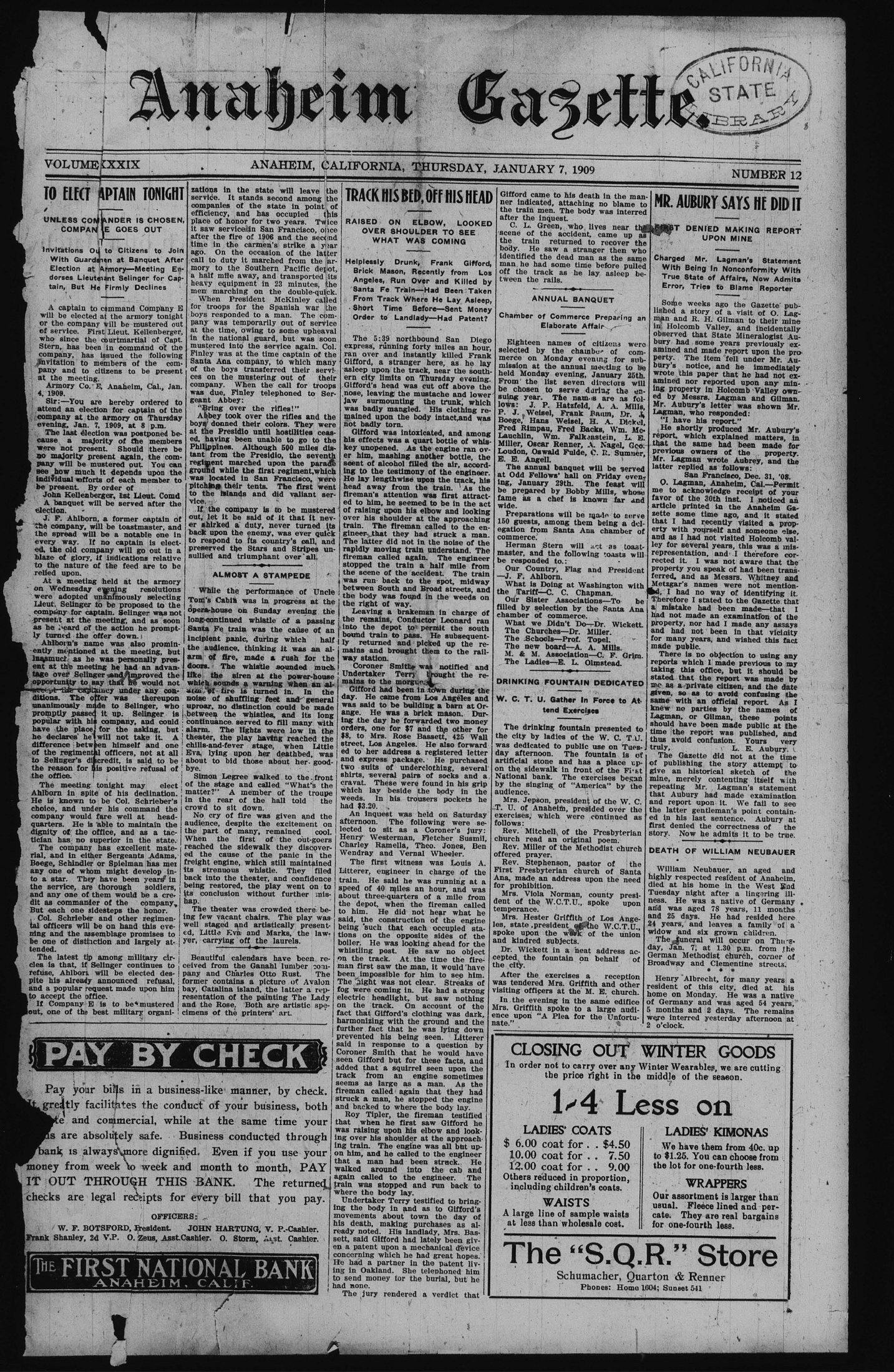
Searchable text
TO ELECT APTAIN TONIGHT
UNLESS COMMANDER IS CHOSEN,
COMPANIE GOES OUT
Invitations Out to Citizens to Join
With Guardmen at Banquet After
Election at Armory—Meeting Endorses Lieutenant Selinger for Captain, But He Firmly Declines
A captain to command Company E will be elected at the armory tonight or the company will be mustered out of service. First Lieut. Kellenberger, who since the courtmartial of Capt. Stern, has been in command of the company, has issued the following invitation to members of the company and to citizens to be present at the meeting.
Armory Co. E, Anaheim, Cal., Jan. 4, 1909.
Sir:—You are hereby ordered to attend an election for captain of the company at the armory on Thursday evening, Jan. 7, 1909, at 8 p.m.
The last election was postponed because a majority of the members were not present. Should there be no majority present again, the company will be mustered out. You can see how much it depends upon the individual efforts of each member to be present. By order of John Kellenberger, 1st Lieut. Comd.
A banquet will be served after the elections in the state will leave the service. It stands second among the companies of the state in point of efficiency, and has occupied this place of honor for two years. Twice it saw service in San Francisco, once after the fire of 1906 and the second time in the carmen's strike a year ago. On the occasion of the latter call to duty it marched from the army to the Southern Pacific depot a half mile away, and transported its heavy equipment in 23 minutes, the men marching on the double-quick.
When President McKinley called for troops for the Spanish war the boys responded to a man. The company was temporarily out of service at the time, owing to some upheaval in the national guard, but was soon mustered into the service again. Col Finley was at the time captain of the Santa Ana company, to which many of the boys transferred their services on the mustering out of their company. When the call for troops was due, Finley telephoned to Sergeant Abbey:
"Bring over the rifles!"
Abbey took over the rifles and the boys donned their colors. They were at the Presidio until hostilities ceased, having been unable to go to the Philippines. Although 500 miles distant from the Presidio, the seventh regiment marched upon the parade ground while the first regiment, which was located in San Francisco, were pitching their tents. The first went to the islands and did valiant service.
If the company is to be mustered
attend an election for captain of the company at the armory on Thursday evening, Jan. 7, 1909, at 8 p.m.
The last election was postponed because a majority of the members were not present. Should there be no majority present again, the company will be mustered out. You can see how much it depends upon the individual efforts of each member to be present. By order of John Kellenberger, 1st Lieut. Comd.
A banquet will be served after the election.
J. F. Ahlborn, a former captain of the company, will be toastmaster, and the spread will be a notable one in every way. If no captain is elected, the old company will go out in a blaze of glory, if indications relative to the nature of the feed are to be relied upon.
At a meeting held at the armory on Wednesday evening resolutions were adopted unanimously selecting Lieut. Selinger to be proposed to the company for captain. Selinger was not present at the meeting, and as soon as he heard of the action he promptly turned the offer down.
Ahlborn's name was also prominently mentioned at the meeting, but Inasmuch as he was personally present at the meeting he had an advantage over Selinger and improved the opportunity to say that he would not accept the captaincy under any conditions. The offer was thereupon unanimously made to Selinger, who promptly passed it up. Sellinger is popular with his company, and could have the place for the asking, but he declares he will not take it. A difference between himself and one of the regimental officers, not at all to Selinger's discredit, is said to be the reason for his positive refusal of the office.
The meeting tonight may elect Ahlborn in spite of his declination. He is known to be Col. Schrieber's choice, and under his command the company would fare well at headquarters. He is able to maintain the dignity of the office, and as a tactician has no superior in the state.
The company has excellent material, and in either Sergeants Adams, Boege, Schindler or Spielman has met any one of whom might develop into a star. They have been years in the service, are thorough soldiers, and any one of them would be a credit as commander of the company. But each one sidesteps the honor.
Col. Schrieber and other regimental officers will be on hand this evening and the assemblage promises to be one of distinction and largely attended.
The latest tip among military circles is that, if Selinger continues to
"Bring over the rifles!"
Abbey took over the rifles and the boys donned their colors. They were at the Presidio until hostilities ceased, having been unable to go to the Philippines. Although 500 miles distant from the Presidio, the seventh regiment marched upon the parade ground while the first regiment, which was located in San Francisco, were pitching their tents. The first went to the islands and did valiant service.
If the company is to be mustered out, let it be said of it that it never shirked a duty, never turned its back upon the enemy, was ever quick to respond to its country's call, and preserved the Stars and Stripes unsullied and triumphant over all.
ALMOST A STAMPEDE
While the performance of Uncle Tom's Cabin was in progress at the opera-house on Sunday evening the long-continued whistle of a passing Santa Fe train was the cause of an incipient panic, during which half the audience, thinking it was an alarm of fire, made a rush for the doors. The whistle sounded much like the siren at the power-house which sounds a warning when an alarm of fire is turned in. In the noise of shuffling feet and general uproar, no distinction could be made between the whistles, and its long continuance served to fill many with alarm. The lights were low in the theater, the play having reached the chills-and-fever stage, when Little Eva, lying upon her deathbed, was about to bid those about her goodbye.
Simon Legree walked to the front of the stage and called "What's the matter?" A member of the troupe in the rear of the hall told the crowd to sit down.
No cry of fire was given and the audience, despite the excitement on the part of many, remained cool. When the first of the out-goers reached the sidewalk they discovered the cause of the panic in the freight engine, which still maintained its strenuous whistle. They filed back into the theater, and confidence being restored, the play went on to its conclusion without further mishap.
The theater was crowded there being few vacant chairs. The play was well staged and artistically presented, Little Eva and Marks, the lawyer, carrying off the laurels.
Beautiful calendars have been received from the Ganahl lumber com-
Boege, Schindler or Spielman has merited any one of whom might develop into a star. They have been years in the service, are thorough soldiers, and any one of them would be a credit as commander of the company. But each one sidesteps the honor.
Col. Schrieber and other regimental officers will be on hand this evening and the assemblage promises to be one of distinction and largely attended.
The latest tip among military circles is that, if Selinger continues to refuse, Ahlborn will be elected despite his already announced refusal, and a popular request made upon him to accept the office.
If Company E is to be mustered out, one of the best military organi-
PAY BY CHECK
Pay your bills in a business-like manner, by check. It greatly facilitates the conduct of your business, both private and commercial, while at the same time your bills are absolutely safe. Business conducted through the bank is always more dignified. Even if you use your money from week to week and month to month, PAY IT OUT THROUGH THIS BANK. The returned checks are legal receipts for every bill that you pay.
OFFICERS:
W. F. BOTSFORD, President. JOHN HARTUNG, V. P.-Cashier.
Frank Shanley, 2d V.P. O. Zeus, Asst.Cashier. O. Storm, Asst. Cashier.
THE FIRST NATIONAL BANK
ANAHEIM, CALIF.
HEIM GAZETTE
NAHEIM, CALIFORNIA, THURSDAY, JANUARY 7, 1909
TRACK HIS BED, OFF HIS HEAD
RAISED ON ELBOW, LOOKED OVER SHOULDER TO SEE WHAT WAS COMING
Helplessly Drunk, Frank Gifford, Brick Mason, Recently from Los Angeles, Run Over and Killed by Santa Fe Train—Had Been Taken From Track Where He Lay Asleep, Short Time Before—Sent Money Order to Landlady—Had Patent?
The 5:39 northbound San Diego express, running forty miles an hour, ran over and instantly killed Frank Gifford, a stranger here, as he lay asleep upon the track, near the southern city limits on Thursday evening. Gifford's head was cut off above the nose, leaving the mustache and lower jaw surmounting the trunk, which was badly mangled. His clothing remained upon the body intact, and was not badly torn.
Gifford was intoxicated, and among his effects was a quart bottle of whiskey unopened. As the engine ran over him, mashing another bottle, the scent of alcohol filled the air, according to the testimony of the engineer. He lay lengthwise upon the track, his head away from the train. As the fireman's attention was first attracted to him, he seemed to be in the act of raising upon his elbow and looking
Gifford came to his death in the morning indicated, attaching no blame to the train men. The body was interred after the inquest.
C. L. Green, who lives near scene of the accident, came up the train returned to recover body. He saw a stranger then identified the dead man as the man he had some time before put off the track as he lay asleep between the rails.
ANNUAL BANQUET
Chamber of Commerce Preparing Elaborate Affair
Eighteen names of citizens selected by the chamber of commerce on Monday evening for mission at the annual meeting held Monday evening, January 29. From the list seven directors be chosen to serve during the suing year. The names are as follows: J. P. Hatzfeld, A. A. McPike, J. Weisel, Frank Baum, Dr. Boege, Hans Weisel, H. A. Dickens, Fred Rimpau, Fred Backs, Wm. Lauchlin, Wm. Falkenstein, L. Miller, Oscar Renner, A. Nagel, C. Loudon, Oswald Fulde, C. R. Sumner, E. E. Angell.
The annual banquet will be served at Odd Fellows' hall on Friday evening, January 29th. The feast will be prepared by Bobby Mills, who fame as a chef is known far wide.
was badly mangled. His clothing remained upon the body intact, and was not badly torn.
Gifford was intoxicated, and among his effects was a quart bottle of whiskey unopened. As the engine ran over him, mashing another bottle, the scent of alcohol filled the air, according to the testimony of the engineer. He lay lengthwise upon the track, his head away from the train. As the fireman's attention was first attracted to him, he seemed to be in the act of raising upon his elbow and looking over his shoulder at the approaching train. The fireman called to the engineer that they had struck a man. The latter did not in the noise of the rapidly moving train understand. The fireman called again. The engineer stopped the train a half mile from the scene of the accident. The train was run back to the spot, midway between South and Broad streets, and the body was found in the weeds on the right of way.
Leaving a brakeman in charge of the remains, Conductor Leonard ran into the depot to permit the south bound train to pass. He subsequently returned and picked up the remains and brought them to the railway station.
Coroner Smith was notified and Undertaker Terry brought the remains to the morgue.
Gifford had been in town during the day. He came from Los Angeles and was said to be building a barn at Orange. He was a brick mason. During the day he forwarded two money orders, one for $7 and the other for $8, to Mrs. Rose Bassett, 425 Wall street, Los Angeles. He also forwarded to her address a registered letter and express package. He purchased two suits of underclothing, several shirts, several pairs of socks and a cravat. These were found in his grip which lay beside the body in the weeds. In his trousers pockets he had $3.20.
An inquest was held on Saturday afternoon. The following were selected to sit as a Coroner's jury: Henry Westerman, Fletcher Susmil, Charley Ramella, Theo. Jones, Ben Wendray and Vernal Wheeler.
The first witness was Louis A. Litterer, engineer in charge of the train. He said he was running at a speed of 40 miles an hour, and was about three-quarters of a mile from the depot, when the fireman called to him. He did not hear what he said, the construction of the engine being such that each occupied stations on the opposite sides of the boiler. He was looking ahead for the whistling post. He saw no object on the track. At the time the fireman first saw the man, it would have
drinking fountain presented by the city by ladies of the W.C.T. was dedicated to public use on Tuesday afternoon. The fountain is artificial stone and has a place on the sidewalk in front of the Fire National bank. The exercises began by the singing of "America" by audience.
Mrs. Jepson, president of the W.C.T. u. of Anaheim, presided over exercises, which were continued follows:
Rev Mitchell of the Presbyterian church read an original poem.
Rev Miller of the Methodist church offered prayer.
Rev Stephenson, pastor of the First Presbyterian church of San Ana, made an address upon the need for prohibition.
Mrs. Viola Norman, county president of the W.C.T.U., spoke up temperance.
Mrs. Hester Griffith of Los Angeles, state president of the W.C.T.U., spoke upon the work of the unit and kindred subjects.
Dr Wickett in a neat address accepted the fountain on behalf of the city.
The first witness was Louis A. Litterer, engineer in charge of the train. He said he was running at a speed of 40 miles an hour, and was about three-quarters of a mile from the depot, when the fireman called to him. He did not hear what he said, the construction of the engine being such that each occupied stations on the opposite sides of the boiler. He was looking ahead for the whistling post. He saw no object on the track. At the time the fireman first saw the man, it would have been impossible for him to see him. The night was not clear. Streaks of fog were coming in. He had a strong electric headlight, but saw nothing on the track. On account of the fact that Gifford’s clothing was dark, harmonizing with the ground and the further fact that he was lying down prevented his being seen. Litterer said in response to a question by Coroner Smith that he would have seen Gifford but for these facts, and added that a squirrel seen upon the track from an engine sometimes seems as large as a man. As the fireman called again that they had struck a man, he stopped the engine and backed to where the body lay.
Roy Tipler, the fireman testified that when he first saw Gifford he was raising upon his elbow and looking over his shoulder at the approaching train. The engine was all but up-on him, and he called to the engineer that a man had been struck. He walked around into the cab and again called to the engineer. The train was stopped and run back to where the body lay.
Undertaker Terry testified to bringing the body in and as to Gifford’s movements about town the day of his death, making purchases as already noted. His landlady, Mrs. Bassett, said Gifford had lately been given a patent upon a mechanical device concerning which he had great hopes. He had a partner in the patent living in Oakland. She telephoned him to send money for the burial, but he had none.
The jury rendered a verdict that
MR. AUBURY SAYS HE DID IT
FIRST DENIED MAKING REPORT UPON MINE
Charged Mr. Lagman's Statement With Being In Nonconformity With True State of Affairs, Now Admits Error, Tries to Blame Reporter
Some weeks ago the Gazette published a story of a visit of O. Lagman and R. H. Gilman to their mine in Holcomb Valley, and incidentally observed that State Mineralogist Aubury had some years previously examined and made report upon the property. The item fell under Mr. Aubury's notice, and he immediately wrote this paper that he had not examined nor reported upon any mining property in Holcomb Valley owned by Messrs. Lagman and Gilman. Mr. Aubury's letter was shown Mr. Lagman, who responded:
"I have his report."
He shortly produced Mr. Aubury's report, which explained matters, in that the same had been made for previous owners of the property. Mr. Lagman wrote Aubrey, and the latter replied as follows:
San Francisco, Dec. 31, '08.
O. Lagman, Anaheim, Cal.—Permit me to acknowledge receipt of your favor of the 30th inst. I noticed an article printed in the Anaheim Ga-
Matzfeld, A. A. Mills,
Frank Baum, Dr. J.
Welsel, H. A. Dickel,
Fred Backs, Wm. McFalkenstein, L. E.
Benner, A. Nagel, Geo.
Fulde, C. R. Sumner,
banquet will be served
hall on Friday even9th. The feast will
Bobby Mills, whose
is known far and
will be made to serve
them being a dellanta Ana chamber of
will act as toastfollowing toasts will
O.: Flag and President
at Washington with
C. Chapman.
Associations—To be
on by the Santa Ana
Amererce.
n't Do—Dr. Wickett.
—Dr. Miller.
Prof. Topel.
Aid—A. A. Mills.
Association—C. F. Grim.
E. L. Olmstead.
UNTAIN DEDICATED
other in Force to Attle Exercises
fountain presented to
des of the W. C. T.U.
public use on Tuesday.
The fountain is of
and has a place upfront of the First
The exercises began
of "America" by the
president of the W. C.
am, presided over the
were continued as
of the Presbyterian
original poem.
the Methodist church
on, pastor of the
an church of Santa
address upon the need
erman, county presiC.T.U., spoke upon
Griffith of Los Angeent of the W.C.T.U.,
work of the union
objects.
a neat address actain on behalf of
Mr. Aubury's letter was shown Mr.
Lagman, who responded:
"I have his report."
He shortly produced Mr. Aubury's
report, which explained matters, in
that the same had been made for
previous owners of the property.
Mr. Lagman wrote Aubrey, and the latter replied as follows:
San Francisco, Dec. 31, '08.
O. Lagman, Anaheim, Cal.—Permit me to acknowledge receipt of your favor of the 30th inst. I noticed an article printed in the Anaheim Gazette some time ago, and it stated that I had recently visited a property with yourself and someone else, and as I had not visited Holcomb valley for several years, this was a misrepresentation, and I therefore corrected it. I was not aware that the property you speak of had been transferred, and as Messrs. Whitney and Metzgar's names were not mentioned, I had no way of identifying it.
Therefore I stated to the Gazette that a mistake had been made—that I had not made an examination of the property, nor had I made any assays and had not been in that vicinity for many years, and wished this fact made public.
There is no objection to using any reports which I made previous to my taking this office, but it should be stated that the report was made by me as a private citizen, and the date given, so as to avoid confusing the same with an official report. As I knew no parties by the names of Lagman, or Gilman, these points should have been made public at the time the report was published, and thus avoid confusion. Yours very truly,
L. E. Aubury.
The Gazette did not at the time of publishing the story attempt to give an historical sketch of the mine, merely contenting itself with repeating Mr. Lagman's statement that Aubury had made examination and report upon it. We fail to see the latter gentleman's point contained in his last sentence. Aubury at first denied the correctness of the story. Now he admits it to be true.
DEATH OF WILLIAM NEUBAUER
William Neubauer, an aged and highly respected resident of Anaheim, died at his home in the West End Tuesday night after a lingering illness. He was a native of Germany and was aged 78 years, 11 months and 25 days. He had resided here 24 years, and leaves a family of a widow and six grown children.
The funeral will occur on Thursday, Jan. 7, at 1:30 p.m. from the German Methodist church, corner of Broadway and Clementine streets.
William Neubauer, an aged and highly respected resident of Anaheim, died at his home in the West End Tuesday night after a lingering illness. He was a native of Germany and was aged 78 years, 11 months and 25 days. He had resided here 24 years, and leaves a family of a widow and six grown children.
The funeral will occur on Thursday, Jan. 7, at 1.30 p.m. from the German Methodist church, corner of Broadway and Clementine streets.
Henry Albrecht, for many years a resident of this city, died at his home on Monday. He was a native of Germany and was aged 54 years, 5 months and 2 days. The remains were interred yesterday afternoon at 2 o'clock.
NING OUT WINTER GOODS
To carry over any Winter Wearables, we are cutting the price right in the middle of the season.
4 Less on
S' COATS
t for . . $4.50
t for . . 7.50
t for . . 9.00
and in proportion,
children's coats.
WAISTS
of sample waists
wholesale cost.
LADIES' KIMONAS
We have them from 40c. up to $1.25. You can choose from the lot for one-fourth less.
WRAPPERS
Our assortment is larger than usual. Fleece lined and per-cate. They are real bargains for one-fourth less.
"S.Q.R." Store
Schumacher, Quarton & Renner
Phones: Home 1604; Sunset 541