anaheim-gazette 1908-12-10
Scanned page
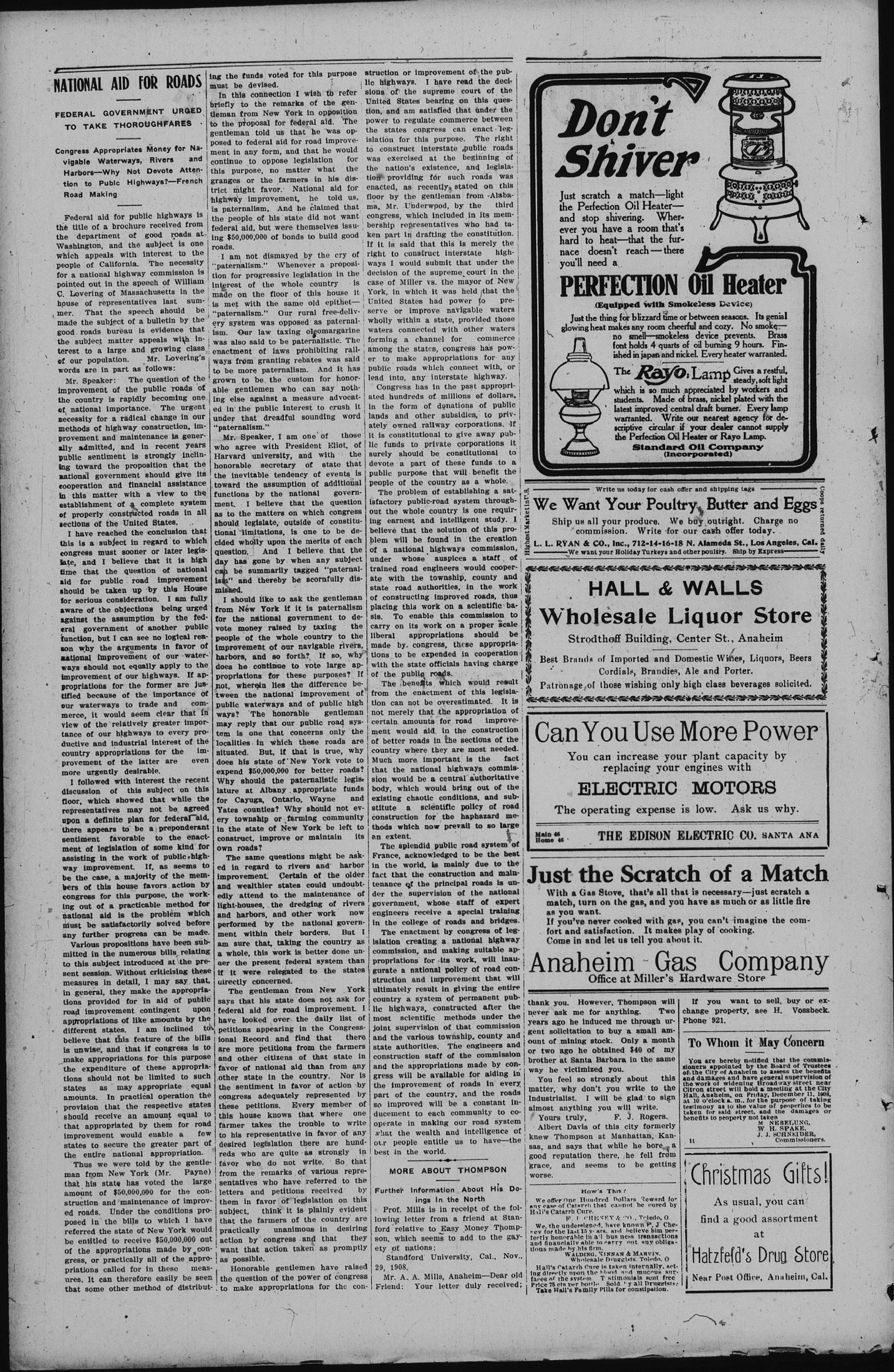
Searchable text
NATIONAL AID FOR ROADS
FEDERAL GOVERNMENT URGED TO TAKE THOROUGHFARES
Congress Appropriates Money for Navigable Waterways, Rivers and Harbors—Why Not Devote Attention to Public Highways?—French Road Making
Federal aid for public highways is the title of a brochure received from the department of good roads at Washington, and the subject is one which appeals with interest to the people of California. The necessity for a national highway commission is pointed out in the speech of William C. Lovering of Massachusetts in the house of representatives last summer. That the speech should be made the subject of a bulletin by the good roads bureau is evidence that the subject matter appeals with interest to a large and growing class of our population. Mr. Lovering's words are in part as follows:
Mr. Speaker: The question of the improvement of the public roads of the country is rapidly becoming one of national importance. The urgent necessity for a radical change in our methods of highway construction, improvement and maintenance is generally admitted, and in recent years public sentiment is strongly inclining toward the proposition that the national government should give its cooperation and financial assistance in this matter with a view to the establishment of a complete system ing the funds voted for this purpose must be devised.
In this connection I wish to briefly to the remarks of the gentleman from New York in opposition to the proposal for federal aid, gentleman told us that he was posed to federal aid for road im-ment in any form, and that he continue to oppose legislation this purpose, no matter what granges or the farmers in his trict might favor. National a highway improvement, he to is paternalism. And he claimed the people of his state did not federal aid, but were themselves ing $50,000,000 of bonds to build roads.
I am not dismayed by the "paternalism." Whenever a petition for progressive legislation interests of the whole country made on the floor of this house is met with the same old epistle "paternalism." Our rural freeway system was opposed as par-ism. Our law taxing oleomans was also said to be paternalistic enactment of laws prohibiting ways from granting rebates wa- to be more paternalism. And grown to be the custom for able gentlemen who can say ing else against a measure ad ed in the public interest to co under that dreadful sounding "paternalism."
Mr. Speaker, I am one of who agree with President E. Harvard university, and with honorable secretary of state the inevitable tendency of evi toward the assumption of add functions by the national ment. I believe that the q
of national importance. The urgent necessity for a radical change in our methods of highway construction, improvement and maintenance is generally admitted, and in recent years public sentiment is strongly inclining toward the proposition that the national government should give its cooperation and financial assistance in this matter with a view to the establishment of a complete system of properly constructed roads in all sections of the United States.
I have reached the conclusion that this is a subject in regard to which congress must sooner or later legislate, and I believe that it is high time that the question of national aid for public road improvement should be taken up by this House for serious consideration. I am fully aware of the objections being urged against the assumption by the federal government of another public function, but I can see no logical reason why the arguments in favor of national improvement of our waterways should not equally apply to the improvement of our highways. If appropriations for the former are justified because of the importance of our waterways to trade and commerce, it would seem clear that in view of the relatively greater importance of our highways to every productive and industrial interest of the country appropriations for the improvement of the latter are even more urgently desirable.
I followed with interest the recent discussion of this subject on this floor, which showed that while the representatives may not be agreed upon a definite plan for federal aid, there appears to be a preponderant sentiment favorable to the enactment of legislation of some kind for assisting in the work of public highway improvement. If, as seems to be the case, a majority of the members of this house favors action by congress for this purpose, the working out of a practicable method for national aid is the problem which must be satisfactorily solved before any further progress can be made.
Various propositions have been submitted in the numerous bills relating to this subject introduced at the pre-ed in the public interest to consider that dreadful sounding "paternalism."
Mr. Speaker, I am one of who agree with President Eisenhart university, and with honorable secretary of state the inevitable tendency of ever toward the assumption of additional functions by the national government. I believe that the question to the matters on which should legislate, outside of national limitations, is one to be cided wholly upon the merits question. And I believe that day has gone by when any can be summarily tagged "paternalism" and thereby be scorned missed.
I should like to ask the general from New York if it is pated for the national government to vote money raised by taxing people of the whole country in improvement of our navigable harbors, and so forth? If so does he continue to vote law appropriations for these purposes, wherein lies the difference between the national improvement public waterways and of public ways? The honorable gentleman reply that our public rote is one that concerns our localities in which these roads situated. But, if that is true does his state of New York expend $50,000,000 for better Why should the paternalistic literature at Albany appropriate for Cayuga, Ontario, Wayne Yates counties? Why should every township or farming community in the state of New York be construct, improve or maintain own roads?
The same questions might be asked in regard to rivers and improvements. Certain of them and wealthier states could easily attend to the maintenance light-houses, the dredging or harbors, and other works performed by the national government within their borders. Am sure that, taking the course a whole, this work is better ower the present federal system.
way improvement. If, as seems to be the case, a majority of the members of this house favors action by congress for this purpose, the working out of a practicable method for national aid is the problem which must be satisfactorily solved before any further progress can be made.
Various propositions have been submitted in the numerous bills relating to this subject introduced at the present session. Without criticising these measures in detail, I may say that, in general, they make the appropriations provided for in aid of public road improvement contingent upon appropriations of like amounts by the different states. I am inclined to believe that this feature of the bills is unwise, and that if congress is to make appropriations for this purpose the expenditure of these appropriations should not be limited to such states as may appropriate equal amounts. In practical operation the provision that the respective states should receive an amount equal to that appropriated by them for road improvement would enable a few states to secure the greater part of the entire national appropriation.
Thus we were told by the gentleman from New York (Mr. Payne) that his state has voted the large amount of $50,000,000 for the construction and maintenance of improved roads. Under the conditions proposed in the bills to which I have referred the state of New York would be entitled to receive $50,000,000 out of the appropriations made by congress, or practically all of the appropriations called for in these measures. It can therefore easily be seen that some other method of distribut-
ed in regard to rivers and improvements. Certain of the and wealthier states could easily attend to the maintenance light-houses, the dredging of and harbors, and other work performed by the national government within their borders. I am sure that, taking the course a whole, this work is better or older than the present federal system if it were relegated to the directly concerned.
The gentleman from New York says that his state does not federal aid for road improvement have looked over the daily petitions appearing in the National Record and find that there are more petitions from the state and other citizens of that favor of national aid than from other state in the country. The sentiment in favor of any congress adequately represents these petitions. Every member of this house knows that when farmer takes the trouble to his representative in favor desired legislation there are reds who are quite as strong favor who do not write. From the remarks of various sentatives who have referred letters and petitions收到 them in favor of legislation subject, think it is plainly that the farmers of the county practically unanimous in action by congress and that want that action taken as possible.
Honorable gentlemen have the question of the power of Congress to make appropriations for
I voted for this purpose raised.
Connection I wish to refer the remarks of the general New York in opposition to federal aid. The would us that he was operational aid for road improvement, and that he would oppose legislation for no matter what the farmers in his disfavor. National aid for improvement, he told us, and he claimed that if his state did not want out were themselves issuance of bonds to build good dismayed by the cry of "Whenever a propositive legislation in the whole country is the floor of this house it is the same old epithet—" Our rural free-deliv was opposed as paternal-law taxing olomargarine to be paternalistic. The laws prohibiting rail-renting rebates was said paternalism. And it has the custom for honor men who can say not insist a measure advocating public interest to crush it dreadful sounding word."
Ker, I am one of those with President Eliot, of diversity, and with the secretary of state that the tendency of events is assumption of additional by the national govern-elieve that the question construction or improvement of the public highways. I have read the decisions of the supreme court of the United States bearing on this question, and am satisfied that under the power to regulate commerce between the states congress can enact legislation for this purpose. The right to construct interstate public roads was exercised at the beginning of the nation's existence, and legislation providing for such roads was enacted, as recently stated on this floor by the gentleman from Alabama, Mr. Underwood, by the third congress, which included its membership representatives who had taken part in drafting the constitution. If it is said that this is merely the right to construct interstate highways I would submit that under the decision of the supreme court in the case of Miller vs. the mayor of New York, in which it was held that the United States had power to preserve or improve navigable waters wholly within a state, provided those waters connected with other waters forming a channel for commerce among the states, congress has power to make appropriations for any public roads which connect with, or lead into, any interstate highway.
Congress has in the past appropriated hundreds of millions of dollars, in the form of donations of public lands and other subsidies, to privately owned railway corporations. If it is constitutional to give away public funds to private corporations it surely should be constitutional to devote a part of these funds to a public purpose that will benefit the people of the country as a whole.
The problem of establishing a satisfactory public-road system throughout the whole country is one requir-
public interest to crush it
dreadful sounding word
maker, I am one of those
with President Eliot, of
University, and with the
secretary of state that
tendency of events is
assumption of additional
by the national governbelieve that the question
atters on which congress
late, outside of constitutions, is one to be dep upon the merits of each
And I believe that the
one by when any subject
similarly tagged "paternalhereby be scornfully dislike to ask the gentleman
York if it is paternalism
national government to deraised by taxing the
whole country to the
out of our navigable rivers,
and so forth? If so, why
continue to vote large apport these purposes? If
lies the difference benational improvement of
airways and of public high
the honorable gentleman
that our public road systhat concerns only the
which these roads are
But, if that is true, why
state of New York vote to
0000,000 for better roads?
and the paternalistic legislAlbany appropriate funds
Ontario, Wayne and
ties? Why should not evicip or farming community
of New York be left to
improve or maintain its
questions might be askrd to rivers and harbor
at. Certain of the older
older states could undoubtto the maintenance of
the dredging of rivers
s, and other work now
by the national governon their borders. But I
hat, taking the country as
this work is better done unresent federal system than
in the form of donations of public lands and other subsidies, to privately owned railway corporations. If it is constitutional to give away public funds to private corporations it surely should be constitutional to devote a part of these funds to a public purpose that will benefit the people of the country as a whole.
The problem of establishing a satisfactory public-road system throughout the whole country is one requiring earnest and intelligent study. I believe that the solution of this problem will be found in the creation of a national highways commission, under whose auspices a staff of trained road engineers would cooperate with the township, county and state road authorities, in the work of constructing improved roads, thus placing this work on a scientific basis. To enable this commission to carry on its work on a proper scale liberal appropriations should be made by congress, these appropriations to be expended in cooperation with the state officials having charge of the public roads.
The benefits which would result from the enactment of this legislation can not be overestimated. It is not merely that the appropriation of certain amounts for road improvement would aid in the construction of better roads in the sections of the country where they are most needed. Much more important is the fact that the national highways commission would be a central authoritative body, which would bring out of the existing chaotic conditions, and substitute a scientific policy of road construction for the haphazard methods which now prevail to so large an extent.
The splendid public road system of France, acknowledged to be the best in the world, is mainly due to the fact that the construction and maintenance of the principal roads is under the supervision of the national government, whose staff of expert engineers receive a special training in the college of roads and bridges.
The enactment by congress of legislation creating a national highway commission, and making suitable appropriations for its work, will inaugurate a national policy of road con-
Certain of the older older states could undoubtably to the maintenance of rivers, the dredging of rivers, and other work now by the national government their borders. But I think, taking the country as this work is better done unrepresented federal system than relegated to the states concerned.
Gentleman from New York this state does not ask for road improvement. I find over the daily list of appearing in the Congressional and find that there petitions from the farmers and citizens of that state in national aid than from any one in the country. Nor is present in favor of action by inadequately represented by unions. Every member of the knows that where one makes the trouble to write representative in favor of any legislation there are hundreds quite as strongly in do not write. So that remarks of various representatives who have referred to the petitions received by favor of legislation on this think it is plainly evident farmers of the country are unanimous in desiring congress and that they action taken as promptly gentlemen have raised on the power of congress appropriations for the con-
in the world, is mainly due to the fact that the construction and maintenance of the principal roads is under the supervision of the national government, whose staff of expert engineers receive a special training in the college of roads and bridges.
The enactment by congress of legislation creating a national highway commission, and making suitable appropriations for its work, will inaugurate a national policy of road construction and improvement that will ultimately result in giving the entire country a system of permanent public highways, constructed after the most scientific methods under the joint supervision of that commission and the various township, county and state authorities. The engineers and construction staff of the commission and the appropriations made by congress will be available for aiding in the improvement of roads in every part of the country, and the roads so improved will be a constant inducement to each community to cooperate in making our road system what the wealth and intelligence of our people entitle us to have—the best in the world.
MORE ABOUT THOMPSON
Further Information About His Doings In the North
Prof. Mills is in receipt of the following letter from a friend at Stanford relative to Easy Money Thompson, which seems to add to the gayety of nations:
Standford University, Cal., Nov., 29, 1908.
Mr. A. A. Mills, Anaheim—Dear old Friend: Your letter duly received;
Don't Shiver
Just scratch a match—light the Perfection Oil Heater—and stop shivering. Whenever you have a room that's hard to heat—that the furnace doesn't reach—there you'll need a PERFECTION Oil Heater (Equipped with Smokeless Device)
Just the thing for blizzard time or between seasons. Its genial glowing heat makes any room cheerful and cozy. No smoke—no smell—smokeless device prevents. Brass font holds 4 quarts of oil burning 9 hours. Finished in japan and nickel. Every heater warranted.
The Rayo Lamp Gives a restful, steady, soft light which is so much appreciated by workers and students. Made of brass, nickel plated with the latest improved central draft burner. Every lamp warranted. Write our nearest agency for descriptive circular if your dealer cannot supply the Perfection Oil Heater or Rayo Lamp.
Standard Oil Company (Incorporated)
Write us today for cash offer and shipping tags
Want Your Poultry, Butter and Eggs
ship us all your produce. We buy outright. Charge no commission. Write for our cash offer today.
RYAN & CO., Inc., 712-14-16-18 N. Alameda St., Los Angeles, Cal.
We want your Holiday Turkeys and other poultry. Ship by Express
HALL & WALLS
Wholesale Liquor Store
Strodthoff Building, Center St., Anaheim
Brands of Imported and Domestic Wines, Liquors, Beers
Cordials, Brandies, Ale and Porter.
Onage of those wishing only high class beverages solicited.
Can You Use More Power
You can increase your plant capacity by replacing your engines with
ELECTRIC MOTORS
The operating expense is low. Ask us why.
THE EDISON ELECTRIC CO. SANTA ANA
Just the Scratch of a Match
With a Gas Stove, that's all that is necessary—just scratch a match, turn on the gas, and you have as much or as little fire you want.
You've never cooked with gas, you can't imagine the comfort and satisfaction. It makes play of cooking.
Me in and let us tell you about it.
Anaheim Gas Company
Just the Scratch of a Match
With a Gas Stove, that's all that is necessary—just scratch a
match, turn on the gas, and you have as much or as little fire
you want.
You've never cooked with gas, you can't imagine the comt and satisfaction. It makes play of cooking.
Me in and let us tell you about it.
Anaheim Gas Company
Office at Miller's Hardware Store
If you want to sell, buy or exchange property, see H. Vossbeck.
Phone 921.
To Whom it May Concern
You are hereby notified that the commissioners appointed by the Board of Trustees
of the City of Anaheim to assess the benefits
and damages and have general supervision of
the work of widening Broadway street near Citron street will hold a meeting at the City
Hall, Anaheim, on Friday, December 11, 1908,
at 10 o'clock a.m., for the purpose of taking
testimony as to the value of properties to be
taken for said street, and the damages or
benefits to property not taken.
M. NEBELUNG,
W. H. SPAKE,
J. J. SCHNEIDER,
Commissioners.
How's This?
For One Hundred Dollars Reward for
of Catarrh that cannot be cured by
Catarrh Cure.
F. J. CHENEY & CO., Toledo, O.
undersigned, have known F. J. Chene last 15 years, and believe him permorable in all business transactions
specially able to carry out any obligable by his firm.
WALDING, KINNAN & MARVIN.
Wholesale Druggists, Toledo, O.
Catarrh Cure is taken internally, actly upon the blood and mucous surhe system. Testimonials sent free
per bottle. Sold by all Druggists.
All's Family Pills for constipation.
Christmas Gifts!
As usual, you can
find a good assortment
at
Hatzfeld's Drug Store
Near Post Office, Anaheim, Cal.