anaheim-gazette 1908-10-22
Scanned page
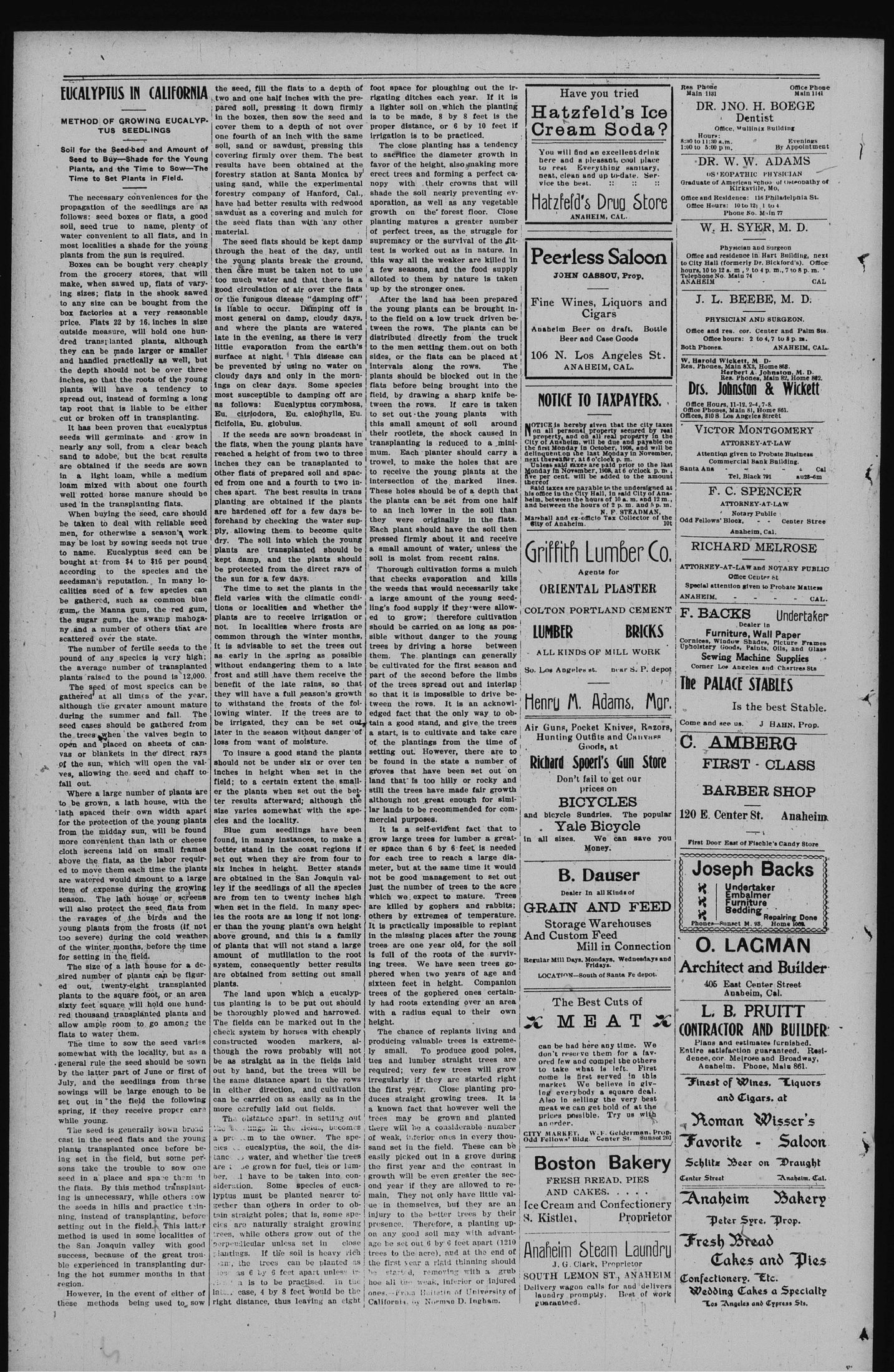
Searchable text
EUCALYPTUS IN CALIFORNIA
METHOD OF GROWING EUCALYPTUS SEEDLINGS
Soil for the Seed-bed and Amount of Seed to Buy—Shade for the Young Plants, and the Time to Sow—The Time to Set Plants in Field.
The necessary conveniences for the propagation of the seedlings are as follows: seed boxes or flats, a good soil, seed true to name, plenty of water convenient to all flats, and in most localities a shade for the young plants from the sun is required.
Boxes can be bought very cheaply from the grocery stores, that will make, when sawed up, flats of varying sizes; flats in the shook sawed to any size can be bought from the box factories at a very reasonable price. Flats 22 by 16 inches in size outside measure, will hold one hundred transplanted plants, although they can be made larger or smaller and handled practically as well, but the depth should not be over three inches, so that the roots of the young plants will have a tendency to spread out, instead of forming a long tap root that is liable to be either cut or broken off in transplanting.
It has been proven that eucalyptus seeds will germinate and grow in nearly any soil, from a clear beach sand to adobe, but the best results are obtained if the seeds are sown in a light loam, while a medium loam mixed with about one fourth well rotted horse manure should be used in the transplanting flats.
the seed, fill the flats to a depth two and one half inches with two pared soil, pressing it down in the boxes, then sow the seed cover them to a depth of no one fourth of an inch with the soil, sand or sawdust, pressing covering firmly over them. The results have been obtained forestry station at Santa Monica using sand, while the expert forestry company of Hanford have had better results with sawdust as a covering and much the seed flats than with any material.
The seed flats should be kept through the heat of the day the young plants break the then care must be taken not too much water and that the good circulation of air over the or the fungous disease "damphis is liable to occur. Damping most general on damp, cloudy and where the plants are late in the evening, as there little evaporation from the surface at night. This disease be prevented by using no water clouds days and only in theings on clear days. Some most susceptible to damping as follows: Eucalyptus coryei Eu. citriodora, Eu. calophyllicifolia, Eu. globulus.
If the seeds are sown broad the flats, when the young plant reached a height of from two inches they can be transplant other flats of prepared soil and ed from one and a fourth toches apart. The best results in planting are obtained if they are hardened off for a few d
It has been proven that eucalyptus seeds will germinate and grow in nearly any soil, from a clear beach sand to adobe, but the best results are obtained if the seeds are sown in a light loam, while a medium loam mixed with about one fourth well rotted horse manure should be used in the transplanting flats.
When buying the seed, care should be taken to deal with reliable seed men, for otherwise a season's work may be lost by sowing seeds not true to name. Eucalyptus seed can be bought at from $4 to $15 per pound according to the species and the seedsman's reputation. In many localities seed of a few species can be gathered, such as common blue gum, the Manna gum, the red gum, the sugar gum, the swamp mahogany and a number of others that are scattered over the state.
The number of fertile seeds to the pound of any species is very high; the average number of transplanted plants raised to the pound is 12,000.
The seed of most species can be gathered at all times of the year, although the greater amount mature during the summer and fall. The seed cases should be gathered from the trees when the valves begin to open and placed on sheets of canvas or blankets in the direct rays of the sun, which will open the valves, allowing the seed and chaff to fall out.
Where a large number of plants are to be grown, a lath house, with the lath spaced their own width apart for the protection of the young plants from the midday sun, will be found more convenient than lath or cheese cloth screens laid on small frames above the flats, as the labor required to move them each time the plants are watered would amount to a large item of expense during the growing season. The lath house or screens will also protect the seed flats from the ravages of the birds and the young plants from the frosts (if not too severe) during the cold weather of the winter months, before the time for setting in the field.
The size of a lath house for a tap root that is liable to be either cut or broken off in transplanting.
If the seeds are sown broadly on the flats, when the young plants reached a height of from two to three inches they can be transplanted other flats of prepared soil and ed from one and a fourth to five inches apart. The best results in planting are obtained if they are hardened off for a few days forehand by checking the water ply, allowing them to become dry. The soil into which the plants are transplanted should kept damp, and the plants be protected from the direct sunlight for a few days.
The time to set the plants in field varies with the climatic conditions or localities and whether plants are to receive irrigation not. In localities where common through the winter it is advisable to set the trees as early in the spring as possible without endangering them to frost and still have them receive benefit of the late rains, so they will have a full season's to withstand the frosts of the following winter. If the trees be irrigated, they can be set later in the season without daily loss from want of moisture.
To insure a good stand they should not be under six or over inches in height when set in field; to a certain extent they er the plants when set out after results afterward; although size varies somewhat with the cities and the locality.
Blue gum seedlings have found, in many instances, to better stand in the coast region set out when they are from six inches in height. Better are obtained in the San Joaquín ley if the seedlings of all these are from ten to twenty inches when set in the field. In many leses the roots are as long if not longer than the young plant's own above ground, and this is a sign of plants that will not stand an amount of mutilation to this system, consequently better...
above the flats, as the labor required to move them each time the plants are watered would amount to a large item of expense during the growing season. The lath house or screens will also protect the seed flats from the ravages of the birds and the young plants from the frosts (if not too severe) during the cold weather of the winter months, before the time for setting in the field.
The size of a lath house for a desired number of plants can be figured out, twenty-eight transplanted plants to the square foot, or an area sixty feet square will hold one hundred thousand transplanted plants and allow ample room to go among the flats to water them.
The time to sow the seed varies somewhat with the locality, but as a general rule the seed should be sown by the latter part of June or first of July, and the seedlings from these sowings will be large enough to be set out in the field the following spring, if they receive proper care while young.
The seed is generally sown broad cast in the seed flats and the young plants transplanted once before being set in the field, but some persons take the trouble to sow one seed in a place and space them in the flats. By this method transplanting is unnecessary, while others sow the seeds in hills and practice thinning, instead of transplanting, before setting out in the field. This latter method is used in some localities of the San Joaquin valley with good success, because of the great trouble experienced in transplanting during the hot summer months in that region.
However, in the event of either of these methods being used to sow six inches in height. Better results are obtained in the San Joaquin valley if the seedlings of all the plants are from ten to twenty inches when set in the field. In many cases the roots are as long if not longer than the young plant's own above ground, and this is a sign of plants that will not stand at a amount of mutilation to the system, consequently better are obtained from setting out plants.
The land upon which a ectus planting is to be put out be thoroughly plowed and hand. The fields can be marked out by check system by horses with constructed wooden markers though the rows probably will be as straight as in the field out by hand, but the trees will have same distance apart in their direction, and cultivation can be carried on as easily as more carefully laid out fields.
The distance apart, in settling the seedlings in the fields, be a problem to the owner. The cies eucalyptus, the soil, the tance, water, and whether they are to be grown for fuel, ties ber, I have to be taken into consideration. Some species of ectus must be planted near together than others in order to attain straight poles; that is, some species are naturally straight trees, while others grow out perpendicular unless set in plantings. If the soil is heavy, the trees can be planted less as 6 by 6 feet apart unless it is to be practised.
Latter case, 4 by 8 feet would right distance, thus leaving an
all the flats to a depth of half inches with the pre-pressing it down firmly, then sow the seed and to a depth of not over an inch with the same sawdust, pressing this firmly over them. The best have been obtained at the station at Santa Monica by while the experimental company of Hanford, Cal., better results with redwood covering and mulch for plants than with any other.
flats should be kept damp in heat of the day, until plants break the ground, must be taken not to use water and that there is a motion of air over the flats serious disease "damping off" occur. Damping off is real on damp, cloudy days, the plants are watered evening, as there is very evaporation from the earth's night. This disease can be used by using no water on and only in the morn-ear days. Some species able to damping off are Eucalyptus corymbosa, Borra, Eu. calophylla, Eu. globulus.
buds are sown broadcast in when the young plants have weight of from two to three can be transplanted to prepared soil and space and a fourth to two in. The best results in trans obtained if the plants off for a few days be foot space for ploughing out the irrigating ditches each year. If it is a lighter soil on which the planting is to be made, 8 by 8 feet is the proper distance, or 6 by 10 feet if irrigation is to be practiced.
The close planting has a tendency to sacrifice the diameter growth in favor of the height, also making more erect trees and forming a perfect canopy with their crowns that will shade the soil nearly preventing evaporation, as well as any vegetable growth on the forest floor. Close planting matures a greater number of perfect trees, as the struggle for supremacy or the survival of the fittest is worked out as in nature. In this way all the weaker are killed in a few seasons, and the food supply alloted to them by nature is taken up by the stronger ones.
After the land has been prepared the young plants can be brought into the field on a low truck driven between the rows. The plants can be distributed directly from the truck to the men setting them out on both sides, or the flats can be placed at intervals along the rows. The plants should be blocked out in the flats before being brought into the field, by drawing a sharp knife between the rows. If care is taken to set out the young plants with this small amount of soil around their rootlets, the shock caused in transplanting is reduced to a minimum. Each planter should carry a trowel, to make the holes that are to receive the young plants at the intersection of the marked lines. These holes should be of a depth that the plants can be set from one half to an inch lower in the soil than
Have you tried Hatzfeld’s Cream Soak
You will find an excellent here and a pleasant cool to rest Everything sa-neat, clean and up to-date vice the best.
Hatzfeld’s Drug ANAHEIM, CAL.
Peerless Sal
JOHN CASSOU, PR
Fine Wines, Liquor Cigars
Anaheim Beer on draft Beer and Case Good
106 N. Los Angeles ANAHEIM, CAL
NOTICE TO TAXPAYER
NOTICE is hereby given that tha-on all personal property sec-property, and on all real pro-City of Anaheim, will be due andthe first Monday in October, 1908 delinquent on the last Monday fnext thereafter, at 6 o'clock p.m.
Unless said taxes are paid priorMonday in November, 1908, at 6 o'five per cent. will be added tothereof.
Said taxes are payable to the un-his office in the City Hall, in said heim, between the hours of 10 a.m.and between the hours of 2 p.m.
Eucalyptus corymbosa,
Obra, Eu. calophylla, Eu.
globulus.
Beds are sown broadcast in
when the young plants have
weight of from two to three
can be transplanted to
of prepared soil and space
and a fourth to two inThe best results in transare obtained if the plants
and off for a few days bechecking the water supthem to become quite
soil into which the young
transplanted should be
and the plants should
from the direct rays of
a few days.
To set the plants in the
with the climatic condicilities and whether the
to receive irrigation or
localities where frosts are
through the winter months,
able to set the trees out
in the spring as possible
angering them to a late
will have them receive the
the late rains, so that
have a full season's growth
and the frosts of the foler. If the trees are to
they can be set out
season without danger of
grant of moisture.
A good stand the plants
be under six or over ten
height when set in the
certain extent the smallness when set out the betafterward; although the
somewhat with the specilocality.
Seedlings have been
many instances, to make a
in the coast regions if
then they are from four to
ten height. Better stands
in the San Joaquin valeedlings of all the species
to twenty inches high
in the field. In many specare as long if not longyoung plant's own height
and this is a family
that will not stand a large
mutiliation to the root
sequently better results
If care is taken to set out the young plants with this small amount of soil around their rootlets, the shock caused in transplanting is reduced to a minimum. Each planter should carry a trowel, to make the holes that are to receive the young plants at the intersection of the marked lines. These holes should be of a depth that the plants can be set from one half to an inch lower in the soil than they were originally in the flats. Each plant should have the soil then pressed firmly about it and receive a small amount of water, unless the soil is moist from recent rains.
Thorough cultivation forms a mulch that checks evaporation and kills the weeds that would necessarily take a large amount of the young seedling's food supply if they were allowed to grow; therefore cultivation should be carried on as long as possible without danger to the young trees by driving a horse between them. The plantings can generally be cultivated for the first season and part of the second before the limbs of the trees spread out and interlap so that it is impossible to drive between the rows. It is an acknowledged fact that the only way to obtain a good stand, and give the trees a start, is to cultivate and take care of the plantings from the time of setting out. However, there are to be found in the state a number of groves that have been set out on land that is too hilly or rocky and still the trees have made fair growth although not great enough for similar lands to be recommended for commercial purposes.
It is a self-evident fact that to grow large trees for lumber a greater space than 6 by 6 feet is needed for each tree to reach a large diameter, but at the same time it would not be good management to set out just the number of trees to the acre which we expect to mature. Trees are killed by gophers and rabbits; others by extremes of temperature. It is practically impossible to replant in the missing places after the young trees are one year old, for the soil is full of the roots of the surviving trees. We have seen trees go-
Better stands in the San Joaquin valleys of all the species than to twenty inches high on the field. In many specimens are as long if not long-young plant's own height and, this is a family that will not stand a large mutilation to the root consequently better results from setting out small upon which a eucalyptus is to be put out should easily plowed and harrowed. Can be marked out in the can by horses with cheaply wooden markers, although probably will not light as in the fields laid out, but the trees will be distance apart in the rows direction, and cultivation need on as easily as in the fully laid out fields.
Once apart, in setting out crops in the fields, becomes too the owner. The speciptus, the soil, the disser, and whether the trees down for fuel, ties or lumine to be taken into cone. Some species of eucalyptus be planted nearer to others in order to oblige; that is, some spectrally straight growing others grow out of the soil unless set in close. If the soil is heavy rich trees can be planted as 6 feet apart unless it to be practised. In the case by 8 feet would be the tree, thus leaving an eight meter, but at the same time it would not be good management to set out just the number of trees to the acre which we expect to mature. Trees are killed by gophers and rabbits; others by extremes of temperature. It is practically impossible to replant in the missing places after the young trees are one year old, for the soil is full of the roots of the surviving trees. We have seen trees gophered when two years of age and sixteen feet in height. Companion trees of the gophered ones certainly had roots extending over an area with a radius equal to their own height.
The chance of replants living and producing valuable trees is extremely small. To produce good poles, ties and lumber straight trees are required; very few trees will grow irregularly if they are started right the first year. Close planting produces straight growing trees. It is a known fact that however well the trees may be grown and planted there will be a considerable number of weak, inferior ones in every thousand set in the field. These can be easily picked out in a grove during the first year and the contrast in growth will be even greater the second year if they are allowed to remain. They not only have little value in themselves, but they are an injury to the better trees by their presence. Therefore, a planting upon any good soil may with advantage be set out 6 by 6 feet apart (1210 trees to the acre), and at the end of the first year a rigid thinning should be started, removing with a grub hoe all the weak, inferior or injured ones.—From Bulletin of University of California, by Norman D. Ingham.
B. Dause
Dealer In all Kindsof GRAIN AND MATERIALS Storage Warehouse And Custom Feed Mill in Concord Regular Mill Days, Mondays, Wednesdays LOCATION—South of Santa Fe
The Best Cuts MEAT can be bad here any time don't reserve them for ored few and compel them to take what is left come is first served in market We believe ing everybody a square Also in selling the very meat we can get hold of prices possible. Try us an order.
CITY MARKET, W.F. Gelder Odd Fellows' Bldg. Center St.
Boston Bakery FRESH BREAD, PAN AND CAKES. Ice Cream and Confederate S. Kistler.
Anaheim Steam Laundry J.G. Clark, Proprietor SOUTH LEMON ST., ANAHEIM Delivery wagon calls for laundry promptly. Best guaranteed.
Have you tried
Ztzfeld's Ice
cream Soda?
will find an excellent drink
and a pleasant, cool place
Everything sanitary,
clean and up to-date. Serthe best.
Ztzfeld's Drug Store
ANAHEIM, CAL.
erless Saloon
JOHN CASSOU, Prop.
Wines, Liquors and
Cigars
Beer on draft, Bottle
Beer and Case Goods
N. Los Angeles St.
ANAHEIM, CAL.
CE TO TAXPAYERS.
hereby given that the city taxes
personal property secured by real
and on all real property in the
heim, will be due and payable on
Monday in October, 1908, and will be
on the last Monday in November,
after, at 6 o'clock p.m.
Old taxes are paid prior to the last
November, 1908, at 6 o'clock p.m.
nt. will be added to the amount
are payable to the undersigned at
the City Hall, in said City of Anaeen the hours of 10 a.m. and 12 m.,
in the hours of 2 p.m. and 5 p.m.
Res Phone
Main 1131
Office Phone
Main 1141
DR. JNO. H. BOEGE
Dentist
Office, Mullinix Building
Hours:
8:30 to 11:30 a.m.
1:00 to 5:00 p.m.
Evenings
By Appointment
DR. W. W. ADAMS
OSI'EOPATHIC PHYSICIAN
Graduate of American School of Osteopathy of
Kirksville, Mo.
Office and Residence: 116 Philadelphia St.
Office Hours: 10 to 12; 1 to 4
Phone No. Main 77
W. H. SYER, M. D.
Physician and Surgeon
Office and residence in Hart Building, next
to City Hall (formerly Dr. Bickford's). Officehours, 10 to 12 a.m., 9 to 4 p.m., 7 to 8 p.m.
Telephone No. Main 74
ANAHEIM
J. L. BEEBE, M. D.
PHYSICIAN AND SURGEON.
Office and res. cor. Center and Palm Sts.
Office hours: 2 to 4, 7 to 8 p.m.
Both Phones.
W. Harold Wickett, M. D.
Res. Phones, Main 8X3, Home 868.
Herbert A. Johnston, M. D.
Res. Phones, Main 82, Home 862.
Drs. Johnston & Wickett
Office Hours, 11-12, 2-4, 7-8.
Office Phones, Main 81, Home 861.
Offices, 810 S. Los Angeles Street
VICTOR MONTGOMERY
ATTORNEY-AT-LAW
Attention given to Probate Business
Commercial Bank Building.
Santa Ana - Cal
Tel. Black 791 au28-6m
F. C. SPENCER
ATTORNEY-AT-LAW
hereby given that the city taxes personal property secured by real and on all real property in the Anaheim will be due and payable on Monday in October, 1908, and will be on the last Monday in November, after at 6 o'clock p.m. Old taxes are paid prior to the last November, 1908, at 6 o'clock p.m., and will be added to the amount are payable to the undersigned at the City Hall, in said City of Anaheim the hours of 10 a.m. and 12 m., on the hours of 2 p.m. and 5 p.m.
N. F. STEADMAN and ex-officio Tax Collector of the Anaheim.
With Lumber Co.
Agents for
ENTAL PLASTER
N PORTLAND CEMENT
ER BRICKS
KINDS OF MILL WORK
Angeles st. near S. P. depot
M. Adams, Mgr.
s, Pocket Knives, Razors,
ing Outfits and Canvass Goods, at
d Spoerl's Gun Store
Don't fail to get our prices on
BICYCLES
cycle Sundries. The popular Yale Bicyclezes. We can save you Money.
B. Dauser
Dealer In all Kinds of
MIN AND FEED
orage Warehouses custom Feed Mill in Connection
Office Hours, 11-12, 2-4, 7-8.
Office Phones, Main 81, Home 861.
Offices, 810 S. Los Angeles Street
VICTOR MONTGOMERY
ATTORNEY-AT-LAW
Attention given to Probate Business
Commercial Bank Building.
Santa Ana - Cal
Tel. Black 791 au28-6m
F. C. SPENCER
ATTORNEY-AT-LAW
Notary Public
Odd Fellows' Block, Center Stree
Anaheim, Cal.
RICHARD MELROSE
ATTORNEY-AT-LAW and NOTARY PUBLIC
Office Center St
Special attention given to Probate Matters
ANAHEIM. - - - - CAL.
F. BACKS Undertaker
Dealer in
Furniture, Wall Paper
Cornices, Window Shades, Picture Frames
Upholstery Goods, Paints, Oils, and Glass
Sewing Machine Supplies
Corner Los Angeles and Chartres Sta
The PALACE STABLES
Is the best Stable.
Come and see us. J HAHN, Prop.
C. AMBERG
FIRST - CLASS
BARBER SHOP
120 E. Center St. Anaheim
First Door East of Fischle's Candy Store
Joseph Backs
Undertaker
Embalmer
Furniture
Bedding
Repairing Done
Phones—Sunset M. 98, Home 100a
O. LAGMAN
Architect and Builder
B. Dauser
Dealer In all kinds of
MIN AND FEED
Storage Warehouses
Custom Feed
Mill in Connection
All Days, Mondays, Wednesdays and Fridays.
The Best Cuts of MEAT
We had here any time. We reserve them for a favrew and compel the others like what is left. First it is first served in this set. We believe in giving everybody a square deal. In selling the very best we can get hold of at the possible. Try us with her.
KET, W.F. Gelderman, Prop.
Ws' Bldg. Center St. Sunset 201
oston Bakery
FRESH BREAD, PIES
AND CAKES.
Am and Confectionery
lei, Proprietor
m Steam Laundry
G. Clark, Proprietor
LEMON ST., ANAHEIM
wagon calls for and delivers promptly. Best of work needed.
Joseph Backs
Undertaker
Embalmer
Furniture
Bedding
Repairing Done
Phones—Sunset M. 98, Home 1008
O. LAGMAN
Architect and Builder
405 East Center Street
Anaheim, Cal.
L. B. PRUITT
CONTRACTOR AND BUILDER:
Plans and estimates furnished.
Entire satisfaction guaranteed. Residence, cor. Melrose and Broadway,
Anaheim. Phone, Main 861.
Finest of Wines, Liquors and Tigars, at
Roman Wisser's Favorite - Saloon
Schlitz Beer on Draught
Center Street Anaheim, Cal.
Anaheim Bakery
Peter Syre, Prop.
Fresh Bread Cakes and Pies
Confectionery. Etc.
Wedding Cakes a Specialty
Los Angeles and Cypress Sts.