anaheim-gazette 1908-09-17
Scanned page
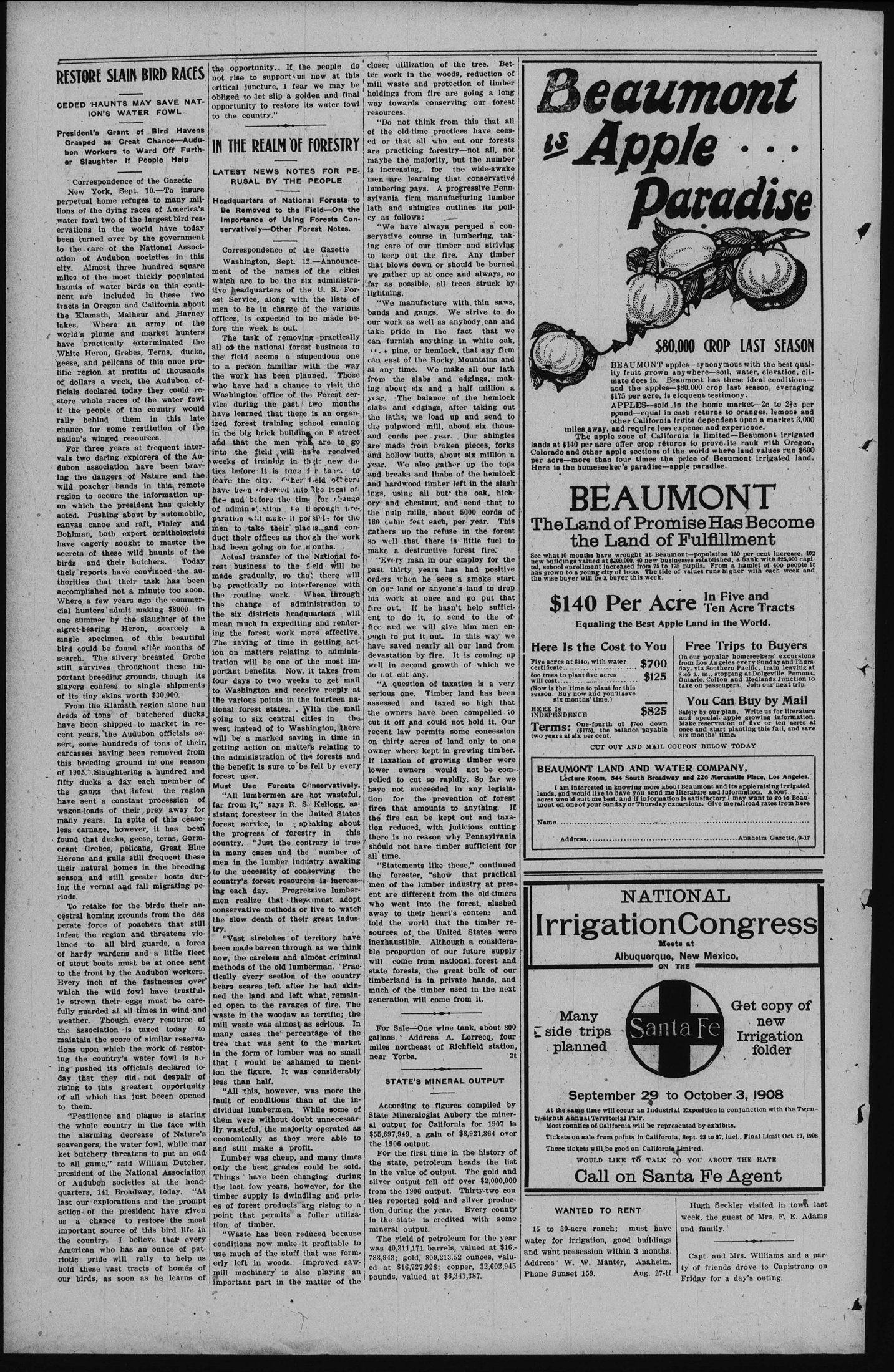
Searchable text
RESTORE SLAIN BIRD RACES
CEDED HAUNTS MAY SAVE NATION'S WATER FOWL
President's Grant of Bird Havens Grasped as Great Chance—Audubon Workers to Ward Off Further Slaughter If People Help
Correspondence of the Gazette
New York, Sept. 10.—To insure perpetual home refuges to many millions of the dying races of America's water fowl two of the largest bird reservations in the world have today been turned over by the government to the care of the National Association of Audubon societies in this city. Almost three hundred square miles of the most thickly populated haunts of water birds on this continent are included in these two tracts in Oregon and California about the Klamath, Malheur and Harney lakes. Where an army of the world's plume and market hunters have practically exterminated the White Heron, Grebes, Terns, ducks, geese, and pelicans of this once prolific region at profits of thousands of dollars a week, the Audubon officials declared today they could restore whole races of the water fowl if the people of the country would rally behind them in this late chance for some restitution of the nation's winged resources.
For three years at frequent intervals two daring explorers of the Audubon association have been braving the dangers of Nature and the wild poacher bands in this remote region to secure the information upon which the president has quickly the opportunity. If the people not rise to support us now a critical juncture, I fear we must obliged to let slip a golden and opportunity to restore its water to the country."
IN THE REALM OF FOREST
LATEST NEWS NOTES FOR RUSAL BY THE PEOPLE
Headquarters of National Forest
Be Removed to the Field—Importance of Using Forest servatively—Other Forest Needs
Correspondence of the Gazette
Washington, Sept. 12.—Announcement of the names of the which are to be the six administrative headquarters of the U.S. West Service, along with the men to be in charge of the offices, is expected to be made fore the week is out.
The task of removing prairie all of the national forest business from the field seems a stupendous task to a person familiar with the work has been planned. Who have had a chance to visit Washington office of the Forest service during the past two weeks have learned that there is an organized forest training school run in the big brick building on Fond and that the men who are into the field will have rewrites of training in their niceties before it is time for them to leave the city. Other fields have been ordered into the office and before the time for administration.
if the people of the country would rally behind them in this late chance for some restitution of the nation's winged resources.
For three years at frequent intervals two daring explorers of the Audubon association have been braving the dangers of Nature and the wild poacher bands in this remote region to secure the information upon which the president has quickly acted. Pushing about by automobile, canvas canoe and raft, Finley and Bohlman, both expert ornithologists have eagerly sought to master the secrets of these wild haunts of the birds and their butchers. Today their reports have convinced the authorities that their task has been accomplished not a minute too soon. Where a few years ago the commercial hunters admit making $8000 in one summer by the slaughter of the aigret-bearing Heron, scarcely a single specimen of this beautiful bird could be found after months of search. The silvery breasted Grebe still survives throughout these important breeding grounds, though its slayers confess to single shipments of its tiny skins worth $30,000.
From the Klamath region alone hundreds of tons of butchered ducks have been shipped to market in recent years, the Audubon officials assert, some hundreds of tons of their carcasses having been removed from this breeding ground in one season of 1905. Slaughtering a hundred and fifty ducks a day each member of the gangs that infest the region have sent a constant procession of wagon-loads of their prey away for many years. In spite of this ceaseless carnage, however, it has been found that ducks, geese, terns, Gormorant Grebes, pelicans, Great Blue Herons and gulls still frequent these their natural homes in the breeding season and still greater hosts during the vernal and fall migrating periods.
To retake for the birds their ancestral homing grounds from the desperate force of poachers that still infest the region and threatens violence to all bird guards, a force of hardy wardens and a little fleet of stout boats must be at once sent
device during the past two years have learned that there is an organized forest training school run in the big brick building on F and that the men who are into the field will have re-weeks of training in their niceties before it is time for them to leave the city. Other field officers have been ordered into the office and before the time for administration to thorough paration will make it possible men to take their places and duct their offices as though they had been going on for months.
Actual transfer of the National forest business to the field was made gradually, so that they be practically no interference in the routine work. When the change of administration the six districts headquarters mean much in expediting and improving the forest work more efficiently. The saving of time in getting ion on matters relating to administration will be one of the most important benefits. Now, it takes four days to two weeks to get to Washington and receive records of various points in the fourteental forest states. With this going to six central cities in west instead of to Washington will be a marked saving in the getting action on matters related to the administration of the forests the benefit is sure to be felt by forest user.
Must Use Forests Conserva
"All lumbermen are hot war far from it," says R. S. Kellogg assistant foresteer in the United forest service, in speaking of the progress of forestry in country. "Just the contrary in many cases and the number men in the lumber industry are to the necessity of conserving country's forest resources is ing each day. Progressive men realize that they must conserve methods or live to the slow death of their great try.
"Vast stretches of territory been made barren through as well now, the careless and almost c methods of the old lumberman."
their natural homes in the breeding season and still greater hosts during the vernal and fall migrating periods.
To retake for the birds their ancestral homing grounds from the desperate force of poachers that still infest the region and threatens violence to all bird guards, a force of hardy wardens and a little fleet of stout boats must be at once sent to the front by the Audubon workers. Every inch of the fastnesses over which the wild fowl have trustfully strewn their eggs must be carefully guarded at all times in wind and weather. Though every resource of the association is taxed today to maintain the score of similar reservations upon which the work of restoring the country's water fowl is being pushed its officials declared today that they did not despair of rising to this greatest opportunity of all which has just been opened to them.
"Pestilence and plague is staring the whole country in the face with the alarming decrease of Nature's scavengers, the water fowl, while market butchery threatens to put an end to all game," said William Dutcher, president of the National Association of Audubon societies at the headquarters, 141 Broadway, today. "At last our explorations and the prompt action of the president have given us a chance to restore the most important source of this bird life in the country. I believe that every American who has an ounce of patriotic pride will rally to help us hold these vast tracts of homes of our birds, as soon as he learns of
men in the lumber industry and to the necessity of conserving country’s forest resources is ing each day. Progressive men realize that they must conserve methods or live to the slow death of their great try.
"Vast stretches of territory been made barren through as well now, the careless and almost cunning methods of the old lumberman. Tically every section of the bears scares left after he had ned the land and left what ed open to the ravages of fire waste in the woodsw as terrific mill waste was almost as serious many cases the percentage tree that was sent to the in the form of lumber was so that I would be ashamed to ion the figure. It was consider less than half.
"All this, however, was more fault of conditions than of individual lumbermen. While some them were without doubt unnecessarily wasteful, the majority operated economically as they were and still make a profit.
Lumber was cheap, and many only the best grades could be Things have been changing on the last few years, however, timber supply is dwindling and es of forest products are rising point that permits a fuller tion of timber.
"Waste has been reduced by conditions now make it profitable use much of the stuff that was early left in woods. Improved mill machinery is also playing an important part in the matter."
If the people do not support us now at this picture, I fear we may be at slip a golden and final to restore its water fowl cry."
REALM OF FORESTRY
NEWS NOTES FOR PEOPLE BY THE PEOPLE
Issues of National Forests to be addressed to the Field—On the issue of Using Forests Concerned—Other Forest Notes.
Evidence of the Gazette Journal, Sept. 12.—Announcement names of the cities to be the six administra-tors of the U. S. For-mer along with the lists of man charge of the various expected to be made be-ck is out.
Of removing practically national forest business to seems a stupendous one familiar with the way has been planned. Those had a chance to visit the office of the Forest ser-vice in the past two months that there is an organ-training school running trick building on F street where men who are to go field will have received training in their new da-lit is time for them to city. Other field officers ordered into the local office the time for change through pre-closer utilization of the tree. Better work in the woods, reduction of mill waste and protection of timber holdings from fire are going a long way towards conserving our forest resources.
"Do not think from this that all of the old-time practices have ceased or that all who cut our forests are practicing forestry—not all, not maybe the majority, but the number is increasing, for the wide-awake men are learning that conservative lumbering pays. A progressive Pennsylvania firm manufacturing lumber lath and shingles outlines its policy as follows:
"We have always persued a conserative course in lumbering, taking care of our timber and striving to keep out the fire. Any timber that blows down or should be burned we gather up at once and always, so far as possible, all trees struck by lightning.
"We manufacture with thin saws, bands and gangs. We strive to do our work as well as anybody can and take pride in the fact that we can furnish anything in white oak, pine, or hemlock, that any firm can east of the Rocky Mountains and at any time. We make all our lath from the slabs and edgings, making about six and a half million a year. The balance of the hemlock slabs and edgings, after taking out the laths, we load up and send to the pulpwood mill, about six thousand cords per year. Our shingles are made from broken pieces, forks and hollow butts, about six million a year. We also gather up the tops and breaks and limbs of the hemlock and hardwood timber left in the slashings, using all but the oak, hickory and chestnut, and send that to the pulp mills, about 5000 cords of..."
Forests Conservatively, men are not wasteful, says R. S. Kellogg, as steer in the United States case, in speaking about forestry in this must the contrary is true and the number of lumber industry awakening is costly of conserving theorest resources is increasey. Progressive lumber that they must adopt methods or live to watch path of their great industrialets of territory have arisen through as we think less and almost criminal the old lumberman. Pracslabs and edgings, after taking out the laths, we load up and send to the pulpwood mill, about six thousand and cords per year. Our shingles are made from broken pieces, forks and hollow butts, about six million a year. We also gather up the tops and breaks and limbs of the hemlock and hardwood timber left in the slashings, using all but the oak, hickory and chestnut, and send that to the pulp mills, about 5000 cords of 160 cubic feet each, per year. This gathers up the refuse in the forest so well that there is little fuel to make a destructive forest fire.
"Every man in our employ for the past thirty years has had positive orders when he sees a smoke start on our land or anyone's land to drop his work at once and go put that fire out. If he hasn't help sufficient to do it, to send to the office and we will give him men enough to put it out. In this way we have saved nearly all our land from devastation by fire. It is coming up well in second growth of which we do not cut any.
"A question of taxation is a very serious one. Timber land has been assessed and taxed so high that the owners have been compelled to cut it off and could not hold it. Our recent law permits some concession on thirty acres of land only to one owner where kept in growing timber. If taxation of growing timber were lower owners would not be compelled to cut so rapidly. So far we have not succeeded in any legislation for the prevention of forest fires that amounts to anything. If the fire can be kept out and taxation reduced, with judicious cutting there is no reason why Pennsylvania should not have timber sufficient for all time.
"Statements like these," continued the forester, "show that practical men of the lumber industry at present are different from the old-timers who went into the forest, slashed away to their heart's content; and told the world that the timber resources of the United States were inexhaustible. Although a considerable proportion of our future supply will come from national forest and state forests, the great bulk of our
"Statements like these," continued the forester, "show that practical men of the lumber industry at present are different from the old-timers who went into the forest, slashed away to their heart's content; and told the world that the timber resources of the United States were inexhaustible. Although a considerable proportion of our future supply will come from national forest and state forests, the great bulk of our timberland is in private hands, and much of the timber used in the next generation will come from it.
For Sale—One wine tank, about 800 gallons. Address A. Lorrecq, four miles northeast of Richfield station, near Yorba.
STATE'S MINERAL OUTPUT
According to figures compiled by State Mineralogist Aubery the mineral output for California for 1907 is $55,697,949, a gain of $8,921,864 over the 1906 output.
For the first time in the history of the state, petroleum heads the list in the value of output. The gold and silver output fell off over $2,000,000 from the 1906 output. Thirty-two counties reported gold and silver production during the year. Every county in the state is credited with some mineral output.
The yield of petroleum for the year was 40,311,171 barrels, valued at $16,-783,943; gold, 809,213.52 ounces, valued at $16,727,928; copper, 32,602,945 pounds, valued at $6,341,387."
Beaumont
Apple ...
Paradise
$80,000 CROP LAST SEASON
BEAUMONT apples—synonymous with the best quality fruit grown anywhere—soil, water, elevation, climate does it. Beaumont has these ideal conditions—and the apples—$80,000 crop last season, everaging $175 per acre, is eloquent testimony.
APPLES—sold in the home market—2c to 2½c per pound—equal in cash returns to oranges, lemons and other California fruits dependent upon a market 3,000 miles away, and require less expense and experience.
The apple zone of California is limited—Beaumont irrigated $140 per acre offer crop returns to prove its rank with Oregon, so and other apple sections of the world where land values run $600 more than four times the price of Beaumont irrigated land. The homeseeker’s paradise—apple paradise.
APPLES—sold in the home market—2c to 2¢ per pound—equal in cash returns to oranges, lemons and other California fruits dependent upon a market 3,000 miles away, and require less expense and experience.
The apple zone of California is limited—Beaumont irrigated $140 per acre offer crop returns to prove its rank with Oregon, and other apple sections of the world where land values run $600 more than four times the price of Beaumont irrigated land. The homeseeker’s paradise—apple paradise.
BEAUMONT
The Land of Promise Has Become
the Land of Fulfillment
10 months have wrought at Beaumont—population 150 per cent increase, 102 buildings valued at $100,000, 40 new businesses established, a bank with $25,000 capital enrollment increased from 75 to 175 pupils. From a hamlet of 400 people it turns to a young city of 1000. The tide of values runs higher with each week and buyer will be a buyer this week.
$140 Per Acre In Five and Ten Acre Tracts
Equaling the Best Apple Land in the World.
Is the Cost to You
at $140, with water $700
to plant five acres $125
one time to plant for this buy now and you’ll save six months’ time.)
INDENCE $825
Free Trips to Buyers
On our popular homeseekers’ excursions from Los Angeles every Sunday and Thursday, via Southern Pacific, train leaving at 8:05 a.m., stopping at Dolgeville, Pomona, Ontario, Colton and Redlands Junction to take on passengers. Join our next trip.
You Can Buy by Mail
Safely by our plan. Write us for literature and special apple growing information. Make reservation of five or ten acres at once and start planting this fail, and save six months’ time.
CUT OUT AND MAIL COUPON BELOW TODAY
BEAUMONT LAND AND WATER COMPANY,
Lecture Room, 544 South Broadway and 226 Mercantile Place, Los Angeles.
I am interested in knowing more about Beaumont and its apple raising irrigated land would like to have you send me literature and information. About...
would suit me best, and if information is satisfactory I may want to go to Beaun one of your Sunday or Thursday excursions. Give me railroad rates from here
Address... Anaheim Gazette, 9-17
NATIONAL
irrigation Congress
Meets at
Albuquerque, New Mexico,
ON THE
NATIONAL
Irrigation Congress
Meets at
Albuquerque, New Mexico,
ON THE
Many
side trips
planned
Get copy of
new
Irrigation
folder
September 29 to October 3, 1908
The same time will occur an Industrial Exposition in conjunction with the Twenth Annual Territorial Fair.
Counties of California will be represented by exhibits.
Meets on sale from points in California, Sept. 23 to 27, incl., Final Limit Oct. 21, 1908
Tickets will be good on California Limited.
WOULD LIKE TO TALK TO YOU ABOUT THE RATE
Call on Santa Fe Agent
WANTED TO RENT
30-acre ranch; must have irrigation, good buildings possession within 3 months.
W. W. Manter, Anaheim.
Sunset 159. Aug. 27-tf
Hugh Seckler visited in town last week, the guest of Mrs. F. E. Adams and family.
Capt. and Mrs. Williams and a party of friends drove to Capistrano on Friday for a day's outing.