anaheim-gazette 1908-07-02
Scanned page
Searchable text
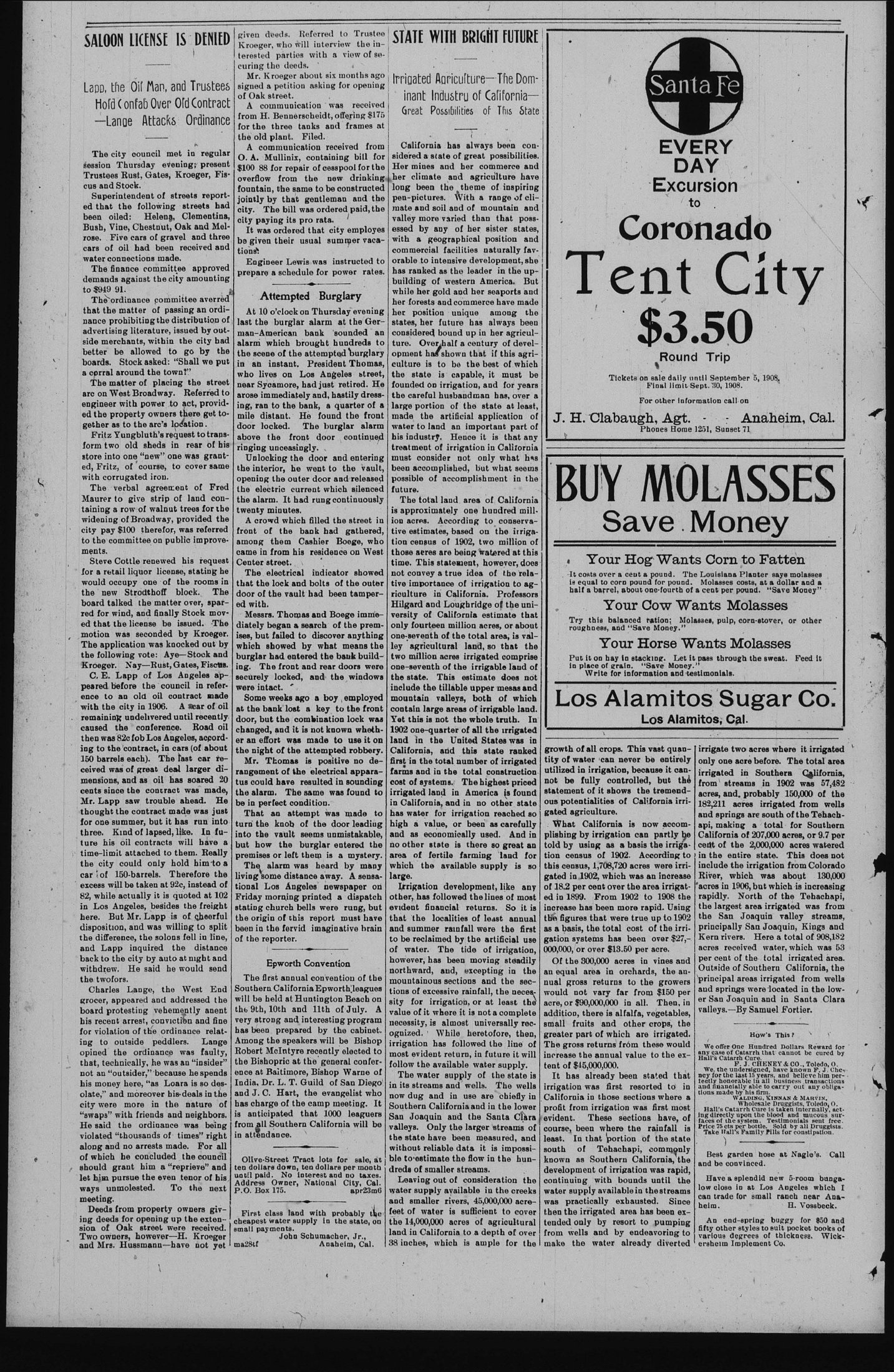
SALOON LICENSE IS DENIED
Lapp, the Oil Man, and Trustees Hold Confab Over Old Contract — Lange Attacks Ordinance
The city council met in regular session Thursday evening; present Trustees Rust, Gates, Kroeger, Fiscus and Stock.
Superintendent of streets reported that the following streets had been oiled: Helena, Clementina, Bush, Vine, Chestnut, Oak and Melrose. Five cars of gravel and three cars of oil had been received and water connections made.
The finance committee approved demands against the city amounting to $949 91.
The ordinance committee averred that the matter of passing an ordinance prohibiting the distribution of advertising literature, issued by outside merchants, within the city had better be allowed to go by the boards. Stock asked: "Shall we put a corral around the town?"
The matter of placing the street arc on West Broadway. Referred to engineer with power to act, provided the property owners there get together as to the arc's location.
Fritz Yungbluth's request to transform two old sheds in rear of his store into one "new" one was granted, Fritz, of course, to cover same with corrugated iron.
The verbal agreement of Fred Maurer to give strip of land containing a row of walnut trees for the given deeds. Referred to Kroeger, who will intercede parties with curing the deeds.
Mr. Kroeger about six signed a petition asking of Oak street.
A communication wired from H. Bennerscheidt, for the three tanks and the old plant. Filed.
A communication re-received O. A. Mullinix, containing $100 88 for repair of cesna overflow from the new fountain, the same to be jointly by that gentleman city. The bill was ordered city paying its pro rata.
It was ordered that can be given their usual situations!
Engineer Lewis was in prepare a schedule for
Fritz Yungbluth's request to transform two old sheds in rear of his store into one "new" one was granted, Fritz, of course, to cover same with corrugated iron.
The verbal agreement of Fred Maurer to give strip of land containing a row of walnut trees for the widening of Broadway, provided the city pay $100 therefor, was referred to the committee on public improvements.
Steve Cottle renewed his request for a retail liquor license, stating he would occupy one of the rooms in the new Strodthoff block. The board talked the matter over, sparred for wind, and finally Stock moved that the license be issued. The motion was seconded by Kroeger. The application was knocked out by the following vote: Aye—Stock and Kroeger. Nay—Rust, Gates, Fiscas.
C. E. Lapp of Los Angeles appeared before the council in reference to an old oil contract made with the city in 1906. A car of oil remaining undelivered until recently caused the conference. Road oil then was 82c fob Los Angeles, according to the contract, in cars (of about 150 barrels each). The last car received was of great deal larger dimensions, and as oil has soared 20 cents since the contract was made, Mr. Lapp saw trouble ahead. He thought the contract made was just for one summer, but it has run into three. Kind of lapsed, like. In future his oil contracts will have a time-limit attached to them. Really the city could only hold him to a car of 150-barrels. Therefore the excess will be taken at 92c, instead of 82, while actually it is quoted at 102 in Los Angeles, besides the freight here. But Mr. Lapp is of cheerful disposition, and was willing to split the difference, the solons fell in line, and Lapp inquired the distance back to the city by auto at night and withdrew. He said he would send
the city could only hold him to a car of 150-barrels. Therefore the excess will be taken at 92c, instead of 82, while actually it is quoted at 102 in Los Angeles, besides the freight here. But Mr. Lapp is of cheerful disposition, and was willing to split the difference, the solons fell in line, and Lapp inquired the distance back to the city by auto at night and withdrew. He said he would send the twofors.
Charles Lange, the West End grocer, appeared and addressed the board protesting vehemently anent his recent arrest, conviction and fine for violation of the ordinance relating to outside peddlers. Lange opined the ordinance was faulty, that, technically, he was an "insider" not an "outsider," because he spends his money here, "as Loara is so desolate," and moreover his deals in the city were more in the nature of "swaps" with friends and neighbors. He said the ordinance was being violated "thousands of times" right along and no arrests made. For all of which he concluded the council should grant him a "reprieve" and let him pursue the even tenor of his ways unmolested. To the next meeting.
Deeds from property owners giving deeds for opening up the extension of Oak street were received. Two owners, however—H. Kroeger and Mrs. Hussmann—have not yet
deeds. Referred to Trustee
giver, who will interview the informed parties with a view of seing the deeds.
Kroeger about six months ago
said a petition asking for opening
a street.
Communication was received
from H. Bennerscheidt, offering $175
for three tanks and frames at
plant. Filed.
Communication received from
Mullinix, containing bill for
$68 for repair of cesspool for the
now from the new drinking
min, the same to be constructed
by that gentleman and the
The bill was ordered paid, the
paying its pro rata.
Was ordered that city employes
en their usual summer vacaneer Lewis was instructed to
are a schedule for power rates.
Attempted Burglary
At 10 o'clock on Thursday evening
the burglar alarm at the GerAmerican bank sounded an
which brought hundreds to
sense of the attempted burglary
instant. President Thomas,
dives on Los Angeles street,
Bycamore, had just retired. He
immediately and, hastily dresson to the bank, a quarter of a
distant. He found the front
locked. The burglar alarm
at the front door continued
unceasingly.
Locking the door and entering
interior, he went to the vault,
giving the outer door and released
electric current which silenced
arm. It had rung continuously
STATE WITH BRIGHT FUTURE
Irrigated Agriculture—The Dominant Industry of California—Great Possibilities of This State
California has always been considered a state of great possibilities.
Her mines and her commerce and
her climate and agriculture have long been the theme of inspiring pen-pictures. With a range of climate and soil and of mountain and valley more varied than that possessed by any of her sister states,
with a geographical position and commercial facilities naturally favorable to intensive development, she has ranked as the leader in the upbuilding of western America. But while her gold and her seaports and her forests and commerce have made her position unique among the states, her future has always been considered bound up in her agriculture. Over half a century of development has shown that if this agricuture is to be the best of which
the state is capable, it must be founded on irrigation, and for years the careful husbandman has, over a large portion of the state at least,
made the artificial application of water to land an important part of his industry. Hence it is that any treatment of irrigation in California must consider not only what has been accomplished, but what seems possible of accomplishment in the future.
The total land area of California is approximately one hundred mill-
to the bank, a quarter of a
adistant. He found the front
locked. The burglar alarm
in the front door continued
unceasingly.
ocking the door and entering
interior, he went to the vault,
giving the outer door and released
electric current which silenced
arm. It had rung continuously
very minutes.
rowd which filled the street in
of the bank had gathered,
giving them Cashier Boege, who
ran from his residence on West
street.
An electrical indicator showed
the lock and bolts of the outer
of the vault had been tamperished.
ers. Thomas and Boege immebly began a search of the prembut failed to discover anything
showed by what means the
door had entered the bank buildThe front and rear doors were
only locked, and the windows
contact.
The weeks ago a boy employed
the bank lost a key to the front
about the combination lock was
used, and it is not known whethfort was made to use it on
night of the attempted robbery.
Thomas is positive no dement of the electrical apparature have resulted in sounding
farm. The same was found to
perfect condition.
It an attempt was made to
the knob of the door leading
the vault seems unmistakable,
now the burglar entered the
les or left them is a mystery.
A alarm was heard by many
some distance away. A sensaLos Angeles newspaper on
morning printed a dispatch
church bells were rung, but
origin of this report must have
in the fervid imaginative brain
reporter.
Epworth Convention
large portion of the state at least,
made the artificial application of
water to land an important part of
his industry. Hence it is that any
treatment of irrigation in California
must consider not only what has
been accomplished, but what seems
possible of accomplishment in the future.
The total land area of California
is approximately one hundred million acres. According to conservative estimates, based on the irrigation census of 1902, two million of those acres are being watered at this time. This statement, however, does not convey a true idea of the relative importance of irrigation to agricurulture in California. Professors Hilgard and Loughridge of the university of California estimate that only fourteen million acres, or about one-seventh of the total area, is valley agricultural land, so that the two million acres irrigated comprise one-seventh of the irrigable land of the state. This estimate does not include the tillable upper mesas and mountain valleys, both of which contain large areas of irrigable land. Yet this is not the whole truth. In 1902 one-quarter of all the irrigated land in the United States was in California, and this state ranked first in the total number of irrigated farms and in the total construction cost of systems. The highest priced irrigated land in America is found in California, and in no other state has water for irrigation reached so high a value, or been as carefully and as economically used. And in no other state is there so great an area of fertile farming land for which the available supply is so large.
Irrigation development, like any other, has followed the lines of most evident financial returns. So it is that the localities of least annual and summer rainfall were the first to be reclaimed by the artificial use of water. The tide of irrigation, however, has been moving steadily northward and westward in the
growth of all crops. The city of water can now utilized in irrigation, not be fully controlled statement of it shows ous potentialities of irrigated agriculture.
What California is plishing by irrigation told by using as a builtn census of 1902. this census, 1,708,720 agated in 1902, which wi of 18.2 per cent over th ed in 1899. From 190 increase has been more the figures that were as a basis, the total co gation systems has b 000,000, or over $13.50.
Of the 300,000 acres
alarm was heard by many some distance away. A sensaLos Angeles newspaper on the morning printed a dispatch
church bells were rung, but begin of this report must have
the fervid imaginative brain reporter.
Epworth Convention
first annual convention of the
Born California Epworth leagues held at Huntington Beach on
10th and 11th of July. A strong and interesting program
prepared by the cabinet.
the speakers will be Bishop McIntyre recently elected to
ephoric at the general conferBaltimore, Bishop Warne of
Dr. L. T. Guild of San Diego
C. Hart, the evangelist who
large of the camp meeting. It
incipated that 1000 leaguers
all Southern California will be
audance.
Street Tract lots for sale, at
dars down, ten dollars per month
aid. No interest and no taxes.
Owner, National City, Cal.
box 175.
apr23m6
class land with probably the best water supply in the state, on payments.
John Schumacher, Jr., Anaheim, Cal.
which the available supply is so large.
Irrigation development, like any other, has followed the lines of most evident financial returns. So it is that the localities of least annual and summer rainfall were the first to be reclaimed by the artificial use of water. The tide of irrigation, however, has been moving steadily northward, and, excepting in the mountainous sections and the sections of excessive rainfall, the necessity for irrigation, or at least the value of it where it is not a complete necessity, is almost universally recognized. While heretofore, then, irrigation has followed the line of most evident return, in future it will follow the available water supply.
The water supply of the state is in its streams and wells. The wells now dug and in use are chiefly in Southern California and in the lower San Joaquin and the Santa Clara valleys. Only the larger streams of the state have been measured, and without reliable data it is impossible to estimate the flow in the hundreds of smaller streams.
Leaving out of consideration the water supply available in the creeks and smaller rivers, 45,000,000 acre-feet of water is sufficient to cover the 14,000,000 acres of agricultural land in California to a depth of over 38 inches, which is ample for the
this census, 1,708,720 acres gated in 1902, which w of 18.2 per cent over th ed in 1899. From 190 increase has been more the figures that were as a basis, the total cation systems has be 000,000, or over $13.50.
Of the 300,000 acres an equal area in orcual gross returns would not vary far acre, or $90,000,000 in addition, there is alfa small fruits and ot greater part of which The gross returns from increase the annual vatent of $45,000,000.
It has already been irrigation was first in California in those secr profit from irrigation evident. These sec course, been where te least. In that portion south of Tehachai known as Southern development of irrigation continuing with bou water supply available was practically exha then the irrigated area tended only by resor from wells and by em make the water alr
Santa Fe
EVERY DAY
Excursion to
Coronado
Tent City
$3.50
Round Trip
Tickets on sale daily until September 5, 1908.
Final limit Sept. 30, 1908.
For other information call on
T. H. Clabaugh, Agt. - Anaheim, Cal.
Phones Home 1251, Sunset 71
BUY MOLASSES
Save Money
Your Hog Wants Corn to Fatten
It costs over a cent a pound. The Louisiana Planter says molasses is equal to corn pound for pound. Molasses costs, at a dollar and a half a barrel, about one-fourth of a cent per pound. "Save Money"
Your Cow Wants Molasses
Try this balanced ration; Molasses, pulp, corn-stover, or other roughness, and "Save Money."
Your Horse Wants Molasses
Put it on hay in stacking. Let it pass through the sweat. Feed it in place of grain. "Save Money."
Write for information and testimonials.
Los Alamitos Sugar Co.
Los Alamitos, Cal.
width of all crops. This vast quantity of water can never be entirely used in irrigation, because it cannot be fully controlled, but the element of it shows the tremendous potentialities of California irrigated agriculture.
What California is now accomplishing by irrigation can partly be by using as a basis the irriga-census of 1902. According to the census, 1,708,720 acres were irri-ced in 1902, which was an increase of 8.2 per cent over the area irrigat-ion in 1899. From 1902 to 1908 the ease has been more rapid. Using figures that were true up to 1902 on basis, the total cost of the irri-ron systems has been over $27,-000, or over $13.50 per acre.
If the 300,000 acres in vines and irrigate two acres where it irrigated only one acre before. The total area irrigated in Southera California, from streams in 1902 was 57,482 acres, and probably 150,000 of the 182,211 acres irrigated from wells and springs are south of the Tehachapi, making a total for Southern California of 207,000 acres, or 9.7 per cent of the 2,000,000 acres watered in the entire state. This does not include the irrigation from Colorado River, which was about 130,000 acres in 1906, but which is increasing rapidly. North of the Tehachapi, the largest area irrigated was from the San Joaquin valley streams, principally San Joaquin, Kings and Kern rivers. Here a total of 908,182 acres received water, which was 53 per cent of the total irrigated area. Outside of Southern California, the
census, 1,708,720 acres were irrigated in 1902, which was an increase of 8.2 per cent over the area irrigated in 1899. From 1902 to 1908 the decrease has been more rapid. Using figures that were true up to 1902 on basis, the total cost of the irrigation systems has been over $27,000, or over $13.50 per acre.
Of the 300,000 acres in vines and equal area in orchards, the annual gross returns to the growers would not vary far from $150 per acre, or $90,000,000 in all. Then, in addition, there is alfalfa, vegetables, all fruits and other crops, the latter part of which are irrigated. The gross returns from these would increase the annual value to the extent of $45,000,000.
It has already been stated that irrigation was first resorted to in California in those sections where a suit from irrigation was first most recent. These sections have, of course, been where the rainfall is at. In that portion of the state north of Tehachapi, commonly known as Southern California, the development of irrigation was rapid, continuing with bounds until the water supply available in the streams practically exhausted. Since in the irrigated area has been exiled only by resort to pumping wells and by endeavoring to raise the water already diverted include the irrigation from Colorado River, which was about 130,000 acres in 1906, but which is increasing rapidly. North of the Tehachapi, the largest area irrigated was from the San Joaquin valley streams, principally San Joaquin, Kings and Kern rivers. Here a total of 908,182 acres received water, which was 53 per cent of the total irrigated area. Outside of Southern California, the principal areas irrigated from wells and springs were located in the lower San Joaquin and in Santa Clara valleys.—By Samuel Fortier.
How's This?
We offer One Hundred Dollars Reward for any case of Catarrh that cannot be cured by Hall's Catarrh Cure.
F. J. CHENEY & CO., Toledo, O.
We, the undersigned, have known F. J. Cheney for the last 15 years, and believe him perfectly honorable in all business transactions and financially able to carry out any obligations made by his firm.
WALDING, KINNAN & MARVIN,
Wholesale Druggists, Toledo, O.
Hall's Catarrh Cure is taken internally, acting directly upon the blood and mucous surfaces of the system. Testimonials sent free. Price 75 cts per bottle. Sold by all Druggists.
Take Hall's Family Pills for constipation.
Best garden hose at Nagle's. Call and be convinced.
Have a splendid new 5-room bungalow close in at Los Angeles which I can trade for small ranch near Anaheim.
H. Vossbeck.
An end-spring buggy for $50 and fifty other styles to suit pocket books of various degrees of thickness. Wickersheim Implement Co.