anaheim-gazette 1908-05-14
Scanned page
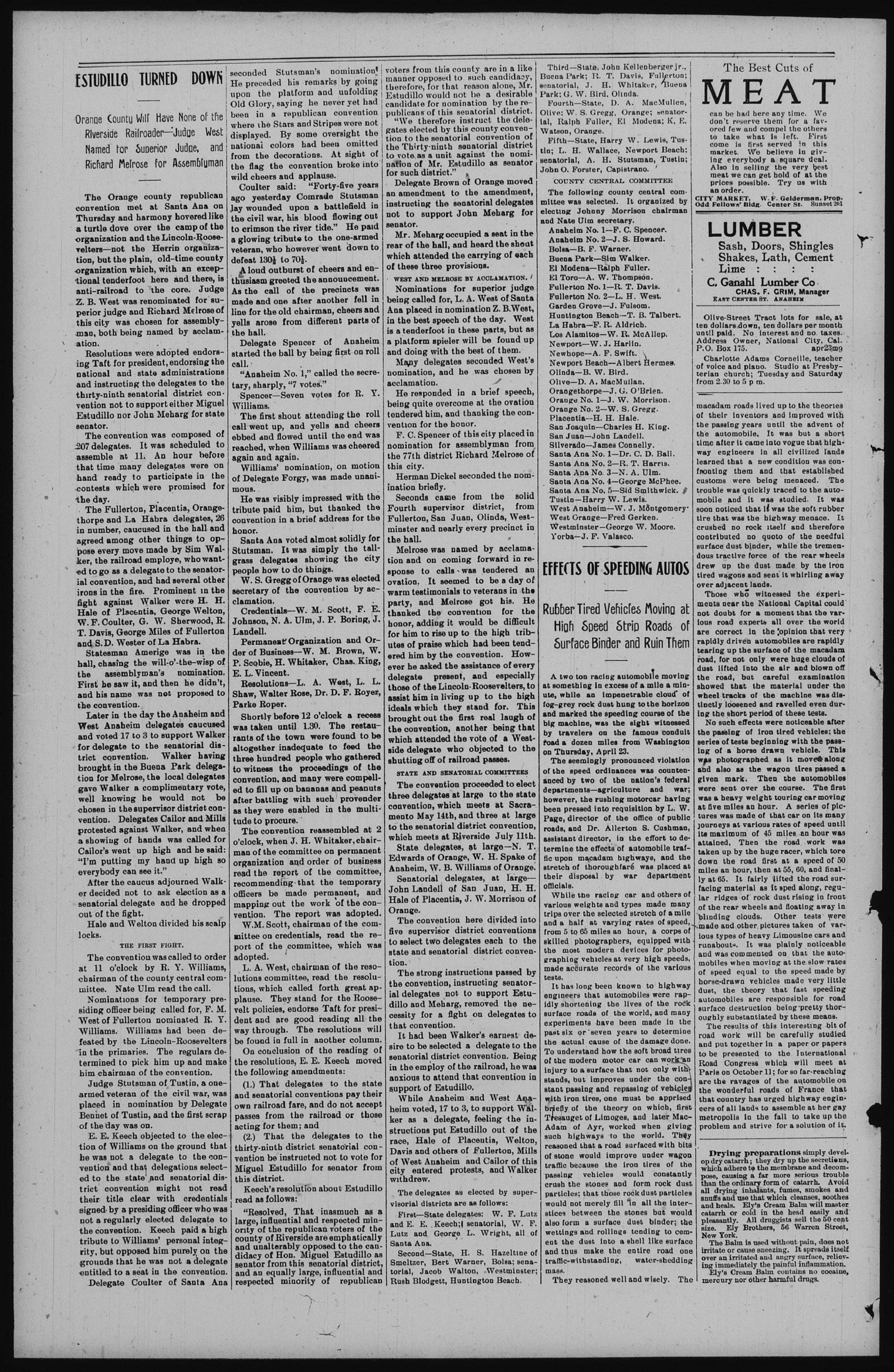
Searchable text
ESTUDILLO TURNED DOWN
Orange County Will Have None of the Riverside Railroader—Judge West Named for Superior Judge, and Richard Melrose for Assemblyman
The Orange county republican convention met at Santa Ana on Thursday and harmony hovered like a turtle dove over the camp of the organization and the Lincoln-Roosevelters—not the Herrin organization, but the plain, old-time county organization which, with an exceptional tenderfoot here and there, is anti-railroad to the core. Judge Z. B. West was renominated for superior judge and Richard Melrose of this city was chosen for assemblyman, both being named by acclamation.
Resolutions were adopted endorsing Taft for president, endorsing the national and state administrations and instructing the delegates to the thirty-ninth senatorial district convention not to support either Miguel Estudillo nor John Meharg for state senator.
The convention was composed of 207 delegates. It was scheduled to assemble at 11. An hour before that time many delegates were on hand ready to participate in the contests which were promised for the day.
The Fullerton, Placentia, Orange-seconded Stutsman's mansion He preceded his remarks upon the platform and Old Glory, saying he never been in a republican where the Stars and Stripes displayed. By some over national colors had been from the decorations. A the flag the convention wild cheers and applause.
Coulter said: "Forty ago yesterday Comrade lay wounded upon a battle the civil war, his blood fled to crimson the river tide. a glowing tribute to the veteran, who however went defeat 130½ to 70½.
A loud outburst of cheers thusiasm greeted the annual As the call of the preamble made and one after another line for the old chairman, yells arose from different the hall.
Delegate Spencer of started the ball by being call.
"Anaheim No. 1," called tary, sharply, "7 votes."
Spencer—Seven votes Williams.
The first shout attending call went up, and yells ebbed and flowed until reached, when Williams wagged again and again.
Williams' nomination, of Delegate Forgy, was mous.
He was visibly impressed tribute paid him, but th
The convention was composed of 207 delegates. It was scheduled to assemble at 11. An hour before that time many delegates were on hand ready to participate in the contests which were promised for the day.
The Fullerton, Placentia, Orange-thorpe and La Habra delegates, 26 in number, caucused in the hall and agreed among other things to oppose every move made by Sim Walker, the railroad employee, who wanted to go as a delegate to the senatorial convention, and had several other irons in the fire. Prominent in the fight against Walker were H. H. Hale of Placentia, George Welton, W. F. Coulter, G. W. Sherwood, R. T. Davis, George Miles of Fullerton and S. D. Wester of La Habra.
Statesman Amerige was in the hall, chasing the will-o'-the-wisp of the assemblyman's nomination. First he saw it, and then he didn't, and his name was not proposed to the convention.
Later in the day the Anaheim and West Anaheim delegates caucused and voted 17 to 3 to support Walker for delegate to the senatorial district convention. Walker having brought in the Buena Park delegation for Melrose, the local delegates gave Walker a complimentary vote, well knowing he would not be chosen in the supervisor district convention. Delegates Cailor and Mills protested against Walker, and when a showing of hands was called for Cailor's went up high and he said: "I'm putting my hand up high so everybody can see it."
After the caucus adjourned Walker decided not to ask election as a senatorial delegate and he dropped out of the fight.
Hale and Welton divided his scalp locks.
THE FIRST FIGHT.
The convention was called to order at 11 o'clock by R. Y. Williams.
I'm putting my hand up high so everybody can see it."
After the caucus adjourned Walker decided not to ask election as a senatorial delegate and he dropped out of the fight.
Hale and Welton divided his scalp locks.
THE FIRST FIGHT.
The convention was called to order at 11 o'clock by R. Y. Williams, chairman of the county central committee. Nate Ulm read the call.
Nominations for temporary presiding officer being called for, F. M. West of Fullerton nominated R. Y. Williams. Williams had been defeated by the Lincoln–Roosevelters in the primaries. The regulars determined to pick him up and make him chairman of the convention.
Judge Stutsman of Tustin, a one-armed veteran of the civil war, was placed in nomination by Delegate Bennet of Tustin, and the first scrap of the day was on.
E. E. Keech objected to the election of Williams on the ground that he was not a delegate to the convention and that delegations selected to the state and senatorial district convention might not read their title clear with credentials signed by a presiding officer who was not a regularly elected delegate to the convention. Keech paid a high tribute to Williams' personal integrity, but opposed him purely on the grounds that he was not a delegate entitled to a seat in the convention.
Delegate Coulter of Santa Ana
Stutsman's nomination needed his remarks by going to the platform and unfolding the story, saying he never yet had seen a republican convention where the Stars and Stripes were not used. By some oversight the colors had been omitted in the decorations. At sight of the convention broke into cheers and applause.
Offer said: "Forty-five years ago today Comrade Stutsman handed upon a battlefield in Civil War, his blood flowing out Jason the river tide." He paid tribute to the one-armed man who however went down to 70½ to 70½.
And outburst of cheers and enmire greeted the announcement. The call of the precincts was heard one after another fell in on the old chairman, cheers androse from different parts of town.
Spencer of Anaheim the ball by being first on roll
No. 1," called the secretarply, "7 votes."
Seven votes for R. Y. Jones.
First shout attending the roll up, and yells and cheers flowed until the end was real, when Williams was cheered and again.
Anaheim nomination, on motion for Forgy, was made unanimous visibly impressed with the paid him, but thanked the voters from this county are in a like manner opposed to such candidacy, therefore, for that reason alone, Mr. Estudillo would not be a desirable candidate for nomination by the republicans of this senatorial district.
"We therefore instruct the delegates elected by this county convention to the senatorial convention of the Thirty-ninth senatorial district to vote as a unit against the nomination of Mr. Estudillo as senator for such district."
Delegate Brown of Orange moved an amendment to the amendment, instructing the senatorial delegates not to support John Meharg for senator.
Mr. Meharg occupied a seat in the rear of the hall, and heard the shout which attended the carrying of each of these three provisions.
West and Melrose by acclamation.
Nominations for superior judge being called for, L. A. West of Santa Ana placed in nomination Z. B.West, in the best speech of the day. West is a tenderfoot in these parts, but as a platform spieler will be found up and doing with the best of them.
Many delegates seconded West's nomination, and he was chosen by acclamation.
He responded in a brief speech, being quite overcome at the ovation tendered him, and thanking the convention for the honor.
F. C. Spencer of this city placed in nomination for assemblyman from the 77th district Richard Melrose of this city.
Herman Dickel seconded the nomination briefly.
Seconds came from the solid Fourth supervisor district, from
Third—State, John Kendall Buena Park; R. T. Davis senatorial, J. H. Whitley Park; G. W. Bird, Olinda Fourth—State, D. A. Olive; W. S. Gregg, Orlandal, Ralph Fuller, El Watson, Orange.
Fifth—State, Harry Wittin; L. H. Wallace, N. senatorial, A. H. Stutts John O. Forster, Capistrano
COUNTY CENTRAL COUNTY
The following county mittee was selected. It electing Johnny Morris and Nate Ulm secretary.
Anaheim No. 1—F. C.
Anaheim No. 2—J. S.
Bolsa—B. F. Warner.
Buena Park—Sim Walsh
El Modena—Ralph Fuhr
El Toro—A. W. Thomas
Fullerton No. 1—R. T.
Fullerton No. 2—L. H.
Garden Grove—J. Full
Huntington Beach—T.
La Habra—F. R. Aldrethos Los Alamitos—W. R.
Newport—W. J. Harlow
Newhope—A. F. Swift
Newport Beach—Albemarle
Olinda—B. W. Bird.
Olive—D. A. MacMulligan
Orangethorpe—J. G.
Orange No. 1—J. W.
Orange No. 2—W. S.
Placentia—H. H. Hall
San Joaquin—Charles
San Juan—John Landis
Silverado—James Conn
Santa Ana No. 1—Dr.
Santa Ana No. 2—R.
Santa Ana No. 3—N.
Santa Ana No. 4—George Santa Ana No. 5—Sidney Tustin-Harry W. Lee
West Anaheim-W.J.
first shout attending the roll call up, and yells and cheers and flowed until the end was called when Williams was cheered and again.
Williams' nomination, on motion to delegate Forgy, was made unanimous.
Ana voted almost solidly for Juan. It was simply the tall delegates showing the city how to do things.
Gregg of Orange was elected mayor of the convention by action.
Essentials—W. M. Scott, F. E. Brenn, N. A. Ulm, J. P. Boring, J. L.
Organization and Business—W. M. Brown, W. Joe, H. Whitaker, Chas. King, Vincent.
Solutions—L. A. West, L. L. Walter Rose, Dr. D. F. Royer, Roper.
Only before 12 o'clock a recess began until 1:30. The restaution of the town were found to be rather inadequate to feed the hundred people who gathered across the proceedings of the convention, and many were compelled to pull up on bananas and peanuts battling with such provender that were enabled in the multi-procure.
Convention reassembled at 2 p.m., when J. H. Whitaker, chair of the committee on permanent organization and order of business, report of the committee, extending that the temporary work be made permanent, and going out the work of the confirmation. The report was adopted.
Scott, chairman of the common credentials, read the report of the committee, which was read.
West, chairman of the reso-
being quite overcome at the ovation tendered him, and thanking the convention for the honor.
F. C. Spencer of this city placed in nomination for assemblyman from the 77th district Richard Melrose of this city.
Herman Dickel seconded the nomination briefly.
Seconds came from the solid Fourth supervisor district, from Fullerton, San Juan, Olinda, Westminster and nearly every precinct in the hall.
Melrose was named by acclamation and on coming forward in response to calls was tendered an ovation. It seemed to be a day of warm testimonials to veterans in the party, and Melrose got his. He thanked the convention for the honor, adding it would be difficult for him to rise up to the high tributes of praise which had been tendered him by the convention. However he asked the assistance of every delegate present, and especially those of the Lincoln-Roosevelters, to assist him in living up to the high ideals which they stand for. This brought out the first real laugh of the convention, another being that which attended the vote of a Westside delegate who objected to the shutting off of railroad passes.
STATE AND SENATORIAL COMMITTEES
The convention proceeded to elect three delegates at large to the state convention, which meets at Sacramento May 14th, and three at large to the senatorial district convention, which meets at Riverside July 11th.
State delegates, at large—N. T. Edwards of Orange, W. H. Spake of Anaheim, W. B. Williams of Orange.
Senatorial delegates, at large—John Landell of San Juan, H. H. Hale of Placentia, J. W. Morrison of Orange.
The convention here divided into five supervisor district conventions to select two delegates each to the state and senatorial district convention.
EFFECTS OF SPEED
Rubber Tired Vehicles High Speed Street Surface Binder and
A two ton racing auto at something in excess of statute, while an impenetrable fog-grey rock dust hung and marked the speeding big machine, was the sole by travelers on the road a dozen miles from on Thursday, April 23.
The seemingly pronounced speed ordinanceanced by two of the departments—agriculture however, the rushing man been pressed into require Page, director of the roads, and Dr. Allerton assistant director, in termine the effects of a fic upon macadam high stretch of thoroughfare their disposal by was officials.
While the racing car various weights and type trips over the selected saddle and a half at varying from 5 to 65 miles an hour skilled photographers, the most modern deviographing vehicles at venues made accurate records
The report of the committee, pending that the temporary work be made permanent, and going out the work of the committee, which was adopted.
West, chairman of the resolution which called forth great applause. They stand for the Roosevelt policies, endorse Taft for president and are good reading all the through. The resolutions will stand in full in another column. Conclusion of the reading of resolutions, E. E. Keech moved following amendments:
That delegates to the state senatorial conventions pay their railroad fare, and do not accept any from the railroad or those for them; and
That the delegates to the ninth district senatorial convention be instructed not to vote for Estudillo for senator from district.
Keech's resolution about Estudillo follows:
Involved, That inasmuch as a influential and respected minor of the republican voters of the Riverside are emphaticallyalterably opposed to the cannion of Hon. Miguel Estudillo as far from this senatorial district, it equally large, influential and related minority of republican senators.
Senatorial delegates, at large—John Landell of San Juan, H. H. Hale of Placentia, J. W. Morrison of Orange.
The convention here divided into five supervisor district conventions to select two delegates each to the state and senatorial district convention.
The strong instructions passed by the convention, instructing senatorial delegates not to support Estudillo and Meharg, removed the necessity for a fight on delegates to that convention.
It had been Walker’s earnest desire to be selected a delegate to the senatorial district convention. Being in the employ of the railroad, he was anxious to attend that convention in support of Estudillo.
While Anaheim and West Anaheim voted, 17 to 3, to support Walker as a delegate, feeling the instructions put Estudillo out of the race, Hale of Placentia, Welton, Davis and others of Fullerton, Mills of West Anaheim and Cailor of this city entered protests, and Walker withdrew.
The delegates as elected by supervisorial districts are as follows:
First—State delegates: W. F. Lutz and E. E. Keech; senatorial, W. F. Lutz and George L. Wright, all of Santa Ana.
Second—State, H. S. Hazeltine of Smeltzer, Bert Warner, Bolsa; senatorial, Jacob Walton, Westminster; Rush Blodgett, Huntington Beach.
The Best Cuts of MEAT
can be had here any time. We don't reserve them for a favored few and compel the others to take what is left. First come is first served in this market. We believe in giving everybody a square deal. Also in selling the very best meat we can get hold of at the prices possible. Try us with an order.
CITY MARKET, W.F. Gelderman, Prop. Odd Fellows' Bldg. Center St. Sunset 201
LUMBER
Sash, Doors, Shingles
Shakes, Lath, Cement
Lime : : : :
C. Ganahl Lumber Co
CHAS. F. GRIM, Manager
EAST CENTER ST. ANAHEIM
Olive-Street Tract lots for sale, at ten dollars down, ten dollars per month until paid. No interest and no taxes. Address Owner, National City, Cal. P.O. Box 175. apr23m9
Charlotte Adams Corneille, teacher of voice and piano. Studio at Presbyterian church; Tuesday and Saturday from 2.30 to 5 p.m.
macadam roads lived up to the theories of their inventors and improved with the passing years until the advent of the automobile. It was but a short time after it came into vogue that highway engineers in all civilized lands learned that a new condition was confronting them and that established customs were being menaced. The trouble was quickly traced to the automobile and it was studied. It was soon noticed that it was the soft rubber
EJECTS OF SPEEDING AUTOS
Two ton racing automobile moving something in excess of a mile a minute while an impenetrable cloud of grey rock dust hung to the horizon marked the speeding course of the machine, was the sight witnessed by travelers on the famous conduit a dozen miles from Washington Thursday, April 23.
The seemingly pronounced violation of speed ordinances was countered by two of the nation's federal departments—agriculture and war; never, the rushing motorcar having pressed into requisition by L. W. White, director of the office of public works, and Dr. Allerton S. Cushman,istant director, in the effort to define the effects of automobile traf-fion macadam highways, and the reach of thoroughfare was placed at disposal by war department officials.
While the racing car and others of various weights and types made many over the selected stretch of a mile a half at varying rates of speed, a 5 to 65 miles an hour, a corps of speed photographers, equipped with most modern devices for photo-taking vehicles at very high speeds, accurate records of the various macadam roads lived up to the theories of their inventors and improved with the passing years until the advent of the automobile. It was but a short time after it came into vogue that highway engineers in all civilized lands learned that a new condition was confronting them and that established customs were being menaced. The trouble was quickly traced to the automobile and it was studied. It was soon noticed that it was the soft rubber tire that was the highway menace. It crushed no rock itself and therefore contributed no quota of the needful surface dust binder, while the tremendous tractive force of the rear wheels drew up the dust made by the iron tired wagons and sent it whirling away over adjacent lands.
Those who witnessed the experiments near the National Capital could not doubt for a moment that the various road experts all over the world are correct in the opinion that very rapidly driven automobiles are rapidly tearing up the surface of the macadam road, for not only were huge clouds of dust lifted into the air and blown off the road, but careful examination showed that the material under the wheel tracks of the machine was distinctly loosened and ravelled even during the short period of these tests.
No such effects were noticeable after the passing of iron tired vehicles; the series of tests beginning with the passing of a horse drawn vehicle. This was photographed as it moved along and also as the wagon tires passed a given mark. Then the automobiles were sent over the course. The first was a heavy weight touring car moving at five miles an hour. A series of pictures was made of that car on its many journeys at various rates of speed until its maximum of 45 miles an hour was attained. Then the road work was taken up by the huge racer, which tore down the road first at a speed of 50 miles an hour, then at 55, 60, and finally at 65. It fairly lifted the road surfacing material as it sped along, regular ridges of rock dust rising in front of the rear wheels and floating away in blinding clouds. Other tests were made and other pictures taken of various types of heavy Limousine cars and runabouts. It was plainly noticeable and was commented on that the automobiles when moving at the slow rates...
which of thoroughfare was placed at war disposal by war department officials.
While the racing car and others of various weights and types made many runs over the selected stretch of a mile a half at varying rates of speed, 5 to 65 miles an hour, a corps of speed photographers, equipped with most modern devices for photohing vehicles at very high speeds, have accurate records of the various events.
It has long been known to highway engineers that automobiles were rapidly shortening the lives of the rock face roads of the world, and many experiments have been made in the six or seven years to determine the actual cause of the damage done. Understand how the soft broad tires on the modern motor car can work and try to a surface that not only withdries, but improves under the constant passing and repassing of vehicles on iron tires, one must be apprised fully of the theory on which, first Sauget of Limoges, and later Macmillan of Ayr, worked when giving highways to the world. They observed that a road surfaced with bits of stone would improve under wagon traffic because the iron tires of the running vehicles would constantly touch the stones and form rock dust particles; that those rock dust particles did not merely fill in all the intersections between the stones but would form a surface dust binder; the rocks and rollings tending to cement the dust into a shell like surface thus make the entire road one solid-withstanding, water-shedding surface.
They reasoned well and wisely. The drying preparations simply develop dry catarrh; they dry up the secretions, which adhere to the membrane and decompose, causing a far more serious trouble than the ordinary form of catarrh. Avoid all drying inhalants, fumes, smokes and snuffs and use that which cleanses, soothes and heals. Ely's Cream Balm will master catarrh or cold in the head easily and pleasantly. All druggists sell the 50 cent size. Ely Brothers, 56 Warren Street, New York.
The Balm is used without pain, does not irritate or cause sneezing. It spreads itself over an irritated and angry surface, relieving immediately the painful inflammation.
Ely's Cream Balm contains no cocaine, mercury nor other harmful drugs.