anaheim-gazette 1908-02-13
Scanned page
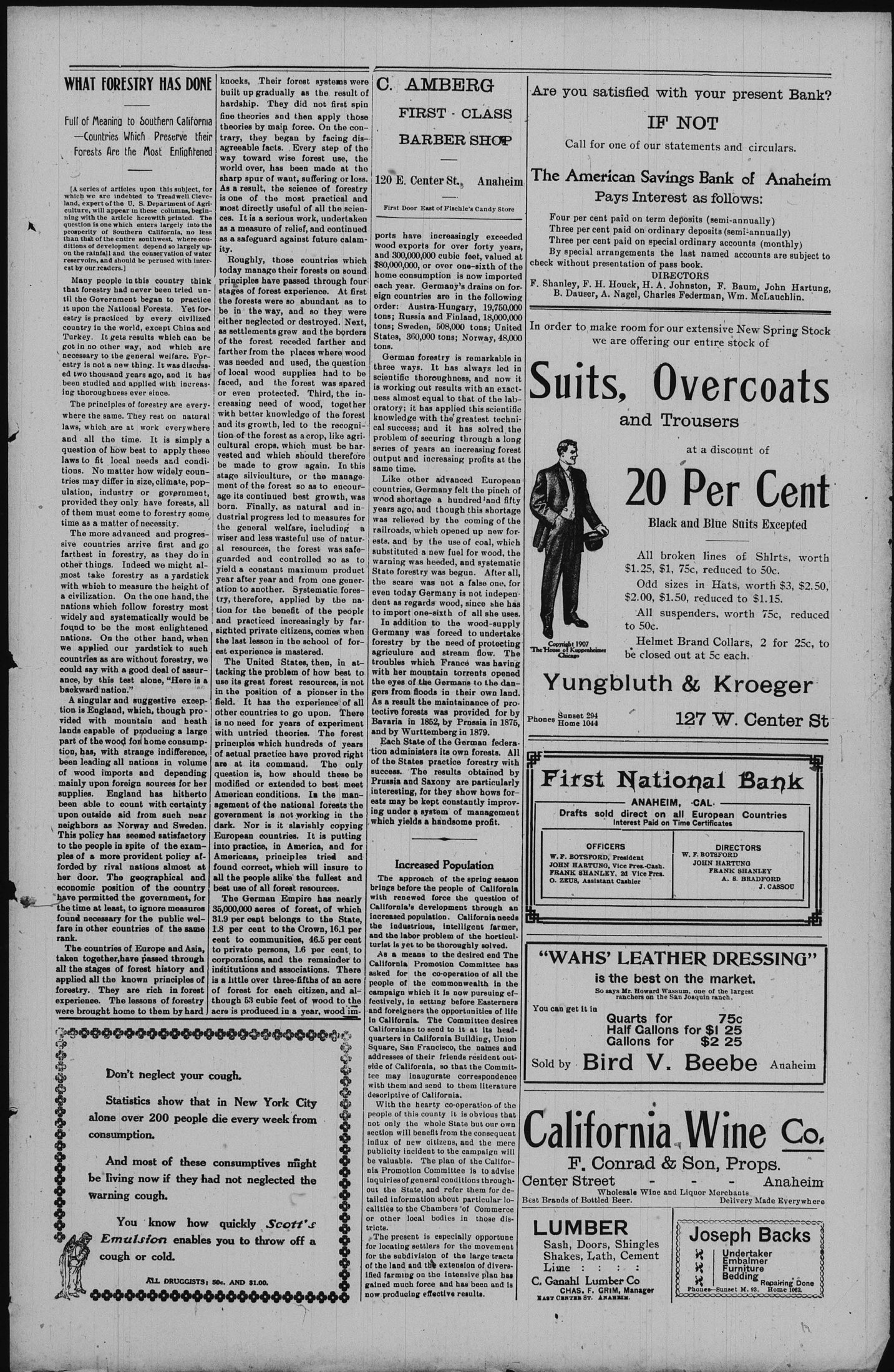
Searchable text
WHAT FORESTRY HAS DONE
Full of Meaning to Southern California
—Countries Which Preserve their Forests Are the Most Enlightened
[A series of articles upon this subject, for which we are indebted to Treadwell Cleveland, expert of the U. S. Department of Agriculture, will appear in these columns, beginning with the article herewith printed. The question is one which enters largely into the prosperity of Southern California, no less than that of the entire southwest, where conditions of development depend so largely upon the rainfall and the conservation of water reservoirs, and should be perused with interest by our readers.]
Many people in this country think that forestry had never been tried until the Government began to practice it upon the National Forests. Yet forestry is practiced by every civilized country in the world, except China and Turkey. It gets results which can be got in no other way, and which are necessary to the general welfare. Forestry is not a new thing. It was discussed two thousand years ago, and it has been studied and applied with increasing thoroughness ever since.
The principles of forestry are everywhere the same. They rest on natural laws, which are at work everywhere and all the time. It is simply a question of how best to apply these laws to fit local needs and conditions. No matter how widely countries may differ in size, climate, population, industry or government, provided they only have forests, all of them must come to forestry some knocks, Their forest systems built up gradually as the hardship. They did not fine theories and then apply theories by main force. On trary, they began by fact agreeable facts. Every step toward wise forest world over, has been made sharp spur of want, suffering As a result, the science of forest is one of the most practical most directly useful of all the cases. It is a serious work, unceasely as a measure of relief, and coas as a safeguard against future city.
Roughly, those countries today manage their forests on principles have passed through stages of forest experience. The forests were so abundant be in the way, and so the either neglected or destroyed as settlements grew and the of the forest receded farther from the places where was needed and used, the oo of local wood supplies had faced, and the forest was or even protected. Third, creasing need of wood, with better knowledge of the and its growth, led to the ntion of the forest as a crop, life cultural crops, which must invested and which should th be made to grow again. stage silviculture, or the ment of the forest so as to age its continued best grown born. Finally, as natural
The principles of forestry are everywhere the same. They rest on natural laws, which are at work everywhere and all the time. It is simply a question of how best to apply these laws to fit local needs and conditions. No matter how widely countries may differ in size, climate, population, industry or government, provided they only have forests, all of them must come to forestry some time as a matter of necessity.
The more advanced and progressive countries arrive first and go farthest in forestry, as they do in other things. Indeed we might almost take forestry as a yardstick with which to measure the height of a civilization. On the one hand, the nations which follow forestry most widely and systematically would be found to be the most enlightened nations. On the other hand, when we applied our yardstick to such countries as are without forestry, we could say with a good deal of assurance, by this test alone, "Here is a backward nation."
A singular and suggestive exception is England, which, though provided with mountain and heath lands capable of producing a large part of the wood for home consumption, has, with strange indifference, been leading all nations in volume of wood imports and depending mainly upon foreign sources for her supplies. England has hitherto been able to count with certainty upon outside aid from such near neighbors as Norway and Sweden. This policy has seemed satisfactory to the people in spite of the examples of a more provident policy afforded by rival nations almost at her door. The geographical and economic position of the country have permitted the government, for the time at least, to ignore measures found necessary for the public welfare in other countries of the same rank.
The countries of Europe and Asia, taken together, have passed through all the stages of forest history and creasing need of wood, with better knowledge of the land and its growth, led to the creation of the forest as a crop, life-cultural crops, which must be invested and which should then be made to grow again. The stage silviculture, or the management of the forest so as to age its continued best growth born. Finally, as natural industrial progress led to measures the general welfare, including wiser and less wasteful use of resources, the forest was guarded and controlled so yield a constant maximum year after year and from anotheration to another. Systematic try, therefore, applied by the tion for the benefit of the land and practiced increasingly by sighted private citizens, comes the last lesson in the school of best experience is mastered.
The United States, then, tacking the problem of how to use its great forest resources in the position of a pioneer field. It has the experience of other countries to go upon. It is no need for years of experiment with untried theories. The principles which hundreds of actual practice have proved are at its command. The question is, how should the modified or extended to best American conditions. In the agement of the national forest government is not working dark. Nor is it slavishly coEuropean countries. It is put into practice, in America, and Americans, principles tried found correct, which will insure all the people alike the fullest best use of all forest resources.
The German Empire has 35,000,000 acres of forest, of 31.9 per cent belongs to the 1.8 per cent to the Crown, 1.6 cent to communities, 46.5 per to private persons, 1.6 per corporation, and the remain institutions and associations.
forded by rival nations almost at her door. The geographical and economic position of the country have permitted the government, for the time at least, to ignore measures found necessary for the public welfare in other countries of the same rank.
The countries of Europe and Asia, taken together, have passed through all the stages of forest history and applied all the known principles of forestry. They are rich in forest experience. The lessons of forestry were brought home to them by hard
Don't neglect your cough.
Statistics show that in New York City alone over 200 people die every week from consumption.
And most of these consumptives might be living now if they had not neglected the warning cough.
You know how quickly Scott's Emulsion enables you to throw off a cough or cold.
ALL DRUGGISTS; 50c. AND $1.00.
Their forest systems were gradually as the result of
They did not first spin
ries and then apply those
by main force. On the conly began by facing disfacts. Every step of the
ward wise forest use, the
has been made at the
of want, suffering or loss.
the science of forestry
the most practical and
tly useful of all the scienserious work, undertaken
re of relief, and continued
hard against future calam-
, those countries which
age their forests on sound
have passed through four
forest experience. At first
were so abundant as to
way, and so they were
ected or destroyed. Next,
points grew and the borders
rest receded farther and
from the places where wood
and used, the question
food supplies had to be
the forest was spared
protected. Third, the inneed of wood, together
knowledge of the forest
growth, led to the recogniforest as a crop, like agrirops, which must be harwhich should therefore
to grow again. In this
culture, or the manageforest so as to encournued best growth, was
ally, as natural and in-
C. AMBERG
FIRST - CLASS
BARBER SHOP
120 E. Center St. Anaheim
First Door East of Fischle's Candy Store
ports have increasingly exceeded wood exports for over forty years,
and 300,000,000 cubic feet, valued at $80,000,000, or over one-sixth of the home consumption is now imported each year. Germany's drains on foreign countries are in the following order: Austra-Hungary, 19,750,000 tons; Russia and Finland, 18,000,000 tons; Sweden, 508,000 tons; United States, 360,000 tons; Norway, 48,000 tons.
German forestry is remarkable in three ways. It has always led in scientific thoroughness, and now it is working out results with an exactness almost equal to that of the laboratory; it has applied this scientific knowledge with the greatest technical success; and it has solved the problem of securing through a long series of years an increasing forest output and increasing profits at the same time.
Like other advanced European countries, Germany felt the pinch of wood shortage a hundred and fifty years ago, and though this shortage
need of wood, together with knowledge of the forest growth, led to the recognition of forest as a crop, like agri- crops, which must be hardened which should therefore grow again. In this culture, or the management of the forest so as to encourage best growth, was really, as natural and in-progress led to measures for social welfare, including a less wasteful use of nature, the forest was safe and controlled so as to prevent maximum product loss and from one genera- other. Systematic foresture, applied by the native benefit of the people increased increasingly by far-vate citizens, comes when soon in the school of force is mastered.
United States, then, in at- problem of how best to meet forest resources, is notation of a pioneer in the field as the experience of all societies to go upon. There are years of experiment and theories. The forest which hundreds of years practice have proved right in command. The only way how should these be extended to best meet conditions. In the man- the national forests the forest is not working in the country is it slavishly copying countries. It is putting aside, in America, and for principles tried and act, which will insure to alike the fullest and all forest resources.
Human Empire has nearly forests of forest, of which it belongs to the State, but to the Crown, 16.1 per cent communities, 46.5 per cent persons, 1.6 per cent to, and the remainder to and associations. It has applied this scientific knowledge with the greatest technical success; and it has solved the problem of securing through a long series of years an increasing forest output and increasing profits at the same time.
Like other advanced European countries, Germany felt the pinch of wood shortage a hundred and fifty years ago, and though this shortage was relieved by the coming of the railroads, which opened up new forests, and by the use of coal, which substituted a new fuel for wood, the warning was heeded, and systematic State forestry was begun. After all, the scare was not a false one, for even today Germany is not independent as regards wood, since she has to import one-sixth of all she uses.
In addition to the wood-supply Germany was forced to undertake forestry by the need of protecting agriculture and stream flow. The troubles which France was having with her mountain torrents opened the eyes of the Germans to the dangers from floods in their own land. As a result the maintenance of protective forests was provided for by Bavaria in 1852, by Prussia in 1875, and by Wurttemberg in 1879.
Each State of the German federation administers its own forests. All of the States practice forestry with success. The results obtained by Prussia and Saxony are particularly interesting, for they show how forests may be kept constantly improving under a system of management which yields a handsome profit.
Increased Population
The approach of the spring season brings before the people of California with renewed force the question of California's development through an increased population. California needs the industrious, intelligent farmer, and the labor problem of the horticulturalist is yet to be thoroughly solved.
As a means to the desired end The California Promotion Committee has
Increased Population
The approach of the spring season brings before the people of California with renewed force the question of California's development through an increased population. California needs the industrious, intelligent farmer, and the labor problem of the horticulturist is yet to be thoroughly solved.
As a means to the desired end The California Promotion Committee has asked for the co-operation of all the people of the commonwealth in the campaign which it is now pursuing effectively, in setting before Easterners and foreigners the opportunities of life in California. The Committee desires Californians to send to it at its headquarters in California Building, Union Square, San Francisco, the names and addresses of their friends resident outside of California, so that the Committee may inaugurate correspondence with them and send to them literature descriptive of California.
With the hearty co-operation of the people of this county it is obvious that not only the whole State but our own section will benefit from the consequent influx of new citizens, and the mere publicity incident to the campaign will be valuable. The plan of the California Promotion Committee is to advise inquiries of general conditions throughout the State, and refer them for detailed information about particular localities to the Chambers of Commerce or other local bodies in those districts.
The present is especially opportune for locating settlers for the movement for the subdivision of the large tracts of the land and the extension of diversified farming on the intensive plan has gained much force and has been and is now producing effective results.
you satisfied with your present Bank?
IF NOT
Call for one of our statements and circulars.
American Savings Bank of Anaheim
Pays Interest as follows:
our per cent paid on term deposits (semi-annually)
three per cent paid on ordinary deposits (semi-annually)
three per cent paid on special ordinary accounts (monthly)
by special arrangements the last named accounts are subject to without presentation of pass book.
DIRECTORS
Hanley, F. H. Houck, H. A. Johnston, F. Baum, John Hartung,
E. Dauser, A. Nagel, Charles Federman, Wm. McLauchlin.
For to make room for our extensive New Spring Stock
we are offering our entire stock of
uits, Overcoats
and Trousers
at a discount of
20 Per Cent
and Trousers
at a discount of
20 Per Cent
Black and Blue Suits Excepted
All broken lines of Shlrts, worth $1.25, $1, 75c, reduced to 50c.
Odd sizes in Hats, worth $3, $2.50,
$2.00, $1.50, reduced to $1.15.
All suspenders, worth 75c, reduced
to 50c.
Helmet Brand Collars, 2 for 25c, to
be closed out at 5c each.
ungbluth & Kroeger
Sunset 294
Home 1044
127 W. Center St
first National Bank
ANAHEIM, CAL.
Drafts sold direct on all European Countries
Interest Paid on Time Certificates
OFFICERS
F. BOTSFORD, President
JOHN HARTUNG, Vice Pres.-Cash.
ANK SHANLEY, 2d Vice Pres.
ZEUS, Assistant Cashier
DIRECTORS
W. F. BOTSFORD
JOHN HARTUNG
FRANK SHANLEY
A. S. BRADFORD
J. CASSOU
VAHS' LEATHER DRESSING"
WAHS' LEATHER DRESSING"
is the best on the market.
So says Mr. Howard Wassum, one of the largest
ranchers on the San Joaquin ranch.
Quarts for 75c
Half Gallons for $1 25
Gallons for $2 25
by Bird V. Beebe Anaheim
California Wine Co.
F. Conrad & Son, Props.
For Street - Anaheim
Wholesale Wine and Liquor Merchants
Bands of Bottled Beer.
Delivery Made Everywhere
Joseph Backs
Undertaker
Embalmer
Furniture
Bedding
Repairing Done
Phones—Sunset M. 93. Home 1062.