anaheim-gazette 1908-01-16
Scanned page
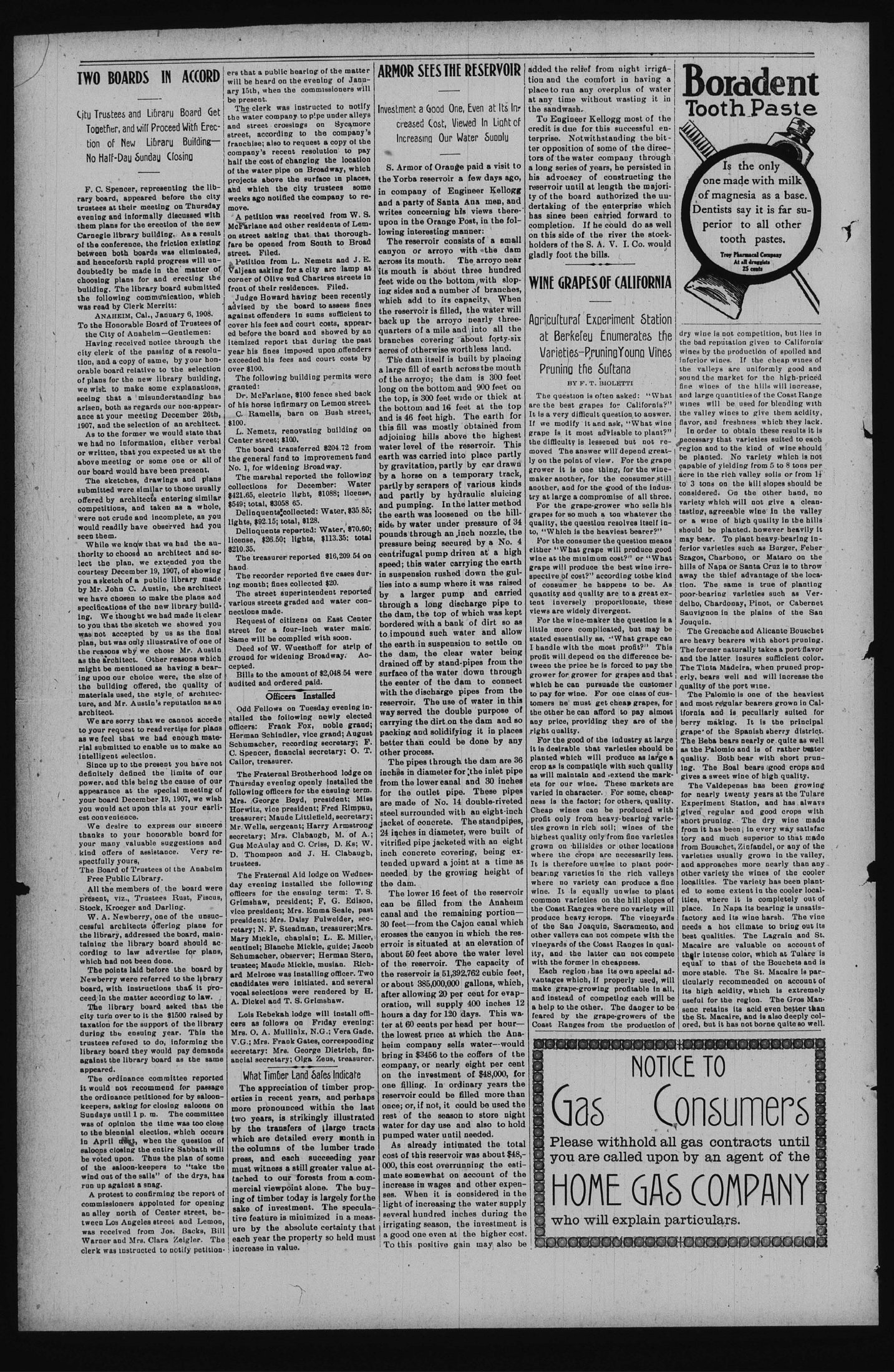
Searchable text
TWO BOARDS IN ACCORD
City Trustees and Library Board Get Together, and will Proceed With Erection of New Library Building—No Half-Day Sunday Closing
F. C. Spencer, representing the library board, appeared before the city trustees at their meeting on Thursday evening and informally discussed with them plans for the erection of the new Carnegie library building. As a result of the conference, the friction existing between both boards was eliminated, and henceforth rapid progress will undoubtedly be made in the matter of choosing plans for and erecting the building. The library board submitted the following communication, which was read by Clerk Merritt:
ANAHEIM, Cal., January 6, 1908.
To the Honorable Board of Trustees of the City of Anaheim—Gentlemen:
Having received notice through the city clerk of the passing of a resolution, and a copy of same, by your honorable board relative to the selection of plans for the new library building, we wish to make some explanations, seeing that a misunderstanding has arisen, both as regards our non-appearance at your meeting December 26th, 1907, and the selection of an architect.
As to the former we would state that we had no information, either verbal or written, that you expected us at the above meeting or some one or all of our board would have been present.
The sketches, drawings and plans submitted were similar to those usually offered by architects entering similar competitions, and taken as a whole,
ers that a public hearing of this will be heard on the evening of January 15th, when the commission be present.
The clerk was instructed to the water company to pipe unseen street crossings on street, according to the franchise; also to request a company’s recent resolution half the cost of changing the of the water pipe on Broadway projects above the surface and which the city trustee weeks ago notified the company move.
A petition was received from McFarlane and other residents on street asking that that fare be opened from South Street. Filed.
Petition from L. Nemetz Valjean asking for a city area corner of Olive and Chartres front of their residences. Filed.
Judge Howard having been advised by the board to as against offenders in sums su cover his fees and court cost ed before the board and short itemized report that during year his fines imposed upon exceeded his fees and court over $100.
The following building per granted:
Dr. McFarlane, $100 fence of his horse infirmary on Lenox.
C. Ramella, barn on Buckley $100.
L. Nemetz, renovating Center street; $100.
The board transferred $200 the general fund to improve No. 1, for widening Broadway.
The marshal reported the collections for December $421.65, electric light, $108.54; total, $3058 65.
arisen, both as regards our non-appearance at your meeting December 26th, 1907, and the selection of an architect.
As to the former we would state that we had no information, either verbal or written, that you expected us at the above meeting or some one or all of our board would have been present.
The sketches, drawings and plans submitted were similar to those usually offered by architects entering similar competitions, and taken as a whole, were not crude and incomplete, as you would readily have observed had you seen them.
While we know that we had the authority to choose an architect and select the plan, we extended you the courtesy December 19, 1907, of showing you a sketch of a public library made by Mr. John C. Austin, the architect we have chosen to make the plans and specifications of the new library building. We thought we had made it clear to you that the sketch we showed you was not accepted by us as the final plan, but was only illustrative of one of the reasons why we chose Mr. Austin as the architect. Other reasons which might be mentioned as having a bearing upon our choice were, the size of the building offered, the quality of materials used, the style of architecture, and Mr. Austin's reputation as an architect.
We are sorry that we cannot accede to your request to readvertise for plans as we feel that we had enough material submitted to enable us to make an intelligent selection.
Since up to the present you have not definitely defined the limits of our power, and this being the cause of our appearance at the special meeting of your board December 19, 1907, we wish you would act upon this at your earliest convenience.
We desire to express our sincere thanks to your honorable board for your many valuable suggestions and kind offers of assistance. Very respectfully yours,
The Board of Trustees of the Anabeim Free Public Library.
All the members of the board were present, viz., Trustees Rust, Fiscus, Stock, Kroeger and Darling.
W. A. Newberry, one of the unsuccessful architects offering plans for the library, addressed the board, maintaining the library board should according to law advertise for plans, which had not been done.
The points laid before the board by
The Board of Trustees of the Anabeim Free Public Library.
All the members of the board were present, viz., Trustees Rust, Fiscus, Stock, Kroeger and Darling.
W. A. Newberry, one of the unsuccessful architects offering plans for the library, addressed the board, maintaining the library board should according to law advertise for plans, which had not been done.
The points laid before the board by Newberry were referred to the library board, with instructions that it proceed in the matter according to law.
The library board asked that the city turn over to it the $1500 raised by taxation for the support of the library during the ensuing year. This the trustees refused to do, informing the library board they would pay demands against the library board as the same appeared.
The ordinance committee reported it would not recommend for passage the ordinance petitioned for by saloon-keepers, asking for closing saloons on Sundays until 1 p.m. The committee was of opinion the time was too close to the biennial election, which occurs in April next, when the question of saloons closing the entire Sabbath will be voted upon. Thus the plan of some of the saloon-keepers to "take the wind out of the sails" of the drys, has run up against a snag.
A protest to confirming the report of commissioners appointed for opening an alley north of Center street, between Los Angeles street and Lemon, was received from Jos. Backs, Bill Warner and Mrs. Clara Zeigler. The clerk was instructed to notify petition-
The Fraternal Aid lodge on day evening installed the officers for the ensuing term Grimshaw, president; F. C. vice president; Mrs. Emma S. president; Mrs. Daisy Fulwer retary; N. F. Steadman, treasurer; Mary Mickle, chaplain; L. sentinel; Blanche Mickle, guerrillaacher, observer; Herr trustee; Maude Mickle, muskard Melrose was installing candidates were initiated. A vocal selections were rendered A. Dickel and T. S. Grimshaw.
Lois Rebekah lodge will accept as follows on Friday: Mrs. O. A. Mullinix, N.G.; V.G.; Mrs. Frank Gates, corp secretary: Mrs. George Diess financial secretary; Olga Zeus.
What Timber Land Sales
The appreciation of timber esties in recent years, and more pronounced within two years, is strikingly by the transfers of land which are detailed every column of the lumber press, and each succeed must witness a still greater tached to our forests from mercial viewpoint alone. The ing of timber today is large sake of investment. The tive feature is minimized by the absolute cert each year the property so increase in value.
The public hearing of the matter heard on the evening of Janury when the commissioners will attend.
Work was instructed to notify the company to pipe under alleys set crossings on Sycamore according to the company's recent resolution to pay cost of changing the location water pipe on Broadway, which above the surface in places such the city trustees some notified the company to relation was received from W. S. Hale and other residents of Lemasking that that thorough-opened from South to Broad Filed.
From L. Nemetz and J. E. asking for a city arc lamp at Olive and Chartres streets in their residences. Filed.
Howard having been recently by the board to assess fines offenders in sums sufficient to fees and court costs, appear the board and showed by an report that during the past fines imposed upon offenders his fees and court costs by allowing building permits were Farlane, $100 fence shed back house infirmary on Lemon street. Nella, barn on Bush street, Netz, renovating building on street; $100.
Bard transferred $204.72 from general fund to improvement fund for widening Broadway.
Marshal reported the following as for December: Water electric light, $1088; license, l., $3058 65.
Armor sees the reservoir
Investment a Good One, Even at Its Increased Cost, Viewed In Light of Increasing Our Water Supply
S. Armor of Orange paid a visit to the Yorba reservoir a few days ago, in company of Engineer Kellogg and a party of Santa Ana men, and writes concerning his views thereupon in the Orange Post, in the following interesting manner:
The reservoir consists of a small canyon or arroyo with the dam across its mouth. The arroyo near its mouth is about three hundred feet wide on the bottom with sloping sides and a number of branches, which add to its capacity. When the reservoir is filled, the water will back up the arroyo nearly three-quarters of a mile and into all the branches covering about forty-six acres of otherwise worthless land.
The dam itself is built by placing a large fill of earth across the mouth of the arroyo; the dam is 300 feet long on the bottom and 900 feet on the top, is 300 feet wide or thick at the bottom and 16 feet at the top and is 46 feet high. The earth for this fill was mostly obtained from adjoining hills above the highest water level of the reservoir. This earth was carried into place partly by gravitation, partly by car drawn by a horse on a temporary track, partly by scrapers of various kinds and partly by hydraulic sluicing and pumping. In the latter method added the relief from night tion and the comfort in a place to run any overplus at any time without waste the sandwash.
To Engineer Kellogg my credit is due for this success terprise. Notwithstanding ter opposition of some of the water company a long series of years, he p his advocacy of construc reservoir until at length th ty of the board authorize dertaking of the enterprise has since been carried for completion. If he could on this side of the river holders of the S. A. V. I. gladly foot the bills.
WINE GRAPES OF CALIFORNIA
Agricultural Experiment at Berkeley Enumeration Varieties—Pruning Your Pruning the Suitana
BY F. T. BIOLETTI
The question is often asked are the best grapes for C It is a very difficult question If we modify it and ask, "grape is it most advisable the difficulty is lessened but moved The answer will dep ly on the point of view. For grower it is one thing, for maker another, for the con another, and for the good o try at large a compromise o For the grape-grower wh
their innermary on Lemon street.
quella, barn on Bush street,
zetz, renovating building on
street; $100.
hard transferred $204.72 from
local fund to improvement fund
for widening Broadway.
marshal reported the following
uses for December: Water
electric light, $1088; license,
$3058 65.
quents collected: Water, $35.85;
12.15; total, $128.
quents reported: Water, $70.60;
$26.50; lights, $113.35; total
reasurer reported $16,209.54 on
order reported five cases durth; fines collected $20.
street superintendent reported
streets graded and water conmade.
set of citizens on East Center
for a four-inch water main.
will be complied with soon.
of W. Wuesthoff for strip of
for widening Broadway. According to the amount of $2,048.54 were
and ordered paid.
Officers Installed
follows on Tuesday evening in
the following newly elected
Frank Fox, noble grand;
Schindler, vice grand; August
other, recording secretary; F.
fer, financial secretary; O. T.
reasurer.
external Brotherhood lodge on
day evening openly installed the
officers for the ensuing term.
George Boyd, president; Miss
service president; Fred Rimpau,
er; Maude Littlefield, secretary;
sergeant; Harry Armstrong;
Mrs. Clabaugh, M. of A.;
Bulay and C. Criss, D. Ks; W.
Jenson and J. H. Clabaugh,
external Aid lodge on Wednesning installed the following
for the ensuing term: T. S.
Saw, president; F, G. Edison,
ident; Mrs. Emma Seale, past;
Mrs. Daisy Fulweider, secL. F. Steadman, treasurer; Mrs.
Stekle, chaplain; L. E. Miller,
Blanche Mickle, guide; Jacob
other, observer; Herman Stern,
Maude Mickle, musian. Rich-
Aaternal Aid lodge on Wednesning installed the following
for the ensuing term: T. S.
Law, president; F, G. Edison,
president; Mrs. Emma Seale, past
attent; Mrs. Daisy Fulweider, sector; M. F. Steadman, treasurer; Mrs.
Bekle, chaplain; L. E. Miller,
Blanche Mickle, guide; Jacob
other, observer; Herman Stern,
Maude Mickle, musian. Richrose was installing officer. Two
sites were initiated, and several
sections were rendered by H.
Hel and T. S. Grlmshaw.
Timber Land Sales Indicate
Appreciation of timber proprecent years, and perhaps
pronounced within the last
years, is strikingly illustrated
by transfers of large tracts
are detailed every month in
umns of the lumber trade
and each succeeding year
witness a still greater value atto our forests from a comviewpoint alone. The buytimber today is largely for the
investment. The speculature is minimized in a measuthe absolute certainty that
ear the property so held must
be in value.
The lower 16 feet of the reservoir
can be filled from the Anaheim
canal and the remaining portion—30 feet—from the Cajon canal which crosses the canyon in which the reservoir is situated at an elevation of about 50 feet above the water level of the reservoir. The capacity of the reservoir is 51,392,762 cubic feet,
or about 385,000,000 gallons, which,
after allowing 20 per cent for evaporation, will supply 400 inches 12 hours a day for 120 days. This water at 60 cents per head per hour—the lowest price at which the Anaheim company sells water—would bring in $3456 to the coffers of the company, or nearly eight per cent on the investment of $48,000, for one filling. In ordinary years the reservoir could be filled more than once; or, if not, it could be used the rest of the season to store night water for day use and also to hold pumped water until needed.
As already intimated the total cost of this reservoir was about $48,-000, this cost overrunning the estimate somewhat on account of the increase in wages and other expenses. When it is considered in the light of increasing the water supply several hundred inches during the irrigating season, the investment is a good one even at the higher cost. To this positive gain may also be
It is therefore unwise to bear varieties in the river where no variety can produce wine. It is equally unwieldy common varieties on the bank of the Coast Ranges where no produce heavy crops. The of the San Joaquin, Sacramento valleys can not compete vineyards of the Coast Ranges city, and the latter can with the former in cheapne.
Each region has its own vantages which, if properly made grape-growing profit and instead of competing with a help to the other. The de-feared by the grape-grower Coast Ranges from the pr
Boradent Tooth Paste
Is the only one made with milk of magnesia as a base. Dentists say it is far superior to all other tooth pastes.
Troy Pharmacal Company
At all druggists
25 cents
GRAPES OF CALIFORNIA
Natural Experiment Station Berkeley Enumerates theeties—PruningYoung Vines during the Sultana
BY F. T. BIOLETTI
Question is often asked: "What best grapes for California?" A very difficult question to answer. Modify it and ask, "What wine is most advisable to plant?" Result is lessened but not re-The answer will depend greatly point of view. For the grape it is one thing, for the wine another, for the consumer still and for the good of the industry a compromise of all three. The grape-grower who sells his dry wine is not competition, but lies in the bad reputation given to California wines by the production of spoiled and inferior wines. If the cheap wines of the valleys are uniformly good and sound the market for the high-priced fine wines of the hills will increase, and large quantities of the Coast Range wines will be used for blending with the valley wines to give them acidity, flavor, and freshness which they lack.
In order to obtain these results it is necessary that varieties suited to each region and to the kind of wine should be planted. No variety which is not capable of yielding from 5 to 8 tons per acre in the rich valley soils or from 14 to 3 tons on the hill slopes should be considered. On the other hand, no variety which will not give a clean-tasting agreeable wine in the valley
best grapes for California? Very difficult question to answer. Modify it and ask, "What wine is it most advisable to plant?"ulty is lessened but not re-The answer will depend great-point of view. For the grape it is one thing, for the wine-mother, for the consumer still and for the good of the industry a compromise of all three. The grape-grower who sells his or so much a ton whatever the question resolves itself in which is the heaviest bearer?"
The consumer the question means What grape will produce good the minimum cost? or "What will produce the best wine irre-Of cost?" according to the kind farmer he happens to be. As and quality are to a great ex-versely proportionate, these are widely divergent.
The wine-maker the question is a more complicated, but may be essentially as. "What grape can be with the most profit?" This will depend on the difference between price he is forced to pay the grower for grapes and that he can pursue the customer for wine. For one class of cus-One must get cheap grapes, for he can afford to pay almost once, providing they are of the quality.
The good of the industry at large variable that varieties should be which will produce as large as compatible with such quality maintain and extend the markour wine. These markets are in character. For some, cheap-the factor; for others, quality. Wines can be produced with only from heavy-bearing variewn in rich soil; wines of the quality only from fine varieties on hillsides or other locations the crops are necessarily less. Therefore unwise to plant poor-varieties in the rich valleys no variety can produce a fine it is equally unwise to plant varieties on the hill slopes of most Ranges where no variety will heavy crops. The vineyards San Joaquin, Sacramento, and valleys can not compete with the kinds of the Coast Ranges in qual-ld the latter can not compete with former in cheapness.
wines will be used for blending with the valley wines to give them acidity, flavor, and freshness which they lack.
In order to obtain these results it is necessary that varieties suited to each region and to the kind of wine should be planted. No variety which is not capable of yielding from 5 to 8 tons per acre in the rich valley soils or from 14 to 3 tons on the hill slopes should be considered. On the other hand, no variety which will not give a cleantasting, agreeable wine in the valley or a wine of high quality in the hills should be planted. however heavily it may bear. To plant heavy-bearing inferior varieties such as Burger, Feher Szagos, Charbono, or Mataro on the hills of Napa or Santa Cruz is to throw away the thief advantage of the location. The same is true of planting poor-bearing varieties such as Verdelho, Chardonay, Pinot, or Cabernet Sauvignon in the plains of the San Jouquin.
The Grenache and Alicante Bouschet are heavy bearers with short pruning. The former naturally takes a port flavor and the latter insures sufficient color. The Tinta Madeira, when pruned properly, bears well and will increase the quality of the port wine.
The Palomio is one of the heaviest and most regular bearers grown in California and is peculiarly suited for berry making. It is the principal grape of the Spanish sherry district. The Beba bears nearly or quite as well as the Palomio and is of rather better quality. Both bear with short pruning. The Boal bears good crops and gives a sweet wine of high quality.
The Valdepenas has been growing for nearly twenty years at the Tulare Experiment Station, and has always given regular and good crops with short pruning. The dry wine made from it has been in every way satisfactory and much superior to that made from Bouschet, Zinfandel, or any of the varieties usually grown in the valley, and approaches more nearly than any other variety the wines of the cooler localities. The variety has been planted to some extent in the cooler localities, where it is completely out of place. In Napa its bearing is unsatisfactory and its wine harsh. The vine needs a hot climate to bring out its best qualities. The Lagrain and St. Macaire are valuable on account of their intense color, which at Tulare is equal to that of the Bouchets and is
NOTICE TO
Gas Consumers
Please withhold all gas contracts until you are called upon by an agent of the
HOME GAS COMPANY
who will explain particulars.