anaheim-gazette 1907-10-03
Scanned page
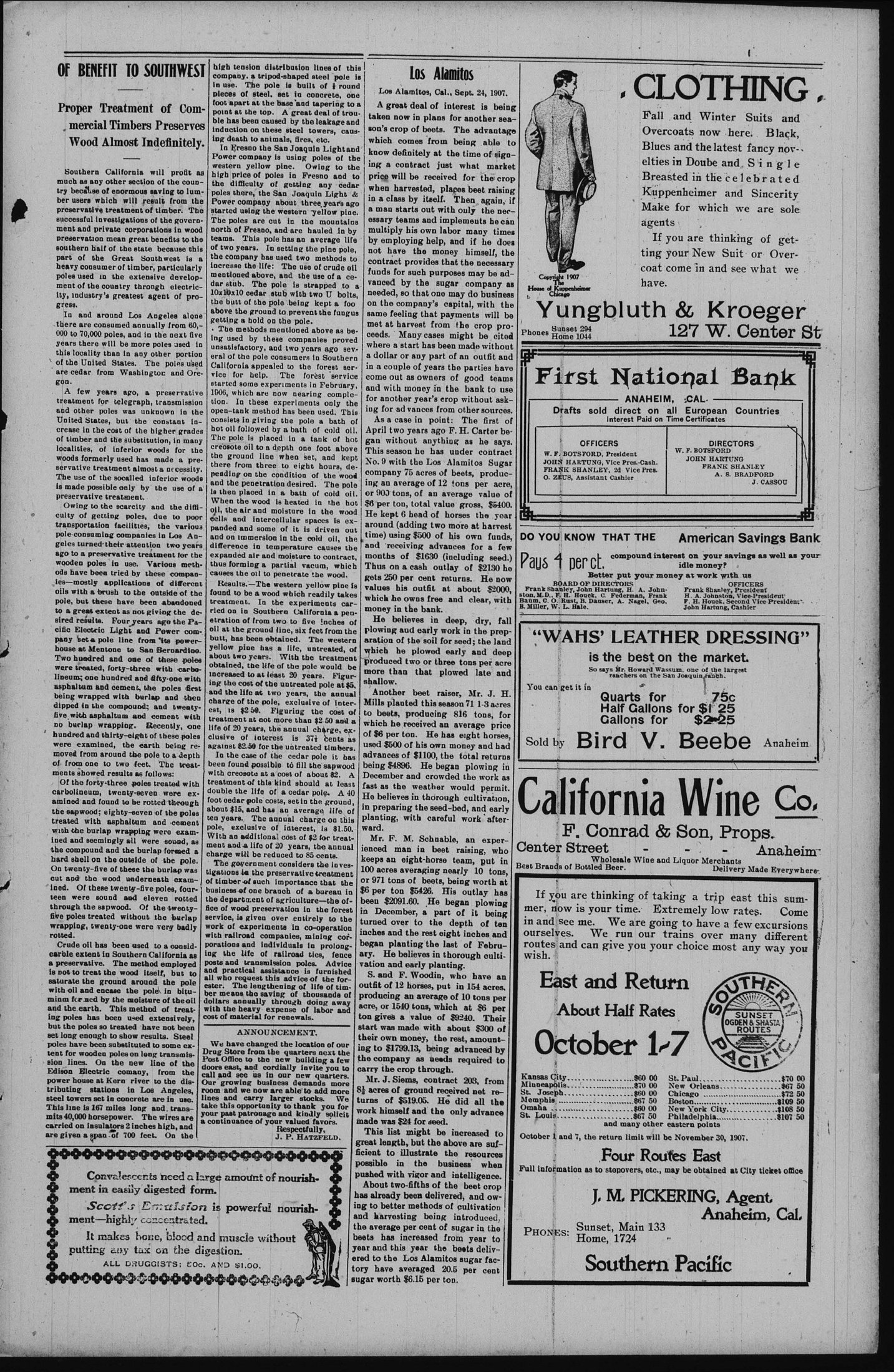
Searchable text
OF BENEFIT TO SOUTHWEST
Proper Treatment of Commercial Timbers Preserves Wood Almost Indefinitely.
Southern California will profit as much as any other section of the country because of enormous saving to lumber users which will result from the preservative treatment of timber. The successful investigations of the government and private corporations in wood preservation mean great benefits to the southern half of the state because this part of the Great Southwest is a heavy consumer of timber, particularly poles used in the extensive development of the country through electricity, industry's greatest agent of progress.
In and around Los Angeles alone there are consumed annually from 60,000 to 70,000 poles, and in the next five years there will be more poles used in this locality than in any other portion of the United States. The poles used are cedar from Washington and Oregon.
A few years ago, a preservative treatment for telegraph, transmission and other poles was unknown in the United States, but the constant increase in the cost of the higher grades of timber and the substitution, in many localities, of inferior woods for the woods formerly used has made a preservative treatment almost a necessity. The use of the socalled inferior woods is made possible only by the use of a preservative treatment.
Owing to the scarcity and the difficulty distribution lines company, a tripod-shaped steel point at the top. A great deal of trouble has been caused by the leakage induction on these steel towers ing death to animals, fires, etc.
In Fresno the San Joaquin Light Power company is using poles in western yellow pine. Owing to high price of poles in Fresno the difficulty of getting any poles there, the San Joaquin Light Power company about three years started using the western yellow. The poles are cut in the mountain north of Fresno, and are hauled to teams. This pole has an average of two years. In setting the pine the company has used two methods increase the life: The use of crucified mentioned above, and the use of dar stub. The pole is strapped 10x10x10 cedar stub with two U-shaped butt of the pole being kept above the ground to prevent getting a hold on the pole.
The methods mentioned above being used by these companies are unsatisfactory, and two years ago general of the pole consumers in Southern California appealed to the forest service for help. The forest staff started some experiments in February 1906, which are now nearing completion. In these experiments one open-tank method has been used consists in giving the pole a hot oil followed by a bath of colony. The pole is placed in a tank of creosote oil to a depth one foot from the ground line when set, and there from three to eight hours pacing on the condition of the oil and the penetration desired. The pole is then placed in a bath of colony. When the wood is heated in the oil, the air and moisture in the
and other poles was unknown in the United States, but the constant increase in the cost of the higher grades of timber and the substitution, in many localities, of inferior woods for the woods formerly used has made a preservative treatment almost necessary. The use of the so-called inferior woods is made possible only by the use of a preservative treatment.
Owing to the scarcity and the difficulty of getting poles, due to poor transportation facilities, the various pole-consuming companies in Los Angeles turned their attention two years ago to a preservative treatment for the wooden poles in use. Various methods have been tried by these companies—mostly applications of different oils with a brush to the outside of the pole, but these have been abandoned to a great extent as not giving the desired results. Four years ago the Pacific Electric Light and Power company set a pole line from its power-house at Mentone to San Bernardino. Two hundred and one of these poles were treated, forty-three with carbolineum; one hundred and fifty-one with asphaltum and cement, the poles first being wrapped with burlap and then dipped in the compound; and tweaty-five with asphaltum and cement with no burlap wrapping. Recently, one hundred and thirty-eight of these poles were examined, the earth being removed from around the pole to a depth of from one to two feet. The treatments showed results as follows:
Of the forty-three poles treated with carbolineum, twenty-seven were examined and found to be rotted through the sapwood; eighty-seven of the poles treated with asphaltum and cement with the burlap wrapping were examined and seemingly all were sound, as the compound and the burlap formed a hard shell on the outside of the pole. On twenty-five of these the burlap was cut and the wood underneath examined. Of these twenty-five poles, fourteen were sound and eleven rotted through the sapwood. Of the twenty-five poles treated without the burlap wrapping, twenty-one were very badly rotted.
Crude oil has been used to a considerable extent in Southern California as a preservative. The method employed
Results.—The western yellow pine found to be a wood which readily treatment. In the experiments tried on in Southern California an etration of from two to five inch oil at the ground line, six feet from butt, has been obtained. The yellow pine has a life, untreated about two years. With the treatment obtained, the life of the pole would increased to at least 20 years. Figuring the cost of the untreated pole and the life at two years, the annual charge of interest is 37 cents against $2.50 for the untreated time.
In the case of the cedar pole it been found possible to fill the sap with creosote at a cost of about $1 treatment of this kind should at double the life of a cedar pole-foot cedar pole costs, set in the great about $15, and has an average ten years. The annual charge of pole, exclusive of interest, is $2 With an additional cost of $2 for treatment and a life of 20 years, the annual charge will be reduced to 85 cents.
The government considers the implications in the preservative treat- of timber of such importance that business of one branch of a bureau-the department of agriculture—the face of wood preservation in the service, is given over entirely to work of experiments in co-op-with railroad companies, mining operations and individuals in pro-ing the life of railroad ties, posts and transmission poles.
On twenty-five of these the burlap was cut and the wood underneath examined. Of these twenty-five poles, fourteen were sound and eleven rotted through the sapwood. Of the twenty-five poles treated without the burlap wrapping, twenty-one were very badly rotted.
Crude oil has been used to a considerable extent in Southern California as a preservative. The method employed is not to treat the wood itself, but to saturate the ground around the pole with oil and encase the pole in bituminum formed by the moisture of the oil and the earth. This method of treating poles has been used extensively, but the poles so treated have not been set long enough to show results. Steel poles have been substituted to some extent for wooden poles on long transmission lines. On the new line of the Edison Electric company, from the power house at Kern river to the distributing stations in Los Angeles, steel towers set in concrete are in use. This line is 167 miles long and transmits 40,000 horsepower. The wires are carried on insulators 2 inches high, and are given a span of 700 feet. On the
ANNOUNCEMENT.
We have changed the location of Drug Store from the quarters next Post Office to the new building at doors east, and cordially invite you call and see us in our new quart Our growing business demands room and we now are able to add lines and carry larger stocks. Take this opportunity to thank your past patronage and kindly so a continuance of your valued favors.
Respectfully,
J. P. HATZFELT
Convalescents need a large amount of nourishment in easily digested form.
Scott's Emulsion is powerful nourishment—highly concentrated.
It makes bone, blood and muscle without putting any tax on the digestion.
ALL DRUGGISTS; 50c. AND $1.00.
Los Alamitos
Los Alamitos, Cal., Sept. 24, 1907.
A great deal of interest is being taken now in plans for another season's crop of beets. The advantage which comes from being able to know definitely at the time of signing a contract just what market price will be received for the crop when harvested, places beet raising in a class by itself. Then again, if a man starts out with only the necessary teams and implements he can multiply his own labor many times by employing help, and if he does not have the money himself, the contract provides that the necessary funds for such purposes may be advanced by the sugar company as needed, so that one may do business on the company's capital, with the same feeling that payments will be met at harvest from the crop proceeds. Many cases might be cited where a start has been made without a dollar or any part of an outfit and in a couple of years the parties have come out as owners of good teams and with money in the bank to use for another year's crop without asking for advances from other sources.
As a case in point: The first of April two years ago F. H. Carter began without anything as he says. This season he has under contract No. 9 with the Los Alamitos Sugar company 75 acres of beets, producing an average of 12 tons per acre, or 900 tons, of an average value of $6 per ton, total value gross, $5400.
As a case in point: The first of April two years ago F. H. Carter began without anything as he says. This season he has under contract No. 9 with the Los Alamitos Sugar company 75 acres of beets, producing an average of 12 tons per acre, or 900 tons, of an average value of $6 per ton, total value gross, $5400. He kept 6 head of horses the year around (adding two more at harvest time) using $500 of his own funds, and receiving advances for a few months of $1630 (including seed.) Thus on a cash outlay of $2130 he gets 250 per cent returns. He now values his outfit at about $2000, which he owns free and clear, with money in the bank.
He believes in deep, dry, fall plowing and early work in the preparation of the soil for seed; the land which he plowed early and deep produced two or three tons per acre more than that plowed late and shallow.
Another beet raiser, Mr. J. H. Mills planted this season 71 1-3 acres to beets, producing 816 tons, for which he received an average price of $6 per ton. He has eight horses, used $500 of his own money and had advances of $1100, the total returns being $4896. He began plowing in December and crowded the work as fast as the weather would permit. He believes in thorough cultivation, in preparing the seed-bed, and early planting, with careful work afterward.
Mr. F. M. Schnable, an experienced man in beet raising, who keeps an eight-horse team, put in 100 acres averaging nearly 10 tons, or 971 tons of beets, being worth at $6 per ton $5426. His outlay has been $2091.60. He began plowing in December, a part of it being turned over to the depth of ten inches and the rest eight inches and began planting the last of February. He believes in thorough cultivation and early planting.
DO YOU KNOW THAT
Pays 4 per ct.
Better put
BOARD OF DIRECTORS
Frank Shanley, John Hartung, Boston, M.D., F. H. Houck, C. Federmann Baum, C. O. Rust, B. Dauser, A. N.
B. Miller, W. L. Hale.
"WAHS' LEADER
is the b
So says Mr. B.
ranche
You can get it in
Quart
Half G
Gallon
Sold by Bird
California
F. Conra
Center Street
Wholesale
Best Brands of Bottled Beer.
If you are thinking mer, now is your time in and see me. We are ourselves. We run routes and can give you wish.
ment considers the investment preservative treatment which importance that the branch of a bureau in part of agriculture—the off-reservation in the forest on over entirely to theiments in co-operation companies, mining cor-individuals in prolong-of railroad ties, fence admission poles. Advice assistance is furnished this advice of the for-ghtening of life of tim-saving of thousands of days through doing away with expense of labor and for renewals.
RENOUNCEMENT.
Engaged the location of our farm in the quarters next the new building a few cordially invite you to visit in our new quarters. Business demands more now are able to add more larger stocks. Weunity to thank you for usage and kindly solicit your valued favors.
Respectfully,
J. P. HATZFELD.
of nourishful nourishwithout
100 acres averaging nearly 10 tons, or 971 tons of beets, being worth at $6 per ton $5426. His outlay has been $2091.60. He began plowing in December, a part of it being turned over to the depth of ten inches and the rest eight inches and began planting the last of February. He believes in thorough cultivation and early planting.
S. and F. Woodin, who have an outfit of 12 horses, put in 154 acres, producing an average of 10 tons per acre, or 1540 tons, which at $6 per ton gives a value of $9240. Their start was made with about $300 of their own money, the rest, amounting to $1799.13, being advanced by the company as needs required to carry the crop through.
Mr. J. Siems, contract 203, from 8½ acres of ground received net returns of $519.05. He did all the work himself and the only advance made was $24 for seed.
This list might be increased to great length, but the above are sufficient to illustrate the resources possible in the business when pushed with vigor and intelligence.
About two-fifths of the beet crop has already been delivered, and owing to better methods of cultivation and harvesting being introduced, the average per cent of sugar in the beets has increased from year to year and this year the beets delivered to the Los Alamitos sugar factory have averaged 20.5 per cent sugar worth $6.15 per ton.
CLOTHING
Fall and Winter Suits and Overcoats now here. Black, Blues and the latest fancy novelties in Doube and Single Breasted in the celebrated Kuppenheimer and Sincerity Make for which we are sole agents.
If you are thinking of getting your New Suit or Overcoat come in and see what we have.
Yungbluth & Kroeger
127 W. Center St
First National Bank
ANAHEIM, CAL.
crafts sold direct on all European Countries
Interest Paid on Time Certificates
OFFICERS
BOTSFORD, President
HARTUNG, Vice Pres.-Cash.
SHANLEY, 2d Vice Pres.
EUS, Assistant Cashier
DIRECTORS
W. F. BOTSFORD
JOHN HARTUNG
FRANK SHANLEY
A. S. BRADFORD
J. CASSOU
crafts sold direct on all European Countries
Interest Paid on Time Certificates
OFFICERS
BOTSFORD, President
HARTUNG, Vice Pres.-Cash.
SHANLEY, 2d Vice Pres.
EUS, Assistant Cashier
DIRECTORS
W. F. BOTSFORD
JOHN HARTUNG
FRANK SHANLEY
A. S. BRADFORD
J. CASSOU
KNOW THAT THE American Savings Bank compound interest on your savings as well as your idle money?
Better put your money at work with us
BOARD OF DIRECTORS
Shley, John Hartung, H. A. JohnH. Houck, C. Federman, Frank
Rust, B. Dauser, A. Nagel, Geo.
L. Hale.
OFFICERS
Frank Shanley, President
H. A. Johnston, Vice-President
F. H. Houck, Second Vice-President
John Hartung, Cashier
"AHS' LEATHER DRESSING"
is the best on the market.
So says Mr. Howard Wassum, one of the largest ranchers on the San Joaquin canch.
get it in
Quarts for $75c
Half Gallons for $125
Gallons for $2-25
by Bird V. Beebe Anaheim
California Wine Co.
F. Conrad & Son, Props.
Street Anaheim
Wholesale Wine and Liquor Merchants
of Bottled Beer.
Delivery Made Everywhere
You are thinking of taking a trip east this sumow is your time. Extremely low rates. Come see me. We are going to have a few excursionses. We run our trains over many differentand can give you your choice most any way you
you are thinking of taking a trip east this sumow is your time. Extremely low rates. Come
see me. We are going to have a few excursions
es. We run our trains over many different
and can give you your choice most any way you
East and Return
About Half Rates
October 1-7
City.....$60 00 St. Paul.....$70 00
Is.....$70 00 New Orleans.....$67 50
In.....$60 00 Chicago.....$72 50
In.....$67 50 Boston.....$109 50
In.....$60 00 New York City.....$108 50
In.....$67 50 Philadelphia.....$107 50
and many other eastern points
and 7, the return limit will be November 30, 1907.
Four Routes East
nation as to stopovers, etc., may be obtained at City ticket office
J. M. PICKERING, Agent,
Anaheim, Cal,
S: Sunset, Main 133
Home, 1724
Southern Pacific