anaheim-gazette 1907-09-26
Scanned page
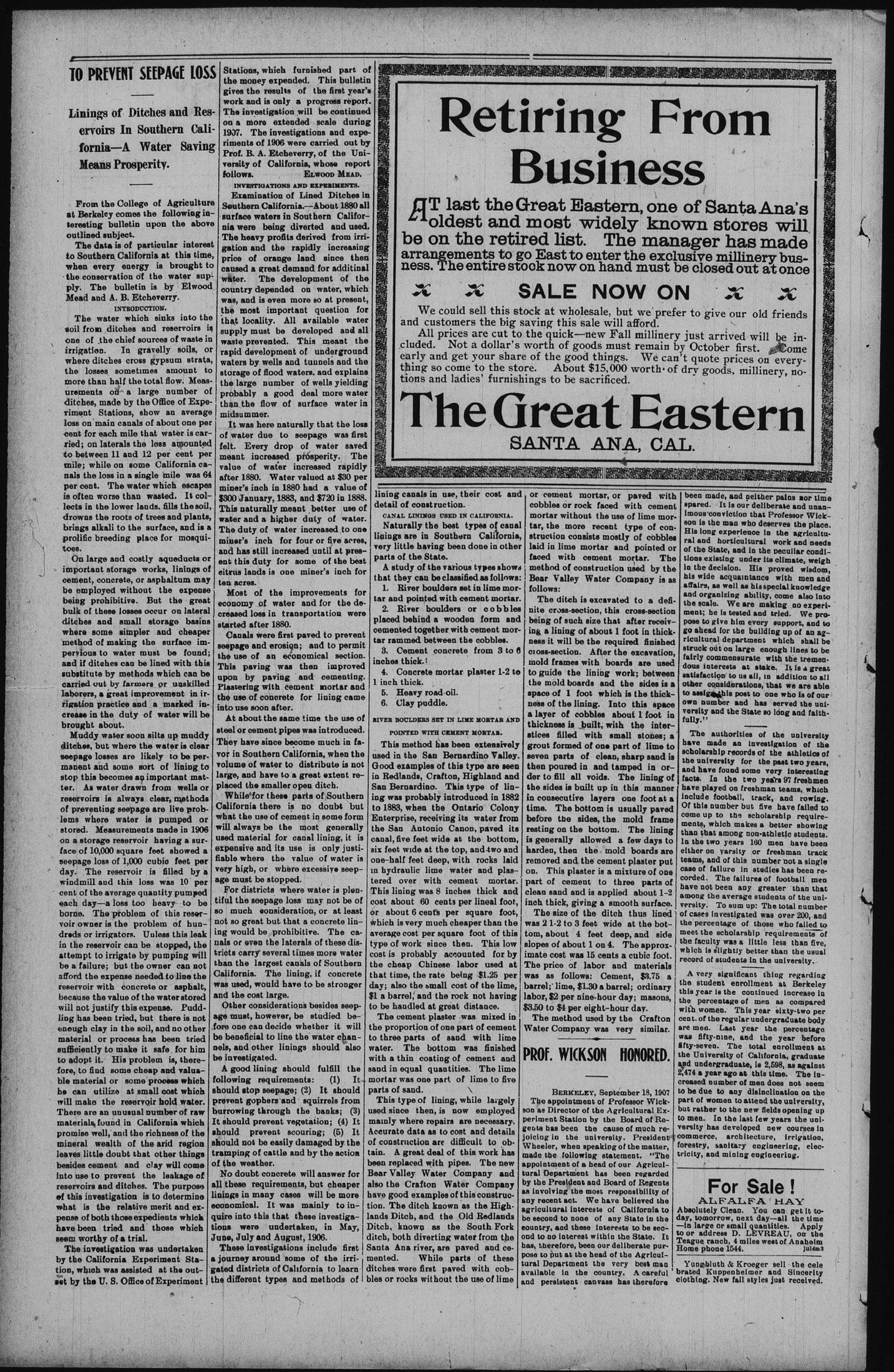
Searchable text
TO PREVENT SEEPAGE LOSS
Linings of Ditches and Reservoirs In Southern California—A Water Saving Means Prosperity.
From the College of Agriculture at Berkeley comes the following interesting bulletin upon the above outlined subject.
The data is of particular interest to Southern California at this time, when every energy is brought to the conservation of the water supply. The bulletin is by Elwood Mead and A. B. Etcheverry.
INTRODUCTION.
The water which sinks into the soil from ditches and reservoirs is one of the chief sources of waste in irrigation. In gravelly soils, or where ditches cross gypsum strata, the losses sometimes amount to more than half the total flow. Measurements on a large number of ditches, made by the Office of Experiment Stations, show an average loss on main canals of about one per cent for each mile that water is carried; on laterals the loss amounted to between 11 and 12 per cent per mile; while on some California canals the loss in a single mile was 64 per cent. The water which escapes is often worse than wasted. It collects in the lower lands, fills the soil, Stations, which furnished the money expended. This gives the results of the first work and is only a progress. The investigation will be conducted on a more extended scale 1937. The investigations and riments of 1906 were carried out by Prof. B. A. Etcheverry, of the University of California, whose follows.
INVESTIGATIONS AND EXPERIMENTS OF LINED DITCHES IN SOUTHERN CALIFORNIA.
About surface waters in Southern California were being diverted. The heavy profits derived from the rapid in price of orange land since caused a great demand for water. The development country depended on water was, and is even more so at the most important question locality. All available supply must be developed waste prevented. This meant rapid development of underwaters by wells and tunnels storage of flood waters, and the large number of wells probably a good deal more than the flow of surface midsummer.
It was here naturally that of water due to seepage felt. Every drop of water meant increased prosperity value of water increased after 1880. Water valued at miner's inch in 1880 had a $300 January, 1883, and $720 This naturally meant better
ment Stations, show an average loss on main canals of about one per cent for each mile that water is carried; on laterals the less amounted to between 11 and 12 per cent per mile; while on some California canals the loss in a single mile was 64 per cent. The water which escapes is often worse than wasted. It collects in the lower lands, fills the soil, drowns the roots of trees and plants, brings alkali to the surface, and is a prolific breeding place for mosquitoes.
On large and costly aqueducts or important storage works, linings of cement, concrete, or asphaltum may be employed without the expense being prohibitive. But the great bulk of these losses occur on lateral ditches and small storage basins where some simpler and cheaper method of making the surface impervious to water must be found; and if ditches can be lined with this substitute by methods which can be carried out by farmers or unskilled laborers, a great improvement in irrigation practice and a marked increase in the duty of water will be brought about.
Muddy water soon silts up muddy ditches, but where the water is clear seepage losses are likely to be permanent and some sort of lining to stop this becomes an important matter. As water drawn from wells or reservoirs is always clear, methods of preventing seepage are live problems where water is pumped or stored. Measurements made in 1906 on a storage reservoir having a surface of 10,000 square feet showed a seepage loss of 1,000 cubic feet per day. The reservoir is filled by a windmill and this loss was 10 per cent of the average quantity pumped each day—a loss too heavy to be borne. The problem of this reservoir owner is the problem of hundreds or irrigators. Unless this leak in the reservoir can be stopped, the attempt to irrigate by pumping will be a failure; but the owner can not
It was here naturally that of water due to seepage felt. Every drop of water meant increased prosperity value of water increased after 1880. Water valued at miner's inch in 1880 had a $300 January, 1883, and $720. This naturally meant better water and a higher duty of the duty of water increased miner's inch for four or five and has still increased until this duty for some of its citrus lands is one miner's ten acres.
Most of the improvement economy of water and for decreased loss in transportation started after 1880.
Canals were first paved to seepage and erosion; and to the use of an economical This paving was then in upon by paving and cement Plastering with cement more the use of concrete for lining into use soon after.
At about the same time the steel or cement pipes was intruded They have since become much vor in Southern California, with volume of water to distribute large, and have to a great extent placed the smaller open ditches.
While for these parts of So California there is no doubt what the use of cement in so will always be the most used material for canal lining expensive and its use is onlyifiable where the value of very high, or where excessive age must be stopped.
For districts where water is tiful the seepage loss may not so much consideration, or not so great but that a concreting would be prohibitive. Tunnels or even the laterals of the tricts carry several times more than the largest canals of So
The reservoir is filled by a windmill and this loss was 10 per cent of the average quantity pumped each day—a loss too heavy to be borne. The problem of this reservoir owner is the problem of hundreds or irrigators. Unless this leak in the reservoir can be stopped, the attempt to irrigate by pumping will be a failure; but the owner can not afford the expense needed to line the reservoir with concrete or asphalt, because the value of the water stored will not justify this expense. Puddling has been tried, but there is not enough clay in the soil, and no other material or process has been tried sufficiently to make it safe for him to adopt it. His problem is, therefore, to find some cheap and valuable material or some process which he can utilize at small cost which will make the reservoir hold water. There are an unusual number of raw materials found in California which promise well, and the richness of the mineral wealth of the arid region leaves little doubt that other things besides cement and clay will come into use to prevent the leakage of reservoirs and ditches. The purpose of this investigation is to determine what is the relative merit and expense of both those expedients which have been tried and those which seem worthy of a trial.
The investigation was undertaken by the California Experiment Station, which was assisted at the outset by the U.S. Office of Experiment
For districts where water is tiful the seepage loss may not so much consideration, or not so great but that a concrete would be prohibitive. The nails or even the laterals of the tricts carry several times more than the largest canals of South California. The lining, if co-was used, would have to be stitched and the cost large.
Other considerations beside age must, however, be studied fore one can decide whether to be beneficial to line the waternels, and other linings should be investigated.
A good lining should fulfill following requirements: (1) should stop seepage; (2) It should prevent gophers and squirrel burrowing through the banks. It should prevent vegetation; should prevent scouring; should not be easily damaged by trampling of cattle and by the weather.
No doubt concrete will answer all these requirements, but clinkings in many cases will be economical. It was mainly quire into this that these investigations were undertaken, in June, July and August, 1906.
These investigations include a journey around some of the gated districts of California to the different types and methods
Retiring Business
At last the Great Eastern oldest and most widely be on the retired list. The arrangements to go East to enter the ness. The entire stock now on hand
SALE NOW
We could sell this stock at wholesale, but and customers the big saving this sale will all prices are cut to the quick—new Fall included. Not a dollar's worth of goods must early and get your share of the good things thing so come to the store. About $15,000 tions and ladies' furnishings to be sacrificed.
The Great Santa Ana
lining canals in use, their cost and detail of construction.
or cement mortar, or p cobbles or rock faced w
The Great Sanita Anadarko
lining canals in use, their cost and detail of construction.
CANAL LININGS USED IN CALIFORNIA.
Naturally the best types of canal linings are in Southern California, very little having been done in other parts of the State.
A study of the various types shows that they can be classified as follows:
1. River boulders set in lime mortar and pointed with cement mortar.
2. River boulders or cobbles placed behind a wooden form and cemented together with cement mortar rammed between the cobbles.
3. Cement concrete from 3 to 6 inches thick.
4. Concrete mortar plaster 1-2 to 1 inch thick.
5. Heavy road oil.
6. Clay puddle.
RIVER BOULDERS SET IN LIME MORTAR AND POINTED WITH CEMENT MORTAR.
This method has been extensively used in the San Bernardino Valley. Good examples of this type are seen in Redlands, Crafton, Highland and San Bernardino. This type of lining was probably introduced in 1882 to 1883, when the Ontario Colony Enterprise, receiving its water from the San Antonio Canon, paved its canal, five feet wide at the bottom, six feet wide at the top, and two and one-half feet deep, with rocks laid in hydraulic lime water and plastered over with cement mortar. This lining was 8 inches thick and cost about 60 cents per lineal foot, or about 6 cents per square foot, which is very much cheaper than the average cost per square foot of this type of work since then. This low cost is probably accounted for by the cheap Chinese labor used at or cement mortar, or pebbles or rock faced with mortar without the use of tar, the more recent type of construction consists mostly of laid in lime mortar and faced with cement mortar method of construction using Bear Valley Water Company follows:
The ditch is excavated nite cross-section, this crevice being of such size that an ing a lining of about 1 footness it will be the required cross-section. After the mold frames with boards to guide the lining work the mold boards and the space of 1 foot which isness of the lining. Into a layer of cobbles about thickness is built, with stices filled with small grout formed of one part seven parts of clean, shaken poured in and tamped der to fill all voids. The sides is built up in the consecutive layers on time. The bottom is usually before the sides, the most resting on the bottom. It is generally allowed a few harden, then the mold removed and the cement plaster on. This plaster is a mixture part of cement to three clean sand and is applied inch thick, giving a smooth.
The size of the ditch t was 2 1-2 to 3 feet wide at tom, about 4 feet deep, slopes of about 1 on 4. The imate cost was 15 cents a c The price of labor and
where excessive seepage stopped.
acts where water is plenipotence loss may not be of consideration, or at least but that a concrete linite prohibitive. The case the laterals of these disseveral times more water largest canals of Southern California. The lining, if concrete should have to be stronger than large.
considerations besides seepower, be studied before decide whether it will lead to line the water channel linings should also be used.
should fulfill the requirements: (1) It seepage; (2) It should others and squirrels from through the banks; (3) Event vegetation; (4) Event scouring; (5) It easily damaged by the cattle and by the action of other concrete will answer for requirements, but cheaper many cases will be more difficult that these investigations undertaken, in May, and August, 1906.
Investigations include first ground some of the irrigation of California to learn types and methods of hydraulic lime water and plastered over with cement mortar. This lining was 8 inches thick and cost about 60 cents per lineal foot, or about 6 cents per square foot, which is very much cheaper than the average cost per square foot of this type of work since then. This low cost is probably accounted for by the cheap Chinese labor used at that time, the rate being $1.25 per day; also the small cost of the lime, $1 a barrel, and the rock not having to be handled at great distance.
The cement plaster was mixed in the proportion of one part of cement to three parts of sand with lime water. The bottom was finished with a thin coating of cement and sand in equal quantities. The lime mortar was one part of lime to five parts of sand.
This type of lining, while largely used since then, is now employed mainly where repairs are necessary. Accurate data as to cost and details of construction are difficult to obtain. A great deal of this work has been replaced with pipes. The new Bear Valley Water Company and also the Crafton Water Company have good examples of this construction. The ditch known as the Highlands Ditch, and the Old Redlands Ditch, known as the South Fork ditch, both diverting water from the Santa Ana river, are paved and cemented. While parts of these ditches were first paved with cobbles or rocks without the use of lime removed and the cement placed on. This plaster is a mixture part of cement to three clean sand and is applied inch thick, giving a smooth
The size of the ditch that was 21-2 to 3 feet wide at tom, about 4 feet deep, slopes of about 1 on 4. The imate cost was 15 cents a c. The price of labor and was as follows: Cement barrel; lime, $1.30 a barrel; labor, $2 per nine-hour day; $3.50 to $4 per eight-hour day.
The method used by the Water Company was very
PROF. WICKSON HOUSE
BERKELEY, September
The appointment of Professor son as Director of the Agricultural Experiment Station by the Board gents has been the cause of joicing in the university.
Wheeler, when speaking of the made the following statement appointment of a head of our natural Department has been by the President and Board o as involving the most response any recent act. We have been agricultural interests of Canada second to none of any St country, and these interests end to no interest within the has, therefore, been our deliberate pose to put at the head of the natural Department the very available in the country. and persistent canvass has
ing From
business
at Eastern, one of Santa Ana's
most widely known stores will
list. The manager has made
it to enter the exclusive millinery busow on hand must be closed out at once
SALE NOW ON
wholesale, but we prefer to give our old friends
this sale will afford.
quick—new Fall millinery just arrived will be inof goods must remain by October first. Come
good things. We can't quote prices on everyabout $15,000 worth of dry goods, millinery, nobe sacrificed.
Great Eastern
TA ANA, CAL.
Great Eastern
TA ANA, CAL.
ment mortar, or paved with
or rock faced with cement
without the use of lime mormore recent type of conconsists mostly of cobbles
time mortar and pointed or
with cement mortar. The
of construction used by the
Valley Water Company is as
litch is excavated to a deficess-section, this cross-section
of such size that after receiving of about 1 foot in thickwill be the required finished
section. After the excavation,
games with boards are used
to the lining work; between
boards and the sides is a
1 foot which is the thickthe lining. Into this space
of cobbles about 1 foot in
is built, with the interfilled with small stones; a
armed of one part of lime to
parts of clean, sharp sand is
used in and tamped in orall voids. The lining of
is built up in this manner
executive layers one foot at a
The bottom is usually paved
the sides, the mold frame
on the bottom. The lining
ally allowed a few days to
then the mold boards are
and the cement plaster put
plaster is a mixture of one
cement to three parts of
and is applied about 1-2
k, giving a smooth surface.
Size of the ditch thus lined
to 3 feet wide at the botout 4 feet deep, and side
about 1 on 4. The approxest was 15 cents a cubic foot.
of labor and materials
been made, and neither paints nor time spared. It is our deliberate and unanimous conviction that Professor Wickson is the man who deserves the place.
His long experience in the agricural and horticultural work and needs
of the State, and in the peculiar conditions existing under its climate, weigh
in the decision. His proved wisdom,
his wide acquaintance with men and
affairs, as well as his special knowledge
and organizing ability, come also into
the scale. We are making no experiment; he is tested and tried. We propose to give him every support, and to go ahead for the building up of an agricultural department which shall be struck out on large enough lines to be fairly commensurate with the tremendous interests at stake. It is a great satisfaction to us all, in addition to all other considerations, that we are able to assign this post to one who is of our own number and has served the university and the State so long and faithfully."
The authorities of the university have made an investigation of the scholarship records of the athletics of the university for the past two years, and have found some very interesting facts. In the two years 97 freshmen have played on freshman teams, which include football, track, and rowing. Of this number but five have failed to come up to the scholarship requirements, which makes a better showing than that among non-athletic students. In the two years 160 men have been either on yarsity or freshman track teams, and of this number not a single case of failure in studies has been recorded. The failures of football men have not been any greater than that among the average students of the university. To sum up: The total number of cases investigated was over 200, and the percentage of those who failed to meet the scholarship requirements of the faculty was a little less than five, which is slightly better than the usual record of students in the university.
and the cement plaster put
as plaster is a mixture of one
cement to three parts of
and is applied about 1-2
kick, giving a smooth surface.
size of the ditch thus lined
to 3 feet wide at the botout 4 feet deep, and side
about 1 on 4. The approxest was 15 cents a cubic foot.
of labor and materials
follows: Cement, $3.75 a
time, $1.30 a barrel; ordinary
per nine-hour day; masons,
$64 per eight-hour day.
method used by the Crafton
company was very similar.
WICKSON HONORED.
BERKELEY, September 18, 1907
pointment of Professor Wickector of the Agricultural Exstation by the Board of Rebeen the cause of much rethe university. President
when speaking of the matter,
following statement. "The
cent of a head of our Agriculartment has been regarded
president and Board of Regents
the most responsibility of
act. We have believed the
real interests of California to
to none of any State in the
and these interests to be secinterest within the State. It
fore, been our deliberate purat at the head of the Agriculartment the very best man
in the country. A careful
stent canvass has therefore
For Sale!
ALFALFA HAY
Absolutely Clean. You can get it today, tomorrow, next day—all the time
—in large or small quantities. Apply
to or address D. LEVREAU, on the
Teague ranch, 4 miles west of Anaheim
Home phone 1544.
Yungbluth & Kroeger sell the celebrated Kuppenheimer and Sincerity clothing. New fall styles just received.