anaheim-gazette 1906-08-23
Scanned page
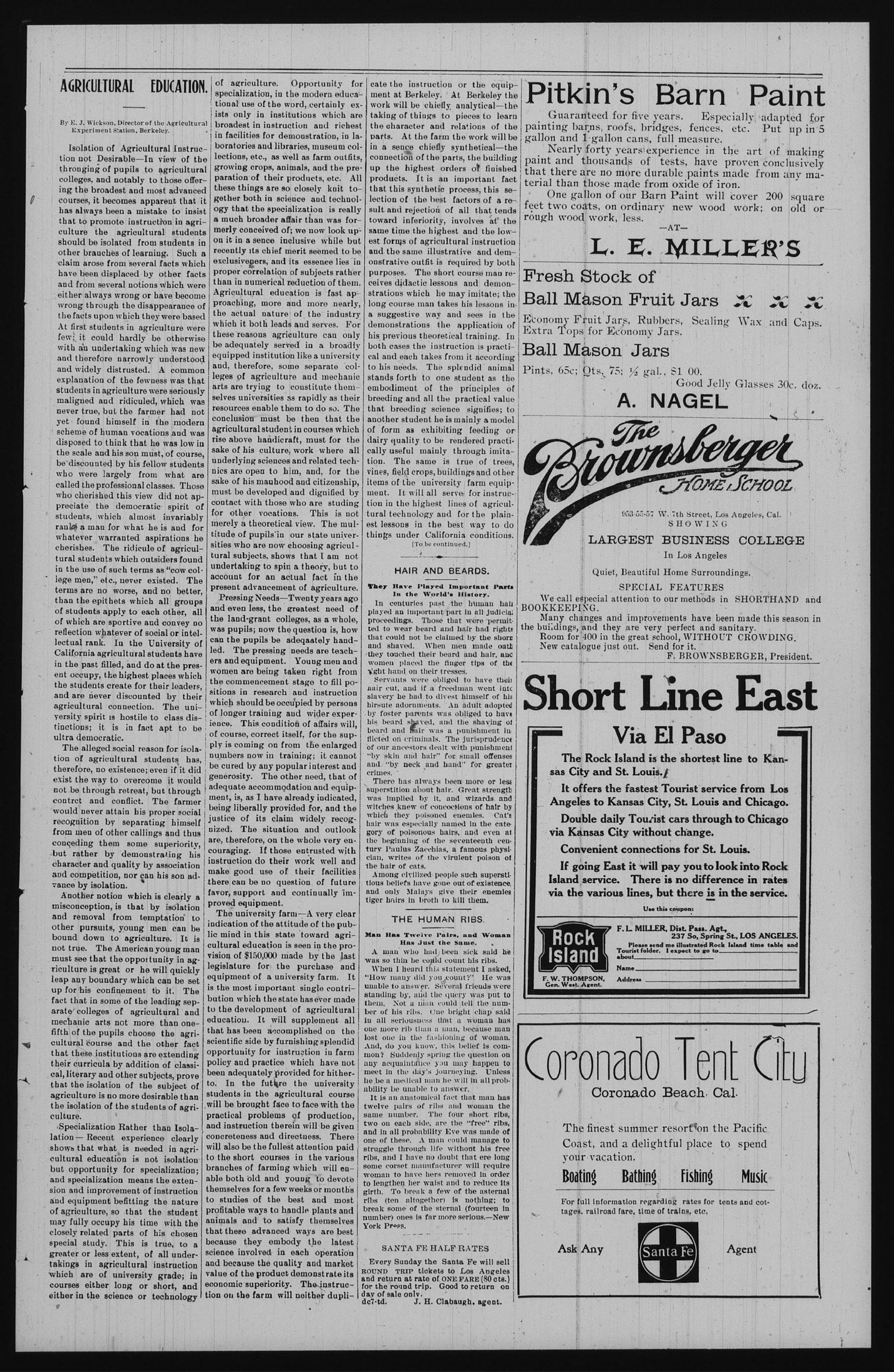
Searchable text
AGRICULTURAL EDUCATION.
By E. J. Wickson, Director of the Agricultural Experiment Station, Berkeley.
Isolation of Agricultural Instruction not Desirable—In view of the thronging of pupils to agricultural colleges, and notably to those offering the broadest and most advanced courses, it becomes apparent that it has always been a mistake to insist that to promote instruction in agriculture the agricultural students should be isolated from students in other branches of learning. Such a claim arose from several facts which have been displaced by other facts and from several notions which were either always wrong or have become wrong through the disappearance of the facts upon which they were based. At first students in agriculture were few; it could hardly be otherwise with an undertaking which was new and therefore narrowly understood and widely distrusted. A common explanation of the fewness was that students in agriculture were seriously maligned and ridiculed, which was never true, but the farmer had not yet found himself in the modern scheme of human vocations and was disposed to think that he was low in the scale and his son must, of course, be discounted by his fellow students who were largely from what are called the professional classes. Those who cherished this view did not appreciate the democratic spirit of agriculture. Opportunities specialization, in the modern national use of the word, certainists only in institutions where broadest in instruction and in facilities for demonstration boratories and libraries, museums, etc., as well as farm growing crops, animals, and the paration of their products, etc., these things are so closely knit gether both in science and technology that the specialization is a much broader affair than merely conceived of; we now look on it in a sense inclusive which recently its chief merit seemed exclusiveners, and its essence proper correlation of subjects than in numerical reduction of Agricultural education is far proaching, more and more in the actual nature of the industry which it both leads and serves; these reasons agriculture can be adequately served in a bi-equipped institution like a university, therefore, some separate leges of agriculture and med arts are trying to constitute ourselves universities as rapidly as resources enable them to do so conclusion must be then that agricultural student in courses rise above handicraft, must for sake of his culture, work when underlying sciences and related nics are open to him, and, for sake of his manhood and citizenry must be developed and dignified contact with those who are st
never true, but the farmer had not yet found himself in the modern scheme of human vocations and was disposed to think that he was low in the scale and his son must, of course, be discounted by his fellow students who were largely from what are called the professional classes. Those who cherished this view did not appreciate the democratic spirit of students, which almost invariably rank a man for what he is and for whatever warranted aspirations he cherishes. The ridicule of agricultural students which outsiders found in the use of such terms as "cow college men," etc., never existed. The terms are no worse, and no better, than the epithets which all groups of students apply to each other, all of which are sportive and convey no reflection whatever of social or intellectual rank. In the University of California agricultural students have in the past filled, and do at the present occupy, the highest places which the students create for their leaders, and are never discounted by their agricultural connection. The university spirit is hostile to class distinctions; it is in fact apt to be ultra democratic.
The alleged social reason for isolation of agricultural students has, therefore, no existence; even if it did exist the way to overcome it would not be through retreat, but through contract and conflict. The farmer would never attain his proper social recognition by separating himself from men of other callings and thus conceding them some superiority, but rather by demonstrating his character and quality by association and competition, nor can his son advance by isolation.
Another notion which is clearly a misconception, is that by isolation and removal from temptation to other pursuits, young men can be bound down to agriculture. It is not true. The American young man must see that the opportunity in agriculture is great or he will quickly resources enable them to do so conclusion must be then that agricultural student in courses rise above handicraft, must for sake of his culture, work where underlying sciences and related nics are open to him, and, for sake of his manhood and citizenship must be developed and dignified contact with those who are still for other vocations. This merely a theoretical view. The titude of pupils in our state universities who are now choosing agrultural subjects, shows that I am undertaking to spin a theory, my account for an actual fact in present advancement of agriculture.
Pressing Needs—Twenty years and even less, the greatest need the land-grant colleges, as a was pupils; now the question is can the pupils be adequately led. The pressing needs are the hers and equipment. Young men women are being taken right to the commencement stage to fessions in research and instruction which should be occupied by peo of longer training and wider eience. This condition of affair of course, correct itself, for theyply is coming on from the endless numbers now in training; it can be cured by any popular interest generosity. The other need, the adequate accommodation and eminent, is, as I have already indicated being liberally provided for, and justice of its claim widely realized. The situation and our are, therefore, on the whole very couraging. If those entrusted instruction do their work well make good use of their fac there can be no question of favor, support and continually proved equipment.
The university farm—A very indication of the attitude of the public mind in this state toward cultural education is seen in the vision of $150,000 made by the legislature for the purchase
character and quality by association and competition, nor can his son advance by isolation.
Another notion which is clearly a misconception, is that by isolation and removal from temptation to other pursuits, young men can be bound down to agriculture. It is not true. The American young man must see that the opportunity in agriculture is great or he will quickly leap any boundary which can be set up for his confinement to it. The fact that in some of the leading separate colleges of agricultural and mechanic arts not more than one-fifth of the pupils choose the agricultural course and the other fact that these institutions are extending their curricula by addition of classical, literary and other subjects, prove that the isolation of the subject of agriculture is no more desirable than the isolation of the students of agriculture.
Specialization Rather than Isolation—Recent experience clearly shows that what is needed in agricultural education is not isolation but opportunity for specialization; and specialization means the extension and improvement of instruction and equipment befitting the nature of agriculture, so that the student may fully occupy his time with the closely related parts of his chosen special study. This is true, to a greater or less extent, of all undertakings in agricultural instruction which are of university grade; in courses either long or short, and either in the science or technology
Opportunity for education in the modern education of the word, certainly exquisite instruction and richest for demonstration, in land libraries, museum collections, as well as farm outfits, hats, animals, and the preparation of their products, etc. All these are so closely knit to science and technology specialization is really harder affair than was forgiven of; we now look up once inclusive while but chief merit seemed to be less, and its essence lies in relation of subjects rather theoretical reduction of them. Education is fast ap- more and more nearly, mature of the industry which leads and serves. For agriculture can only serve in a broadly institution like a university here, some separate col-riculture and mechanic- ing to constitute them- sities as rapidly as their capable them to do so. The must be then that the student in courses which handicraft, must for the culture, work where all sciences and related tech- nics to him, and, for the manhood and citizenship, developed and dignified by those who are studying agriculture. At Berkeley the work will be chiefly analytical—the taking of things to pieces to learn the character and relations of the parts. At the farm the work will be in a sense chiefly synthetical—the connection of the parts, the building up the highest orders of finished products. It is an important fact that this synthetic process, this selection of the best factors of a result and rejection of all that tends toward inferiority, involves at the same time the highest and the lowest forms of agricultural instruction and the same illustrative and demonstrative outfit is required by both purposes. The short course man receives didactic lessons and demonstrations which he may imitate; the long course man takes his lessons in a suggestive way and sees in the demonstrations the application of his previous theoretical training. In both cases the instruction is practical and each takes from it according to his needs. The splendid animal stands forth to one student as the embodiment of the principles of breeding and all the practical value that breeding science signifies; to another student he is mainly a model of form as exhibiting feeding or dairy quality to be rendered practically useful mainly through imitation. The same is true of trees, vines, field crops, buildings and other items of the university farm equipment. It will all serve for instruction in the highest lines of agricul- tural technology.
HAIR AND BEARDS.
They Have Played Important Parts In the World's History.
In centuries past the human hair played an important part in all judicial proceedings. Those that were permitted to wear beard and hair had rights that could not be claimed by the shorn and shaved. When men made oath they touched their beard and hair, and women placed the finger tips of the right hand on their tresses.
Servants were obliged to have their hair cut, and if a freedman went into slavery he had to divest himself of his hirsute adornments. An adult adopted by foster parents was obliged to have his beard shaved, and the shaving of beard and hair was a punishment inflicted on criminals. The jurisprudence of our ancestors dealt with punishment "by skin and hair" for small offenses and "by neck and hand" for greater crimes.
There has always been more or less superstition about hair. Great strength was implied by it, and wizards and witches knew of concoctions of hair by which they poisoned enemies. Cat's hair was especially named in the category of poisonous hairs, and even at the beginning of the seventeenth century Paulus Zacchias, a famous physician, writes of the virulent poison of the hair of cats.
Among civilized people such superstitious beliefs have gone out of existence, and only Malays give their enemies tiger hairs in broth to kill them.
THE HUMAN RIBS.
Man Has Twelve Pairs, and Woman Has Just the Same.
A man who had been sick said he was so thin he could count his ribs.
When I heard this statement I asked...
THE HUMAN RIBS.
Man Has Twelve Pairs, and Woman Has Just the Same.
A man who had been sick said he was so thin he could count his ribs.
When I heard this statement I asked, "How many did you count?" He was unable to answer. Several friends were standing by, and the query was put to them. Not a man could tell the number of his ribs. One bright chap said in all seriousness that a woman has one more rib than a man, because man lost one in the fashioning of woman. And, do you know, this belief is common? Suddenly spring the question on any acquaintance you may happen to meet in the day's journeying. Unless he be a medical man he will in all probability be unable to answer.
It is an anatomical fact that man has twelve pairs of ribs and woman the same number. The four short ribs, two on each side, are the "free" ribs, and in all probability Eve was made of one of these. A man could manage to struggle through life without his free ribs, and I have no doubt that ere long some corset manufacturer will require woman to have hers removed in order to lengthen her waist and to reduce its girth. To break a few of the asternal ribs (ten altogether) is nothing; to break some of the sternal (fourteen in number) ones is far more serious.—New York Press.
SANTA FE HALF RATES
Every Sunday the Santa Fe will sell ROUND TRIP tickets to Los Angeles and return at rate of ONE FARE (80 cts.) for the round trip. Good to return on day of sale only.
dc7-td. J. H. Clabaugh, agent.
tkin's Barn Paint
guaranteed for five years. Especially adapted for
big barns, roofs, bridges, fences, etc. Put up in 5
and 1 gallon cans, full measure.
early forty years experience in the art of making
and thousands of tests, have proven conclusively
there are no more durable paints made from any mahan those made from oxide of iron.
The gallon of our Barn Paint will cover 200 square
two coats, on ordinary new wood work; on old or
wood work, less.
—AT—
L. E. MILLER'S
ish Stock of
Mason Fruit Jars
ny Fruit Jars, Rubbers, Sealing Wax and Caps.
Tops for Economy Jars.
Mason Jars
65c; Qts, 75; ½ gal., $1 00.
Good Jelly Glasses 30c. doz.
A. NAGEL
The Grownberger
HOME SCHOOL
The Brownsberger Home School
953-55-57 W. 7th Street, Los Angeles, Cal.
SHOWING
LARGEST BUSINESS COLLEGE
In Los Angeles
Quiet, Beautiful Home Surroundings.
SPECIAL FEATURES
All especial attention to our methods in SHORTHAND and SEEPING.
Any changes and improvements have been made this season in things, and they are very perfect and sanitary.
In for 400 in the great school, WITHOUT CROWDING.
Catalogue just out. Send for it.
F. BROWNSBERGER, President.
Short Line East
Via El Paso
The Rock Island is the shortest line to Kansas City and St. Louis.
It offers the fastest Tourist service from Los Angeles to Kansas City, St. Louis and Chicago.
Double daily Tourist cars through to Chicago a Kansas City without change.
Convenient connections for St. Louis.
If going East it will pay you to look into Rockland service. There is no difference in rates on the various lines, but there is in the service.
Use this coupon:
F. L. MILLER, Dist. Pass. Agt.,
237 So, Spring St., LOS ANGELES.
Please send me illustrated Rock Island time table and Tourist folder. I expect to go to about Name
If going East it will pay you to look into Rock Island service. There is no difference in rates on the various lines, but there is in the service.
Use this coupon:
F. L. MILLER, Dist. Pass. Agt., 237 So, Spring St., LOS ANGELES.
Please send me illustrated Rock Island time table and tourist folder. I expect to go to about___
Name___
Address___
Coronado Tent City
Coronado Beach, Cal.
The finest summer resort on the Pacific Coast, and a delightful place to spend your vacation.
Boating Bathing Fishing Music
For full information regarding rates for tents and cottages, railroad fare, time of trains, etc,
Ask Any Santa Fe Agent