anaheim-gazette 1906-08-02
Scanned page
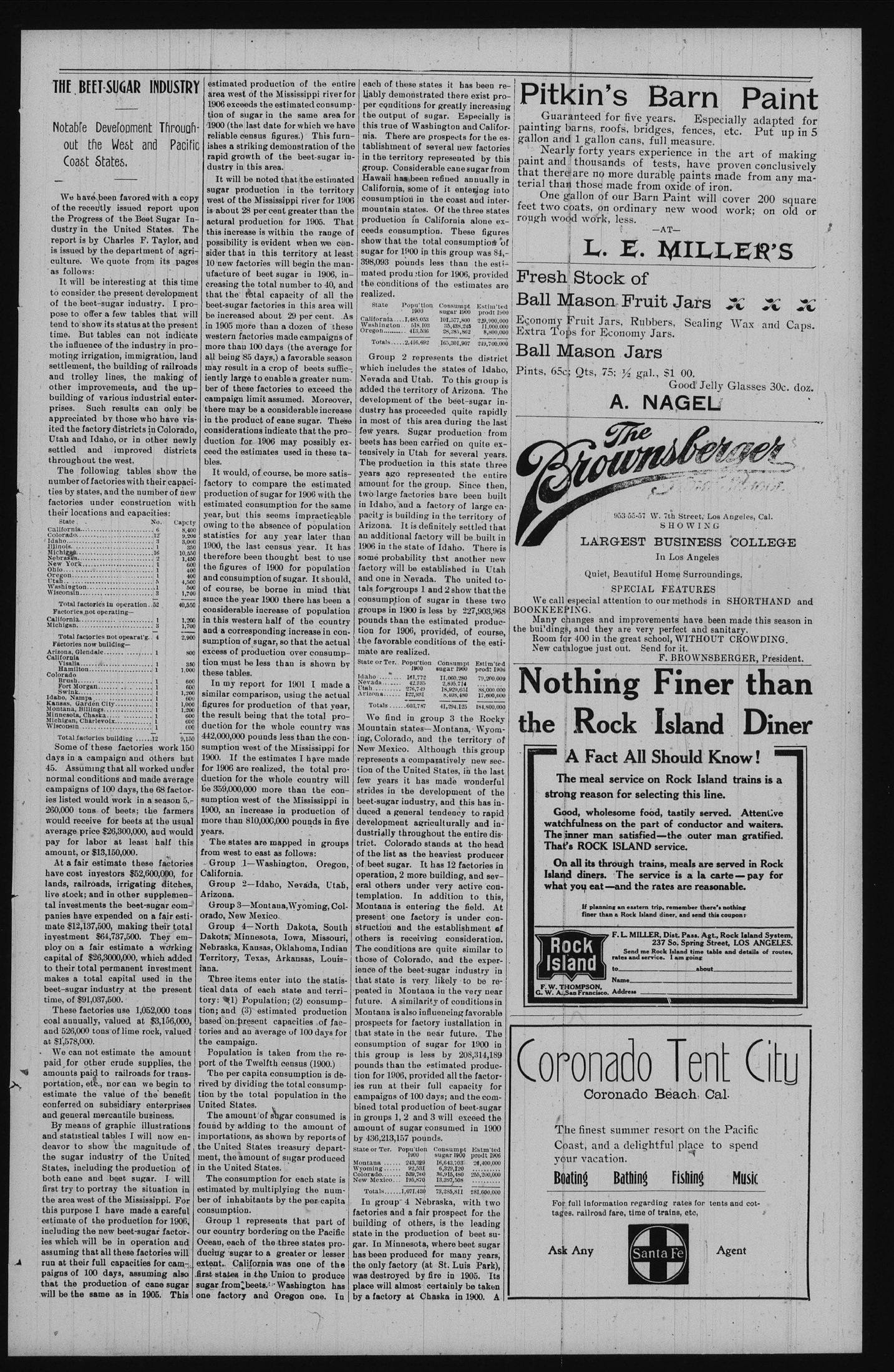
Searchable text
THE BEET-SUGAR INDUSTRY
Notable Development Throughout the West and Pacific Coast States.
We have been favored with a copy of the recently issued report upon the Progress of the Beet Sugar Industry in the United States. The report is by Charles F. Taylor, and is issued by the department of agriculture. We quote from its pages as follows:
It will be interesting at this time to consider the present development of the beet-sugar industry. I propose to offer a few tables that will tend to show its status at the present time. But tables can not indicate the influence of the industry in promoting irrigation, immigration, land settlement, the building of railroads and trolley lines, the making of other improvements, and the up-building of various industrial enterprises. Such results can only be appreciated by those who have visited the factory districts in Colorado, Utah and Idaho, or in other newly settled and improved districts throughout the west.
The following tables show the number of factories with their capacities by states, and the number of new factories under construction with estimated production of the area west of the Mississippi river 1906 exceeds the estimated consumption of sugar in the same area 1900 (the last date for which we reliable census figures.) This isishes a striking demonstration of rapid growth of the beet-sugar dustry in this area.
It will be noted that the estimated sugar production in the territory west of the Mississippi river for 1906 is about 28 per cent greater than actual production for 1905. This increase is within the range possibility is evident when we consider that in this territory at 10 new factories will begin the manufacture of beet sugar in 1906 creasing the total number to 400 that the total capacity of all beet-sugar factories in this area be increased about 29 per cent. in 1905 more than a dozen of western factories made campaign more than 100 days (the average all being 85 days,) a favorable result in a crop of beets sufficiently large to enable a greater number of these factories to exceed campaign limit assumed. More there may be a considerable increase in the product of cane sugar. The considerations indicate that the production for 1906 may possiblyceed the estimates used in these tables.
It would, of course, be more safe factory to compare the estimated production of sugar for 1906 with estimated consumption for the s
Such results can only be appreciated by those who have visited the factory districts in Colorado, Utah and Idaho, or in other newly settled and improved districts throughout the west.
The following tables show the number of factories with their capacities by states, and the number of new factories under construction with their locations and capacities:
| State | No. | Capacity |
| :--- | :--- | :--- |
| California | 6 | 8,400 |
| Colorado | 12 | 9,200 |
| Idaho | 3 | 3,000 |
| Illinois | 1 | 350 |
| Michigan | 16 | 10,550 |
| Nebraska | 2 | 1,450 |
| New York | 1 | 600 |
| Ohio | 1 | 400 |
| Oregon | 1 | 400 |
| Utah | 5 | 4,500 |
| Washington | 1 | 500 |
| Wisconsin | 3 | 1,700 |
Total factories in operation: 52
Factories not operating:
- California: 1
- Michigan: 3
Total factories not operat'g.: 4
Factories now building:
- Arizona, Glendale: 1
- California
- Visalia: 1
- Hamilton: 1
Colorado
- Brush: 1
- Fort Morgan: 1
- Swink: 1
- Idaho, Nampa: 1
- Kansas, Garden City: 1
- Montana, Billings: 1
- Minnesota, Chaska: 1
- Michigan, Charlevoix: 1
- Wisconsin: 1
Total factories building: 12
Some of these factories work 150 days in a campaign and others but 45. Assuming that all worked under normal conditions and made average campaigns of 100 days, the 68 factories listed would work in a season 5,-260,000 tons of beets; the farmers would receive for beets at the usual average price $26,300,000, and would pay for labor at least half this amount, or $13,150,000.
At a fair estimate these factories have cost investors $52,600,000, for lands, railroads, irrigating ditches, live stock; and in other supplemental investments the beet-sugar companies have expended on a fair estimate $12,137,500, making their total investment $64,737,500. They employ on a fair estimate a working capital of $26,300,000, which added to their total permanent investment there may be a considerable increase in the product of cane sugar. The considerations indicate that the production for 1906 may possibly exceed the estimates used in these tables.
It would, of course, be more safe factory to compare the estimated production of sugar for 1906 with estimated consumption for the same year, but this seems impractical owing to the absence of population statistics for any year later than 1900, the last census year. It therefore been thought best to the figures of 1900 for population and consumption of sugar. It shows of course, be borne in mind since the year 1900 there has been considerable increase of population in this western half of the country and a corresponding increase in the sumption of sugar, so that the excess of production over consumption must be less than is shown these tables.
In my report for 1901 I made similar comparison, using the actual figures for production of that year the result being that the total production for the whole country was 442,000,000 pounds less than the sumption west of the Mississippi in 1900. If the estimates I have made for 1906 are realized, the total production for the whole country will be 359,000,000 more than the sumption west of the Mississippi in 1900, an increase in production more than 810,000,000 pounds in five years.
The states are mapped in groups from west to east as follows:
Group 1—Washington, Oregon
Group 2—Idaho, Nevada, Utah
Group 3—Montaua, Wyoming, Oklahoma, New Mexico
Group 4—North Dakota, South Dakota, Minnesota, Iowa, Missouri, Nebraska, Kansas, Oklahoma, Indiana Territory, Texas, Arkansas, Louisiana.
At a fair estimate these factories have cost investors $52,600,000, for lands, railroads, irrigating ditches, live stock; and in other supplemental investments the beet-sugar companies have expended on a fair estimate $12,137,500, making their total investment $64,737,500. They employ on a fair estimate a working capital of $26,300,000, which added to their total permanent investment makes a total capital used in the beet-sugar industry at the present time, of $91,037,500.
These factories use 1,052,000 tons coal annually, valued at $3,156,000, and 526,000 tons of lime rock, valued at $1,578,000.
We can not estimate the amount paid for other crude supplies, the amounts paid to railroads for transportation, etc., nor can we begin to estimate the value of the benefit conferred on subsidiary enterprises and general mercantile business.
By means of graphic illustrations and statistical tables I will now endeavor to show the magnitude of the sugar industry of the United States, including the production of both cane and beet sugar. I will first try to portray the situation in the area west of the Mississippi. For this purpose I have made a careful estimate of the production for 1906, including the new beet-sugar factories which will be in operation and assuming that all these factories will run at their full capacities for campaigns of 100 days, assuming also that the production of cane sugar will be the same as in 1905. This
production of the entire Mississippi river for the estimated consumption in the same area for date for which we have figures.) This furnishing demonstration of the use of the beet-sugar industry area.
Note that the estimated action in the territory Mississippi river for 1906 or cent greater than the action for 1905. That is within the range of evident when we conceive this territory at least will begin the manned sugar in 1906, in total number to 40, and all capacity of all the factories in this area will about 29 per cent. As than a dozen of these factories made campaigns of days (the average for days,) a favorable season a crop of beets suffice enable a greater num-actories to exceed the assumed. Moreover, a considerable increase of cane sugar. These indicate that the production may possibly ex-ates used in these ta-course, be more satis-compare the estimated sugar for 1906 with the consumption for the same each of these states it has been reliably demonstrated there exist proper conditions for greatly increasing the output of sugar. Especially is this true of Washington and California. There are prospects for the establishment of several new factories in the territory represented by this group. Considerable cane sugar from Hawaii has been refined annually in California, some of it entering into consumption in the coast and intermountain states. Of the three states production in California alone exceeds consumption. These figures show that the total consumption of sugar for 1900 in this group was 84,-398,093 pounds less than the estimated production for 1906, provided the conditions of the estimates are realized.
State Population 1900 Consumption Sugar 1900 Estimated Product 1900
California...1,485,053 101,577,800 229,900,000
Washington...518,103 35,438,245 11,000,000
Oregon...413,536 28,285,862 8,800,000
Totals...2,416,692 165,301,907 249,700,000
Group 2 represents the district which includes the states of Idaho, Nevada and Utah. To this group is added the territory of Arizona. The development of the beet-sugar industry has proceeded quite rapidly in most of this area during the last few years. Sugar production from beets has been carried on quite extensively in Utah for several years. The production in this state three years ago represented the entire amount for the group. Since then, two large factories have been built in Idaho, and a factory of large ca-
a considerable increase of cane sugar. These indicate that the production in 1906 may possibly exceeds used in these tastes, be more satisfactory the estimated sugar for 1906 with the assumption for the same seems impracticable absence of population any year later than the census year. It has thought best to use 1900 for population on of sugar. It should,borne in mind that 1900 there has been a decrease of population half of the country pending increase in consumer, so that the actualuction over consump-ness than is shown by it for 1901 I made a decision, using the actual reduction of that year,
that the total prowhole country was much less than the conof the Mississippi for estimates I have made realized, the total prowhole country will more than the conof the Mississippi in case in production of 2000,000 pounds in five
mapped in groups just as follows:
Washington, Oregon,
Idaho, Nevada, Utah,
Montana, Wyoming, Colxico.
North Dakota, South
Southeast Iowa, Missouri,
Missouri, Oklahoma, Indian
as, Arkansas, Louisindustry has proceeded quite rapidly in most of this area during the last few years. Sugar production from beets has been carried on quite extensively in Utah for several years. The production in this state three years ago represented the entire amount for the group. Since then, two large factories have been built in Idaho, and a factory of large capacity is building in the territory of Arizona. It is definitely settled that an additional factory will be built in 1906 in the state of Idaho. There is some probability that another new factory will be established in Utah and one in Nevada. The united totals for groups 1 and 2 show that the consumption of sugar in these two groups in 1900 is less by 227,903,968 pounds than the estimated produc-tion for 1906, provided, of course, the favorable conditions of the estimate are realized.
State or Ter. Population 1900 Consumpt sugar 1900 Estimated prod: 1906
Idaho.....161,772 II,060,280 79,200,009
Nevada.....42,385 2,835,714 ...
Utah.....276,749 18,929,651 88,000,000
Arizona.....122,981 8,408,480 17,600,000
Totals.....603,787 41,294,125 184,800,000
We find in group 3 the Rocky Mountain states—Montana, Wyoming, Colorado, and the territory of New Mexico. Although this group represents a comparatively new section of the United States, in the last few years it has made wonderful strides in the development of the beet-sugar industry, and this has induced a general tendency to rapid development agriculturally and industrially throughout the entire district. Colorado stands at the head of the list as the heaviest producer of beet sugar. It has 12 factories in operation, 2 more building, and several others under very active contemplation. In addition to this, Montana is entering the field. At present one factory is under construction and the establishment of others is receiving consideration. The conditions are quite similar to those of Colorado, and the experience of the beet-sugar industry in
of beet sugar. It has 12 factories in operation, 2 more building, and several others under very active contemplation. In addition to this, Montana is entering the field. At present one factory is under construction and the establishment of others is receiving consideration. The conditions are quite similar to those of Colorado, and the experience of the beet-sugar industry in that state is very likely to be repeated in Montana in the very near future. A similarity of conditions in Montana is also influencing favorable prospects for factory installation in that state in the near future. The consumption of sugar for 1900 in this group is less by 208,314,189 pounds than the estimated production for 1906, provided all the factors run at their full capacity for campaigns of 100 days; and the combined total production of beet-sugar in groups 1, 2 and 3 will exceed the amount of sugar consumed in 1900 by 436,213,157 pounds.
In group 4 Nebraska, with two factories and a fair prospect for the building of others, is the leading state in the production of beet sugar. In Minnesota, where beet sugar has been produced for many years, the only factory (at St. Luis Park), was destroyed by fire in 1905. Its place will almost certainly be taken by a factory at Chaska in 1900.
kin's Barn Paint
guaranteed for five years. Especially adapted for
barns, roofs, bridges, fences, etc. Put up in 5
and 1 gallon cans, full measure.
early forty years experience in the art of making
and thousands of tests, have proven conclusively
there are no more durable paints made from any mapan those made from oxide of iron.
A gallon of our Barn Paint will cover 200 square
coats, on ordinary new wood work; on old or
wood work, less.
—AT—
L. E. MILLER'S
in Stock of
Mason Fruit Jars
Fruit Jars, Rubbers, Sealing Wax and Caps.
ops for Economy Jars.
Mason Jars
6c; Qts, 75; ½ gal., $1 00.
Good Jelly Glasses 30c. doz.
A. NAGEL
The Brownsberger
The Brownsberger
953-55-57 W. 7th Street, Los Angeles, Cal.
SHOWING
LARGEST BUSINESS COLLEGE
In Los Angeles
Quiet, Beautiful Home Surroundings.
SPECIAL FEATURES
All especial attention to our methods in SHORTHAND and KEEPING.
Changes and improvements have been made this season in bags, and they are very perfect and sanitary.
For 400 in the great school, WITHOUT CROWDING.
Catalogue just out. Send for it.
F. BROWNSBERGER, President.
thing Finer than Rock Island Diner
A Fact All Should Know!
The meal service on Rock Island trains is a strong reason for selecting this line.
Good, wholesome food, tastily served. Attentive touchfulness on the part of conductor and waiters.
The inner man satisfied—the outer man gratified.
It's ROCK ISLAND service.
On all its through trains, meals are served in Rock Island diners. The service is a la carte—pay for what you eat—and the rates are reasonable.
If planning an eastern trip, remember there's nothing finer than a Rock Island diner, and send this coupon:
F. L. MILLER, Dist. Pass. Agt., Rock Island System,
237 So, Spring Street, LOS ANGELES.
Send me Rock Island time table and details of routes, rates and service. I am going
On all its through trains, meals are served in Rock Island diners. The service is a la carte—pay for what you eat—and the rates are reasonable.
If planning an eastern trip, remember there's nothing finer than a Rock Island diner, and send this coupon:
F. L. MILLER, Dist. Pass. Agt., Rock Island System,
237 So. Spring Street, LOS ANGELES.
Send me Rock Island time table and details of routes, rates and service. I am going to about Name
THOMPSON, San Francisco, Address
Coronado Tent City
Coronado Beach, Cal.
The finest summer resort on the Pacific Coast, and a delightful place to spend your vacation.
Boating Bathing Fishing Music
For full information regarding rates for tents and cotages. railroad fare, time of trains, etc,
Any Santa Fe Agent