anaheim-gazette 1906-02-15
Scanned page
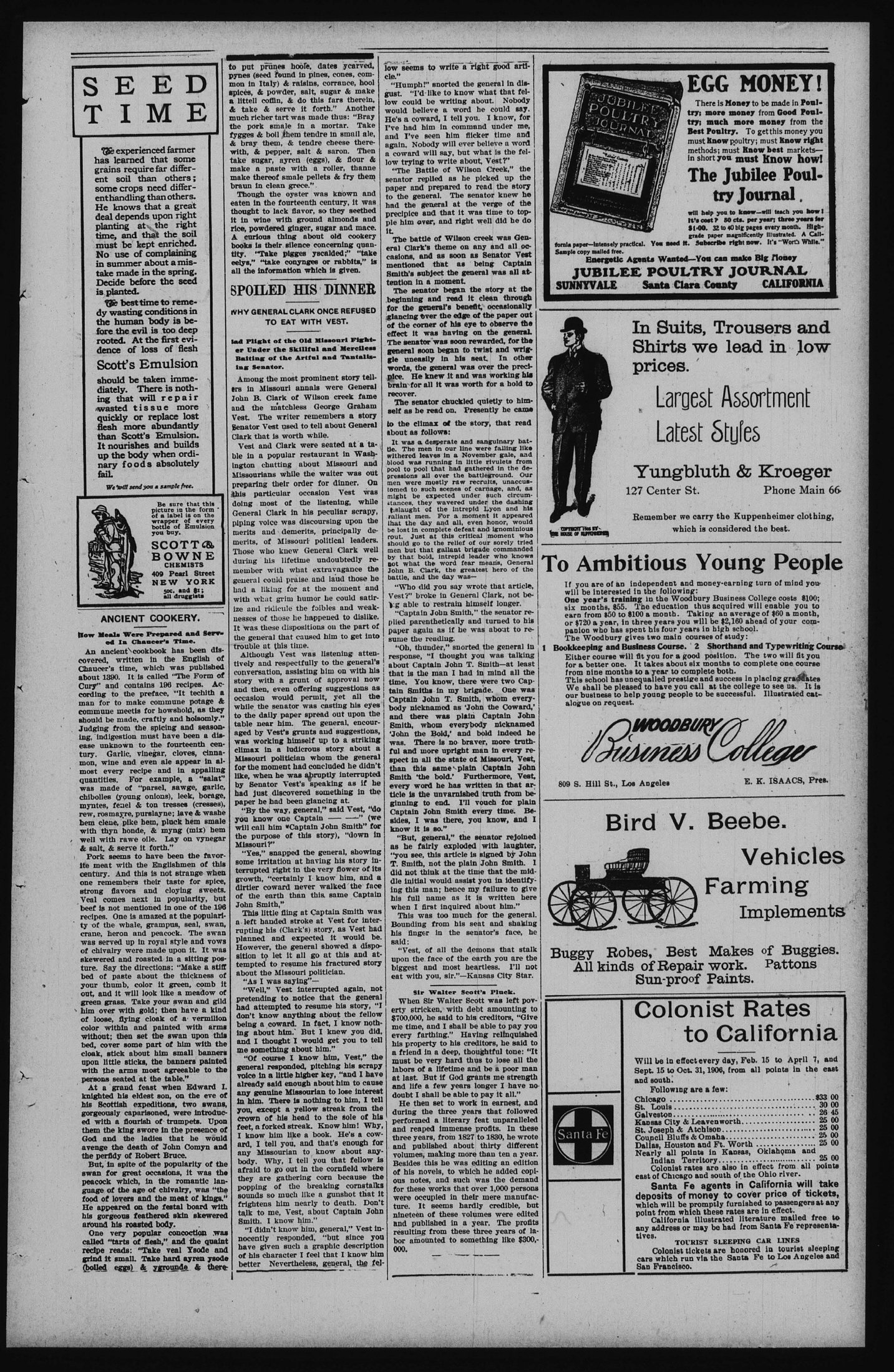
Searchable text
SEED TIME
The experienced farmer has learned that some grains require far different soil than others; some crops need different handling than others. He knows that a great deal depends upon right planting at the right time, and that the soil must be kept enriched. No use of complaining in summer about a mistake made in the spring. Decide before the seed is planted.
The best time to remedy wasting conditions in the human body is before the evil is too deep rooted. At the first evidence of loss of flesh Scott's Emulsion should be taken immediately. There is nothing that will repair wasted tissue more quickly or replace lost flesh more abundantly than Scott's Emulsion. It nourishes and builds up the body when ordinary foods absolutely fail.
We will send you a sample free.
to put prunes hoole, date pynes (seed found in pines, mon in Italy) & raisins, corns spices, & powder, salt, sugar a littell coffin, & do this fast & take & serve it forth. Much richer tart was made to the pork smale in a mor fygges & boil them tendre in & bray them, & tendre ch with, & pepper, salt & salt take sugar, ayren (eggs), make a paste with a roll make thereof smale pellets braun in clean grece."
Though the oyster was eaten in the fourteenth century thought to lack flavor, so that it in wine with ground al rice, powdered ginger, sugar A curious thing about books is their silence concern. "Take pigges yscald eelys," "take conynges or all the information which is
SPOILED HIS D
WHY GENERAL CLARK ONCE TO EAT WITH VE
lad Plight of the Old Missouri Under the Skillful and Baiting of the Artful and ing Senator.
Among the most prominenters in Missouri annals were John B. Clark of Wilson and the matchless George Vest. The writer remember Senator Vest used to tell ab Clark that is worth while.
Vest and Clark were seable in a popular restaurantington chatting about Missourians while the wait preparing their order for this particular occasion doing most of the listening General Clark in his pecu
wasted tissue more quickly or replace lost flesh more abundantly than Scott's Emulsion. It nourishes and builds up the body when ordinary foods absolutely fail.
We will send you a sample free.
Be sure that this picture in the form of a label is on the wrapper of every bottle of Emulsion you buy.
SCOTT & BOWNE CHEMISTS
409 Pearl Street NEW YORK
50c. and 8r.; all druggists
ANCIENT COOKERY.
How Meals Were Prepared and Served In Chaucer's Time.
An ancient cookbook has been discovered, written in the English of Chaucer's time, which was published about 1390. It is called "The Form of Cury" and contains 196 recipes. According to the preface, "It techith a man for to make commune potage & commune meetis for howshold, as they should be made, craftly and holosomly." Judging from the spicing and seasoning, indigestion must have been a disease unknown to the fourteenth century. Garlic, vinegar, cloves, cinnamon, wine and even ale appear in almost every recipe and in appalling quantities. For example, a "salat" was made of "parsel, sawge, garlic, chibolles (young onions), leek, borage, myntes, fenel & ton tresses (cresses), rew, rosmayre, purslayne; lave & washe hem clene, pike hem, pluck hem smale with thyn honde, & myng (mix) hem well with rawe ole. Lay on vynegar & salt, & serve it forth."
Pork seems to have been the favorite meat with the Englishmen of this century. And this is not strange when one remembers their taste for spice, strong flavors and cloying sweets. Veal comes next in popularity, but beef is not mentioned in one of the 196 recipes. One is amazed at the popularity of the whale, grampus, seal, swan, crane, heron and peacock. The swan was served up in royal style and vows of chivalry were made upon it. It was skewered and roasted in a sitting posture. Say the directions: "Make a stiff and the matchless George Vest. The writer remember Senator Vest used to tell about Clark that is worth while.
Vest and Clark were seated in a popular restaurantington chatting about Mr. Missourians while the waiter preparing their order for this particular occasion doing most of the listening. General Clark in his peculiar piping voice was discoursing merits and demerits, prim merits, of Missouri politics. Those who knew General Clark during his lifetime undo member with what extra general could praise and lay had a liking for at the nth with what grim humor he size and ridicule the foiblesnesses of those he happened It was these dispositions on the general that caused him trouble at this time.
Although Vest was listened to and respectfully to the conversation, assisting him story with a grunt of ap and then, even offering sucession would permit, while the senator was cast to the daily paper spread on table near him. The gen-aged by Vest's grunts and was working himself up to climax in a ludicrous story Missouri politician whom for the moment had conclude like, when he was abruptly by Senator Vest's speaking had just discovered some paper he had been glancing.
"By the way, general," said you know one Captain — will call him "Captain John" the purpose of this story Missouri?"
"Yes," snapped the gene some irritation at having terrupted right in the very growth, "certainly I know dirtier coward never wall of the earth than this ssa John Smith."
This little fling at Captain a left handed stroke at Virupting his (Clark's) story planned and expected if However, the general show sition to let it all go at tempted to resume his fr
ite meat with the Englishmen of this century. And this is not strange when one remembers their taste for spice, strong flavors and cloying sweets. Veal comes next in popularity, but beef is not mentioned in one of the 196 recipes. One is amazed at the popularity of the whale, grampus, seal, swan, crane, heron and peacock. The swan was served up in royal style and vows of chivalry were made upon it. It was skewered and roasted in a sitting posture. Say the directions: "Make a stiff bed of paste about the thickness of your thumb, color it green, comb it out, and it will look like a meadow of green grass. Take your swan and gild him over with gold; then have a kind of loose, flying cloak of a vermilion color within and painted with arms without; then set the swan upon this bed, cover some part of him with the cloak, stick about him small banners upon little sticks, the banners painted with the arms most agreeable to the persons seated at the table."
At a grand feast when Edward I. knighted his eldest son, on the eve of his Scottish expeditions, two swans, gorgeously caparisoned, were introduced with a flourish of trumpets. Upon them the king swore in the presence of God and the ladies that he would avenge the death of John Comyn and the perfidy of Robert Bruce.
But, in spite of the popularity of the swan for great occasions, it was the peacock which, in the romantic language of the age of chivalry, was "the food of lovers and the meat of kings." He appeared on the festal board with his gorgeous feathered skin skewered around his roasted body.
One very popular concoction was called "tarts of flesh," and the quaint recipe reads: "Take veal Ysode and grind it small. Take hard ayren ysode (bolled eggs) & ygrounde & there-
This little fling at Captain a left handed stroke at Vest rupting his (Clark's) story, planned and expected in However, the general shout to let it all go at tempted to resume his fright about the Missouri politician.
"As I was saying"—
"Well," Vest interrupted pretending to notice that had attempted to resume don't know anything about being a coward. In fact, ing about him. But I knew and I thought I would get me something about him."
"Of course I know him general responded, pitching voice in a little higher key already said enough about any genuine Missourian to in him. There is nothing you, except a yellow strewn crown of his head to the feet, a forked streak. Know I know him like a book. ard, I tell you, and that's any Missourian to know body. Why, I tell you they afraid to go out in the coat they are gathering corn popping of the breaking sounds so much like a guff frightens him nearly to talk to me, Vest, about Smith. I know him."
"I didn't know him, generally responded, "but have given such a graphic of his character I feel better Nevertheless, gen-
porunes hoole, dates ycarved,
used found in pines, cones, comtaly) & raisins, corrance, hool
powder, salt, sugar & make
coffin, & do this fars therein,
& serve it forth.” Another
other tart was made thus: “Bray
smale in a mortar. Take
boil them tendre in small ale,
them, & tendre cheese therepepper, salt & saron. Then
sugar, ayren (eggs), & flour &
paste with a roller, thanne
thereof smale pellets & fry them
clean grece.”
In the oyster was known and
the fourteenth century, it was
to lack flavor, so they seethed
one with ground almonds and
powdered ginger, sugar and mace.
Thus thing about old cookery
their silence concerning quanTake pigges yscalded;” “take
take conynges or rabbits,” is
information which is given.
LED HIS DINNER
GENERAL CLARK ONCE REFUSED
TO EAT WITH VEST.
Light of the Old Missouri Fightover the Skillful and Merciless
War of the Artful and Tantalizinator.
The most prominent story telling Missouri annals were General
Clark of Wilson creek fame
matchless George Graham
The writer remembers a story
Vest used to tell about General
that is worth while.
And Clark were seated at a tapopular restaurant in Washchatting about Missouri and
mans while the waiter was out
giving their order for dinner. On
particular occasion Vest was
most of the listening, while
Clark in his peculiar sorny
low seems to write a right good article."
“Humph!” snorted the general in disgust. “I’d like to know what that fellow could be writing about. Nobody would believe a word he could say. He’s a coward, I tell you. I know, for I’ve had him in command under me,
and I’ve seen him flicker time and again. Nobody will ever believe a word a coward will say, but what is the fellow trying to write about, Vest?”
“The Battle of Wilson Creek,” the senator replied as he picked up the paper and prepared to read the story to the general. The senator knew he had the general at the verge of the precipice and that it was time to topple him over, and right well did he do it.
The battle of Wilson creek was General Clark’s theme on any and all occasions, and as soon as Senator Vest mentioned that as being Captain Smith’s subject the general was all attention in a moment.
The senator began the story at the beginning and read it clean through for the general’s benefit, occasionally glancing over the edge of the paper out of the corner of his eye to observe the effect it was having on the general. The senator was soon rewarded, for the general soon began to twist and wriggle uneasily in his seat. In other words, the general was over the precipice. He knew it and was working his brain for all it was worth for a hold to recover.
The senator chuckled quietly to himself as he read on. Presently he came to the climax of the story, that read about as follows:
It was a desperate and sanguinary battle. The men in our line were falling like withered leaves in a November gale, and blood was running in little rivulets from pool to pool that had gathered in the depressions all over the battleground. Our men were mostly raw recruits, unaccustomed to such scenes of carnage, and, as might be expected under such circumstances, they wavered under the dashing slaught of the intrepid Lyon and his
The writer remembers a story Vest used to tell about General Clark being seated at a popular restaurant in Wash.-chatting about Missouri and plans while the waiter was out of their order for dinner. On particular occasion Vest was most of the listening, while Clark in his peculiar scrapy voice was discoursing upon the stand demerits, principally de- of Missouri political leaders. Who knew General Clark well in his lifetime undoubtedly re- with what extravagance he could praise and laud those he liking for at the moment and grim humor he could satirize the foibles and weak- of those he happened to dislike. These dispositions on the part of general that caused him to get into this time.
Though Vest was listening attentively and respectfully to the general's station, assisting him on with his with a grunt of approval now, even offering suggestions as would permit, yet all the senator was casting his eyes daily paper spread out upon the dear him. The general, encour- Vest's grunts and suggestions, working himself up to a striking in a ludicrous story about a politician whom the general moment had concluded he didn't when he was abruptly interrupted Senator Vest's speaking as if he had discovered something in the case had been glancing at.
The way, general," said Vest, "do know one Captain — —" (we call him "Captain John Smith" for purpose of this story), "down in trii?"
"Snapped the general, showing irritation at having his story ined right in the very flower of its, 'certainly I know him, and a coward never walked the face earth than this same Captain Smith," little fling at Captain Smith was handed stroke at Vest for inter- his (Clark's) story, as Vest had and expected it would be. After, the general showed a dispo- let it all go at this and at- to resume his fractured story
The senator chuckled quietly to himself as he read on. Presently he came to the climax of the story, that read about as follows:
It was a desperate and sanguinary battle. The men in our line were falling like withered leaves in a November gale, and blood was running in little rivulets from pool to pool that had gathered in the depressions all over the battleground. Our men were mostly raw recruits, unaccustomed to such scenes of carnage, and, as might be expected under such circumstances, they wavered under the dashing slaught of the intrepid Lyon and his ralliant men. For a moment it appeared that the day and all, even honor, would be lost in complete defeat and ignominious rout. Just at this critical moment who should go to the relief of our sorely tried men but that gallant brigade commanded by that bold, intrepid leader who knows not what the word fear means, General John B. Clark, the greatest hero of the battle, and the day was—
"Who did you say wrote that article, Vest?" broke in General Clark, not being able to restrain himself longer.
"Captain John Smith," the senator replied parenthetically and turned to his paper again as if he was about to resume the reading.
"Oh, thunder," snorted the general in response, "I thought you was talking about Captain John T. Smith—at least that is the man I had in mind all the time. You know, there were two Captain Smiths in my brigade. One was Captain John T. Smith, whom everybody nicknamed as 'John the Coward,' and there was plain Captain John Smith, whom everybody nicknamed 'John the Bold,' and bold indeed he was. There is no braver, more truthful and more upright man in every respect in all the state of Missouri, Vest, than this same plain Captain John Smith 'the bold.' Furthermore, Vest, every word he has written in that article is the unwarnished truth from beginning to end. I'll vouch for plain Captain John Smith every time. Besides, I was there, you know, and I know it is so."
"But, general," the senator rejoined as he fairly exploded with laughter, "you see, this article is signed by John T. Smith, not the plain John Smith. I did not think at the time that the middle initial would assist you in identifying this man; hence my failure to give his full name as it is written here when I first inquired about him."
This was too much for the general. Bounding from his seat and shaking his finger in the senator's face, he said:
"Vest, of all the demons that stalk upon the face of the earth you are the biggest and most heartless. I'll not
Sir Walter Scott's Pluck.
When Sir Walter Scott was left poverty stricken, with debt amounting to $700,000, he said to his creditors, "Give me time, and I shall be able to pay you every farthing." Having relinquished his property to his creditors, he said to a friend in a deep, thoughtful tone: "It must be very hard thus to lose all the labors of a lifetime and be a poor man at last. But if God grants me strength and life a few years longer I have no doubt I shall be able to pay it all."
He then set to work in earnest, and during the three years that followed performed a literary feat unparalleled and reaped immense profits. In these three years, from 1827 to 1830, he wrote and published about thirty different volumes, making more than ten a year. Besides this he was editing an edition of his novels, to which he added copious notes, and such was the demand for these works that over 1,000 persons were occupied in their mere manufacture. It seems hardly credible, but nineteen of these volumes were edited and published in a year. The profits resulting from these three years of labor amounted to something like $300,-000.
EGG MONEY!
There is Money to be made in Poultry; more money from Good Poultry; much more money from the Best Poultry. To get this money you must know poultry; must know right methods; must know best markets—in short you must know how!
The Jubilee Poultry Journal.
will help you to know—will teach you how! It's cost? 50 cts. per year; three years for $1.00. 32 to 40 big pages every month. High-grade paper magnificently illustrated. A Call-onia paper—intensely practical. You need it. Subscribe right now. It's "Worth While."
Energetic Agents Wanted—You can make Big Money
JUBILEE POULTRY JOURNAL
SUNNYVALE Santa Clara County CALIFORNIA
In Suits, Trousers and Shirts we lead in low prices.
Largest Assortment
Latest Styles
Yungbluth & Kroeger
127 Center St. Phone Main 66
Latest Styles
Yungbluth & Kroeger
127 Center St. Phone Main 66
Remember we carry the Kuppenheimer clothing,
which is considered the best.
To Ambitious Young People
If you are of an independent and money-earning turn of mind you will be interested in the following:
One year’s training in the Woodbury Business College costs $100;
six months, $55. The education thus acquired will enable you to earn from $50 to $100 a month. Taking an average of $60 a month,
or $720 a year, in three years you will be $2,160 ahead of your companion who has spent his four years in high school.
The Woodbury gives two main courses of study:
Bookkeeping and Business Course. 2 Shorthand and Typewriting Course
Either course will fit you for a good position. The two will fit you for a better one. It takes about six months to complete one course from nine months to a year to complete both.
This school has unequalled prestige and success in placing graduates We shall be pleased to have you call at the college to see us. It is our business to help young people to be successful. Illustrated catalogue on request.
WOODBURY
Business College
809 S. Hill St., Los Angeles E. K. ISAACS, Pres.
Bird V. Beebe.
Vehicles Farming Implements
Guggy Robes, Best Makes of Buggies.
All kinds of Repair work. Pattons
Colonist Rates to California
Will be in effect every day, Feb. 15 to April 7, and Sept. 15 to Oct. 31, 1906, from all points in the east and south.
Following are a few:
Chicago ... $33 00
St. Louis ... 30 00
Galveston ... 26 45
Kansas City & Leavenworth ... 25 00
St. Joseph & Atchison ... 25 00
Council Bluffs & Omaha ... 25 00
Dallas, Houston and Ft. Worth ... 25 00
Nearly all points in Kansas, Oklahoma and Indian Territory ... 25 00
Colonist rates are also in effect from all points east of Chicago and south of the Ohio river.
Santa Fe agents in California will take deposits of money to cover price of tickets, which will be promptly furnished to passengers at any point from which these rates are in effect.
California illustrated literature mailed free to any address or may be had from Santa Fe representatives.
TOURIST SLEEPING CAR LINES
Colonist tickets are honored in tourist sleeping cars which run via the Santa Fe to Los Angeles and San Francisco.