anaheim-gazette 1906-02-08
Scanned page
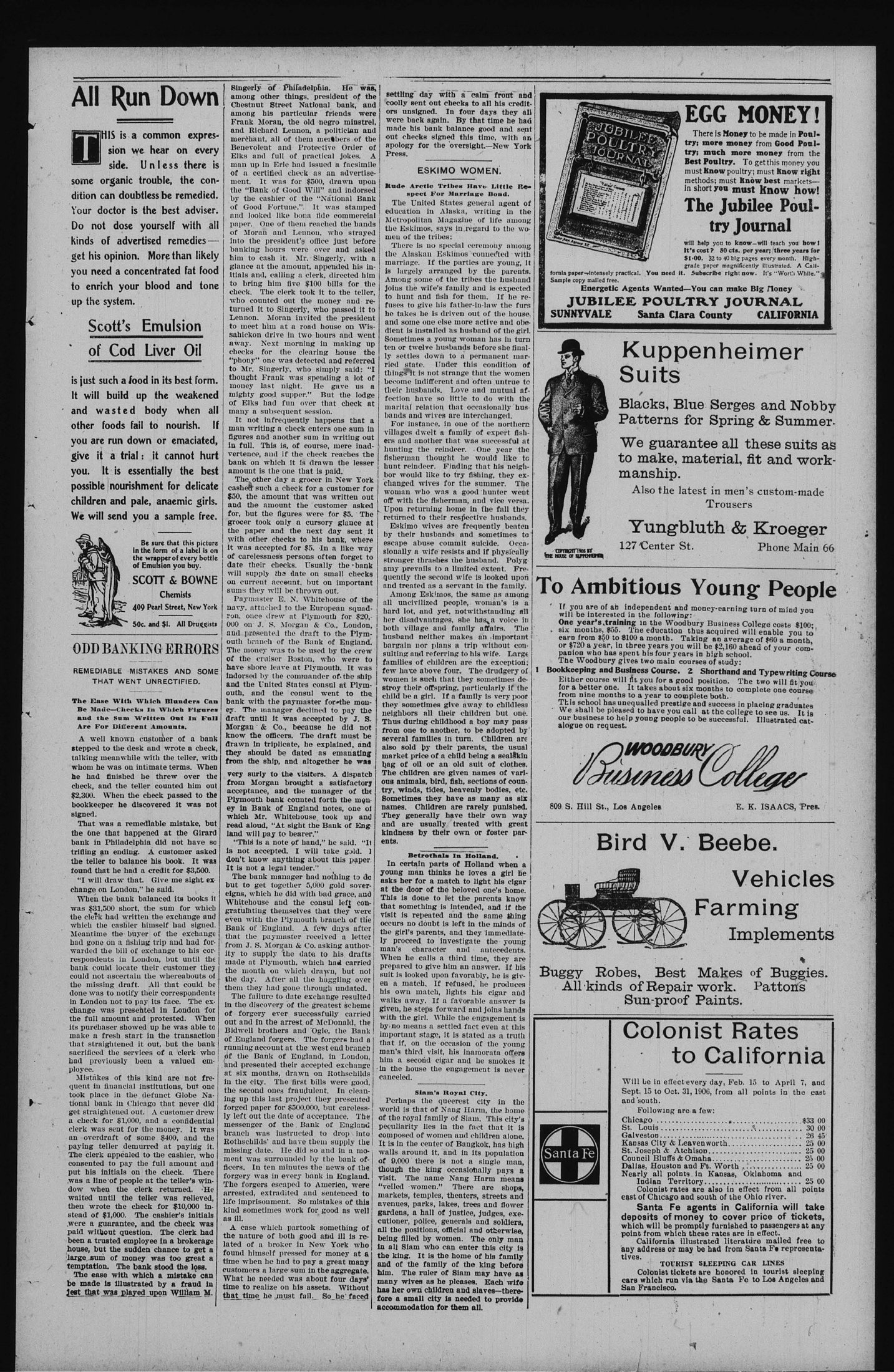
Searchable text
All Run Down
THIS is a common expression we hear on every side. Unless there is some organic trouble, the condition can doubtless be remedied. Your doctor is the best adviser. Do not dose yourself with all kinds of advertised remedies—get his opinion. More than likely you need a concentrated fat food to enrich your blood and tone up the system.
Scott’s Emulsion of Cod Liver Oil
is just such a food in its best form. It will build up the weakened and wasted body when all other foods fail to nourish. If you are run down or emaciated, give it a trial: it cannot hurt you. It is essentially the best possible nourishment for delicate children and pale, anaemic girls.
Singerly of Philadelphia among other things, presides over Chestnut Street National among his particular friend Frank Moran, the old negro and Richard Lennon, a poor merchant, all of them men of Benevolent and Protective Elks and full of practical man up in Erie had issued a certified check as an amendment. It was for $500, due to the “Bank of Good Will” and by the cashier of the “National Good Fortune.” It was and looked like bona fide paper. One of them reached of Moran and Lennon, went into the president's office, banking hours were over him to cash it. Mr. Singer glance at the amount, appen itials and, calling a clerk, decided to bring him five $100 bills check. The clerk took it to who counted out the money turned it to Singerly, who paid Lennon. Moran invited the man to meet him at a road house sahickon drive in two hours away. Next morning in the checks for the clearing "phony" one was detected and to Mr. Singerly, who simply thought Frank was spending money last night. He gave mighty good supper." But of Elks had fun over that many a subsequent session.
It not infrequently happen man writing a check enters figures and another sum in full. This is, of course, vergence, and if the check ran bank on which it is drawn amount is the one that is paid.
The other day a grocer in cashed such a check for a cu $50, the amount that was w and the amount the custo
and wasted body when all other foods fail to nourish. If you are run down or emaciated, give it a trial: it cannot hurt you. It is essentially the best possible nourishment for delicate children and pale, anaemic girls. We will send you a sample free.
Be sure that this picture in the form of a label is on the wrapper of every bottle of Emulsion you buy.
SCOTT & BOWNE Chemists
409 Pearl Street, New York
50c. and $1. All Druggists
ODD BANKING ERRORS
REMEDIABLE MISTAKES AND SOME THAT WENT UNRECTIFIED.
The Ease With Which Blunders Can Be Made—Checks In Which Figures and the Sum Written Out In Full Are For Different Amounts.
A well known customer of a bank stepped to the desk and wrote a check, talking meanwhile with the teller, with whom he was on intimate terms. When he had finished he threw over the check, and the teller counted him out $2,300. When the check passed to the bookkeeper he discovered it was not signed.
That was a remediable mistake, but the one that happened at the Girard bank in Philadelphia did not have so trifling an ending. A customer asked the teller to balance his book. It was found that he had a credit for $3,500.
"I will draw that. Give me sight exchange on London," he said.
When the bank balanced its books it was $31,500 short, the sum for which the clerk had written the exchange and which the cashier himself had signed. Meantime the buyer of the exchange had gone on a fishing trip and had forwarded the bill of exchange to his correspondents in London, but until the bank could locate their customer they
It not infrequently happen man writing a check enters figures and another sum in full. This is, of course, verence, and if the check记 bank on which it is drawn amount is the one that is paid.
The other day a grocer in cashed such a check for a cu$50, the amount that was w and the amount the custor for, but the figures were for grocer took only a cursory of the paper and the next day with other checks to his ba it was accepted for $5. In a of carelessness persons often date their checks. Usually will supply the date on sm on current account, but on sums they will be thrown out.
Paymaster E. N. Whitehouse, attached to the Europe ron, once drew at Plymouth 000 on J. S. Morgan & Co. and presented the draft to south branch of the Bank of The money was to be used by of the cruiser Boston, who have shore leave at Plymouth Indorsed by the commander o and the United States consuouth, and the consul went bank with the paymaster for ey. The manager declined t draft until it was accepted Morgan & Co., because he know the officers. The draft drawn in triplicate, he expla they should be dated as o from the ship, and altogether very surly to the visitors. A from Morgan brought a s acceptance, and the manage Plymouth bank counted forthey in Bank of England not which Mr. Whitehouse too read aloud, "At sight the Ban land will pay to bearer."
"This is a note of hand," he is not accepted. I will tak don't know anything about t It is not a legal tender."
The bank manager had not but to get together 5,000 g eigns, which he did with bad Whitehouse and the consul gratulating themselves that even with the Plymouth brank Bank of England. A few o that the paymaster received from J. S. Morgan & Co. aski ity to supply the date to made at Plymouth, which ha
"I will draw that. Give me sight exchange on London," he said.
When the bank balanced its books it was $31,500 short, the sum for which the clerk had written the exchange and which the cashier himself had signed. Meantime the buyer of the exchange had gone on a fishing trip and had forwarded the bill of exchange to his correspondents in London, but until the bank could locate their customer they could not ascertain the whereabouts of the missing draft. All that could be done was to notify their correspondents in London not to pay its face. The exchange was presented in London for the full amount and protested. When its purchaser showed up he was able to make a fresh start in the transaction that straightened it out, but the bank sacrificed the services of a clerk who had previously been a valued employee.
Mistakes of this kind are not frequent in financial institutions, but one took place in the defunct Globe National bank in Chicago that never did get straightened out. A customer drew a check for $1,000, and a confidential clerk was sent for the money. It was an overdraft of some $400, and the paying teller demurred at paying it. The clerk appealed to the cashier, who consented to pay the full amount and put his initials on the check. There was a line of people at the teller's window when the clerk returned. He waited until the teller was relieved, then wrote the check for $10,000 instead of $1,000. The cashier's initials were a guarantee, and the check was paid without question. The clerk had been a trusted employee in a brokerage house, but the sudden chance to get a large sum of money was too great a temptation. The bank stood the loss.
The ease with which a mistake can be made is illustrated by a fraud in jest that was played upon William M.
of Philadelphia. He was,
other things, president of the
Street National bank, and
his particular friends were
Moran, the old negro minstrel,
Richard Lennon, a politician and
it, all of them members of the
Cent and Protective Order of
full of practical jokes. A
kin Erie had issued a facsimile
certified check as an advertisetion was for $500, drawn upon
bank of Good Will" and indorsed
rashier of the "National Bank
Fortune." It was stamped
like bona fide commercial
One of them reached the hands
in and Lennon, who strayed
from president's office just before
hours were over and asked
to brush it. Mr. Singerly, with a
at the amount, appended his inl, calling a clerk, directed him
him five $100 bills for the
The clerk took it to the teller,
untied out the money and reto Singerly, who passed it to
Moran invited the president
him at a road house on Wisdrive in two hours and went
Next morning in making up
for the clearing house the
one was detected and referred
Singerly, who simply said: "I
Frank was spending a lot of last night. He gave us a good supper." But the lodge had fun over that check at subsequent session.
Infrequently happens that a
ding a check enters one sum in
and another sum in writing out
This is, of course, mere inadand if the check reaches the
which it is drawn the lesser
is the one that is paid.
Other day a grocer in New York
such a check for a customer for
amount that was written out
amount the customer asked
settling day with a calm front and coolly sent out checks to all his creditors unsigned. In four days they all were back again. By that time he had made his bank balance good and sent out checks signed this time, with an apology for the oversight.—New York Press.
ESKIMO WOMEN.
Rude Arctic Tribes Have Little Respect For Marriage Bond.
The United States general agent of education in Alaska, writing in the Metropolitan Magazine of life among the Eskimos, says in regard to the women of the tribes:
There is no special ceremony among the Alaskan Eskimos connected with marriage. If the parties are young, it is largely arranged by the parents. Among some of the tribes the husband joins the wife's family and is expected to hunt and fish for them. If he refuses to give his father-in-law the furs he takes he is driven out of the house, and some one else more active and obedient is installed as husband of the girl. Sometimes a young woman has in turn ten or twelve husbands before she finally settles down to a permanent married state. Under this condition of things it is not strange that the women become indifferent and often untrue to their husbands. Love and mutual affection have so little to do with the marital relation that occasionally husbands and wives are interchanged.
For instance, in one of the northern villages dwelt a family of expert fishers and another that was successful at hunting the reindeer. One year the fisherman thought he would like to hunt reindeer. Finding that his neighbor would like to try fishing, they exchanged wives for the summer. The woman who was a good hunter went off with the fisherman, and vice versa. Upon returning home in the fall they
infrequently happens that a checking a check enters one sum in and another sum in writing out. This is, of course, mere inadvertance and if the check reaches the bank which it is drawn the lesser amount the customer asked for the figures were for $5. The book only a cursory glance at her and the next day sent it to her checks to his bank, where accepted for $5. In a like way business persons often forget to check their checks. Usually the bank only the date on small checks at account, but on important will be thrown out.
Enter E. N. Whitehouse of the reached to the European squadron drew at Plymouth for $20. S. Morgan & Co., London,ented the draft to the Plymouth branch of the Bank of England. It was to be used by the crew of艇 Boston, who were to leave at Plymouth. It was by the commander of the ship United States consul at Plymouth the consul went to the paymaster for the monastery declined to pay the bill it was accepted by J. S. & Co., because he did not officers. The draft must be triplicate, he explained, and should be dated as emanating ship, and altogether he was ready to the visitors. A dispatch organ brought a satisfactory service, and the manager of the bank counted forth the monastery notes, one of Mr. Whitehouse took up and said, "At sight the Bank of England pay to bearer."
A note of hand," he said. "It accepted. I will take gold. I saw anything about this paper a legal tender."
The manager had nothing to do but together 5,000 gold sovereigns he did with bad grace, and seize and the consul left confess themselves that they were at the Plymouth branch of the England. A few days after paymaster received a letter Morgan & Co. asking authorily the date to his drafts Plymouth, which had carried marital relation that occasionally husbands and wives are interchanged.
For instance, in one of the northern villages dwelt a family of expert fishers and another that was successful at hunting the reindeer. One year the fisherman thought he would like to hunt reindeer. Finding that his neighbor would like to try fishing, they exchanged wives for the summer. The woman who was a good hunter went off with the fisherman, and vice versa. Upon returning home in the fall they returned to their respective husbands.
Eskimo wives are frequently beaten by their husbands and sometimes to escape abuse commit suicide. Occasionally a wife resists and if physically stronger thrashes the husband. Polygamy prevails to a limited extent. Frequently the second wife is looked upon and treated as a servant in the family.
Among Eskimos, the same as among all uncivilized people, woman's is a hard lot, and yet, notwithstanding all her disadvantages, she has a voice in both village and family affairs. The husband neither makes an important bargain nor plans a trip without consulting and referring to his wife. Large families of children are the exception; few have above four. The drudgery of women is such that they sometimes destroy their offspring, particularly if the child be a girl. If a family is very poor they sometimes give away to childless neighbors all their children but one. Thus during childhood a boy may pass from one to another, to be adopted by several families in turn. Children are also sold by their parents, the usual market price of a child being a sealskin bag of oil or an old suit of clothes. The children are given names of various animals, bird, fish, sections of country, winds, tides, heavenly bodies, etc. Sometimes they have as many as six names. Children are rarely punished. They generally have their own way and are usually treated with great kindness by their own or foster parents.
Betrothals In Holland.
In certain parts of Holland when a young man thinks he loves a girl he asks her for a match to light his cigar at the door of the beloved one's home. This is done to let the parents know that something is intended, and if the visit is repeated and the same thing occurs no doubt is left in the minds of the girl's parents, and they immediately proceed to investigate the young man's character and antecedents. When he calls a third time, they are prepared to give him an answer. If his
In certain parts of Holland when a young man thinks he loves a girl he asks her for a match to light his cigar at the door of the beloved one's home. This is done to let the parents know that something is intended, and if the visit is repeated and the same thing occurs no doubt is left in the minds of the girl's parents, and they immediately proceed to investigate the young man's character and antecedents. When he calls a third time, they are prepared to give him an answer. If his suit is looked upon favorably, he is given a match. If refused, he produces his own match, lights his cigar and walks away. If a favorable answer is given, he steps forward and joins hands with the girl. While the engagement is by no means a settled fact even at this important stage, it is stated as a truth that if, on the occasion of the young man's third visit, his inamorata offers him a second cigar and he smokes it in the house the engagement is never canceled.
Siam's Royal City.
Perhaps the queerest city in the world is that of Nang Harm, the home of the royal family of Siam. This city's peculiarity lies in the fact that it is composed of women and children alone. It is in the center of Bangkok, has high walls around it, and in its population of 9,000 there is not a single man, though the king occasionally pays a visit. The name Nang Harm means "veiled women." There are shops, markets, temples, theaters, streets and avenues, parks, lakes, trees and flower gardens, a hall of justice, judges, executioner, police, generals and soldiers, all the positions, official and otherwise, being filled by women. The only man in all Siam who can enter this city is the king. It is the home of his family and of the family of the king before him. The ruler of Siam may have as many wives as he pleases. Each wife has her own children and slaves—therefore a small city is needed to provide accommodation for them all.
EGG MONEY!
There is Money to be made in Poultry; more money from Good Poultry; much more money from the Best Poultry. To get this money you must know poultry; must know right methods; must know best markets—in short you must know how!
The Jubilee Poultry Journal
will help you to know—will teach you how! It's cost? 50 cts. per year; three years for $1.00. 32 to 40 big pages every month. High-grade paper magnificently illustrated. A Calla paper→Intensely practical. You need it. Subscribe right now. It's "Worth While." Sample copy mailed free.
Energetic Agents Wanted—You can make Big Money
JUBILEE POULTRY JOURNAL
UNNYVALE Santa Clara County CALIFORNIA
Kuppenheimer Suits
Blacks, Blue Serges and Nobby Patterns for Spring & Summer.
We guarantee all these suits as to make, material, fit and workmanship.
Also the latest in men's custom-made Trousers
Blacks, Blue Serges and Nobby Patterns for Spring & Summer.
We guarantee all these suits as to make, material, fit and workmanship.
Also the latest in men's custom-made Trousers
Yungbluth & Kroeger
127 Center St. Phone Main 66
Ambitious Young People
If you are of an independent and money-earning turn of mind you will be interested in the following:
One year's training in the Woodbury Business College costs $100; six months, $55. The education thus acquired will enable you to earn from $50 to $100 a month. Taking an average of $60 a month, or $720 a year, in three years you will be $2,160 ahead of your companion who has spent his four years in high school.
The Woodbury gives two main courses of study:
1. Keeping and Business Course. 2. Shorthand and Typewriting Course
Either course will fit you for a good position. The two will fit you for a better one. It takes about six months to complete one course from nine months to a year to complete both.
This school has unequalled prestige and success in placing graduates. We shall be pleased to have you call at the college to see us. It is our business to help young people to be successful. Illustrated catalogue on request.
WOODBURY Business College
D. S. Hill St., Los Angeles E. K. ISAACS, Pres.
Bird V. Beebe.
Vehicles Farming
Implements
Vehicles Farming Implements
Ggy Robes, Best Makes of Buggies.
All kinds of Repair work. Pattons
Sun-proof Paints.
Colonist Rates to California
Will be in effect every day, Feb. 15 to April 7, and Sept. 15 to Oct. 31, 1906, from all points in the east and south.
Following are a few:
Chicago ... $33 00
St. Louis ... 30 00
Galveston ... 26 45
Kansas City & Leavenworth ... 25 00
St. Joseph & Atchison ... 25 00
Council Bluffs & Omaha ... 25 00
Dallas, Houston and Ft. Worth ... 25 00
Nearly all points in Kansas, Oklahoma and Indian Territory ... 25 00
Colonist rates are also in effect from all points east of Chicago and south of the Ohio river.
Santa Fe agents in California will take deposits of money to cover price of tickets, which will be promptly furnished to passengers at any point from which these rates are in effect.
California illustrated literature mailed free to any address or may be had from Santa Fe representatives.
TOURIST SLEEPING CAR LINES
Colonist tickets are honored in tourist sleeping cars which run via the Santa Fe to Los Angeles and San Francisco.