anaheim-gazette 1906-02-01
Scanned page
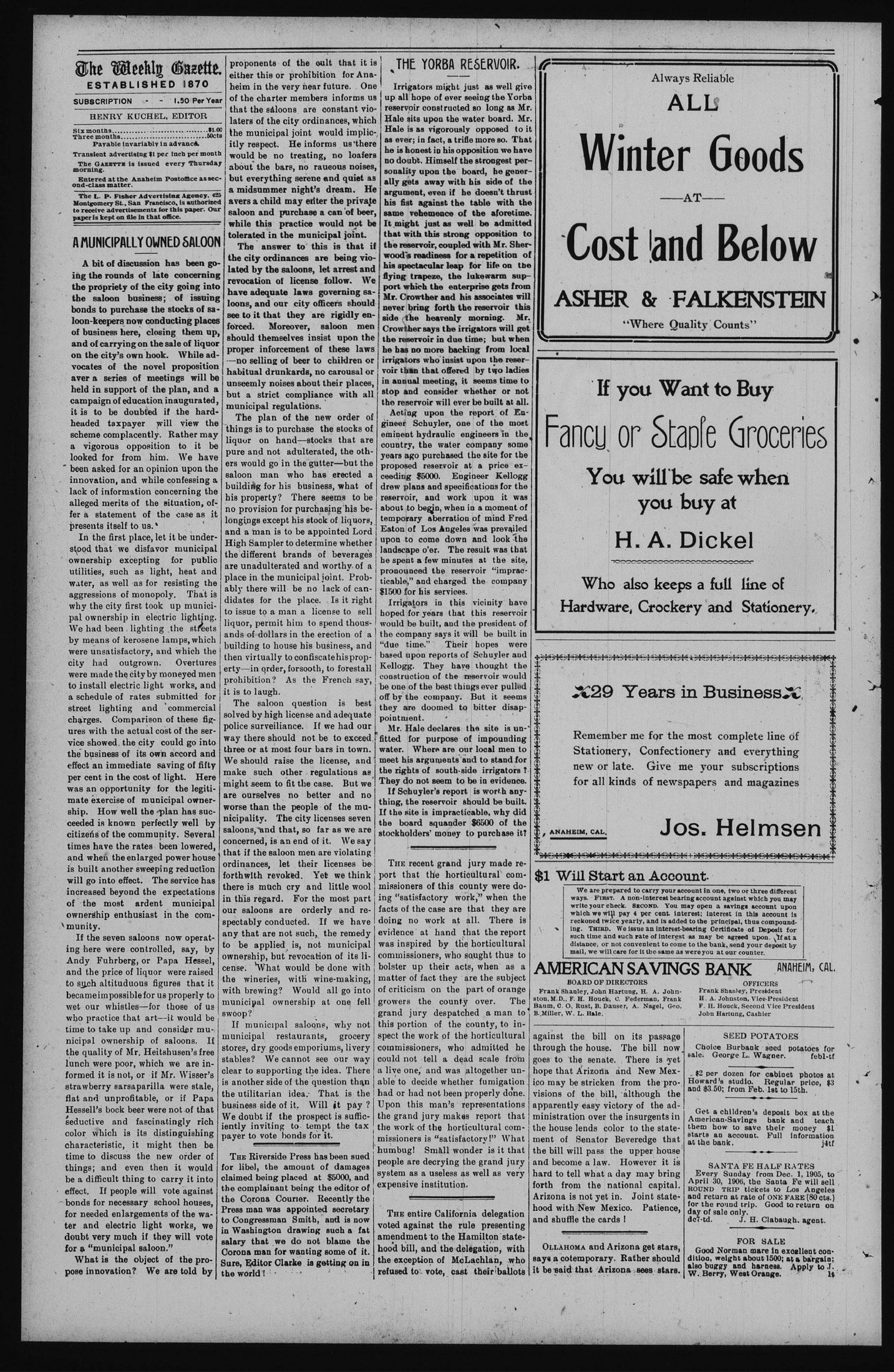
Searchable text
The Weekly Gazette.
ESTABLISHED 1870
SUBSCRIPTION - 1.50 Per Year
HENRY KUCHEL, EDITOR
Six months...$1.00
Three months...50cts
Payable invariably in advance.
Transient advertising $1 per inch per month
The GAZETTE is issued every Thursday morning.
Entered at the Anaheim Postoffice as second-class matter.
The L. P. Fisher Advertising Agency, 425 Montgomery St., San Francisco, is authorized to receive advertisements for this paper. Our paper is kept on file in that office.
A MUNICIPALLY OWNED SALOON
A bit of discussion has been going the rounds of late concerning the propriety of the city going into the saloon business; of issuing bonds to purchase the stocks of saloon-keepers now conducting places of business here, closing them up, and of carrying on the sale of liquor on the city’s own hook. While advocates of the novel proposition aver a series of meetings will be held in support of the plan, and a campaign of education inaugurated, it is to be doubted if the hard-headed taxpayer will view the scheme complacently. Rather may a vigorous opposition to it be looked for from him. We have been asked for an opinion upon the innovation, and while confessing a lack of information concerning the alleged merits of the situation, of proponents of the oult either this or prohibition heim in the very near future of the charter members in that the saloons are conformers of the city ordinances the municipal joint would itly respect. He informs would be no treating, not about the bars, no rauced but everything serene and a midsummer night’s drivers a child may enter the saloon and purchase a cauldron while this practice would tolerated in the municipal.
The answer to this is the city ordinances are lated by the saloons, let revocation of license follow have adequate laws govern saloons, and our city office see to it that they are not forced. Moreover, saloons should themselves insist proper enforcement of the—no selling of beer to chabitual drunkards, no can unseemly noises about the but a strict compliance with municipal regulations.
The plan of the new things is to purchase the liquor on hand—stocks pure and not adulterated ers would go in the gutter saloon man who has building for his business, his property? There seem no provision for purchasing
it is to be doubted if the hard-headed taxpayer will view the scheme complacently. Rather may a vigorous opposition to it be looked for from him. We have been asked for an opinion upon the innovation, and while confessing a lack of information concerning the alleged merits of the situation, offer a statement of the case as it presents itself to us.
In the first place, let it be understood that we disfavor municipal ownership excepting for public utilities, such as light, heat and water, as well as for resisting the aggressions of monopoly. That is why the city first took up municipal ownership in electric lighting. We had been lighting the streets by means of kerosene lamps, which were unsatisfactory, and which the city had outgrown. Overtures were made the city by moneyed men to install electric light works, and a schedule of rates submitted for street lighting and commercial charges. Comparison of these figures with the actual cost of the service showed the city could go into the business of its own accord and effect an immediate saving of fifty per cent in the cost of light. Here was an opportunity for the legitimate exercise of municipal ownership. How well the plan has succeeded is known perfectly well by citizens of the community. Several times have the rates been lowered, and when the enlarged power house is built another sweeping reduction will go into effect. The service has increased beyond the expectations of the most ardent municipal ownership enthusiast in the community.
If the seven saloons now operating here were controlled, say, by Andy Fuhrberg, or Papa Hessel,
is built another sweeping reduction will go into effect. The service has increased beyond the expectations of the most ardent municipal ownership enthusiast in the community.
If the seven saloons now operating here were controlled, say, by Andy Fuhrberg, or Papa Hessel, and the price of liquor were raised to such altituduous figures that it became impossible for us properly to wet our whistles—for those of us who practice that art—it would be time to take up and consider municipal ownership of saloons. If the quality of Mr. Heitshusen's free lunch were poor, which we are informed it is not, or if Mr. Wisser's strawberry sarsaparilla were stale, flat and unprofitable, or if Papa Hessell's bock beer were not of that seductive and fascinatingly rich color which is its distinguishing characteristic, it might then be time to discuss the new order of things; and even then it would be a difficult thing to carry it into effect. If people will vote against bonds for necessary school houses, for needed enlargements of the water and electric light works, we doubt very much if they will vote for a "municipal saloon."
What is the object of the propose innovation? We are told by ordinances, let their licious forthwith revoked. Yet there is much cry and litter in this regard. For the most our saloons are orderly spectably conducted. If any that are not such, the to be applied is, not my ownership, but revocation cense. What would be done the wineries, with wine with brewing? Would all municipal ownership at the swoop?
If municipal saloons, municipal restaurants, stores, dry goods emporium stables? We cannot see clear to supporting the idea is another side of the question the utilitarian idea. That business side of it. Will We doubt if the prospectiently inviting to tempt payer to vote bonds for it.
The Riverside Press has been for libel, the amount of claimed being placed at $50 the complainant being the Corona Courier. Recorder Press man was appointed to Congressman Smith, and in Washington drawing sur salary that we do not blink Corona man for wanting so Sure, Editor Clarke is getting the world!
ments of the oult that it is this or prohibition for Anathe very near future. One charter members informs us the saloons are constant vioof the city ordinances, which municipal joint would implicpect. He informs us there are no treating, no loafers on bars, no raucous noises, everything serene and quiet as summer night's dream. He child may enter the private land purchase a can of beer, his practice would not be held in the municipal joint.
Answer to this is that if ordinances are being violated the saloons, let arrest and possession of license follow. We equate laws governing sale and our city officers should that they are rigidly enforced. Moreover, saloon men themselves insist upon the enforcement of these laws ruling of beer to children or drunkards, no carousal or any noises about their places, strict compliance with all local regulations.
Plan of the new order of law to purchase the stocks of onion hand—stocks that are not adulterated, the other go in the gutter—but the man who has erected a bill for his business, what oferty? There seems to be confusion for purchasing his be-
THE YORBA RESERVOIR.
Irrigators might just as well give up all hope of ever seeing the Yorba reservoir constructed so long as Mr. Hale sits upon the water board. Mr. Hale is as vigorously opposed to it as ever; in fact, a trifle more so. That he is honest in his opposition we have no doubt. Himself the strongest personality upon the board, he generally gets away with his side of the argument, even if he doesn't thrust his fist against the table with the same vehemence of the aforetime. It might just as well be admitted that with this strong opposition to the reservoir, coupled with Mr. Sherwood's readiness for a repetition of his spectacular leap for life on the flying trapeze, the lukewarm support which the enterprise gets from Mr. Crowther and his associates will never bring forth the reservoir this side (the heavenly morning). Mr. Crowther says the irrigators will get the reservoir in due time; but when he has no more backing from local irrigators who insist upon the reservoir than that offered by two ladies in annual meeting, it seems time to stop and consider whether or not the reservoir will ever be built at all.
Acting upon the report of Engineer Schuyler, one of the most eminent hydraulic engineers in the country, the water company some years ago purchased the site for the proposed reservoir at a price exceeding $5000. Engineer Kellogg drew plans and specifications for the reservoir, and work upon it was about to begin, when in a moment of
Acting upon the report of Engineer Schuyler, one of the most eminent hydraulic engineers in the country, the water company some years ago purchased the site for the proposed reservoir at a price exceeding $5000. Engineer Kellogg drew plans and specifications for the reservoir, and work upon it was about to begin, when in a moment of temporary aberration of mind Fred Eaton of Los Angeles was prevailed upon to come down and look the landscape o’er. The result was that he spent a few minutes at the site, pronounced the reservoir “impracticable,” and charged the company $1500 for his services.
Irrigators in this vicinity have hoped for years that this reservoir would be built, and the president of the company says it will be built in “due time.” Their hopes were based upon reports of Schuyler and Kellogg. They have thought the construction of the reservoir would be one of the best things ever pulled off by the company. But it seems they are doomed to bitter disappointment.
Mr. Hale declares the site is unfitted for purpose of impounding water. Where are our local men to meet his arguments and to stand for the rights of south-side irrigators? They do not seem to be in evidence.
If Schuyler’s report is worth anything, the reservoir should be built. If the site is impracticable, why did the board squander $6500 of the stockholders’ money to purchase it?
The recent grand jury made report that the horticultural commissioners of this county were doing “satisfactory work,” when the facts of the case are that they are doing no work at all. There is evidence at hand that the report was inspired by the horticultural commissioners, who sought thus to bolster up their acts, when as a
The recent grand jury made report that the horticultural commissioners of this county were doing "satisfactory work," when the facts of the case are that they are doing no work at all. There is evidence at hand that the report was inspired by the horticultural commissioners, who sought thus to bolster up their acts, when as a matter of fact they are the subject of criticism on the part of orange growers the county over. The grand jury despatched a man to this portion of the county, to inspect the work of the horticultural commissioners, who admitted he could not tell a dead scale from a live one, and was altogether unable to decide whether fumigation had or had not been properly done. Upon this man's representations the grand jury makes report that the work of the horticultural commissioners is "satisfactory!" What humbug! Small wonder is it that people are decrying the grand jury system as a useless as well as very expensive institution.
The entire California delegation voted against the rule presenting amendment to the Hamilton statehood bill, and the delegation, with the exception of McLachlan, who refused to vote, cast their ballots
$1 Will Start a
We are prepared ways. First. A new write your check which we will pay reckoned twice year ing. Third. We in such time and such distance, or not com mail, we will care for
AMERICAN S
BOARD OF DIRECTOR
Frank Shanley, John Hartunston, M.D., F. H. Houck, C. Fe Baum, C. O., Rust, B. Dauser, B. Miller, W. L. Hale.
against the bill on through the house. The goes to the senate. The hope that Arizona and ico may be stricken from visions of the bill, all apparently easy victory ministration over the in the house lends color ment of Senator Beve the bill will pass the u and become a law. Ho hard to tell what a day forth from the nation Arizona is not yet in. hood with New Mexico and shuffle the cards!
OLLAHOMA and Arizona says a cotemporary. Ra it be said that Arizona
Always Reliable
ALL
Winter Goods
AT
Cost and Below
ASHER & FALKENSTEIN
"Where Quality Counts"
If you Want to Buy
Fancy or Staple Groceries
You will be safe when
you buy at
Fancy or Staple Groceries
You will be safe when you buy at
H. A. Dickel
Who also keeps a full line of
Hardware, Crockery and Stationery.
29 Years in Business
Remember me for the most complete line of
Stationery, Confectionery and everything
new or late. Give me your subscriptions
for all kinds of newspapers and magazines
Jos. Helmsen
Will Start an Account.
We are prepared to carry your account in one, two or three different ways. First. A non-interest bearing account against which you may write your check. Second. You may open a savings account upon which we will pay 4 per cent. interest; interest in this account is reckoned twice yearly, and is added to the principal, thus compounding. Third. We issue an interest-bearing Certificate of Deposit for such time and such rate of interest as may be agreed upon. If at a distance, or not convenient to come to the bank, send your deposit by mail, we will care for it the same as were you at our counter.
Will Start an Account.
We are prepared to carry your account in one, two or three different ways. First. A non-interest bearing account against which you may write your check. Second. You may open a savings account upon which we will pay 4 per cent. interest; interest in this account is reckoned twice yearly, and is added to the principal, thus compounding. Third. We issue an interest-bearing Certificate of Deposit for such time and such rate of interest as may be agreed upon. If at a distance, or not convenient to come to the bank, send your deposit by mail, we will care for it the same as were you at our counter.
AMERICAN SAVINGS BANK ANAHEIM, CAL.
BOARD OF DIRECTORS
Shanley, John Hartung, H. A. John-D., F. H. Houck, C. Federman, Frank O. Rust, B. Dauser, A. Nagel, Geo. W. L. Hale.
OFFICERS
Frank Shanley, President
H. A. Johnston, Vice-President
F. H. Houck, Second Vice President
John Hartung, Cashier
At the bill on its passage with the house. The bill now goes to the senate. There is yet what Arizona and New Mexico be stricken from the provisions of the bill, although theently easy victory of the adoration over the insurgents in house lends color to the state-of Senator Beveredge that will pass the upper house become a law. However it is so tell what a day may bring from the national capital. Arizona is not yet in. Joint state-with New Mexico. Patience, ruffle the cards!
Oklahoma and Arizona get stars, contemporary. Rather should aid that Arizona sees stars.
SEED POTATOES
Choice Burbank seed potatoes for sale. George L. Wagner. feb1-tf
$2 per dozen for cabinet photos at Howard's studio. Regular price, $3 and $3.50; from Feb. 1st to 15th.
Get a children's deposit box at the American-Savings bank and teach them how to save their money $1 starts an account. Full information at the bank.
SANTA FE HALF RATES
Every Sunday from Dec. 1, 1905, to April 30, 1906, the Santa Fe will sell ROUND TRIP tickets to Los Angeles and return at rate of ONE FARE (80 cts.) for the round trip. Good to return on day of sale only.
dc7-td. J. H. Clabaugh, agent.
FOR SALE
Good Norman mare in excellent condition, weight about 1500; at a bargain; also buggy and harness. Apply to J. W. Berry, West Orange.