anaheim-gazette 1906-02-01
Scanned page
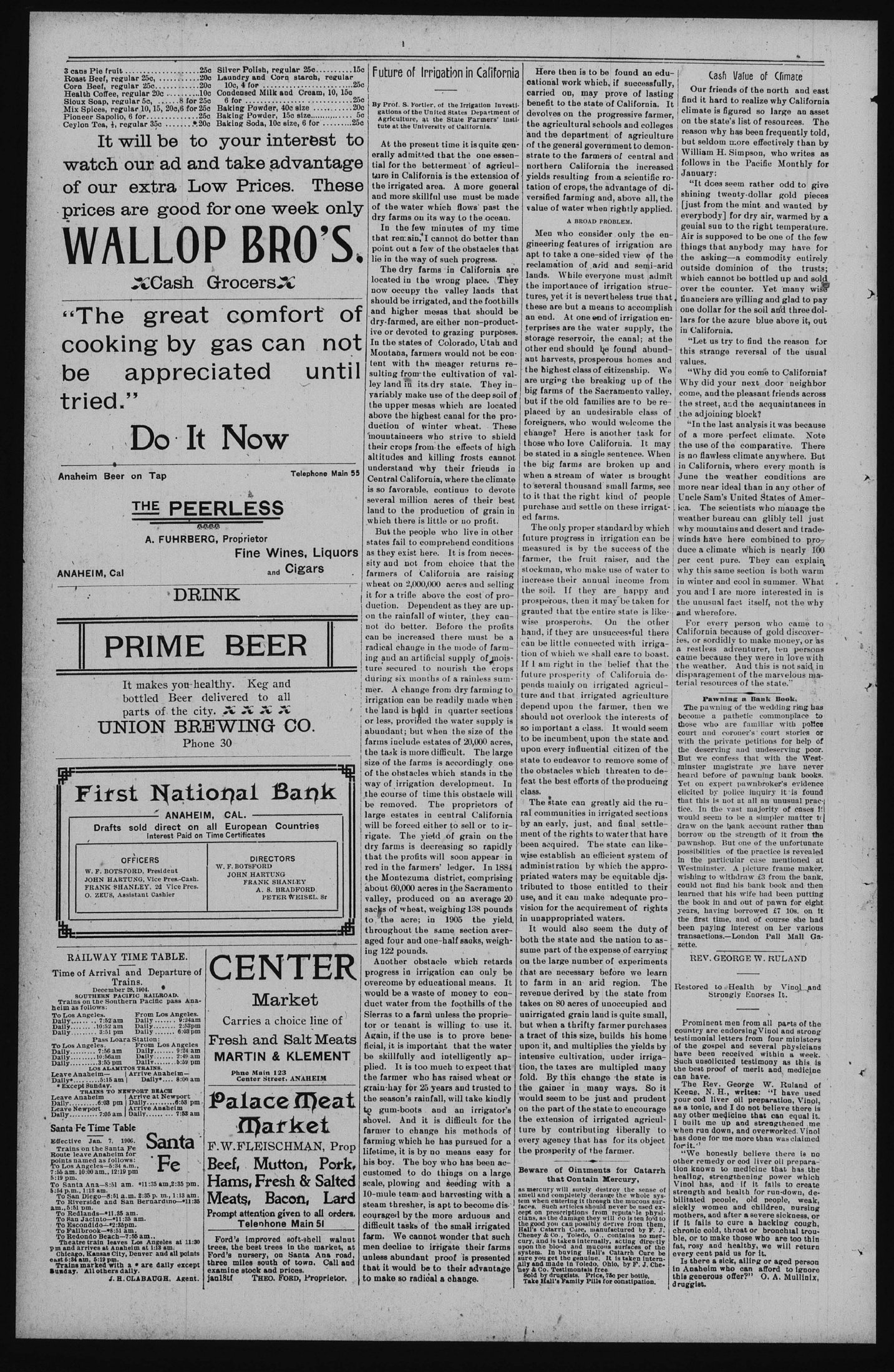
Searchable text
3 cans Pie fruit ... 25c
Roast Beef, regular 25c, ... 20c
Corn Beef, regular 25c... 20c
Health Coffee, regular 20c ...10c
Sioux Soap, regular 5c, ...8 for 25c
Mix Spices, regular 10, 15, 20c,6 for 25c
Pioneer Sapolio, 6 for ...25c
Ceylon Tea, ¼, regular 35c ...20c
Silver Polish, regular 25c...
Laundry and Corn starch, re10c, 4 for
Condensed Milk and Cream, 10
6 for
Baking Powder, 40c size
Baking Powder, 15c size
Baking Soda, 10c size, 6 for
It will be to your interest
watch our ad and take advantage
of our extra Low Prices. The
prices are good for one week o
WALLOP BRO'S
Cash Grocers
"The great comfort
cooking by gas can n
be appreciated un
tried."
Do It Now
Anaheim Beer on Tap
Telephone M
THE PEERLESS
Do It Now
Anaheim Beer on Tap
Telephone
THE PEERLESS
A. FUHRBERG, Proprietor
Fine Wines, Liquors
ANAHEIM, Cal
and Cigars
DRINK
PRIME BEER
It makes you healthy. Keg and bottled Beer delivered to all parts of the city.
UNION BREWING CO.
Phone 30
First National Bank
ANAHEIM, CAL.
Drafts sold direct on all European Countries
Interest Paid on Time Certificates
OFFICERS
W. F. BOTSFORD, President
JOHN HARTUNG, Vice Pres.-Cash.
FRANK SHANLEY, 2d Vice Pres.
O. ZEUS, Assistant Cashier
DIRECTORS
W. F. BOTSFORD
JOHN HARTUNG
FRANK SHANLEY
A. 8. BRADFORD
PETER WEISEL, Sr
RAILWAY TIME TABLE.
RAILWAY TIME TABLE.
Time of Arrival and Departure of Trains.
December 28, 1904.
SOUTHERN PACIFIC RAILROAD.
Trains on the Southern Pacific pass Anaheim as follows:
To Los Angeles. From Los Angeles.
Daily... 7:52 am Daily... 9:24 am
Daily... 10:52 am Daily... 2:53 pm
Daily... 3:51 pm Daily... 6:03 pm
Pass Loara Station:
To Los Angeles. From Los Angeles
Daily... 7:56 am Daily... 9:24 am
Daily... 10:56 am Daily... 2:49 am
Daily... 3:55 pm Daily... 5:59 pm
LOS ALAMITOS TRAINS.
Leave Anaheim— Arrive Anaheim—
Daily*... 5:15 am Daily*... 8:00 am
* Except Sunday.
TRAINS TO NEWPORT BEACH
Leave Anaheim Arrive at Newport
Daily... 6:03 pm Daily... 6:58 pm
Leave Newport Arrive Anaheim
Daily... 7:05 am Daily... 7:53 am
Santa Fe Time Table
Effective Jan. 7, 1906.
Trains on the Santa Fe Route leave Anaheim for points named as follows:
To Los Angeles—5:34 a.m., 7:55 a.m., 10:00 a.m., 12:19 p.m,
5:19 p.m.
To Santa Ana—8:51 a.m. *11:35 am, 2:35 p.m.
5:54 p.m., 1:13 a.m.
To San Diego—8:51 a.m. 2:35 p.m., 1:13 a.m.
To Riverside and San Bernardino—*11:35 a.m., 5:51 p.m.
To Redlands—*11:35 a.m.
To San Jacinto—*11:35 a.m.
To Escondido—*2:35 p.m.
To Fallbrook—*8:51 a.m.
To Redondo Beach—7:55 a.m..
Theatre train leaves Los Angeles at 11:30 p.m and arrives at Anaheim at 1:13 a.m.
Chicago, Kansas City, Denver and all points east at 6:34 a.m., 5:19 ppm.
Trains marked with a * are daily except Sunday. All others daily.
J. H. CLABAUGH, Agent.
Future of Irrigation in California
By Prof. S. Fortier, of the Irrigation Investigations of the United States Department of Agriculture, at the State Farmers' Institute at the University of California.
At the present time it is quite generally admitted that the one essential for the betterment of agriculture in California is the extension of the irrigated area. A more general and more skillful use must be made of the water which flows past the dry farms on its way to the ocean.
In the few minutes of my time that remain, I cannot do better than point out a few of the obstacles that lie in the way of such progress.
The dry farms in California are located in the wrong place. They now occupy the valley lands that should be irrigated, and the foothills and higher mesas that should be dry-farmed, are either non-productive or devoted to grazing purposes. In the states of Colorado, Utah and Montana, farmers would not be content with the meager returns resulting from the cultivation of valley land in its dry state. They invariably make use of the deep soil of the upper mesas which are located above the highest canal for the production of winter wheat. These mountaineers who strive to shield their crops from the effects of high altitudes and killing frosts cannot understand why their friends in Central California, where the climate is so favorable, continue to devote several million acres of their best land to the production of grain in
Here then is to be found cational work which, if carried on, may prove a benefit to the state of California devolves on the progress of the agricultural schools and the department of agriculture of the general government.
Strate to the farmers of northern California the yields resulting from a scitation of crops, the advantage versified farming and, about value of water when rightly A BROAD PROBLEM.
Men who consider only gineering features of irrigation apt to take a one-sided view reclamation of arid and lands. While everyone must the importance of irrigation tures, yet it is nevertheless these are but a means to an end. At one end of irriterprises are the water storage reservoir, the can other end should be found harvests, prosperous he highest class of citizens are urging the breaking big farms of the Sacramento but if the old families are placed by an undesirable foreigners, who would well change? Here is another those who love California. be stated in a single sentence the big farms are broken when a stream of water is to several thousand small to it that the right kind of purchase and settle on these
Telephone Main 55
Wines, Liquors and Cigars
But the people who live in other states fail to comprehend conditions as they exist here. It is from necessity and not from choice that the farmers of California are raising wheat on 2,000,000 acres and selling it for a trifle above the cost of production. Dependent as they are upon the rainfall of winter, they cannot do better. Before the profits can be increased there must be a radical change in the mode of farming and an artificial supply of moisture secured to nourish the crops during six months of a rainless summer. A change from dry farming to irrigation can be readily made when the land is held in quarter sections or less, provided the water supply is abundant; but when the size of the farms include estates of 20,000 acres, the task is more difficult. The large size of the farms is accordingly one of the obstacles which stands in the way of irrigation development. In the course of time this obstacle will be removed. The proprietors of large estates in central California will be forced either to sell or to irrigate. The yield of grain on the dry farms is decreasing so rapidly that the profits will soon appear in red in the farmers’ ledger. In 1884 the Montezuma district, comprising about 60,000 acres in the Sacramento valley, produced on an average 20 sacks of wheat, weighing 138 pounds to the acre; in 1905 the yield throughout the same section averaged four and one-half sacks, weighing 122 pounds.
Another obstacle which retards the upper mesas which are located above the highest canal for the production of winter wheat. These mountaineers who strive to shield their crops from the effects of high altitudes and killing frosts cannot understand why their friends in Central California, where the climate is so favorable, continue to devote several million acres of their best land to the production of grain in which there is little or no profit.
The only proper standard future progress in irrigation measured is by the success farmer, the fruit raiser, stockman, who make use of increase their annual income the soil. If they are hard prosperous, then it may be granted that the entire state wise prosperous. On the hand, if they are unsuccessful can be little connected with tion of which we shall care. If I am right in the belief future prosperity of California pends mainly on irrigated nature and that irrigated age depend upon the farmer, should not overlook the importance a class. It would be incumbent upon the state upon every influential citizen state to endeavor to remove the obstacles which threaten feat the best efforts of the public class.
The state can greatly aid rural communities in irrigated by an early, just, and final administration by which the prized waters may be equituted to those entitled to use, and it can make adequate vision for the acquirement of in unappropriated waters.
It would also seem that both the state and the nation sum part of the expense of on the large number of expired farms.
In 1884 the Montezuma district, comprising about 60,000 acres in the Sacramento valley, produced on an average 20 sacks of wheat, weighing 138 pounds to the acre; in 1905 the yield throughout the same section averaged four and one-half sacks, weighing 122 pounds.
Another obstacle which retards progress in irrigation can only be overcome by educational means. It would be a waste of money to conduct water from the foothills of the Sierras to a farm unless the proprietor or tenant is willing to use it. Again, if the use is to prove beneficial, it is important that the water be skillfully and intelligently applied. It is too much to expect that the farmer who has raised wheat or grain-hay for 25 years and trusted to the season's rainfall, will take kindly to gum-boots and an irrigator's shovel. And it is difficult for the farmer to change his methods of farming which he has pursued for a lifetime, it is by no means easy for his boy. The boy who has been accustomed to do things on a large scale, plowing and seeding with a 10-mule team and harvesting with a steam thresher, is apt to become discouraged by the more arduous and difficult tasks of the small irrigated farm. We cannot wonder that such men decline to irrigate their farms unless abundant proof is presented that it would be to their advantage to make so radical a change.
Beware of Ointments for that Contain Mercury
as mercury will surely destroy the smell and completely derange the worm when entering it through the mouth. Such articles should never be accepted on prescriptions from reputable clans, as the damage they will do is the good you can possibly derive from Hall's Catarrh Cure, manufactured by Cheney & Co., Toledo, O... contain mercury, and is taken internally, acting upon the blood and mucous surface system. In buying Hall's Catarrh cure you get the genuine. It is taken ally and made in Toledo, Ohio, by Cheney & Co. Testimontals free.
Sold by druggists. Price, 75c per lb.
Take Hall's Family Pills for constipation by which the prized waters may be equitably tributed to those entitled to use, and it can make adequate vision for the acquirement of in unappropriated waters.
It would also seem that both the state and the nation sume part of the expense of on the large number of expenses that are necessary before we to farm in an arid region revenue derived by the state takes on 80 acres of unoccupied unirrigated grain land is quiet but when a thrifty farmer puts a tract of this size, builds upon it, and multiplies the intensive cultivation, under tion, the taxes are multiple fold. By this change the gainer in many ways would seem to be just and on the part of the state to end the extension of irrigated nature by contributing liberty every agency that has for it the prosperity of the farmer.
when is to be found an eduwork which, if successfully,
on, may prove of lasting
to the state of California. It
on the progressive farmer,
cultural schools and colleges
department of agriculture
general government to demonthe farmers of central and
California the increased
resulting from a scientific rocrops, the advantage of difarming and, above all, the
water when rightly applied.
A BROAD PROBLEM.
who consider only the eng features of irrigation are
like a one-sided view of the
union of arid and semi-arid
While everyone must admit
importance of irrigation structure it is nevertheless true that
but a means to accomplish
At one end of irrigation enare the water supply, the
preservoir, the canal; at the
should be found abundests, prosperous homes and
best class of citizenship. We
the breaking up of the
of the Sacramento valley,
the old families are to be rery an undesirable class of
ers, who would welcome the
Here is another task for
to love California. It may
in a single sentence. When
farms are broken up and
stream of water is brought
thousand small farms, see
the right kind of people
and settle on these irrigat-
Cash Value of Climate
Our friends of the north and east find it hard to realize why California climate is figured so large an asset on the state's list of resources. The reason why has been frequently told, but seldom more effectively than by William H. Simpson, who writes as follows in the Pacific Monthly for January:
"It does seem rather odd to give shining twenty-dollar gold pieces [just from the mint and wanted by everybody] for dry air, warmed by a genial sun to the right temperature. Air is supposed to be one of the few things that anybody may have for the asking—a commodity entirely outside dominion of the trusts; which cannot be bottled up and sold over the counter. Yet many wise financiers are willing and glad to pay one dollar for the soil and three dollars for the azure blue above it, out in California.
"Let us try to find the reason for this strange reversal of the usual values.
"Why did you come to California? Why did your next door neighbor come, and the pleasant friends across the street, and the acquaintances in the adjoining block?
"In the last analysis it was because of a more perfect climate. Note the use of the comparative. There is no flawless climate anywhere. But in California, where every month is June the weather conditions are more near ideal than in any other of Uncle Sam's United States of America. The scientists who manage the
by an undesirable class of
farmers, who would welcome the
Here is another task for
to love California. It may
be in a single sentence. When
farms are broken up and
stream of water is brought
almost small farms, see
the right kind of people
and settle on these irrigatly proper standard by which
progress in irrigation can be
is by the success of the
fruit raiser, and the
who make use of water to
their annual income from
If they are happy and
us, then it may be taken for
that the entire state is likeserious. On the other
they are unsuccessful there
tle connected with irrigawhich we shall care to boast.
Right in the belief that the
prosperity of California denily on irrigated agriculthat irrigated agriculture
upon the farmer, then we
not overlook the interests of
plant a class. It would seem
ambent upon the state and
any influential citizen of the
endeavor to remove some of
cles which threaten to dedest efforts of the producing
state can greatly aid the ruunities in irrigated sections
y, just, and final settlethe rights to water that have
died. The state can liklish an efficient system of
ation by which the approaters may be equitable disto those entitled to their
it can make adequate prothe acquirement of rights
appropriated waters.
And also seem the duty of
state and the nation to asof the expense of carrying
large number of experiments
"In the last analysis it was because
of a more perfect climate. Note
the use of the comparative. There
is no flawless climate anywhere. But
in California, where every month is
June the weather conditions are
more near ideal than in any other of Uncle Sam's United States of America. The scientists who manage the weather bureau can glibly tell just why mountains and desert and trade-winds have here combined to produce a climate which is nearly 100 per cent pure. They can explain why this same section is both warm in winter and cool in summer. What you and I are more interested in is the unusual fact itself, not the why and wherefore.
For every person who came to California because of gold discoveries, or sordidly to make money, or as a restless adventurer, ten persons came because they were in love with the weather. And this is not said in disparagement of the marvelous material resources of the state."
Pawning a Bank Book.
The pawning of the wedding ring has become a pathetic commonplace to those who are familiar with police court and coroner's court stories or with the private petitions for help of the deserving and undeserving poor. But we confess that with the Westminster magistrate we have never heard before of pawning bank books. Yet on expert pawnbroker's evidence elicited by police inquiry it is found that this is not at all an unusual practice. In the vast majority of cases it would seem to be a simpler matter to draw on the bank account rather than borrow on the strength of it from the pawnshop. But one of the unfortunate possibilities of the practice is revealed in the particular case mentioned at Westminster. A picture frame maker, wishing to withdraw £3 from the bank, could not find his bank book and then learned that his wife had been putting the book in and out of pawn for eight years, having borrowed £7 10s. on it the first time, and of course she had been paying interest on her various transactions.—London Pall Mall Gazette.
REV. GEORGE W. RULAND
REV. GEORGE W. RULAND
Restored to Health by Vinol and Strongly Enorses It.
Prominent men from all parts of the country are endorsing Vinol and strong testimonial letters from four ministers of the gospel and several physicians have been received within a week. Such unsolicited testimony as this is the best proof of merit and medicine can have.
The Rev. George W. Ruland of Keene, N. H., writes: "I have used your cod liver oil preparation, Vinol, as a tonic, and I do not believe there is any other medicine that can equal it. I built me up and strengthened me when run down, and overworked. Vinol has done for me more than was claimed for it."
"We honestly believe there is no other remedy or cod liver oil preparation known to medicine that has the healing, strengthening power which Vinol has, and if it fails to create strength and health for run-down, debilitated people, old people, weak, sickly women and children, nursing mothers, and after a severe sickness, or if it fails to cure a hacking cough, chronic cold, throat or bronchial trouble, or to make those who are too thin fat, rosy and healthy, we will return every cent paid us for it.
Is there a sick, ailing or aged person in Anaheim who can afford to ignore this generous offer?" O. A. Mullinix, druggist.