anaheim-gazette 1905-11-16
Scanned page
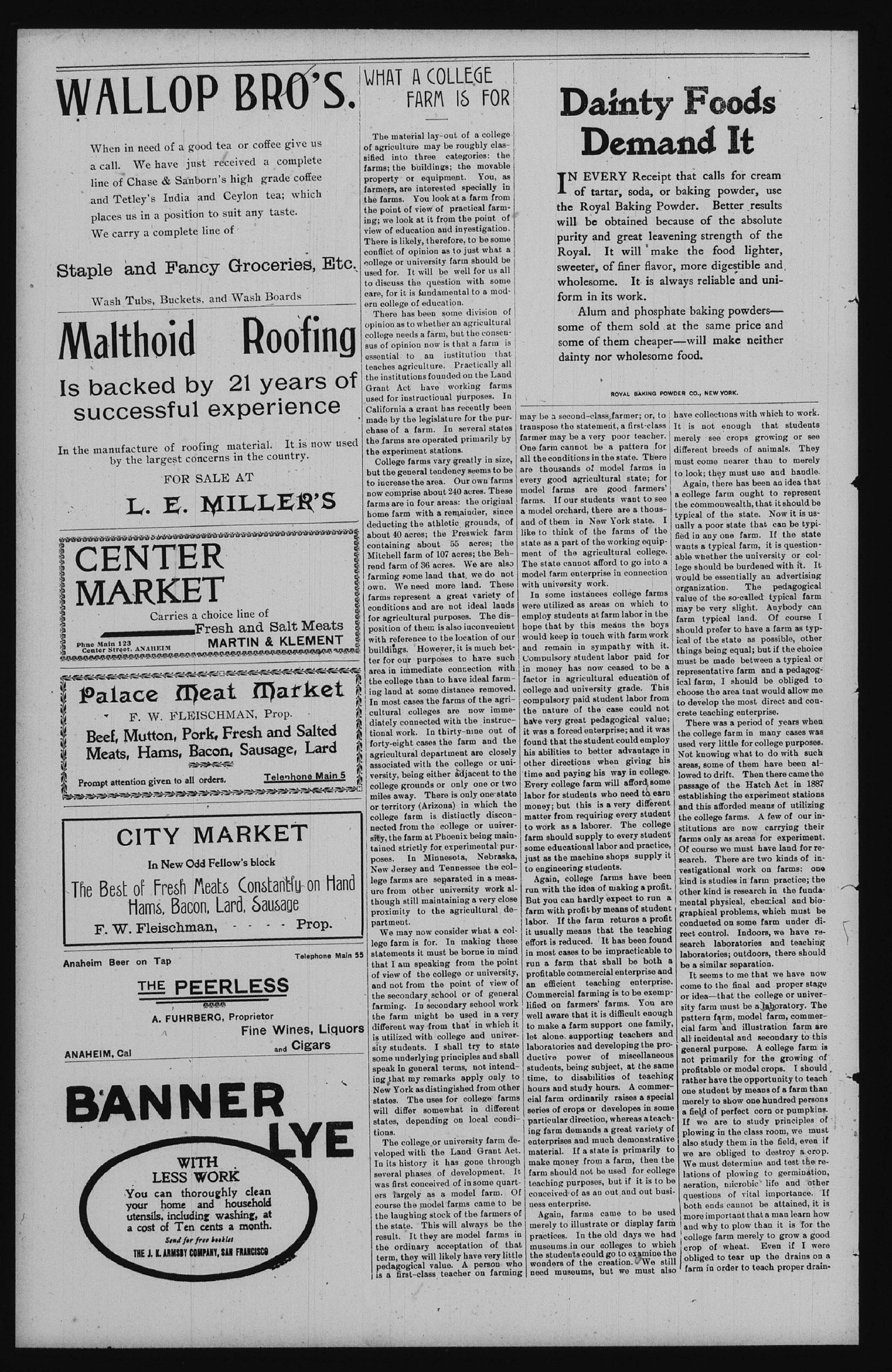
Searchable text
WALLOP BRO'S
When in need of a good tea or coffee give us a call. We have just received a complete line of Chase & Sanborn's high grade coffee and Tetley's India and Ceylon tea; which places us in a position to suit any taste.
We carry a complete line of
Staple and Fancy Groceries,
Wash Tubs, Buckets, and Wash Boards
Malthoid Roofing
Is backed by 21 years successful experience
In the manufacture of roofing material. It is now by the largest concerns in the country.
FOR SALE AT
L. E. MILLER'S
successful experience
In the manufacture of roofing material. It is now
by the largest concerns in the country.
FOR SALE AT
L. E. MILLER'S
CENTER
MARKET
Carries a choice line of
Fresh and Salt Meat
Phne Main 123
Center Street, ANAHEIM
MARTIN & KLEMEN
Palace Meat Market
F. W. FLEISCHMAN, Prop.
Beef, Mutton, Pork, Fresh and Salted
Meats, Hams, Bacon, Sausage, Lard
Prompt attention given to all orders.
Telephone Main
CITY MARKET
In New Odd Fellow's block
The Best of Fresh Meats Constantly on H
Hams, Bacon, Lard, Sausage
F. W. Fleischman,
Telephone
Anaheim Beer on Tap
In New Odd Fellow's block
The Best of Fresh Meats Constantly on Hams, Bacon, Lard, Sausage
F. W. Fleischman, Prop.
Anaheim Beer on Tap Telephone
THE PEERLESS
A. FUHRBERG, Proprietor
Fine Wines, Licenses
ANAHEIM, Cal and Cigars
BANNER
WITH
LESS WORK
You can thoroughly clean your home and household utensils, including washing, at a cost of Ten cents a month.
Send for free booklet
THE J. K. ARMSBY COMPANY, SAN FRANCISCO
RO'S.
WHAT A COLLEGE FARM IS FOR
The material lay-out of a college of agriculture may be roughly classified into three categories: the farms; the buildings; the movable property or equipment. You, as farmers, are interested specially in the farms. You look at a farm from the point of view of practical farming; we look at it from the point of view of education and investigation. There is likely, therefore, to be some conflict of opinion as to just what a college or university farm should be used for. It will be well for us all to discuss the question with some care, for it is fundamental to a modern college of education.
There has been some division of opinion as to whether an agricultural college needs a farm, but the consensus of opinion now is that a farm is essential to an institution that teaches agriculture. Practically all the institutions founded on the Land Grant Act have working farms used for instructional purposes. In California a grant has recently been made by the legislature for the purchase of a farm. In several states the farms are operated primarily by the experiment stations.
College farms vary greatly in size, but the general tendency seems to be to increase the area. Our own farms now comprise about 240 acres. These farms are in four areas: the original farm with a remainder since
Dairy Den
IN EVERY OF tartar, so the Royal Bail will be obtain purity and great Royal. It will sweeter, of fine wholesome. form in its wo
Alum and some of them some of them dainty nor wh
ROYAL
California a grant has recently been made by the legislature for the purchase of a farm. In several states the farms are operated primarily by the experiment stations.
College farms vary greatly in size, but the general tendency seems to be to increase the area. Our own farms now comprise about 240 acres. These farms are in four areas: the original home farm with a remainder, since deducting the athletic grounds, of about 40 acres; the Preswick farm containing about 55 acres; the Mitchell farm of 107 acres; the Behrend farm of 36 acres. We are also farming some land that we do not own. We need more land. These farms represent a great variety of conditions and are not ideal lands for agricultural purposes. The disposition of them is also inconvenient with reference to the location of our buildings. However, it is much better for our purposes to have such area in immediate connection with the college than to have ideal farming land at some distance removed. In most cases the farms of the agricultural colleges are now immediately connected with the instructional work. In thirty-nine out of forty-eight cases the farm and the agricultural department are closely associated with the college or university, being either adjacent to the college grounds or only one or two miles away. There is only one state or territory (Arizona) in which the college farm is distinctly disconnected from the college or university, the farm at Phoenix being maintained strictly for experimental purposes. In Minnesota, Nebraska, New Jersey and Tennessee the college farms are separated in a measure from other university work although still maintaining a very close proximity to the agricultural department.
We may now consider what a college farm is for. In making these statements it must be borne in mind that I am speaking from the point may be a second-class farmer transpose the statement, a far farmer may be a very poor farmer. One farm cannot be a pathetic all the conditions in the state are thousands of model farms every good agricultural school models farms are good farms. If our students want a model orchard, there are and of them in New York like to think of the farm state as a part of the working of the agricultural industry. The state cannot afford to model farm enterprise in cooperation with university work.
In some instances colleges were utilized as areas on the employ students at farm labor hope that by this means they would keep in touch with faculty and remain in sympathy. Compulsory student labor in money has now ceased factor in agricultural education college and university graduate compulsory paid student labor the nature of the case we have very great pedagogic it was a forced enterprise; and found that the student could his abilities to better advance other directions when given time and paying his way in Every college farm will affect labor for students who need money; but this is a very matter from requiring even to work as a laborer. The farm should supply to every some educational labor and just as the machine shops to engineering students.
Again, college farms have run with the idea of making But you can hardly expect farm with profit by means of labor. If the farm returns it usually means that the effort is reduced. It has been in most cases to be improved run a farm that shall
New Jersey and Tennessee the college farms are separated in a measure from other university work although still maintaining a very close proximity to the agricultural department.
We may now consider what a college farm is for. In making these statements it must be borne in mind that I am speaking from the point of view of the college or university, and not from the point of view of the secondary school or of general farming. In secondary school work the farm might be used in a very different way from that in which it is utilized with college and university students. I shall try to state some underlying principles and shall speak in general terms, not intending that my remarks apply only to New York as distinguished from other states. The uses for college farms will differ somewhat in different states, depending on local conditions.
The college or university farm developed with the Land Grant Act. In its history it has gone through several phases of development. It was first conceived of in some quarters largely as a model farm. Of course the model farms came to be the laughing stock of the farmers of the state. This will always be the result. It they are model farms in the ordinary acceptance of that term, they will likely have very little pedagogical value. A person who is a first-class teacher on farming
Again, college farms run with the idea of making but you can hardly expect farm with profit by means of labor. If the farm returns it usually means that the effort is reduced. It has been in most cases to be impractical run a farm that shall be profitable commercial enterprise an efficient teaching of Commercial farming is to be lified on farmers' farms. Well aware that it is difficult to make a farm support or let alone supporting team laboratories and developing ductive power of misstudents, being subject, at time, to disabilities of hours and study hours. A civil farm ordinarily raises series of crops or develops particular direction, where ing farm demands a great enterprises and much demand material. If a state is pr make money from a farm farm should not be used for teaching purposes, but if conceived of as an out and wonders enterprise.
Again, farms came to merely to illustrate or di practices. In the old day museums in our colleges the students could go to wonders of the creation need museums, but we
Dainty Foods Demand It
IN EVERY Receipt that calls for cream of tartar, soda, or baking powder, use the Royal Baking Powder. Better results will be obtained because of the absolute purity and great leavening strength of the Royal. It will make the food lighter, sweeter, of finer flavor, more digestible and wholesome. It is always reliable and uniform in its work.
Alum and phosphate baking powders—some of them sold at the same price and some of them cheaper—will make neither dainty nor wholesome food.
ROYAL BAKING POWDER CO., NEW YORK.
second-class farmer; or, to the statement, a first-class may be a very poor teacher. cannot be a pattern for conditions in the state. There thousands of model farms in good agricultural state; for farms are good farmers' our students want to see archard. there are a thous- have collections with which to work. It is not enough that students merely see crops growing or see different breeds of animals. They must come nearer than to merely to look; they must use and handle.
Again, there has been an idea that a college farm ought to represent the commonwealth, that it should be
second-class farmer; or, to
the statement, a first-class
may be a very poor teacher.
cannot be a pattern for
conditions in the state. There
thousands of model farms in
good agricultural state; for
farms are good farmers'
of our students want to see
marchard, there are a thousdem in New York state. I
think of the farms of the
part of the working equipment the agricultural college.
we cannot afford to go into a
farm enterprise in connection
with university work.
The instances college farms
are used as areas on which to
students at farm labor in the
at by this means the boys
keep in touch with farm work
main in sympathy with it.
Every student labor paid for
they has now ceased to be a
a agricultural education of
and university grade. This
every paid student labor from
here of the case could not
be great pedagogical value;
forced enterprise; and it was
that the student could employ
ties to better advantage in
rections when giving his
paying his way in college.
College farm will afford some
students who need to earn
out this is a very different
from requiring every student
as a laborer. The college
could supply to every student
educational labor and practice,
the machine shops supply it
feeding students.
College farms have been
the idea of making a profit.
can hardly expect to run a
profit by means of student
If the farm returns a profit
means that the teaching
reduced. It has been found
cases to be impracticable to
farm that shall be both a
have collections with which to work.
It is not enough that students merely see crops growing or see different breeds of animals. They must come nearer than to merely to look; they must use and handle.
Again, there has been an idea that a college farm ought to represent the commonwealth, that it should be typical of the state. Now it is usually a poor state that can be typified in any one farm. If the state wants a typical farm, it is questionable whether the university or college should be burdened with it. It would be essentially an advertising organization. The pedagogical value of the so-called typical farm may be very slight. Anybody can farm typical land. Of course I should prefer to have a farm as typical of the state as possible, other things being equal; but if the choice must be made between a typical or representative farm and a pedagogical farm, I should be obliged to choose the area that would allow me to develop the most direct and concrete teaching enterprise.
There was a period of years when the college farm in many cases was used very little for college purposes. Not knowing what to do with such areas, some of them have been allowed to drift. Then there came the passage of the Hatch Act in 1887 establishing the experiment stations and this afforded means of utilizing the college farms. A few of our institutions are now carrying their farms only as areas for experiment. Of course we must have land for research. There are two kinds of investigational work on farms: one kind is studies in farm practice; the other kind is research in the fundamental physical, chemical and biographical problems, which must be conducted on some farm under direct control. Indoors, we have research laboratories and teaching laboratories; outdoors, there should be a similar separation.
college farms have been
the idea of making a profit.
can hardly expect to run a
profit by means of student
If the farm returns a profit
means that the teaching
reduced. It has been found
cases to be impracticable to
farm that shall be both a
commercial enterprise and
patient teaching enterprise.
special farming is to be exempt in farmers' farms. You are
aware that it is difficult enough
to a farm support one family,
the supporting teachers and
cries and developing the propower of miscellaneous
ties, being subject, at the same
to disabilities of teaching
and study hours. A commerion ordinarily raises a special
of crops or develops in some
ear direction, whereas a teachdemands a great variety of
uses and much demonstrative
al. If a state is primarily to
money from a farm, then the
should not be used for college
ing purposes, but if it is to be
used of as an out and out busiterprise.
farms came to be used
to illustrate or display farm
less. In the old days we had
in our colleges to which
students could go to examine the
as of the creation. We still
museums, but we must also
vestigational work on farms: one kind is studies in farm practice; the other kind is research in the fundamental physical, chemical and biographical problems, which must be conducted on some farm under direct control. Indoors, we have research laboratories and teaching laboratories; outdoors, there should be a similar separation.
It seems to me that we have now come to the final and proper stage or idea—that the college or university farm must be a laboratory. The pattern farm, model farm, commercial farm and illustration farm are all incidental and secondary to this general purpose. A college farm is not primarily for the growing of profitable or model crops. I should rather have the opportunity to teach one student by means of a farm than merely to show one hundred persons a field of perfect corn or pumpkins. If we are to study principles of plowing in the class room, we must also study them in the field, even if we are obliged to destroy a crop. We must determine and test the relations of plowing to germination, aeration, microbiic life and other questions of vital importance. If both ends cannot be attained, it is more important that a man learn how and why to plow than it is for the college farm merely to grow a good crop of wheat. Even if I were obliged to tear up the drains on a farm in order to teach proper drain-