anaheim-gazette 1905-08-03
Scanned page
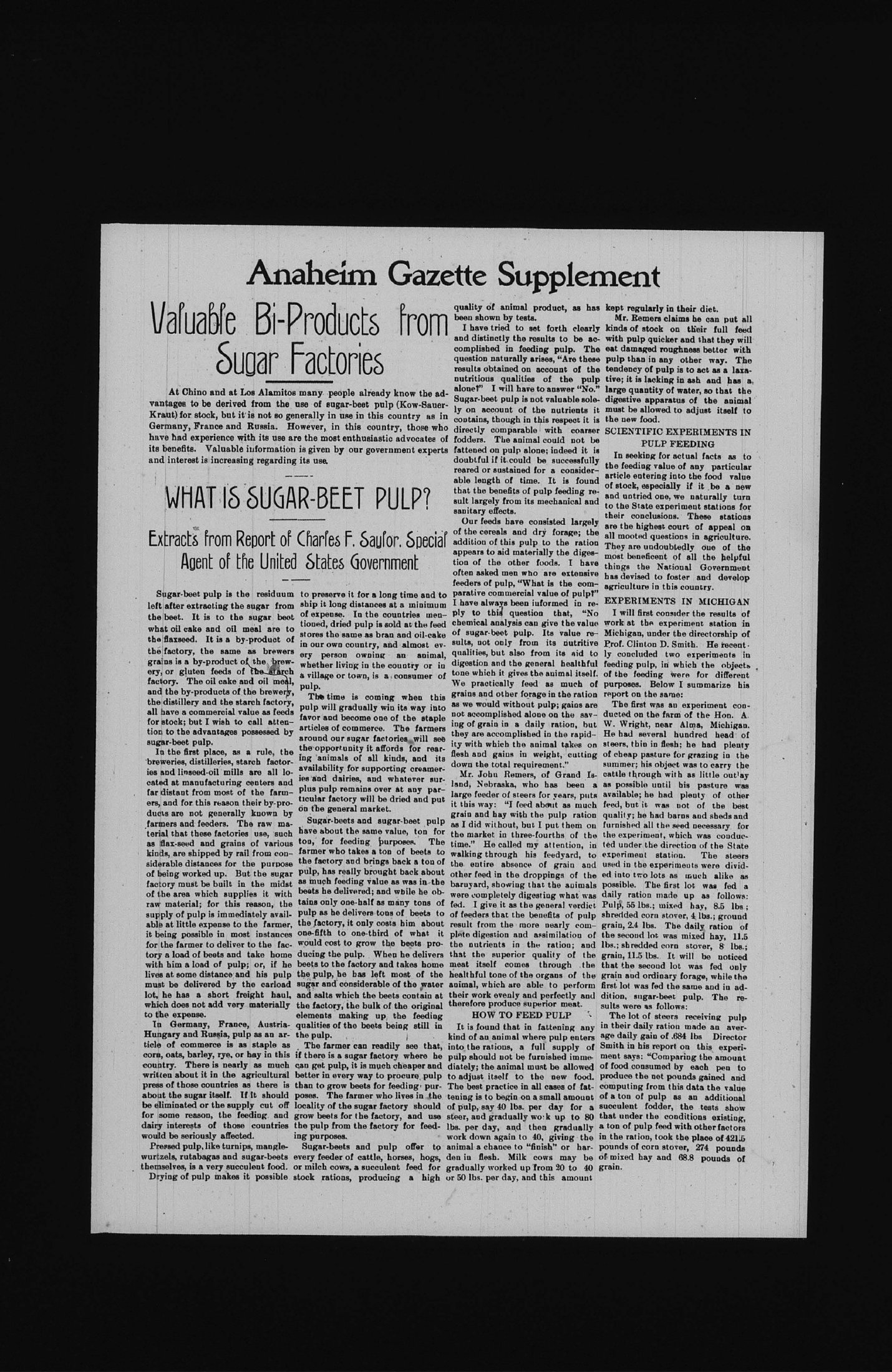
Searchable text
Anahe
Valuable Bi-Product
Sugar Fact
At Chino and at Los Alamitos many p
vantages to be derived from the use of su
Kraut) for stock, but it is not so generally in
Germany, France and Russia. However, i
have had experience with its use are the mo
its benefits. Valuable information is given
and interest is increasing regarding its use.
WHAT IS SUGAR-BE
WHAT IS SUGAR-BEET
Extracts from Report of Charleston Agent of the United States
Sugar-beet pulp is the residuum left after extracting the sugar from the beet. It is to the sugar beet what oil cake and oil meal are to the flaxseed. It is a by-product of the factory, the same as brewers grains is a by-product of the brewery, or gluten feeds of the starch factory. The oil cake and oil meal, and the by-products of the brewery, the distillery and the starch factory, all have a commercial value as feeds for stock; but I wish to call attention to the advantages possessed by sugar-beet pulp.
In the first place, as a rule, the breweries, distilleries, starch factories and linseed-oil mills are all located at manufacturing centers and far distant from most of the farmers, and for this reason their by-products are not generally known by farmers and feeders. The raw material that these factories use, such as flax-seed and grains of various kinds, are shipped by rail from considerable distances for the purpose of being worked up. But the sugar factory must be built in the midst of the area which supplies it with raw material; for this reason, the supply of pulp is immediately available at little expense to the farmer, it being possible in most instances for the farmer to deliver to the factory a load of beets and take home with him a load of pulp; or, if he to present ship it less of expen- tioned, do stores ther- in our ow- ery per- ment whether a village pulp.
The ti- pulp will favor and articles o around o the oppo- ing anim- availabil- ies and o plus pulp ticular fa- on the go.
Sugar-have abo- ton, for farmer wi- the facto- pulp, has as much beets he tains only pulp as b the facto- one-fifth would co- ducing tha beets to t
siderable distances for the purpose of being worked up. But the sugar factory must be built in the midst of the area which supplies it with raw material; for this reason, the supply of pulp is immediately available at little expense to the farmer, it being possible in most instances for the farmer to deliver to the factory a load of beets and take home with him a load of pulp; or, if he lives at some distance and his pulp must be delivered by the carload lot, he has a short freight haul, which does not add very materially to the expense.
In Germany, France, Austria-Hungary and Russia, pulp as an article of commerce is as staple as corn, oats, barley, rye, or hay in this country. There is nearly as much written about it in the agricultural press of those countries as there is about the sugar itself. If it should be eliminated or the supply cut off for some reason, the feeding and dairy interests of those countries would be seriously affected.
Pressed pulp, like turnips, mangle-wurtzels, rutabagas and sugar-beets themselves, is a very succulent food.
Drying of pulp makes it possible
Anaheim Gazette Supplement
Bi-Products from Sugar Factories
Alamitos many people already know the admonition the use of sugar-beet pulp (Kow-Sauer not so generally in use in this country as in Russia. However, in this country, those who use are the most enthusiastic advocates of formation is given by our government experts regarding its use.
SUGAR-BEET PULP?
quality of animal product, as has been shown by tests.
I have tried to set forth clearly and distinctly the results to be accomplished in feeding pulp. The question naturally arises, "Are these results obtained on account of the nutritious qualities of the pulp alone?" I will have to answer "No." Sugar-beet pulp is not valuable solely on account of the nutrients it contains, though in this respect it is directly comparable with coarser fodders. The animal could not be fattened on pulp alone; indeed it is doubtful if it could be successfully reared or sustained for a considerable length of time. It is found that the benefits of pulp feeding result largely from its mechanical and sanitary effects.
Mr. kinds o with p eat da pulp t tender tive; it large o digesti must b the ne SCIEN
In se the fee article of stock and un to the
UGAR-BEET PULP?
Port of Charles F. Saylor, Special United States Government
to preserve it for a long time and to ship it long distances at a minimum of expense. In the countries mentioned, dried pulp is sold at the feed stores the same as bran and oil-cake in our own country, and almost every person owning an animal, whether living in the country or in a village or town, is a consumer of pulp.
The time is coming when this pulp will gradually win its way into favor and become one of the staple articles of commerce. The farmers around our sugar factories will see the opportunity it affords for rearing animals of all kinds, and its availability for supporting creameries and dairies, and whatever surplus pulp remains over at any particular factory will be dried and put on the general market.
Sugar-beets and sugar-beet pulp have about the same value, ton for ton, for feeding purposes. The farmer who takes a ton of beets to the factory and brings back a ton of pulp, has really brought back about as much feeding value as was in the beets he delivered; and while he obtains only one-half as many tons of pulp as he delivers tons of beets to the factory, it only costs him about one-fifth to one-third of what it would cost to grow the beets producing the pulp. When he delivers beets to the factory and takes home on account of the nutrients it contains, though in this respect it is directly comparable with coarser fodders. The animal could not be fattened on pulp alone; indeed it is doubtful if it could be successfully reared or sustained for a considerable length of time. It is found that the benefits of pulp feeding result largely from its mechanical and sanitary effects.
Our feeds have consisted largely of the cereals and dry forage; the addition of this pulp to the ration appears to aid materially the digestion of the other foods. I have often asked men who are extensive feeders of pulp, "What is the comparative commercial value of pulp?" I have always been informed in reply to this question that, "No chemical analysis can give the value of sugar-beet pulp. Its results, not only from its nutritive qualities, but also from its aid to digestion and the general healthful tone which it gives the animal itself. We practically feed as much of grains and other forage in the ration as we would without pulp; gains are not accomplished alone on the saving of grain in a daily ration, but they are accomplished in the rapidity with which the animal takes on flesh and gains in weight, cutting down the total requirement."
Mr. John Remers, of Grand Island, Nebraska, who has been a large feeder of steers for years, puts it this way: "I feed about as much grain and hay with the pulp ration as I did without, but I put them on the market in three-fourths of the time." He called my attention, in walking through his feedyard, to the entire absence of grain and other feed in the droppings of the barnyard, showing that the animals were completely digesting what was fed. I give it as the general verdict of feeders that the benefits of pulp result from the more nearly complete digestion and assimilation of the nutrients in the ration; and that the superior quality of the meat itself comes through the...
purpose of sugar beets midst it with onion, the only available farmer, instances the factory home for, if he is pulp scarload at haul, materially Austria an archaic as in this much cultural there is should cut off ing and countries angle-beets it food. Possible
the factory and brings back about as much feeding value as was in the beets he delivered; and while he obtains only one-half as many tons of pulp as he delivers tons of beets to the factory, it only costs him about one-fifth to one-third of what it would cost to grow the beets producing the pulp. When he delivers beets to the factory and takes home the pulp, he has left most of the sugar and considerable of the water and salts which the beets contain at the factory, the bulk of the original elements making up the feeding qualities of the beets being still in the pulp.
The farmer can readily see that, if there is a sugar factory where he can get pulp, it is much cheaper and better in every way to procure pulp than to grow beets for feeding purposes. The farmer who lives in the locality of the sugar factory should grow beets for the factory, and use the pulp from the factory for feeding purposes.
Sugar-beets and pulp offer to every feeder of cattle, horses, hogs, or milch cows, a succulent feed for stock rations, producing a high
the entire absence of grain and other feed in the droppings of the barnyard, showing that the animals were completely digesting what was fed. I give it as the general verdict of feeders that the benefits of pulp result from the more nearly complete digestion and assimilation of the nutrients in the ration; and that the superior quality of the meat itself comes through the healthful tone of the organs of the animal, which are able to perform their work evenly and perfectly and therefore produce superior meat.
HOW TO FEED PULP
It is found that in fattening any kind of an animal where pulp enters into the rations, a full supply of pulp should not be furnished immediately; the animal must be allowed to adjust itself to the new food. The best practice in all cases of fattening is to begin on a small amount of pulp, say 40 lbs. per day for a steer, and gradually work up to 80 lbs. per day, and then gradually work down again to 40, giving the animal a chance to "finish" or harden in flesh. Milk cows may be gradually worked up from 20 to 40 or 50 lbs. per day, and this amount used in their age daily Smith in ment sait of food produced compute of a ton succuler that under a ton off in the racks pounds of mixed grain.
element
et, as has kept regularly in their diet.
Mr. Remers claims he can put all kinds of stock on their full feed with pulp quicker and that they will eat damaged roughness better with pulp than in any other way. The tendency of pulp is to act as a laxative; it is lacking in ash and has a large quantity of water, so that the digestive apparatus of the animal must be allowed to adjust itself to the new food.
SCIENTIFIC EXPERIMENTS IN PULP FEEDING
In seeking for actual facts as to the feeding value of any particular article entering into the food value of stock, especially if it be a new and untried one, we naturally turn to the State experiment stations for
SCIENTIFIC EXPERIMENTS IN PULP FEEDING
In seeking for actual facts as to the feeding value of any particular article entering into the food value of stock, especially if it be a new and untried one, we naturally turn to the State experiment stations for their conclusions. These stations are the highest court of appeal on all mooted questions in agriculture. They are undoubtedly one of the most beneficent of all the helpful things the National Government has devised to foster and develop agriculture in this country.
EXPERIMENTS IN MICHIGAN
I will first consider the results of work at the experiment station in Michigan, under the directorship of Prof. Clinton D. Smith. He recently concluded two experiments in feeding pulp, in which the objects of the feeding were for different purposes. Below I summarize his report on the same:
The first was an experiment conducted on the farm of the Hon. A. W. Wright, near Alma, Michigan. He had several hundred head of steers, thin in flesh; he had plenty of cheap pasture for grazing in the summer; his object was to carry the cattle through with as little outlay as possible until his pasture was available; he had plenty of other feed, but it was not of the best quality; he had barns and sheds and furnished all the seed necessary for the experiment, which was conducted under the direction of the State experiment station. The steers used in the experiments were divided into two lots as much alike as possible. The first lot was fed a daily ration made up as follows: Pulp, 55 lbs.; mixed hay, 8.5 lbs.; shredded corn stover, 4 lbs.; ground grain, 2.4 lbs. The daily ration of the second lot was mixed hay, 11.5 lbs.; shredded corn stover, 8 lbs.; grain, 11.5 lbs. It will be noticed that the second lot was fed only
grain and
worms of the
animals
what was
real verdict
of pulp
early complication of
ration; and
wr of the
rough the
worms of the
perform
directly and
meat.
LP
making any
pulp enters
supply of
ed immeallowed
new food.
less of fatamount
y for a
up to 80
radually
giving the
or harmay be
40 to 40
amount
used in the experiments were divided into two lots as much alike as possible. The first lot was fed a daily ration made up as follows: Pulp, 55 lbs.; mixed hay, 8.5 lbs.; shredded corn stover, 4 lbs.; ground grain, 2.4 lbs. The daily ration of the second lot was mixed hay, 11.5 lbs.; shredded corn stover, 8 lbs.; grain, 11.5 lbs. It will be noticed that the second lot was fed only grain and ordinary forage, while the first lot was fed the same and in addition, sugar-beet pulp. The results were as follows:
The lot of steers receiving pulp in their daily ration made an average daily gain of .684 lbs Director Smith in his report on this experiment says: "Comparing the amount of food consumed by each pen to produce the net pounds gained and computing from this data the value of a ton of pulp as an additional succulent fodder, the tests show that under the conditions existing, a ton of pulp feed with other factors in the ration, took the place of 421.5 pounds of corn stover, 274 pounds of mixed hay and 68.8 pounds of grain.