anaheim-gazette 1905-08-03
Scanned page
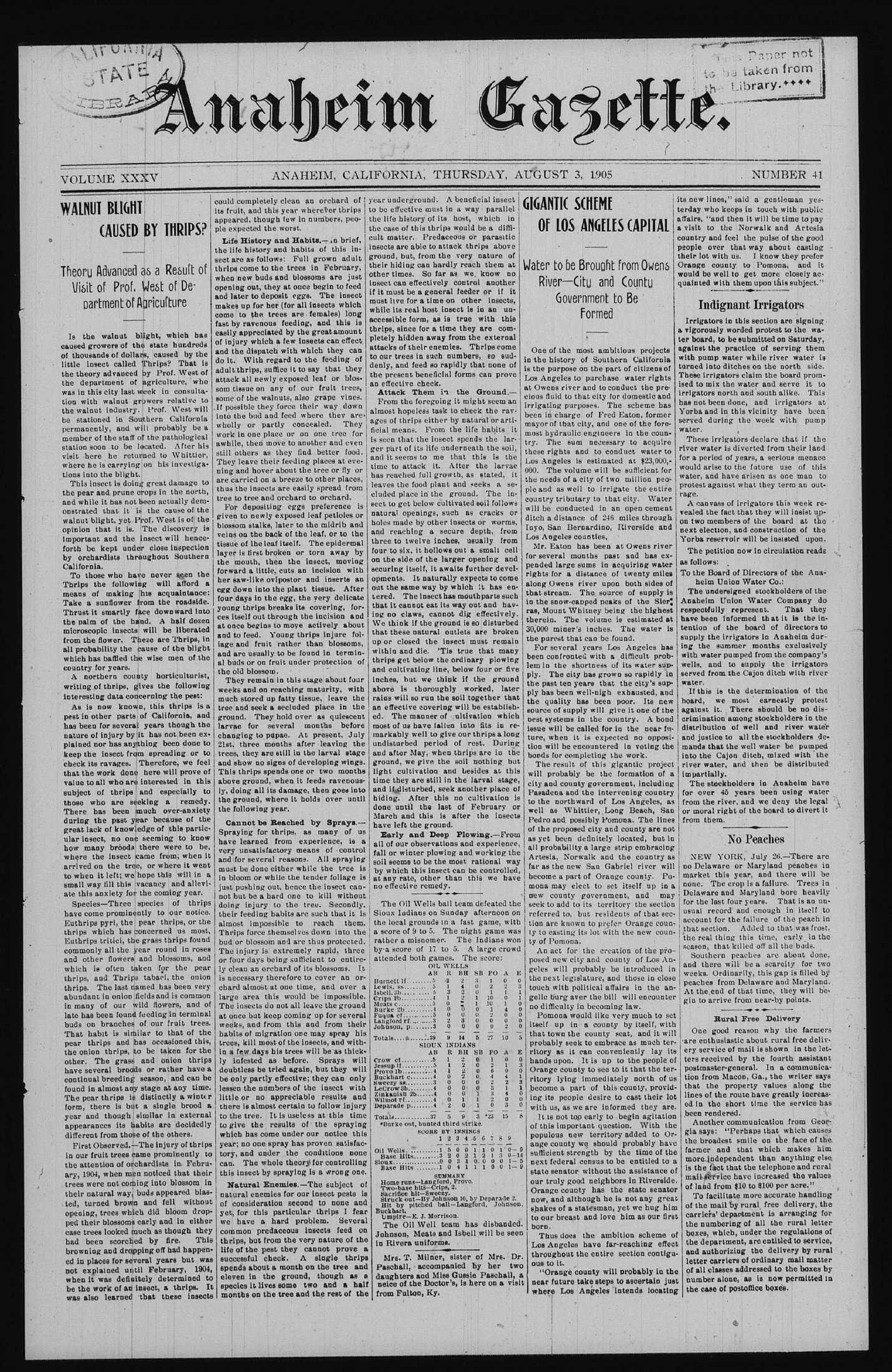
Searchable text
WALNUT BLIGHT
CAUSED BY THRIPS?
Theory Advanced as a Result of Visit of Prof. West of Department of Agriculture
Is the walnut blight, which has caused growers of the state hundreds of thousands of dollars, caused by the little insect called Thrips? That is the theory advanced by Prof. West of the department of agriculture, who was in this city last week in consultation with walnut growers relative to the walnut industry. Prof. West will be stationed in Southern California permanently, and will probably be a member of the staff of the pathological station soon to be located. After his visit here he returned to Whittier, where he is carrying on his investigations into the blight.
This insect is doing great damage to the pear and prune crops in the north, and while it has not been actually demonstrated that it is the cause of the could completely clean an orchid its fruit, and this year wherever appeared, though few in number ple expected the worst.
Life History and Habits.—the life history and habits of the sect are as follows: Full growth thrips come to the trees in Fe when new buds and blossoms are opening out, they at once begin and later to deposit eggs. The makes up for her (for all insects come to the trees are female fast by ravenous feeding, and easily appreciated by the great of injury which a few insects can and the dispatch with which they do it. With regard to the feed adult thrips, suffice it to say that attack all newly exposed leaf or som tissue on any of our fruiting some of the walnuts, also grape. If possible they force their way into the bud and feed where the wholly or partly concealed. work in one place or on one awhile, then move to another still others as they find better. They leave their feeding places ning and hover about the tree or are carried on a breeze to other thus the insects are easily spread tree to tree and orchard to orchard.
For depositing eggs prefer
the walnut industry. Prof. West will be stationed in Southern California permanently, and will probably be a member of the staff of the pathological station soon to be located. After his visit here he returned to Whittier, where he is carrying on his investigations into the blight.
This insect is doing great damage to the pear and prune crops in the north, and while it has not been actually demonstrated that it is the cause of the walnut blight, yet Prof. West is of the opinion that it is. The discovery is important and the insect will henceforth be kept under close inspection by orchardists throughout Southern California.
To those who have never seen the Thrips the following will afford a means of making his acquaintance: Take a sunflower from the roadside. Thrust it smartly face downward into the palm of the hand. A half dozen microscopic insects will be liberated from the flower. These are Thrips, in all probability the cause of the blight which has baffled the wise men of the country for years.
A northern county horticulturist, writing of thrips, gives the following interesting data concerning the pest:
As is now known, this thrips is a pest in other parts of California, and has been for several years though the nature of injury by it has not been explained nor has anything been done to keep the insect from spreading or to check its ravages. Therefore, we feel that the work done here will prove of value to all who are interested in this subject of thrips and especially to those who are seeking a remedy. There has been much over-anxiety during the past year because of the great lack of knowledge of this particular insect, no one seeming to know how many broods there were to be, where the insect came from; when it arrived on the tree, or where it went to when it left; we hope this will in a small way fill this vacancy and alleviate this anxiety for the coming year.
Species—Three species of thrips have come prominently to our notice. Euthrips pyri, the pear thrips, or the thrips which has concerned us most, Euthrips tritici, the grass thrips found commonly all the year round in roses and other flowers and blossoms, and which is often taken for the pear
If possible they force their way into the bud and feed where they wholly or partly concealed. Work in one place or on one awhile, then move to another area still others as they find better. They leave their feeding places ning and hover about the tree or are carried on a breeze to other thus the insects are easily spread tree to tree and orchard to orchard.
For depositing eggs prefer given to newly exposed leaf pea blossom stalks, later to the mid veins on the back of the leaf, or tissue of the leaf itself. The epiphyte is first broken or torn at the mouth, then the insect, forward a little, cuts an incision her saw-like ovipostor and inserts egg down into the plant tissue four days in the egg, the very young thrips breaks its covering itself out through the incision at once begins to move actively and to feed. Young thrips injage and fruit rather than bury and are usually to be found in buds or on fruit under protection of the old blossom.
They remain in this stage ab weeks and on reaching maturity much stored up fatty tissue, leaves tree and seek a secluded place ground. They hold over as larvae for several months changing to pupae. At present 21st, three months after leaving trees, they are still in the larvae and show no signs of developing. This thrips spends one or two above ground, when it feeds rapidly, doing all its damage, then goes to the ground, where it holds over the following year.
Cannot be Reached by Spraying for thrips, as many have learned from experience very unsatisfactory means of and for several reasons. All must be done either while they in bloom or while the tender fruit just pushing out, hence the insult but be a hard one to kill doing injury to the tree. Since their feeding habits are such that almost impossible to reach Thrips force themselves down bud or blossom and are thus prone The injury is extremely rapid or four days being sufficient to clean an orchard of its blossoms.
arrived on the tree, or where it went to when it left; we hope this will in a small way fill this vacancy and alleviate this anxiety for the coming year.
Species—Three species of thrips have come prominently to our notice. Euthrips pyri, the pear thrips, or the thrips which has concerned us most, Euthrips tritici, the grass thrips found commonly all the year round in roses and other flowers and blossoms, and which is often taken for the pear thrips, and Thrips tabaci, the onion thrips. The last named has been very abundant in onion fields and is common in many of our wild flowers, and of late has been found feeding in terminal buds on branches of our fruit trees. That habit is similar to that of the pear thrips and has occasioned this, the onion thrips, to be taken for the other. The grass and onion thrips have several broods or rather have a continual breeding season, and can be found in almost any stage at any time. The pear thrips is distinctly a winter form, there is but a single brood a year and though similar in external appearances its habits are decidedly different from those of the others.
First Observed.—The injury of thrips in our fruit trees came prominently to the attention of orchardists in February, 1904, when men noticed that their trees were not coming into blossom in their natural way, buds appeared blasted, turned brown and fell without opening, trees which did bloom dropped their blossoms early and in either case trees looked much as though they had been scorched by fire. This browning and dropping off had happened in places for several years but was not explained until February, 1904, when it was definitely determined to be the work of an insect, a thrips. It was also learned that these insects
Natural Enemies.—The survival enemies for our insects of consideration second to no yet, for this particular thrip we have a hard problem. The common predaceous insects of thrips, but from the very natural life of the pest they cannot be successful check. A single spends about a month on the eleven in the ground, though species it lives some two and months on the tree and the re
Gaiheim Gazette
ANAHEIM, CALIFORNIA, THURSDAY, AUGUST 3, 1905
tely clean an orchard of this year wherever thrips are found few in numbers, peo- the worst.
History and Habits.—In brief, history and habits of this in- follows: Full grown adult into the trees in February, buds and blossoms are just when they at once begin to feed deposit eggs. The insect her (for all insects which trees are females) longuous feeding, and this is associated by the great amount which a few insects can effect match with which they can regard to the feeding of suffice it to say that they newly exposed leaf or blossom any of our fruit trees, walnuts, also grape vines. They force their way down and feed where they are partly concealed. They place or on one tree for move to another and even as they find better food. Their feeding places at ever about the tree or fly or on a breeze to other places, insects are easily spread from and orchard to orchard. Visiting eggs preference is year underground. A beneficial insect to be effective must in a way parallel the life history of its host, which in the case of this thrips would be a difficult matter. Predaceous or parasitic insects are able to attack thrips above ground, but, from the very nature of their hiding can hardly reach them at other times. So far as we know no insect can effectively control another if it must be a general feeder or if it must live for a time on other insects, while its real host insect is in an un-accessible form, as is true with this thrips, since for a time they are completely hidden away from the external attacks of their enemies. Thrips come to our trees in such numbers, so suddenly, and feed so rapidly that none of the present beneficial forms can prove an effective check.
Attack Them in the Ground.
From the foregoing it might seem an almost hopeless task to check the ravages of thrips either by natural or artificial means. From the life habits it is seen that the insect spends the larger part of its life underneath the soil, and it seems to me that this is the time to attack it. After the larvae has reached full growth, as stated, it leaves the food plant and seeks a secluded place in the ground. The insect to get below cultivated soil follows natural enemies such as crabs or
GIGANTIC SCHEME OF LOS ANGELES COUNTY
Water to be Brought from River—City and County Government to Be Formed
One of the most ambitious in the history of Southern California is the purpose on the part of Los Angeles to purchase water at Owens river and to conductcious fluid to that city for domestic irrigating purposes. The state been in charge of Fred Eaton mayor of that city, and one of most hydraulic engineers in try. The sum necessary these rights and to conduct Los Angeles is estimated at 2000. The volume will be su- the needs of a city of two nple and as well to irrigate country tributary to that city will be conducted in an op-
they force their way down and feed where they are partially concealed. They place or on one tree for it to move to another and even as they find better food. Their feeding places at ever over the tree or fly or on a breeze to other places, insects are easily spread from the back of the leaf, or to the leaf itself. The epidermal crack is broken or torn away by then the insect, moving cattle, cuts an incision with the ovipostor and inserts an egg into the plant tissue. After the egg, the very delicate shell breaks its covering, for it through the incision and runs to move actively about young thrips injure foliage rather than blossoms, usually to be found in termite fruit under protection of sloth.
In this stage about four months reaching maturity, with soil up fatty tissue, leave the rock a secluded place in the hay hold over as quiescent several months before pupae. At present, July 10th months after leaving the share still in the larval stage two signs of developing wings. It spends one or two months loud, when it feeds ravenous-its damage, then goes into where it holds over until long year.
Reached by Sprays.—For thrips, as many of us used from experience, is a satisfactory means of control several reasons. All spraying either while the tree is growing while the tender foliage is going out, hence the insect can hard one to kill without injury to the tree. Secondly, ing habits are such that it is possible to reach them. We themselves down into the room and are thus protected. This extremely rapid, three times being sufficient to entire orchard of its blossoms. It almost hopeless task to check the ravages of thrips either by natural or artificial means. From the life habits it is seen that the insect spends the larger part of its life underneath the soil, and it seems to me that this is the time to attack it. After the larvae has reached full growth, as stated, it leaves the food plant and seeks a secluded place in the ground. The insect to get below cultivated soil follows natural openings, such as cracks or holes made by other insects or worms, and reaching a secure depth, from three to twelve inches, usually from four to six, it hollows out a small cell on the side of the larger opening and securing itself, it awaits further developments. It naturally expects to come out the same way by which it has entered. The insect has mouthparts such that it cannot eat its way out and having no claws, cannot dig effectively. We think if the ground is so disturbed that these natural outlets are broken up or closed the insect must remain within and die. 'Tis true that many thrips get below the ordinary plowing and cultivating line, below four or five inches, but we think if the ground above is thoroughly worked, later rains will so run the soil together that an effective covering will be established. The manner of cultivation which most of us have fallen into fits in remarkably well to give our thrips a long undisturbed period of rest. During and after May, when thrips are in the ground, we give the soil nothing but light cultivation and besides at this time they are still in the larval stage, and if disturbed, seek another place of hiding. After this no cultivation is done until the last of February or March and this is after the insects have left the ground.
Early and Deep Plowing.—From all of our observations and experience, fall or winter plowing and working the soil seems to be the most rational way by which this insect can be controlled, at any rate, other than this we have no effective remedy.
The Oil Wells ball team defeated the Sioux Indians on Sunday afternoon on the local grounds in a fast game, with a score of 9 to 5. The night game was rather a misnomer. The Indians won by a score of 17 to 5. A large crowd attended both games. The score:
OIL WELLS
irrigating purposes. The site been in charge of Fred Eaton mayor of that city, and one of most hydraulic engineers in try. The sum necessary to these rights and to conduct Los Angeles is estimated at 000. The volume will be suited the needs of a city of two million people and as well to irrigate country tributary to that city will be conducted in an open ditch a distance of 246 miles Inyo, San Bernardino, Rivers Los Angeles counties.
Mr. Eaton has been at O for several months past and pended large sums in acquiring rights for a distance of two along Owens river upon being that stream. The source o in the snow-capped peaks of ras, Mount Whitney being therein. The volume is e 30,000 miner's inches. Thus the purest that can be found.
For several years Los Angeles been confronted with a difficult item in the shortness of its ply. The city has grown so the past ten years that the ply has been well-nigh exhale quality has been poor source of supply will give it best systems in the country issue will be called for in this nature, when it is expected that tension will be encountered in bonds for completing the work.
The result of this gigant will probably be the form city and county government Pasadena and the intervention to the northward of Los well as Whittier, Long Pedro and possibly Pomona of the proposed city and coors as yet been definitely located all probability a large strip Artesia, Norwalk and there far as the new San Gabriel become a part of Orange c mona may elect to set its new county government, seek to add to its territory referred to, but residents tion are known to prefer O ty to casting its lot with the ty of Pomona.
An act for the creation posed new city and county geles will probably be in
The Oil Wells ball team defeated the Sioux Indians on Sunday afternoon on the local grounds in a fast game, with a score of 9 to 5. The night game was rather a misnomer. The Indians won by a score of 17 to 5. A large crowd attended both games. The score:
OIL WELLS
AB R BH SB PO A E
Burnett 1f...5 2 2 3 1 0 0
Lewis, ss...5 1 4 0 2 2 3
Isbell, 3b...5 3 2 0 1 1 1
Crips 1b...4 1 2 1 10 0 1
Meats c...5 0 1 10 1 0
Burke 2b...4 0 0 0 1 4 0
Fuqua cf...5 0 0 0 2 0 0
Langford rf...3 2 3 0 0 0 0
Johnson, p...3 0 0 0 0 2 0
SIOUX INDIANS
AB R BH SB PO A E
Crow cf...5 1 2 0 1 0 0
Jessup lf...5 1 2 0 2 1 3
Provo lb...4 1 2 0 6 0 0
Buckhart c...4 0 2 0 4 4 1
Sweezy ss...3 0 0 2 2 8
LeCrow 3b...4 0 0 3 1 1
Zinkanish 2b...4 0 0 1 3 4 0
Wilmot rf...4 0 1 1 2 0 0
Deparade p...4 2 0 1 0 3 0
Totals...37 593 *23158
*Burke out, bunted third strike.
SCORE BY INNINGS
123456789
Oil Wells...1500110-9
Base Hits...3202130-14
Sioux...03100001-5
Base Hits...10411001-9
SUMMARY
Home runs—Langford, Provo.
Two-base hits—Crips, Sweezy.
Sacrifice hit—Sweezy.
Struck out—By Johnson, Langford, Johnson, Buckhart.
Umpire—E. J. Morrison.
The Oil Well team has disbanded. Johnson, Meats and Isbell will be seen in Rivera uniforms.
Mrs. T. Milner, sister of Mrs. Dr. Paschall, accompanied by her two daughters and Miss Gussie Paschall, a niece of the Doctor's, is here on a visit from Fulton, Ky.
An act for the creation posed new city and county geles will probably be in the next legislature, and the touch with political affairs angelic burg aver the bill will no difficulty in becoming law.
Pomona would like very itself up in a county by that town the county seat, probably seek to embrace a ritory as it can conveniences hands upon. It is up to Orange county to see to it a ritory lying immediately become a part of this country its people desire to co with us, as we are informed.
It is not too early to begin of this important question. populous new territory ad ange county we should provide sufficient strength by the next federal census to be our truly good neighbors in Orange county has the snow, and although he is no shakes of a statesman, yet to our breast and love him born.
Thus does the ambition Los Angeles have far-reaching throughout the entire secuous to it.
"Orange county will provide future take steps to aid where Los Angeles inter
IT 3, 1905 NUMBER 41
EIC SCHEME
LOS ANGELES CAPITAL
to be Brought from Owens
City and County
Government to Be
Formed
the most ambitious projects
history of Southern California
purpose on the part of citizens of
cles to purchase water rights
river and to conduct the prel to that city for domestic and
ing purposes. The scheme has
charge of Fred Eaton, former
that city, and one of the foreraulic engineers in the counsum necessary to acquire
ights and to conduct water to
cles is estimated at $23,000,
volume will be sufficient for
of a city of two million peoas well to irrigate the entire
ributary to that city. Water
conducted in an open cement
its new lines," said a gentleman yesterday who keeps in touch with public affairs, "and then it will be time to pay a visit to the Norwalk and Artesia country and feel the pulse of the good people over that way about casting their lot with us. I know they prefer Orange county to Pomona, and it would be well to get more closely acquainted with them upon this subject."
Indignant Irrigators
Irrigators in this section are signing a vigorously worded protest to the water board, to be submitted on Saturday, against the practice of serving them with pump water while river water is turned into ditches on the north side. These irrigators claim the board promised to mix the water and serve it to irrigators north and south alike. This has not been done, and irrigators at Yorba and in this vicinity have been served during the week with pump water.
These irrigators declare that if the river water is diverted from their land for a period of years, a serious menace would arise to the future use of this water, and have arisen as one man to protest against what they term an outrage.
A canvass of irrigators this week re-
The scheme has charge of Fred Eaton, former that city, and one of the fore-raillic engineers in the county sum necessary to acquire rights and to conduct water toales is estimated at $23,000, the volume will be sufficient for of a city of two million peoas well to irrigate the entire distributary to that city. Water conducted in an open cement resistance of 246 miles through Bernardino, Riverside and Angeles counties,
Owens river several months past and has exlarge sums in acquiring water for a distance of twenty miles Owens river upon both sides of dam. The source of supply is low-capped peaks of the Siernt Whitney being the highest. The volume is estimated at Whittier's inches. The water is just that can be found.
Several years Los Angeles has fronted with a difficult probne shortness of its water suppe city has grown so rapidly in ten years that the city's suppe been well-nigh exhausted, and city has been poor. Its new supply will give it one of the items in the country. A bond will be called for in the near future it is expected no opposition be encountered in voting the or completing the work.
Result of this gigantic project probably be the formation of a county government, including Ana and the intervening country northward of Los Angeles, as Whittier, Long Beach, San and possibly Pomona. The lines proposed city and county are not seen definitely located, but in inability a large strip embracing Norwalk and the country as the new San Gabriel river will be part of Orange county. Poay elect to set itself up in a county government, and may add to its territory the section to, but residents of that sec-known to prefer Orange counting its lot with the new counmona.
It for the creation of the pro-new city and county of Los Anill probably be introduced in
No Peaches
NEW YORK, July 26.—There are no Delaware or Maryland peaches in market this year, and there will be none. The crop is a failure. Trees in Delaware and Maryland bore heavily for the last four years. That is an unusual record and enough in itself to account for the failure of the peach in that section. Added to that was frost, the real thing this time, early in the season, that killed off all the buds.
Southern peaches are about done, and there will be a scarcity for two
the new San Gabriel river will be part of Orange county. Post may elect to set itself up in a county government, and may add to its territory the section to, but residents of that seceded known to prefer Orange counting its lot with the new county mona.
It for the creation of the pro-new city and county of Los Anzil probably be introduced in a legislature, and those in close with political affairs in the anzil aver the bill will encounter faulty in becoming law.
Anna would like very much to set up in a county by itself, with own the county seat, and it will seek to embrace as much terrors it can conveniently lay its upon. It is up to the people of the county to see to it that the ter-rying immediately north of us is a part of this county, provid-people desire to cast their lot as we are informed they are not too early to begin agitation important question. With the new territory added to Or-nty we should probably have at strength by the time of the federal census to be entitled to a senator without the assistance of any good neighbors in Riverside. The county has the state senator and although he is not any great of a statesman, yet we hug him breast and love him as our first does the ambition scheme of Angeles have far-reaching effect about the entire section contiguit.
Orange county will probably in the future take steps to ascertain just Los Angeles intends locating no Delaware or Maryland peaches in market this year, and there will be none. The crop is a failure. Trees in Delaware and Maryland bore heavily for the last four years. That is an unusual record and enough in itself to account for the failure of the peach in that section. Added to that was frost, the real thing this time, early in the season, that killed off all the buds.
Southern peaches are about done, and there will be a scarcity for two weeks. Ordinarily, this gap is filled by peaches from Delaware and Maryland. At the end of that time, they will begin to arrive from near-by points.
Rural Free Delivery
One good reason why the farmers are enthusiastic about rural free delivery service of mail is shown in the letters received by the fourth assistant postmaster-general. In a communication from Macon, Ga., the writer says that the property values along the lines of the route have greatly increased in the short time the service has been rendered.
Another communication from Georgia says: "Perhaps that which causes the broadest smile on the face of the farmer and that which makes him more independent than anything else is the fact that the telephone and rural mail service have increased the values of land from $10 to $100 per acre."
To facilitate more accurate handling of the mail by rural free delivery, the carriers' department is arranging for the numbering of all the rural letter boxes, which, under the regulations of the department, are entitled to service, and authorizing the delivery by rural letter carriers of ordinary mail matter of all classes addressed to the boxes by number alone, as is now permitted in the case of postoffice boxes.