anaheim-gazette 1905-06-29
Scanned page
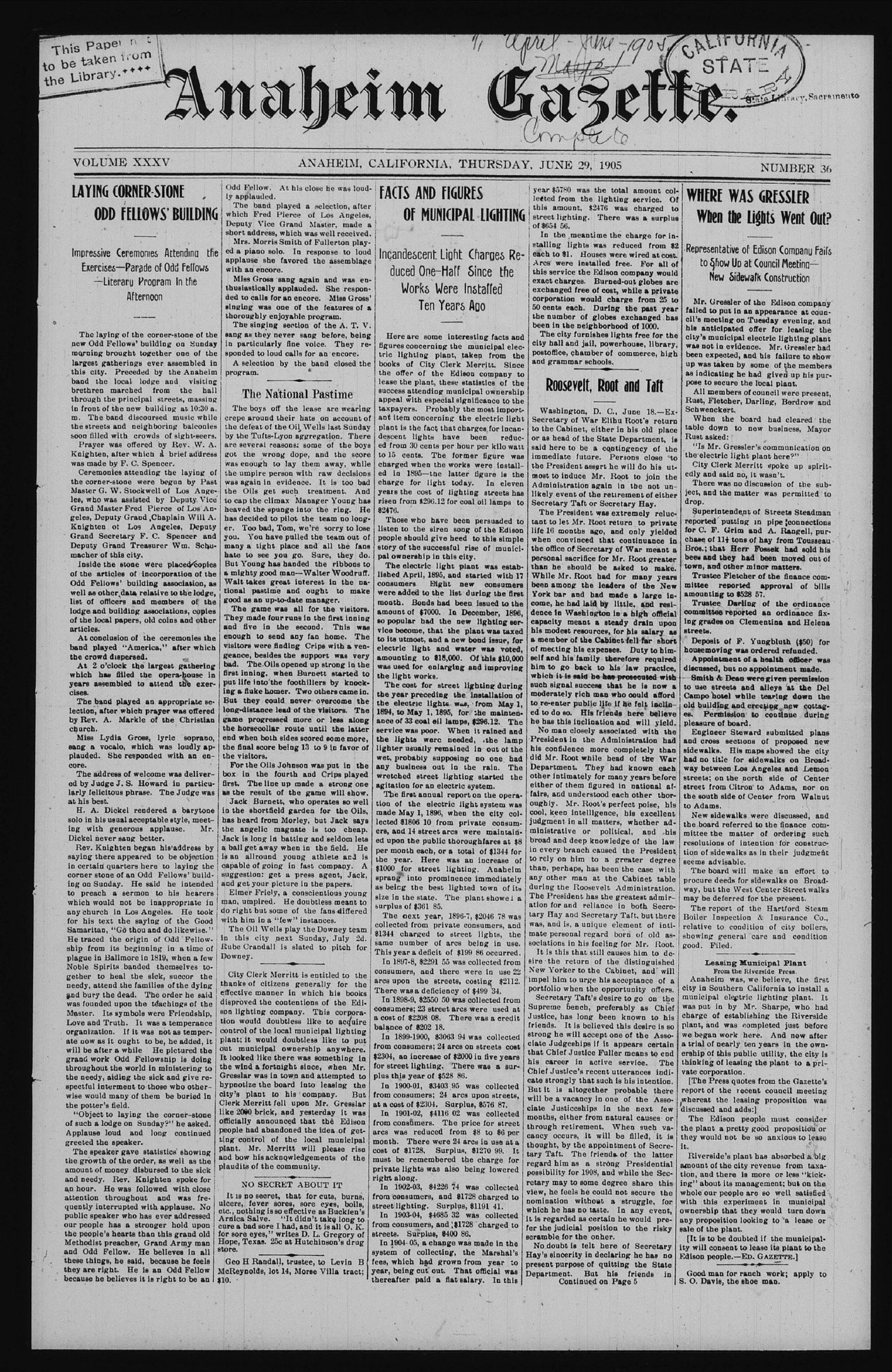
Searchable text
LAYING CORNER-STONE
ODD FELLOWS' BUILDING
Impressive Ceremonies Attending the
Exercises—Parade of Odd Fellows
—Literary Program In the
Afternoon
The laying of the corner-stone of the new Odd Fellows' building on Sunday morning brought together one of the largest gatherings ever assembled in this city. Preceded by the Anaheim band the local lodge and visiting brethren marched from the hall through the principal streets, massing in front of the new building at 10:30 a.m. The band discoursed music while the streets and neighboring balconies soon filled with crowds of sight-seers.
Prayer was offered by Rev. W. A. Knighten, after which a brief address was made by F. C. Spencer.
Ceremonies attending the laying of the corner-stone were begun by Past Master G. W. Stockwell of Los Angeles, who was assisted by Deputy Vice Grand Master Fred Pierce of Los An-
Odd Fellow. At his close he applauded.
The band played a selection which Fred Pierce of Los Deputy Vice Grand Master short address, which was well Mrs. Morris Smith of Fuller ed a piano solo. In response applause she favored the with an encore.
Miss Gross sang again and thusastically applauded. She ded to calls for an encore. M singing was one of the feathoroughly enjoyable programs.
The singing section of the sang as they never sang before in particularly fine voice. Sponded to loud calls for an A selection by the band program.
The National Past
The boys off the lease are crepe around their hats on the defeat of the Oil Wells laid by the Tufts-Lyon aggregation are several reasons: some of got the wrong dope, and was enough to lay them awake the umpire person with raw was again in evidence. It is the Oils get such treatment to cap the climax Manager Y heaved the spunge into the
in front of the new building at 10:30 a.m. The band discoursed music while the streets and neighboring balconies soon filled with crowds of sight-seers.
Prayer was offered by Rev. W. A. Knighten, after which a brief address was made by F. C. Spencer.
Ceremonies attending the laying of the corner-stone were begun by Past Master G. W. Stockwell of Los Angeles, who was assisted by Deputy Vice Grand Master Fred Pierce of Los Angeles, Deputy Grand Chaplain Will A. Knighten of Los Angeles, Deputy Grand Secretary F. C. Spencer and Deputy Grand Treasurer Wm. Schumacher of this city.
Inside the stone were placed copies of the articles of incorporation of the Odd Fellows' building association, as well as other data relative to the lodge, list of officers and members of the lodge and building associations, copies of the local papers, old coins and other articles.
At conclusion of the ceremonies she band played "America," after which the crowd dispersed.
At 2 o'clock the largest gathering which has filled the opera-house in years assembled to attend the exercises.
The band played an appropriate selection, after which prayer was offered by Rev. A. Markle of the Christian church.
Miss Lydia Gross, lyric soprano, sang a vocalo, which was loudly applauded. She responded with an encore.
The address of welcome was delivered by Judge J. S. Howard in particularly felicitous phrase. The Judge was at his best.
H. A. Dickel rendered a barytone solo in his usual acceptable style, meeting with generous applause. Mr. Dickel never sang better.
Rev. Knighten began his address by saying there appeared to be objection in certain quarters here to laying the corner stone of an Odd Fellows' building on Sunday. He said he intended to preach a sermon to his hearers which would not be inappropriate in any church in Los Angeles. He took for his text the saying of the Good Samaritan, "Go thou and do likewise."
He traced the origin of Odd Fellowship from its beginning in a time of plague in Ballmore in 1819, when a few Noble Spirits banded themselves to
The boys off the lease and crepe around their hats on the defeat of the Oil Wells laid by the Tufts-Lyon aggregation are several reasons; some of them got the wrong dope, and they was enough to lay them away the umpire person with raw hair was again in evidence. It is the Oils get such treatment to cap the climax Manager Yhe heaved the spunge into the has decided to pilot the teamer. Too bad, Tom, we're sorry you. You have pulled the test many a tight place and all hate to see you go. Sure, but Young has handed the mighty good man—Walter Walt takes great interest in national pastime and ought to good as an up-to-date manager.
The game was all for the They made four runs in the first and five in the second enough to send any fan host visitors were finding Crips with geance, besides the support bad. The Oils opened up strong inning, when Burnett put life into the foothillers being a fluke homer. Two others But they could never oversee long-distance lead of the visit game progressed more or less the horsecollar route until the end when both sides scored so the final score being 13 to 9 in the visitors.
For the Oils Johnson was put box in the fourth and Crief first. The line up made a stare as the result of the game with Jack Burnett, who operated in the shortfield garden for him has heard from Morley, but Jack the angelic magnate is too Jack is long in batting and seated a ball get away when in the field is an allround young athlete capable of going in fast commonsuggestion: get a press agent and get your picture in the pa
Elmer Friedy, a conscientious man, umpired. He doubtless did right but some of the fans with him in a "few" instances.
The Oil Wells play the Downtown in this city next Sunday, Rube Crandall is slated to p
in certain quarters here to laying the corner stone of an Odd Fellows' building on Sunday. He said he intended to preach a sermon to his hearers which would not be inappropriate in any church in Los Angeles. He took for his text the saying of the Good Samaritan, "Go thou and do likewise." He traced the origin of Odd Fellowship from its beginning in a time of plague in Ballmore in 1819, when a few Noble Spirits banded themselves together to heal the sick, succor the needy, attend the families of the dying and bury the dead. The order he said was founded upon the teachings of the Master. Its symbols were Friendship, Love and Truth. It was a temperance organization. If it was not as temperate now as it ought to be, he added, it will be after a while. He pictured the grand work Odd Fellowship is doing throughout the world in ministering to the needy, aiding the sick and giving respectful interment to those who otherwise would many of them be buried in the potter's field.
"Object to laying the corner-stone of such a lodge on Sunday?" he asked. Applause loud and long continued greeted the speaker.
The speaker gave statistics showing the growth of the order, as well as the amount of money disbursed to the sick and needy. Rev. Knighten spoke for an hour. He was followed with close attention throughout and was frequently interrupted with applause. No public speaker who has ever addressed our people has a stronger hold upon the people's hearts than this grand old Methodist preacher, Grand Army man and Odd Fellow. He believes in all these things, he said, because he feels they are right. He is an Odd Fellow because he believes it is right to be an
City Clerk Merritt is entitled thanks of citizens generally effective manner in which he disproved the contentions of his son lighting company. This situation would doubtless like to control of the local municipal plant; it would doubtless like out municipal ownership and it looked like there was some wind a fortnight since, where Gresslar was in town and attempt hypnotize the board into leaving city's plant to his company. Clerk Merritt fell upon Mr. like 2000 brick, and yesterday officially announced that the people had abandoned the idea ting control of the local m plant. Mr. Merritt will plead and bow his acknowledgements plaudits of the community.
NO SECRET ABOUT IT
It is no secret, that for cuts ulcers, fever sores, sore eyes etc., nothing is so effective as B Arnica Salve. "It didn't take cure a bad sore I had, and it is a for sore eyes," writes D. L. Gr Hope, Texas. 25c at Hutchinson store.
Geo H Randall, trustee, to L McReynolds, lot 14, Morse Village $10.
ANAHEIM, CALIFORNIA, THURSDAY, JUNE 29, 1905
FACTS AND FIGURES OF MUNICIPAL LIGHTING
Incandescent Light Charges Reduced One-Half Since the Works Were Installed Ten Years Ago
Here are some interesting facts and figures concerning the municipal electric lighting plant, taken from the books of City Clerk Merritt. Since the offer of the Edison company to lease the plant, these statistics of the success attending municipal ownership appeal with especial significance to the taxpayers. Probably the most important item concerning the electric light plant is the fact that charges for incandescent lights have been reduced from 30 cents per hour per kilo watt to 15 cents. The former figure was charged when the works were installed in 1895—the latter figure is the charge for light today. In eleven years the cost of lighting streets has risen from $296.12 for coal oil lamps to $2476.
year $5780 was the total selected from the lighting this amount, $2476 was street lighting. There were of $654 56.
In the meantime the stalling lights was reduced each to $1. Houses were Arcs were installed free; this service the Edison con- exact charges. Burned-out exchanged free of cost, which corporation would charge 50 cents each. During the number of globes ex- been in the neighborhood.
The city furnishes lights city hall and jail, powerhouse postoffice, chamber of commerce and grammar schools.
Roosevelt, Root and Washington, D. C., Judicial Secretary of War Elihu R. Ripley to the Cabinet, either in his or as head of the State Department said here to be a contingent immediate future. Personnel the President assort he will most to induce Mr. Root Administration again in likely event of the retirement Secretary Taft or Secretary Woodrow Wilson.
National Pastime
Is off the lease are wearing and their hats on account of the Oil Wells last Sunday's efforts-Lyon aggregation. There are reasons: some of the boys wrong dope, and the score high to lay them away, while one person with raw decisions in evidence. It is too bad get such treatment. And climax Manager Young has spung into the ring. He
off their hats on account of the Oil Wells last Sunday shifts-Lyon aggregation. There are reasons: some of the boys were wrong dope, and the score with to lay them away, while the person with raw decisions in evidence. It is too bad to get such treatment. And climax Manager Young has spung into the ring. He had to pilot the team no long-road, Tom, we're sorry to lose it have pulled the team out of night place and all the fans see you go. Sure, they do. Ing has handed the ribbons to good man—Walter Woodruff. His great interest in the nautitime and ought to make up-to-date manager.
Some was all for the visitors. The four runs in the first inning in the second. This was to send any fan home. The finding Crips with a venesides the support was very Oils opened up strong in the fight when Burnett started to to the foothillers by knock-e-homer. Two others came in. I could never overcome the face lead of the visitors. The greased more or less along dollar route until the latter both sides scored some more, score being 13 to 9 in favor of Oils Johnson was put in the fourth and Crips played line up made a strong one cut of the game will show. Burnett, who operates so well Hartfield garden for the Oils, from Morley, but Jack says electric magnate is too cheap in batting and seldom lets away when in the field. He found young athlete and is going in fast company. A get a press agent, Jack, our picture in the papers. Briefly, a conscientious young friend. He doubtless meant to put some of the fans differed in a "few" instances.
Wells play the Downey team next Sunday, July 2d. Dalil is slated to pitch for taxpayers. Probably the most important item concerning the electric light plant is the fact that charges for incandescent lights have been reduced from 30 cents per hour per kilo watt to 15 cents. The former figure was charged when the works were installed in 1895—the latter figure is the charge for light today. In eleven years the cost of lighting streets has risen from $296.12 for coal oil lamps to $2476.
Those who have been persuaded to listen to the siren song of the Edison people should give heed to this simple story of the successful rise of municipal ownership in this city.
The electric light plant was established April, 1895, and started with 17 consumers. Eight new consumers were added to the list during the first month. Bonds had been issued to the amount of $7000. In December, 1896, so popular had the new lighting service become, that the plant was taxed to its utmost, and a new bond issue, for electric light and water was voted, amounting to $18,000. Of this $10,000 was used for enlarging and improving the light works.
The cost for street lighting during the year preceding the installation of the electric lights was, from May 1, 1894, to May 1, 1895, for the maintenance of 33 coal oil lamps, $296.12. The service was poor. When it rained and the lights were needed, the lamp lighter usually remained in out of the wet, probably supposing no one had any business out in the rain. The wretched street lighting started the agitation for an electric system.
The first annual report on the operation of the electric light system was made May 1, 1896, when the city collected $1806 10 from private consumers, and 14 street arcs were maintained upon the public thoroughfares at $8 per month each, or a total of $1344 for the year. Here was an increase of $1000 for street lighting. Anaheim sprang into prominence immediately as being the best lighted town of its size in the state. The plant showed a surplus of $361 85.
The next year, 1896-7, $2046 78 was collected from private consumers, and $1344 charged to street lights, the same number of arcs being in use. This year a deficit of $199 86 occurred.
In 1897-8, $2291 55 was collected from Washington, D.C., June Secretary of War Elihu Rush to the Cabinet, either in his or as head of the State Department said here to be a continuing immediate future. Personally, the President assert he will most to induce Mr. Root Administration again in likely event of the retirement Secretary Taft or Secretary Taft.
The President was extremelyistant to let Mr. Root return life 16 months ago, and once convinced that concluding office of Secretary of Welfare personal sacrifice for Mr. Root than he should be asked While Mr. Root had for him been among the leaders of York bar and had made a come, he had laid by little dence in Washington in a capacity meant a steady rise his modest resources, for he a member of the Cabinet for meeting his expenses. Self and his family therefore him to go back to his lair which it is said he has prosuch signal success that he moderately rich man who can re-enter public life if heeded to do so. His friends have this inclination and no man closely associated President in the Administration his confidence more compelled Mr. Root while head of Department. They had kept other intimately for many years either of them figured in its fairs, and understood eachoughly. Mr. Root's perfect cool, keen intelligence, his judgment in all matters, his ministrative or political broad and deep knowledge in every branch caused thou rely on him to a greater than, perhaps, has been there any other man at the Cap during the Roosevelt Admiration The President has the greatestation for and reliance in tary Hay and Secretary Taft was, and is, a unique element personal regard born sociations in his feeling for It is this that still causes sire-the return of the di New Yorker to the Cabin
Merritt is entitled to the citizens generally for the banner in which his books the contentions of the Edison company. This corporation doubtless like to acquire the local municipal lighting would doubtless like to putipal ownership anywhere. Like there was something in afternoon since, when Mr. Merritt will please rise is acknowledgements of the community.
SECRET ABOUT IT
secret, that for cuts, burns, her sores, sore eyes, boils, is so effective as Bucklen's use. "It didn't take long to store I had, and it is all O. K. K.," writes D. L. Gregory of 25c at Hutchinson's drug
andall, trustee, to Levin B. lot 14, Morse Villa tract;
The next year, 1896-7, $2046 78 was collected from private consumers, and $1344 charged to street lights, the same number of arcs being in use. This year a deficit of $199 86 occurred.
In 1897-8, $2291 55 was collected from consumers, and there were in use 22 arcs upon the streets, costing $2112. There was a deficiency of $499 34.
In 1898-9, $2550 50 was collected from consumers; 23 street arcs were used at a cost of $2208 08. There was a credit balance of $202 18.
In 1899-1900, $3063 94 was collected from consumers; 24 arcs on streets cost $2304, an increase of $2000 in five years for street lighting. There was a surplus this year of $528 86.
In 1900-01, $3403 95 was collected from consumers; 24 arcs upon streets, at a cost of $2304. Surplus, $576 87.
In 1901-02, $4116 02 was collected from consumers. The price for street arcs was reduced from $8 to $6 per month. There were 24 arcs in use at a cost of $1728. Surplus, $1270 99. It must be remembered the charge for private lights was also being lowered right along.
In 1902-03, $4226 74 was collected from consumers, and $1728 charged to street lighting. Surplus, $1191 41.
In 1903-04, $4685 32 was collected from consumers, and $1728 charged to streets. Surplus, $400 86.
In 1904-05, a change was made in the system of collecting, the Marshal's fees, which had grown from year to year, being cut out. That official was thereafter paid a flat salary. In this than, perhaps, has been the any other man at the Car during the Roosevelt Adm The President has the greatation for and reliance in tary Hay and Secretary Taft was, and is, a unique element personal regard born sociations in his feeling for It is this that still causes sire the return of the di New Yorker to the Cabine impel him to urge his accept portfolio when the opportunity Secretary Taft's desire to Supreme bench, preferably Justice, has long been kn friends. It is believed this strong he will accept one of ciate Judgeships if it appear that Chief Justice Fuller may his career in active service Chief Justice's recent utter cate strongly that such is his But it is altogether prob will be a vacancy in one of ciate Justiceships in the months, either from natural through retirement. When cancy occurs, it will be thought, by the appointment tary Taft. The friends of regard him as a strong Possibility for 1908, and whi retary may to some degree view, he feels he could not nomination without a str which he has no taste. In it it is regarded as certain he w fer the judicial position to scramble for the onher.
No doubt is felt here of Hay's sincerity in declaring present purpose of quitting Department. But his f
Continued on Page
JUNE 29, 1905 NUMBER 36
WHERE WAS GRESSLER
When the Lights Went Out?
Representative of Edison Company Fails
to Show Up at Council Meeting—
New Sidewalk Construction
Mr. Gressler of the Edison company failed to put in an appearance at council's meeting on Tuesday evening, and his anticipated offer for leasing the city's municipal electric lighting plant was not in evidence. Mr. Gressler had been expected, and his failure to show up was taken by some of the members as indicating he had given up his purpose to secure the local plant.
All members of council were present, Rust, Fletcher, Darling, Berdrow and Schwenckert.
When the board had cleared the table down to new business, Mayor Rust asked:
"Is Mr. Gressler's communication on the electric light plant here?"
City Clerk Merritt spoke up spiritedly and said no, it wasn't.
There was no discussion of the subject, and the matter was permitted to drop.
President was extremely reluctant Mr. Root return to private months ago, and only yielded convinced that continuance in office of Secretary of War meant a full sacrifice for Mr. Root greater should be asked to make. Mr. Root had for many years among the leaders of the New York and had made a large in-house laid by little, and resigned Washington in a high officiality meant a steady drain upon best resources, for his salary as officer of the Cabinet fell far short of his expenses. Duty to him, his family therefore required go back to his law practice, it is said he has prosecuted with normal success that he is now a likely rich man who could afford later public life if he felt inclined so. His friends here believe this inclination and will yield an closely associated with the intent in the Administration hadidence more completely than Mr. Root while head of the War Department. They had known each ultimately for many years before of them figured in national affairs understood each other thoroughly. Mr. Root's perfect poise, his keen intelligence, his excellent intel in all matters, whether adative or political, and his deep knowledge of the law which branch caused the President on him to a greater degree perhaps, has been the case with other man at the Cabinet table the Roosevelt Administration. President has the greatest admirer and reliance in both Secretary and Secretary Taft, but there is, a unique element of inti- personal regard born of old asias in his feeling for Mr. Root. This that still causes him to deter return of the distinguished marker to the Cabinet will Schwenckert.
When the board had cleared the table down to new business, Mayor Rust asked:
"Is Mr. Gressler's communication on the electric light plant here?"
City Clerk Merritt spoke up spiritedly and said no, it wasn't.
There was no discussion of the subject, and the matter was permitted to drop.
Superintendent of Streets Steadman reported putting in pipe connections for C. F. Grim and A. Rangell, purchase of 11½ tons of hay from Tousseau Bros.; that Herr Fossek had sold his bees and they had been moved out of town, and other minor matters.
Trustee Fletcher of the finance committee reported approval of bills amounting to $528 57.
Trustee Darling of the ordinance committee reported an ordinance fixing grades on Clementina and Helena streets.
Deposit of F. Yungbluth ($50) for housemoving was ordered refunded.
Appointment of a health officer was discussed, but no appointment made.
Smith & Dean were given permission to use streets and alleys at the Del Campo hotel while tearing down the old building and erecting new cottages. Permission to continue during pleasure of board.
Engineer Steward submitted plans and cross sections of proposed new sidewalks. His maps showed the city had no title for sidewalks on Broadway between Los Angeles and Lemon streets; on the north side of Center street from Citron to Adams, nor on the south side of Center from Walnut to Adams.
New sidewalks were discussed, and the board referred to the finance committee the matter of ordering such resolutions of intention for construction of sidewalks as in their judgment seems advisable.
The board will make an effort to procure deeds for sidewalks on Broadway, but the West Center Street walks may be deferred for the present.
The report of the Hartford Steam Boiler Inspection & Insurance Co., relative to condition of city boilers, showing general care and condition good. Filed.
Leasing Municipal Plant
From the Riverside Press.
Anaheim was, we believe, the first city in Southern California to install a municipal electric lighting plant. It was put in by Mr. Sharpe, who had charge of establishing the Riverside plant, and was completed just before we began work here. And now after a trial of nearly ten years in the ownership of this public utility, the city is thinking of leasing the plant to a private corporation.
[The Press quotes from the Gazette's report of the recent council meeting whereat the leasing proposition was discussed and adds:]
The Edison people must consider the plant a pretty good proposition or they would not be so anxious to lease it.
Riverside's plant has absorbed a big amount of the city revenue from taxation, and there is more or less "kicking" about its management; but on the whole our people are so well satisfied with this experiment in municipal ownership that they would turn down any proposition looking to a lease or sale of the plant.
[It is to be doubted if the municipality will consent to lease its plant to the Edison people.—Ed. GAZETTE.]
Good man for ranch work; apply to S. O. Davis, the shoe man.