anaheim-gazette 1905-04-20
Scanned page
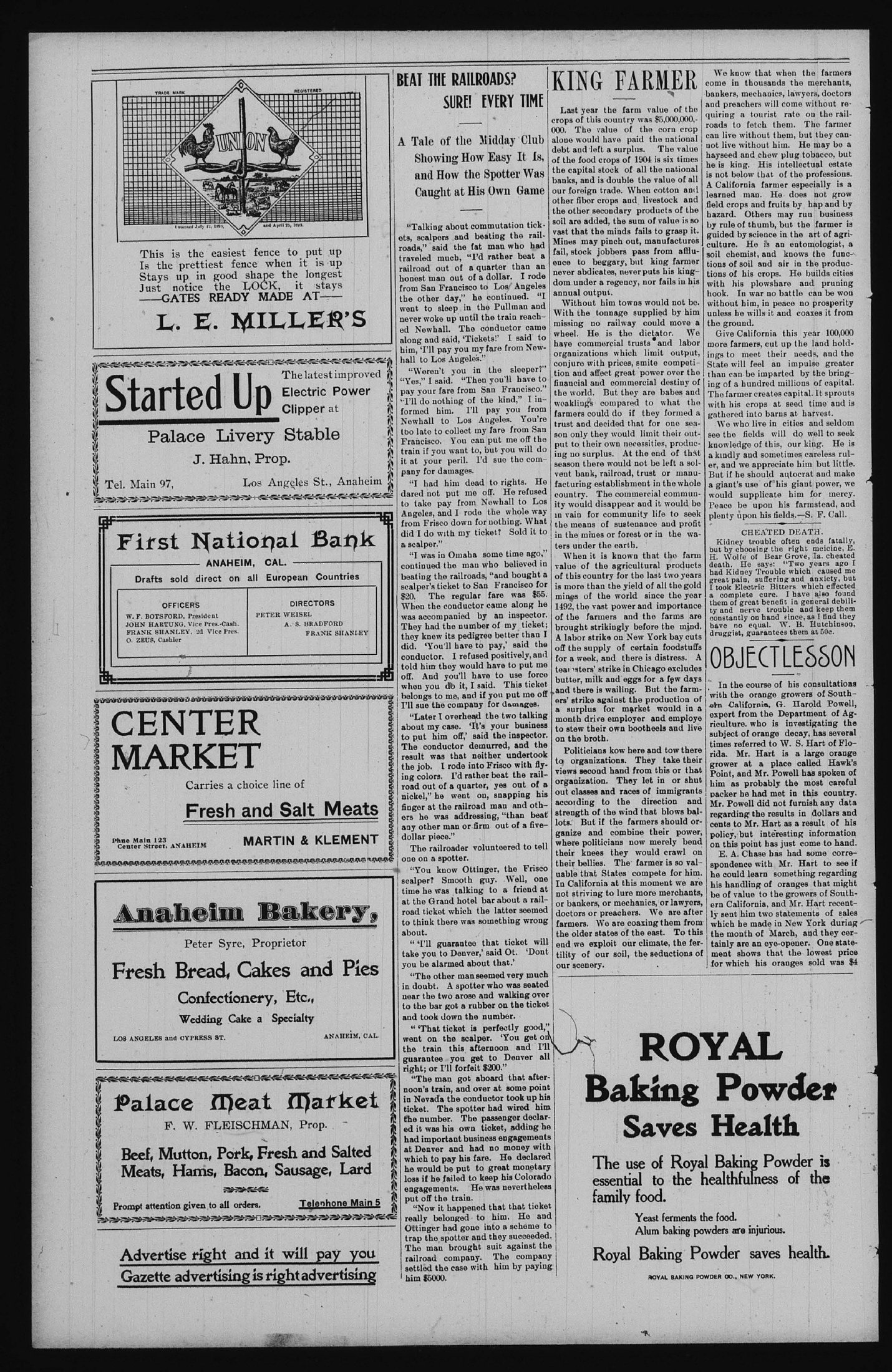
Searchable text
TRADE MARK
REGISTERED
UNION
Patented July 12, 1895
and April 25, 1899.
This is the easiest fence to put up
Is the prettiest fence when it is used
Stays up in good shape the longest
Just notice the LOCK, it stays
GATES READY MADE AT
L. E. MILLE
Started Up
Electric Clipper a
Palace Livery Stable
J. Hahn, Prop.
Tel. Main 97,
Los Angeles St.,
Palace Livery Stable
J. Hahn, Prop.
Tel. Main 97, Los Angeles St.,
First National Bank
ANAHEIM, CAL.
Drafts sold direct on all European Countries
OFFICERS
W. F. BOTSFORD, President
JOHN HARTUNG, Vice Pres.-Cash.
FRANK SHANLEY, 2d Vice Pres.
O. ZEUS, Cashier
DIRECTORS
PETER WEISEL
A. S. BRADFORE
FRANK
CENTER MARKET
Carries a choice line of
Fresh and Salt M
Phne Main 123
Center Street, ANAHEIM
MARTIN & KL
Anaheim Bake
Peter Syre, Proprietor
Anaheim Bake
Peter Syre, Proprietor
Fresh Bread, Cakes and
Confectionery, Etc.,
Wedding Cake a Specialty
LOS ANGELES and CYPRESS ST.
Palace Meat Man
F. W. FLEISCHMAN, Prop.
Beef, Mutton, Pork, Fresh and S
Meats, Hams, Bacon, Sausage,
Prompt attention given to all orders.
Advertise right and it will pay
Gazette advertising is right adve
BEAT THE RAILROADS?
SURE! EVERY TIME
A Tale of the Midday Club
Showing How Easy It Is,
and How the Spotter Was
Caught at His Own Game
"Talking about commutation tickets, scalpers and beating the railroads," said the fat man who had traveled much, "I'd rather beat a railroad out of a quarter than an honest man out of a dollar. I rode from San Francisco to Los Angeles the other day," he continued. "I went to sleep in the Pullman and never woke up until the train reached Newhall. The conductor came along and said, 'Tickets.' I said to him, 'I'll pay you my fare from Newhall to Los Angeles.'"
"Weren't you in the sleeper?" "Yes," I said. "Then you'll have to pay your fare from San Francisco." "I'll do nothing of the kind," I informed him. I'll pay you from Newhall to Los Angeles. You're too late to collect my fare from San Francisco. You can put me off the train if you want to, but you will do it at your peril. I'd sue the company for damages.
"I had him dead to rights. He dared not put me off. He refused to take pay from Newhall to Los Angeles and I rode the whole way."
KING FA
Last year the far crops of this country 000. The value of alone would have paid debt and left a surplus of the food crops of the capital stock of banks, and is doubled our foreign trade. We other fiber crops and the other secondary soil are added, the vast that the minds Mines may pinch or fail, stock jobbers ence to beggary, never abdicates, new dom under a regen annual output.
Without him town With the tonnage missing no railway wheel. He is there have commercial organizations which conjure with prices tion and affect great financial and comm the world. But the weaklings compare farmers could do it trust and decided to son only they would put to their own ne ing no surplus. At season there would vent bank, railroad facturing establishi country. The com city would disappear.
Clipper at
Y Stable
Prop.
Angeles St., Anaheim
Bank
CAL.
European Countries
DIRECTORS
ETER WEISEL
A. S. BRADFORD
FRANK SHANLEY
line of
d Salt Meats
RTIN & KLEMENT
Bakery,
proprietor
formed him. I'll pay you from Newhall to Los Angeles. You're too late to collect my fare from San Francisco. You can put me off the train if you want to, but you will do it at your peril. I'd sue the company for damages.
"I had him dead to rights. He dared not put me off. He refused to take pay from Newhall to Los Angeles, and I rode the whole way from Frisco down for nothing. What did I do with my ticket? Sold it to a scalper."
"I was in Omaha some time ago," continued the man who believed in beating the railroads, "and bought a scalper's ticket to San Francisco for $20. The regular fare was $55. When the conductor came along he was accompanied by an inspector. They had the number of my ticket; they knew its pedigree better than I did. 'You'll have to pay,' said the conductor. I refused positively, and told him they would have to put me off. And you'll have to use force when you do it, I said. This ticket belongs to me, and if you put me off I'll sue the company for damages.
"Later I overhead the two talking about my case. 'It's your business to put him off,' said the inspector. The conductor demurred, and the result was that neither undertook the job. I rode into Frisco with flying colors. I'd rather beat the railroad out of a quarter, yes out of a nickel," he went on, snapping his finger at the railroad man and others he was addressing, "than beat any other man or firm out of a five-dollar piece."
The railroader volunteered to tell one on a spotter.
"You know Ottinger, the Frisco scalper? Smooth guy. Well, one time he was talking to a friend at at the Grand hotel bar about a railroad ticket which the latter seemed to think there was something wrong about.
"'I'll guarantee that ticket will take you to Denver,' said Ott. 'Dont you be alarmed about that.'"
weakings' compare farmers could do trust and decided to son only they would put to their own ning no surplus. At season there would vent bank, railroad facturing establish country. The community would disappear in vain for communities the means of sustaining in the mines or forests under the earth.
When it is known value of the agriculture of this country for is more than the yin mines of the world 1492, the vast power of the farmers are brought strikingly A labor strike on N off the supply of for a week, and the teamsters' strike in butter, milk and eggs and there is wailingers' strike against t a surplus for ma month drive employees to stew their own b on the broth.
Politicianskow to organizations views second hand organization. The out classes and races according to the strength of the win lots. But if the f organize and comb where politicians m their knees they their bellies. The uable that States In California at th not striving to lure or bankers, or mech doctors or preacher farmers. We are c the older states of end we exploit our utility of our soil, our scenery.
"You know Ottinger, the Frisco scalper? Smooth guy. Well, one time he was talking to a friend at at the Grand hotel bar about a railroad ticket which the latter seemed to think there was something wrong about.
"I'll guarantee that ticket will take you to Denver," said Otter. 'Dont you be alarmed about that.'
"The other man seemed very much in doubt. A spotter who was seated near the two arose and walking over to the bar got a rubber on the ticket and took down the number.
"That ticket is perfectly good," went on the scalper. 'You get on the train this afternoon and I'll guarantee you get to Denver all right; or I'll forfeit $200.'"
The man got aboard that afternoon's train, and over at some point in Nevada the conductor took up his ticket. The spotter had wired him the number. The passenger declared it was his own ticket, adding he had important business engagements at Denver and had no money with which to pay his fare. He declared he would be put to great monetary loss if he failed to keep his Colorado engagements. He was nevertheless put off the train.
Now it happened that that ticket really belonged to him. He and Ottinger had gone into a scheme to trap the spotter and they succeeded. The man brought suit against the railroad company. The company settled the case with him by paying him $5000."
KING FARMER
Last year the farm value of the crops of this country was $5,000,000,-100. The value of the corn crop alone would have paid the national debt and left a surplus. The value of the food crops of 1904 is six times the capital stock of all the national banks, and is double the value of all our foreign trade. When cotton and other fiber crops and livestock and the other secondary products of the soil are added, the sum of value is so vast that the minds fails to grasp it. Times may pinch out, manufactures oil, stock jobbers pass from affluence to beggary, but king farmer never abdicates, never puts his kingdom under a regency, nor fails in his annual output.
Without him towns would not be. With the tonnage supplied by him missing no railway could move a wheel. He is the dictator. We have commercial trusts and labor organizations which limit output, conjure with prices, smite competition and affect great power over the financial and commercial destiny of the world. But they are babes and weaklings compared to what the farmers could do if they formed a trust and decided that for one season only they would limit their output to their own necessities, producing no surplus. At the end of that season there would not be left a solvent bank, railroad, trust or manufacturing establishment in the whole country. The commercial community would disappear and it would be
We know that when the farmers come in thousands the merchants, bankers, mechanics, lawyers, doctors and preachers will come without requiring a tourist rate on the railroads to fetch them. The farmer can live without them, but they cannot live without him. He may be a hayseed and chew plug tobacco, but he is king. His intellectual estate is not below that of the professions. A California farmer especially is a learned man. He does not grow field crops and fruits by hap and by hazard. Others may run business by rule of thumb, but the farmer is guided by science in the art of agriculture. He is an entomologist, a soil chemist, and knows the functions of soil and air in the productions of his crops. He builds cities with his plowshare and pruning hook. In war no battle can be won without him, in peace no prosperity unless he wills it and coaxes it from the ground.
Give California this year 100,000 more farmers, cut up the land holdings to meet their needs, and the State will feel an impulse greater than can be imparted by the bringing of a hundred millions of capital. The farmer creates capital. It sprouts with his crops at seed time and is gathered into barns at harvest.
We who live in cities and seldom see the fields will do well to seek knowledge of this, our king. He is a kindly and sometimes careless ruler, and we appreciate him but little. But if he should autocrat and make a giant's use of his giant power, we would supplicate him for mercy. Peace be upon his farmstead, and
breakings compared to what the farmers could do if they formed a trust and decided that for one season only they would limit their output to their own necessities, producing no surplus. At the end of that season there would not be left a solvent bank, railroad, trust or manufacturing establishment in the whole country. The commercial community would disappear and it would be vain for community life to seek the means of sustenance and profit in the mines or forest or in the waters under the earth.
When it is known that the farm value of the agricultural products of this country for the last two years is more than the yield of all the gold mines of the world since the year 1492, the vast power and importance of the farmers and the farms are brought strikingly before the mind. A labor strike on New York bay cuts off the supply of certain foodstuffs for a week, and there is distress. A teamsters' strike in Chicago excludes butter, milk and eggs for a few days and there is wailing. But the farmers' strike against the production of surplus for market would in a month drive employer and employee to stew their own bootheels and live on the broth.
Politicianskow here and tow there no organizations. They take their views second hand from this or that organization. They let in or shut out classes and races of immigrants according to the direction and strength of the wind that blows ballets. But if the farmers should organize and combine their power, where politicians now merely bend their knees they would crawl on their bellies. The farmer is so valuable that States compete for him. In California at this moment we are not striving to lure more merchants, or bankers, or mechanics, or lawyers, doctors or preachers. We are after farmers. We are coaxing them from the older states of the east. To this end we exploit our climate, the fertility of our soil, the seductions of our scenery.
CHEATED DEATH.
Kidney trouble often ends fatally, but by choosing the right medicine, E. H. Wolfe of Bear Grove, Ia. cheated death. He says: "Two years ago I had Kidney Trouble which caused me great pain, suffering and anxiety, but I took Electric Bitters which effected a complete cure. I have also found them of great benefit in general debility and nerve trouble and keep them constantly on hand since, as I find they have no equal. W. B. Hutchinson, druggist, guarantees them at 50c.
OBJECTLESSON
In the course of his consultations with the orange growers of Southern California, G. Harold Powell, expert from the Department of Agriculture, who is investigating the subject of orange decay, has several times referred to W. S. Hart of Florida. Mr. Hart is a large orange grower at a place called Hawk's Point, and Mr. Powell has spoken of him as probably the most careful packer he had met in this country. Mr. Powell did not furnish any data regarding the results in dollars and cents to Mr. Hart as a result of his policy, but interesting information on this point has just come to hand.
E. A. Chase has had some correspondence with Mr. Hart to see if he could learn something regarding his handling of oranges that might be of value to the growers of Southern California, and Mr. Hart recently sent him two statements of sales which he made in New York during the month of March, and they certainly are an eye-opener. One statement shows that the lowest price for which his oranges sold was $4
ROYAL
Baking Powder
Saves Health
The use of Royal Baking Powder is essential to the healthfulness of the family food.
Yeast ferments the food.
Alum baking powders are injurious.
Royal Baking Powder saves health.
ROYAL BAKING POWDER CO., NEW YORK.