anaheim-gazette 1905-04-06
Scanned page
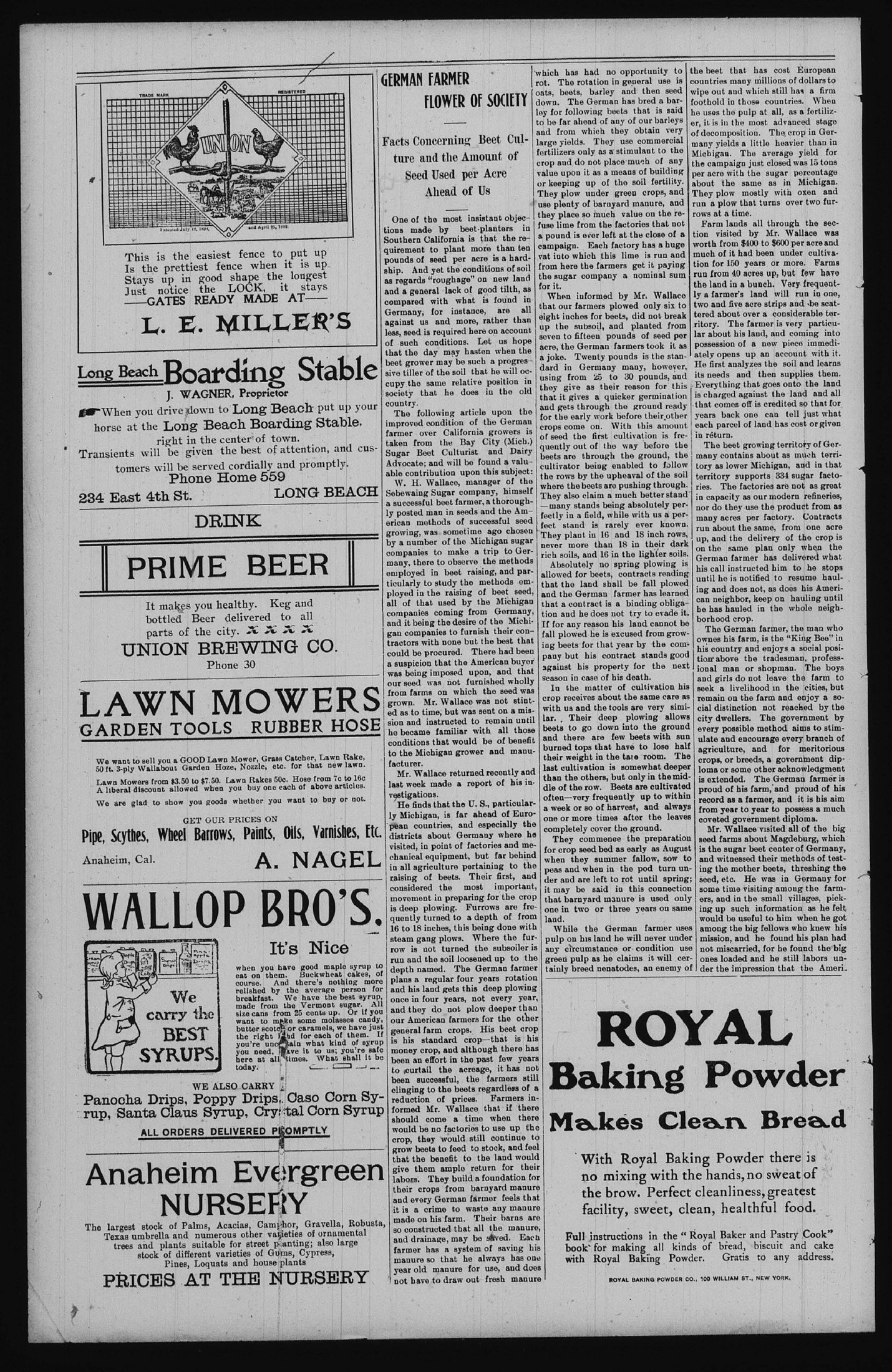
Searchable text
TRADE MARK REGISTERED
UNION
Latenied July 12, 1893 and April 25, 1892.
This is the easiest fence to put up
Is the prettiest fence when it is up
Stays up in good shape the longest
Just notice the LOCK, it stays
GATES READY MADE AT
L. E. MILLER'
Long Beach Boarding St
J. WAGNER, Proprietor
When you drive down to Long Beach put
horse at the Long Beach Boarding Sta
right in the center of town.
Transients will be given the best of attention,
tomers will be served cordially and prompt
Phone Home 559
234 East 4th St. LONG B
When you drive down to Long Beach put
horse at the Long Beach Boarding St
right in the center of town.
Transients will be given the best of attention,
tomers will be served cordially and prompt
Phone Home 559
234 East 4th St. LONG B
DRINK
PRIME BEER
It makes you healthy. Keg and
bottled Beer delivered to all
parts of the city.
UNION BREWING CO
Phone 30
LAWN MOWE
GARDEN TOOLS RUBBER
We want to sell you a GOOD Lawn Mower, Grass Catcher, Law
50 ft. 3-ply Wallabout Garden Hoze, Nozzle, etc. for that n
Lawn Mowers from $3.50 to $7.50. Lawn Rakes 50c. Hose from
A liberal discount allowed when you buy one each of above
We are glad to show you goods whether you want to buy
GET GUR PRICES ON
Pipe, Scythes, Wheel Barrows, Paints, Oils, Varn
Anaheim, Cal.
A. NAC
WALLOP BRO
It's Nic
WALLOP BROOK
It's Nic
when you have good ma
eat on them. Buckwhe
course. And there's n
relished by the average
breakfast. We have th
made from the Vermont
size cans from 25 cents u
want to make some mo
butter scotch or caramels,
the right hand for each
you're uncertain what k
you need, have it to us
here at all times. Wha
today.
WE ALSO CARRY
Panocha Drips, Poppy Drips, Caso C
rup, Santa Claus Syrup, Crystal Corn
ALL ORDERS DELIVERED PROMPTLY
Anaheim Evergreen
NURSERY
The largest stock of Palms, Acacias, Camphor, Gravel,
Texas umbrella and numerous other varieties of orn
trees and plants suitable for street planting; also
stock of different varieties of Gums, Cypress,
Pines, Loquats and house plants
PRICES AT THE NURSE
GERMAN FARMER
FLOWER OF SOCIETY
Facts Concerning Beet Culture and the Amount of Seed Used per Acre
Ahead of Us
One of the most insistent objections made by beet-planters in Southern California is that the requirement to plant more than ten pounds of seed per acre is a hardship. And yet the conditions of soil as regards "roughage" on new land and a general lack of good tilth, as compared with what is found in Germany, for instance, are all against us and more, rather than less, seed is required here on account of such conditions. Let us hope that the day may hasten when the beet grower may be such a progressive tiller of the soil that he will occupy the same relative position in society that he does in the old country.
The following article upon the improved condition of the German farmer over California growers is taken from the Bay City (Mich.) Sugar Beet Culturist and Dairy Advocate; and will be found a valuable contribution upon this subject:
W. H. Wallace, manager of the Sebewaing Sugar company, himself a successful beet farmer, a thoroughly posted man in seeds and the Am-which has had no optionrot. The rotation in geese oats, beets, barley and down. The German hay ley for following beets to be far ahead of any other and from which they large yields. They use fertilizers only as a stimulcrop and do not place no value upon it as a means or keeping up of the crop. They plow under green use plenty of barnyard they place so much value fuse lime from the fact a pound is ever left at the campaign. Each factor vat into which this line from here the farmers the sugar company are for it.
When informed by that our farmers plowed eight inches for beets, up the subsoil, and seven to fifteen pounds acre, the German farm a joke. Twenty pounds dard in Germany making from 25 to 30 they give as their reason that it gives a quicker and gets through the early work before crops come on. With of seed the first cultiquently out of the water beets are through the cultivator being enabled the rows by the uphear where the beets are pushed. They also claim a mucu—many stands being a
The following article upon the improved condition of the German farmer over California growers is taken from the Bay City (Mich.) Sugar Beet Culturist and Dairy Advocate; and will be found a valuable contribution upon this subject:
W. H. Wallace, manager of the Sebewaing Sugar company, himself a successful beet farmer, a thoroughly posted man in seeds and the American methods of successful seed growing, was sometime ago chosen by a number of the Michigan sugar companies to make a trip to Germany, there to observe the methods employed in beet raising, and particularly to study the methods employed in the raising of beet seed, all of that used by the Michigan companies coming from Germany, and it being the desire of the Michigan companies to furnish their contractors with none but the best that could be procured. There had been a suspicion that the American buyer was being imposed upon, and that our seed was not furnished wholly from farms on which the seed was grown. Mr. Wallace was not stinted as to time, but was sent on a mission and instructed to remain until he became familiar with all those conditions that would be of benefit to the Michigan grower and manufacturer.
Mr. Wallace returned recently and last week made a report of his investigations.
He finds that the U.S., particularly Michigan, is far ahead of European countries, and especially the districts about Germany where he visited, in point of factories and mechanical equipment, but far behind in all agriculture pertaining to the raising of beets. Their first, and considered the most important, movement in preparing for the crop is deep plowing. Furrows are frequently turned to a depth of from 16 to 18 inches, this being done with steam gang plows. Where the furrow is not turned the subsoiler is run and the soil loosened up to the depth named. The German farmer and gets through the early work before crops come on. With of seed the first cultiquely out of the water beets are through the cultivator being enabled by the rows by the upheaval where the beets are pushed. They also claim a much—many stands being affected in a field, while thefect stand is rarely used. They plant in 16 and never more than 18 rich soils, and 16 in the Absolutely no spring allowed for beets, concluding that the land shall be and the German farm that a contract is a bition and he does not try. If for any reason his fall plowed he is excusing beets for that year pany but his contract against his property season in case of his die.
In the matter of crop receives about them with us and the tools lar.. Their deep plows to go down into and there are few burned tops that have their weight in the tap last cultivation is so than the others, but o dle of the row. Beets often—very frequently a week or so of harvest one or more times af completely cover the g
They commence for crop seed bed as e when they summer peas and when in th der and are left to rott it may be said in t that barnyard manure one in two or three land.
While the German pulp on his land he w any circumstance or green pulp as he clai tainly breed nenatod
BRO'S.
It's Nice
you have good maple syrup to them. Buckwheat cakes, of And there's nothing more used by the average person for last. We have the best syrup, from the Vermont sugar. All fruits from 25 cents up. Or if you do make some molasses candy, scotch or caramels, we have just right land for each of them. If you untaint what kind of syrup need, leave it to us; you're safe at all times. What shall it be in all agriculture pertaining to the raising of beets. Their first, and considered the most important, movement in preparing for the crop is deep plowing. Furrows are frequently turned to a depth of from 16 to 18 inches, this being done with steam gang plows. Where the furrow is not turned the subsoiler is run and the soil loosened up to the depth named. The German farmer plans a regular four years rotation and his land gets this deep plowing once in four years, not every year, and they do not plow deeper than our American farmers for the other general farm crops. His beet crop is his standard crop—that is his money crop, and although there has been an effort in the past few years to curtail the acreage, it has not been successful, the farmers still clinging to the beets regardless of a reduction of prices. Farmers informed Mr. Wallace that if there should come a time when there would be no factories to use up the crop, they would still continue to grow beets to feed to stock, and feel that the benefit to the land would give them ample return for their labors. They build a foundation for their crops from barnyard manure and every German farmer feels that it is a crime to waste any manure made on his farm. Their barns are so constructed that all the manure, and drainage, may be saved. Each farmer has a system of saving his manure so that he always has one year old manure for use, and does not have to draw out fresh manure
has had no opportunity to
The rotation in general use is
beets, barley and then seed
The German has bred a barter following beets that is said
far ahead of any of our barleys
from which they obtain very
yields. They use commercial
zers only as a stimulant to the
and do not place much of any
upon it as a means of building
keeping up of the soil fertility.
They plow under green crops, and
plenty of barnyard manure, and
place so much value on the retime from the factories that not
land is ever left at the close of a
assign. Each factory has a huge
into which this lime is run and
where the farmers get it paying
sugar company a nominal sum
then informed by Mr. Wallace
our farmers plowed only six to
in inches for beets, did not break
the subsoil, and planted from
to fifteen pounds of seed per
the German farmers took it as
are. Twenty pounds is the standard in Germany many, however,
from 25 to 30 pounds, and
give as their reason for this
it gives a quicker germination
gets through the ground ready
the early work before their other
is come on. With this amount
need the first cultivation is fretly out of the way before the
are through the ground, the
evator being enabled to follow
bows by the upheaval of the soil
the beets are pushing through.
also claim a much better stand
any stands being absolutely per-
the beet that has cost European
countries many millions of dollars to
wipe out and which still has a firm
foothold in those countries. When
he uses the pulp at all, as a fertilizer, it is in the most advanced stage of decomposition. The crop in Germany yields a little heavier than in Michigan. The average yield for the campaign just closed was 15 tons per acre with the sugar percentage about the same as in Michigan. They plow mostly with oxen and run a plow that turns over two furrows at a time.
Farm lands all through the sectivision visited by Mr. Wallace was worth from $400 to $600 per acre and much of it had been under cultivation for 150 years or more. Farms run from 40 acres up, but few have the land in a bunch. Very frequenly a farmer's land will run in one,
two and five acre strips and be scattered about over a considerable territory. The farmer is very particular about his land, and coming into possession of a new piece immediately opens up an account with it. He first analyzes the soil and learns its needs and then supplies them. Everything that goes onto the land is charged against the land and all that comes off is credited so that for years back one can tell just what each parcel of land has cost or given in return.
The beet growing territory of Germany contains about as much territory as lower Michigan, and in that territory supports 334 sugar factories. The factories are not as great in capacity as our modern refineries, nor do they use the product from as
gets through the ground ready
the early work before their other
comes on. With this amount
used the first cultivation is fretely out of the way before the
seeds are through the ground, the
levator being enabled to follow
bows by the upheaval of the soil
like the beets are pushing through.
It also claim a much better stand
many stands being absolutely perfect in a field, while with us a perfect stand is rarely ever known.
My plant in 16 and 18 inch rows,
for more than 18 in their dark
soils, and 16 in the lighter soils.
Absolutely no spring plowing is
waved for beets, contracts reading
of the land shall be fall plowed
if the German farmer has learned
a contract is a binding obligation and he does not try to evade it.
For any reason his land cannot be
plowed he is excused from growbeets for that year by the company but his contract stands good
must his property for the next
month in case of his death.
In the matter of cultivation his
receives about the same care as
us and the tools are very similar. Their deep plowing allows
his to go down into the ground
and there are few beets with sunned tops that have to lose half
or weight in the tare room. The
cultivation is somewhat deeper
in the others, but only in the midof the row. Beets are cultivated
on—very frequently up to within
week or so of harvest, and always
for more times after the leaves
completely cover the ground.
They commence the preparation
crop seed bed as early as August
when they summer fallow, sow to
it and when in the pod turn unand are left to rot until spring;
may be said in this connection
at barnyard manure is used only
in two or three years on same
dial.
While the German farmer uses
up on his land he will never understand circumstance or condition use
when pulp as he claims it will cerly breed nematodes, an enemy of
that comes off is credited so that for
years back one can tell just what
each parcel of land has cost or given
in return.
The beet growing territory of Germany contains about as much territory as lower Michigan, and in that territory supports 334 sugar factories. The factories are not as great in capacity as our modern refineries, nor do they use the product from as many acres per factory. Contracts run about the same, from one acre up, and the delivery of the crop is on the same plan only when the German farmer has delivered what his call instructed him to he stops until he is notified to resume hauling and does not, as does his American neighbor, keep on hauling until he has hauled in the whole neighborhood crop.
The German farmer, the man who owns his farm, is the "King Bee" in his country and enjoys a social position above the tradesman, professional man or shopman. The boys and girls do not leave the farm to seek a livelihood in the cities, but remain on the farm and enjoy a social distinction not reached by the city dwellers. The government by every possible method aims to stimulate and encourage every branch of agriculture, and for meritorious crops, or breeds, a government diploma or some other acknowledgment is extended. The German farmer is proud of his farm, and proud of his record as a farmer, and it is his aim from year to year to possess a much coveted government diploma.
Mr. Wallace visited all of the big seed farms about Magdeburg, which is the sugar beet center of Germany, and witnessed their methods of testing the mother beets, threshing the seed, etc. He was in Germany for some time visiting among the farmers, and in the small villages, picking up such information as he felt would be useful to him when he got among the big fellows who knew his mission, and he found his plan had not miscarried, for he found the big ones loaded and he still labors under the impression that the Ameri-
ROYAL
Baking Powder
Makes Clean Bread
With Royal Baking Powder there is no mixing with the hands, no sweat of the brow. Perfect cleanliness, greatest facility, sweet, clean, healthful food.
Full instructions in the "Royal Baker and Pastry Cook" book for making all kinds of bread, biscuit and cake with Royal Baking Powder. Gratis to any address.
ROYAL BAKING POWDER CO., 100 WILLIAM ST., NEW YORK.