anaheim-gazette 1905-03-16
Scanned page
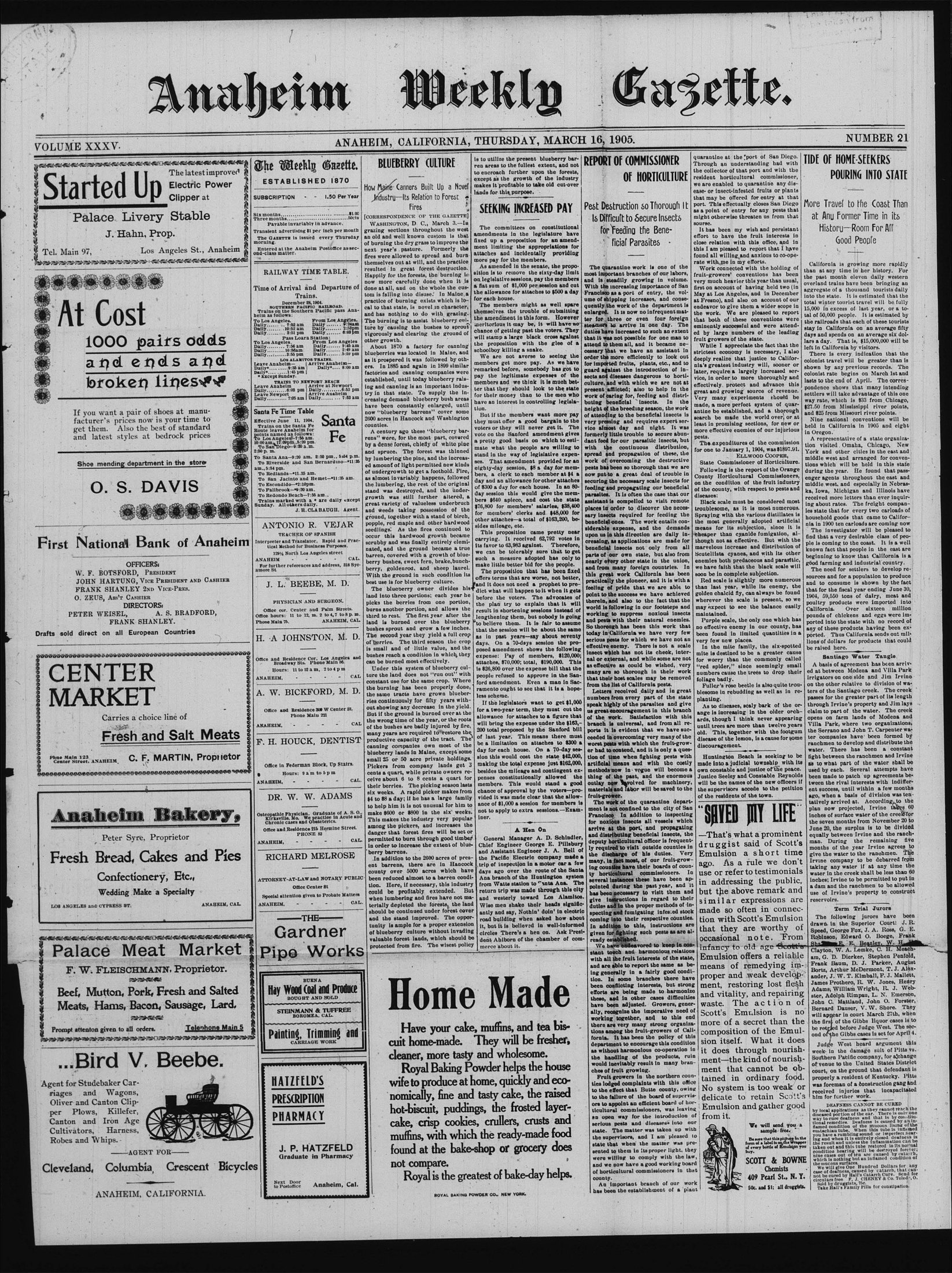
Searchable text
Anaheim
VOLUME XXXV.
Started Up
The latest improved Electric Power Clipper at
Palace Livery Stable
J. Hahn, Prop.
Tel. Main 97, Los Angeles St., Anaheim
At Cost
1000 pairs odds and ends and broken lines
If you want a pair of shoes at manufacturer's prices now is your time to get them. Also the best of standard and latest styles at bedrock prices
Shoe mending department in the store
The Weekly Gazette
ESTABLISHED 1870
SUBSCRIPTION - 1.50 Per Year
Six months... $1.00
Three months... $5.00
Payable invariably in advance.
Transient advertising $1 per inch per month.
The Gazette is issued every Thursday morning.
Entered at the Anaheim Postoffice as second-class matter.
RAILWAY TIME TABLE.
Time of Arrival and Departure of Trains.
December 28, 1904.
SOUTHERN PACIFIC RAILROAD.
Trains on the Southern Pacific pass Anaheim as follows:
To Los Angeles.
Daily... 7:52 am
Daily... 10:52 am
Daily... 3:51 pm
From Los Angeles:
Daily... 9:24 am
Daily... 2:53 pm
Daily... 6:03 pm
Pass Loara Station:
To Los Angeles.
Daily... 7:56 am
Daily... 10:56 am
Daily... 3:55 pm
From Los Angeles:
Daily... 9:45 am
Daily... 2:49 am
Daily... 5:59 pm
LOS ALAMITOS TRAINS.
Leave Anaheim—Arrive Anaheim—
Daily*... 9:35 am
Daily*... 1:45 pm
* Except Sunday.
TRAINS TO NEWPORT BEACH
Leave Anaheim Arrive at Newport
Daily... 6:03 pm
Daily... 6:53 pm
Leave Newport Arrive Anaheim
Daily... 7:05 am
Santa Fe Time Table
Effective June 11, 1904.
Trains on the Santa Fe Route leave Anaheim for points named as follows:
To Los Angeles—7:55 am
10:00 am, 12:00pm, 8:20 pm.
To San Diego—9:20 a.m.
2:50 p.m.
To Santa Ana—9:20 am. 2:50 p.m., 5:54 p.m.
To Riverside and San Bernardino—*11:41 a.m., 5:54 p.m.
To Redlands—*11.35 a.m.
broken lines
If you want a pair of shoes at manufacturer's prices now is your time to get them. Also the best of standard and latest styles at bedrock prices
Shoe mending department in the store
O. S. DAVIS
First National Bank of Anaheim
OFFICERS:
W. F. BOTSFORD, PRESIDENT
JOHN HARTUNG, VICE PRESIDENT AND CASHIER
FRANK SHANLEY 2ND VICE-PRES.
O. ZEUS, ASS'T CASHIER
DIRECTORS:
PETER WEISEL, A. S. BRADFORD,
FRANK SHANLEY.
Drafts sold direct on all European Countries
CENTER MARKET
Carries a choice line of
Fresh and Salt Meats
Phno Main 123
Center Street, ANAHEIM
C. F. MARTIN, Proprietor
Anaheim Bakery,
Peter Syre, Proprietor
Fresh Bread, Cakes and Pies
Confectionery, Etc.,
Wedding Make a Specialty
Santa Fe Time Table
Effective June 11, 1904.
Trains on the Santa Fe Route leave Anaheim for points named as follows:
To Los Angeles -7:58 am.
10:00 am, 12:00pm, 5:30 pm.
To San Diego -9:35 a.m.
2:50 p.m.
To Santa Ana -9:20 am. 2:50 pm., 5:54 p.m.
To Riverside and San Bernardino -11:15 am., 5:54 p.m.
To Redlands -11:35 am.
To San Jacinto and Hemet -11:35 am.
To Escondido -2:50pm.
To Fallbrook -9:20 am.
To Redondo Beach -7:55 am.
Trains marked with a * are daily except Sunday. All others daily.
ANTONIO R. VEJAR
TEACHER OF SPANISH
Interpreter and Translator. Rapid and Practical Method for Business Purposes.
129¼ North Los Angeles street
ANAHEIM
CA
For further references and address, 318 Syamore St.
J. L. BEEBE, M. D.
PHYSICIAN AND SURGEON.
Office cor. Center and Palm Streets.
Office hours: 11 to 12, m. 2 to 4,7 to 8 p.m.
Phone Main 75.
H. A JOHNSTON, M. D.
Office and Residence Cor. Los Angeles a Broadway Sts. Phone Main 86.
Hours: 11 to 12 a.m., 2 to 4 p.m
ANAHEIM,
A. W. BICKFORD, M. I.
Office and Residence 300 W Center St.
Phone Main 221
ANAHEIM,
F. H. HOUCK, DENTIS
Office in Federman Block, Up Stairs.
Hours: 9 a.m to 5 p.m
ANAHEIM,
DR. W. W. ADAMS
Osteopathic Physician. Graduate of A. S. Kirkaville, Mo. We practice in Acute Chronic cases and Obstetrics.
Office and Residence 215 Hermine Street PHONE 83
ANAHEIM,
RICHARD MELROSE
ATTORNEY-AT-LAW and NOTARY PUB
Office Center St
Special attention given to Probate Matters
Anaheim Bakery,
Peter Syre, Proprietor
Fresh Bread, Cakes and Pies
Confectionery, Etc.,
Wedding Make a Specialty
LOS ANGELES and CYPRESS ST.
ANAHEIM, CAL.
Palace Meat Market
F. W. FLEISCHMANN, Proprietor.
Beef, Mutton, Pork, Fresh and Salted
Meats, Hams, Bacon, Sausage, Lard.
Prompt attention given to all orders.
Telenhone Main 5
...Bird V. Beebe.
Agent for Studebaker Carriages and Wagons,
Oliver and Canton Clipper Plows, Killefer,
Canton and Iron Age Cultivators, Harness,
Robes and Whips.
AGENT FOR
Cleveland, Columbia, Crescent Bicycles
ANAHEIM, CALIFORNIA.
Weekly Gazette.
ABLISHED 1870
PTION - 1.50 Per Year
BLUEBERRY CULTURE
How Maine Canners Built Up a Novel Industry—Its Relation to Forest Fires
[CORRESPONDENCE OF THE GAZETTE]
WASHINGTON, D.C., March 3. In grazing sections throughout the west an old and well known custom is that of burning the dry grass to improve the next year's pasture. Formerly the fires were allowed to spread and burn themselves out at will, and the practice resulted in great forest destruction. Happily for the forests, the burning is now more carefully done when it is done at all, and on the whole the custom is falling into disuse. In Maine, a practice of burning exists which is local to that state, is novel in character, and has nothing to do with grazing. The burning is to assist blueberry culture by causing the bushes to sprout vigorously and clearing the ground of other growth.
About 1870 a factory for canning blueberries was located in Maine, and as it prospered it was followed by others. In 1885 and again in 1899 similar factories and canning companies were established, until today blueberry raising and canning is an important industry in that state. To supply the increasing demand blueberry bush areas have been constantly enlarged, until now "blueberry barrens" cover some 2600 acres in Hancock and Washington counties.
A century ago these "blueberry barrens" were, for the most part, covered by a dense forest, chiefly of white pine and spruce. The forest was thinned by lumbering the pine, and the increased amount of light permitted new kinds of undergrowth to get a foothold. Fire, is to utilize the present blueberry barren areas to the fullest extent, and not to encroach further upon the forests, except as the growth of the industry makes it profitable to take old cut-over lands for this purpose.
SEEKING INCREASED PAY
The committees on constitutional amendments in the legislature have fixed up a proposition for an amendment limiting the appropriations for attaches and incidentally providing more pay for the members.
As amended in the senate, the proposition is to remove the sixty-day limit on legislative sessions, pay the members a flat sum of $1,000 per session and cut the allowance for attaches to $500 a day for each house.
The members might as well spare themselves the trouble of submitting the amendment in this form. However meritorious it may be, it will have no chance of getting past the voters. They will stamp a large black cross against the proposition with the glee of a schoolboy killing a snake.
We are not averse to seeing the members get more pay. As we have remarked before, somebody has got to pay the legitimate expenses of the members and we think it is much better that they should look to the state for their money than to the men who have an interest in controlling legislation.
But if the members want more pay they must offer a good bargain to the voters or they will never get it. The vote on the Sanford amendment gives a pretty good basis on which to estimate what the people are willing to stand in the way of legislative expenses. That amendment provided for an eighty-day session, $8 a day for members a clerk to each member at $4 a day.
REPORT OF COMMISSIONER OF HORTICULTURE
Pest Destruction so Thorough Is Difficult to Secure Insects for Feeding the Beneficial Parasites
The quarantine work is one of most important branches of our life and is steadily growing in vow With the increasing importance of Francisco as a port of entry, the time of shipping increases, and frequently the work of the department enlarged. It is now no infrequent ter for three or even four steamers to arrive in one day. duties have increased to such an extent that it was not possible for one man attend to them all, and it became necessary that we have an assistant order the more efficiently to locate for imported fruits, plants, etc., guard against the introduction of sects and diseases dangerous to culture, and with which we are present afflicted; also to help work of caring for, feeding and buting beneficial insects. In height of the breeding season, there of attending to the beneficial insect very pressing and requires expert vice almost day and night. I formerly little trouble to secure dant feed for our parasitic insects with the continuous distribution spread and propagation of these work of overcoming the destructive pests has been so thorough that we now out to a great deal of treat
A century ago these "blueberry barrens" were, for the most part, covered by a dense forest, chiefly of white pine and spruce. The forest was thinned by lumbering the pine, and the increased amount of light permitted new kinds of undergrowth to get a foothold. Fire, as almost invariably happens, followed the lumbering, the rest of the original stand was destroyed, and the undergrowth was still further altered, a great variety of valueless underbrush and weeds taking possession of the ground, together with a stand of birch, popple, red maple and other hardwood seedlings. As the fires continued to occur this hardwood growth became scrubby and was finally entirely eliminated, and the ground became a true barren, covered with a growth of blueberry bushes, sweet fern, brake, buncherry, goldenrod, and sheep laurel. With the ground in such condition its best use is for blueberry culture.
The blueberry owner divides his land into three portions; each year he picks the berries from one portion, burns another portion, and allows the third to rest. The first year after the land is burned over the blueberry bushes sprout and grow a few inches. The second year they yield a full crop of berries. The third season the crop is small and of little value, and the bushes reach a condition in which they can be burned most effectively.
Under this system of blueberry culture the land does not "run out" with constant use for the same crop. Where the burning has been properly done, the same tracts have grown blueberries continuously for fifty years without showing any decrease in the yield. But if the ground is burned over at the wrong time of the year, or the roots of the bushes are badly injured by fire, many years are required to restore the productive capacity of the tract. The canning companies own most of the blueberry lands in Maine, except some small 25 or 50 acre private holdings. Pickers from company lands get 3 cents a quart, while private owners receive about 6 to 8 cents a quart for their berries. The picking season lasts six weeks. A rapid picker makes from $4 to $8 a day; if he has a large family to help him it is not unusual for him to make $600 or $800 in the six weeks. This makes the industry very popular among the pickers, and increases the danger that forest fires will be set or permitted to burn through good timber in order to increase the extent of blueberry barrens.
In addition to the 2600 acres of present barrens, there are in Hancock county over 5000 acres which have been reduced almost to a barren condition. Here, if necessary, this industry could be profitably extended. But when lumbering and fires have not ma-
pay the legitimate expenses of the members and we think it is much better that they should look to the state for their money than to the men who have an interest in controlling legislation.
But if the members want more pay they must offer a good bargain to the voters or they will never get it. The vote on the Sanford amendment gives a pretty good basis on which to estimate what the people are willing to stand in the way of legislative expenses. That amendment provided for an eighty-day session, $8 a day for members, a clerk to each member at $4 a day and an allowance for other attaches of $300 a day for each house. In an 80-day session this would give the members $640 apiece, and cost the state $76,800 for members' salaries, $38,400 for members' clerks and $48,000 for other attaches—a total of $163,200, besides mileage, etc.
This proposition came pretty near carrying. It received 62,792 votes in its favor to 63,983 against. Therefore, we can be tolerably sure that to get such a measure adopted has only to make little better bid for the people.
The proposition that has been fixed offers terms that are worse, not better, and it does not need a prophet to predict what will happen to it when it gets before the voters. The advocates of the plan try to explain that it will result in shortening sessions instead of lengthening them, but nobody is going to believe them. It is fair to assume that the session will be about the same as in past years—say about seventy days. On a 70-days session the proposed amendment shows the following expense: Pay of members, $120,000; attaches, $70,000; total, $190,000. This is $26,800 over the expense bill that the people refused to approve in the Sanford amendment. Even a man in Sacramento ought to see that it is a hopeless scheme.
If the legislators want to get $1,000 for a two-year term, they must cut the allowance for attaches to a figure that will bring the expense under the $163,-200 total proposed by the Sanford bill of last year. This means there must be a limitation on attaches to $300 a day for each house. On a 70-day session this would cost the state $42,000, making the total expense just $162,000, besides the mileage and contingent expenses constitutionally allowed the members. This would stand a good chance of approval by the voters—provided it was made clear that the allowance of $1,000 a session for members is not to apply to extra sessions.—Examiner.
A Hen On
General Manager A. D. Schindler, Chief Engineer George E. Pillsbury and Assistant Engineer J. A. Bell of the Pacific Electric company made a trip of inspection in a motor car a few days ago over the route of the Santa Ana branch of the Huntington system from Watts station to Santa Ana. The return trip was made through this city and westerly toward Los Alamitos.
Letters received daily and in numbers from every part of the speak highly of the parasites and us great encouragement in this work. Satisfaction with branch is universal, and from ports it is evident that we have ceeded in overcoming very many worst pests with which the fruit had to contend, and it is only oition of time when fighting pest artificial means and with the methods now in vogue will be thing of the past, and the enoulay now involved for mack materials and labor will be save fruit-grower.
The work of the quarantine ment is not confined to the city Francisco. In addition to ins for noxious insects all vessels arrive at the port, and propand distributing beneficial insect deputy horticultural officer is frly required to visit outside coul discharge of his duties,many, in fact most, of our fruiting counties have their boards ty horticultural commission several instances these have been pointed during the past year,has been necessary to visit these instructions in regard
Home Made
Have your cake, muffins, and tea biscuit home-made. They will be fresher, cleaner, more tasty and wholesome.
Royal Baking Powder helps the house wife to produce at home, quickly and economically, fine and tasty cake, the raised hot-biscuit, puddings, the frosted layer-cake, crisp cookies, crullers, crusts and muffins, with which the ready-made food found at the bake-shop or grocery does not compare.
Royal is the greatest of bake-day helps.
ROYAL BAKING POWDER CO., NEW YORK.
PORT OF COMMISSIONER OF HORTICULTURE
At Destruction so Thorough It is Difficult to Secure Insects for Feeding the Beneficial Parasites
The quarantine work is one of the important branches of our labors, is steadily growing in volume. Due to the increasing importance of San Francisco as a port of entry, the volume of shipping increases, and consequently the work of the department is enlarged. It is now no infrequent matter; three or even four foreignmers arrive in one day. The workers have increased to such an extent that it was not possible for one man to lead to them all, and it became necessary that we have an assistant in order to more efficiently to look out imported fruits, plants, etc., and to aid against the introduction of in- and diseases dangerous to horticulture, and with which we are not at present afflicted; also to help in the care of caring for, feeding and distributing beneficial insects. In the light of the breeding season, the work extending to the beneficial insects is pressing and requires expert ser- almost day and night. It was merely little trouble to secure abun-d feed for our parasitic insects, but the continuous distribution, spread and propagation of these, the fear of overcoming the destructive has been so thorough that we are out to a great deal of trouble in quarantine at the port of San Diego. Through an understanding had with the collector of that port and with the resident horticultural commissioner, we are enabled to quarantine any disease- or insect-infested fruits or plants that may be offered for entry at that port. This effectually closes San Diego as a point of entry for any pests that might otherwise threaten us from that source.
It has been my wish and persistent effort to have the fruit interests in close relation with this office, and in this I am pleased to report that I have found all willing and anxious to co-operate with me in my efforts.
Work connected with the holding of fruit-growers' conventions has been very much heavier this year than usual, first on account of having held two (in May at Los Angeles, and in December at Fresno), and also on account of our endeavor to give them a wider scope in the work. We are pleased to report that both of these conventions were eminently successful and were attended by large numbers of the leading fruit growers of the state.
While I appreciate the fact that the strictest economy is necessary, I also deeply realize that justice to California's greatest industry will, sooner or later, require a largely increased service, in order to more thoroughly and effectively protect and advance this great and growing source of revenue. Very many experiments should be made, a more perfect system of quarantine be established, and a thorough search be made the world over, or at least in promising sections, for new or more effective enemies of our injurious pests.
The expenditures of the commission for one to January 1, 1904, was $1897.91. ELLWOOD COOPER,
State Commissioner of Horticulture.
Following is the report of the Orange County Horticultural Commission.
TIDE OF HOME-SEEKERS POURING INTO STATE
More Travel to the Coast Than at Any Former Time in its History—Room For All Good People
California is growing more rapidly than at any time in her history. For the past month eleven daily western overland trains have been bringing an aggregate of a thousand tourists daily into the state. It is estimated that the total winter tourist travel will be fully 15,000 in excess of last year, or a total of 50,000 people. It is estimated by the railroads that each of these tourists stay in California on an average fifty days and spends on an average six dollars a day. That is, $15,000,000 will be left in California by visitors.
There is every indication that the colonist travel will be greater than is shown by any previous records. The colonist rate begins on March 1st and lasts to the end of April. The correspondence shows that many intending settlers will take advantage of this one way rate, which is $33 from Chicago, $27.50 from Mississippi river points, and $25 from Missouri river points.
Nine national conventions will be held in California in 1905 and eight in Oregon.
A representative of a state organization visited Omaha, Chicago, New York and other cities in the east and middle west and arranged for conventions which will be held in this state during the year. He found that pass-
and diseases dangerous to horticulture, and with which we are not at present afflicted; also to help in the care of caring for, feeding and distributing beneficial insects. In the light of the breeding season, the work extending to the beneficial insects is pressing and requires expert servery almost day and night. It was merely little trouble to secure abun- feed for our parasitic insects, but the continuous distribution, and propagation of these, the work of overcoming the destructive insects has been so thorough that we are put to a great deal of trouble in caring the necessary scale insects for feeding and propagating our beneficial insects. It is often the case that ouristant is compelled to visit remote areas in order to discover the necessities insects required for feeding the beneficial ones. The work entails considerable expense, and the demands us in this direction are daily insisting, as applications are made for artificial insects not only from all areas of our own state, but also from only every other state in the union, from many foreign countries. In great work California has been critically the pioneer, and it is with a kind of pride that we are able to put to the success we have achieved herein, and also to the fact that the field is following in our footsteps and taking to suppress noxious insects pests with their natural enemies. Through has been this work that lay in California we have very few pests for which we have not an active enemy. There is not a scale effect which has not its check, inter- or external, and while some are not effective as could be wished, very may are so thorough in their work that their host scales may be removed on the list of California pests.
Betters received daily and in great numbers from every part of the state took highly of the parasites and give great encouragement in this branch of the work. Satisfaction with this branch is universal, and from all re- tests it is evident that we have succeeded in overcoming very many of the pest pests with which the fruit-grow-oad to contend, and it is only a question of time when fighting pests with official means and with the costly methods now in vogue will become a king of the past, and the enormous lay now involved for machinery, materials and labor will be saved to the next grower.
The work of the quarantine depart- ment is not confined to the city of San Francisco. In addition to inspecting noxious insects all vessels which live at the port, and propagating and distributing beneficial insects, the county horticultural officer is frequent- required to visit outside counties in discharge of his duties. Very many, in fact most, of our fruit-grow- ing counties have their boards of coun- short cultural commissioners. In several instances these have been ap- pended during the past year, and it has been necessary to visit them and instruct instructions in regard to their service, in order to more thoroughly and effectively protect and advance this great and growing source of revenue. Very many experiments should be made, a more perfect system of quar- antine be established, and a thorough search be made the world over, or at least in promising sections, for new or more effective enemies of our injurious pests.
The expenditures of the commission for one to January 1, 1904, was $1897.91. ELLWOOD COOPER,
State Commissioner of Horticulture.
Following is the report of the Orange County Horticultural Commissioners, on the condition of the fruit industry of the county, with respect to pests and diseases:
Black scale must be considered most troublesome, as it is most numerous. Spraying with the various distillates is the most generally adopted artificial means for its subjection, since it is cheaper than cyanide fumigation, although not as effective. But with the marvelous increase and distribution of Scutellista cyanes, and with its other enemies both predaceous and parasitic, we have faith that the black scale will soon be in complete subjection.
Red scale is slightly more numerous than last year, while its enemy, the golden chalcid fly, can always be found wherever the scale is present, so we may expect to see the balance easily maintained.
Purple scale, the only one which has no effective enemy in our county, has been found in limited quantities in a very few new places.
In the mite family, the six-spotted mite is destined to be a greater cause for worry than the commonly called "red spider," since seemingly small numbers cause the trees to drop their foliage badly.
Fuller's rose beetle is also quite troublesome in rebudding as well as in replanting.
As to diseases, scaly bark of the orange is increasing in the older orchards, though I think never appearing until trees are more than twelve years old. This, together with the footgum disease of the lemon, is a cause for some discouragement.
Huntington Beach is seeking to be made into a judicial township with its own constable and justice of the peace. Justice Seeley and Constable Reynolds will be the names of the new officers if the supervisors accede to the petition of the residents of the town.
"SAVED MY LIFE"
—That's what a prominent druggist said of Scott's Emulsion a short time ago. As a rule we don't use or refer to testimonials in addressing the public, but the above remark and similar expressions are
A representative of a state organization visited Omaha, Chicago, New York and other cities in the east and middle west and arranged for conventions which will be held in this state during the year. He found that passenger agents throughout the east and middle west, and especially in Nebraska, Iowa, Michigan and Illinois have received more letters than ever inquiry about rates. The freight companies state that for every two carloads of household goods that came to California in 1900 ten carloads are coming now.
The investigator will be pleased to find that a very desirable class of people is coming to the coast. It is a well known fact that people in the east are beginning to know that California is a good farming and industrial country.
The need for settlers to develop resources and for a population to produce and to consume is shown by the fact that for the fiscal year ending June 30, 1904, 59,550 tons of dairy, meat and poultry products were imported into California. Over sixteen million pounds of chickens and eggs were imported into the state with no record of any of these products having been exported. Thus California sends out millions of dollars for products that could be raised here.
Santiago Water Tangle
A basis of agreement has been arrived at between Modena and Villa Park irrigators on one side and Jim Irvine on the other relative to division of waters of the Santiago creek. The creek passes for the greater part of its length through Irvine's property and Jim lays claim to part of the water. The creek opens on farm lands of Modena and Villa Park, where two organizations, the Serrano and John T. Carpenter water companies have been formed by ranchmen to develop and distribute the water. There has been a constant fight between the ranchmen and Irvine as to what part of the water shall be used by each. Several attempts have been made to patch up agreements between the rival interests with indifferent success, until within a few months ago, when a basis of division was tentatively arrived at. According to the plan now projected, Irvine takes 60 inches of surface water of the creek for seven months from November 20 to June 20, the surplus is to be divided equally between Irvine and the ranchman. During the remaining five months of the year Irvine agrees to give the water to the ranchmen. The Irvine company to be debarred from taking any water if at any time the water in the creek shall be less than 60 inches; Irvine to be permitted to put in a dam and the ranchmen to be allowed use of Irvine's property to construct reservoirs.
"SAVED MY LIFE"
—That's what a prominent druggist said of Scott's Emulsion a short time ago. As a rule we don't use or refer to testimonials in addressing the public, but the above remark and similar expressions are made so often in connection with Scott's Emulsion that they are worthy of occasional note. From infancy to old age Scott's Emulsion offers a reliable means of remedying improper and weak development, restoring lost flesh and vitality, and repairing waste. The action of Scott's Emulsion is no more of a secret than the composition of the Emulsion itself. What it does it does through nourishment—the kind of nourishment that cannot be obtained in ordinary food. No system is too weak or delicate to retain Scott's Emulsion and gather good from it.
We will send you a sample free.
Be sure that this picture in the form of a label is on the wrapper of every bottle of Emulsion you buy.
SCOTT & BOWNE Chemists
409 Pearl St., N.Y.
50c. and $1; all druggists.
tatively arrived at. According to the plan now projected, Irvine takes 60 inches of surface water of the creek for the seven months from November 20 to June 20, the surplus is to be divided equally between Irvine and the ranchman. During the remaining five months of the year Irvine agrees to give the water to the ranchmen. The Irvine company to be debarred from taking any water if at any time the water in the creek shall be less than 60 inches; Irvine to be permitted to put in a dam and the ranchmen to be allowed use of Irvine's property to construct reservoirs.
Term Trial Jurors
The following jurors have been drawn in the Superior Court: J. R. Speed, George Fox, J. A. Ross, G. E. Robinson, Edward O. Boege, Frank Shafer, E. E. Beazley, W. H. Clayton, W. A. Lemke, C. H. Meacham, G. D. Dierker, Stephen Penfold, Frank Baum, D. J. Parker, August Bortz, Arthur McDermont, T. J. Alexander, J. W. T. Klimball, F. J. Mallett, James Prothero, R. W. Jones, Henry Adams, William Wright, R. J. Webster, Adolph Rimpau, L. N. Emerson, John C. Mattland, John O. Forster, Bernard Dauser, V.W.Shore. They will appear in court March 27th, when the first of the Gibbs liquor cases is to be retried before Judge West. The second of the Gibbs cases is set for April 4.
Judge West heard argument this week in the damage suit of Pitts vs. Southern Pacific company, for a change of venue to the United States District court, on the ground that defendant is properly a resident of Kentucky. Pitts was foreman of a construction gang and received injuries that incapacitated him for further work.
DEAFNESS CANNOT BE CURED
by local applications as they cannot reach the diseased portion of the ear. There is only one way to cure deafness and that is by constitutional remedies. Deafness is caused by an inflamed condition of the mucous lining of the enchachan tube. When this tube is inflamed you have a rumbling sound or imperfect hearing and when it is entirely closed deafness is the result and unless the inflammation can be taken out and this tube restored to its normal condition hearing will be destroyed forever; nine cases out of ten are caused by catarh, which is nothing but an inflamed condition of the mucous surfaces.
We will give One Hundred Dollars for any case of deafness caused by catarrh that cannot be cured by Hall's Catarrh Cure. Send for circulars free F.J.CHENEY&Co.Toledo.O.Sold by druggists, 75c.
Take Hall's Family Pills for constipation.