anaheim-gazette 1905-03-02
Scanned page
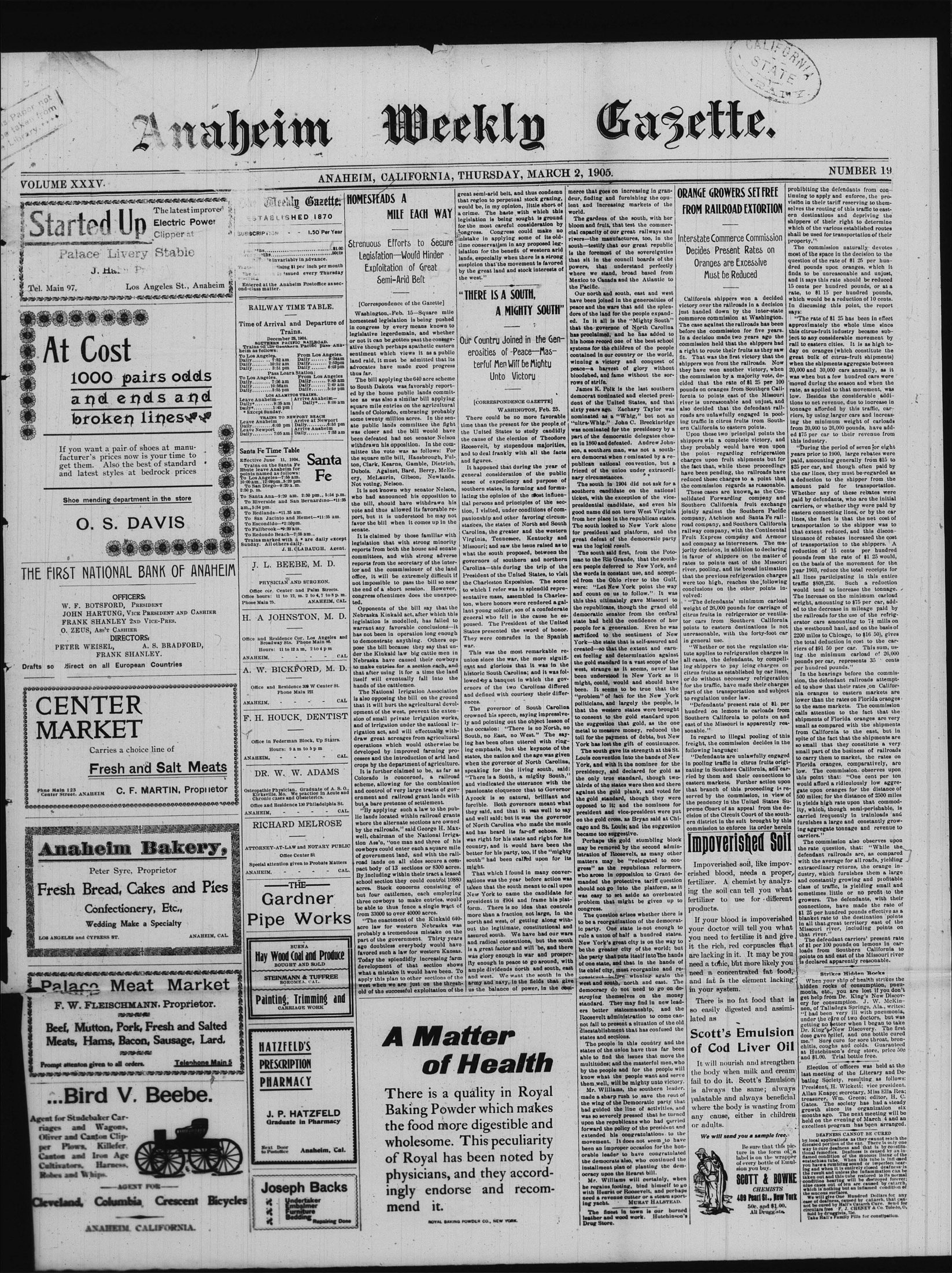
Searchable text
Anaheim
VOLUME XXXV.
Started Up
The latest improved Electric Power Clipper at Palace Livery Stable
J. Hahn Pr
Tel. Main 97, Los Angeles St., Anaheim
At Cost
1000 pairs odds and ends and broken lines
If you want a pair of shoes at manufacturer's prices now is your time to get them. Also the best of standard and latest styles at bedrock prices
Weekly Gazette:
ESTABLISHED 1870
SUBSCRIPTION - 1.50 Per Year
RAILWAY TIME TABLE.
Time of Arrival and Departure of Trains.
December 28, 1904.
SOUTHERN PACIFIC RAILROAD.
Trains on the Southern Pacific pass Anaheim as follows:
To Los Angeles.
Daily... 7:52 am Daily... 9:24am
Daily... 10:52 am Daily... 2:53pm
Daily... 3:51 pm Daily... 6:03pm
Pass Loara Station:
To Los Angeles.
Daily... 7:56 am Daily... 9:45 am
Daily... 10:56am Daily... 2:49 am
Daily... 3:55 pm Daily... 5:59 pm
LOS ALAMITOS TRAINS.
Leave Anaheim—Arrive Anaheim—
Daily*... 9:35 am Daily*... 8:00 am
Daily*... 1:45 pm
* Except Sunday.
TRAINS TO NEWPORT BEACH
Leave Anaheim Arrive at Newport
Daily... 6:03 pm Daily... 6:53 pm
Leave Newport Arrive Anaheim
Daily... 7:05 am Daily... 7:53 am
Santa Fe Time Table
Effective June 11, 1904.
Trains on the Santa Fe Route leave Anaheim for points named as follows:
If you want a pair of shoes at manufacturer's prices now is your time to get them. Also the best of standard and latest styles at bedrock prices
Shoe mending department in the store
O. S. DAVIS
THE FIRST NATIONAL BANK OF ANAHEIM
OFFICERS:
W. F. BOTSFORD, PRESIDENT
JOHN HARTUNG, VICE PRESIDENT AND CASHIER
FRANK SHANLEY 2ND VICE-PRES.
O. ZEUS, ASS'T CASHIER
DIRECTORS:
PETER WEISEL, A. S. BRADFORD,
FRANK SHANLEY.
Drafts so direct on all European Countries
CENTER MARKET
Carries a choice line of
Fresh and Salt Meats
Phne Main 123
Center Street. ANAHEIM
C. F. MARTIN, Proprietor
Anaheim Bakery,
Peter Syre, Proprietor
Fresh Bread, Cakes and Pies
Santa Fe Time Table
Effective June 11, 1904.
Trains on the Santa Fe Route leave Anaheim for points named as follows:
To Los Angeles—7:55 am.
10:00 am, 12:00 pm, 5:20 pm.
To San Diego—9:20 a.m.
2:50 p.m.
To Santa Ana—9:20 am. 2:50 pm., 5:54 p.m.
To Riverside and San Bernardino—11:35 am., 5:54 p.m.
To Redlands—11.35 am.
To San Jacinto and Hemet—11:35 am.
To Esccondido—2:50pm.
To Fallbrook—9:20 am.
To Redondo Beach—7:55 am..
Trains marked with a * are daily except Sunday. All others daily.
J. H. CLABAUGH, Agent.
J. L. BEEBE, M. D.
PHYSICIAN AND SURGEON.
Office cor. Center and Palm Streets.
Office hours: 11 to 12, m. 2 to 4,7 to 8 p.m.
Phone Main 75.
H. A JOHNSTON, M. D.
Office and Residence Cor. Los Angeles and Broadway Sts. Phone Main 86.
Hours: 11 to 12 a.m, 2 to 4 p.m
ANAHEIM.
A. W. BICKFORD, M. D.
Office and Residence 300 W Center St.
Phone Main 221
ANAHEIM.
F. H. HOUCK, DENTIST
Office in Federman Block, Up Stairs.
Hours: 9 a.m to 5 p.m
ANAHEIM,
DR. W. W. ADAMS
Osteopathic Physician. Graduate of A. S. O., Kirksville, Mo. We practice in Acute and Chronic cases and Obstetrics.
Office and Residence 130 Philadelphia St.
ANAHEIM,
RICHARD MELROSE
ATTORNEY-AT-LAW and NOTARY PUBLIC
Office Center 8t
Special attention given to Probate Matters
ANAHEIM.
THE Gardner
Anaheim Bakery,
Peter Syre, Proprietor
Fresh Bread, Cakes and Pies
Confectionery, Etc.,
Wedding Make a Specialty
LOS ANGELES and CYPRESS ST.
ANAHEIM, CAL.
Palace Meat Market
F. W. FLEISCHMANN, Proprietor.
Beef, Mutton, Pork, Fresh and Salted
Meats, Hams, Bacon, Sausage, Lard,
Prompt attention given to all orders.
Telephone Main 5
...Bird V. Beebe.
Agent for Studebaker Carriages and Wagons,
Oliver and Canton Clipper Plows, Killefer,
Canton and Iron Age Cultivators, Harness,
Robes and Whips.
AGENT FOR
Cleveland, Columbia, Crescent Bicycles
ANAHEIM, CALIFORNIA.
ANAHEIM, CALIFORNIA, THURSDAY, MARCH 2, 1905.
HOMESTEADS A
MILE EACH WAY
Strenuous Efforts to Secure Legislation—Would Hinder Exploitation of Great Semi-Arid Belt
[Correspondence of the Gazette]
Washington, Feb. 15—Square mile homestead legislation is being pushed in congress by every means known to legislative legerdemain, and whether or not it can be gotten past the conservative though perhaps apathetic eastern sentiment which views it as a public land raid, it must be admitted that its advocates have made good progress thus far.
The bill applying the 640 acre scheme to South Dakota was favorably reported by the house public lands committee as was also a similar bill applying square mile entries on the agricultural lands of Colorado, embracing probably some twenty million acres. In the senate public lands committee the fight was closer and the bill would have been defeated had not Senator Nelson withdrawn his opposition. In the committee the vote was as follows: For the square mile bill, Hansbrough, Fulton, Clark, Kearns, Gamble, Dietrich, Dubois. Against, Bard, Berry, McEnnedy that goes on increasing in grandeur, finding and furnishing the opulent and increasing markets of the world.
The gardens of the south, with her bloom and fruit, that test the commercial capacity of our great railways and rivers—the manufactures, too, in the south—testify that our great republic is the foremost of the sovereignties that sit in the council boards of the powers, that understand perfectly where we stand, broad based from Mexico to Canada and the Atlantic to the Pacific.
Our north and south, east and west have been joined in the generosities of peace and the wars that add the splendors of the land for the people expanded. In it all is the "Mighty South" that the governor of North Carolina has proclaimed, and he has added to his home record one of the best school systems for the children of the people contained in our country or the world, winning a victory and conquest of peace—a harvest of glory without bloodshed, and fame without the sorrows of strife.
James K. Polk is the last southern democrat nominated and elected president of the United States, and that sixty years ago. Zachary Taylor was nominated as a "Whig," but not an "ultra-Whig." John C. Breckinridge was nominated for the presidency by a part of the democratic delegates chosen in 1860 and defeated. Andrew Johnson son, a southern man, was not a southern democrat when nominated by a republican national convention, but a friend of the union under extraordi
The bill applying the 640 acre scheme to South Dakota was favorably reported by the house public lands committee as was also a similar bill applying square mile entries on the agricultural lands of Colorado, embracing probably some twenty million acres. In the senate public lands committee the fight was closer and the bill would have been defeated had not Senator Nelson withdrawn his opposition. In the committee the vote was as follows: For the square mile bill, Hansbrough, Fulton, Clark, Kearns, Gamble, Dietrich, Dubois. Against, Bard, Berry, McEnery, McLaurin, Gibson, Newlands. Not voting, Nelson.
It is not known why Senator Nelson, who had announced his opposition to the bill, should have withdrawn his vote and thus allowed its favorable report, but it is understood he may not favor the bill when it comes up in the senate.
It is claimed by those familiar with legislation that with strong minority reports from both the house and senate committees, and with strong adverse reports from the secretary of the interior and the commissioner of the land office, it will be extremely difficult if not impossible to pass the bill so near the end of a short session. However, congress oftentimes does the unexpected.
Opponents of the bill say that the Nebraska Kinkaid act, after which this legislation is modelled, has failed to warrant any favorable conclusions—it has not been in operation long enough to demonstrate anything. Others oppose the bill because they say that under the Kinkaid law big cattle men in Nebraska have caused their cowboys to make entries for a section each, and that after using it for a time the land itself will eventually fall into the hands of the cattlemen.
The National Irrigation Association is also opposing the bill on the ground that it will hurt the agricultural development of the west, prevent the extension of small private irrigation works, and of irrigation under the national irrigation act, and will effectually withdraw great acreages from agricultural operations which would otherwise be developed by improved farming processes and the introduction of arid land crops by the department of agriculture.
It is further claimed to be, as far as Colorado is concerned, a railroad scheme, allowing for the combination and control of very large tracts of government and railroad grant lands with but a bare pretense of settlement.
By applying such a law to the public lands located within railroad grants where the alternate sections are owned by the railroads," said George H. Maxwell, chairman of the National Irrigation Ass'n," one man and three of his cowboys could enter each a square mile of government land, and with the railroad lands on all sides secure a compact body of 13 sections or 8300 acres. By including within their tract a leased school section they could control 10880 acres. Stock concerns consisting of but four cattlemen, each employing bloodhed, and fame without the sort rows of strife.
James K. Polk is the last southern democrat nominated and elected president of the United States, and that sixty years ago, Zachary Taylor was nominated as a "Whig," but not an "ultra-Whig." John C. Breckinridge was nominated for the presidency by a part of the democratic delegates chosen in 1860 and defeated. Andrew Johnson son, a southern man, was not a southern democrat when nominated by a republican national convention, but a friend of the union under extraordinary circumstances.
The south in 1904 did not ask for a southern candidate on the nation's ticket, with the exception of the vice-presidential candidate, and even his good name did not turn West Virginia from her place in the republican states. The south looked to New York alone for president and platform, and the great defeat of the democratic party was the logical result.
The south said first, from the Potomac to the Rio Grande, that the southern people deferred to New York, and the words in constant use, and accepted from the Ohio river to the Gulf were: "Let New York point the way and count on us to follow." It was this that ultimately gave Missouri to the republicans, though the grand olympic state had held the confidence of his people for a generation. Even he was sacrificed to the sentiment of New York—the state that is self-assured and created—so that the extent and extent feeling and determination against the gold standard in a vast scope of the west, strange as it seems, never been understood in New York as might could, would and should have been. It seems to be true that the "problem" of fact for the New York politicians, and largely the people that the western states were brought to consent to the gold standard upon the suggestion that gold, as the only metal to measure money, reduced to toll for the payment of debts, but New York has lost the gift of continuance.
The south gave its strength at this Louis convention into the hands of New York, and with it the nominee for presidency, and declared for gold—the only true standard, though two thirds of the states were then and there against the gold plank, and voted for the gold standard, though they opposed to it; and the nominees president and vice-president were on the gold cross, as Bryan said at Cagelo and St. Louis; and the suggestive became too suggestive.
Perhaps the gold stumbling blade may be removed by the second administration of Roosevelt, as many other matters may be "relegated to Congress" as the republican reformers who arose in opposition to Grant mandated the protective tariff question should not go into the platform, so was easy to set aside an overheard
A Matter of Health
There is a quality in Royal Baking Powder which makes the food more digestible and wholesome. This peculiarity of Royal has been noted by physicians, and they accordingly endorse and recommend it.
ROYAL BAKING POWDER CO., NEW YORK.
ORANGE GROWERS SET FREE FROM RAILROAD EXTORTION
Interstate Commerce Commission Decides Present Rates on Oranges are Excessive Must be Reduced
California shippers won a decided victory over the railroads in a decision just handed down by the inter-state commerce commission at Washington. The case against the railroads has been before the commission for five years. In a decision made two years ago the commission held that the shippers had a right to route their fruits as they saw fit. That was the first victory that the shippers won from the railroads. Now they have won another victory, when the commission by a majority vote, decided that the rate of $1 25 per 100 pounds on oranges from Southern California to points east of the Missouri river is unreasonable and unjust, and also decided that the defendant railroads are unlawfully engaged in pooling traffic in citrus fruits from Southern California to eastern points.
Upon these two principal points the shippers win a complete victory, and they probably would have won upon the point regarding refrigeration charges upon fruit shipments but for the fact that, while these proceedings have been pending, the railroads have prohibiting the defendants from continuing to apply and enforce, the provision in their tariff reserving to themselves the routing of this traffic to eastern destinations and depriving the shippers of their right to determine which of the various established routes shall be used for transportation of their property."
The commission naturally devotes most of the space in the decision to the question of the rate of $1 25 per hundred pounds upon oranges, which it finds to be unreasonable and unjust, and it says this rate should be reduced 15 cents per hundred pounds, or at a rate, to $1 15 per hundred pounds, which would be a reduction of 10 cents. In discussing this point, the report says:
"The rate of $1 25 has been in effect approximately the whole time since this citrus-fruit industry became subject to any considerable movement by rail to eastern cities. It is as high today on oranges (which constitute the great bulk of citrus-fruit shipments) when the shipments aggregate between 20,000 and 30,000 cars annually, as it was when but a few hundred cars were moved during the season and when the rate, as applied to that movement, was low. Besides the considerable additions to net revenue, due to increase in tonnage afforded by this traffic, carriers, by using larger cars and increasing the minimum weight of carloads from 20,000 to 26,000 pounds, have added $75 per car to their revenue from this industry."
"During the period of seven or eight years prior to 1900, large rebates were paid, amounting generally from $15 to $25 per car, and though often paid by the car lines, they must be-regarded as..."
K. Polk is the last southern nominated and elected presiding United States, and that was ago. Zachary Taylor was also as a "Whig," but not an Whig." John C. Breckinridge nominated for the presidency by a democratic delegate chose and defeated. Andrew John Southern man, was not a southcorat when nominated by a re-national convention, but a union under extraordi-standances.
South in 1904 did not ask for a candidate on the national with the exception of the vice-special candidate, and even his vote did not turn West Virginia place in the republican states. South looked to New York alone resident and platform, and the defeat of the democratic party logical result.
South said first, from the Potomac Rio Grande, that the southside deferred to New York, and was in constant use, and accept-that the Ohio river to the Gulf, Let New York point the way out on us to follow." It was ultimately gave Missouri to publicans, though the grand old static senator from the central held the confidence of her for a generation. Even he was led to the sentiment of New state that is self-assured and so that the extent and earning and determination against standard in a vast scope of the orange as it seems, never has understood in New York as it would, would and should have seen to be true that the reason" of fact for the New Yorkans, and largely the people, is the western states were brought up to the gold standard upon suggestion that gold, as the one measure money, reduced the debt payment of debts, but New has lost the gift of continuance. South gave its strength at the St. Convention into the hands of New land with it the nominee for theacy, and declared for gold as true standard, though two of the states were then and there gold plank, and voted for gold standard, though they were not to it; and the nominees for president and vice-president were put gold cross, as Bryan said at Chidst St. Louis; and the suggestion too suggestive.
Hampshire the gold stumbling block removed by the second admin-istration of Roosevelt, as many other may be "relegated to con-duct as the republican reformers, lose in opposition to Grant desi-lable the protective tariff question cannot go into the platform, as it easy to set aside an overheated commission by a majority vote, decided that the rate of $1.25 per 100 pounds on oranges from Southern California to points east of the Missouri river is unreasonable and unjust, and also decided that the defendant railroads are unlawfully engaged in pooling traffic in citrus fruits from Southern California to eastern points.
Upon these two principal points the shippers win a complete victory, and they probably would have won upon the point regarding refrigeration charges upon fruit shipments but for the fact that, while these proceedings have been pending, the railroads have reduced these charges to a point that the commission regards as reasonable.
These cases are known as the Consolidated Forwarding company and Southern California fruit exchange jointly against the Southern Pacific company, Atchison and Santa Fe railroad company, and Southern California railway company, with the Continental Fruit Express company and Armour and company as interveners. The majority decision, in addition to declaring in favor of shippers on the matter of rates to points east of the Missouri river, pooling, and its broad intimation that the previous refrigeration charges were too high, reaches the following conclusions on the other points involved:
"The defendants' minimum carload weight of 26,000 pounds for carriage of citrus fruits in refrigerator or ventilator cars from Southern California points to eastern destinations is not unreasonable, with the forty-foot car in general use.
"Whether or not the regulation statute applies to refrigeration charges in all cases, the defendants, by compelling shippers to pay iceing charges on citrus fruits as established by car lines, or do without necessary refrigeration for the traffic, have made their charges part of the transportation and subject to regulation under law.
"Defendants' present rate of $1 per hundred on lemons in carloads from Southern California to points on and east of the Missouri is apparently reasonable."
In regard to illegal pooling of this freight, the commission decides in the following language:
"Defendants are unlawfully engaged in pooling traffic in citrus fruits originating in Southern California, and carried by them and their connections to eastern markets. Further action upon that branch of this proceeding is reserved by the commission, in view of the pendency in the United States Supreme Court of an appeal from the decision of the Circuit Court of the southern district in the suit brought by this commission to enforce its order herein
Impoverished Soil
Impoverished soil, like impoverished blood, needs a proper fertilizer. A chemist by analyzing the soil can tell you what fertilizer to use for different was when but a few hundred cars were moved during the season and when the rate, as applied to that movement, was low. Besides the considerable additions to net revenue, due to increase in tonnage afforded by this traffic, carriers, by using larger cars and increasing the minimum weight of carloads from 20,000 to 26,000 pounds, have added $75 per car to their revenue from this industry.
"During the period of seven or eight years prior to 1900, large rebates were paid, amounting generally from $15 to $25 per car, and though often paid by the car lines, they must be-regarded as a deduction to the shipper from the amount paid for transportation. Whether any of these rebates were paid by defendants, who are the initial carriers, or whether they were paid by eastern connecting lines, or by the car lines, the fact is that the net cost of transportation to the shipper was to that extent reduced, and this discontinuance of rebates increased the cost of transportation to the shippers. A reduction of 15 cents per hundred pounds from the rate of $1.25 would, on the basis of the movement for the year 1903, reduce the total receipts for all lines participating in this entire traffic $808,236. Such a reduction would tend to increase the tonnage. The increase on the minimum carload weight, amounting to $75 per car, added to the decrease in mileage paid by the railroads for the use of the refrigerator cars amounting to 71 mills on the westbound haul, and on the basis of 2200 miles to Chicago, to $16 50), gives the total deduction in cost to the carriers of $91 50 per car. This sum, using the minimum carload of 26,000 pounds per car, represents 35 cents per hundred pounds."
In the hearings before the commission, the defendant railroads attempted to show that their rates on California oranges to eastern markets are lower than the rates on Florida oranges to same markets. The commission calls attention to the fact that the shipments of Florida oranges are very small as compared with the shipments from California to the east, but in spite of the fact that they constitute a very small part of their business of railroads to carry them to market, the rates on Florida oranges, comparatively, are low. The commission observes upon this point that: "One cent per ton would afford a ridiculously low aggregate upon oranges for the distance of 500 miles; for the distance of 2500 miles it yields high rate upon that commodity which, though semi-perishable, is carried frequently in trainloads and furnishes a large and constantly growing aggregate tonnage and revenue to carriers."
The commission also observes upon the rate question, that: "While the defendant railroads are, as compared with the average for all roads, yielding extraordinary returns, the orange industry which furnishes them a large and constantly growing and profitable class of traffic is yielding small and sometimes little or no profit to their growers. The defendants with their
Impoverished Soil
Impoverished soil, like impoverished blood, needs a proper fertilizer. A chemist by analyzing the soil can tell you what fertilizer to use for different products.
If your blood is impoverished your doctor will tell you what you need to fertilize it and give it the rich, red corpuscles that are lacking in it. It may be you need a tonic, but more likely you need a concentrated fat food, and fat is the element lacking in your system.
There is no fat food that is so easily digested and assimilated as Scott's Emulsion of Cod Liver Oil
It will nourish and strengthen the body when milk and cream fail to do it. Scott's Emulsion is always the same; always palatable and always beneficial where the body is wasting from any cause, either in children or adults.
We will send you a sample free.
Be sure that this picture in the form of a label is on the wrapper of every bottle of Emulsion you buy.
SCOTT & BOWNE
CHEMISTS
409 Pearl St., New York
50c. and $1.00.
All Druggists.
The commission also observes upon the rate question, that: "While the defendant railroads are, as compared with the average for all roads, yielding extraordinary returns, the orange industry, which furnishes them a large and constantly growing and profitable class of traffic, is yielding small and sometimes little or no profit to the growers. The defendants, with their connections, have made the rate of $1 25 per hundred pounds effective as a blanket rate to the destination points in all that great territory east of the Missouri river, including points on that river."
The defendant carriers' present rate of $1 per 100 pounds on lemons in carloads from Southern California to points on and east of the Missouri river is declared apparently reasonable.
Strikes Hidden Rocks
When your ship of health strikes the hidden rocks of consumption, pneumonia, etc., you are lost if you don't get help from Dr. King's New Discovery for consumption. J. W. McKinney, of Talladega Springs, Ala., writes: "I had been very ill with pneumonia, under the care of two doctors, but was getting no better when I began to take Dr. King's New Discovery. The first dose gave relief, and one bottle cured me." Sure cure for sore throat, bronchitis, coughs and colds. Guaranteed at Hutchinson's drug store, price 50c and $1.00. Trial bottle free.
Election of officers was held at the last meeting of the Literary and Debating Society, resulting as follows: President, H. Wickett; vice president, Allan Knapp; secretary, Miss Ella Rea; treasurer, Wm. Green; editor, H. C. Gates. The society has had a steady growth since its organization six months ago. The next meeting will be held on the evening of March 4 and an excellent program has been arranged.
DEAFNESS CANNOT BE CURED
by local applications as they cannot reach the discussed portion of the ear. There is only one way to cure deafness and that is by constitutional remedies. Deafness is caused by an inflamed condition of the mucous lining of the entachian tube. When this tube is inflamed you have a rumbling sound or imperfect hearing and when it is entirely closed deafness is the result and unless the inflammation can be taken out and this tube restored to its normal condition hearing will be destroyed forever; nine cases out of ten are caused by catarrh, which is nothing but an inflamed condition of the mucous surfaces.
We will give One Hundred Dollars for any case of deafness caused by catarrh, that cannot be cured by Hall's Catarrh Cure. Send for circulators free. F. J. CHENEY & Co. Toilet, O., Sold by druggists, 75c.
Take Hall's Family Pills for constipation.