anaheim-gazette 1905-01-26
Scanned page
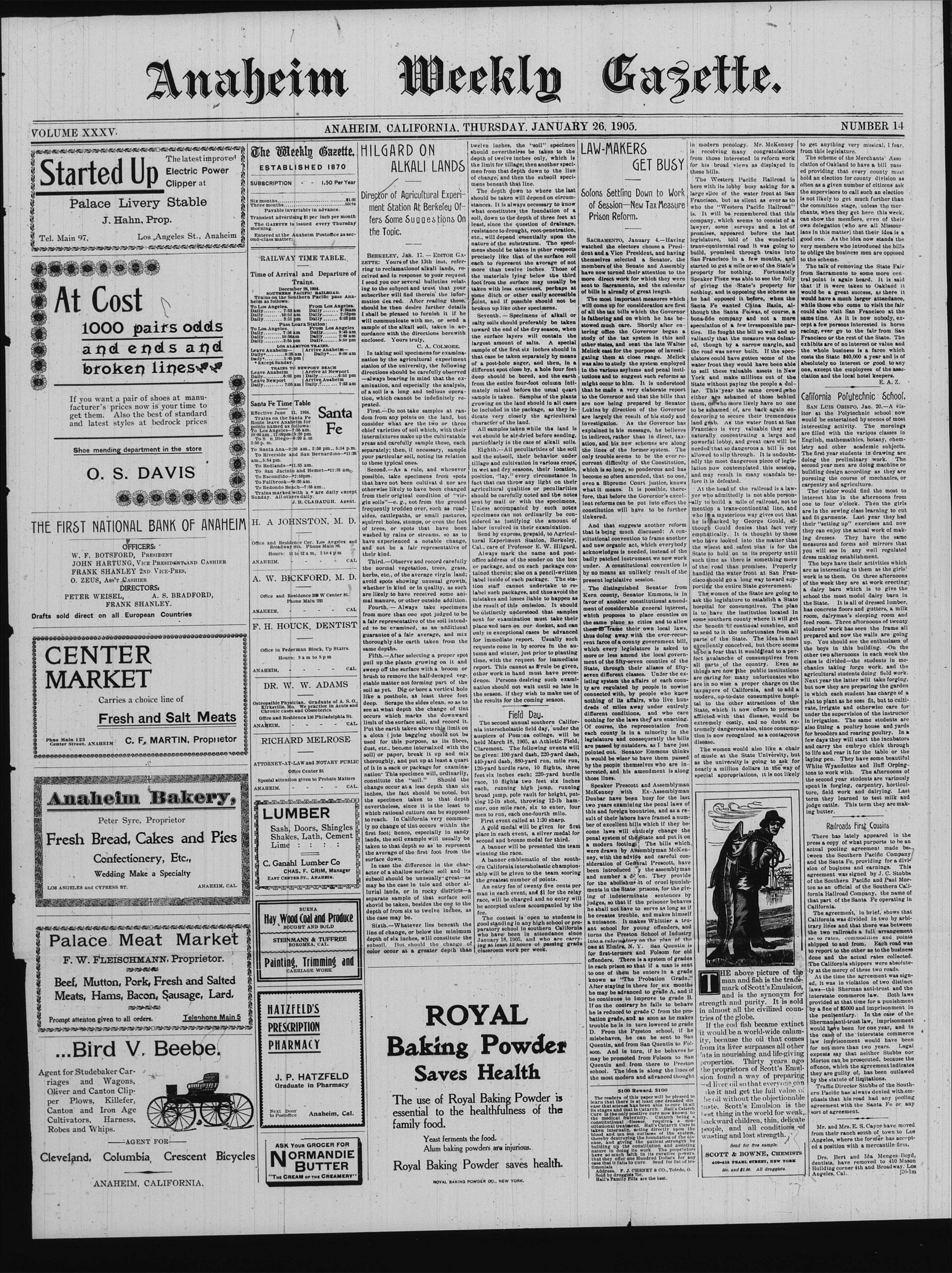
Searchable text
Anaheim
VOLUME XXXV.
ANAH
Started Up
The latest improved Electric Power Clipper at Palace Livery Stable
J. Hahn, Prop.
Tel. Main 97, Los Angeles St., Anaheim
At Cost
1000 pairs odds and ends and broken lines
If you want a pair of shoes at manufacturer's prices now is your time to get them. Also the best of standard and latest styles at bedrock prices
Shoe mending department in the store
O. S. DAVIS
The Weekly Gazette,
ESTABLISHED 1870
SUBSCRIPTION - 1.50 Per Year
Six months... $1.00
Three months... 50cts
Payable invariably in advance.
Transient advertising $1 per inch per month.
The GAZETTE is issued every Thursday morning.
Entered at the Anaheim Postoffice as second-class matter.
RAILWAY TIME TABLE.
Time of Arrival and Departure of Trains.
December 28, 1904.
SOUTHERN PACIFIC RAILROAD.
Trains on the Southern Pacific pass Anaheim as follows:
To Los Angeles.
Daily... 7:52 am
Daily... 9:24am
Daily... 10:52 am
Daily... 2:53pm
Daily... 3:51 pm
Daily... 6:03 pm
Pass Loara Station:
To Los Angeles.
Daily... 7:56 am
Daily... 9:45 am
Daily... 10:56am
Daily... 2:49 am
Daily... 3:55 pm
Daily... 5:59 pm
LOS ALAMITOS TRAINS.
Leave Anaheim—Arrive Anaheim—
Daily*... 9:35 am
Daily*... 8:00 am
Daily*... 1:45 pm
* Except Sunday.
TRAINS TO NEWPORT BEACH
Leave Anaheim—Arrive at Newport
Daily... 6:03 pm
Daily... 6:53 pm
Leave Newport—Arrive Anaheim
Daily... 7:05 am
Daily... 7:53 am
Santa Fe Time Table
Effective June 11, 1904.
Trains on the Santa Fe Route leave Anaheim for points named as follows:
To Los Angeles—7:55 am
10:00 am.. 12:00 pm.. 15:20 pm.
To S. n Diego—9:20 a.m.
2:50 p.m.
To Santa Ana—9:20 a.m., 2:50 p.m., 5:54 p.m.
To Riverside and San Bernardino—11:35 a.m., 5:54 p.m.
To Redlands—11:35 a.m.
To San Jacinto and Hemet—11:35 a.m.
If you want a pair of shoes at manufacturer's prices now is your time to get them. Also the best of standard and latest styles at bedrock prices
Shoe mending department in the store
O. S. DAVIS
THE FIRST NATIONAL BANK OF ANAHEIM
OFFICERS:
W. F. BOTSFORD, PRESIDENT
JOHN HARTUNG, VICE PRESIDENT AND CASHIER
FRANK SHANLEY 2ND VICE-PRES.
O. ZEUS, ASS'T CASHIER
DIRECTORS:
PETER WEISEL, A. S. BRADFORD,
FRANK SHANLEY.
Drafts sold direct on all European Countries
CENTER MARKET
Carries a choice line of
Fresh and Salt Meats
Phue Main 123
Center Street. ANAHEIM
C. F, MARTIN, Proprietor
Anaheim Bakery,
Peter Syre, Proprietor
Fresh Bread, Cakes and Pies
Confectionery, Etc.,
Wedding Make a Specialty
LOS ANGELES and CYPRESS ST.
ANAHEIM, CAL.
Santa Fe Time Table
Effective June 11, 1904.
Trains on the Santa Fe Route leave Anaheim for points named as follows:
To Los Angeles—7:55 am.
10:00 am..12:00pm..5:20 pm.
To S n Diego—9:20 a.m.
2:50 p.m.
To Santa Ana—9:20 am., 2:50 pm., 5:54 p.m.
To Riverside and San Bernardino—11:35 am., 5:54 p.m.
To Redlands—11:35 am.
To San Jacinto and Hemet—11:35 am.
To Escondido—2:50pm.
To Fallbrook—9:20 am.
To Redondo Beach—7:55 am..
Trains marked with a * are daily except Sunday. All others daily.
H. A JOHNSTON, M. D.
Office and Residence Cor. Los Angeles and Broadway Sts. Phone Main 86.
Hours: 11 to 12 a.m., 2 to 4 p.m
ANAHEIM.
A. W. BICKFORD, M. D.
Office and Residence 309 W Center St.
Phone Main 221
ANAHEIM.
F. H. HOUCK, DENTIST
Office in Federman Block, Up Stairs.
Hours: 9 a.m to 5 p.m
ANAHEIM,
DR. W. W. ADAMS
Osteopathic Physician. Graduate of A. S. O. Kirkaville, Mo. We practice in Acute and Chronic cases and Obstetrics.
Office and Residence 130 Philadelphia St.
ANAHEIM,
RICHARD MELROSE
ATTORNEY-AT-LAW and NOTARY PUBLIC
Office Center St.
Special attention given to Probate Matters
ANAHEIM.
LUMBER
Sash, Doors, Shingles
Shakes, Lath, Cement
Lime : : : :
C. Ganahl Lumber Co
CHAS. F. CRIM, Manager
EAST CENTER ST., ANAHEIM.
Peter Syre, Proprietor
Fresh Bread, Cakes and Pies
Confectionery, Etc.,
Wedding Make a Specialty
LOS ANGELES and CYPRESS ST.
ANAHEIM, CAL.
Palace Meat Market
F. W. FLEISCHMANN, Proprietor.
Beef, Mutton, Pork, Fresh and Salted
Meats, Hams, Bacon, Sausage, Lard,
Prompt attention given to all orders.
Telenhone Main 5
...Bird V. Beebe.
Agent for Studebaker Carriages and Wagons,
Oliver and Canton Clipper Plows, Killefer,
Canton and Iron Age Cultivators, Harness,
Robes and Whips.
AGENT FOR
Cleveland, Columbia, Crescent Bicycles
ANAHEIM, CALIFORNIA.
Weekly Gazette
ABLISHED 1870
TION - 1.50 Per Year
ANAHEIM, CALIFORNIA, THURSDAY. JANUARY 26, 1905.
WAY TIME TABLE.
Arrival and Departure of Trains.
December 28, 1904.
MERCER PACIFIC RAILROAD.
the Southern Pacific pass Anaows:
From Los Angeles.
7:52 am Daily... 9:24am
10:52 am Daily... 2:53pm
3:51 pm Daily... 6:03pm
Pass Loara Station:
From Los Angeles
7:56 am Daily... 9:45am
10:56am Daily... 2:49am
3:55 pm Daily... 5:59pm
OS ALAMITOS TRAINS.
Arrive Anaheim...
9:35 am Daily*... 8:00 am
1:45 pm Sunday.
INNS TO NEWPORT BEACH
Arrive at Newport
6:03 pm Daily... 6:53 pm
ort
7:05 am Daily... 7:53 am
Time Table
June 11, 1904.
the Santa Fe Anaheim for
and as follows:
7:58 am.
00:00 pm-15:20 pm.
Mego-9:20 a.m.
Santa Fe
na-9:20 am., 2:50 pm., 5:54 p.m.
side and San Bernardino-*11:35 am.
acinto and Hemet-*11:35 am.
HILGARD ON ALKALI LANDS
Director of Agricultural Experiment Station At Berkeley Offers Some Suggestions On the Topic.
BERKELEY, Jah. 17. — EDITOR GAZETTE: Yours of the 13th inst. refering to reclamation of alkali lands, received and in response to your request I send you our several bulletins relating to the subject and trust that your subscriber will find therein the information desired. After reading these, should he then desire further details I shall be pleased to furnish it if he will communicate with me, or send a sample of the alkali soil, taken in accordance with the directions herewith enclosed. Yours truly,
C. A. COLMORE.
In taking soil specimens for examination by the agricultural experiment station of the university, the following directions should be carefully observed—always bearing in mind that the examination, and especially the analysis, of a soil is a long and tedious operation, which cannot be indefinitely repeated.
First.—Do not take samples at random from any points on the land, but consider what are the two or three chief varieties of soil which, with their intermixtures make up the cultivatable areas and carefully sample these, each separately; then, if necessary, sample your particular soil, noting its relation to these typical ones.
Second.—As a rule, and whenever twelve inches, the "soil" specimen should nevertheless be taken to the depth of twelve inches only, which is the limit for tillage; then another specimen from that depth down to the line of change; and then the subsoll specimens beneath that line.
The depth down to where the last should be taken will depend on circumstances. It is always necessary to know what constitutes the foundation of a soil, down to the depth of three feet at least, since the question of drainage, resistance to drought, root-penetration, etc., will depend essentially upon the nature of the substratum. The specimens should be taken in other respects precisely like that of the surface soil each to represent the average of not more than twelve inches. Those of the materials lying below the third foot from the surface may usually be taken with less exactness, perhaps at some ditch or other easily accessible point, and if possible should not be broken up like other specimens.
Seventh.—Specimens of alkali or salty soils should preferably be taken toward the end of the dry season, when the surface layers will contain the largest amount of salts. A special sample of the first six inches should in that case be taken separately by means of a post-hole auger, and then, in a different spot close by, a hole four feet deep should be bored, and the earth from the entire four-foot column intimately mixed before the usual quart sample is taken. Samples of the plants growing on the land should in all cases be included in the package, as they indicate very closely the agricultural character of the land.
All samples taken while the land is wet should be air-dried before sending, particularly in the case of alkali soils.
Eighth.—All peculiarities of the soil and the subsoil, their behavior under tillage and cultivation in various crops, in wet and dry seasons, their location,
LAW-MAKERS GET BUS
Solons Settling Down to Wof Session—New Tax Measure Prison Reform.
SACRAMENTO, January 4.—Ha watched the electors choose a President and a Vice President, and had themselves selected a Senator, members of the Senate and Assessors have now turned their attention to more direct work for which they sent to Sacramento, and the calendar of bills is already of great length.
The most important measures we will come up for consideration are of all the tax bills which the Governor is fathering and on which he has stowed much care. Shortly aftertering office the Governor began study of the tax system in this other states, and sent the late W Melick east for the purpose of inviting them at close range. Mr was also to study the system emple in the various asylums and penal institutions and to suggest such reforms might occur to him. It is unders that he made a very elaborate reto the Governor and that the bills are now being prepared by Sen Lukins by direction of the Governor are largely the result of his study investigation. As the Governor explained in his message, he believed in indirect, rather than in direct,
ation, and his new schemes are as
the lines of the former system. Only trouble seems to be the ever current difficulty of the Constitution which is so long, so ponderous and
Time Table
Santa Fe
June 11, 1904. the Santa Fe Anaheim for and as follows:
hales-7:55 am. 10:00 pm; 15:20 pm. tego-9:20 a.m.
na-9:20 am., 2:50 pm., 5:54 p.m.
hide and San Bernardino—*11:35 am.
arked with a * are daily except all others daily.
J. H. CLABAUGH. Agent.
JOHNSTON, M. D.
Residence Cor. Los Angeles and
adway Sts. Phone Main 86.
rks: 11 to 12 a.m. 2 to 4 p.m.
CAL
BICKFORD, M. D.
and Residence 309 W Center St.
Phone Main 221
HOUCK, DENTIST
Federman Block, Up Stairs.
Hours: 9 a.m to 5 p.m.
CAL.
W. W. ADAMS
Physician. Graduate of A. S.O.
Mile Mo. We practice in Acute and cases and Obstetrics.
and Residence 130 Philadelphia St.
HARD MELROSE
Y-AT-LAW and NOTARY PUBLIC
Office Center St.
attention given to Probate Matters
JUMBER
ash, Doors, Shingles
akes, Lath, Cement
me : : : : : : : : : : : : : : : : : : : : : : : : : : : : : : : : : : : : : : : :
Time Table
Santa Fe
June 11, 1904. the Santa Fe Anaheim for and as follows:
hales-7:55 am. 10:00 pm; 15:20 pm. tego-9:20 a.m.
na-9:20 am., 2:50 pm., 5:54 p.m.
hide and San Bernardino—*11:35 am.
arked with a * are daily except all others daily.
J. H. CLABAUGH. Agent.
JOHNSTON, M. D.
Residence Cor. Los Angeles and
adway Sts. Phone Main 86.
rks: 11 to 12 a.m. 2 to 4 p.m.
CAL
BICKFORD, M. D.
and Residence 309 W Center St.
Phone Main 221
HOUCK, DENTIST
Federman Block, Up Stairs.
Hours: 9 a.m to 5 p.m.
CAL.
W. W. ADAMS
Physician. Graduate of A. S.O.
Mile Mo. We practice in Acute and cases and Obstetrics.
and Residence 130 Philadelphia St.
HARD MELROSE
Y-AT-LAW and NOTARY PUBLIC
Office Center St.
attention given to Probate Matters
JUMBER
ash, Doors, Shingles
akes, Lath, Cement
me : : : : : : : : : : : : : : : : : : : : : : : : : : : : : : : : : : : : : : :
Time Table
Santa Fe
June 11, 1904. the Santa Fe Anaheim for and as follows:
hales-7:55 am. 10:00 pm; 15:20 pm. tego-9:20 a.m.
na-9:20 am., 2:50 pm., 5:54 p.m.
hide and San Bernardino—*11:35 am.
arked with a * are daily except all others daily.
J. H. CLABAUGH. Agent.
JOHNSTON, M. D.
Residence Cor. Los Angeles and
adway Sts. Phone Main 86.
rks: 11 to 12 a.m. 2 to 4 p.m.
CAL
BICKFORD, M. D.
and Residence 309 W Center St.
Phone Main 221
HOUCK, DENTIST
Federman Block, Up Stairs.
Hours: 9 a.m to 5 p.m.
CAL.
W. W. ADAMS
Physician. Graduate of A. S.O.
Mile Mo. We practice in Acute and cases and Obstetrics.
and Residence 130 Philadelphia St.
HARD MELROSE
Y-AT-LAW and NOTARY PUBLIC
Office Center St.
attention given to Probate Matters
JUMBER
ash, Doors, Shingles
akes, Lath, Cement
me : : : : : : : : : : : : : : : . . . . . . . . . . . . . . . . . . . . . . . . . . . . . . . . . . . . . . . . . . . . . . . . .
Time Table
Santa Fe
June 11, 1904. the Santa Fe Anaheim for and as follows:
hales-7:55 am. 10:00 pm; 15:20 pm. tego-9:20 a.m.
na-9:20 am., 2:50 pm., 5:54 p.m.
hide and San Bernardino—*11:35 am.
arked with a * are daily except all others daily.
J. H. CLABAUGH. Agent.
JOHNSTON, M. D.
Residence Cor. Los Angeles and
adway Sts. Phone Main 86.
rks: 11 to 12 a.m. 2 to 4 p.m.
CAL
BICKFORD, M. D.
and Residence 309 W Center St.
Phone Main 221
HOUCK, DENTIST
Federman Block, Up Stairs.
Hours: 9 a.m to 5 p.m.
CAL.
W. W. ADAMS
Physician. Graduate of A. S.O.
Mile Mo. We practice in Acute and cases and Obstetrics.
and Residence 130 Philadelphia St.
HARD MELROSE
Y-AT-LAW and NOTARY PUBLIC
Office Center St.
attention given to Probate Matters
JUMBER
ash, Doors, Shingles
akes, Lath, Cement
me ::::::::::::::::::::::::::::::::::::::::::::::::::::::::::
Time Table
Santa Fe
June 11, 1904. the Santa Fe Anaheim for and as follows:
hales-7:55 am. 10:00 pm; 15:20 pm. tego-9:20 a.m.
na-9:20 am., 2:50 pm., 5:54 p.m.
hide and San Bernardino—*11:35 am.
arked with a * are daily except all others daily.
J. H. CLABAUGH. Agent.
JOHNSTON, M. D.
Residence Cor. Los Angeles and
adway Sts. Phone Main 86.
rks: 11 to 12 a.m. 2 to 4 p.m.
CAL
BICKFORD, M. D.
and Residence 309 W Center St.
Phone Main 221
HOUCK, DENTIST
Federman Block, Up Stairs.
Hours: 9 a.m to 5 p.m.
CAL.
W.W.ADAMS
Physician. Graduate of A.S.O.
Mile Mo..We practice in Acute and cases and Obstetrics.
and Residence 130 Philadelphia St.
HARD MELROSE
Y-AT-LAW and NOTARY PUBLIC
Office Center St..
attention given to Probate Matters
JUMBER
ash, Doors, Shingles
akes, Lath, Cement
me : : : : : : : : : : : : : : : : : : : : : : : : : : : : : : : : : : : : : : : : : : : : : : : : : : : : : : : :
Time Table
Santa Fe
June 11, 1904. the Santa Fe Anaheim for and as follows:
hales-7:55 am. 10:00 pm; 15:20 pm. tego-9:20 a.m.
na-9:20 am., 2:50 pm., 5:54 p.m.
hide and San Bernardino—*11:35 am.
arked with a * are daily except all others daily.
J. H. CLABAUGH. Agent.
JOHNSTON, M.D.
Residence Cor..Los Angeles and
adway Sts.Phone Main86.
rks:11 to 12 a.m..2 to4 p.m
CAL
BICKFORD,M.D.
and Residence309 W CenterSt.PhoneMain86.rks:
rks:
rks:
Fourth.-Always take specimens from more than one spot judged to be a fair representative of the soil intended to be examined, as an additional guarantee of a fair average,and mix thoroughly the earth taken from the same depths.
Fifth.-After selecting a proper spot pull up the plants growing on it and sweep off the surface with a broom or brush to remove the half-decayed vegetable matter not forming part of the soil as yet.Dig or bore a vertical hole like a posthole,a least three feet deep.Scrype the sides clean,so as to see at what depth the change of tint occurs which marks the downward limit of the surface soil,and record it.Put the earth taken above this limit on a cloth (jute bagging should not be used for this purpose ,as its fibres,dust etc.,become intermixed with the soil) or paper,break it up and mix thoroughly,and put up at least a quart of it in a sack or package for examination!This specimen will ordinarily constitute the "soil."Should the change occur at a less depth than six inches,the fact should be notedbutthe specimen taken to that depth nevertheless,since it is the least to which rational culture can be supposed to reach.In California very commonly no change of tint occurs within the first foot; hence,especially in sandy lands,the soil example will usually be taken to that depth so as to represent the average of the first foot from the surface down.
In case the difference in the character of a shallow surface soil and its subsoil should be unusually great-as may be the case in tule and other alluvial lands,r in rocky districts-a separate sample of that surface soil
ROYAL Baking Powder Saves Health
The use of Royal Baking Powder is essential to the healthfulness of the family food.
Yeast ferments the food.
Alum baking powders are injurious.
Royal Baking Powder saves health.
ROYAL BAKING POWDER CO., NEW YORK.
Gazette.
26. 1905. NUMBER 14
NEW-MAKERS GET BUSY
Settling Down to Work Session—New Tax Measure Revision Reform.
RAMENTO, January 4.—Having elected the electors choose a Presidency and a Vice President, and having themselves selected a Senator, the members of the Senate and Assembly now turned their attention to the direct work for which they were to Sacramento, and the calendar is already of great length.
The most important measures which come up for consideration are first the tax bills which the Governor hearing and on which he has been much care. Shortly after enquiry of the tax system in this and states, and sent the late Walter Wake east for the purpose of investigating them at close range. Melick also to study the system employed by various asylums and penal institutions and to suggest such reforms as it occur to him. It is understood he made a very elaborate report the Governor and that the bills that know being prepared by Senator was by direction of the Governor largely the result of his study andigation. As the Governor has defined in his message, he believes direct, rather than in direct, tax and his new schemes are along lines of the former system. The trouble seems to be the ever-recent difficulty of the Constitution, which is so long, so ponderous and has in modern penology. Mr. McKenney is receiving many congratulations from those interested in reform work for his broad views as displayed in these bills.
The Western Pacific Railroad is here with its lobby busy asking for a large slice of the water front at San Francisco, but as silent as ever as to who the "Western Pacific Railroad" is. It will be remembered that this company, which seems to consist of a lawyer, some surveys and a lot of promises, appeared before the last legislature, told of the wonderful trans-continental road it was going to build, promised through trains into San Francisco in a few months, and started to get a mile or so of the State's property for nothing. Fortunately Speaker Fiske was able to see the folly of giving the State's property for nothing, and is opposing the scheme as he had opposed it before, when the Santa Fe wanted China Basin, although the Santa Fe was, of course, a bona-fide company and not a mere speculation of a few irresponsible parties. He fought the bill so well and so valiantly that the measure was defeated, though by a narrow margin, and the road was never built. If the speculators could have gotten some of the water front they would have been able to sell these valuable assets in New York and make millions out of the State without paying the people a dollar. This year the same crowd who either are ashamed of those behind them, or who more likely have no one to be ashamed of, are back again endeavoring to secure their tremendous land grab. As the water front at San Francisco is very valuable they are naturally concentrating a large and powerful lobby, and great care will be needed that so dangerous a bill is not allowed to slip through. It is undoubtedly the most dangerous piece of legislation now contemplated this session, and may result in many scandals to get anything very musical. I fear, from this legislature.
The scheme of the Merchants' Association of Oakland to have a bill passed providing that every county must hold an election for county division as often as a given number of citizens ask the supervisors to call such an election is not likely to get much further than the committee stage, unless the merchants, when they get here this week, can show the members, even of their own delegation (who are all Missourians in this matter) that their idea is a good one. As the idea now stands the very members who introduced the bills to oblige the business men are opposed to the scheme.
The talk of removing the State Fair from Sacramento to some more central point is again heard. It is said that if it were taken to Oakland it would be a great success, as there it would have a much larger attendance, while those who come to visit the fair could also visit San Francisco at the same time. As it is now nobody, except a few persons interested in horse racing, ever go to the fair from San Francisco or the rest of the State. The exhibits are of no interest or value and the whole business is a farce which costs the State $40,000 a year and is of absolutely no interest or good to any one, except the employees of the association and the local hotel keepers.
E. A. Z.
California Polytechnic School.
SAN LUIS OBISPO, Jan. 20.—A visitor at the Polytechnic school now would be entertained by scenes of most interesting activity. The mornings are filled with the various classes in English, mathematics, botany, chemistry and other academic subjects. The first year students in drawing are doing the preliminary work. The second year men are doing machine or building design according as they are
and to suggest such reforms as occur to him. It is understood he made a very elaborate report the Governor and that the bills that now being prepared by Senator has by direction of the Governor largely the result of his study andigation. As the Governor has defined in his message, he believes direct, rather than in direct, taxation and his new schemes are along lines of the former system. The trouble seems to be the ever-recent difficulty of the Constitution, which is so long, so ponderous and has been so often amended, that no one, with a Supreme Court justice, knows it means. It is possible, thereafter before the Governor's excellences can be put into effect the institution will have to be further abolished.
And that suggests another reform being much discussed: A conditional convention to frame another new organic act, which everybody knows is needed, instead of the patched instrument we now work on. A constitutional convention is also means an unlikely result of the recent legislative session.
The distinguished Senator from the county, Senator Emmons, is in favor of another constitutional amendment of considerable general interest, which proposes to place counties on same plane as cities and to allow them to frame their own local laws, doing away with the ever-recurring force of a county government bill, which every legislature is asked to or less amend the local governorship of the fifty-seven counties of the state, through their aliases of fifty different classes. Under the exigent system the affairs of each county are regulated by people in nowise affected by, by people who know nothing of its affairs, who live hundreds of miles away under entirely current conditions, and who care for the laws they are enacting. Course, the representation from the county is in a minority in the statute and consequently the bills passed by outsiders, as I have just stated out. Senator Emmons thinks would be wiser to have them passed the people themselves who are interested, and his amendment is along these lines.
Speaker Prescott and Assemblyman Kenney with Ex-Assemblyman Bar have been busy for the last years examining the penal laws of New York and foreign countries, and as a result their labors have framed a number of excellent bills which if they be laws will entirely change the general system of the State and put it on modern footing. The bills which he drawn by Assemblyman McKenzie with the advice and careful consideration of General Prescott, have been introduced by the assemblyman in number a dozen. They provide the abolishment of cruel punishments in the State prisons, for the giving of indeterminate sentences by York and make millions out of the State without paying the people a dollar. This year the same crowd who either are ashamed of those behind them, or who more likely have no one to be ashamed of, are back again endeavoring to secure their tremendous land grab. As the water front at San Francisco is very valuable they are naturally concentrating a large and powerful lobby, and great care will be needed that so dangerous a bill is not allowed to slip through. It is undoubtedly the most dangerous piece of legislation now contemplated this session, and may result in many scandals before it is defeated.
At the head of the railroad is a lawyer who admittedly is not able personally to build a mile of railroad, not mention a trans-continental line, and who it a mysterious way gives out that he is backed by George Gould, although Gould denies that fact very emphatically. It is thought by those who have looked into the matter that the wisest and safest plan is for the State to hold on to its property until such time as there is something more of the road than promises. Properly handled the water front at San Francisco should go a long way toward supporting the entire State government.
The women of the State are going to ask the legislature to establish a State hospital for consumptives. The plan is to have the institution located in some southern county where it will get the benefit of continual sunshine, and to send to it the unfortunates from all parts of the State. The idea is most excellently conceived, but there seems to be a fear that it would lead to a perfect avalanche of consumptives from all parts of the country. Even as things are now public institutions are caring for many unfortunate who are in no wise a proper charge on the taxpayers of California, and to add a moderu, up-to-date consumptive hospital to the other attractions of the State, which it now offers to persons afflicted-with that disease, would be extremely costly, and no doubt extremely dangerous also, since consumption is now recognized as a contagious disease.
The women would also like a chair of music at the State University, but as the university is going to ask for nearly a million dollars in the way of special appropriations, it is not likely
Cafifornia Polytechnic School.
SAN LUIS OBISPO, Jan. 20.—A visitor at the Polytechnic school now would be entertained by scenes of most interesting activity. The mornings are filled with the various classes in English, mathematics, botany, chemistry and other academic subjects. The first year students in drawing are doing the preliminary work. The second year men are doing machine or building design according as they are pursuing the course of mechanics, or carpentry and agriculture.
The visitor would find the most to interest him in the afternoons from one to four o'clock. Then the girls are in the sewing class learning to cut and fit garments. Last year they had their "setting up" exercises and now they can enjoy the actual work of making dresses. They have the same measures and forms and mirrors that you will see in any well regulated dress making establishment.
The boys have their activities which are as interesting to them as the girls work is to them. On three afternoons of the week they are at work erecting a dairy barn which is to give the school the most model dairy barn in the State. It is all of dressed lumber, has concrete floors and gutters, a milk room, dairyman's sleeping room and feed room. Three afternoons of twenty students' work has seen the frame all prepared and now the walls are going up. You should see the enthusiasm of the boys in this building. On the other two afternoons in each week the class is divided—the students in mechanics taking forge work, and the agricultural students doing field work. Next year the latter will take forging, but now they are preparing the garden in which each student has charge of a plat to plant as he sees fit, but to cultivate, irrigate and otherwise care for under the supervision of the instructor in irrigation. The same students are also fitting a poultry house and yards for brooders and rearing poultry. In a few days they will start the incubators and carry the embryo chick through to life and rear it for the table or the laying pen. They have some beautiful White Wyandottes and Buff Orpingtons to work with. The afternoons of the second year students are variously spent in forging, carpentry, horticulture, field work and dairying. Last term they learned to test milk and judge cattle. This term they are making butter.
Railroads First Cousins
There has lately appeared in the press a copy of what purports to be an actual pooling agreement made between the Southern Pacific Company and the Santa Fe, providing for a division of business and earnings. This agreement was signed by J.C. Stubbs of the Southern Pacific and Paul Morton as an official of the Southern California Railroad Company, the name of that part of the Santa Fe operating in
THE above picture of the man and fish is the trademark of Scott's Emulsion, and is the synonym for strength and purity. It is sold in almost all the civilized countries of the globe.
If the cod fish became extinct it would be a world-wide calamity, because the oil that comes from its liver surpasses all other fats in nourishing and life-giving properties. Thirty years ago the proprietors of Scott's Emulsion found a way of preparing cod liver oil so that everyone can take it and get the full value of the oil without the objectionable taste. Scott's Emulsion is the best thing in the world for weak, backward children, thin, delicate people, and all conditions of wasting and lost strength.
Send for free sample.
SCOTT & BOWNE, CHEMISTS
409-418 PEARL STREET, NEW YORK
50c. and $1.00. All druggists.
Railroads First Cousins
There has lately appeared in the press a copy of what purports to be an actual pooling agreement made between the Southern Pacific Company and the Santa Fe, providing for a division of business and earnings. This agreement was signed by J. C. Stubbs of the Southern Pacific and Paul Morton as an official of the Southern California Railroad Company, the name of that part of the Santa Fe operating in California.
The agreement, in brief, shows that California was divided in two by arbitrary lines and that there was between the two railroads a full arrangement as to rates, commodities and points shipped to and from. Each road was to report to the other as to the business done and the actual rates collected. The California shippers were absolutely at the mercy of these two roads.
At the time the agreement was signed, it was in violation of two distinct laws—the Sherman anti-trust and the interstate commerce law. Both laws provided at that time for a punishment by a fine of $5000 and imprisonment in the penitentiary. In the case of the Sherman anti-trust law, imprisonment would have been for one year, and in the case of the interstate commerce law imprisonment would have been for not more than two years. Legal experts say that neither Stubbs nor Morton can be prosecuted, because the offence, which the agreement indicates they are guilty of, has been outlawed by the statute of limitations.
Traffic Director Stubbs of the Southern Pacific has always denied with emphasis that his road had any pooling agreement with the Santa Fe or any sort of agreement.
Mr. and Mrs. E. S. Cayce have moved from their ranch south of town to Los Angeles, where the former has accepted a position with a mercantile firm.
Drs. Bert and Ida Menges-Boyd, dentists, have removed to 410 Mason Building corner 4th and Broadway; Los Angeles, Cal.