anaheim-gazette 1905-01-19
Scanned page
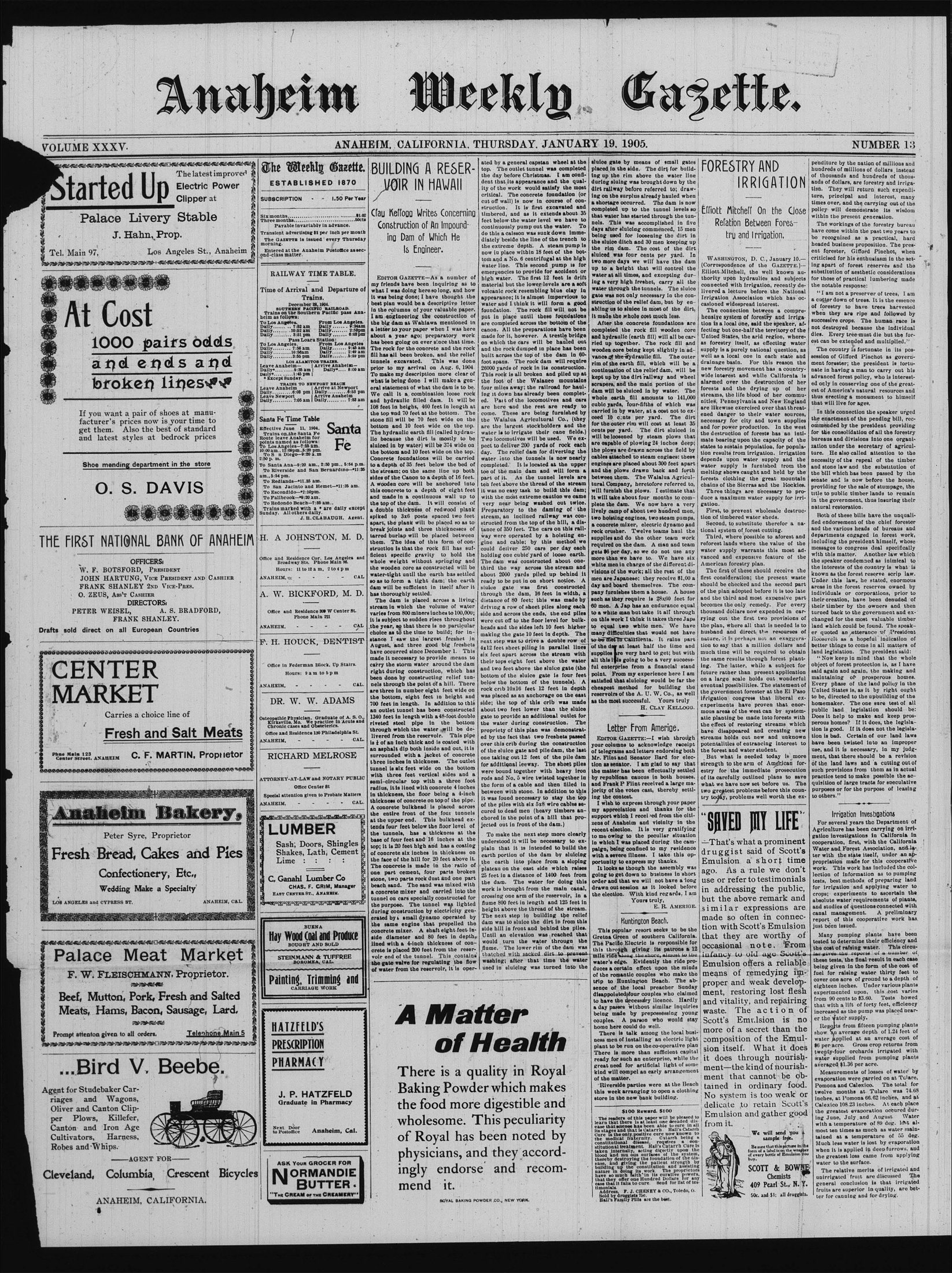
Searchable text
Anaheim
VOLUME XXXV.
Started Up
Electric Power Clipper at
Palace Livery Stable
J. Hahn, Prop.
Tel. Main 97, Los Angeles St., Anaheim
At Cost
1000 pairs odds and ends and broken lines
If you want a pair of shoes at manufacturer's prices now is your time to get them. Also the best of standard and latest styles at bedrock prices
Shoe mending department in the store
The Weekly Gazette
ESTABLISHED 1870
SUBSCRIPTION - 1.50 Per V
Six months... Three months... Payable invariably in advance.
Transient advertising $1 per inch per meter.
The GAZETTE is issued every Thursday morning.
Entered at the Anaheim Postoffice as ond-class matter.
RAILWAY TIME TABLE
Time of Arrival and Departure Trains.
December 28, 1904.
SOUTHERN PACIFIC RAILROAD.
Trains on the Southern Pacific pass Anaheim as follows:
To Los Angeles.
Daily... 7:52 am Dally... 9:25 am
Daily... 10:52 am Dally... 2:55 am
Daily... 3:51 pm Dally... 6:00 pm
Pass Loara Station:
To Los Angeles.
Daily... 7:56 am Dally... 9:45 am
Daily... 10:56am Dally... 2:45 am
Daily... 3:55 pm Dally... 5:55 pm
LOS ALAMITOS TRAINS.
Leave Anaheim—Arrive Anaheim—Daily*... 9:35 am Daily*... 8:00 am
Daily*... 1:45 pm * Except Sunday.
TRAINS TO NEWPORT BEACH
Leave Anaheim Arrive at Newport
Daily... 6:03 pm Daily... 6:55 pm
Leave Newport Arrive Anaheim
Daily... 7:05 am Daily... 7:55 am
Santa Fe Time Table
Effective June 11, 1904.
Trains on the Santa Fe Route leave Anaheim for points named as follows:
To Los Angeles—7:55 am.
10:00 am.. 12:00pm.. 5:20 pm.
To S n Diego—9:20 a.m.
2:50 p.m.
To Santa Ana—9:20 am.. 2:50 pm.. 5:54 p.m.
To Riverside and San Bernardino—
broken lines
If you want a pair of shoes at manufacturer's prices now is your time to get them. Also the best of standard and latest styles at bedrock prices
Shoe mending department in the store
O. S. DAVIS
THE FIRST NATIONAL BANK OF ANAHEIM
OFFICERS:
W. F. BOTSFORD, PRESIDENT
JOHN HARTUNG, VICE PRESIDENT AND CASHIER
FRANK SHANLEY 2ND VICE-PRES.
O. ZEUS, ASS'T CASHIER
DIRECTORS:
PETER WEISEL, A. S. BRADFORD,
FRANK SHANLEY.
Drafts sold direct on all European Countries
CENTER MARKET
Carries a choice line of
Fresh and Salt Meats
Phne Main 123
Center Street, ANAHEIM
C. F. MARTIN, Proprietor
Anaheim Bakery,
Peter Syre, Proprietor
Fresh Bread, Cakes and Pies
Confectionery, Etc.,
Wedding Make a Specialty
Santa Fe Time Table
Effective June 11, 1904.
Trains on the Santa Fe Route leave Anaheim for points named as follows:
To Los Angeles—7:55 am.
10:00 am., 12:00pm., 5:20 pm.
To S n Diego—9:20 a.m.
2:50 p.m.
To Santa Ana—9:20 am., 2:50 pm., 5:54 am.
To Riverside and San Bernardino—
am., 5:54 pm.
To Redlands—11:35 am.
To San Jacinto and Hemet—11:35 am.
To Escondido—2:50pm.
To Fallbrook—9:20 am.
To Redondo Beach—7:55 am.
Trains marked with a * are daily except Sunday. All others daily.
H. A JOHNSTON, M.
Office and Residence Cor, Los Angeles Broadway Sts. Phone Main 86.
Hours: 11 to 12 a.m., 2 to 4 p.m.
ANAHEIM,
A. W. BICKFORD, M.
Office and Residence 309 W Center St
Phone Main 221
ANAHEIM,
F. H. HOUCK, DENTIST
Office in Federman Block, Up Stairs
Hours: 9 a.m to 5 p.m
ANAHEIM,
DR. W. W. ADAMS
Osteopathic Physician. Graduate of A. S. Kirksville, Mo. We practice in Acute Chronic cases and Obstetrics.
Office and Residence 130 Philadelphia S
ANAHEIM,
RICHARD MELROSE
ATTORNEY-AT-LAW and NOTARY PUBLIC
Office Center St
Special attention given to Probate Matters
ANAHEIM,
LUMBER
Sash; Doors, Shingle; Shakes, Lath, Cement; Lime:
C, Ganahl Lumber Co
CHAS. F. GRIM, Manager
EAST CENTER ST., ANAHEIM.
Anaheim Bakery,
Peter Syre, Proprietor
Fresh Bread, Cakes and Pies
Confectionery, Etc.,
Wedding Make a Specialty
LOS ANGELES and CYPRESS ST.
ANAHEIM, CAL.
Palace Meat Market
F. W. FLEISCHMANN, Proprietor.
Beef, Mutton, Pork, Fresh and Salted
Meats, Hams, Bacon, Sausage, Lard.
Prompt attention given to all orders.
Telenphone Main 5
...Bird V. Beebe.
Agent for Studebaker Carriages and Wagons,
Oliver and Canton Clipper Plows, Killefer,
Canton and Iron Age Cultivators, Harness,
Robes and Whips.
AGENT FOR
Cleveland, Columbia, Crescent Bicycles
ANAHEIM, CALIFORNIA.
ANAHEIM, CALIFORNIA. THURSDAY. JANUARY 19, 1905.
BUILDING A RESERVOIR IN HAWAII
Clay Kelfoga Writes Concerning Construction of An Impound- ing Dam of Which He Is Engineer.
EDITOR GAZETTE—As a number of my friends have been inquiring as to what I was doing here so long, and how it was being done; I have thought the best plan would be a descriptive letter in the columns of your valuable paper. I am engineering the construction of the big dam at Wahiawa mentioned in a letter to your paper when I was here about a year ago; preparatory work has been going on ever since that time. The rock for the concrete and the rock fill has all been broken, and the relief tunnels excavated. This was done prior to my arrival on Aug. 6, 1904. To make my description more clear of what is being done I will make a general statement of what the dam is to be. We call it a combination loose rock and hydraulic filled dam. It will be 108 feet in height, 460 feet in length at the top and 70 feet at the bottom. The stone fill will be 70 feet wide on the bottom and 10 feet wide on the top. The hydraulic earth fill (called hydraulic because the dirt is mostly to be sluiced in by water) will be 374 wide on the bottom and 10 feet wide on the top. Concrete foundations will be carried to a depth of 35 feet below the bed of the stream; on the same line up both dated by a general capstan wheel at the top. The outlet tunnel was completed the day before Christmas. I am confident that its appearance and the quality of the work would satisfy the most critical. The concrete foundation (or cut off wall) is now in course of construction. It is first excavated and timbered, and as it extends about 35 feet below the water level we have to continuously pump out the water. To do this a calsson was sunk down immediately beside the line of the trench to the extreme depth. A steam pump is now in place within 18 feet of the bottom and a No. 6 centrifugal at the high water line. This second pump is for emergencies to provide for accident or high water. The first 12 feet is drift material but the lower levels are a soft volcanic rock resembling blue clay in appearance; it is almost impervious to water and I think it will form a good foundation. The rock fill will not be put in place until these foundations are completed across the bottom of the canon. All the preparations have been made for it, however. A trestle bridge on which the cars will be hauled out and the rock dumped in place has been built across the top of the dam in 60-foot spans. The rock dam will require 26000 yards of rock in its construction. This rock is all broken and piled up at the foot of the Waialua mountains four miles away; the railroad for hauling it down has already been completed. Part of the locomotives and cars are here and the rest are ready to come. These are being furnished by the Waialua Agricultural Co., (they are the largest stockholders and the water is to irrigate their cane fields.) Two locomotives will be used. We expect to deliver 200 yards of rock each day. The relief dam for diverting the water into the tunnels is now nearly completed. It is located at the upper toe of the main dam and will form a sluice gate by means of small placed in the side. The dirt falling up the rim above the water during sluing was brought down dirt railway before referred to on the surplus already hauled a shortage occurred. The date completed up to the tunnel that water has started throughnels. This was accomplished days after sluing commenced being used for loosening throughthe sluice ditch and 30 men keptthe rim dam. The cost of sluiced was four cents per year two more days we will have up to a height that will contain water at all times, and excepting a very high freshet, carrywater through the tunnels. The gate was not only necessary in construction of the relief dam, but abling us to sluice in most of it made the whole cost much less.
After the concrete foundation completed the rock fill wood and hydraulic (earth fill) will be ried up together. The rock wooden core being kept slightly vance of the hydraulic fill. The rim of the earth fill, which was continuation of the relief dam, kept up by the dirt railway and scrapers, and the main portion dam will be sluiced in by water, whole earth fill amounts to cubic yards, four-fifths of wha carried in by water, at a cost noceed 10 cents per yard. To for the outer rim will cost at cents per yard. The dirt sluice will be loosened by steam plow are capable of plowing 24 inchesthe plows are drawn across these cables attached to steam engines are placed about 300 feet and the plows drawn back an
To make my description more clear of what is being done I will make a general statement of what the dam is to be. We call it a combination loose rock and hydraulic filled dam. It will be 108 feet in height, 460 feet in length at the top and 70 feet at the bottom. The stone fill will be 70 feet wide on the bottom and 10 feet wide on the top. The hydraulic earth fill (called hydraulic because the dirt is mostly to be sluiced in by water) will be 374 wide on the bottom and 10 feet wide on the top. Concrete foundations will be carried to a depth of 35 feet below the bed of the stream; on the same line up both sides of the Canon to a depth of 16 feet. A wooden core will be anchored into this concrete to a depth of eight feet and made in a continuous wall up to the top of the dam. It will consist of a double thickness of redwood plank spiked to 3x6 posts spaced two feet apart, the plank will be placed so as to break joints and three thicknesses of tarred burlap will be placed between them. The idea of this form of construction is that the rock fill has sufficient specific gravity to hold the whole weight without springing and the wooden core as constructed will be water-tight until the earth has settled so as to form a tight dam; the earth dam will be sufficient in itself after it has thoroughly settled.
The dam is placed across a living stream in which the volume of water varies from 800 miners inches to 100,000; it is subject to sudden rises throughout the year, so that there is no particular choice as to the time to build; for instance I saw the largest freshet in August, and three good big freshets have occurred since December 1. This made it necessary to provide means to carry the storm water around the dam right during construction, which has been done by constructing relief tunnels through the point of a hill. There are three in number eight feet wide on the bottom, eight feet in height and 700 feet in length. In addition to this an outlet tunnel has been constructed 1340 feet in length with a 48-foot double riveted steel pipe in the bottom through which the water will be delivered from the reservoir. This pipe is of an inch thick and is coated with an asphalt dip both inside and out, it is surrounded with a jacket of concrete three inches in thickness. The outlet tunnel is six feet wide on the bottom with three feet vertical sides and a semi-circular top with a three foot radius, it is lined with concrete 4 inches in thickness, the floor being a 4-inch thickness of concrete on top of the pipe. A concrete bulkhead is placed across the entire front of the four tunnels at the upper end. This bulkhead extends four feet below the floor level of the tunnels, has a thickness at the base of four feet and 16 inches at the top; it is 20 feet high and has a coating of concrete six inches in thickness on the face of the hill for 20 feet above it. The concrete is made in the ratio of one part cement, four parts broken stone, two parts rock dust and one part beach sand. The sand was mixed with a concrete mixer and carried into the tunnel on cars specially constructed for
This rock is all broken and piled up at the foot of the Waalanee mountains four miles away; the railroad for hauling it down has already been completed. Part of the locomotives and cars are here and the rest are ready to come. These are being furnished by Waalala Agricultural Co., (they are the largest stockholders and the water is to irrigate their cane fields.) Two locomotives will be used. We expect to deliver 200 yards of rock each day. The relief dam for diverting the water into the tunnels is now nearly completed. It is located at the upper toe of the main dam and will form a part of it. As the tunnel levels are ten feet above the thread of the stream it was no easy task to build this dam; with the most extreme caution we came very near being washed out twice. Preparatory to the daming of the stream, an inclined railway was constructed from the top of the hill, a distance of 350 feet. The cars on this railway were operated by a hoisting engine and cable; by this method we could deliver 250 cars per day each holding one cubic yard of loose earth. The dam was constructed about one-third the way across the stream and about 2000 yards piled up behind it ready to be put in on short notice. A sluice gate was first constructed through the dam, 16 feet in width, a distance of 80 feet; this was made by driving a row of sheet piles along each side and across the ends, the end piles were cut off to the floor level for bulkheads and the sides left 10 feet higher making the gate 10 feet in depth. The next step was to drive a double row of 4x12 feet sheet piling in parallel lines six feet apart across the stream with their tops eight feet above the water and two feet above the sluice gate (the bottom of the sluice gate is four feet below the bottom of the tunnels). A rock crub 10x16 feet 12 feet in depth was placed as an anchorage on the east side; the top of this crub was made about two feet lower than the sluice gate to provide an additional outlet for the water during construction. The propriety of this plan was demonstrated by the fact that two freshets passed over this crub during the construction of the sluice gate and pile dam, last one taking out 12 feet of the pile dam for additional leeway. The sheet piles were bound together with heavy iron rods and No. 5 wire twisted together in the form of a cable and then filled in between with stone. In addition to this it was found necessary to stay atop the piles with six 5x8 wire cables secured to dead men (heavy timbers anchored in the point of a hill that projected out in front of the dam.)
To make the next step more clearly understood it will be necessary to explain that it is intended to build the earth portion of the dam by sluicing the earth into place from a sloping plateau on the east side which raises 25 feet in a distance of 1400 feet from the dam. The water for doing this work is brought from the main canal, crossing one arm of the reservoir, in a kept up by the dirt railway and scrapers, and the main portion dam will be sluiced in by water, whole earth fill amounts to cubic yards, four-fifths of what carried in by water, at a cost not exceeding 10 cents per yard. The dirt slip will be loosened by steam plowing capable of plowing 24 inches on the plows are drawn across these cables attached to steam engines engineered are placed about 300 feet and the plows drawn back are between them. The Waalala Company, heretofore referred to will furnish the plows. I estimate it will take about four months to complete the dam. We now have lively camp of about two hundred two hoisting engines, two steam a concrete mixer, electric dynamo rock crusher. Twelve teams will supplies them a house such as they require is 28x60-60 men. A Jap has an endurance to a white man but take it all on this work I think it takes them to equal two white men. Many difficulties that would mean to be met in California. It rains of the day at least half the supplies are very hard to get; all this is going to be a very full enterprise from a financial point. From my experience he satisfied that sluicing would be cheapest method for building reservoirs of A. U. W. Co., as the most successful. Yours,
H. CLAY K
Letter From America
EDITOR GAZETTE:—I wish you your columns to acknowledge of telegrams and letters endorsed Mr. Flint and Senator Bard for position as senator. I am glad to see that matter has been effectually by republican caucus in both North Dakota and Frank P Flint received a large majority of the votes cast, thereby supporting me.
I wish to express through you my appreciation and thanks support which I received from dozens of Anaheim and vicinity recent election. It is very great to me owing to the peculiar nature in which I was placed during my reelection being confined to my area with a severe illness. I take portability to express my thank you.
It looks as though the assent going to get down to business order and that we will not have drawn out session as it looked like election. With kind regards
A Matter of Health
There is a quality in Royal Baking Powder which makes the food more digestible and wholesome. This peculiarity of Royal has been noted by physicians, and they accordingly endorse and recommend it.
ROYAL BAKING POWDER CO., NEW YORK.
FORESTRY AND IRRIGATION
Elliott Mitcheff On the Close Relation Between Forestry and Irrigation.
WASHINGTON, D. C., January 10.—(Correspondence of the GAZETTE.)—Elliott Mitchell, the well known authority upon hydraulics and subjects connected with irrigation, recently delivered a lecture before the National Irrigation Association which has occasioned widespread interest.
The connection between a comprehensive system of forestry and irrigation is a local one, said the speaker, affecting but one-half the territory of the United States, the arid region, whereas forestry itself, as effecting water supply is a purely national question, as well as a local one in each state and drainage basin. For this reason the new forestry movement has a country-wide interest and while California is alarmed over the destruction of her forests and the drying up of her streams, the life blood of her communities, Pennsylvania and New England are likewise exercised over that threatened danger to their water sources, necessary for city and town supplies and for power production. In the west the destruction of forests has an intimate bearing upon the capacity of the states to sustain population, for population results from irrigation. irrigation depends upon water supply and the water supply is furnished from the melting shows caught and held by the expenditure by the nation of millions and hundreds of millions of dollars instead of thousands and hundreds of thousands of dollars, are forestry and irrigation. They will return such expenditure, principal and interest, many times over, and the carrying out of the policy will demonstrate its wisdom within the present generation.
The workings of the forestry bureau have come within the past two years to be recognized as a practical, hard headed business proposition. The present forester, Gifford Pinchot, when criticised for his enthusiasm in the setting apart of forest reserves and the substitution of aesthetic considerations for those of practical lumbering made the notable response:
"I am not a preserver of trees, I am a cutter down of trees. It is the essence of forestry to have trees harvested when they are ripe and followed by successive crops. The human race is not destroyed because the individual dies. Every tree must die but the forest can be extended and multiplied."
The country is fortunate in its possession of Gifford Pinchot as government forester; the president is fortunate in having a man to carry out his advanced forest policy, who is interested only in conserving one of the greatest of America's natural resources and thus erecting a monument to himself that will live for ages.
In this connection the speaker urged the enactment of the pending bill, recommended by the president providing for the consolidation of all the forestry bureaus and divisions into one organization under the secretary of agriculture. He also called attention to the necessity of the repeal of the timber and stone law and the substitution of the bill which has been passed by the
"SAVED MY LIFE"
—That's what a prominent druggist said of Scott's Emulsion a short time ago. As a rule we don't use or refer to testimonials in addressing the public, but the above remark and wide interest and while California is alarmed over the destruction of her forests and the drying up of her streams, the life blood of her communities, Pennsylvania and New England are likewise exercised over that threatened danger to their water sources, necessary for city and town supplies and for power production. In the west the destruction of forests has an intimate bearing upon the capacity of the states to sustain population, for population results from irrigation. irrigation depends upon water supply and the water supply is furnished from the melting shows caught and held by the forests clothing the great mountain chains of the Sierras and the Rockies.
Three things are necessary to produce a maximum water supply for irrigation.
First, to prevent wholesale destruction of timbered water sheds.
Second, to substitute therefor a national system of forest cutting.
Third, where possible to aforest and reforest lands where the value of the water supply warrants this most advanced and expensive feature of the American forestry plan.
The first of these should receive the first consideration; the present waste should be checked and the second part of the plan adopted before it is too late and the third and most expensive part becomes the only remedy. For every thousand dollars now expended in carrying out the first two provisions of the plan, where all that is needed is to husband and direct the resources of nature, it is perhaps not an exaggeration to say that a million dollars and much time will be required to obtain the same results through forest planting. The latter, while a subject for future rather than present application on a large scale holds out wonderful eventual possibilities. The statement of the government forester at the El Paso irrigation congress that liberal experiments have proven that enormous areas of the west can by systematic planting be made into forests with the effect of restoring streams which have disappeared and creating new streams holds out new and unknown potentialities of entrancing interest to the forest and water student.
But what is needed today is more strength to the arm of American forestry for the immediate prosecution of its carefully outlined plans to save what we have now set before us. The two greatest problems before this country today, problems well worth the ex-
"Irrigation Investigations"
For several years the Department of Agriculture has been carrying on irrigation investigations in California in cooperation, first, with the California Water and Forest Association, and later with the state itself, under an appropriation made for this cooperative work. This work has included the collection of information as to pumping tests, best methods of preparing land for irrigation and applying water to crops; experiments to ascertain the absolute water requirements of plants."
"I wish to express through your paper my appreciation and thanks for the support which I received from the citizens of Anaheim and vicinity in the recent election. It is very gratifying me owing to the peculiar situation which I was placed during the campaign, being confined to my residence with a severe illness. I take this opportunity to express my thanks.
It looks as though the assembly was going to get down to business in short order and that we will not have a long drawn out session as it looked before the election. With kind regards, I am Yours truly,
E. R. AMERIGE."
Huntington Beach.
This popular resort seeks to be the prettna Green of southern California. The Pacific Electric is responsible for its through giving its patrons a 12 mile ride along the shore, almost to the water's edge. Evidently the ride produces a certain effect upon the minds of the romantic couples who make the trip to Huntington Beach. The absence of the local preacher Sunday disappoluted four couples who claimed to have the necessary licence. Hardly any day passes without similar inquiries being made by prepossessing young couples. A person who would stay here could do well.
There is talk among the local business men of installing an electric light plant to be run on the co-operative plan. There is more than sufficient capital ready for such an enterprise, while the great need for artificial light of some kind will compel an early arrangement of the matter.
Riverside parties were at the Beach this week arranging to open a clothing store in the new bank building.
$100 Reward. $100
The readers of this paper will be pleased to learn that there is at least one dreaded disease that science has been able to cure in all its stages and that is Catarrh. Hall's Catarrh cure is the only positive cure now known to the medical fraternity. Catarrh being a constitutional disease, requires a constitutional treatment. Hall's Catarrh Cure is taken internally, acting directly upon the blood and mucous surfaces of the system, thereby destroying the foundation of the disease, and giving the patient strength by building up the constitution and assisting nature in doing its work. The proprietors have so much faith in its curative powers, that they offer one Hundred Dollars for any case that it fails to cure. Send for list of testimonials.
Address. F. J. CHENEY & CO., Toledo, O. Sold by druggists 75c.
Hall's Family Pills are the best.
"SAVED MY LIFE"
—That's what a prominent druggist said of Scott's Emulsion a short time ago. As a rule we don't use or refer to testimonials in addressing the public, but the above remark and similar expressions are made so often in connection with Scott's Emulsion that they are worthy of occasional note. From infancy to old age Scott's Emulsion offers a reliable means of remedying improper and weak development, restoring lost flesh and vitality, and repairing waste. The action of Scott's Emulsion is no more of a secret than the composition of the Emulsion itself. What it does it does through nourishment—the kind of nourishment that cannot be obtained in ordinary food. No system is too weak or delicate to retain Scott's Emulsion and gather good from it.
We will send you a sample free.
Be sure that this picture in the form of a label is on the wrapper of every bottle of Emulsion you buy.
SCOTT & BOWNE Chemists
409 Pearl St., N.Y.
50c. and $1; all druggists.
Irrigation Investigations
For several years the Department of Agriculture has been carrying on irrigation investigations in California in cooperation, first, with the California Water and Forest Association, and later with the state itself, under an appropriation made for this cooperative work. This work has included the collection of information as to pumping tests, best methods of preparing land for irrigation and applying water to crops; experiments to ascertain the absolute water requirements of plants, and studies of questions connected with canal management. A preliminary report of this cooperative work has just been issued.
Many pumping plants have been tested to determine their efficiency and the cost of raising water. This circular gives the reports of a number of these tests, the final result in each case being given in the form of the cost of fuel for raising water thirty feet to cover one acre of ground to a depth of eighteen inches. Under various plants experimented upon, this cost varies from 90 cents to $3.60. Tests howed that with a lift of forty feet, efficiency increased as the pump was placed nearer the water supply.
Reports from fifteen pumping plants show an average depth of 1.24 feet of water applied at an average cost of $6 per acre. Gross crop returns from twenty-four orchards irrigated with water supplied from pumping plants averaged $1.36 per acre.
Measurements of losses of water by evaporation were carried on at Tulare, Pomona and Calexico. The total for twelve months at Tulare was 74.68 inches, at Pomona 66.62 inches, and at Calexico 108.23 inches. At each place the greatest evaporation occurred during June, July, and August. Water with a temperature of 89 deg. lost almost ten times as much as water maintained at a temperature of 55 deg. Much less water is lost by evaporation when it is applied in deep furrows, and the greatest loss came from applying water to the surface.
The relative merits of irrigated and unirrigated fruit are discussed. The general conclusion is that irrigated fruits are superior in quality, are better for canning and for drying.