anaheim-gazette 1905-01-05
Scanned page
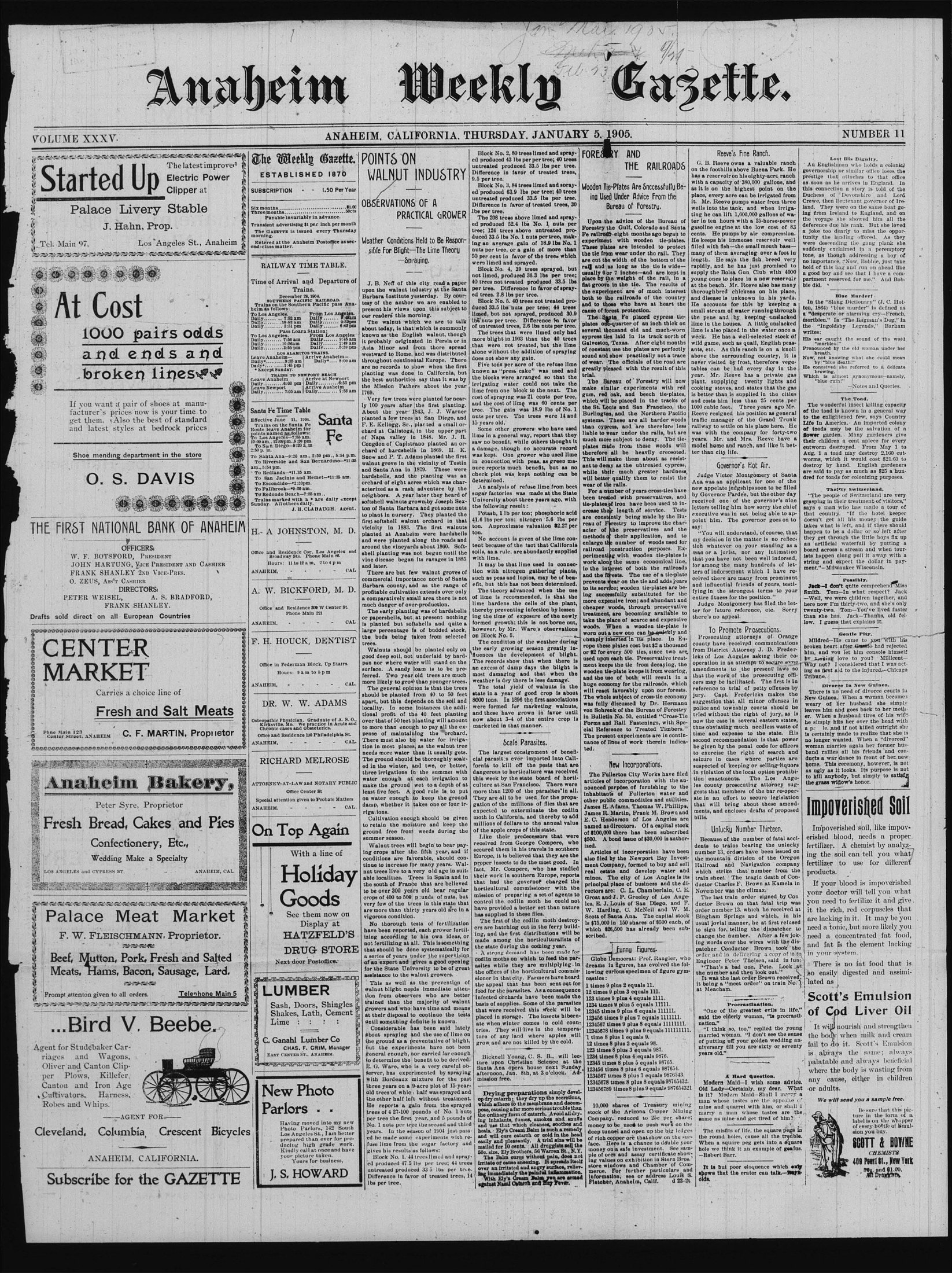
Searchable text
Anaheim
VOLUME XXXV.
Started Up
The latest improved Electric Power Clipper at
Palace Livery Stable
J. Hahn, Prop.
Tel: Main 97. Los Angeles St., Anaheim
At Cost
1000 pairs odds and ends and broken lines
If you want a pair of shoes at manufacturer's prices now is your time to get them. Also the best of standard and latest styles at bedrock prices
Shoe mending department in the store
The Weekly Gazette.
ESTABLISHED 1870
SUBSCRIPTION - 1.50 Per Year
Six months... $1.00
Three months... $0.60cts
Payable invariably in advance.
Transient advertising $1 per inch per month.
The GAZETTE is issued every Thursday morning.
Entered at the Anaheim Postoffice as second-class matter.
RAILWAY TIME TABLE.
Time of Arrival and Departure of Trains.
December 28, 1904.
SOUTHERN PACIFIC RAILROAD.
Trains on the Southern Pacific pass Anaheim as follows:
To Los Angeles.
Daily... 7:52 am Dally... 9:48 am
Daily... 10:52 am Dally... 2:33 pm
Daily... 3:51 pm Dally... 6:03 pm
Pass Loara Station:
To Los Angeles.
Daily... 7:56 am Dally... 9:48 am
Daily... 10:56 am Dally... 2:49 am
Daily... 3:55 pm Dally... 5:59 pm
LOS ALAMITOS TRAINS.
Leave Anaheim—Arrive Anaheim—
Daily*... 9:35 am Dally*... 8:00 am
Daily*... 1:45 pm
* Except Sunday.
TRAINS TO NEWPORT BEACH
Leave Anaheim—Arrive at Newport
Daily... 6:03 pm Daily... 6:53 pm
Leave Newport—Arrive Anaheim
Daily... 7:05 am Daily... 7:53 am
Santa Fe Time Table
Effective June 11, 1904.
Trains on the Santa Fe Route leave Anaheim for points named as follows:
To Los Angeles-7:55 am.
10:00am..12:09pm..5:29pm.
To San Diego-9:20 a.m.
2:50 p.m.
To Santa Ana-9:20 am..2:50 pm..5:54 p.m.
To Riverside and San Bernardino-*11:38 am..5:54 p.m.
To Redlands-*11.35 am.
If you want a pair of shoes at manufacturer's prices now is your time to get them. Also the best of standard and latest styles at bedrock prices
Shoe mending department in the store
O. S. DAVIS
THE FIRST NATIONAL BANK OF ANAHEIM
OFFICERS:
W. F. BOTSFORD, PRESIDENT
JOHN HARTUNG, VICE PRESident and Cashier
FRANK SHANLEY 2ND Vice-Pres.
O. ZEUS, Ass't Cashier
DIRECTORS:
PETER WEISEL, A. S. BRADFORD,
FRANK SHANLEY.
Drafts sold direct on all European Countries
CENTER MARKET
Carries a choice line of
Fresh and Salt Meats
Phno Main 123
Center Street, ANAHEIM
C. F. MARTIN, Proprietor
Anaheim Bakery,
Peter Syre, Proprietor
Fresh Bread, Cakes and Pies
Confectionery, Etc.,
Wedding Make a Specialty
LOS ANGELES and CYPRESS ST.
ANAHEIM, CAL.
Santa Fe Time Table
Effective June 11, 1904.
Trains on the Santa Fe Route leave Anaheim for points named as follows:
To Los Angeles—7:55 am.
10:00 am., 12:00pm, 5:20 pm.
To San Diego—9:20 a.m.
2:50 p.m.
To Santa Ana—9:20 am., 2:50 pm., 5:54 p.m.
To Riverside and San Bernardino—11:38 am., 5:54 p.m.
To Redlands—11:35 am.
To San Jacinto and Hemet—11:35 am.
To Escondido—2:50pm.
To Fallbrook—9:20 am.
To Redondo Beach—7:55 am..
Trains marked with a * are daily except Sunday. All others daily.
H.- A JOHNSTON, M. D.
Office and Residence Cor, Los Angeles and Broadway Sts. Phone Main 86.
Hours: 11 to 12 a.m., 2 to 4 p.m
ANAHEIM,
A. W. BICKFORD, M. D.
Office and Residence 300 W Center St.
Phone Main 221
ANAHEIM,
F. H. HOUCK, DENTIST
Office in Federman Block, Up Stairs.
Hours: 9 a.m to 5 p.m
ANAHEIM,
DR. W. W. ADAMS
Osteopathic Physician. Graduate of A. S. O. Kirksville, Mo. We practice in Acute and Chronic cases and Obstetrics.
Office and Residence 130 Philadelphia St.
ANAHEIM,
RICHARD MELROSE
ATTORNEY-AT-LAW and NOTARY PUBLIC
Office Center St
Special attention given to Probate Matters
ANAHEIM,
On Top Again
With a line of Holiday Goods
Peter Syre, Proprietor
Fresh Bread, Cakes and Pies
Confectionery, Etc.,
Wedding Make a Specialty
LOS ANGELES and CYPRESS ST.
ANAHEIM, CAL.
Palace Meat Market
F. W. FLEISCHMANN, Proprietor.
Beef, Mutton, Pork, Fresh and Salted
Meats, Hams, Bacon, Sausage, Lard.
Prompt attention given to all orders.
Telenhone Main 5
...Bird V. Beebe.
Agent for Studebaker Carriages and Wagons,
Oliver and Canton Clipper Plows, Killefer,
Canton and Iron Age Cultivators, Harness,
Robes and Whips.
AGENT FOR
Cleveland, Columbia, Crescent Bicycles
ANAHEIM, CALIFORNIA.
Subscribe for the GAZETTE
ANAHEIM, CALIFORNIA, THURSDAY, JANUARY 5, 1905.
POINTS ON WALNUT INDUSTRY
OBSERVATIONS OF A PRACTICAL GROWER
Weather Conditions Held to Be Responsible For Blight—The Lime Theory—Spraying.
J. B. Neff of this city read a paper upon the walnut industry at the Santa Barbara Institute yesterday. By courtesy of the author we are enabled to present his views upon this subject to our readers this morning.
The walnut which we are to talk about today, is that which is commonly known as the English walnut, though it probably originated in Persia or in Asia Minor and from there spread westward to Rome, and was distributed throughout continental Europe. There are no records to show when the first planting was done in California, but the best authorities say that it was by the Mission Fathers about the year 1769.
Very few trees were planted for nearly 100 years after the first planting. About the year 1843, J. J. Warner planted a few trees at San Diego, and F. E. Kellogg, Sr., planted a small orchard at Calistoga, in the upper part of Napa valley in 1848. Mr. J. R. Congdon of Capistrano planted an orchard of hardshells in 1869. H. K. Snow and P. T. Adams planted the first walnut grove in the vicinity of Tustin and Santa Ana in 1879. These were Block No. 2, 80 trees limed and sprayed produced 43 lbs per tree; 40 trees untreated produced 33.5 lbs per tree. Difference in favor of treated trees, 9.5 per tree.
Block No. 3, 84 trees limed and sprayed produced 63.9 lbs per tree; 40 trees untreated produced 33.5 lbs per tree. Difference in favor of treated trees, 30 lbs per tree.
The 208 trees above limed and sprayed produced 52.4 lbs No. 1 nuts per tree; 124 trees above untreated produced 33.5 lbs No. 1 nuts per tree, making an average gain of 18.9 lbs No. 1 nuts per tree, or a gain of more than 50 per cent in favor of the trees which were limed and sprayed.
Block No. 4, 39 trees sprayed, but not limed, produced 36.3 lbs per tree; 40 trees not treated produced 33.5 lbs per tree. Difference in favor of sprayed trees, 2.8 lbs per tree.
Block No. 5, 40 trees not treated produced 33.5 lbs nuts per tree; 44 trees limed, but not sprayed, produced 30.9 lbs nuts per tree. Difference in favor of untreated trees, 2.6 lbs nuts per tree.
The trees that were limed only had more blight in 1903 than the 40 trees that were not treated, but the lime alone without the addition of spraying does not show any gain.
Five tons per acre of the refuse lime known as "press cake" was used and the blocks were arranged so that the irrigating water could not take the lime from one block to the next. The cost of spraying was 21 cents per tree, and the cost of lime was 60 cents per tree. The gain was 18.9 lbs of No. 1 nuts per tree. The trees were 14 and 15 years old.
Some other growers who have used lime in a general way, report that they saw no benefit, while others thought it a damage, though no accurate record was kept. One grower who used lime in connection with peas, as green manure reports much benefit, but as no check plot was kept nothing can be
FORESTRY AND THE RAILROAD
Wooden Tie-Plates Are Successful Using Under Advice From the Bureau of Forestry.
Upon the advice of the Bureau Forestry the Gulf, Colorado and Sierra Railroad eight months ago began experiment with wooden tie-plates These plates are intended to protect the tie from wear under the rail. They are cut out the width of the bottom of rail and as long as the tie is usually 6 or 7 inches—and are kept place by the weight of the rail flat groove in the tie. The result is the experiment are of much interest both to the railroads of the country and to those who have at heart cause of forest protection.
The Santa Fe placed cypress plates one-quarter of an inch thick several thousand old and much-cypress ties laid in its track near Galveston, Texas. After eight months of constant use the plates are perfect sound and show practically not a bit of wear. The officials of the road greatly pleased with the result of trial.
The Bureau of Forestry will make similar experiments with gum, red oak, and beech tie-plates which will be placed in the track the St. Louis and San Francisco Burlington, and the Northern Pacific systems. These are all harder wilt than cypress, and are therefore liable to wear under the rails, but much more subject to decay. The plates made from these woods therefore all be heavily creosal This will make them about as resistant to decay as the uhtreated cypress while their much greater hardness...
Time Table
June 11, 1904
the Santa Fe Anaheim for the following weeks:
7:55 am, 5:20 pm, 5:00 pm, 5:20 pm, 5:00 pm
JOHNSTON, M. D.
BICKFORD, M. D.
HOUCK, DENTIST
W. W. ADAMS
PHYSICIAN, Graduate of A.S.O., late Mo. We practice in Acute and cases and Obstetrics.
Residence 130 Philadelphia St.
HARD MELROSE
AT-LAW and NOTARY PUBLIC Office Center St.
ention given to Probate Matters
CAL.
Top Again
With a line of Holiday Goods
Arrive at Newport Daily...6:53 pm Arrive Anaheim Daily...7:53 am
planting was done in California, but the best authorities say that it was by the Mission Fathers about the year 1769.
Very few trees were planted for nearly 100 years after the first planting. About the year 1843, J. J. Warner planted a few trees at San Diego, and F. E. Kellogg, Sr., planted a small orchard at Calistoga, in the upper part of Napa valley in 1848. Mr. J. R. Congdon of Capitrano planted an orchard of hardshells in 1869. H. K. Snow and P. T. Adams planted the first walnut grove in the vicinity of Tustin and Santa Ana in 1879. These were hardshells, and the planting was an orchard of eight acres which was characterized as a rash adventure by the neighbors. A year later they heard of softshell walnuts grown by Joseph Sexton of Santa Barbara and got some nuts to plant in nursery. They planted the first softshell walnut orchard in that vicinity in 1883. The first walnuts planted at Anahaim were hardshells and were planted along the roads and around the vineyards about 1860. Softshell planting was not begun until the vine disease began its ravages in 1885 and later.
There are but few walnut groves of commercial importance north of Santa Barbara county, and as the range of profitable cultivation extends over only a comparatively small area there is not much danger of over-production.
The early planting was of hardshells or papershells, but at present nothing is planted but softshells and quite a large percentage is of budded stock, the buds being taken from selected trees.
Walnuts should be planted only on good deep soil, not underlaid by hardpan nor where water will stand on the surface. A sandy loam is to be preferred. Two year old trees are much more likely to grow than younger trees.
The general opinion is that the trees should be planted from 40 to 50 feet apart, but this depends on the soil and locality. In some instances the additional profit of the 40 feet planting over that of 50 feet planting will amount to more than enough to pay all the expense of maintaining the orchard.
There must also be water for irrigation in most places, as the walnut tree needs more water than it usually gets. The ground should be thoroughly soaked in the winter, and two, or better, three irrigations in the summer with water enough at each irrigation to make the ground wet to a depth of at least five feet. A good rule is to put on water enough to keep the ground damp, whether it takes one or four irrigations.
Cultivation enough should be given to retain the moisture and keep the ground free from weeds during the summer season.
Walnut trees will begin to bear paying crops after the fifth year, and if conditions are favorable, should continue to increase for many years. Walnut trees live to a very old age in suitable localities. Trees in Spain and in the south of France that are believed to be over 300 years old bear regular crops of 400 to 509 pounds of nuts, but very few trees were planted for nearly 100 years after the first planting. About the year 1843, J. J. Warner planted a few trees at San Diego, and F. E. Kellogg, Sr., planted a small orchard at Calistoga, in the upper part of Napa valley in 1848. Mr. J. R. Congdon of Capitrano planted an orchard of hardshells in 1869. H. K. Snow and P. T. Adams planted the first walnut grove in the vicinity of Tustin and Santa Ana in 1879. These were hardshells, and the planting was an orchard of eight acres which was characterized as a rash adventure by the neighbors. A year later they heard of softshell walnuts grown by Joseph Sexton of Santa Barbara and got some nuts to plant in nursery. They planted the first softshell walnut orchard in that vicinity in 1883. The first walnuts planted at Anahaim were hardshells and were planted along the roads and around the vineyards about 1860. Softshell planting was not begun until the vine disease began its ravages in 1885 and later.
There are but few walnut groves of commercial importance north of Santa Barbara county, and as the range of profitable cultivation extends over only a comparatively small area there is not much danger of over-production.
The early planting was of hardshells or papershells, but at present nothing is planted but softshells and quite a large percentage is of budded stock, the buds being taken from selected trees.
Walnuts should be planted only on good deep soil, not underlaid by hardpan nor where water will stand on the surface. A sandy loam is to be preferred. Two year old trees are much more likely to grow than younger trees.
The general opinion is that the trees should be planted from 40 to 50 feet apart, but this depends on the soil and locality. In some instances the additional profit of the 40 feet planting over that of 50 feet planting will amount to more than enough to pay all the expense of maintaining the orchard.
There must also be water for irrigation in most places, as the walnut tree needs more water than it usually gets. The ground should be thoroughly soaked in the winter, and two, or better, three irrigations in the summer with water enough at each irrigation to make the ground wet to a depth of at least five feet. A good rule is to put on water enough to keep the ground damp, whether it takes one or four irrigations.
Cultivation enough should be given to retain the moisture and keep the ground free from weeds during the summer season.
Walnut trees will begin to bear paying crops after the fifth year, and if conditions are favorable, should continue to increase for many years. Walnut trees live to a very old age in suitable localities. Trees in Spain and in the south of France that are believed to be over 300 years old bear regular crops of 400 to 509 pounds of nuts, but very few trees were planted for nearly 100 years after the first planting. About the year 1843, J. J. Warner planted a few trees at San Diego, and F. E. Kellogg, Sr., planted a small orchard at Calistoga, in the upper part of Napa valley in 1848. Mr. J. R. Congdon of Capitrano planted an orchard of hardshells in 1869. H. K. Snow and P. T. Adams planted the first walnut grove in the vicinity of Tustin and Santa Ana in 1879. These were hardshells, and the planting was an orchard of eight acres which was characterized as a rash adventure by the neighbors. A year later they heard of softshell walnuts grown by Joseph Sexton of Santa Barbara and got some nuts to plant in nursery. They planted the first softshell walnut orchard in that vicinity in 1883. The first walnuts planted at Anahaim were hardshells and were planted along the roads and around the vineyards about 1860. Softshell planting was not begun until the vine disease began its ravages in 1885 and later.
There are but few walnut groves of commercial importance north of Santa Barbara county, and as the range of profitable cultivation extends over only a comparatively small area there is not much danger of over-production.
The early planting was of hardshells or papershells, but at present nothing is planted but softshells and quite a large percentage is of budded stock, the buds being taken from selected trees.
Walnuts should be planted only on good deep soil, not underlaid by hardpan nor where water will stand on the surface. A sandy loam is to be preferred. Two year old trees are much more likely to grow than younger trees.
The general opinion is that the trees should be planted from 40 to 50 feet apart, but this depends on the soil and locality. In some instances the additional profit of the 40 feet planting over that of 50 feet planting will amount to more than enough to pay all the expense of maintaining the orchard.
There must also be water for irrigation in most places, as the walnut tree needs more water than it usually gets. The ground should be thoroughly soaked in the winter, and two, or better, three irrigations in the summer with water enough at each irrigation to make the ground wet to a depth of at least five feet. A good rule is to put on water enough to keep the ground damp, whether it takes one or four irrigations.
Cultivation enough should be given to retain the moisture and keep the ground free from weeds during the summer season.
Walnut trees will begin to bear paying crops after the fifth year, and if conditions are favorable, should continue to increase for many years. Walnut trees live to a very old age in suitable localities. Trees in Spain and in the south of France that are believed to be over 300 years old bear regular crops of 400 to 509 pounds of nuts, but very few trees were planted for nearly 100 years after the first planting. About the year 1843, J. J. Warner planted a few trees at San Diego, and F. E. Kellogg, Sr., planted a small orchard at Calistoga, in the upper part of Napa valley in 1848. Mr. J. R. Congdon of Capitrano planted an orchard of hardshells in 1869. H. K. Snow and P. T. Adams planted the first walnut grove in the vicinity of Tustin and Santa Ana in 1879. These were hardshells, and the planting was an orchard of eight acres which was characterized as a rash adventure by the neighbors. A year later they heard of softshell walnuts grown by Joseph Sexton of Santa Barbara and got some nuts to plant in nursery. They planted the first softshell walnut orchard in that vicinity in 1883. The first walnuts planted at Anahaim were hardshells and were planted along the roads and around the vineyards about 1860. Softshell planting was not begun until the vine disease began its ravages in 1885 and later.
There are but few walnut groves of commercial importance north of Santa Barbara county, and as the range of profitable cultivation extends over only a comparatively small area there is not much danger of over-production.
The early planting was of hard shells or papershells, but at present nothing is planted but soft shells and quite a large percentage is of budded stock, the buds being taken from selected trees.
Walnuts should be planted only on good deep soil, not underlaid by hardpan nor where water will stand on the surface. A sandy loam is to be preferred. Two year old trees are much more likely to grow than younger trees.
The general opinion is that the trees should be planted from 40 to 50 feet apart, but this depends on the soil and locality. In some instances the additional profit of the 40 feet planting over that of 50 feet planting will amount to more than enough to pay all the expense of maintaining the orchard.
There must also be water for irrigation in most places, as the walnut tree needs more water than it usually gets. The ground should be thoroughly soaked in the winter, and two, or better, three irrigations in the summer with water enough at each irrigation to make the ground wet to a depth of at least five feet. A good rule is to put on water enough to keep the ground damp, whether it takes one or four irrigations.
Cultivation enough should be given to retain the moisture and keep the ground free from weeds during the summer season.
Walnut trees will begin to bear paying crops after the fifth year, and if conditions are favorable, should continue to increase for many years. Walnut trees live to a very old age in suitable localities. Trees in Spain and in the south of France that are believed to be over 300 years old bear regular crops of 400 to 509 pounds of nuts, but very few trees were planted for nearly 100 years after the first planting. About the year 1843, J.J.Warner plants a few trees at San Diego, and F.E.Kellogg,Sr.,plants an orchardofhardshellsandwornhellasandwherewaterwillstandonthesurface.A Sandyloamistobepreferred.Twoyearoldtreesaremuchmorelikelytogrowthanyoutheremainstherailroadconstructionpurpose.permittingwithwooden tie-plantworkalongthesameeconomicalintheinterestoftherailandtheforests.Theuseofthetiespreventswearonthetieandaddstoitservice;wooden tie-plantworksingsuccessfullysubstitutedformoreexpensiveirond;andabundane cheaperwoods,towherestaypreservationtreatmentaretakingtheplaceofscarceandexperiencewearoftherails.Foranumbertiescanbequicklycheapenedinitsplace.Inropethesesplatescostbut$2abookor$2forevery50ties,sincetwosteaduponeach tie.Preservativementkeepsthetiefromdecayingwooden tie-plantkeepsitfromweedandtheuseofthebothwillresulthugeeconomyfortherailroad.twosteaduptonwillresulthugeeconomyfortherailroad.Thepresentexperimentsareincourageofflowestthereinted.NewIncorporations.TheFullertonCityWorkshavearticlesofincorporationwiththenouncedpurposeoffurnishingtheinhabitantsofFullertonwaterotherpubliccommoditiesandutilizesJamesH.AdamsThomasW.Ph JamesR.MartinFrankM.BrownE.C.HendersonLosAngelesnamedasdirectorsOfacapitalof$100,000therehas beensubsoffounded.NewIncorporations.TheFullertonCityWorkshavearticlesofincorporationwiththenouncedpurposeoffurnishingtheinhabitantsofFullertonwaterotherpubliccommoditiesandutilizesJamesH.AdamsThomasW.Ph JamesR.MartinFrankM.BrownE.C.HendersonLosAngelesnamedasdirectorsOfacapitalof$100,000therehas beensubsoffounded.NewIncorporations.TheFullertonCityWorkshavearticlesofincorporationwiththenouncedpurposeoffurnishingtheinhabitantsofFullertonwaterotherpubliccommoditiesandutilizesJamesH.AdamsThomasW.Ph JamesR.MartinFrankM.BrownE.C.HendersonLosAngelesnamedasdirectorsOfacapitalof$100,000therehas beensubsoffounded.NewIncorporations.TheFullertonCityWorks have articlesofincorporationwiththenouncedpurposeoffurnishingtheinhabitantsofFullertonwaterotherpubliccommoditiesandutilizesJamesH.AdamsThomasW.Ph JamesR.MartinFrankM.BrownE.C.HendersonLosAngelesnamedasdirectorsOfacapitalof$100,000therehas beensubsoffounded.NewIncorporations.TheFullertonCityWorks have articlesofincorporationwiththenouncedpurposeoffurnishingtheinhabitantsofFullertonwaterotherpubliccommoditiesandutilizesJamesH.AdamsThomasW.Ph JamesR.MartinFrankM.BrownE.C.HendersonLosAngelesnamedasdirectorsOfacapitalof$100,000therehas beensubsoffounded.NewIncorporations.TheFullertonCityWorks have articlesofincorporationwiththenouncedpurposeoffurnishingtheinhabitantsofFullertonwaterotherpubliccommoditiesandutilizesJamesH.AdamsThomasW.Ph JamesR.MartinFrankM.BrownE.C.HendersonLosAngelesnamedasdirectorsOfacapitalof$100,000therehas beensubsoffounded.NewIncorporations.TheFullertonCityWorks have articlesofincorporationwiththenouncedpurposeoffurnishingtheinhabitantsofFullertonwaterotherpubliccommoditiesandutilizesJamesH.AdamsThomasW.Ph JamesR.MartinFrankM.BrownE.C.HendersonLosAngelesnamedasdirectorsOfacapitalof$100,000therehas beensubsoffounded.NewIncorporations.TheFullertonCityWorks have articlesofincorporationwiththenouncedpurposeoffurnishingtheinhabitantsofFullertonwaterotherpubliccommoditiesandutilizesJamesH.AdamsThomasW.Ph JamesR.MartinFrankM.BrownE.C.HendersonLosAngelesnamedasdirectorsOfacapitalof$100,000therehas beensubsoffounded.NewIncorporations.TheFullertonCityWorks have articlesofincorporationwiththenouncedpurposeoffurnishingtheinhabitantsofFullertonwaterotherpubliccommoditiesandutilizesJamesH.AdamsThomasW.Ph JamesR.MartinFrankM.BrownE.C.HendersonLosAngelesnamedasdirectorsOfacapitalof$100,000therehas beensubsoffounded.NewIncorporations.TheFullertonCityWorks have articlesofincorporationwiththenouncedpurposeoffurnishingtheinhabitantsofFullertonwaterotherpubliccommoditiesandutilizesJamesH.AdamsThomasW.Ph JamesR.MartinFrankM.BrownE.C.HendersonLosAngelesnamedasdirectorsOfacapitalof$100,000therehas beensubsoffounded.NewIncorporations.TheFullertonCityWorks have articlesofincorporationwiththenouncedpurposeoffurnishingtheinhabitantsofFullertonwaterotherpubliccommoditiesandutilizesJamesH.AdamsThomasW.Ph JamesR.MartinFrankM.BrownE.C.HendersonLosAngelesnamedasdirectorsOfacapitalof$100,000therehas beensubsoffounded.NewIncorporations.TheFullertonCityWorks have articlesofincorporationwiththenouncedpurposeoffurnishingtheinhabitantsofFullertonwaterotherpubliccommoditiesandutilizesJamesH.AdamsThomasW.Ph JamesR.MartinFrankM.BrownE.C.HendersonLosAngelesnamedasdirectorsOfacapitalof$1
With a line of Holiday Goods
See them now on Display at HATZFELD'S DRUG STORE next door Postoffice.
Cultivation enough should be given to retain the moisture and keep the ground free from weeds during the summer season.
Walnut trees will begin to bear paying crops after the fifth year, and if conditions are favorable, should continue to increase for many years. Walnut trees live to a very old age in suitable localities. Trees in Spain and in the south of France that are believed to be over 300 years old bear regular crops of 400 to 509 pounds of nuts, but very few of the trees in this state that are more than thirty years old are in a vigorous condition.
No thorough tests of fertilization have been reported, each grower fertilizing according to his own ideas, or not fertilizing at all. This is something that should be done systematically for a series of years under the supervision of an expert and gives a good opening for the State University to be of great assistance to the walnut growers.
This as well as the prevention of walnut blight needs immediate attention from observers who are better trained than the majority of walnut growers and who have time and means at their disposal to continue the tests until something definite is known.
Considerable has been said lately about spraying and the use of lime on the ground as a preventative of blight, but the experiments have not been general enough, nor carried far enough to determine the benefit to be derived. E. G. Ware, who is a very careful observer, has experimented by spraying with Bordeaux mixture for the past three years on a 9-acre plot of 15-year-old trees of which half was sprayed and the other half left without treatment. He reports a gain from the sprayed trees of 427-100 pounds of No. 1 nuts per tree the first year, and 5 pounds of No. 1 nuts per tree the second and third years. In the season of 1904 just passed he made some experiments with refuse lime from the sugar factory and gives his results as follows:
Block No. 1. 44 trees limed and sprayed produced 47.5 lbs per tree; 44 trees untreated produced 33.5 lbs per tree. Difference in favor of treated trees, 14 lbs per tree.
They are all to be used for the preparation of the millions of files that are expected to exterminate the codlin moth in California, and thereby to add millions of dollars to the annual value of the apple crops of this state.
Like their predecessors that were received from George Compere, who secured them in his travels in southern Europe, it is believed that they are the proper insects to do the most good. In fact, Mr. Compere, who has studied their work in southern Europe, reports that had the governor charged the horticultural commissioner with the mission of preparing a set of agents to control the codlin moth he could not have provided a better set than nature has supplied in these files.
The first of the codlin moth destroyers are hatching out in the ferry building, and the first distributions will be made among the horticulturalists of the state during the coming year.
A strong demand has been made for codlin moths on which to feed the parasites while they are multiplying. In the offices of the horticultural commissioner in that city. Farmers have heard the appeal that has been sent out for food for the parasites. As a consequence infected orchards have been made the basis of supplies. Some of the parasites that were received this week will be placed in storage. The insects hibernate when winter comes in cold countries. They will live in the temperature of any land where apples will grow and are not killed by the cold.
Bicknell Young, C. S. B., will lecture upon Christian Science at the Santa Ana opera house next Sunday afternoon, Jan. 8th, at 3 o'clock. Admission free.
Drying preparations simply develop dry catarrh; they dry up the secretions, which adhere to the membrane and decompose, causing a far more serious trouble than the ordinary form of catarrh. Avoid all drying inhalants, fumes, smokes and snuffs and use that which cleanses, soothes and heals. Ely's Cream Balm is such a remedy and will cure catarrh or cold in the head easily and pleasantly. A trial size will be mailed for 10 cents. All druggists sell the 50c. size. Ely Brothers, 56 Warren St., N.Y.
The Balm cures without pain, it spreads itself over an irritated and angry surface, relieving immediately the painful inflammation.
With Ely's Cream Balm you are armed against Nasal Catarrh and Hay Fever.
10,000 shares of Treasury stock of the Arizona Copper Company, reduced to 25c per money to be used to push work deep tunnel and open up the big of rich copper ore that show on its face. Here is a chance to double money on a safe investment. Sale of ores and assay certificates indicating values on exhibition in Sterling store windows and Chamber of Commerce. For further particular information, see or address L Fletcher, Anaheim, Calif.
Gazette.
RESTRY AND THE RAILROADS
Ten Tie-Plates Are Successfully Been Used Under Advice From the Bureau of Forestry.
On the advice of the Bureau of Forestry the Gulf, Colorado and Santa Cruz railroad eight months ago began to implement with wooden tie-plates. The plates are intended to protect trees from wear under the rail. They fit the width of the bottom of the land as long as the tie is wide—6 or 7 inches—and are kept in by the weight of the rail, in a groove in the tie. The results of experiment are of much interest to the railroads of the country so those who have at heart the need for forest protection.
Santa Fe placed cypress ties one-quarter of an inch thick on several thousand old and much-worn ties laid in its track north of Boston, Texas. After eight months constant use the plates are perfectly and show practically not a trace scar. The officials of the road are very pleased with the result of this Bureau of Forestry will now conduct similar experiments with red oak, and beech tie-plates, which will be placed in the tracks of St. Louis and San Francisco, theington, and the Northern Pacific coasts. These are all harder woods cypress, and are therefore less prone to wear under the rails, but are more subject to decay. The ties made from these woods will therefore all be heavily creosoted. Will make them about as resistively decay as the uhtreated cypress, and their much greater hardness.
Reeve's Fine Ranch.
G. B. Reeve owns a valuable ranch on the foothills above Buena Park. He has a reservoir on his eighty-acre ranch with a capacity of 380,000 gallons, and as it is on the highest point on the place, every acre can be irrigated from it. Mr. Reeve pumps water from three wells into the tank, and when irrigating he can lift 1,000,000 gallons of water in ten hours with a 25-horse-power gasoline engine at the low cost of 83 cents. He pumps by air compression. He keeps his immense reservoir well filled with fish—the small mouth bass—many of them averaging over a foot in length. He says the fish breed very rapidly, and he has just promised to supply the Bolsa Gun Club with 4000 young ones to place in a new reservoir at the beach. Mr. Reeve also has many thoroughbred chickens on his place, and disease is unknown in his yards. He accounts for this by keeping a small stream of water running through the pens and by keeping unslacked lime in the houses. A little unslacked lime is also placed in the water once a week. He has a well-selected stock of wild game, such as quail, English peasants, etc. As this ranch is on a knoll above the surrounding country, it is never visited by frost, therefore vegetables can be had every day in the year. Mr. Reeve has a private gas plant, supplying twenty lights and cooking stoves, and states that the gas is better than is supplied in the cities and costs him less than 25 cents per 1000 cubic feet. Three years ago Mr. Reeve resigned his position as general traffic manager of the Grand Trunk railway to settle on his place here. He was with the company for forty-two years. Mr. and Mrs. Reeve have a model home and ranch, and like it better than city life.
Governor's Hot Air.
Judge Victor Montgomery of Saints Lost His Dignity.
An Englishman who holds a colonial governorship or similar office loses the prestige that attaches to that office as soon as he arrives in England. In this connection a story is told of the Duchess of Devonshire and Lord Crewe, then lieutenant governor of Ireland. They were on the same boat going from Ireland to England, and on the voyage she showed him all the deference due his rank. But she loved a joke too dearly to miss the opportunity the landing offered. As they were descending the gang plank she suddenly exclaimed in a peremptory tone, as though addressing a boy of no importance, "Now, Bobble, just take hold of this flag and run on ahead like a good boy and see that I have a compartment reserved for me." And Bobble did.
Blue Murder!
In the "Slang Dictionary" (J. C. Hotten, 1864) "blue murder" is defined as a "desperate or alarming cry—French, mortbien." In "The Bigman's Dog," in the "Ingoldsby Legends," Barham writes:
His ear caught the sound of the word "morbleu!"
Pronounced by the old woman under her breath.
Now, not knowing what she could mean by "blue death!"
He conceived she referred to a delicate brewing.
Which is almost synonymous—namely, "blue ruin!"
Notes and Queries.
The Toad.
The wonderful insect killing capacity of the toad is known in a general way to the enlightened few, says Country Life In America. An imported colony of toads may be the salvation of a slower garden. Many gardeners give their children a cent apiece for every cutworm destroyed. From May 1 to Aug. 1 a toad may destroy 2,100 cutworms, which it would cost $21.60 to destroy by hand. English gardeners are said to pay as much as $25 a hun-
Bureau of Forestry will now treat similar experiments with red oak, and beech tie-plates, to be placed in the tracks of St. Louis and San Francisco, theington, and the Northern Pacific coasts. These are all harder woods cypress, and are therefore less prone to wear under the rails, but are more subject to decay. The ties made from these woods will before all be heavily creosoted. They will make them about as resistive decay as the uhtreated cypress, and their much greater hardness better qualify them to resist the rails.
A number of years cross-ties have been treated with preservatives, and states of iron have been used to increase their length of service. Tests constantly being made by the Bureau of Forestry to improve the charm of the preservatives and the woods of their application, and to reduce the number of woods used for road construction purposes. Experimenting with wooden tie-plates is along the same economical line, the interest of both the railroads and forests. The use of a tie-plate joints wear on the tie and adds years of service; wooden tie-plates are successfully substituted for the expensive iron; and abundant and superior woods, through preservation, are becoming available to the place of scarce and expensive trees. When a wooden tie-plate is out a new one can be quickly and easily inserted in its place. In these plates cost but $2 a thousand for every 500 ties, since two are upon each tie. Preservative treatment keeps the tie from decaying, the ten tie-plate keeps it from wearing, the use of both will result in a economy for the railroads, which react favorably upon our forests. Whole subject of cross-tie economy fully discussed by Dr. Hermann Schrenk of the Bureau of Forestry Bulletin No. 50, entitled "Cross-Tie Ties and Rail Fastenings, with Spe-Reference to Treated Timbers." Present experiments are in continuation of lines of work therein indicated.
New Incorporations.
The Fullerton City Works have filed files of incorporation with the authorized purpose of furnishing to the inhabitants of Fullerton water and public commodities and utilities. Mrs H. Adams, Thomas W. Phillips, Mrs R. Martin, Frank M. Brown and Mr Henderson of Los Angeles are asked as directors. Of a capital stock of 100,000 there has been subscribed a bond issue of $30,000 is authorized.
Articles of incorporation have been filled by the Newport Bay Investment Company, formed to buy and sell estate and develop water and gas. The city of Los Angles is its principal place of business and the districts are: C. L. Chamberlain, C. E. J. P. Greeley of Los Angeles and J. P. Greeley of Los Angeles.
Governor's Hot Air.
Judge Victor Montgomery of Santa Ana was an applicant for one of the new appellate judgships soon to be filled by Governor Pardee, but the other day received one of the governor's nice letters telling him how sorry the chief executive was in not being able to appoint him. The governor goes on to say:
"You will understand, of course, that my decision in the matter is no reflection whatever on your standing as a man or a jurist, nor any intimation that you have not been well indorsed, for among the many hundreds of letters of endorsement which I have received there are many from prominent and influential friends of yours, testifying in the strongest terms to your entire fitness for the position."
Judge Montgomery has filed the letter for future reference, etc. Sorry there's no appeal.
To Promote Prosecutions.
Prosecuting attorneys of Orange county have received communications from District Attorney J. D. Fredericks of Los Angeles asking their cooperation in an attempt to secure some amendments to the present laws so that the work of the prosecuting officers may be facilitated. The first is in reference to trial of petty offenses by jury. Capt. Fredericks makes the suggestion that all minor offenses in police and township courts should be tried without the right of jury, as is now the case in several eastern states, thus obviating much needless waste of time and expense to the state. His second recommendation is that power be given by the penal code for officers to exercise the right of search and seizure in cases where parties are suspected of keeping or selling liquors in violation of the local option prohibition enactments. The Los Angeles county prosecuting attorney suggests that members of the bar co-operate in an effort to secure legislation that will bring about these amendments, and encloses drafts of proposed bills.
Unfucky Number Thirteen.
Because of the number of fatal accidents to trains bearing the unlucky number 13, orders have been issued on the mountain division of the Oregon Railroad and Navigation company which strike that number from the train sheet. The tragic death of Conductor Charles F. Brown at Kamela in November was the climax.
The last train order signed by Con...
Unlucky Number Thirteen.
Because of the number of fatal accidents to trains bearing the unlucky number 13, orders have been issued on the mountain division of the Oregon Railroad and Navigation company which strike that number from the train sheet. The tragic death of Conductor Charles F. Brown at Kamela in November was the climax.
The last train order signed by Conductor Brown on that fatal trip was order number 13, which he received at Bingham Springs and which, in his usual jovial manner, he at first refused to sign for, telling the dispatcher to change the number. After a few joking words over the wires with the dispatcher Conductor Brown took the order and in delivering a copy of it to Engineer Peter Theisen, said in fun:
"That's a bad one. Pete. Look at the number and then look out."
It was the last order Brown received, it being a "meet order" on train No. 1 at Meacham.
Procrastination.
"One of the greatest evils in life," said the elderly woman, "is procrastination."
"I think so, too," replied the young married woman. "I don't see the sense of putting off your golden wedding anniversary till you are sixty or seventy years old."
A Hard Question.
Modern Maid—I wish some advice. Old Lady—Certainly, my dear. What is it? Modern Maid—Shall I marry a man whose tastes are the opposite of mine and quarrel with him, or shall I marry a man whose tastes are the same as mine and get tired of him?
The misfits of life, the square pegs in the round holes, cause all the trouble. When a square peg gets into a square hole we think it an example of goofus—Robert Barr.
It is but poor eloquence which only shows that the orator can talk—Waynolds.
Impoverished soil, like impoverished blood, needs a proper fertilizer. A chemist by analyzing the soil can tell you what fertilizer to use for different products.
If your blood is impoverished your doctor will tell you what you need to fertilize it and give it the rich, red corpuscles that are lacking in it. It may be you need a tonic, but more likely you need a concentrated fat food, and fat is the element lacking in your system.
There is no fat food that is so easily digested and assimilated as Scott's Emulsion of Cod Liver Oil
It will nourish and strengthen the body when milk and cream fail to do it. Scott's Emulsion is always the same; always palatable and always beneficial where the body is wasting from any cause, either in children or adults.
We will send you a sample free.
Be sure that this picture in the form of a label is on the wrapper of every bottle of Emulsion you buy.
SCOTT & BOWNE
CHEMISTS
409 Pearl St., New York
700. and $1.00.
MI DRUGGERS