anaheim-gazette 1904-09-22
Scanned page
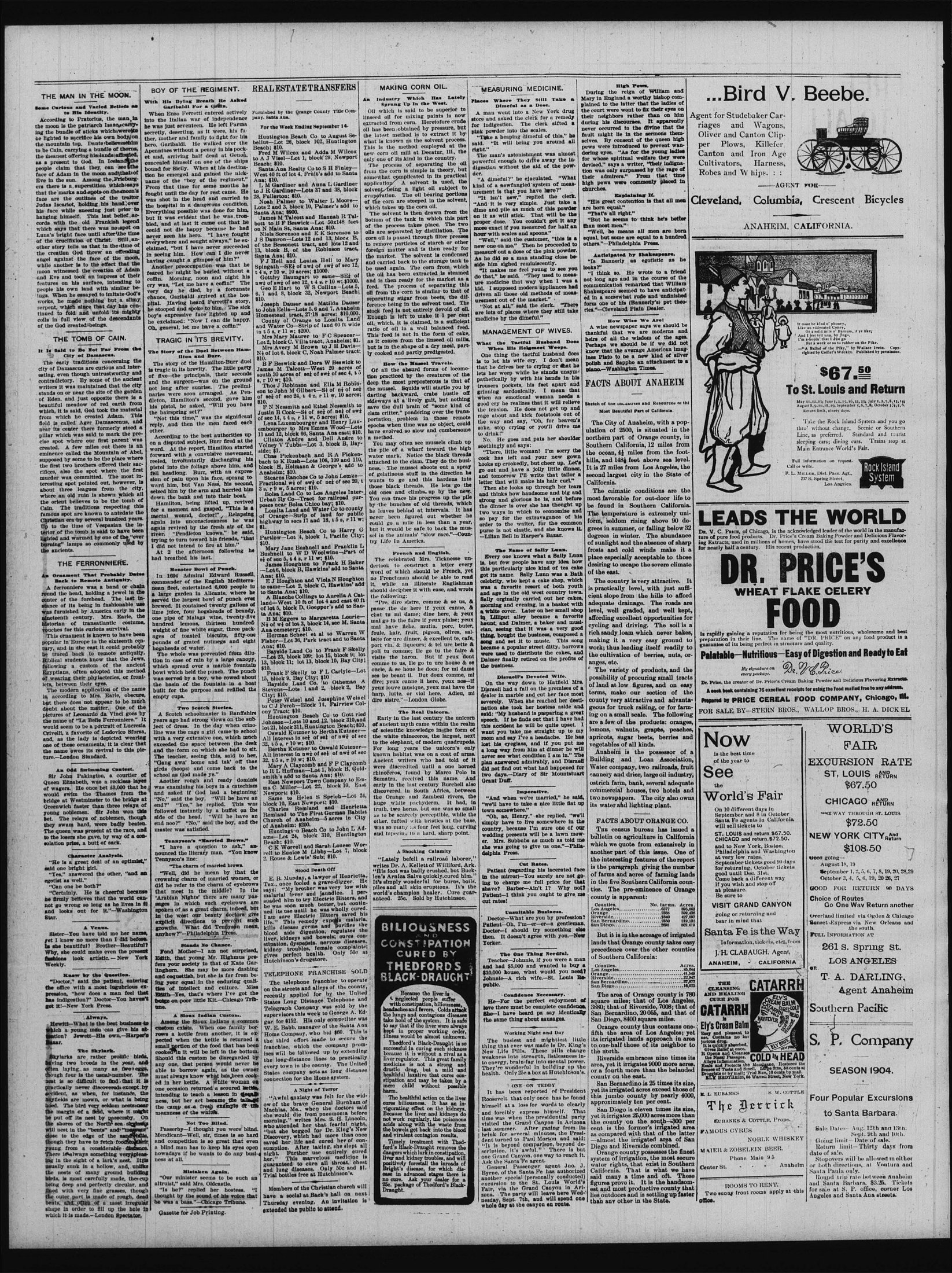
Searchable text
THE MAN IN THE MOON.
Some Curious and Varied Beliefs as to His Identity.
According to Pratorius, the man in the moon is the patriarch Isaac, carrying the bundle of sticks which were lighted to sacrifice his own body on the mountain top. Dante believes him to be Cain, carrying a bundle of thorns, the meanest offering his lands afforded, as a present to God. In Iceland, the people claim that they can see the face of Adam in the moon and that of Eve in the sun. Among the Frieburgers there is a superstition which says that the marks and spots on the moon's face are the outlines of the traitor Judas Iscariot, holding his hand over his face while sneezing just prior to hanging himself. This last belief accords with the old Frankish legend which says that there was no spot on Luna's bright face until after the time of the crucifixion of Christ. Still, another story tells us that in the time of the creation God threw an offending angel against the face of the moon, while another is to the effect that the moon witnessed the creation of Adam and Eve and took an impress of their features on his surface, intending to people his own land with similar beings. When he essayed to imitate God's works, he made nothing but a slimy serpent, which since that day has continued to fold and unfold its mighty coils in full view of the descendants of the God created beings.
THE TOMB OF CAIN.
It Is Said to Be Not Far From the City of Damascus.
The early traditions concerning the city of Damascus are curious and interesting, even though untrustworthy and contradictory. By some of the ancient writers it was maintained that the city stands on or near the site of the garden of Eden, and just opposite there is a beautiful meadow of red earth from which, it is said, God took the material from which he created Adam. This field is called Ager Damascenus, and near its center there formerly stood a pillar which was said to mark the precise spot where our first parent was created. A few miles out there is an eminence called the Mountain of Abel, supposed by some to be the place where the first two brothers offered their sacrifices, also the spot where the first boy of The Regiment.
BOY OF THE REGIMENT.
With His Dying Breath He Asked Garibaldi For a Coin.
When Enzo Ferretti entered actively into the Italian war of independence he was just seventeen. He left Parma secretly, deserting, as it were, his father, mother and family to fight for his hero, Garibaldi. He walked over the Apennines without a penny in his pocket and, arriving half dead at Genoa, concealed himself on one of the ships bound for Sicily. When at his destination he emerged and gained the nickname of the "boy of the regiment." From that time for some months he fought until the day for rest came. He was shot in the head and carried to the hospital in a dangerous condition. Everything possible was done for him, but it was evident that he was troubled, and at last it came out that he could not die happy because he had never seen his hero. "I have fought everywhere and sought always," he exclaimed, "but I have never succeeded in seeing him. How can I die never having caught a glimpse of him?"
Another preoccupation was that he feared he might be buried without a coffin. Morning, noon and night his cry was, "Let me have a coffin!" The very day he died, by a fortunate chance, Garibaldi arrived at the hospital. Having heard Ferretti's story, he stooped and spoke to him. The sick boy's expressive face lighted up and he exclaimed: "Now I can die happy. Oh, general, let me have a coffin!"
TRAGIC IN ITS BREVITY.
The Story of the Duel Between Hamilton-Burr duel is tragic in its brevity. The little party of five—the principals, their seconds and the surgeon—was on the ground not long after sunrise. The preliminaries were soon arranged. As Pendleton, Hamilton's second, gave him his pistol, he asked, "Will you have the hairspring set?"
"Not this time," was the significant reply, and then the men faced each other.
According to the best authorities upon a disputed subject, Burr fired at the word. At the report, Hamilton started forward with a convulsive movement, reeled, involuntarily discharging his pistol into the follicle above him, and fell headlong. Burr, with an expres-
Furnished by the Orange County Title Company, Santa Ana.
For the Week Ending September 14.
Huntington Beach Co to August Seebellus—Lot 26, block 102, Huntington Beach; $10.
Fred M Wilcox and Adda M Wilcox to A J Visel—Lot 1, block 29, Newport Beach; $10.
Santa Ana Realty Co to S H Finley—West 40 ft of lot 4, Fruit's add to Santa Ana; $10.
L M Gardiner and Anna L Gardiner to J R Gardiner—Lots 37 and 38, block 28, Fullerton; $10.
Noah Palmer to Walter L Moore—Lots 2 and 3, block 10, Palmer's add to Santa Ana; $900.
James M Talcott and Hannah R Talcott to B F Beswick—Lot 50x148 feet on N Main St, Santa Ana; $10.
Niels Sorenson and E K Sorenson to J S Damron—Lots 12 and 13, block B of the Bessonett tract, and lots 12 and 13, block B, of the Robinson tract Santa Ana; $10.
F J Heil and Louisa Heil to Mary Spingath—SE of nw² of sw² of sec 12 t 4 s r 10 w , 10 acres; $1000.
Gottfrey Baumgart to same—SE of nw² of sw² of sec 12 t 4 s r 10 w ; $1000.
Geo E Hart to W S Collins—Lots 6 , 7 and 8, block 32, Newport Beach; $10.
Joseph Dauser and Matilda Dauser to John Eells—Lots 5.6 and 7, Anaheli Homestead tract, 27:18 acres; $10,000.
County of Orange to Lomita Land and Water Co—Strip of land 60 ft wide in t 5 s r 11 w ; $200.
Mrs Mary Maurer to F C Spencer-Lot 2, block C. Villa tract; Anaheim; $8.
Mrs Avery M Brown to J H Davis-N of lot 6, block C, Noah Palmer tract; $10.
B F Beswick and Dora W Beswick to James M Talcott—West 20 acres south 30 acres of set² of sw² of sec 4 , t 4 w ; $10.
Thos J Robinson and Ella M Robbson to John M Gilbert—SE of nw² of set² of sec 24 , t 4 z r 11 w , 10 acres; $10.
F N Nessmith and Ethel Nessmith Justin B Cook—SE of set² of nw² of set² of sec 14 , t 4 s , r 11 w , 5 acres; $10.
Lena Luxembourger and Henry Lu embourger to Mrs Emma Wood—Lot 11 and 12, block 66,Santa Ana east; $8.
Clinton Andre and Dell Andre Volney V Tubbs—Lot 3, block B,B side; $1.
Chas Pickenbach and R A Pickenbach to K Rush—Lots 106 , 109 and 11 block H, Helmann & George's add Anaheim; $10.
THE FERRONNIERE.
An Ornament That Probably Dates Back to Remote Antiquity.
A ferronniere was a band or chain round the head, holding a jewel in the center of the forehead. The last instance of its being in fashionable use was furnished by America early in the nineteenth century. Mrs. Earle, the historian of transatlantic costume, vouches for this curious survival.
This ornament is known to have been popular in Europe in the sixteenth century, and in the east it could probably be traced back to remote antiquity. Biblical students know that the Jews, following a custom of the ancient Egyptians, often adopted this method of wearing their phylacteries, or frontlets, between their eyes.
The modern application of the name is, according to Mrs. Earle, obscure, but there does not appear to be much doubt about the matter. One of the pictures of Leonardo da Vinci goes by the name of "La Belle Ferronniere." It would seem to be a portrait of Lucrezia Crivelli, a favorite of Ludovico Sforza, and, as the lady is depicted wearing one of these ornaments, it is clear that the name owes its revival to this picture—London Standard.
An Odd Swimming Contest.
Sir John Pakington, a courtier of Queen Elizabeth, was a reckless layer of wagers. He once bet £8,000 that he would swim the Thames from the bridge at Westminster to the bridge at Greenwich faster than three relays of young noblemen. Sir John won this bet. The relays of noblemen, though they swam hard, were badly beaten. The queen was present at the race, and to the losers she gave, by way of a consolation prize, a butt of sack.
Character Analysis.
"He is a great deal of an optimist," said one bright girl.
"Yes," answered the other, "and an egotist as well."
"Can one be both?"
"Certainly." He is cheerful because he firmly believes that the world can eat, even though untrustworthy and contradictory. By some of the ancient writers it was maintained that the city stands on or near the site of the garden of Eden, and just opposite there is a beautiful meadow of red earth from which, it is said, God took the material from which he created Adam. This field is called Ager Damascenus, and near its center there formerly stood a pillar which was said to mark the precise spot where our first parent was created. A few miles out there is an eminence called the Mountain of Abel, supposed by some to be the place where the first two brothers offered their sacrifices, also the spot where the first murder was committed. The most interesting spot pointed out, however, is about three leagues from the city, where an old ruin is shown which all the orient believes to be the tomb of Cain. The traditions respecting this famous spot are known to antedate the Christian era by several hundred years. Up to the time of Vespasian the interior of the tomb is said to have been lighted and warmed by one of the "ever burning" lamps so commonly used by the ancients.
THE FERRONNIERE.
An Ornament That Probably Dates Back to Remote Antiquity.
A ferronniere was a band or chain round the head, holding a jewel in the center of the forehead. The last instance of its being in fashionable use was furnished by America early in the nineteenth century. Mrs. Earle, the historian of transatlantic costume, vouches for this curious survival.
This ornament is known to have been popular in Europe in the sixteenth century, and in the east it could probably be traced back to remote antiquity. Biblical students know that the Jews, following a custom of the ancient Egyptians, often adopted this method of wearing their phylacteries, or frontlets, between their eyes.
The modern application of the name is, according to Mrs. Earle, obscure, but there does not appear to be much doubt about the matter. One of the pictures of Leonardo da Vinci goes by the name of "La Belle Ferronniere." It would seem to be a portrait of Lucrezia Crivelli, a favorite of Ludovico Sforza, and, as the lady is depicted wearing one of these ornaments, it is clear that the name owes its revival to this picture—London Standard.
An Odd Swimming Contest.
Sir John Pakington, a courtier of Queen Elizabeth, was a reckless layer of wagers. He once bet £8,000 that he would swim the Thames from the bridge at Westminster to the bridge at Greenwich faster than three relays of young noblemen. Sir John won this bet. The relays of noblemen, though they swam hard, were badly beaten. The queen was present at the race, and to the losers she gave, by way of a consolation prize, a butt of sack.
Character Analysis.
"He is a great deal of an optimist," said one bright girl.
"Yes," answered the other, "and an egotist as well."
"Can one be both?"
"Certainly." He is cheerful because he firmly believes that the world can eat, even though untrustworthy and contradictory. By some of the ancient writers it was maintained that the city stands on or near the site of the garden of Eden, and just opposite there is a beautiful meadow of red earth from which it is said, God took the material from which our first parent was created. A few miles out there is an eminence called the Mountain of Abel, supposed by some to be the place where the first two brothers offered their sacrifices, also the spot where the first murder was committed. The most interesting spot pointed out, however, is about three leagues from the city, where an old ruin is shown which all the orient believes to be the tomb of Cain. The traditions respecting this famous spot are known to antedate the Christian era by several hundred years. Up to the time of Vespasian the interior of the tomb is said to have been lighted and warmed by one of the "ever burning" lamps so commonly used by the ancients.
THE FERRONNIERE.
An Ornament That Probably Dates Back to Remote Antiquity.
A ferronniere was a band or chain round the head, holding a jewel in the center of the forehead. The last instance of its being in fashionable use was furnished by America early in the nineteenth century. Mrs. Earle, the historian of transatlantic costume, vouches for this curious survival.
This ornament is known to have been popular in Europe in the sixteenth century, and in the east it could probably be traced back to remote antiquity. Biblical students know that the Jews, following a custom of the ancient Egyptians, often adopted this method of wearing their phylacteries, or frontlets, between their eyes.
The modern application of the name is, according to Mrs. Earle, obscure, but there does not appear to be much doubt about the matter. One of the pictures of Leonardo da Vinci goes by the name of "La Belle Ferronniere." It would seem to be a portrait of Lucrezia Crivelli, a favorite of Ludovico Sforza, and, as the lady is depicted wearing one of these ornaments, it is clear that the name owes its revival to this picture—London Standard.
An Odd Swimming Contest.
Sir John Pakington, a courtier of Queen Elizabeth, was a reckless layer of wagers. He once bet £8,000 that he would swim the Thames from the bridge at Westminster to the bridge at Greenwich faster than three relays of young noblemen. Sir John won this bet. The relays of noblemen, though they swam hard, were badly beaten. The queen was present at the race, and to the losers she gave, by way of a consolation prize, a butt of sack.
Character Analysis.
"He is a great deal of an optimist," said one bright girl.
"Yes," answered the other, "and an egotist as well."
"Can one be both?"
"Certainly." He is cheerful because he firmly believes that the world can eat, even though untrustworthy and contradictory. By some of the ancient writers it was maintained that the city stands on or near the site of the garden of Eden, and just opposite there is a beautiful meadow of red earth from which it is said, God took the material from which our first parent was created. A few miles out there is an eminence called the Mountain of Abel, supposed by some to be the place where the first two brothers offered their sacrifices, also the spot where the first murder was committed. The most interesting spot pointed out, however, is about three leagues from the city, where an old ruin is shown which all the orient believes to be the tomb of Cain. The traditions respecting this famous spot are known to antedate the Christian era by several hundred years. Up to the time of Vespasian the interior of the tomb is said to have been lighted and warmed by one of the "ever burning" lamps so commonly used by the ancients.
THE FERRONNIERE.
An Ornament That Probably Dates Back to Remote Antiquity.
A ferronniere was a band or chain round the head, holding a jewel in the center of the forehead. The last instance of its being in fashionable use was furnished by America early in the nineteenth century. Mrs. Earle, the historian of transatlantic costume, vouches for this curious survival.
This ornament is known to have been popular in Europe in the sixteenth century, and in the east it could probably be traced back to remote antiquity. Biblical students know that the Jews, following a custom of the ancient Egyptians, often adopted this method of wearing their phylacteries, or frontlets, between their eyes.
The modern application of the name is, according to Mrs. Earle, obscure, but there does not appear to be much doubt about the matter. One ofthe pictures of Leonardo da Vinci goes bythe nameof "La Belle Ferronniere."It would seemtobeaportraitofLucreziaCrivelli,afavoriteofLudovicoSforza,andas,the ladyisdepictedwearingoneoftheorearnmentsitwillhaveattainedtheseornaments.itisclearthatthenameowesrevivaltothispicture.-LondonStandard.
An Odd Swimming Contest.
Sir John Pakington,a courtierofQueenElizabethwasareckleslayerofwagers.Herheponsthedaywhencrinoinewasragegirlcametocchoolwithaveryextensiveonewhichmuchexceededthespacebetweenthedeskandtheformonthewhichshehadtosit.Theteacher,seeingthis,saidtoher,Gangawahomeand tak'off thaegirds(hoops)andcomebacktotheschoolasGodmadeye."
Another rough and ready dominlewasexamininghisboysinacatechismandaskedifGodhadabeginning:No,"saidtheboy.Willheaveanend?"Yes,"he replied.Thiswouldfollowinstantlybya buffetonthesideofthehead.“Willheaveanendno?”No,"saidtheboy,andthemasterwassatisfied.
Tennyson's "Married Brows."
"I haveaquestiontoask,'announcedtheliteraryman."YouknowTennyson'sline:
"Thecharmofmarriedbrows."
Well,didhemeanbythatthecrowningcharmofmarriedwomen,或dhedrefertoothecharmofeyebrowsthatmeetinthemiddle?Inthe'ArabianNights'therearemanypassesalreadybuilt10,block12,Bock12Newport;$10.SametoHelenSpeclly-Lot13,block10,Bock12Newport;$10.CharlesRemlandandHenriRemlandtoTheFirstGermanBailChurchofAnaheim-5acresinOfAnaheim;$200.HuntingtonBeachCo.toJohnLams-lot24block310,HuntingBeach;$10.CKWorrrellandSarahLoueseWrelltoEuniceMLibby-Lot7,b2.Rouse&Lewis'Sub;$10.
StoodDeathOff
E.B.Munday,a lawyerofHenriTex.,oncefooledagrave-digger.says:"Mybrotherwasverylowmalarialfeverandjaundice.I
Character Analysis.
"He is a great deal of an optimist," said one bright girl.
"Yes," answered the other, "and an egotist as well."
"Can one be both?"
"Certainly. He is cheerful because he firmly believes that the world cannot go wrong so long as he lives in it and looks out for it."—Washington Star.
A Venus.
Sister—You have told me her name, yet I know no more than I did before. Is she beautiful? Brother—Beautiful? Why, she could make even the present fashions look artistic.—New York Weekly.
Knew by the Question.
"Doctor," said the patient, entering the office with a most lugubrious expression, "how does a man feel that has indigestion?" Doctor—You haven't got it!—New York Press.
Always.
Hewitt—What is the best business to which a young man can give his attention? Jewett—His own. Harper's Bazar.
The Skylark.
Skylarks are rather prolific birds, having two broods in the year, and often laying as many as five eggs, though four is the usual number. The nest is so difficult to find that it is practically never discovered except by accident, as when, for instance, the hayfields are mown, or what is being hoed. The bird very seldom nests near the margin of a field, where it might be put off its nest by passersby. On the shores of the North sea skylarks will nest in the "bents" and "mammum" close to the edge of the sandy hills, though they have to fetch food to their young from a considerable distance. There is always something very pleasing in the sight of a lark's nest. It is usually sunk in a hollow, and, unlike the nests of many ground building birds, is most carefully made, the cup being deep and perfectly circular, and lined with very fine grasses, though the outer part is made of rough, dead bents, and often of a most irregular shape in order to fill up the hole in which it is made.—London Spectator,
Tennyson's "Married Brows."
"I have a question to ask," announced the literary man. "You know Tennyson's line:
"The charm of married brows.
Well, did he mean by that the crowning charm of married women, or did he refer to the charm of eyebrows that meet in the middle? In the Arabian Nights' there are many passages in which such eyebrows are spoken of as a great charm, indeed, but in the west our beauty doctors give explicit directions to prevent such growths. What did Tennyson mean, anyhow?"—Philadelphia Press.
Stands No Chance.
Fond Mother—I am not surprised, Edith, that young Mr. Highmus prefers your society to that of Kate Garlinghorn. She may be more dashing and coquettish, but she is far from being your equal in the enduring qualities of intellect and culture. Miss Edith—Yes, that's where I've got the bulge on poor little Kit.—Chicago Tribune.
A Sioux Indian Custom.
Among the Sioux Indians a common custom exists. When one family borrows a kettle from another, it is expected when the kettle is returned a small portion of the food that has been cooked in it will be left in the bottom. Should this custom be disregarded by any one, that person would never be able to borrow again, as the owner must always know what has been cooked in her kettle. A white woman on one occasion returned a scoured kettle, intending to teach a lesson in demeaness, but her act became the talk of the camp as a fresh example of the meanness of the whites.
Not Too Blind.
Passerby—I thought you were blind. Mendicant—Well, sir, times is so hard and competition is so great that even a blind man has to keep his eyes open howadays if he wants to do any business at all.
Mistaken Again.
"Our minister seems to be such an altruist," said Mrs. Oldcastle.
"Is he?" replied her hostess. "I thought by the sound of his voice that he was a bass."—Chicago Tribune.
Gazette for Job Printing.
The telephone franchise to open on the streets and alleys of the county recently applied for by the United States Long Distance Telephone Telegraph Company was sold by supervisors this week to George Agar for $152. His only competitor W. E. Babb, manager of the Santa Home Company, who bid $60. The third effort made to secure franchise, which the company promises will be followed up by extending the long-distance lines to practise every town in the county. The United States company acts as long distance connection for the Home system.
A Night of Terror
"Awful anxiety was felt for the owl of the brave General Burnham Machias, Me., when the doctors she would die from pneumonia be morning," writes Mrs. S. H. Linde who attended her that fearful night "but she begged for Dr. King's Discovery, which had more than saved her life and cured her of sumption. After taking, she slept night. Further use entirely enherered." This marvelous medicine guaranteed to cure all throat, cough and lung diseases. Only 50c and Trial bottles free at Hutchinson's.
Members of the Christian church have a social at Back's hall on Thursday evening. An invitation extended the public to attend.
MOSTATE TRANSFERS
Week Ending September 14.
Boston Beach Co to August Sept. 26, block 102, Huntington St.
Wilcox and Adda M Wilcox Gel—Lot 1, block 29, Newport St.
Ana Realty Co to S H Finley—lot of lot 4, Fruit's add to Santa Barbara.
Gardiner and Anna L Gardiner Gardiner—Lots 37 and 38, block Boston; $10.
Palmer to Walter L Moore—lot 10, Palmer's add to Ana; $900.
M Talcott and Hannah R Talcott F Beswick—Lot 50x148 feet in St, Santa Ana; $10.
Sorenson and E K Sorenson to Son—Lots 12 and 13, block B, Jessonett tract, and lots 12 and B, of the Robinson tract, Ana; $10.
Hill and Louisa Heil to Mary SE of nwf of swf of sec 12, t 10 w, 10 acres; $1000.
Baumgart to same—SE of sec 12, t 4 s, r 10 w; $1000.
Hart to W S Collins—Lots 5, 8, block 32, Newport Beach;
Dauser and Matilda Dauser Cells—Lots 5, 6 and 7, Anabeim land Co—Strip of land 60 ft wide at 11 w; $200.
Mary Maurer to F C Spencer—Lock C. Villa tract, Anabeim; $1.
Very M Brown to J H Davis—6, block C, Noah Palmer tract;
Besswick and Dora W Beswick to M Talcott—West 20 acres of acres of set of swf of sec 4, t 5; $10.
Robinson and Ella M Robin-Mobin and Ella M Gilbert—S of net of sec 24, t 4 z, r 11 w, 10 acres;
Luxembourgger and Henry Luxemger to Mrs Emma Wood—Lots 22, block 66, Santa Ana east; $10.
An Andre and Dell Andre to V Tubbs—Lot 3, block B, BayPickenbach and R A Picken-K Rush—Lots 106, 109 and 110,
M. Holmann & George's add to Ana; $10.
MAKING CORN OIL.
An Industry Which Has Lately Sprung Up In the West.
Oil which is said to be superior to linseed oil for mixing paints is now extracted from corn. Heretofore crude oil has been obtained by pressure, but the latest method is to extract it by what is known as the solvent process. This is the method employed at the new corn oil mill at Decatur, Ill., the only one of its kind in the country.
The process of separating the oil from the corn is simple in theory, but somewhat complicated in its practical application. A solvent is used, the solvent being a light oil subject to evaporation. The oil bearing portions of the corn are steeped in the solvent, which takes up the corn oil.
The solvent is then drawn from the bottom of the tank in which this part of the process takes place. The two oils are separated by distillation. The corn oil is passed through filter presses to remove particles of starch or other foreign matter and is then ready for the market. The solvent is condensed and carried back to the storage tank to be used again. The corn from which the oil has been extracted is steamed and is then ready for the market as a feed. The process of separating this oil from the corn is similar to that of separating sugar from beets, the difference being in the solvent used. The stock feed is not entirely devoid of oil. Enough is left to make it per cent oil, which it is claimed, is a sufficient ratio of oil in a well balanced feed. This feed is not in the form of cake, as it comes from the linseed oil mills, but is in the shape of a dry meal, partly cooked and partly predigested.
How the Mussel Travels.
Of all the absurd forms of locomotion practiced by the creatures of the deep the most preposterous is that of the mussel. Squids will startle you by darting backward, crabs hustle off sideways at a lively gait, but nothing save the dull brain of "some kind of clam critter," pondering over the transportation problem in those remote epochs when time was no object, could have evolved so slow and cumbersome a method.
You may often see mussels climb up the pile of a wharf toward the high water mark. Notice the black threads attached to the clam. They do the business. The mussel shoots out a spray of gelatinous stuff in the direction he measures.
MEASURING MEDICINE.
Places Where They Still Take a Dimeful as a Dose.
A man went into a New York drug store and asked the clerk for a remedy for indigestion. The clerk sifted a pink powder into the scales.
"Take a heaping dimeful of this," he said. "It will bring you around all right."
The man's astonishment was almost powerful enough to drive away the indigestion without the aid of the powder.
"A dimeful?" he ejaculated. "What kind of a newfangled system of measurement is that you have here?"
"It isn't new," replied the clerk. "And it is very simple. Just take a dime and pile as much of this powder on it as will stick. That will be the proper dose. You couldn't get it any more exact if you measured for half an hour with scales and spoons."
"Well," said the customer, "this is a new one on me." Then he proceeded to measure out a dose of the pink powder. As he did so a man standing close beside him sighed reminiscently.
"It makes me feel young to see you do that," he said. "They used to measure medicine that way when I was a kid. I supposed modern appliances had driven all those old methods of measurement out of the market."
"Not at all," said the clerk. "There are lots of places where they still take medicine by the dimeful."
MANAGEMENT OF WIVES.
What the Tactful Husband Does
When His Helgeet Weeps.
One thing the tactful husband does is to let his wife cry. I don't mean that he drives her to crying or that he lets her weep while he stands unsympathetically by with his hands in his trousers pockets, his feet apart and grinning sardonicly. I mean that when an emotional woman needs a good cry he realizes that it will relieve the tension. He does not get up and rage about and kick footstools out of the way and say, "Oh, for heaven's sake, stop crying or you'll drive me to drink!"
No. He goes and pats her shoulder soothingly and says:
"There, little woman! I'm sorry the cook has left and your new gown books up crookedly, but cheer up. Let's go out and have a jolly little dinner."
Ill write that taller a High Pews.
During the reign of William Mary in England a worthy bishop explained to the latter that the ladies the court were wont to fix their eyes their neighbors rather than on during his discourses. It apparently never occurred to the divine that fault might lie in the sermons that selves. By consent of the queen pews were introduced to prevent widing eyes. "As for the young lady for whose spiritual welfare they devised," says a writer, "their indignation was only surpassed by the rags their admirers." From that high pews were commonly placed churches.
Explaining It.
"His great contention is that all are born equal."
"That's all right."
"But he seems to think he's better than most men."
"Well, he means all men are equal, but some are equal to a hunter others."—Philadelphia Press.
Anticipated by Shakespeare.
"Is Bannerly as egotistic as looks?"
"I think so. He wrote to a fighter not long ago and in the course of communication remarked that Shakespeare seemed to have antiqued in a somewhat rude and unfunny form one of his (Bannerly)'s petriles."—Cleveland Plain Dealer.
How Wise We Are!
A wise newspaper says we show thankfulness that we are modern heirs of all the wisdom of the Perhaps we should be if we didn't know that the average American lives Plato to be a new kind of polish and Sappho an attachment piano—Washington Times.
FACTS ABOUT ANAHHE
Sketch of the industries and Resources
Most Beautiful Part of California
The City of Anaheim, with a population of 2500, is situated in northern part of Orange county Southern California, 12 miles north from the hills, and 148½ feet above sea level. It is 27 miles from Los Angeles second largest city in the St.
FACTS ABOUT ANAHEIM
Sketch of the industries and Resources
Most Beautiful Part of California
The City of Anaheim, with a population of 2500, is situated in northern part of Orange County. Southern California, 12 miles north of the ocean, has 4½ miles from the hills, and 148½ feet above sea level. It is 27 miles from Los Angeles second largest city in the St. Louis County.
The climatic conditions are most favorable for out-door recreation, be found in Southern California. The temperature is extremely warm, seldom rising above 65 degrees in summer, or falling below 20 degrees in winter. The abundance of sunlight and the absence of frosts and cold winds make place especially acceptable to those desiring to escape the severe cold of the east.
The country is very attractive, is practically level, with just a slight slope from the hills to adequate drainage. The rocky level, well graded, and well affording excellent opportunities for cycling and driving. The rich sandy loam which never grows is a popular street ditty, barrows were used to distribute the cakes, and Dalmer finally retired on the profits of the business.
Disraeli's Devoted Wife
On the way down to Hatfield Mrs. Disraeli had a fall on the premises of a dealer in marble and cut her face most severely. When she reached her destination she took her hostess aside and said: "My husband is preparing a great speech. If he finds out that I have had this accident he will be quite upset. I want you take me straight up into my room and say I've a headache. He has lost his eyeglass, and if you put me a long way from him at dinner he will never see what condition I am in." The plan answered admirably, and Disraeli did not find out what had happened two days.—Diary of Sir Mountstuart Grant Duff.
Imperative
"And when we're married," he said, "we'll have to take a nice little flat up town somewhere."
Oh, no, Henry," she replied, "we'll simply have to live somewhere in the country, because I'm sure one of our wedding presents will be a lawn mower. Mrs. Subbubs as much as told me she was going to give us one."—Philadelphia Press.
Cut Rates
Patient (regarding his lacerated face in the mirror)—You surely are not going to charge me full price for that shave? Barber—Ain't I? Why not? Patient—I think you ought to give me weep wine with pathetically by with his hands in his trousers pockets, his feet apart and grinning sardonically. I mean that when an emotional woman needs a good cry he realizes that it will relieve the tension. He does not get up and rage about and kick footstools out of the way and say, "Oh, for heaven's sake, stop crying or you'll drive me to drink!"
No. He goes and pats her shoulder soothingly and says:
"There, little woman! I'm sorry the cook has left and your new gown hooks up crookedly, but cheer up. Let's go out and have a jolly little dinner, and tomorrow I'll write that tailor a letter that will make his hair curl."
Then she looks up through her tears and thinks how handsome and big and strong and glorious he is, and before the dinner is over she has thought up two ways in which to economize and so pay for the extravagance of his order to the waiter, for the common purse is not elastic, and she knows it—Lillian Bell in Harper's Bazar.
The Real Unicorn
Early in the last century the unicorn of ancient myth came within the realm of scientific knowledge in the form of the white rhinoceros, the largest, next to the elephant, of modern quadrupeds. For long years the unicorn's only known habitat was on a coat of arms. Ancient writers who had told of it were discredited until a one horned rhinoceros, found by Marco Polo in Sumatra, received this name. And early in the last century Burchell also discovered in South Africa, between the Orange and Zambesi rivers, the huge white pachyderm. It had, in truth, two horns, but one was so small as to be scarcely perceptible, while the other, tufted with bristles at the base, was so many as four feet long, curving and tapering to a hard, sharp point.
A Shocking Calamity
"Lately befell a railroad laborer," writes Dr. A. Kellett of Williford, Ark. "His foot was badly crushed, but Bucklen's Arnica Salve quickly cured him." It's simply wonderful for burns, boils, piles and all skin eruptions. It's the world's champion healer. Cure guaranted. 250. Sold by Hutchinson.
FACTS ABOUT ORANGE
The census bureau has its bulletin on agriculture in California which we quote from extensive another part of this issue. The interesting features of this is the paragraph giving the facts of farms and acres of farming in the five Southern California towns. The pre-eminence of county is apparent:
A Shocking Calamity
"Lately befell a railroad laborer," writes Dr. A. Kellett of Williford, Ark.
"His foot was badly crushed, but Bucklen's Arnica Salve quickly cured him."
It's simply wonderful for burns, boils, piles and all skin eruptions. It's the world's champion healer. Cure guaranteed. 25c. Sold by Hutchinson.
BILIOUSNESS AND CONSTIPATION CURED BY THEDFORD'S BLACK-DRAUGHT
Because the liver is neglected people suffer with constipation, billiousness, headaches and fevers. Colds attack the lungs and contagious diseases take hold of the system. It is safe to say that if the liver were always kept in proper working order, illness would be almost unknown.
Thedford's Black-Draught is so successful in curing such sickness because it is without a rival as a liver regulator. This great family medicine is not a strong and drastic drug, but a mild and healthful laxative that cures constipation and may be taken by a mere child without possible harm.
The healthful action on the liver cures billiousness. It has an invigorating effect on the kidneys. Because the liver and kidneys do not work regularly, the poisonous acids along with the waste from the bowels get back into the blood and virulent contagion results.
Timely treatment with Thedford's Black-Draught removes the dangers which lurk in constipation, liver and kidney troubles, and will positively forestall the inroads of Bright's disease, for which disease in advanced stages there is no cure. Ask your dealer for a 25c. package of Thedford's Black-Draught.
And when we married, he said "we'll have to take a nice little flat up town somewhere."
"Oh, no, Henry," she replied, "we'll simply have to live somewhere in the country, because I'm sure one of our wedding presents will be a lawn mower. Mrs. Subbubs as much as told me she was going to give us one."—Philadelphia Press.
Cut Rates.
Patient (regarding his lacerated face in the mirror)—You surely are not going to charge me full price for that shave? Barber-Ain't I? Why not? Patient-I think you ought to give me cut rates!
Unsuitable Business.
Doctor—What are you by profession?
Patient-Oh, I'm-er-er—a gentleman.
Doctor-I should try something else then. It doesn't agree with you—New Yorker.
The One Thing Needful.
Teacher—Johnnie, if you were a man and had $5,000 and wanted to buy a $10,000 house, what would you need? Johnnie-A rich wife-St. Louis Republic.
Confidence Necessary.
He—For the perfect enjoyment of love there must be complete confidence she-I have heard pa say identically the same thing about sausages.
Working Night and Day
The busiest and mightiest little thing that ever was made is Dr. King's New Life Pills. These pills change weakness into strength, listlessness into energy, brain-flag into mental power. They're wonderful in building up the health. Only 25c a box at Hutchinson's.
ONE ON TEDDY
It has been reported of President Roosevelt that only once has he found himself at a loss for words to clearly and forcibly express himself. That time was when the presidential party visited the Grand Canyon in Arizona last summer. After gazing from its brink for several minutes, the President turned to Paul Morton and said: "It is beyond comparison, beyond description. it's awful." There is but one Grand Canyon, one way to reach it. Ask the Santa Fe agent.
General Passenger agent Jno. J. Byrne, of the Santa Fe has authorized another special (personally conducted) excursion to the St. Louis World's Fair, via the Grand Canyon in Arizona. The party will leave here Wednesday, Sept. 7th, and will spend one whole day at the canyon en route.
FACTS ABOUT ORANGER
The census bureau has issued bulletin on agriculture in California which we quote from extensive another part of this issue. The interesting features of this is the paragraph giving the story of farms and acres of farming in the five Southern California counties. The pre-eminence of county is apparent:
Counties.
Los Angeles
Orange
Riverside
San Bernardino
San Diego
But it is in the acreage of lands that Orange county takes precedence over the other of Southern California:
Counties.
Los Angeles
Orange
Riverside
San Bernardino
San Diego
The area of Orange county square miles; that of Los Angeles its irrigated lands approach; to one-half those of its neighbor the north.
Riverside embraces nine town areas, yet it irrigates 9000 more or a fourth more than the borough on the east.
San Bernardino is 25 times yet its irrigated acres exceed this jumbo county by nearly approximately ten per cent.
San Diego is eleven times yet it irrigates 25,000 acres more than the county on the south-central is the former's irrigation as compared with that of the almost the irrigated area Diego and Riverside combine.
Orange county possesses the system of irrigation, the most water rights, that exist in South California. That is what we said many a time and oftfigures prove it. It is the highest and most productive counlies outdoors and is settling uth than any other in the State.
High Pews.
During the reign of William and John England a worthy bishop compared to the latter that the ladies of court were wont to fix their eyes on neighbors rather than on him for his discourses. It apparently occurred to the divine that the might lie in the sermons themself. By consent of the queen high were introduced to prevent waner eyes. "As for the young ladies whose spiritual welfare they were indignated," says a writer, "their indignation was only surpassed by the rage of admirers." From that time pews were commonly placed in churches.
Explaining It.
It is great contention is that all men born equal."
What's all right."
But he seems to think he's better most men."
Anticipated by Shakespeare.
Bannerly as egotistic as he thinks so. He wrote to a friend long ago and in the course of the communication remarked that William Shakespeare seemed to have anticipating a somewhat rude and unfinished one of his (Bannerly's) pet theo-
—Cleveland Plain Dealer.
How Wise We Are!
wise newspaper says we should be thankful that we are moderns and of all the wisdom of the ages.
haps we should be if we did not know that the average American imagPlato to be a new kind of silver and Sappho an attachment to a loo—Washington Times.
CTS ABOUT ANAHEIM
Of the industries and Resources or this Most Beautiful Part of California.
The City of Anaheim, with a popation of 2500, is situated in the northern part of Orange county, in Northern California, 12 miles from ocean, 4¼ miles from the foots, and 148½ feet above sea level. 27 miles from Los Angeles, the largest city in the State of
...Bird V. Beebe.
Agent for Studebaker Carriages and Wagons,
Oliver and Canton Clipper Plows, Killefer,
Canton and Iron Age Cultivators, Harness,
Robes and Whips. ::
AGENT FOR
Cleveland, Columbia, Crescent Bicycles
ANAHEIM, CALIFORNIA.
It must be kind o' phoney,
Like an eddycated Coney,
Or a solid mile o' Bainum, if ye like;
And I jest tell you, by jingo,
I'm a-shopin' that I kin go
For a week or so to rubber on the Pike.
"A Ballad of the Pike," by Wallace Irwin. Copyrighted by Collier's Weekly. Published by permission.
$67.50
To St. Louis and Return
May 11, 12, 13; June 1, 2, 15, 16, 22, 23; July 1, 2, 7, 8, 13, 14;
August 8, 9, 10, 18, 19, September 5, 6, 7, 8; October 1, 4, 5, 6.
Return limit, ninety days.
Take the Rock Island System and you go thro' without change. Scenic or Southern Line, as preferred. Standard and tourist sleeping cars; dining cars. Trains stop at Main Entrance World's Fair.
Full information on request.
Call or write.
F. L. MILLER, Dist. Pass. Agt.
To St. Louis and Return
May 11, 12, 13; June 1, 2, 15, 16, 22, 23; July 1, 2, 7, 8, 11; August 8, 9, 10, 18, 19; September 5, 6, 7; October 1, 4, 5, 6;
Return limit, ninety days.
Take the Rock Island System and you go thro' without change. Scenic or Southern Line, as preferred. Standard and tourist sleeping cars; dining cars. Trains stop at Main Entrance World's Fair.
Full information on request.
Call or write.
F. L. MILLER, DIST. PASS. Agt.
237 S. Spring Street,
Los Angeles.
LEADS THE WORLD
Dr. V. C. Price, of Chicago, is the acknowledged leader of the world in the manufacture of pure food products. Dr. Price's Cream Baking Powder and Delicious Flavoring Extracts, used in millions of homes, have stood the test for purity and excellence for nearly half a century. His recent production.
DR. PRICE'S
WHEAT FLAKE CELERY
FOOD
Is rapidly gaining a reputation for being the most nutritious, wholesome and best preparation in their line. The name of "DR. PRICE" on any food product is a guarantee of its being perfect in structure and quality.
Palatable—Nutritious—Easy of Digestion and Ready to Eat
My signature on every package.
Dr. Price, the creator of Dr. Price's Cream Baking Powder and Delicious Flavoring Extracts.
A cook book containing 76 excellent receipts for using the Food mailed free to any address.
Prepared by PRICE CEREAL FOOD COMPANY, Chicago, Ill.
FOR SALE BY—STERN BROS., WALLOP BROS., H. A. DICK EL
Now
is the best time
of the year to
See
the
World's Fair
On 10 different days in September and 8 in October Santa Fe agents in California will sell tickets to ST. LOUISE and return $67.50.
CHICAGO and return $72.50.
and to New York, Boston, Philadelphia and Washington at very low rates.
September tickets good 90 days for returning, October tickets good until Dec. 31st.
Come back a different way if you wish and stop off at pleasure.
Be sure to
WORLD'S FAIR
EXCURSION RATE
ST, LOUIS AND RETURN
$67.50
CHICAGO AND RETURN
ONE WAY THROUGH ST. LOUIS
$72.50
NEW YORK CITY And Return
$108.50
Good going—
August 18, 19
September 1, 2, 5, 6, 7, 8, 19, 20, 28, 29
October 3, 4, 5, 6, 19, 20, 26, 27
GOOD FOR RETURN 90 DAYS
Choice of Routes
FACTS ABOUT ORANGE CO.
The census bureau has issued a bulletin on agriculture in California which we quote from extensively in another part of this issue. One of the interesting features of the report is the paragraph giving the number of farms and acres of farming lands in the five Southern California counties. The pre-eminence of Orange County is apparent:
Counties. No. farms. Acres.
Los Angeles...6577 895,063
Orange...2388 599,436
Riverside...2340 427,097
Bernardino...2350 219,132
Diego...2998 809,419
But it is in the acreage of irrigated lands that Orange county takes easy precedence over the other counties in Southern California:
Counties. Acres.
Los Angeles...85,644
Orange...41,549
Riverside...32,947
Bernardino...37,877
Diego...16,022
The area of Orange county is 780 square miles; that of Los Angeles, 880; that of Riverside, 7008; that of Bernardino, 20,055, and that of Diego, 8400 square miles.
Orange county thus contains one-third the area of Los Angeles; yet it irrigates 9000 more acres, a fourth more than the belauded county on the east.
San Bernardino is 25 times its size; but it irrigates 25,000 acres more than the county on the south—300 per cent is the former's irrigated area compared with that of the latter almost the irrigated area of San Diego and Riverside combined.
Orange county possesses the finest system of irrigation, the most secure water rights, that exist in Southern California. That is what we have had many a time and oft. These measures prove it. It is the handsomest and most productive county that outdoors and is settling up faster than any other in the State.
WORLD'S WAY
On 10 different days in September and 8 in October Santa Fe agents in California will sell tickets to:
ST. LOUIS and return $67.50.
CHICAGO and return $72.50.
and to New York, Boston, Philadelphia and Washington at very low rates.
September tickets good 90 days for returning, October tickets good until Dec. 31st.
Come back a different way if you wish and stop off at pleasure.
Be sure to VISIT GRAND CANYON going or returning and bear in mind that
Santa Fe is the Way
Information, tickets, etc., from J. H. CLABAUGH. Agent Anaheim, CALIFORNIA
THE CLEANSING AND HEALING CURE FOR CATARRH
Ely's Cream Balm
Easy and pleasant to use. Contains no injurious drug.
It is quickly absorbed.
Gives Relief at once.
It Opens and Cleanses the Nasal Passages.
Allays Inflammation.
Heals and Protects the Membrane. Restores the Senses of Taste and Smell. Large Size, 60 cents at Drogs or by mail; Trial Size, 10 cents by mail.
ELY BROTHERS, 56 Warren Street, New York.
M. L. EUBANKS S. W. COTTLE
The Jerrick
EUBANKS & COTTLE, Props.
FAMOUS CYRUS
NOBLE WHISKEY
MAIER & ZOBELEIN BEER.
Phone Main 95
Center St. Anaheim
ROOMS TO RENT.
Two sunny front rooms apply at this office.
CHICAGO AND RETURN
NEW YORK CITY And Return
$108.50
Good going—August 18, 19
September 1, 2, 5, 6, 7, 8, 19, 20, 28, 29
October 3, 4, 5, 6, 19, 20, 26, 27
GOOD FOR RETURN 90 DAYS
Choice of Routes Go One Wav Return another
Overland limited via Ogden & Chicago Sunset Express via New Orleans and the south.
FULL INFORMATION AT
261 S. Spring St.
LOS ANGELES
or
T. A. DARLING,
Agent Anaheim
Southern Pacific
S. P. Company
SEASON 1904.
Four Popular Excursions to Santa Barbara.
Sale Date—Aug. 12th and 13th.
Sept. 9th and 10th.
Going limit—Date of sale.
Return limit—Thirty days from date of sale.
Stopovers will be allowed in either or both directions, at Ventura and Santa Paula only.
Round trip rate between Anaheim and Santa Barbara, $3.25. Tickets for sale at S. P. office, corner Los Angeles and Santa Ana streets.