anaheim-gazette 1904-09-08
Scanned page
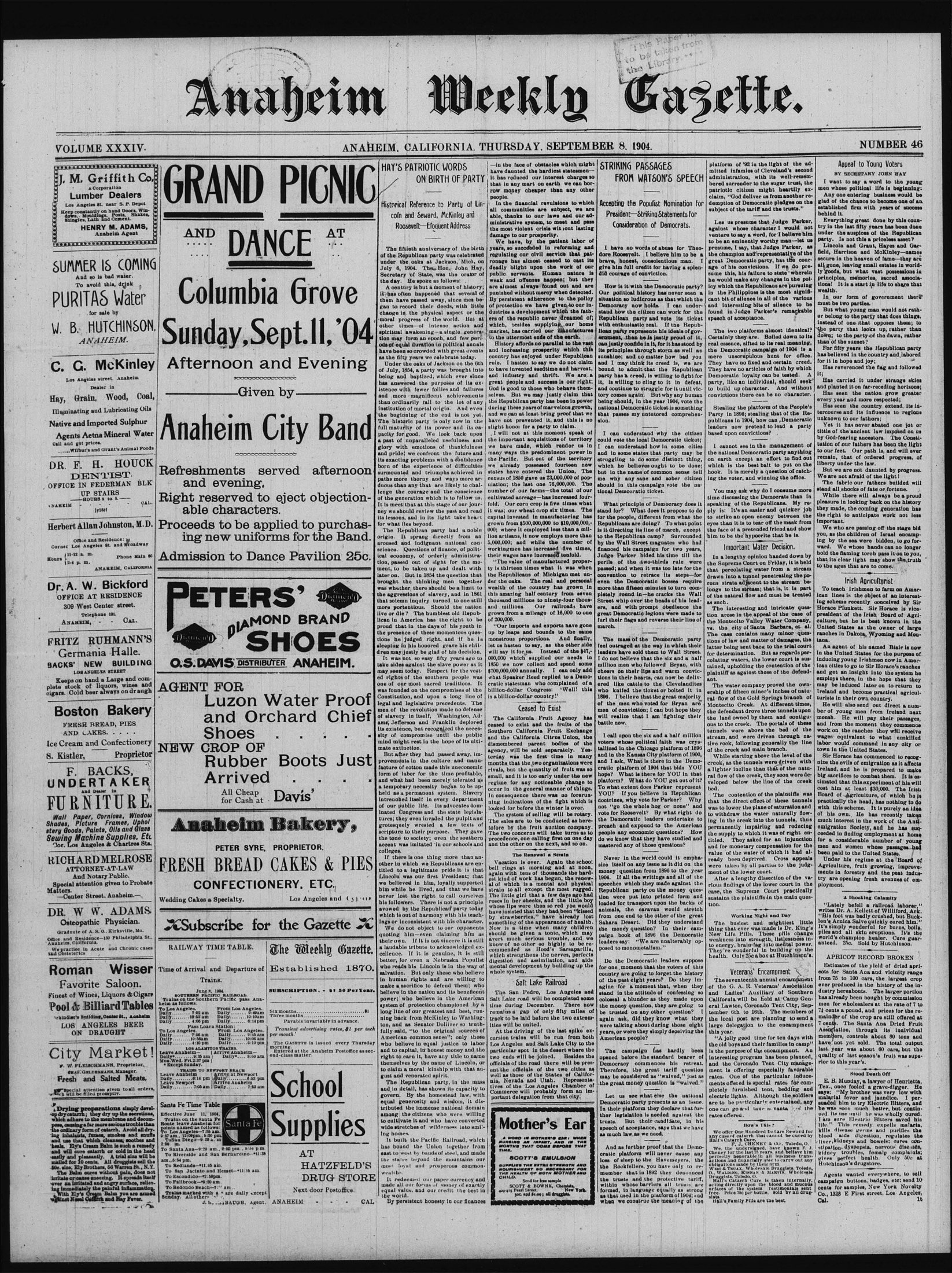
Searchable text
Anaheim
VOLUME XXXIV.
J. M. Griffith Co,
A Corporation
Lumber Dealers
Los Angeles St. near S. P. Depot
Keep constantly on hand Doors, Windows, Mouldings, Posts, Shakes, Shingles, Lath and Cement.
HENRY M. ADAMS,
Anaheim Agent
SUMMER IS COMING
And so is bad water.
To avoid this, drink PURITAS Water
for sale by W. B. HUTCHINSON,
ANAHEIM.
C. G. McKinley
Los Angeles street, Anaheim
Dealer in
Hay, Grain, Wood, Coal,
Illuminating and Lubricating Oils
Native and Imported Sulphur
Agents Aetna Mineral Water
Call and get prices.
...Wilbur's and Grant's Animal Foods
GRAND PICNIC
AND DANCE AT
Columbia Grove
Sunday, Sept. 11, '00
Afternoon and Evening
Given by
Anaheim City Bank
Refreshments served afternoon
Los Angeles street, Anaheim
Dealer in
Hay, Grain, Wood, Coal,
Illuminating and Lubricating Oils
Native and Imported Sulphur
Agents Aetna Mineral Water
Call and get prices.
Wilbur's and Grant's Animal Foods
DR. F. H. HOUCK
DENTIST.
OFFICE IN FEDERMAN BLK
UP STAIRS
HOURS 9 to 5
ANAHEIM CAL.
jy16tt
Herbert Allan Johnston, M.D.
Office and Residence:
Corner Los Angeles St. and Broadway
Hours 11-12 a.m.
2-4 p.m.
ANAHEIM, CALIFORNIA
Dr. A. W. Bickford
OFFICE AT RESIDENCE
309 West Center street.
Telephone 101.
ANAHEIM, CAL.
FRITZ RUHMANN'S
Germania Halle.
BACKS' NEW BUILDING
LOS ANGELES STREET
Keeps on hand a Large and complete stock of liquors, wines and cigars. Cold beer always on draught
Boston Bakery
FRESH BREAD, PIES AND CAKES.
Ice Cream and Confectionery
S. Kistler, Proprietor
F. BACKS,
UNDERTAKER
And Dealer in
FURNITURE.
Wall Paper, Cornloes, Window Shades, Picture Frames, Upholstery Goods, Paints, Oils and Glass Sewing Machine Supplies, Etc.
Cor. Los Angeles & Chartres Sts.
RICHARDMELROSE
ATTORNEY-AT-LAW
And Notary Public.
Special attention given to Probate Matters.
Center Street, Anaheim—
Given by
Anaheim City Bank
Refreshments served afternoon and evening,
Right reserved to eject objectionable characters.
Proceeds to be applied to purchasing new uniforms for the Bar
Admission to Dance Pavilion 28
PETERS'
DIAMOND BRAND SHOES
O.S.DAVIS DISTRIBUTER ANAHEIM.
AGENT FOR
Luzon Water Products Orchard Chic Shoes
NEW CROP OF
Rubber Boots Just Arrived
All Cheap for Cash at Davis'
Anaheim Bakery,
PETER SYRE, PROPRIETOR.
FRESH BREAD CAKES & PI CONFECTIONERY, ETC.
FURNITURE.
Wall Paper, Cornices, Window Shades, Picture Frames, Upholstery Goods, Paints, Oils and Glass Sewing Machine Supplies, Etc.
Cor. Los Angeles & Chartres Sts.
RICHARDMELROSE
ATTORNEY-AT-LAW
And Notary Public.
Special attention given to Probate Matters.
—Center Street. Anaheim.
DR. W. W. ADAMS.
Osteopathic Physician.
Graduate of A. S. O., Kirksville, Mo.
Office and Residence—130 Philadelphia St., Anaheim, California.
We practice in Acute and Chronic cases and Obstetrics.
Roman Wisser
Favorite Saloon.
Finest of Wines, Liquors & Cigare
Pool & Billiard Tables
Indieser's Building, Center St., Anaheim
LOS ANGELES BEER ON DRAUGHT
City Market!
W. W. PLEISCHMANN, Proprietor
CHAS. GELDERMANN, Manager.
Fresh and Salted Meats,
Special attention given to all orders,
which will be filled promptly.
Drying preparations simply develop dry catarrh; they dry up the secretions, which adhere to the membrane and decompose, causing a far more serious trouble than the ordinary form of catarrh. Avoid all drying inhalants, fumes, smokes and snuffs and use that which cleanses, soothes and heals. Ely's Cream Balm is such a remedy and will cure catarrh or cold in the head easily and pleasantly. A trial size will be mailed for 10 cents. All druggists sell the 50c. size. Ely Brothers, 56 Warren St., N.Y.
The Balm cures without pain, does not irritate or cause sneezing. It spreads itself over an irritated and angry surface, relieving immediately the painful inflammation.
With Ely's Cream Balm you are armed against Nasal Catarrh and Hay Fever.
RAILWAY TIME TABLE.
Time of Arrival and Departure of Trains.
June 8, 1904.
SOUTHERN PACIFIC RAILROAD.
Trains on the Southern Pacific pass Anaheim as follows:
To Los Angeles.
Daily...7:52 am Dally...9:49am
Daily...10:52 am Dally...10:10am
Daily...4:06 pm Dally...6:14pm
Pass Loara Station:
To Los Angeles.
Daily...7:56 am Dally...9:45am
Daily...10:56am Dally...10:06am
Daily...4:10 pm Dally...6:10pm
LOS ALAMITOS TRAINS.
Leave Anaheim—Arrive Anaheim—Daily*...8:00 am Mon.Wed.Fri.2:37 pm *Except Sunday.
TRAINS TO NEWPORT BEACH
Leave Anaheim Arrive at Newport
Daily...6:14 pm Dally...6:53 pm
Leave Newport Arrive Anaheim
Daily...7:05 am Dally...7:53 am
Santa Fe Time Table
Effective June 11, 1904.
Trains on the Santa Fe Route leave Anaheim for points named as follows:
No Los Angeles-7:55 am
9:57 am, 12:09pm, 5:20 pm
To San Diego-9:20 a.m, 2:50 pm.
To Santa Ana-9:20 a.m, 2:50 pm, 5:54 p.m.
To Riverside and San Bernardino-*11:38 am,.5:54 p.m.
To Redlands-*11:35 am.
To San Jacinto and Hemet-*11:35 am.
To Escondido-*2:50pm.
To Fallbrook-*9:20 am.
To Redondo Beach-7:57 am.
Trains marked with a star daily except Sunday. All others.
The Weekly Gazette
Established 18
SUBSCRIPTION.. - $1.50 Pe
Six months...
Three months...
Pavable invariably in advance
Transient advertising rates,$1 per month.
The GAZETTE is issued every T morning.
Entered at the Anaheim Postoffice on-class matter.
School Supplies
AT HATZFELT DRUG STO
Next door Postoffice.
ANAHEIM
HEIM WEEKLY GARDEN
ANAHEIM, CALIFORNIA, THURSDAY, SEPTEMBER 8, 1904.
PICNIC AT Grove Sept. 11, '04 and Evening by City Band
HAY'S PATRIOTIC WORDS ON BIRTH OF PARTY
Historical Reference to Party of Lincoln and Seward, McKinley and Roosevelt—Efoquent Address
The fiftieth anniversary of the birth of the Republican party was celebrated under the oaks at Jackson, Mich., on July 6, 1904. The Hon. John Hay, Secretary of State, was the orator of the day. He spoke as follows:
A century is but a moment of history; it has often happened that several of them have passed away, since men began to record their deeds, with little change in the physical aspect or the moral progress of the world. But at other times—of intense action and spiritual awakening—a single generation may form an epoch, and few periods of equal duration in political annals have been so crowded with great events as the fifty years we celebrate today.
Under the oaks of Jackson on the 6th of July, 1854, a party was brought into being and baptized, which ever since has answered the purposes of its existence with fewer follies and failures and more magnificent achievements than ordinarily fall to the lot of any institution of mortal origin. And even the beginning of the end is not yet. The historic party is only now in the full maturity of its power and its capacity for good. We look back upon a past of unparalleled usefulness and glory with emotions of thankfulness and pride; we confront the future and its exacting problems with a confidence born of the experience of difficulties surmounted and triumphs achieved in
—in the face of obstacles which might have daunted the hardiest statesmen—it has reduced our interest charges so that in any mart on earth we can borrow money cheaper than any other people.
In the financial revulsions to which all communities are subject, we are able, thanks to our laws and our administrative system, to meet and pass the most violent crisis without lasting damage to our prosperity.
We have, by the patient labor of years, so succeeded in reforming and regulating our civil service that patronage has almost ceased to cast its deadly blight upon the work of our public servants. Human nature is weak and offenses happen; but they are almost always found out and are punished without mercy when detected. By persistent adherence to the policy of protection we have given to our industries a development which the fathers of the republic never dreamed of; which, besides supplying our home market, has carried our manufactures to the uttermost ends of the earth.
History affords no parallel to the vast and increasing prosperity which this country has enjoyed under Republican rule. I hasten to say we do not claim to have invented seedtime and harvest, and industry and thrift. We are a great people and success is our right; God is good to those who behave themselves. But we may justly claim that the Republican party has been in power during these years of marvelous growth, and we can at least bring proof that we have not prevented it, and this is no slight honor for a party to claim.
I will not at this moment speak of the important acquisitions of territory we have made, which render us in many ways the predominant power in the Pacific. But out of the territory we already possessed fourteen new states have entered the Union.
STRIKING PASSAGES FROM WATSON'S
Accepting the Populist Non-President—Striking States Consideration of Democracy
I have no words of abuse dore Roosevelt. I believe he brave, honest, conscientious give him full credit for having did courage of conviction.
How is it with the Democracy Our political history has no situation so ludicrous as that Democracy now holds. I stand how the citizen can we Republican party and vote with enthusiastic zeal. If the lican party represents his idemnment, then he is justly proun justly confide in it, for it its principles through stormy sunshine; and no matter how I bound to admit that the party has a creed, is willing it, is willing to cling to it and continue to struggle for victory comes again. But why being should, in the year 1904 national Democratic ticket is that passes my untutored sion.
I can understand why I could vote the local Democracy I can understand how in some states that party struggling to do some distress which he believes ought to but in the name of common
being and baptized, which ever since has answered the purposes of its existence with fewer follies and failures and more magnificent achievements than ordinarily fall to the lot of any institution of mortal origin. And even the beginning of the end is not yet. The historic party is only now in the full maturity of its power and its capacity for good. We look back upon a past of unparalleled usefulness and glory with emotions of thankfulness and pride; we confront the future and its exacting problems with a confidence born of the experience of difficulties surmounted and triumphs achieved in paths more thorny and ways more arduous than any that are likely to challenge the courage and the conscience of the generation which is to follow us. It is meet that at this stage of our journey we should review the past and read its lessons, and in its light take heart for what lies beyond.
The Republican party had a noble origin. It sprang directly from an aroused and indignant national conscience. Questions of finance, of political economy, of orderly administration, passed out of sight for the moment, to be taken up and dealt with later on. But in 1854 the question that brought the thinking men together was whether there should be a limit to the aggressions of slavery, and in 1861 that solemn inquiry turned to one still more portentious. Should the nation live or die? The humblest old Republican in America has the right to be proud that in the days of his youth in the presence of these momentous questions he judged right, and if he is sleeping in his honored grave his children may justly be glad of his decision.
It was not so easy fifty years ago to take sides against the slave power as it may seem today. Respect for the vested rights of the southern people was one of our most sacred traditions. It was founded on the compromises of the Constitution, and upon a long line of legal and legislative precedents. The men of the revolution made no defense of slavery in itself, Washington, Adams, Jefferson and Franklin deplored its existence, but recognized the necessity of compromise until the public mind might rest in the hope of its ultimate extinction.
But after they had passed away, improvements in the culture and manufacture of cotton made this uneconomic form of labor for the time profitable, and what had been merely tolerated as a temporary necessity began to be held as a permanent system. Slavery intrenched itself in every department of our public life. Its advocates dominated Congress and the state legislatures; they even invaded the pulpit and grotesquely wrested a few texts of scripture to their purpose. They gave the tone to society; even the southern accent was imitated in our schools and colleges.
If there is one thing more than another in which we Republicans are entitled to a legitimate pride it is that Lincoln was our first President; that we believed in him, loyally supported him while he lived, and that we have never lost the right to call ourselves being and baptized, which ever since has answered the purposes of its existence with fewer follies and failures and more magnificent achievements than ordinarily fall to the lot of any institution of mortal origin. And even the beginning of the end is not yet. The historic party is only now in the full maturity of its power and its capacity for good. We look back upon a past of unparalleled usefulness and glory with emotions of thankfulness and pride; we confront the future and its exacting problems with a confidence born of the experience of difficulties surmounted and triumphs achieved in paths more thorny and ways more arduous than any that are likely to challenge the courage and the conscience of the generation which is to follow us. It is meet that at this stage of our journey we should review the past and read its lessons, and in its light take heart for what lies beyond.
The Republican party had a noble origin. It sprang directly from an aroused and indignant national conscience. Questions of finance, of political economy, of orderly administration, passed out of sight for the moment, to be taken up and dealt with later on. But in 1854 the question that brought the thinking men together was whether there should be a limit to the aggressions of slavery, and in 1861 that solemn inquiry turned to one still more portentious. Should the nation live or die? The humblest old Republican in America has the right to be proud that in the days of his youth in the presence of these momentous questions he judged right, and if he is sleeping in his honored grave his children may justly be glad of his decision.
It was not so easy fifty years ago to take sides against the slave power as it may seem today. Respect for the vested rights of the southern people was one of our most sacred traditions. It was founded on the compromises of the Constitution, and upon a long line of legal and legislative precedents. The men of the revolution made no defense of slavery in itself, Washington, Adams, Jefferson and Franklin deplored its existence, but recognized the necessity of compromise until the public mind might rest in the hope of its ultimate extinction.
But after they had passed away, improvements in the culture and manufacture of cotton made this uneconomic form of labor for the time profitable, and what had been merely tolerated as a temporary necessity began to be held as a permanent system. Slavery intrenched itself in every department of our public life. Its advocates dominated Congress and the state legislatures; they even invaded the pulpit and grotesquely wrested a few texts of scripture to their purpose. They gave the tone to society; even the southern accent was imitated in our schools and colleges.
If there is one thing more than another in which we Republicans are entitled to a legitimate pride it is that Lincoln was our first President; that we believed in him, loyally supported him while he lived, and that we have never lost the right to call ourselves being and baptized, which ever since has answered the purposes of its existence with fewer follies and failures and more magnificent achievements than ordinarily fall to the lot of any institution of mortal origin. And even the beginning of the end is not yet. The historic party is only now in the full maturity of its power and its capacity for good. We look back upon a past of unparalleled usefulness and glory with emotions of thankfulness and pride; we confront the future and its exacting problems with a confidence born of the experience of difficulties surmounted and triumphs achieved in paths more thorny and ways more arduous than any that are likely to challenge the courage and the conscience of the generation which is to follow us. It is meet that at this stage of our journey we should review the past and read its lessons, and in its light take heart for what lies beyond.
The Republican party had a noble origin. It sprang directly from an aroused and indignant national conscience. Questions of finance, of political economy, of orderly administration, passed out of sight for the moment, to be taken up and dealt with later on. But in 1854 the question that brought the thinking men together was whether there should be a limit to the aggressions of slavery, and in 1861 that solemn inquiry turned to one still more portentious. Should the nation live or die? The humblest old Republican in America has the right to be proud that in the days of his youth in the presence of these momentous questions he judged right, and if he is sleeping in his honored grave his children may justly be glad of his decision.
It was not so easy fifty years ago to take sides against the slave power as it may seem today. Respect for the vested rights of the southern people was one of our most sacred traditions. It was founded on the compromises of the Constitution, and upon a long line of legal and legislative precedents. The men of the revolution made no defense of slavery in itself, Washington, Adams, Jefferson和Franklin deplored its existence, but recognized the necessity of compromise until the public mind might rest in the hope of its ultimate extinction.
But after they had passed away, improvements in the culture and manufacture of cotton made this uneconomic form of labor for the time profitable, and what had been merely tolerated as a temporary necessity began to be held as a permanent system. Slavery intrenched itself in every department of our public life. Its advocates dominated Congress和the state legislatures; they even invaded the pulpit and grotesquely wrested a few texts of scripture to their purpose. They gave the tone to society; even the southern accent was imitated in our schools and colleges.
If there is one thing more than another in which we Republicans are entitled to a legitimate pride it is that Lincoln was our first President; that we believed in him, loyally supported him while he lived, and that we have never lost the right to call ourselves being and baptized, which ever since has answered the purposes of its existence with fewer follies and failures and more magnificent achievements than ordinarily fall to the lot of any institution of mortal origin. And even the beginning of the end is not yet. The historic party is only now in the full maturity of its power and its capacity for good. We look back upon a past of unparalleled usefulness and glory with emotions of thankfulness and pride; we confront the future and its exacting problems with a confidence born of the experience of difficulties surmounted and triumphs achieved in paths more thorny and ways more arduous than any that are likely to challenge the courage and the conscience of the generation which is to follow us. It is meet that at this stage of our journey we should review the past and read its lessons, and in its light take heart for what lies beyond.
The Republican party had a noble origin. It sprang directly from an aroused and indignant national conscience. Questions of finance,of political economy,of orderly administration,passed out of sight for the moment,tobe taken up and dealt with later on.But in 1854the question that broughtthe thinkingmen togetherwas whetherthereshouldbealimittotheaggressionsofslavesy,andin1861thatsolemninquiryturnedtoonestillmoreportentious.Shouldthe nationliveordie?ThehumblestoldRepublicaninAmericahastherighttobeproudthatinthedaysofhisyouthinthepresenceofthemomentousquestionshejudgedright,andifheissleepinginhishonoredgravehischildrenmayjustlybegladofhisdecision.
Itwasnotsoeasyfiftyyearsagototake sidesagainsttheslavepowerasitmayseemtoday.Respectforthevestedrightsofthesouthernpeoplewashereofourmostsacredtraditions.itwasfoundonthecompromisesoftheConstitution,anduponalonglineoflegalandlegislativeprecedents.Themenoftherevolutionmadenodefenseofslavesyinitself.Washington,AdajsJeffersonandFranklindeploreditsexistence,bbutrecognizedthenecessityofcompromiseuntilthepublicmindmightrestinthenopefultheultimateextinction.
Butaftertheyhadpassawayimprovementsinthecultureandmanufactureofcottonmadethisuneconomicformoflaborfordtimeprofitable,andwhathadbeenmerelytoleratedasatemporarynecessitybegantoubelheldaspermanentsystem.Slaveryintrencheditsineverydepartmentofourpubliclife.ItsadvocatesdominatedCongressandthestatelegislatures;theyeveninvadedthepulpitandgrotesquelywrestedafewtextsfoscripturetotheturpose.Payethetonetotociety;eventhesouthernaccentwasimitatedinourschoolsandcolleges.
IfthereisonethingmorethananotherinwhichweRepublicansareentitledtoalegitimateprideitisthatLincolnwasourfirstPresident;thatwebelievedinhim,Loyallysupportedhimwhilehelived,andthatwehaveneverlosttherighttocalowerselves
Iwillnotatthismomentspeakoftheimportantacquisitionsofterritorywehavemade,mishertenderusinmanywaysthepredominentpowerinthePacific.ButoutoftheterritorywealreadypossessedfourteennewsthatenteredtheUnion.Thecensusof1850gaveus2300000population;thelastone7600000.Thenumberofourfarms—thetotalofourcultivatedacreage—hasincreasedfourfold.Ourcorncropisfivetimeswhatitwas;ourwheatcrop sixtimes.Thecapitalinvestedinmanufacturinghasgrownfrom$5000000to$10000000;whereitemployedlessthanamillionartisans,它nowemploysmorethan5000000andwhilethenumberofworkingmenhasincreasedfivetimes,theirwageshavengainedtenfold.“ThevalueofmanufacturedpropertyisthirteentimeswhatitwaswhentheRepublicansofMichiganmetundertheoaks.Therealandpersonalwealthofthecountryhasgrowninthisamazinghalfcenturyfromseventhousandmillionsto ninety-fourthousandmillions Ourrailroadshavegrownfroma mileageof16000toone200000.
“Ourimportsandexportshavegoneupbyleapsandboundsto-thesemagnosticproportionss.And finallyletus hastentosay,astheothersidewill sayitforus.Insteadofthe$47,-000000whichsuppliedourneedsin1850wenowcollectandspendsome$7000000annually.IcanonlyaddwhatSpeakerReed repliedtoaDemocraticstatesmanwhocomplainedofa billion-dollarCongress:‘Well!thisisabillion-dollarcountry!’
CeasedtoExist
TheCaliforniaFruitAgencyhasceasedtoexistandthefruitsoftheSouthernCaliforniaFruitExchangeandtheCaliforniaCitrusUnion,thedismemberedparentbodiesoftheagency willsb Sold separately.Yesterdaywasthefirsttimeinmanymonthsthatthetwoorganizationswererivals,但thequantityoffruitwassosmall,anditis tooearlyunderthenewregimeforanynoticeablechangetocoverinthegeneral mannerof things.Inconsequencetherewasnoforerunningindicationsofthefightwhichislookedforbeforethewinterisover.
Thesystemofsellingwillberealtotheexactdiseasearetobeconductedashereforebythefruitauctioncompany.Thetwoconcernswilltaketurnastoprecedence,一callingfirstononedayandtheotheronthenext,andsoon.
TheRenewalAStrata
Vacationisover.Againtheschoolbellringsatmorningandatnoon,gainwithtenofthousandsthehardestkindofworkhasbegun,the renewalofwhichisa mentalandphysicalstraincouldallexceptthemostrugged.Thelittlegirlthata fewdaysagohad
IcalluponthesixandahighvotestwholepoliticianswhosepoliticalfaithtallizedintheChicagoplatformandIaskWhat.Isthereinthecraticplatformof1904thatpeaceachexpoundandexpoundtothepeopleanyeconomicquestiondoweknowthattheyhavemasteredanyofthosequestions
Neverintheworldcouldsizeitselfonanyissueasitismoneyquestionfrom1896towearmenofconviction;iCanbutwillrealizethatIamfightbattlenow.
IcalluponthesixandahighvotestwholepoliticianswhosepoliticalfaithtallizedintheChicagoplatformandIaskWhat.Isthereinthecraticplatformof1904thatpeaceachexpoundandexpoundtothepeopleanyeconomicquestiondoweknowthattheyhavemasteredanyofthosequestions
Bakery,
PROPRIETOR.
AKES & PIES
ERY. ETC.
Los Angeles and
the Gazette
established 1870.
SCRIPTION. - $150 Per Year.
months. $1
free months.
Payable invariably in advance.
transient advertising rates, $1 per inch month."
The Gazette is issued every Thursday morning.
Entered at the Anaheim Postoffice as second-class matter.
School Supplies
AT HATZFELD'S DRUG STORE
Next door Postoffice.
NAHEIM CAL
Intrenched itself in every department of our public life. Its advocates dominated Congress and the state legislatures; they even invaded the pulpit and grotesquely wrested a few texts of scripture to their purpose. They gave the tone to society; even the southern accent was imitated in our schools and colleges.
If there is one thing more than another in which we Republicans are entitled to a legitimate pride it is that Lincoln was our first President; that we believed in him, loyally supported him while he lived, and that we have never lost the right to call ourselves his followers. There is not a principle avowed by the Republican party today which is out of harmony with his teachings or inconsistent with his character.
We do not object to our opponents quoting him—even claiming him as their own. If it is not sincere it is still a laudable tribute to acknowledged excellence. If it is genuine, it is still better, for even a Nebraska Populist who reads his Lincoln is in the way of salvation. But only those who believe in human rights and are willing to make a sacrifice to defend them; who believe in the nation and its beneficent power; who believe in the American system of protection championed by a long line of our greatest and best, running back from McKinley to Washington, and as Senator Dolliver so truthfully said, "to the original sources of American common sense"; only those who believe in equal justice to labor and to capital, in honest money and the right to earn it, have any title to name themselves by the name of Lincoln, or to claim a moral kinship with that august and venerated spirit.
The Republican party, in the mass and in detail, has shown its capacity to govern. By the homestead law, with equal generosity and wisdom, it distributed the immense national domain among the citizens who were willing to cultivate it and who have converted wide stretches of wilderness into smiling homes.
It built the Pacific Railroad, which has bound the Union together from east to west by bands of steel, and made the states beyond the mountains our most loyal and prosperous commonwealths.
It redeemed our paper currency and made all our forms of money of exactly equal value, and our credit the best in the world.
By persistent honesty in our finances
The system of selling will be rotary. The sales are to be conducted as herefore by the fruit auction company. The two concerns will take turns as to precedence, one calling first on one day and the other on the next, and so on.
The Renewal a Strain
Vacation is over. Again the school bell rings at morning and at noon, again with tens of thousands the hardest kind of work has begun, the renewal of which is a mental and physical strain to all except the most rugged. The little girl that a few days ago had roses in her cheeks, and the little boy whose lips were then so red you would have insisted that they had been "kissed by strawberries," have already lost something of the appearance of health. Now is a time when many children should be given a tonic, which may avert much serious trouble, and we know of no other so highly to be recommended as Hood's Sarsaparilla, which strengthens the nerves, perfects digestion and assimilation, and aids mental development by building up the whole system.
Salt Lake Railroad
The San Pedro, Los Angeles and Salt Lake road will be completed some time during December. There now remains a gap of only fifty miles of track to be laid before the two extremities will be united.
At the driving of the last spike excursion trains will be run from both Los Angeles and Salt Lake City to the particular spot in the desert where the two ends will be joined. Besides the officials of the road there will be present the officials of the two cities as well as those of the States of California, Nevada and Utah. Representatives of the Los Angeles Chamber of Commerce will probably form an important delegation from that city.
Mother's Ear
A WORD IN MOTHER'S EAR: WHEN NURSING ARE INPART, AND IN THE MONTHS THAT COME BEFORE THAT TIME,
SCOTT'S EMULSION
SUPPLIES THE EXTRA STRENGTH AND NOURRISHMENT SO NECESSARY FOR THE HEALTH OF BOTH MOTHER AND CHILD.
Send for free sample.
SCOTT & BOWNE, Chemists,
409-415 Pearl Street,
50C. and $1.00; all druggists.
Never in the world could size itself on any issue as it money question from 1896 to 1904. If all the writings and speeches which they made on Republican party on the motion were put into printed loaded for transport upon the animals, the caravan work from one end to the other on Sahara Desert. Did they pay the money question? In paign book of 1896 the leaders say: "We are unlawful posed to monometalism."
Do the Democratic leader for one moment that the vote country are going to forget of the past eight years? Do againe for a moment that, stand in the attitude of colossal a blunder as they are money question, they are be trusted on any other quail ask, did they know were talking about during this years, or were they simply de American people?
The campaign has had opened before the standard Democracy commences here. Therefore, the great tariff may be considered as "waive" the great money question let us see what else the Democratic party presents at their platform they declare their legislation is needed trusts. But their candid speech of acceptance says that as much law as we need.
And as further proof that cratic platform will never lose of sleep to the Havemore Rockfellers, you have been member that in 1892 they trust the trusts and the protec within whose barriers all formed, in language equally as that used in the platform when we construe the mean
BER 8. 1904.
STRIKING PASSAGES FROM WATSON'S SPEECH
Accepting the Populist Nomination for President—Striking Statements for Consideration of Democrats.
I have no words of abuse for Theodore Roosevelt. I believe him to be a brave, honest, conscientious man. I give him full credit for having a splendid courage of conviction.
How is it with the Democratic party? Our political history has never seen a situation so ludicrous as that which the Democracy now holds. I can understand how the citizen can work for the Republican party and vote its ticket with enthusiastic zeal. If the Republican party represents his ideals of government, then he is justly proud of it, can justly confide in it, for it has stood by its principles through storm as well as sunshine; and no matter how bad you and I may think its creed is, we are bound to admit that the Republican party has a creed, is willing to fight for it, is willing to cling to it in defeat, and continue to struggle for it until victory comes again. But why any human being should, in the year 1904, vote the national Democratic ticket is something that passes my untutored comprehension.
I can understand why the citizen could vote the local Democratic ticket; I can understand how in some cities and in some states that party may be struggling to do some distinct thing, which he believes ought to be done; but in the name of common sense tell platform of '92 in the light of the admitted infamies of Cleveland's second administration, with its well-remembered surrender to the sugar trust, the patriotic citizen might heartily exclaim, "God deliver us from another redemption of Democratic pledges on the subject of the tariff and the trusts."
Les us presume that Judge Parker, against whose character I would not venture to say a word, for I believe him to be an eminently worthy man—let us presume, I say, that Judge Parker, as the champion and representative of the great Democratic party, has the courage of his convictions. If we do presume this, his failure to state wherein he would make any changes in the policy which the Republicans are pursuing in the Philippines is the most significant bit of silence in all of the various and interesting bits of silence to be found in Judge Parker's remarkable speech of acceptance.
The two platforms almost identical? Certainly they are. Boiled down to its real essence, sifted to its real meaning, the Democratic campaign of 1904 is a mere unscrupulous hunt for office. They have no fixed and certain creed. They have no articles of faith by which Democratic loyalty can be tested. A party, like an individual, should seek to build up character. And without convictions there can be no character.
Stealing the platform of the People's Party in 1896; stealing that of the Republicans in 1904, how can Democratic leaders now pretend to lead a party based upon convictions?
I cannot see in the management of the national Democratic party anything on earth except an effort to find out which is the best bait to put on the hook. It is merely a question of catch-
Appeal to Young Voters
BY SECRETARY JOHN HAY
I want to say a word to the young men whose political life is beginning:
Any one entering business would be glad of the chance to become one of an established firm with years of success behind it.
Everything great done by this country in the last fifty years has been done under the auspices of the Republican party. Is not this a priceless asset?
Lincoln and Grant, Hayes and Garfield, Harrison and McKinley—names secure in the heaven of fame—they are all gone, leaving small estates in worldly goods, but what vast possessions in principles, memories, sacred associations! It is a start in life to share that wealth.
In our form of government there must be two parties.
But what young man would not rather belong to the party that does things, instead of one that opposes them; to the party that looks up, rather than down; to the party of the dawn, rather than of the sunset?
For fifty years the Republican party has believed in the country and labored for it in hope and joy;
Has reverenced the flag and followed it;
Has carried it under strange skies and planted it on far-receding horizons;
Has seen the nation grow greater every year and more respected;
Has seen the country extend its intercourse and its influence to regions unknown to our fathers;
Yet it has never abated one jot or tittle of the ancient law imposed on us by God-fearing ancestors. The Constitution of our fathers has been the light to our feet. Our path is, and will ever remain, that of ordered progress, of liberty under the law.
But we are not daunted by progress.
party has a creed, is willing to fight for it, is willing to cling to it in defeat, and continue to struggle for it until victory comes again. But why any human being should, in the year 1904, vote the national Democratic ticket is something that passes my untutored comprehension.
I can understand why the citizen could vote the local Democratic ticket; I can understand how in some cities and in some states that party may be struggling to do some distinct thing, which he believes ought to be done; but in the name of common sense tell me why any sane and sober citizen should in this campaign vote the national Democratic ticket.
What principle of Democracy does it stand for? What does it propose to do for the people, different from what the Republicans are doing? To what point is it directing its line of march, except to the Republican camp? Surrounded by the Wall Street magnates who had financed his campaign for two years, Judge Parker bided his time till the perils of the two-thirds rule were passed; and when it was too late for the convention to retrace its steps—for even the Democratic bosses require more than fifteen minutes to turn completely round in—the cracks the Wall Street whip over the heads of his leaders, and with prompt obedience the great Democratic legions were made to furl their flags and reverse their line of march.
The mass of the Democratic party feel outraged at the way in which their leaders have sold them to Wall Street. I do not believe that the six and a half million men who followed Bryan, with cheers on their lips and warm convictions in their hearts, can now be delivered like cattle to the Clevelandites who knifed the ticket or bolted it in 1896. I believe that the great majority of the men who voted for Bryan are men of conviction; I can but hope they will realize that I am fighting their battle now.
I call upon the six and a half million voters whose political faith was crystallized in the Chicago platform of 1896 and in the Kansas City platform of 1900, and I ask, What is there in the Democratic platform of 1904 that bids YOU hope? What is there for YOU in that platform? What do YOU get out of it? To what extent does Parker represent YOU? If you believe in Republican doctrines, why vote for Parker? Why not "go the whole hog or none" and vote for Roosevelt? By what right do the Democratic leaders undertake to preach and expound to the American people any economic questions? How do we know that they have studied and mastered any of those questions?
Never in the world could it emphasize itself on any issue as it did on the money question from 1896 to the year 1904. If all the writings and all of the speeches which they made against the Republican party on the money question were put into printed form and Democratic loyalty can be tested. A party, like an individual, should seek to build up character. And without convictions there can be no character.
Stealing the platform of the People's Party in 1896; stealing that of the Republicans in 1904, how can Democratic leaders now pretend to lead a party based upon convictions?
I cannot see in the management of the national Democratic party anything on earth except an effort to find out which is the best bait to put on the hook. It is merely a question of catching the voter, and winning the office.
You may ask why do I consume more time discussing the Democrats than in speaking of the Republicans. My reply is: It's an easier and quicker job to strike an open enemy between the eyes than it is to tear off the mask from the face of a pretended friend and show him to be the hypocrite that he is.
Important Water Decision.
In a lengthy opinion handed down by the Supreme Court on Friday, it is held that percolating water from a stream drawn into a tunnel penetrating the porous strata adjacent to the stream belongs to the stream; that is, it is part of the natural flow and must be treated as such.
The interesting and intricate question arose in the appeal of the case of Montecito Valley Water Company, vs. the city of Santa Barbara, et al. The case contains many minor questions of law and matter of damages, the latter being sent back to the trial court for determination. But as regards percolating waters, the lower court is sustained, upholding the contention of the plaintiff as against those of the defendant.
The water company proved the ownership of fifteen miner's inches of natural flow of the Gold Springs branch of Montecito Creek. At different times, the defendant drove three tunnels upon the land owned by them and contiguous to the creek. The portals of these tunnels were above the bed of the stream, and were driven through native rock, following generally the line of the creek and main branch.
While starting above the level of the creek, as the tunnels were driven with a lighter incline than that of the natural flow of the creek, they soon were developed below the line of the creek bed.
The contention of the plaintiffs was that the direct effect of these tunnels was to lower the plane of saturation and to withdraw the water naturally flowing in the creek into the tunnels, thus permanently impairing and reducing the supply to which it was of right entitled. They asked for an injunction and for monetary compensation for the value of the water of which it had already been deprived. Cross appeals were taken by all parties to the judgment of the lower court.
After a lengthy dissection of the various findings of the lower court in case, the Supreme Court practically sustains the plaintiffs in main ques-
Has carried it under strange skies and planted it on far-receding horizons;
Has seen the nation grow greater every year and more respected;
Has seen the country extend its intercourse and its influence to regions unknown to our fathers;
Yet it has never abated one jot or tittle of the ancient law imposed on us by God-fearing ancestors. The Constitution of our fathers has been the light to our feet. Our path is, and will ever remain, that of ordered progress, of liberty under the law.
But we are not daunted by progress. We are not afraid of the light!
The fabric our fathers built will stand all shocks of fate or fortune.
While there will always be a proud pleasure in looking back on the history they made, the coming generation has the right to anticipate work not less important.
We who are passing off the stage bid you, as the children of Israel encamping by the sea were bidden, to go forward. We whose hands can no longer hold the flaming torch pass it on you, that its clear light may show the truth to the ages that are to come.
Irish Agriculturist
To teach Irishmen to farm on American lines is the object of an interesting scheme recently conceived by Sir Horace Plunkett. Sir Horace is vice-president of the Irish Board of Agriculture, but he is best known in the United States as the owner of large ranches in Dakota, Wyoming and Montana.
An agent of his named Blair is now in the United States for the purpose of inducing young Irishmen now in American cities to go to Sir Horace's ranches and get an insight into the system he employs there, in the hope that they may be induced later on to return to Ireland and become practical agriculturists in their own country.
He will also send out direct a number of young men from Ireland next monah. He will pay their passages, and from the moment they commence work on the ranches they will receive wages equivalent to what unskilled labor would command in any city or town in the United States.
Sir Horace has commenced to recognize the evils of emigration as it affects Ireland, and he is prepared to make big sacrifices to combat them. It is estimated that this experiment of his will coat him at least $30,000. The Irish Board of Agriculture, of which he is practically the head, has nothing to do with this scheme. It is purely an idea of his own. He has recently taken much interest in the work of the Anti-emigration Society, and he has succeeded in finding employment at home for a considerable number of young men and women whose passages had been paid to the United States.
Under his regime at the Board of Agriculture, fruit growing, improvements in forestry and the peat industry are opening fresh avenues of employment.
Never in the world could it emphasize itself on any issue as it did on the money question from 1896 to the year 1904. If all the writings and all of the speeches which they made against the Republican party on the money question were put into printed form and loaded for transport upon the backs of animals, the caravan would stretch from one end to the other of the great Sahara Desert. Did they understand the money question? In their campaign book of 1896 the Democratic leaders say: "We are unalterably opposed to monometalism."
Do the Democratic leaders suppose for one moment that the voters of this country are going to forget the history of the past eight years? Do they imagine for a moment that, when they stand in the attitude of confessing so colossal a blunder as they made upon the money question, they are going to be trusted on any other question? I again ask, did they know what they were talking about during those eight years, or were they simply deceived the American people?
The campaign has hardly been opened before the standard bearer of Democracy commences his retreat. Therefore, the great tariff question may be considered as "waived," just as the great money question is "walved."
Let us see what else the national Democratic party presents as an issue. In their platform they declare that further legislation is needed against the trusts. But their candidate, in his speech of acceptance, says that we have as much law as we need.
And as further proof that the Democratic platform will never cause any loss of sleep to the Havemeyers, the Rockfellers, you have only to remember that in 1892 they denounced the trusts and the protective tariff, within whose barriers all trusts are formed, in language equally as strong as that used in the platform of 1904; and when we construe the meaning of the
that the direct effect of these tunnels was to lower the plane of saturation and to withdraw the water naturally flowing in the creek into the tunnels, thus permanently impairing and reducing the supply to which it was of right entitled. They asked for an injunction and for monetary compensation for the value of the water of which it had already been deprived. Cross appeals were taken by all parties to the judgment of the lower court.
After a lengthy dissection of the various findings of the lower court in the case, the Supreme Court practically sustains the plaintiffs in the main question.
Working Night and Day
The busiest and mightiest little thing that ever was made is Dr. King's New Life Pills. These pills change weakness into strength, listlessness into energy, brain-fag into mental power. They're wonderful in building up the health. Only 25c a box at Hutchinson's.
Veterans' Encampment
The seventeenth annual encampment of the G. A. R. Veterans' Association and Ladies' Auxiliary of Southern California will be held at Camp General Lawton, Coronado Tent City, September 6th to 16th. The members of the local post are planning to send a large delegation to the encampment this year.
"A jolly good time for ten days with the old boys and their families in camp" is the purpose of the encampment. An interesting program has been planned, and the Coronado Tent City management is offering especially favorable rates. One of the particular inducements offered is special rates for completely furnished tent, bedding and electric lights. Although the soldiers are to be particularly entertained, any one can go and take advantage of the rates offered.
How's This?
We offer One Hundred Dollars Reward for any case of catarh that cannot be cured by Hall's Catarrh Cure.
F. J. CHENEY & CO., Toledo, O.
We, the undersigned, have known F. J. Cheney for the last 15 years, and believe him perfectly honorable in all business transactions and financially able to carry out any obligations made by their firm.
West & Truax, Wholesale Druggists, Toledo, O.
Hall's Catarrh Cure is taken internally, acting directly upon the blood and mucous surfaces of the system testimonial sent free. Price 75c per bottle. Sold by all drugsists.
practically the head, has nothing to do with this scheme. It is purely an idea of his own. He has recently taken much interest in the work of the Anti-emigration Society, and he has succeeded in finding employment at home for a considerable number of young men and women whose passages had been paid to the United States.
Under his regime at the Board of Agriculture, fruit growing, improvements in forestry and the peat industry are opening fresh avenues of employment.
A Shocking Calamity
"Lately befell a railroad laborer," writes Dr. A. Kellett of Williford, Ark.
"His foot was badly crushed, but Bucklen's Arnica Salve quickly cured him." It's simply wonderful for burns, boils, piles and all skin eruptions. It's the world's champion healer. Cure guaranteed. 25c. Sold by Hutchinson.
APRICOT RECORD BROKEN
Estimates of the yield of dried apricots for Santa Ana and vicinity range from 75 to 100 cars, the largest crop ever produced in the history of the industry hereabouts. The larger portion has already been bought by commission men for wholesalers at the rate of 7 to 74 cents a pound, and prices for the remainder of the crop are still offered at 7 cents. The Santa Ana Dried Fruit Association, through its individual members, controls about 80 tons and have not yet sold. The total output last year was about 60 cars, but the quality of last season's fruit was superior to this year's.
Stood Death Off
E. B. Munday, a lawyer of Henrietta, Tex., once fooled a grave-digger. He says: "My brother was very low with malarial fever and jaundice. I persuaded him to try Electric Bitters, and he was soon much better, but continued its use until he was wholly owed. I am sure Electric Bitters saved his life." This remedy expells malaria, kills disease germs and purifies the blood aids digestion, regulates the liver, kidneys and bowels; cures constipation, dyspepsia, nervous diseases, kidney troubles, female complaints; gives perfect health. Only 50c at Hutchinson's drugstore.
Agents wanted everywhere, to sell campaign buttons, badges, etc; send 10 cents for samples, New York Novelty Co., 1328 E First street, Los Angeles, Cal.