anaheim-gazette 1904-08-04
Scanned page
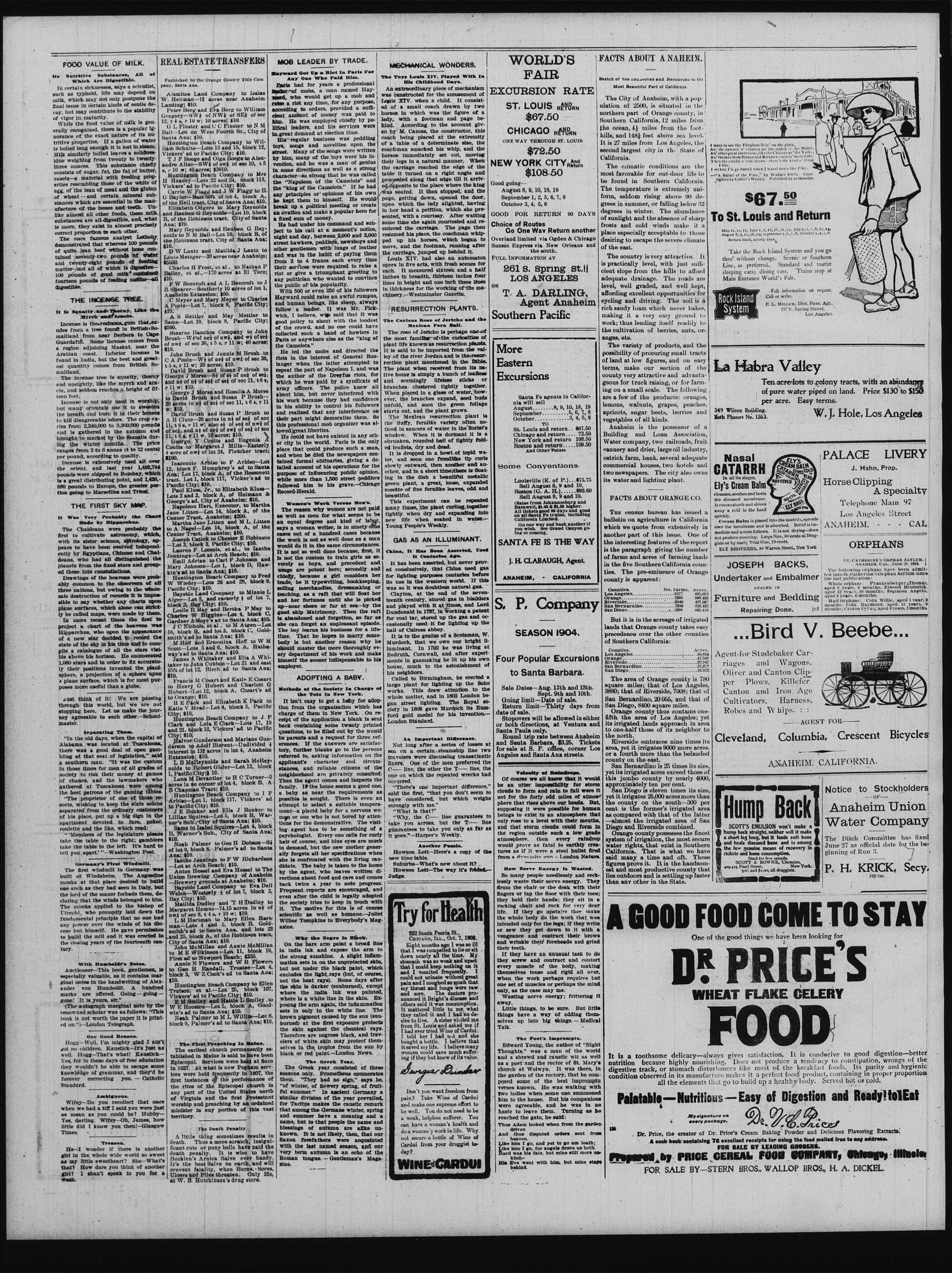
Searchable text
FOOD VALUE OF MILK.
Its Nutritive Substances, All of Which Are Digestible.
In certain sicknesses, says a scientist, such as typhoid, life may depend on milk, which may not only postpone the final issue in certain kinds of senile decay, but may contribute to the stability of vigor in maturity.
While the food value of milk is generally recognized, there is a popular ignorance of the exact nature of its nutritive properties. If a gallon of water is boiled long enough it is lost in steam. Milk similarly boiled leaves a solid residue weighing from twenty to twenty-three ounces. This substance chiefly consists of sugar, fat, the fat of butter, casein—a material with feeding properties resembling those of the white of egg, of the lean of meat and the gluten of wheat—and certain mineral substances which are essential in the manufacture of the bones and teeth. Unlike almost all other foods, these milk substances are all digestible, and, what is more, they exist in almost precisely correct proportion to each other.
The once famous analyst Letheby demonstrated that whereas 100 pounds of quite lean beef without bone contained seventy-two pounds of water and twenty-eight pounds of feeding matter—not all of which is digestive—100 pounds of good milk contained fourteen pounds of feeding matter—all digestible.
THE INCENSE TREE.
It Is Squatty and Thorny, Like the Myrrh and Acacia.
Incense is the restless gum that exudes from a tree found in British Somaliland from near Berbera to Cape Guardafah. Some incense comes from a region adjoining Maskat, near the Arabian coast. Inferior incense is found in India, but the best and greatest quantity comes from British Somaliland.
The incense tree is squatty, thorny and unslightly, like the myrrh and acacia, and seldom reaches a height of fifteen feet.
Incense is not only used in worship, but many orientals use it to sweeten the breath and burn it in their houses to kill disagreeable odors. The crop varies from 2,240,000 to 3,300,000 pounds and is gathered in the autumn and brought to market by the Somalis during the winter months. The price ranges from 2 to 6 annas (4 to 12 cents) per pound, according to quality.
Incense is extensively used all over the orient, and last year 1,493,744 pounds were shipped to Bombay, which furnished by the Orange County Title Company, Santa Ana.
Alamitos Land Company to Isaias W. Hellman—1½ acres near Anaheim Landing; $10.
Peter Berg and Eva Berg to William Gregory—SW† of NW† of SE† of sec 12, t 4 s, r 10 w; 10 acres; $10.
G L Floster and C C Finster to N M Ball—Lot on West Fourth St., City of Santa Ana; $10.
Huntington Beach Company to William Schulte—Lots 13 and 15, block 12, Vickers’ ad to Pacific City; $10.
T J F Boege and Olga Boege to Alexandra Allec—SW† of sw† of sec 10, t 5 s, r 10 w; 40 acres; $3910.
Huntington Beach Company to Mrs H Heaney—Lots 22 and 24, block 113, Vickers’ ad to Pacific City; $10.
Carrie W Flagg and J W Flagg to R G Baylor—Bast 50ft of lot 4, block A, of the Heil tract, City of Santa Ana; $10.
Elizabeth Ogders to Mary Reynolds and Reuben G Reynolds—Lot 10, block B, of the Robinson tract, City of Santa Ana; $10.
Mary Reynolds and Reuben G Reynolds to N M Ball—Lot 10, block B, of the Robinson tract, City of Santa Ana; $10.
D W Lentz and Matilda J Lentz to Louis Metzger—30 acres near Anaheim; $5500.
Charles H Frost, et al., to Nathan P Bailey, et al.,—170 acres at El Toro; $10.
F W Beecroft and A L Beecroft to J R Shearer—Southerly 10 acres of lot 1, Anaheim Extension; $50.
C Meyer and Mary Meyer to Charles A Poole—Lot 7, block 8, Pacific City; $10.
A S Mettler and May Mettler to Same—Lot 19, block 8, Pacific City; $500.
Stearns Ranchos Company to John Brush—W† of net† of nw†, and w† of set† of nw† of sec 36, t 5 s, r 11 w; 40 acres; $10.
John Brush and Jennie M Brush to C A Poole—W† of net† of nw† of sec 36, t 5 s, r 11 w; 20 acres; $10.
David Brush and Susan P Brush to George J Morse—S† of set† of set† of sec 11, t 6 s, r 11 w; $10.
George J Morse and Rosella A Morse to David Brush and Susan P Brush—20 acres in n† of set† of sec 11, t 6 s, r 11 w; $10.
David Brush and Susan P Brush to A H Clute—20 acres in n† of set† of sec 11, t 6 s, r 11 w; also set† of set† of nw† of set† and n† of set† of sw† of set† of sec 11, t 6 s, r 11 w; 10 acres; $10.
George Y Counts and Eugenia A Counts to Margaret J Millis—Easterly acre of nw† of lot 24, Fletcher tract; $100.
Inacencio Arbiso to F Arbiso—Lot 12, block F. Humphrey’s ad to Santa Ana; Lot 17, block A, of the Bessonett
MOB LEADER BY TRANSFERS
Mayward Got Up a Riot In Paris Any One Who Paid Him
Paris had for years a profiler-of mobs, a man named ward, who would get up a man raise a riot any time, for any person according to orders provided by client amount of money was paid him. He was employed chiefly with his services in great demand at election time.
His regular business was past toys, songs and novelties up street. Many of the songs were by him, many of the toys were invention, and he was a man or in some directions as well as a character—so strong that he was the “Napoleon of the Camelots.” If any principles or opinions of him kept them to himself. He break up a political meeting on an ovation and make a popular fixed sum of money.
He had under his command a ject to his call at a moment’s night and day, between 2,000 and street hawkers, peddlers, newsmen other gentlemen with lungs or was in the habit of paying from 2 to 4 francs each evening their services were required to riot or give a triumphant greet any politician who wanted to be the public of his popularity.
With 500 or even 250 of his Hayward could raise an awful human beings like sheep follow a leader. It was Mr wick, I believe, who said that good policy to shout with the crowd, and no one could collected such a band of horse Paris or anywhere else as the Camelots.”
He led the mobs and directed riots in the interest of Genie langer when the latter attempt repeat the part of Napoleon I. The author of the Dreyfus mish which he was paid by a symphony officer. The police had about him, but never interfere with his work because they had cried in his ability to control his mish realized that any interference their part might demoralize this professional mob organized lowed great liberties.
He could not have existed in her city in the world. Paris is place that could produce such and when he died the newspapers trained formal obituaries, giving a fixed account of his operation purpose of influencing public
The incense tree is squatty, thorny and unsightly, like the myrrh and acacia, and seldom reaches a height of fifteen feet.
Incense is not only used in worship, but many orientals use it to sweeten the breath and burn it in their houses to kill disagreeable odors. The crop varies from 2,240,000 to 3,300,000 pounds and is gathered in the autumn and brought to market by the Somalis during the winter months. The price ranges from 2 to 6 annas (4 to 12 cents) per pound, according to quality.
Incense is extensively used all over the orient, and last year 1,498,744 pounds were shipped to Bombay, which is a great distributing point, and 1,426,880 pounds to Europe, the greater portion going to Marseilles and Triest.
THE FIRST SKY MAP.
It Was Very Probably the Chart Made by Hipparchus.
The Chalcens were probably the first to cultivate astronomy, which, with its sister science, astrology, appears to have been evolved independently by Egyptians, Chinese and Chaldeans, who had all distinguished the planets from the fixed stars and grouped these into constellations.
Drawings of the heavens were probably common to the observers of all three nations, but owing to the wholesale destruction of records it is impossible to say whether any charts upon plane surfaces, which alone can strictly be called maps, were made by them.
In more recent times the first to project a chart of the heavens was Hipparchus, who upon the appearance of a new star decided to record the state of the sky in his time and to compile a catalogue of all the stars visible above his horizon. He enumerated 1,080 stars and in order to fix accurately their positions invented the planisphere, a projection of a sphere upon a plane surface, which is for most purposes more useful than a globe.
Just think of it! We are passing through this world, but we are not stopping here. Let us make the journey agreeable to each other—Schoolmaster.
Separating Them.
"In the old days, when the capital of Alabama was located at Tuscaloosa, there was a good deal of open gambling at that seat of legislation," said a southern man. "It was the custom in those times for men of all grades of society to risk their money at games of chance, and the lawmakers who gathered at Tuscaloosa were among the best patrons of the gaming tables.
"The proprietor of one of those resorts, wishing to keep the state solons separated from the ordinary customers of his place, put up a big sign in the apartment devoted to faro, poker, roulette and the like, which read:
"'Members of the legislature please take the table to the right; gamblers take the table to the left. It's hard to tell you apart.'"—Washington Post.
Germany's First Windmill.
The first windmill in Germany was built at Windsheim. The Augustine monks at that place desired to build one such as they had seen in Italy, but the lord of the manor forbade them, depriving the winds belonged to him.
George J Morse—Si of ni of nei of set;
and nj of ni of sei of set of sec 11, t 6 s,
r 11 w: $10.
George J Morse and Rosella A Morse to David Brush and Susan P Brush—20 acres in ni of sei of sec 11, t 6 s, r 11 w: $10.
David Brush and Susan P Brush to A H Clute—20 acres in ni of sei of sec 11, t 6 s, r 11 w; also si of sei of nwf of set si, and ni of nei of swf of set sec 11, t 6 s, r 11 w: 10 acres; $10.
George Y Coutts and Eugenia A Coutts to Margaret J Mills—Easterly acre of nwf of lot 24, Fletcher tract; $100.
Inacencio Arbiso to F Arbiso—Lot 12, block F. Humphrey's ad to Santa Ana; Lot 17, block A. of the Bessonett tract. Lot 1, block 117, Vicker's ad to Pacific City; $10.
Paul Kluss, Jr., to Elizabeth Kluss—Lots 2 and 3, block A, of Helmann & George's ad, City of Anaheim; $10.
Napoleon Hart, Executor, to Martha Jane Litten—Lot 14, block A, of the Center Tract, Anaheim; $200.
Martha Jane Litten and M L Litten to A Nagel—Lot 14, block A, of the Center Tract, Anaheim; $10.
Joseph Catlek to Chester E Robinson—Lot 3, block 3, Pacific City; $10.
Lauren F Loomis, et al., to Ianthe Jennings—Lot at Arch Beach; $10.
Emil Adrian to Carl F Johnson and Mary Johnson—Lot 1, block D, Hawkin's ad to Santa Ana; $10.
Huntington Beach Company to Fred W Wiedey—Lots 26 and 28, block 8. Pacific City; $10.
Bayside Land Company to Minnie L Alger—Lot 8, and easterly i of lot 7. block 3, Bay City; $10.
Leslie R May and Bertha P May to Charles W Higgins—Lot 4, block C Gardner & Moye's ad to Santa Ana; $10.
J C Nichols, et al., to M Atgen—Lot 16, block B, and lot 3, block C Goldsmith's ad to Santa Ana; $10.
M Hoff and Ernestina Hoff to W M Scott—Lots 5 and 6. block A, Hathaway's ad to Santa Ana; $10.
James A Whitaker and Ella A Whitaker to John Cubbon—Lot 21 and east 15ft of lot 12. Birch ad to Santa Ana; $10.
Francis M Cosart and Katie E Cosart to Henry G Hubert and Charlotte G Hubert—Lot 12, block A. Cosart's ad to Orange; $10.
H E Pack and Elizabeth K Pack to Katie V Mead—Lot 4, block 5. Pacific City; $10.
Huntington Beach Company to J F Clark and Lula E Clark—Lots 17, 19 and 21, block 12, Vickers' ad to Pacific City; $10.
Halvor Gunderson and Mariane Gunderson to Adolf Bierent—Undivided interest in 13t acres in lot 4. Anaheim Extension; $10.
L B McKeynolds and Sarah McReynolds to Robert Gisler—Lot 12, block 1. Pacific City;$10.
Lena M Devantier to H C Turner—5 acres in ne corner of lot 4. block B. A Chapman Tract; $10.
Huntington Beach Company to I F Arbiso—Lot 1, block 117. Vickers' ad to Pacific City; $10.
J E Bunker and Ella J Bunker to Lillian Squires—Lot 5, block B. Warner's Sub.-City of Santa Ana; $10.
Same to Isabel Squires—Lot 4, block B. Warner's Sub.-City of Santa Ana; $10.
Noah Palmer to Geo H Dobson—Si of lot 9. block 8. Palmer's ad to Santa Ana; $10.
Ianthe Jennings to F W Richardson—Lot at Arch Beach; $10.
Anton Hessel and Eva Hessel to The Union Brewing Company of Anaheim—Brewery grounds at Anaheim; $10.
Bayside Land Company to Eva Dell Welch—Westerly i of lot 7. block 3. Bay City; $10.
George J Morse and Rosella A Morse to David Brush and Susan P Brush—20 acres in ni of sei of sec 11. t 6 s,r 11 w: $10.
George J Morse and Rosella A Morse to David Brush and Susan P Brush—20 acres in ni of sei of sec 11. t 6 s,r 11 w: $10.
The reason why women are as well as men for what seem an equal degree and kind says a woman writer, is in nine cases out of a hundred cases the work is not as well done would do it in the same circuit. It is not so well done because is not the custom to train girls verely as boys, and prece usage are potent here; second chieftly because a girl consort be it typewriting book selling merchandise dress teaching. as a raft that will stand near shore or far at sea good ship Matrimony. They is abandoned and forgotten she can forget an unpleasant The boy learns his business at time. That he hopes to make body is but another reason should master the more thorough department of his work himself the sooner indispensable employer.
ADOPTING A BABY
Methods of the Society In Othe Tots In New York
It isn't easy to get a baby from the organization without them in New York ceipt of the application a blank back containing some twenty questions, to be filled out by be parents and a request for erences. If the answers are torture further blanks go to referred to, asking information applicant's character and stances, and reliable citizen neighborhood are privately woven. Then the agent comes and in family. If the home seems as a baby as near the require possible is sought. There is attempt to select a suitable ment—a placid baby for a new man or one who is not bored for the demonstrative ing agent has to be sometime psychologist. Every one calls hair of course, and blue eyes in demand, but the new motions forget all her specificity she is confronted with the lady didate. The baby is taken by the agent, who leaves w rections about food and care back twice a year to note Frequent reports are encountered even after the child is legal
"The proprietor of one or those sorts, wishing to keep the state solons separated from the ordinary customers of his place, put up a big sign in the apartment devoted to faro, poker, roulette and the like, which read:
"Members of the legislature please take the table to the right; gamblers take the table to the left. It's hard to tell you apart."—Washington Post.
Germany's First Windmill.
The first windmill in Germany was built at Windshelm. The Augustine monks at that place desired to build one such as they had seen in Italy, but the lord of the manor forbade them, declaring that the winds belonged to him. The monks applied to the bishop of Utrecht, who promptly laid down the fundamental principle that no one had any power over the winds of his diocese but himself. He gave permission to build the mill and it was erected in the closing years of the fourteenth century.
With Humboldt's Notes.
Auctioneer—This book, gentlemen, is especially valuable, as it contains marginal notes in the handwriting of Alexander von Humboldt. A hundred marks are offered. Going—going—gone! It is yours, sir."
(The autograph marginal note by the renowned scholar was as follows: "This book is not worth the paper it is printed on.")—London Telegraph.
One Good Reason.
Hogg—Well, I'm mighty glad I ain't got no children. Kaustick—It's just as well. Hogg—That's what! Kaustick—Yes, for in these days of free education they wouldn't be able to escape some knowledge of grammar, and they'd be forever correcting you. — Catholic Standard.
Ambiguous.
Wifey—Do you recollect that once when we had a tiff I said you were just as mean as you could be? Hubby—Yes, darling. Wifey—Oh, James, how little did I know you then!—Glasgow Times.
Treason.
He—I wonder if there is another girl in the whole wide world so sweet as my little sweetheart? She—What's that? How dare you think of another girl? I shan't speak to you for a week.
The First Preaching In Maine.
The earliest church permanently established in Maine is said to have been Episcopal. Services were held at Saco in 1637. At what is now Popham services were held frequently in 1607, the first instances of the performance of the rites of the Episcopal church in any part of the United States north of Virginia and the first Protestant worship and preaching by an ordained minister in any portion of this vast territory.
The Death Penalty
A little thing sometimes results in death. Thus a mere scratch, insignificant cuts or puny bolls have paid the death penalty. It is wise to have Bucklen's Arnica Salve ever handy. It's the best Salve on earth, and will prevent fatality, when Burns, Sores, Ulcers and Piles threaten. Only 25c, at W. B. Hutchinson's drug store.
Why the Negro Is Black
On the bare arm paint a black india ink and expose the strong sunshine. A slight mation sets in on the unprooted but not under the black pain excludes the light rays (but not the heat rays). Some of the skin is darker (sunburned where the india ink was where is a white line in the posing the arm again, the infuses in only in the white brown pigment caused by the burned) at the first exposure the skin against the chem Therefore are negroes black elers of white skin may possess in the tropics from the black or red paint.—London
The Greek Year.
The Greek year consisted seasons only. Prometheus eats them. "They had no sign," "of winter, of flowery spring ful summer." In ancient G similar division of the year for Tacitus makes the cause that among the Germans win and summer have a means name, but to that people their blessings of autumn are known. It is not likely, their Saxon forefathers were with the last named season very term autumn is an ecdromic Roman tongue.—Gentleman sine.
MOB LEADER BY TRADE.
Yeward Got Up a Riot In Paris For Any One Who Paid Him.
Paris had for years a professional order of mobs, a man named Hayward, who would get up a mob and take a riot any time, for any purpose, according to orders, provided a sufficient amount of money was paid to him. He was employed chiefly by political leaders, and his services were great demand at election time.
His regular business was peddling songs and novelties upon the street. Many of the songs were written for him, many of the toys were his invention, and he was a man of genius in some directions as well as a strong character—so strong that he was called the "Napoleon of the Camelots" and the "king of the Camelots." If he had any principles or opinions of his own he kept them to himself. He would break up a political meeting or create innovation and make a popular hero for fixed sum of money.
He had under his command and subject to his call at a moment's notice, night and day, between 2,000 and 3,000 street hawkers, peddlers, newsboys and other gentlemen with lungs of leather and was in the habit of paying them from 2 to 4 francs each every time their services were required to raise a lot or give a triumphant greeting to any politician who wanted to convince the public of his popularity.
With 500 or even 250 of his followers Bayward could raise an awful rumpus, and human beings, like sheep, always follow a leader. It was Mr. Pickwick, I believe, who said that it was good policy to shout with the loudest of the crowd, and no one could have collected such a band of howlers in Paris or anywhere else as the "king of the Camelots."
He led the mobs and directed the riots in the interest of General Boulanger when the latter attempted to repeat the part of Napoleon I. and was the author of the Dreyfus riots, for which he was paid by a syndicate of army officers. The police knew all about him, but never interfered with his work because they had confidence in his ability to control his followers and realized that any interference on their part might demoralize them. So this professional mob organizer was allowed great liberties.
He could not have existed in any other city in the world. Paris is the only place that could produce such a man, and when he died the newspapers contained formal obituaries, giving a detailed account of his operations for the purpose of influencing public opinion,
MECHANICAL WONDERS.
The Toys Louis XIV. Played With In His Childhood Days.
An extraordinary piece of mechanism was constructed for the amusement of Louis XIV. when a child. It consisted of a small coach drawn by two horses in which was the figure of a lady, with a footman and page behind. According to the account given by M. Camus, the constructor, this coach being placed at the extremity of a table of a determinate size, the coachman smacked his whip, and the horses immediately set out, moving their legs in a natural manner. When the carriage reached the edge of the table it turned on a right angle and proceeded along that edge till it arrived opposite to the place where the king was seated. It then stopped, and the page, getting down, opened the door, upon which the lady alighted, having in her hand a petition, which she presented, with a courtesy. After waiting some time she again courtesied and entered the carriage. The page then resumed his place, the coachman whipped up his horses, which began to move, and the footman, running after the carriage, jumped up behind it.
Louis XIV. had also an automaton opera in five acts, with fresh scenes for each. It measured sixteen and a half inches in breadth, thirteen inches four lines in height and one inch three lines in thickness for the working of the machinery.—Westminster Gazette.
RESURRECTION PLANTS.
The Curious Rose of Jericho and the Mexican Fern Ball.
The rose of Jericho is perhaps one of the most familiar of the curiosities of plant life known as resurrection plants. It is said to be imported from the valley of the river Jordan and is the resurrection plant mentioned in the Bible. The plant when received from its native home is simply a bunch of leafless and seemingly lifeless sticks or branches clustered tightly together. When placed in a glass of water, however, the branches expand, seed buds unfold, and soon the green foliage starts out, and the plant grows.
The Mexican resurrection plant is the fluffy, fernlike variety often noticed in saucers of water in the horist's window. When it is dormant it is a shrunken, rounded ball of tightly folded leaflets, dry and dead.
It is dropped in a bowl of tepid water, and soon one frondlike tip curls slowly outward, then another and another, in a short time; there is floatation.
WORLD'S FAIR
EXCURSION RATE
ST. LOUIS AND RETURN
$67.50
CHICAGO AND RETURN
ONE WAY THROUGH ST. LOUIS
$72.50
NEW YORK CITY And Return
$108.50
Good going--
August 8, 9, 10, 18, 19
September 1, 2, 5, 6, 7, 8
October 3, 4, 5, 6
GOOD FOR RETURN 90 DAYS
Choice of Routes
Go One Wav Return another
Overland limited via Ogden & Chicago
Sunset Express via New Orleans and the south.
FULL INFORMATION AT
261 S. Spring St.||
LOS ANGELES
OR
T. A. DARLING,
Agent Anaheim
Southern Pacific
More Eastern Excursions
Santa Fe agents in California will sell
August...8, 9, 10, 18, 19
September...5, 6, 7, 8
October...3, 4, 5, 6 TO
St. Louis and return... $67.50
Chicago and return... 72.50
New York and return 108.50
Boston and return...109.50
And Other Points
Some Conventions.
The author of the Dreyfus riots, for which he was paid by a syndicate of army officers. The police knew all about him, but never interfered with his work because they had confidence in his ability to control his followers and realized that any interference on their part might demoralize them. So this professional mob organizer was allowed great liberties.
He could not have existed in any other city in the world. Paris is the only place that could produce such a man, and when he died the newspapers contained formal obituaries, giving a detailed account of his operations for the purpose of influencing public opinion, while more than 1,500 street peddlers followed him to his grave.—Chicago Record-Herald.
Women's Work Versus Men's.
The reason why women are not paid as well as men for what seems to be an equal degree and kind of labor, says a woman writer, is in ninety-nine cases out of a hundred cases because the work is not as well done as a man would do it in the same circumstances. It is not so well done because, first, it is not the custom to train girls as severely as boys, and precedent and message are potent here; secondly and chiefly, because a girl considers her teacher, be it typewriting, bookkeeping, selling merchandise, dressmaking or teaching, as a raft that will float her and her fortunes until she is picked up near shore or far at sea—by the good ship Matrimony. Then the raft is abandoned and forgotten, so far as the can forget an unpleasant episode. The boy learns his business for a lifetime. That he hopes to marry somebody is but another reason why he should master the more thoroughly every department of his work and make himself the sooner indispensable to his employer.
ADOPTING A BABY.
Methods of the Society In Charge of the Tota in New York.
It isn't easy to get a baby for adoption from the organization which has charge of them in New York. On receipt of the application a blank is sent back containing some twenty printed questions, to be filled out by the would-be parents and a request for three references. If the answers are satisfactory, further blanks go to the persons referred to, asking information on the applicant's character and circumstances, and reliable citizens of the neighborhood are privately consulted. Then the agent comes and inspects the family. 19 the home seems a good one, a baby as near the requirements as possible is sought. There is even an attempt to select a suitable temperament—a placid baby for a nervous woman or one who is not bored by attentions for the demonstrative. The visiting agent has to be something of a psychologist. Every one calls for curly hair of course, and blue eyes are much in demand, but the new mother generally forgets all her specifications when she is confronted with the living candidate. The baby is taken to the home by the agent, who leaves written directions about food and care and comes back twice a year to note progress. Frequent reports are encouraged, and even after the child is legally adopted live home is simply a bunch of leavers and seemingly lifeless sticks or branches clustered tightly together. When placed in a glass of water, however, the branches expand, seed buds unfold, and soon the green foliage starts out, and the plant grows.
The Mexican resurrection plant is the fluffy, fernlike variety often noticed in saucers of water in the florist's window. When it is dormant it is a shrunken, rounded ball of tightly folded leaflets, dry and dead.
It is dropped in a bowl of tepid water, and soon one frondlike tip curls slowly outward, then another and another, and in a short time there is floating in the dish a beautiful metallic green plant, a great, loose, expanded rosette of fine fernlike leaves, odd and beautiful.
This experiment can be repeated many times, the plant curling together tightly when dry and expanding into new life when soaked in water—Young People's Weekly.
GAS AS AN ILLUMINANT.
China, It Has Been Asserted, Used It Centuries Age.
It has been asserted, but never proved conclusively, that China used gas for lighting purposes centuries before its use in the western world. If this was so it was doubtless natural gas.
Clayton, at the end of the seventeenth century, stored gas in bladders and played with it at times, and Lord Dundonald in 1787, in working a patent for coal tar, stored up the gas and occasionally used it for lighting up the hall of Culross abbey.
It is to the genius of a Scotsman, W. Murdoch, that we owe our bright illuminant. In 1792 he was living at Redruth, Cornwall, and after experiments in gasmaking he lit up his own house, much to the astonishment of his neighbors.
Called to Birmingham, he erected a large plant for lighting up the Soho works. This drew attention to the whole matter, and in 1803 London began street lighting. The Royal society in 1808 gave Murdoch its Rumford gold medal for his invention—London Standard.
An Important Difference.
Not long after a series of losses at sea on a certain steamship line two travelers were discussing transatlantic liners. One of the men preferred the C—line, the other the T—line, the one on which the repeated wrecks had occurred.
"There's one important difference," said the first, "that you don't seem to have considered, but which weighs strongly with me."
"What is that?"
"Why, the C—line guarantees to take you across, but the T—line guarantees to take you only as far as it goes."—Harper's Weekly.
Another Puzzle.
Howson Lott—Here's a copy of the new time table.
Suburbs—What's new about it?
Howson Lott—The way it's folded—Judge.
Excursions
Santa Fe agents in California will sell August...8,9,10,18,19 September...5,6,7,8 October...3,4,5,6 TO St. Louis and return...$67.50 Chicago and return...72.50 New York and return 108.50 Boston and return...109.50 And Other Points
Some Conventions.
Louisville (K. of P.)...$75.75 Sell August 8, 9 and 10. Boston (G. A. R.)...$22.60 Sell August 8, 9 and 10.
(Rates from Johannesburg and Barewell $14.55-$15.50 higher. All tickets good 90 days and good on all Santa Fe trains, including California Limited.
Go one way and back another if you wish. See Grand Canyon going or coming.
SANTA FE IS THE WAY
J.H. CLABAUGH, Agent.
ANAHEIM,-CALIFORNIA
S.P. Company
SEASON 1904.
Four Popular Excursions to Santa Barbara.
Sale Dates—Aug. 12th and 13th.Sept. 9th and 10th.
Going limit—Date of sale.
Return limit—Thirty days from date of sale.
Stopovers will be allowed in either or both directions, at Ventura and Santa Paula only.
Round trip rate between Anaheim and Santa Barbara,$3.25.Tickets for sale at S.P. office,corner Los Angeles and Santa Ana streets.
Velocity of Raindrops.
Of course we all know that it would be an utter impossibility for storm clouds to form and rain to fall were it not for the forty odd miles of atmosphere that rises above our heads. But supposing it were possible for human beings to exist in an atmosphere that only rose to a level with their mouths,and that storm clouds could form in the region outside such a low grade atmosphere. then every raindrop would prove as fatal to earthly creatures as if it were a steel bullet fired from a dynamite gun—London Nature.
How Nerve Energy Is Wasted.
So many people needlessly and recklessly waste their nerve energy. They drum the chair or the desk with their fingers or tap the floor with their toes; they hold their hands; they sit in a county very attractive and geous for truck raising; they are on a small scale.
There are a few of the producer lemons, walnuts, grape apricots,sugar beets vegetables of all kinds.
Anaheim is the posse Building and Loan Water company,two rail cannery and drier large ostrich farm,bank seven commercial houses,two two newspapers.The city its water and lighting plains.
FACTS ABOUT ORANGE
The census bureau hires bulletin on agriculture in which we quote from another part of this issue,the interesting features of farms and acres of farmland in the five Southern Californias.The pre-eminence county is apparent:
Counties.No.
Los AngelesOrange
RiversideSan BernardinoSan Diego
But it is in the acreage lands that Orange county precedence over the other of Southern California:
Counties.Los AngelesOrangeRiversideSan BernardinoSan Diego
The area of Orange county square miles; that of 3880; that of Riverside; San Bernardino; 20 055; San Diego; 8400 square miles; that fifth the area of Los Angeles its irrigated lands approach one-half those of its north.
Riverside embraces nearly area,yet it irrigates 9000 or a fourth more than one county on the east.
San Bernardino is 25 yet its irrigated acres exceed this jumbo county by approximately ten per cent.San Diego is eleven yet it irrigates 25,000 acresthe county on the southcent is the former's interest as compared with that almost the irrigated Diego and Riverside countiesOrange county possesses system of irrigation,the water rights; that existsCaliforniaThat iswaisaid many a time andfigures prove it.It is tastest and most productivelies outdoors and is settledthan any other in the South
Try for Health
222 South Peoria St., Chicago, Ill., Oct. 7, 1902.
Eight months ago I was so ill that I was compelled to lie or sit down nearly all the time. My stomach was so weak and upset that I could keep nothing on it and I vomited frequently. I could not urinate without great pain and I coughed so much that my throat and lungs were raw and sore. The doctors pronounced it Bright's disease and others said it was consumption. It mattered little to me what they called it and I had no desire to live. A sister visited me from St. Louis and asked me if I had ever tried Wine of Cardui. I told her I had not and she bought a bottle. I believe that it saved my life. I believe many women could save much suffering if they but knew of its value.
Sunga Dunker
Don't you want freedom from pain? Take Wine of Cardui and make one supreme effort to be well. You do not need to be a weak, helpless sufferer. You can have a woman's health and do a woman's work in life. Why not secure a bottle of Wine of Cardui from your druggist today?
WINE OF GARDUI
Thus Adam looked when from the garden driven
And thus disputed orders sent from heaven.
Like him I go, and yet to go am loath;
Like him I go, for angels drove us both.
Hard was his fate, but mine still more unkind.
His Eve went with him, but mine stays behind.
FACTS ABOUT ANAHEIM.
Sketch of the industries and Resources of the Most Beautiful Part of California.
The City of Anaheim, with a population of 2500, is situated in the northern part of Orange county, in Southern California, 12 miles from the ocean, 4½ miles from the foothills, and 148½ feet above sea level. It is 27 miles from Los Angeles, the second largest city in the State of California.
The climatic conditions are the most favorable for out-door life to be found in Southern California. The temperature is extremely uniform, seldom rising above 90 degrees in summer, or falling below 32 degrees in winter. The abundance of sunlight and the absence of sharp frosts and cold winds make it a place especially acceptable to those desiring to escape the severe climate of the east.
The country is very attractive. It is practically level, with just sufficient slope from the hills to afford adequate drainage. The roads are level, well graded, and well kept, affording excellent opportunities for cycling and driving. The soil is a rich sandy loam which never bakes, making it a very easy ground to work; thus lending itself readily to the cultivation of berries, nuts, oranges, etc.
The variety of products, and the possibility of procuring small tracts of land at low figures, and on easy terms, make our section of the county very attractive and advantageous for truck raising, or for farming on a small scale. The following are a few of the products: oranges, lemons, waluuts, grapes, peaches, apricots, sugar beets, berries and vegetables of all kinds.
Anaheim is the possessor of a Building and Loan Association, Water company, two railroads, fruit cannery and drier, large oil industry, ostrich farm, bank, several adequate commercial houses, two hotels and two newspapers. The city also owns
$67.50
To St. Louis and Return
May 11, 12, 17, June 1, 2, 15, 16, 22, 25, July 1, 2, 7, 8, 13, 14;
August 8, 9, 10, 18, 19 September 5, 6, 7, 8 October 1, 4, 5, 0.
Return limit ninety days.
Take the Rock Island System and you go thro' without change. Scenic or Southern Line, as preferred. Standard and tourist sleeping cars; dining cars. Trains stop at Main Entrance World's Fair.
Rock Island System
F. L. MILLER, Dist. Pass. Agt.
237 S. Spring Street,
Los Angeles.
La Habra Valley
Ten acres lots to colony tracts, with an abundance of pure water piped on land. Price $130 to $150 per acre. Easy terms.
349 Wilcox Building.
Both Phones No. 1363.
W. J. Hole, Los Angeles
Nasal CATARRH
PALACE LIVERY
J. Hahn, Prop.
FACTS ABOUT ORANGE CO.
The census bureau has issued a bulletin on agriculture in California which we quote from extensively in another part of this issue. One of the interesting features of the report is the paragraph giving the number of farms and acres of farming lands in the five Southern California counties. The pre-eminence of Orange county is apparent:
Counties. No. farms. Acres.
Los Angeles .6577 895,063
Orange .2388 569,436
Riverside .2340 427,067
San Bernardino .2350 219,182
San Diego .2698 809,419
But it is in the acreage of irrigated lands that Orange county takes easy precedence over the other counties of Southern California:
Counties. Acres.
Los Angeles .85,044
Orange .41,549
Riverside .32,947
San Bernardino .37,877
San Diego .10,022
The area of Orange county is 780 square miles; that of Los Angeles, 3880; that of Riverside, 7008; that of San Bernardino, 20,055, and that of San Diego, 8400 square miles.
Orange county thus contains one-fifth the area of Los Angeles; yet its irrigated lands approach in area to one-half those of its neighbor to the north.
Riverside embraces nine times its area, yet it irrigates 9,000 more acres or a fourth more than the belauded county on the east.
San Bernardino is 25 times its size, yet its irrigated acres exceed those of this jumbo county by nearly 4,000, approximately ten per cent.
San Diego is eleven times its size, yet it irrigates 25,000 acres more than the county on the south—300 per cent is the former's irrigated area as compared with that of the latter—almost the irrigated area of San Diego and Riverside combined.
Orange county possesses the finest system of irrigation, the most secure water rights, that exist in Southern California. That is what we have said many a time and oft. These figures prove it. It is the handsomest and most productive county that lies outdoors and is settling up faster than any other in the State.
Nasal CATARRH
In all its stages,
Ely's Cream Balm cleanses, soothes and heals the diseased membrane.
It cures catarrh and drives away a cold in the head quickly.
Cream Balm is placed into the nostrils, spreads over the membrane and is absorbed. Relief is immediate and a cure follows. It is not drying—does not produce sneezing. Large Size, 60 cents at Drug-gists or by mail; Trial Size, 10 cents.
ELY BROTHERS, 56 Warren Street, New York
JOSEPH BACKS,
Undertaker and Embalmer
DEALER IN Furniture and Bedding
Repairing Done.
...Bird V. Beebe...
Agent for Studebaker Carriages and Wagons,
Oliver and Canton Clipper Plows, Killefer Canton and Iron Age Cultivators, Harness,
Robes and Whips. :
AGENT FOR
Cleveland, Columbia, Crescent Bicycles
ANAHEIM, CALIFORNIA.
Hump Back
SCOTT'S EMULSION won't make a hump back straight, neither will it make a short leg long, but it feeds soft bone and heals diseased bone and is among the few genuine means of recovery in rickets and bone consumption.
Seed for free sample.
SCOTT & BOWNE, Chemists,
409-415 Pearl Street,
New York,
50ct. and $1.00; all druggists.
Notice to Stockholders
OF Anaheim Union Water Company
The Ditch Committee has fixed June 27 as official date for the beginning of Run 3.
P. H. KRICK, Secy.
A GOOD FOOD COME TO STAY
One of the good things we have been looking for
DR. PRICE'S
WHEAT FLAKE CELERY
FOOD
It is a toothsome delicacy—always gives satisfaction. It is conducive to good digestion—better nutrition because highly nourishing. Does not produce a tendency to constipation, wrongs of the digestive track, or stomach disturbances like most of the breakfast foods. Its purity and hygienic condition observed in its manufacture makes it a perfect food product, containing in proper proportion all the elements that go to build up a healthy body. Served hot or cold.
Palatable—Nutritious—Easy of Digestion and Ready to Eat
My signature on every package.
Dr. Price, the creator of Dr. Price's Cream Baking Powder and Delicious Flavoring Extracts.
A cook book containing 76 excellent receipts for using the food mailed free to any address.
FOR SALE BY LEADING GROUPS.
Prepared by PRICE GEREAL FOOD COMPANY, Chicago, Illinois
FOR SALE BY—STERN BROS., WALLOP BROS., H. A. DICKEL.