anaheim-gazette 1904-08-04
Scanned page
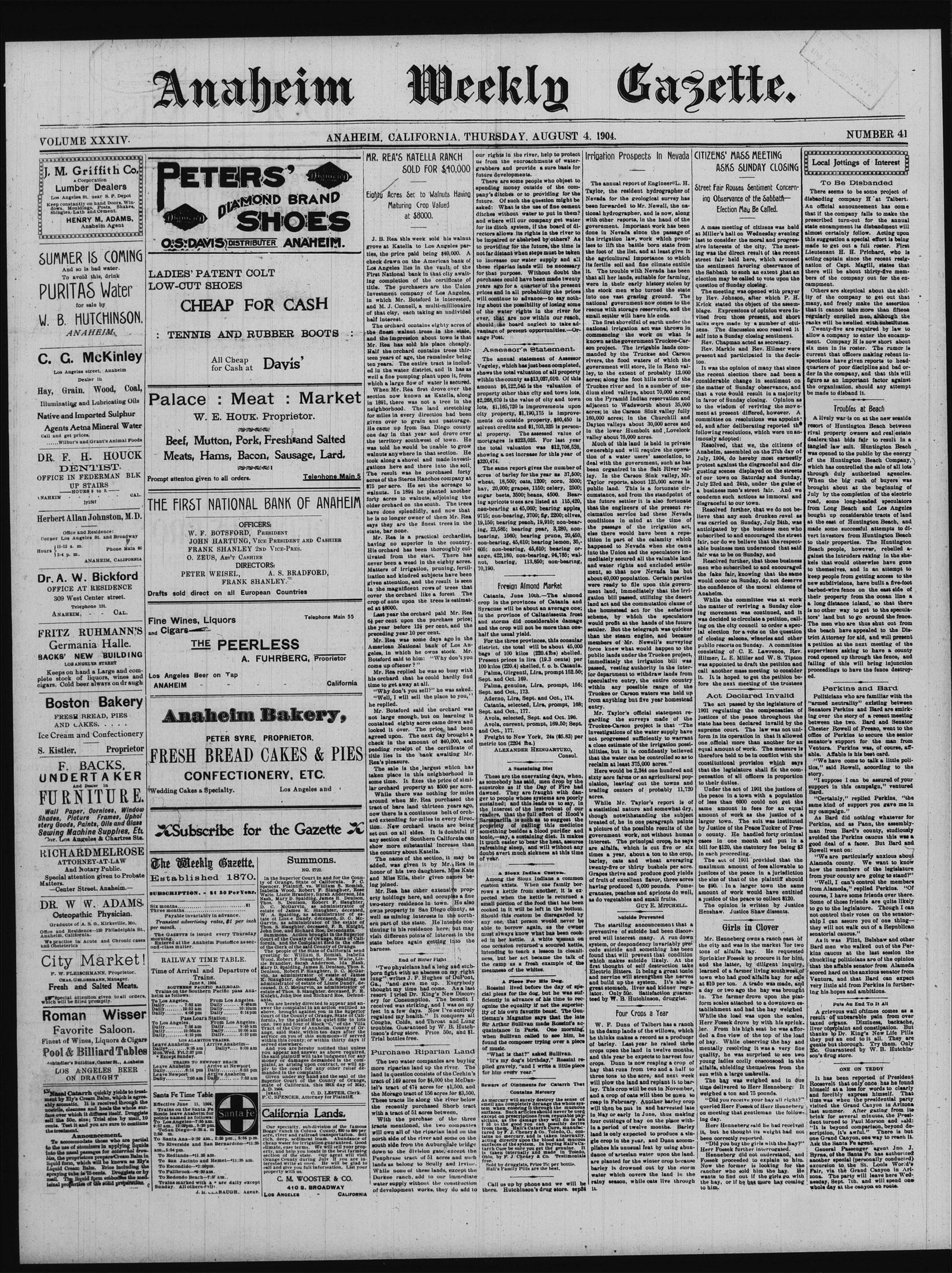
Searchable text
Anaheim
VOLUME XXXIV.
J. M. Griffith Co.
A Corporation
Lumber Dealers
Los Angeles St. near S. P. Depot
Keep constantly on hand Doors, Windows, Mouldings, Posts, Shakes, Shingles, Lath and Cement.
HENRY M. ADAMS,
Anaheim Agent
SUMMER IS COMING
And so is bad water.
To avoid this, drink PURITAS Water
for sale by W. B. HUTCHINSON,
ANAHEIM
C. G. McKinley
Los Angeles street, Anaheim
Dealer in Hay, Grain, Wood, Coal, Illuminating and Lubricating Oils
Native and Imported Sulphur Agents Aetna Mineral Water Call and get prices.
...Wilbur's and Grant's Animal Foods
DR. F. H. HOUCK
DENTIST.
PETERS'
DIAMOND BRAND SHOES
O.S.DAVIS DISTRIBUTOR ANAHEIM.
LADIES' PATENT COLT
LOW-CUT SHOES
CHEAP FOR CASH
: TENNIS AND RUBBER BOOTS:
All Cheap for Cash at Davis'
Palace : Meat : Market
W. E. HOUK, Proprietor.
Beef, Mutton, Pork, Fresh and Salted Meats, Hams, Bacon, Sausage, Lard,
Dealer in Hay, Grain, Wood, Coal, Illuminating and Lubricating Oils Native and Imported Sulphur Agents Aetna Mineral Water Call and get prices. Wilbur's and Grant's Animal Foods
DR. F. H. HOUCK DENTIST OFFICE IN FEDERMAN BLK UP STAIRS HOURS 9 to 5 ANAHEIM CAL. Jy1stt
Herbert Allan Johnston, M.D. Office and Residence: Corner Los Angeles St. and Broadway Hours 11-12 a.m. Phone Main 86 2-4 p.m. ANAHEIM, CALIFORNIA
Dr. A. W. Bickford OFFICE AT RESIDENCE 309 West Center street. Telephone 101. ANAHEIM, CAL.
FRITZ RUHMANN'S Germania Halle. BACKS' NEW BUILDING LOS ANGELES STREET Keeps on hand a Large and complete stock of liquors, wines and cigars. Cold beer always on draught
Boston Bakery FRESH BREAD, PIES AND CAKES. Ice Cream and Confectionery S. Kistler, Proprietor
F. BACKS, UNDERTAKER And Dealer in FURNITURE. Wall Paper, Cornices, Window Shades, Picture Frames, Upholstery Goods, Paints, Oils and Glass Sewing Machine Supplies, Etc. Dor. Los Angeles & Chartres Sta.
RICHARDMELROSE ATTORNEY-AT-LAW And Notary Public Special attention given to Probate Matters. Center Street, Anaheim.
Palace : Meat : Market W. E. HOUK, Proprietor.
Beef, Mutton, Pork, Fresh and Salted Meats, Hams, Bacon, Sausage, Lard.
Prompt attenton given to all orders. Telenhone Main
THE FIRST NATIONAL BANK OF ANAHEIM OFFICERS: W. F. BOTSFORD, PRESIDENT JOHN HARTUNG, VICE PRESIDENT AND CASHIER FRANK SHANLEY 2ND VICE-PRES. O. ZEUS, Ass't Cashier DIRECTORS: PETER WEISEL, A. S. BRADFORD, FRANK SHANLEY.
Drafts sold direct on all European Countries
Fine Wines, Liquors and Cigars THE PEERLESS A. FUHRBERG, Proprietor Los Angeles Beer on Tap ANAHEIM California
Anaheim Bakery, PETER SYRE, PROPRIETOR FRESH BREAD CAKES & PIECONFECTIONERY, ETC. Wedding Cakes a Specialty. Los Angeles and Subscribe for the Gazette
The Weekly Gazette Established 1870.
SUBSCRIPTION - 81 50 Per Year.
Summons NO. 2722.
In the Superior Court in and for the City of Orange, State of California. F Spencer, Plaintiff vs. William S. Romano Isabella Wood, Robert F. Slaughter, R Waite, Lizzie Brandley, Sarah Anderson, Nash Mary D. Spalding, James R. Den
RICHARDMELROSE
ATTORNEY-AT-LAW
And Notary Public.
Special attention given to Probate Matters.
—Center Street, Anaheim.
DR. W. W. ADAMS,
Osteopathic Physician.
Graduate of A. S. O., Kirksville, Mo.
Office and Residence—130 Philadelphia St., Anaheim, California.
We practice in Acute and Chronic cases and Obstetrics
City Market!
F. W. FLEISCHMANN, Proprietor,
CHAS. GEILDERMANN, Manager.
Fresh and Salted Meats.
Special attention given to all orders, which will be filled promptly.
Roman Wisser
Favorite Saloon.
Finest of Wines, Liquors & Cigare
Pool & Billiard Tables
Ashindler's Building, Center St., Anaheim
LOS ANGELES BEER ON DRAUGHT
Nasal Catarrh quickly yields to treatment by Ely's Cream Balm, which is agreeably aromatic. It is received through the nostrils, cleanses and heals the whole surface over which it diffuses itself. Druggists sell the 50c. size; Trial size by mail, 10 cents. Test it and you are sure to continue the treatment.
Announcement.
To accommodate those who are partial to the use of stomizers in applying liquids into the nasal passages for catarrhal troubles, the proprietors prepare Cream Balm in liquid form, which will be known as Ely's Liquid Cream Balm. Brice including the spraying tube is 75 cents. Druggists or by mail. The liquid form embodies the medicinal properties of the solid preparation.
The Weekly Gazette.
Established 1870.
SUBSCRIPTION. - 91 50 Per Year.
Six months...81
Three months... Payable invariably in advance.
Transient advertising rates, $1 per inch per month.
The GAZETTE is issued every Thursday morning.
Entered at the Anaheim Postoffice as second-class matter.
RAILWAY TIME TABLE.
Time of Arrival and Departure of Trains.
June 8, 1904.
SOUTHERN PACIFIC RAILROAD.
Trains on the Southern Pacific pass Anaheim as follows:
To Los Angeles.
Daily...7:52 am
Daily...10:52 am
Daily...4:06 pm
Daily...6:14 pm
From Los Angeles.
Daily...9:49 am
Daily...10:10am
Daily...6:14 pm
Pass Loara Station:
To Los Angeles.
Daily...7:56 am
Daily...10:56am
Daily...4:10 pm
Daily...6:10pm
From Los Angeles.
Daily...9:45 am
Daily...10:06am
Daily...6:10pm
Los ALAMITOS TRAINS.
Leave Anaheim...
Daily*...9:35 am
Mon.Wed.Fri.2:27 pm
* Except Sunday.
Arrive Anaheim...
Daily*...8:00 am
Arrive Newport
Daily...6:53 pm
Arrive Anaheim
Daily...7:05 am
Santa Fe Time Table
Effective June 11, 1904.
Trains on the Santa Fe Route leave Anaheim for points named as follows:
To Los Angeles—7:55 am
9:57 am..12:00pm..5:20 pm.
To San Diego—9:20 a.m..m 2:50 m.
To Santa Ana—9:20 am..2:50 pm..5:54 p.m.
To Riverside and San Bernardino—11:35 am..5:54 p.m.
To Redlands—11.35 am..
To San Jacinto and Hemet—11:35 am..
To Escondido—2:50pm..
To Fallbrook—9:20 am..
To Redondo Beach—7:56 am..
Trains marked with a * are daily except Sunday. All others daily.
Summons.
NO. 2722.
In the Superior Court in and for the County of Orange, State of California.
Spencer, Plaintiff, vs. William S. Romell Isabella Wood, Robert F. Slaughter, Pete Waite, Lizzie Brandley, Sarah Anderson, Nash, Mary D. Spalding, James R. Denil Thos. S. Denison, Robert F. Slaughter, D.C. McGarvin, as administrator of James K. Slaughter, deceased W.A. Spalding, as administrator of state of Lizzie D. Dandy, deceased D.C. Carvin, as administrator of the estate of Lizzie D. Dandy, deceased F.R.Knoll John Doe, and Richard Roe, Deendants.
Summons. Action brought in the Superior Court of the County of Orange, State of California, and the Complaint filed in the office of the Clerk of the said County of Orange.
The people of the State of California are greeting to: William S. Romell Isabella Wood, Robert F. Slaughter, Rose Waite, Zie Brandley, Sarah Anderson, Ida N.Mary D. Spalding, James R. Denison, Robert F. Slaughter, D.C. McGarvin, as administrator of state of Jamaica, as administrator of state of Lizzie D. Dandy, deceased D.C. Carvin, as administrator of the estate of Lizzie D. Dandy, deceased F.R.Knoll John Doe and Richard Roe, Deendants.
You are hereby directed to appear and answer the complaint in an action entitled above, brought against you in the Superior Court of the County of Orange, State of California, by the plaintiff to quiet title to one, two and four Block "C," of the V tract of the City of Anaheim, County of Orange, said State, within ten days after service on you of this summons-if served within county; or within thirty days served elsewhere.
And you are hereby notified that you appear and answer as above required the said plaintiff will take judgment for money or damages demanded in the case plaint, as arising upon contract, or will apply to the court for any other relief mandated in the complaint.
Given under my hand and the seal of Superior Court of the County of Orange State of California, this 28th day of A.D. 1904.
[REAL]
C.D. LESTER, Clever F.C. SPENCER, Attorney for Plaintiff.
California Lands,
Our specialty, sub-division of the far Boggs' ranch in Colusa County, $30 to $90 acre, river and railroad transportation. Rich deep, sediment loam. Abundant cheap water for irrigation guaranteed. Climate easy terms. We will sell your property and help you locate in the best far section of the state. Our agent will Orange County during July if you are interested write at once. He will be give call and give you full information. List property with us.
C.M.WOOSTER & CO.
410 S.BROADWAY
LOS ANGELES
CALIFORNIA
ANAHEIM, CALIFORNIA, THURSDAY, AUGUST 4, 1904.
MR. REA'S KATELLA RANCH
SOLD FOR $40,000
Eighty Acres Set to Walnuts Having Maturing Crop Valued at $8000.
J. B. Rea this week sold his walnut grove at Katella to Los Angeles parties, the price paid being $40,000. A check drawn on the American bank of Los Angeles lies in the vault of the First National bank in that city awaiting completion of the certificate of title. The purchasers are the Union Investment company of Los Angeles, in which Mr. Botsford is interested, and M. J. Connell, a multi-millionaire of that city, each taking an undivided half interest.
The orchard contains eighty acres of the finest walnut trees in the state, and the impression about town is that Mr. Rea has sold his place cheaply. Half the orchard contains trees thirteen years of age, the remainder being ten years. The entire tract is included in the water district, and it has as well a fine pumping plant upon it, from which a large flow of water is secured.
When Mr. Rea first drove over the section now known as Katella, along in 1891, there was not a tree in the neighborhood. The land stretching for miles in every direction had been given over to grain and pasturage. He came up from San Diego county one day in that year and drove over the territory southwest of town. He was told he would be unable to grow walnuts anywhere in that section. He took along a shovel and made investigations here and there into the soil. The result was he purchased forty our rights in the river, help to protect us from the encroachments of water-grabbers and provide a sure basis for future developments.
There are some people who object to spending money outside of the company's ditches or to providing for the future. Of such the question might be asked: What is the use of fine cement ditches without water to put in them? and where will our company get water for its ditch system, if the board of directors allows its rights in the river to be impaired or absorbed by others? As to providing for the future, the time is not far distant when steps must be taken to increase our water supply and all these riparian lands will be necessary for that purpose. Without doubt the purchases could have been made twenty years ago for a quarter of the present prices and in all probability the prices will continue to advance—to say nothing about the possibility of losing some of the water rights in the river for ever, that are now within our reach, should the board neglect to take advantage of present opportunities.—Orange Post.
Assessor's Statement.
The annual statement of Assessor Vegeley, which has just been completed, shows the total valuation of all property within the county as $13,027,010. Of this amount $6,122,545 is the valuation of property other than city and town lots, $2,268,670 is the value of city and town lots, $1,165,720 is improvements upon city property, $1,190,175 is improvements on outside property, $60,450 is solvent credits and $1,703,325 is personal property. The assessed value of mortgages is $223,025. For last year the total valuation was $12,706,526, showing a net increase for this year of $320,474.
The same report gives the number of barrels for the year as 37,500.
Irrigation Prospects In New York
The annual report of Engineer Taylor, the resident hydrographer Nevada for the geological survey been forwarded to Mr. Newell, national hydrographer, and is now with other reports, in the hand government. Important work has done in Nevada since the passage of the irrigation law, work which uses to lift the battle born state the foot of the list, and at least to the agricultural importance to its fertile soil and fine climate it. The trouble with Nevada has that all her lands, suitable for far away in their early history store the stock men who turned them into one vast grazing ground. national government now comes rescue with storage reservoirs; a small settler will have his ends.
The first shevelful of earth unnatural irrigation act was three commencing the work on what known as the government Truckee son project. The irrigable land mandered by the Truckee and O'River, the flood waters of which government will store, lie in Reseley, to the extent of probably acres; along the foot hills north Truckee river and in a number of dium sized valleys, about 70,000 on the Pyramid Indian reservations adjacent to Wadsworth about acres; in the Carson Sink valley 160,000 acres; in the Churchill Dayton valleys about 30,000 acres in the lower Humbolt and Lo Valley about 75,000 acres.
Much of this land is held in ownership and will require the creation of a water users' association deal with the government, such been organized in the Salt River. In the Carson Sink valley
Market
Prietor.
Fresh and Salted
Sausage, Lard,
Telenhone Main 5
BANK OF ANAHEIM
ENT
RESIDENT AND CASHIER
PE-PRES.
S. BRADFORD,
BY.
Countries
Telephone Main 55
SSS
RBERG, Proprietor
California
bakery,
PRIETOR.
KES & PIES
RY. ETC.
Los Angeles and
the Gazette
Summons.
NO. 2722.
Superior Court in and for the County
range, State of California.
P. D. Prestiff, w. William S. Romish,
Wood, Robert F. Shaugher, Rose
izzle Brandley, Sarah Anderson, Ida
The name of the section, it may be added, was given it by Mr. Rea in honor of his two daughters, Miss Kate and Miss Ella, their given names being joined.
Mr. Rea has other extensive property holdings here, and occupies a fine well a fine pumping plant upon it, from which a large flow of water is secured.
When Mr. Rea first drove over the section now known as Katella, along in 1891, there was not a tree in the neighborhood. The land stretching for miles in every direction had been given over to grain and pasturage. He came up from San Diego county one day in that year and drove over the territory southwest of town. He was told he would be unable to grow walnuts anywhere in that section. He took along a shovel and made investigations here and there into the soil. The result was he purchased forty acres of the Sterns Ranchos company at $75 per acre. He set the acreage to walnuts. In 1894 he planted another forty acres to walnuts, adjoining the older orchard on the south. The trees have done splendidly, and now that he is no longer owner of them Mr. Rea says they are the finest trees in the state, bar none.
Mr. Rea is a practical orchardist, having no superior in the country. His orchard has been thoroughly cultivated from the start. There has never been a weed in the eighty acres. Matters of irrigation, pruning, fertilization and kindred subjects have been given attention, and the result is seen in the magnificent rows of trees that cover the orchard like a forest. The crop of nuts upon the trees is estimated at $8000.
Last year the orchard paid Mr. Rea 6½ per cent upon the purchase price; the year before 12¾ per cent, and the preceding year 10 per cent.
Mr. Rea was some days ago in the American National bank of Los Angeles, in which he owns stock. Mr. Botsford said to him: "Why don't you come up oftener?"
Mr. Rea replied he was so busy with his orchard that he could hardly find time to get away at all.
"Why don't you sell?" he was asked.
"Well, I will sell the place to you," he replied.
Mr. Botsford said the orchard was not large enough, but on learning it contained eighty acres came down and looked it over. The price had been agreed upon. The next day brought a check in the amount of $40,000, and pending receipt of the certificate of title lies in the bank awaiting Mr. Rea's pleasure.
The sale is the largest which has taken place in this neighborhood in some time. It fixes the price of similar orchard property at $500 per acre.
While there was nothing for miles around when Mr. Rea purchased the tract of bare land thirteen years ago, now there is a continuous belt of orchard extending for miles in every direction: New orchard tracts are being set out on all sides. It is doubtful if any section of Southern California can show more substantial increase than the country about Katella.
The name of the section, it may be added, was given it by Mr. Rea in honor of his two daughters, Miss Kate and Miss Ella, their given names being joined.
Mr. Rea has other extensive property holdings here, and occupies a fine well a fine pumping plant upon it, from which a large flow of water is secured.
When Mr. Rea first drove over the section now known as Katella, along in 1891, there was not a tree in the neighborhood. The land stretching for miles in every direction had been given over to grain and pasturage. He came up from San Diego county one day in that year and drove over the territory southwest of town. He was told he would be unable to grow walnuts anywhere in that section. He took along a shovel and made investigations here and there into the soil. The result was he purchased forty acres of the Sterns Ranchos company at $75 per acre. He set the acreage to walnuts. In 1894 he planted another forty acres to walnuts, adjoining the older orchard on the south. The trees have done splendidly, and now that he is no longer owner of them Mr. Rea says they are the finest trees in the state, bar none.
Mr. Rea is a practical orchardist, having no superior in the country. His orchard has been thoroughly cultivated from the start. There has never been a weed in the eighty acres. Matters of irrigation, pruning, fertilization and kindred subjects have been given attention, and the result is seen in the magnificent rows of trees that cover the orchard like a forest. The crop of nuts upon the trees is estimated at $8000.
Last year the orchard paid Mr. Rea 6½ per cent upon the purchase price; the year before 12¾ per cent, and the preceding year 10 per cent.
Mr. Rea was some days ago in the American National bank of Los Angeles, in which he owns stock. Mr. Botsford said to him: "Why don't you come up oftener?"
Mr. Rea replied he was so busy with his orchard that he could hardly find time to get away at all.
"Why don't you sell?" he was asked.
"Well, I will sell the place to you," he replied.
Mr. Botsford said the orchard was not large enough, but on learning it contained eighty acres came down and looked it over. The price had been agreed upon. The next day brought a check in the amount of $40,000, and pending receipt of the certificate of title lies in the bank awaiting Mr. Rea's pleasure.
The sale is the largest which has taken place in this neighborhood in some time. It fixes the price of similar orchard property at $500 per acre.
While there was nothing for miles around when Mr. Rea purchased the tract of bare land thirteen years ago, now there is a continuous belt of orchard extending for miles in every direction: New orchard tracts are being set out on all sides. It is doubtful if any section of Southern California can show more substantial increase than the country about Katella.
The name of the section, it may be added, was given it by Mr. Rea in honor of his two daughters, Miss Kate and Miss Ella, their given names being joined.
Mr. Rea has other extensive property holdings here, and occupies a fine well a fine pumping plant upon it, from which a large flow of water is secured.
When Mr. Rea first drove over the section now known as Katella, along in 1891, there was not a tree in the neighborhood. The land stretching for miles in every direction had been given over to grain and pasturage. He came up from San Diego county one day in that year and drove over the territory southwest of town. He was told he would be unable to grow walnuts anywhere in that section. He took along a shovel and made investigations here and there into the soil. The result was he purchased forty acres of the Sterns Ranchos company at $75 per acre. He set the acreage to walnuts. In 1894 he planted another forty acres to walnuts, adjoining the older orchard on the south. The trees have done splendidly, and now that he is no longer owner of them Mr. Rea says they are the finest trees in the state, bar none.
Mr. Rea is a practical orchardist, having no superior in the country. His orchard has been thoroughly cultivated from the start. There has never been a weed in the eighty acres. Matters of irrigation, pruning, fertilization and kindred subjects have been given attention, and the result is seen in the magnificent rows of trees that cover the orchard like a forest. The crop of nuts upon the trees is estimated at $8000.
Last year the orchard paid Mr. Rea 6½ per cent upon the purchase price; the year before 12¾ per cent, and the preceding year 10 per cent.
Mr. Rea was some days ago in the American National bank of Los Angeles, in which he owns stock. Mr. Botsford said to him: "Why don’t you come up oftener?"
Mr. Rea replied he was so busy with his orchard that he could hardly find time to get away at all.
"Why don’t you sell?” he was asked.
"Well, I will sell the place to you," he replied.
Mr Botsford said the orchard was not large enough, but on learning it contained eighty acres came down and looked it over. The price had been agreed upon. The next day brought a check in the amount of $40,000, and pending receipt of the certificate of title lies in the bank awaiting Mr. Rea’s pleasure.
The sale is the largest which has taken place in this neighborhood in some time. It fixes the price of similar orchard property at $500 per acre.
While there was nothing for miles around when Mr. Rea purchased the tract of bare land thirteen years ago, now there is a continuous belt of orchard extending for miles in every direction: New orchard tracts are being set out on all sides. It is doubtful if any section of Southern California can show more substantial increase than the country about Katella.
The name of the section, it may be added, was given it by Mr. Rea in honor of his two daughters, Miss Kate and Miss Ella, their given names being joined.
Mr Rea has other extensive property holdings here, and occupies a fine well a fine pumping plant upon it, from which a large flow of water is secured.
When Mr. Rea first drove over the section now known as Katella, along in 1891, there was not a tree in the neighborhood. The land stretching for miles in every direction had been given over to grain and pasturage. He came up from San Diego county one day in that year and drove over the territory southwest of town. He was told he would be unable to grow walnuts anywhere in that section. He took along a shovel and made investigations here and there into the soil. The result is seen in the magnificent rows of trees that cover the orchard like a forest. The crop of nuts upon the trees is estimated at $8000.
Last year the orchard paid Mr. Rea 6½ per cent upon the purchase price; the year before 12¾ per cent, and the preceding year 10 per cent.
Mr. Rea was some days ago in the American National bank of Los Angeles, in which he owns stock. Mr Botsford said to him: "Why don’t you come up oftener?"
Mr. Rea replied he was so busy with his orchard that he could hardly find time to get away at all.
"Why don’t you sell?” he was asked.
"Well, I will sell the place to you," he replied.
Mr Botsford said the orchard was not large enough, but on learning it contained eighty acres came down and looked it over. The price had been agreed upon. The next day brought a check in the amount of $40,000, and pending receipt of the certificate of title lies in the bank awaiting Mr. Rea’s pleasure.
The sale is the largest which has taken place in this neighborhood in some time. It fixes the price of similar orchard property at $500 per acre.
While there was nothing for miles around when Mr. Rea purchased the tract of bare land thirteen years ago, now there is a continuous belt of orchard extending for miles in every direction: New orchard tracts are being set out on all sides. It is doubtful if any section of Southern California can show more substantial increase than the country about Katella.
The name of the section, it may be added, was given it by Mr. Rea in honor of his two daughters, Miss Kate and Miss Ella, their given names being joined.
Mr Rea has other extensive property holdings here, and occupies a fine well a fine pumping plant upon it, from which a large flow of water is secured.
When Mr. Rea first drove over the section now known as Katella, along in 1891, there was not a tree in the neighborhood. The land stretching for miles in every direction had been given over to grain and pasturage. He came up from San Diego county one day in that year and drove over the territory southwest of town. He was told he would be unable to grow walnuts anywhere in that section. He took along a shovel and made investigations here and there into the soil. The result is seen in the magnificent rows of trees that cover the orchard like a forest. The crop of nuts upon the trees is estimated at $8000.
Last year the orchard paid Mr. Rea 6½ per cent upon the purchase price; the year before 12¾ per cent, and the preceding year 10 per cent.
Mr. Rea was some days ago in the American National bank of Los Angeles, in which he owns stock.Mr Botsford said to him: "Why don’t you come up oftener?"
Mr. Rea replied he was so busy with his orchard that he could hardly find time to get away at all.
"Why don’t you sell?” he was asked.
"Well, I will sell the place to you," he replied.
Mr Botsford said the orchard was not large enough, but on learning it contained eighty acres came down and looked it over. The price had been agreed upon. The next day brought a check in the amount of $40,000, and pending receipt of the certificate of title lies in the bank awaiting Mr. Rea’s pleasure.
The sale is the largest which has taken place in this neighborhood in some time. It fixes the price of similar orchard property at $500 per acre.
While Mr.M.Taylor’s report a statistical nature and somewhat noteworthstandinghe treatedof,hisin one paragraphapictureofthepossiblegovernmentworknotwithoutinterest.Theprincipalcroparealfaltawhichiscutfivetimesayearabouttontobarleyoatsandwheataventy-fiveorthirtybushelsprop.Grapeshriveandproducegoodoffruitexcellent flavor,fthreehavingproduced5,ooo poundsgranatespeachesandapricotsasdo vegetablesandsmall fruits."
Summons.
NO. 2722.
Superior Court in and for the County of California. F. C. Plaintiff, vs. William S. Romish, Wood, Robert F. Slaughter, Rose Zillie Brandley, Sarah Anderson, Ida Gary D. Spalding, James R. Denison, S. Denison, Robert F. Slaughter, McGarvin, as administrator of James K. Slaughter, deceased, Spalding, as administrator of Lizzie Dandy, deceased, D. C. McGarvin, administrator of the estate of Lizzie Dandy, deceased, F. R. Knight, E. and Richard Roe, Deleanders.
Action brought in the Superior Court of Orange, State of Calif., the Complaint filed in the office of the said County of Orange.
People of the State of California send to: William S. Romish, Isabella Robert F. Slaughter, Rose Waite, Lizzie Danny, Sarah Anderson, Ida Nash, Spalding, James R. Denison, Thos S. Robert F. Slaughter, D. C. McGarvin, administrator of estate of James Zillie, deceased, W. A. Spalding, as administrator of estate of Lizzie Dandy, deed, D. C. McGarvin, administrator of estate of James Zillie, deceased, W. A. Spalding, as administrator of estate of Lizzie Dandy, deed, D. C. McGarvin, administrator of estate of James Zillie, deceased, W. A. Spalding, as administrator of estate of James Zillie, deceased, W. A. Spalding, as administrator of estate of James Zillie, deceased, W. A. Spalding, as administrator of estate of James Zillie, deceased, W. A. Spalding, as administrator of estate of James Zillie, deceased, W. A. Spalding, as administrator of estate of James Zillie, deceased, W. A. Spalding
End of Bitter Fight
"Two physicians had a long and stubborn fight with an abscess on my right lung!" writes J. F. Hughes of DuPont, Ga., "and gave me up." Everybody thought my time had come. As a last resort I tried Dr. King's New Discovery for Consumption. The benefit I received was striking, and I was on my feet in a few days. Now I've entirely regained my health." It conquers all Coughs, Colds, and Throat and Lung troubles. Guaranteed by W. B. Hutchinson's drug store. Price 50c, and $1 Trial bottles free.
Puronase Riparian Land
The two water companies are buying more riparian land up the river. The land in question consists of the Cechin's tract of 149 acres for $4,000 the McDaniel's tract of 47½ acres for $1,500, and the Morago tract of 156 acres for $3,500. These tracts lie along the river below the recently purchased Shorb tract with a tract of 51 acres between.
With the purchase of the three tracts mentioned, the two companies will own all of the riparian land on the north side of the river and some on the south side from the Auburndale bridge down to the division gate; except the Penphrase tract of 51 acres and such lands as belong to Seully and Irvine.
While none of these lands, except the Durkee ranch, add to our immediate water supply without the construction of development works, they do add to people whose systems are poorly sustained; and this leads us to say, in the interest of the less robust of our readers, that the full effect of Hood's Sarsaparilla is such as to suggest the propriety of calling this medicine something besides a blood purifier and tonic—say, a sustaining diet. It makes it much easier to bear the heat; assures refreshing sleep; and will without any doubt avert sickness at this time of year.
A Sioux Indian Custom.
Among the Sioux Indians a common custom exists. When one family borrows a kettle from another, it is expected when the kettle is returned a small portion of the food that has been cooked in it will be left in the bottom. Should this custom be disregarded by any one that person would never be able to borrow again, as the owner must always know what has been cooked in her kettle. A white woman on one occasion returned a scoured kettle, intending to teach a lesson in cleanliness, but her act became the talk of the camp as a fresh example of the meanness of the whites.
A Piece For His Dog.
Rossini lived before the day of special pleas for the dog, but he was sufficiently in advance of his time to recognize the equality if not the superiority of his own favorite beast. The Gentleman's Magazine says that the late Sir Arthur Sullivan made Rossini's acquaintance in Paris. One morning when Sullivan called to see him, he found the composer trying over a piece of music.
"What is that?" asked Sullivan.
"It's my dog's birthday," Rossini replied gravely,"and I write a little piece for him every year."
Beware of Ointments for Catarrh That Contains Mercury
As mercury will surely destroy the sense of smell and completely derange the whole system when entering it through the mucous surfaces. Such articles should never be used except on prescriptions from reputable physicians; as the damage they will do is tenfold to the good you can possibly derive from them. Hall's Catarrh Cure; manufactured by F.J.Cheney & Co.Toledo O., contains no mercury; and is taken internally acting directly upon the blood and mucous surfaces of the system.In buying Hall's Catarrh Cure be sure you get the genuine. It is taken internally and made in Toledo Ohio by F.J.Cheney & Co.Testimonials free.
Sold by druggists; Price 75c per bottle.Hall's Family Plims are the best.
Call us up by phone and we will be there.Hutchinson's drug store.sep24
While Mr. Taylor's report a statistical nature and somewhat though notwithstanding the treatment of he in one paragraph a picture of the possible results government work; not without interest.The principal crops are alfalfa which is cut five times a year; about a ton to th barley; oats and wheat aver twenty-five or thirty bushels p Grapes thrive and produce good fruit of excellent flavor; three having produced 5,000 pounds granates; peaches and apricots as do vegetables and small fruits.
GUY E.MITCH
Suicide Prevented
The startling announcement preventive of suicide had been ered will interest many.A run system; or despondency invariation code suicide and something else found that will prevent that code which makes suicide likely.first thought of self destruction Electric Bitters。它 being a great and nervine will strengthen them and build up the system。It's great stomach; liver and kidney.Lower Only 50c.Satisfaction须教 by W.B.Hutchinson,drug
Four Crops a Year
W.F.Dunn of Talbert has in the damp lands of the willows he thinks makes a record as a barley.Last year he raises crops upon the land in twelve and this year he expects to harvest crops.Dunn is now reaping hay that runs from two and three tons to the acre,and new will plow the land and replant ley.The crop will be cut in Nov.a crop of oats will then be reap in February.Another barley will then be put in and harvest in May or early June,these four cuttings of hay on the pla in a period of twelve months.land is only expected to produce gle crop in the year,and Dunn plishes his unusual feat by using dance of artesian water upon tare are planted for the winter crops barley is drowned out by the water which covers the land rainy season while oats live it.
Gazette.
1904. NUMBER 41
Migration Prospects In Nevada
The annual report of Engineer L. H. Morrison, the resident hydrographer of Nevada for the geological survey has been forwarded to Mr. Newell, the natural hydrographer, and is now, along with other reports, in the hand of the government. Important work has been done in Nevada since the passage of irrigation law, work which prompts to lift the battle born state from foot of the list, and at least give it agricultural importance to which fertile soil and fine climate entitlement. The trouble with Nevada has been all her lands, suitable for farming, be in their early history stolen by stock men who turned the state one vast grazing ground. The national government now comes to the issue with storage reservoirs, and the till settler will have his ends. The first shovelful of earth under the national irrigation act was thrown in mencing the work on what is known as the government Truckee-Car project. The irrigable lands comprised by the Truckee and Carson rivers, the flood waters of which the government will store, lie in Reno valley to the extent of probably 12,000 acres; along the foot hills north of the Truckee river and in a number of meadow-sized valleys, about 70,000 acres; the Pyramid Indian reservation and adjacent to Wadsworth about 35,000 acres; in the Carson Sink valley fully 80,000 acres; in the Churchill and Ton Valley about 30,000 acres and the lower Humbolt and Lovelockey about 75,000 acres. Much of this land is held in private ownership and will require the operation of a water users' association, to deal with the government, such as has been organized in the Salt River valley.
CITIZENS' MASS MEETING ASKS SUNDAY CLOSING
Street Fair Rouses Sentiment Concerning Observance of the Sabbath—Election May Be Called.
A mass meeting of citizens was held at Miller's hall on Wednesday evening last to consider the moral and progressive interests of the city. The meeting was the direct result of the recent street fair held here, which aroused the sentiment favoring observance of the Sabbath to such an extent that an election may be called to vote upon the question of Sunday closing.
The meeting was opened with prayer by Rev. Johnson, after which P. H. Krick stated the object of the assembly. Expressions of opinion were invited from those present, and short talks were made by a number of citizens. The discussion soon resolved itself into a Sunday closing sentiment.
Rev. Chapman acted as secretary.
Rev. Markle and Rev. Hilmer were present and participated in the decision.
It was the opinion of many that since the recent election there had been a considerable change in sentiment on the matter of Sunday observance, and that a vote would result in a majority in favor of Sunday closing. Opinion as to the wisdom of reviving the movement at present differed, however. A committee on resolutions was appointed, and after deliberating reported the following resolutions, which were unanimously adopted:
Resolved, that we, the citizens of Anaheim, assembled on the 27th day of July, 1904, do hereby most earnestly protest against the disgraceful and disgusting scenes displayed on the streets
Local Jottings of Interest
To Be Disbanded
There seems to be some project of disbanding company H at Talbert. An official announcement has come that if the company fails to make the prescribed turn-out for the annual state encampment its disbandment will almost certainly follow. Acting upon this suggestion a special effort is being made to get out a full roster. First Lieutenant H. H. Prichard, who is acting captain since the recent resignation of Capt. Magill, states that there will be about thirty-five members of the company out for the encampment.
Others are skeptical about the ability of the company to get out that many, and freely make the assertion that it cannot take more than fifteen regularly enrolled men, although the ranks will be swailed with substitutes.
Twenty-five are required by law to allow a company to enter the encampment. Company H is now short about six men in its roster. The rumor is current that officers making recent inspections have given reports to headquarters of poor discipline and bad order in the company, and that this will figure as an important factor against the organization, should any attempt be made to disband it.
Troubles at Beach
A lively war is on at the new seaside resort of Huntington Beach between rival property owners and real estate dealers that bids fair to result in a tangled law suit. Huntington Beach was opened to the public by the energy of the Huntington Beach Company, which has controlled the sale of all lots through duly authorized agencies.
along the foot hills north of the
okeee river and in a number of menized valleys, about 70,000 acres;
the Pyramid Indian reservation and
accent to Wadsworth about 35,000
acres; in the Carson Sink valley fully
120,000 acres; in the Churchill and
Boston valleys about 30,000 acres and
the lower Humbolt and Lovelock
valley about 75,000 acres.
Much of this land is held in private
ownership and will require the operation of a water users' association, to
with the government, such as has
been organized in the Salt River valley. In the Carson Sink valley, Mr.
Taylor reports, about 125,000 acres is
public land. This is a fortunate circumstance, and from the standpoint of
future settler it is also fortunate
that the engineers of the present remanition service had these Nevada
conditions in mind at the time of
passage of the irrigation act,
there would have been a reponment in part of the calamity which
opened to Nevada when she came
to the Union and the speculators immediately secured all the valuable land
water rights and excluded settlement, so that now Nevada has but
about 40,000 population. Certain parties
are ready to file upon this governent land, immediately that the irriton bill passed, utilizing the desert
and act and the commutation clause of
homestead act for the seafarious
theme, by which the speculators
could profit at the hands of the future
holder. But the telegraph was quicker
in the steam engine, and because
members of Mr. Newell's surveying
force knew what would happen to the
public lands under the Truckee project,
immediately the irrigation bill was
used, vesting authority in the interdepartment to withdraw lands from
culative entry, the entire country
has any possible range of the
okeee or Carson waters was held up
from anything but five year homestead
entry.
Mr. Taylor's official statement reading the surveys made of the
okeee-Carson project is that "The
destinations of the water supply have
progressed sufficiently to warrant
close estimate of the irrigation possities, but it is confidently believed
that the water can be controlled so as to
claim at least 375,000 acres."
Here would be 2,344 one hundred and
any acre farms or an agricultural population, leaving out the towns and
leading centers of probably 11,720 acres.
While Mr. Taylor's report is of statistical nature and somewhat dry,
though notwithstanding the subject
related of, he in one paragraph paints
structure of the possible results of the government work, not without human interest. The principal crops, he says,
are alfalfa, which is cut five or six
days a year, about a ton to the crop,
valley, oats and wheat averaging
twenty-five or thirty bushels per acre.
apes thrive and produce good yields
fruit of excellent flavor, three acres
being produced 5,000 pounds. Pomeanates, peaches and apricots do well,
vegetables and small fruits.
The recent election there had been a considerable change in sentiment on the matter of Sunday observance, and that a vote would result in a majority in favor of Sunday closing. Opinion as to the wisdom of reviving the movement at present differed, however. A committee on resolutions was appointed, and after deliberating reported tho following resolutions, which were unanimously adopted:
Resolved, that we, the citizens of Anaheim, assembled on the 27th day of July, 1904, do hereby most earnestly protest against the disgraceful and disgusting scenes displayed on the streets of our town on Saturday and Sunday,
July 23rd and 24th, under the guise of a business men's street fair. And we condemn such actions as immoral and disgraceful to our town.
Resolved further, that those business men who subscribed to and encouraged the street fair, nor do we believe that the respectable business men understood that said fair was to be on Sunday, and
Resolved further, that those business men who subscribed to and encouraged the fake fair, knowing that the same would occur on Sunday, do not deserve the confidence of the moral citizens of Anaheim.
While the committee was at work the matter of reviving a Sunday closing movement was continued, and it was decided to circulate a petition calling on the city council to order a special election for a vote on the question of closing saloons, wineries and other public resorts on Sunday. A committee consisting of C. E. Lawrence, Rev. Hilmer, L. E. Miller and W. S. Tipton was appointed to draft the petition and call another mass meeting to consider it. It is hoped to get the petition before the next meeting of the trustees
Act Declared Invalid
The act passed by the legislature of 1901 regulating the compensation of justices of the peace throughout the state has been declared invalid by the supreme court. The law was not uniform in its operation in that it allowed one official more than another for an equal amount of work. The measure is therefore held to be in conflict with the constitutional provision which says that the legislature shall fix the compensation of all officers in proportion to their duties.
Under the act of 1901 the justices of the peace in a town with a population of less than 6000 could not get the same amount in fees for an equal amount of work as the justice of a larger town. The suit was instituted by Justice of the Peace Tucker of Fresno county. He handled forty criminal cases in one month and put in a bill for $120, the statutory fee being $3 in each proceeding.
The act of 1901 provided that the maximum amount of fees allowable to justices of the peace in a jurisdiction size of that of the plaintiff should be $90. In a larger town the same amount of work would have entitled a justice of the peace to collect $120.
Troubles at Beach
A lively war is on at the new seaside resort of Huntington Beach between rival property owners and real estate dealers that bids fair to result in a tangled law suit. Huntington Beach was opened to the public by the energy of the Huntington Beach Company, which has controlled the sale of all lots through duly authorized agencies. When the big rush of buyers was brought about at the beginning of July by the completion of the electric road, some long-headed speculators from Long Beach and Los Angeles bought up considerable tracts of land at the east of Huntington Beach, and made some successful attempts to divert investors from Huntington Beach to their properties. The Huntington Beach people, however, rebelled against the intruders raking in shekels that would otherwise have gone to themselves, and in an attempt to keep people from getting access to the new subdivisions, have built a five-foot barbed-wire fence on the east side of their property from the ocean line a long distance inland, so that there is no other way to get to the speculators' land but to go around the fence. The men who are thus shut out from the beach have appealed to the District Attorney for aid, and will present a petition at the next meeting of the supervisors asking to have a county road opened up through the fence, and failing of this will bring injunction proceedings to have the fence destroyed.
Perkins and Bard
Politicians who are familiar with the "armed neutrality" existing between Senators Perkins and Bard are smirking over the story of a recent meeting between two. Bard and Senator Chester Rowell of Fresno, went to the office of Perkins to secure the senior senator's support for the man from Ventura. Perkins was, of course, affable. Affable is his best card.
"We have come to talk a little politics," said Rowell, according to the story.
"I suppose I can be assured of your support in this campaign," ventured Bard.
"Certainly," replied Perkins., "the same kind of support you gave me in my campaign."
As Bard did nothing whatever for Perkins, and as Pann, the assembly-man from Bard's county, studiously avoided the Perkins caucus this was a good deal of a facer. But Bard and Rowell went on:
"We are particularly anxious about Alameda county. We want to know how the members of the legislature from your county are going to stand?"
"Well, I can't control the members from Alameda," replied Perkins." Of course, I have some friends over there."
While Mr. Taylor's report is of statistical nature and somewhat dry, though notwithstanding the subject matter of, he in one paragraph paints picture of the possible results of the government work, not without human interest. The principal crops, he says, are alfalfa, which is cut five or six times a year, about a ton to the crop, hay, oats and wheat averaging twenty-five or thirty bushels per acre. Grape thrive and produce good yields of fruit of excellent flavor, three acres growing produced 5,000 pounds. Pomegranates, peaches and apricots do well, do vegetables and small fruits.
Guy E. Mitchell.
Suicide Prevented
The startling announcement that a preventive of suicide had been discovered will interest many. A run down system, or despondency invariably precludes suicide and something has been found that will prevent that condition which makes suicide likely. At the thought of self destruction take electric Bitters. It being a great tonic and nervine will strengthen the nerves and build up the system. It's also a great stomach, liver and kidney regulator. Only 50c. Satisfaction guaranteed by W. B. Hutchinson, druggist.
Four Crops a Year
W. F. Dunn of Talbert has a ranch on the damp lands of the willows, which thinks makes a record as a producer of barley. Last year he raised three crops upon the land in twelve months, and this year he expects to harvest four crops. Dunn is now reaping a crop of hay that runs from two and a half to three tons to the acre, and next week will plow the land and replant it to barley. This crop will be cut in November, and a crop of oats will then be sown to tap in February. Another barley crop will then be put in and harvested late May or early in June, thus making our cuttings of hay on the place with a period of twelve months. Barley land is only expected to produce a single crop in the year, and Dunn accomplishes his unusual feat by using abundance of artesian water upon the land. He planted for the winter crop because Barley is drowned out by the storm water which covers the land in the early season, while oats live through the same amount in fees for an equal amount of work as the justice of a larger town. The suit was instituted by Justice of the Peace Tucker of Fresno county. He handled forty criminal cases in one month and put in a bill for $120, the statutory fee being $3 in each proceeding.
The act of 1901 provided that the maximum amount of fees allowable to justices of the peace in a jurisdiction the size of that of the plaintiff should be $90. In a larger town the same amount of work would have entitled a justice of the peace to collect $120.
The opinion is written by Justice Henshaw. Justice Shaw dissents.
Girls in Clover
Mr. Henneberg owns a ranch east of the city and was in the market for two tons of alfalfa hay. He requested Sprinkler Fossek to procure it for him, and the latter, by diligent inquiry, learned of a farmer living southwest of town who had good alfalfa hay for sale at $10 per ton. A trade was made, and a day or two ago the hay was brought in. The farmer drove upon the platform scales attached to a downtown establishment and had the hay weighed. While the load was upon the scales, Herr Fossek drove by with his sprinkler. From his high seat he was afforded a fine view of the top of the load of hay. While observing the hay and mentally resolving it was a very fine quality, he was surprised to see two young ladies cozily ensconced in the alfalfa, shielding themselves from the sun with a large umbrella.
The hay was weighed and in due time delivered to Herr Henneberg: It weighed a ton and 75 pounds.
"Did you receive your hay all right?" queried Herr Fossek of Herr Henneberg on meeting that gentleman the following day.
Herr Henneberg said he had received it, but he thought its weight had not been correctly reported.
"Did you buy the girls with the hay?" Herr Fossek further interrogated.
Henneberg did not understand, and Fossek proceeded to explain to him. Now the former is looking for the rancher who sold him the hay. He wants to find out if the girls go with the hay, or if he has more hay coming to him.
Certainly," replied Perkins, "the same kind of support you gave me in my campaign."
As Bard did nothing whatever for Perkins, and as Pann, the assembly-man from Bard's county, studiously avoided the Perkins caucus this was a good deal of a facer. But Bard and Rowell went on:
"We are particularly anxious about Alameda county. We want to know how the members of the legislature from your county are going to stand?"
"Well, I can't control the members from Alameda," replied Perkins. "Of course, I have some friends over there. Some of those friends are quite likely to go to the legislature. Though I can not control their votes on the senatorship I can assure you of one thing—they will not walk out of a Republican senatorial caucus."
As it was Flint, Belshaw and other Bard men who walked out of the Perkins caucus at the last session the chuckling politicians are of the opinion that the affable senator from Alameda scored hard on the anxious senator from Ventura, and that Bard can expect very little aid from Perkins in furthering his hopes and ambitions.
Puts An End To It All
A grievous wall oftimes comes as a result of unbearable pain from over taxed organs. Dizziness, backache, liver complaint and constipation. But thanks to Dr. King's New Life Pills they put an end to it all. They are gentle but thorough. Try them. Only 25c. Guaranteed by W. B. Hutchinson's drug store.
ONE ON TEDDY
It has been reported of President Roosevelt that only once has he found himself at a loss for words to clearly and forcibly express himself. That time was when the presidential party visited the Grand Canyon in Arizona last summer. After gazing from its brink for several minutes, the President turned to Paul Morton and said: "It is beyond comparison, beyond description, it's awful." There is but one Grand Canyon, one way to reach it. Ask the Santa Fe agent.
General Passenger agent Jno. J. Byrne, of the Santa Fe has authorized another special (personally conducted) excursion to the St. Louis World's Fair, via the Grand Canyon in Arizona. The party will leave here Wednesday, Sept. 7th, and will spend one whole day at the canyon en route.