anaheim-gazette 1903-11-19
Scanned page
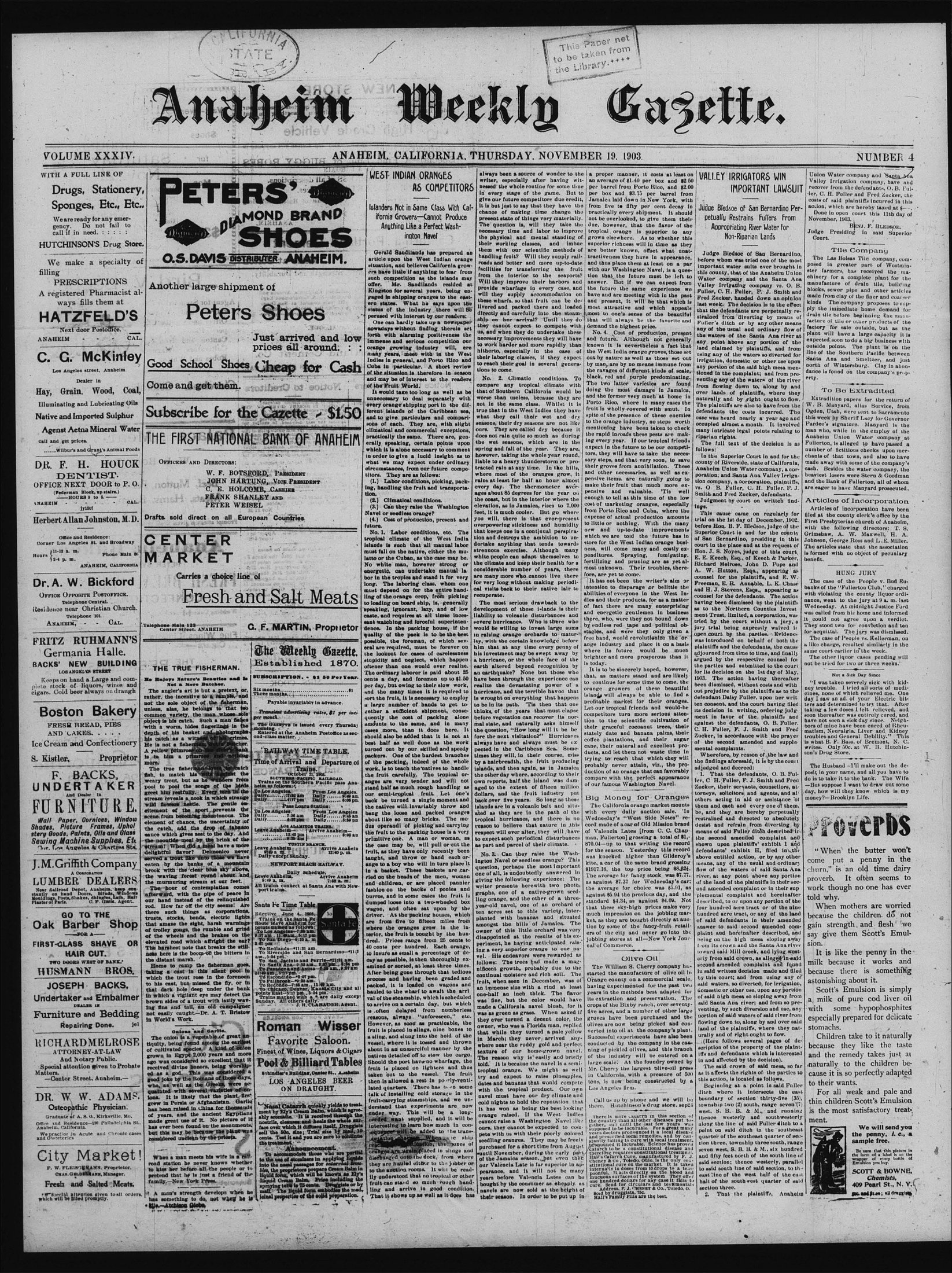
Searchable text
VOLUME XXXIV.
WITH A FULL LINE OF
Drugs, Stationery,
Sponges, Etc., Etc.,
We are ready for any emergency. Do not fail to call if in need. : : : : :
HUTCHINSON'S Drug Store.
We make a specialty of filling
PRESCRIPTIONS
A registered Pharmacist always fills them at
HATZFELD'S
Next door Postoffice.
ANAHEIM - CAL.
C. G. McKinley
Los Angeles street, Anaheim
Dealer in Hay, Grain, Wood, Coal,
Illuminating and Lubricating Oils
Native and Imported Sulphur
Agenst Aetna Mineral Water
Call and get prices.
...Wilbur's and Grant's Animal Foods
PETERS'
DIAMOND BRAND SHOES
O.S.DAVIS DISTRIBUTER ANAHEIM.
Another large shipment of
Peters Shoes
Just arrived and low prices all around. :
Good School Shoes Cheap for Cash
Come and get them.
Subscribe for the Gazette - $1.50
THE FIRST NATIONAL BANK OF ANAHEIM
OFFICERS AND DIRECTORS:
W. F. BOTSFORD, PRESIDENT
Dealer in Hay, Grain, Wood, Coal, Illuminating and Lubricating Oils Native and Imported Sulphur Agenst Aetna Mineral Water Call and get prices. Wilbur's and Grant's Animal Foods
DR. F. H. HOUCK DENTIST. OFFICE NEXT DOOR to P. O. (Federman Block, up stairs.) HOURS 9 TO 5 ANAHEIM CAL. JY15T1 Herbert Allan Johnston, M.D.
Office and Residence: Corner Los Angeles St. and Broadway Hours 11-12 a.m. Phone Main 86 2-4 p.m. ANAHEIM, CALIFORNIA
Dr. A. W. Bickford OFFICE OPPOSITE POSTOFFICE. Telephone Central. Residence near Christian Church. Telephone 101. ANAHEIM, CAL.
FRITZ RUHMANN'S Germania Halle. BACKS' NEW BUILDING LOS ANGELES STREET Keeps on hand a Large and complete stock of liquors, wines and cigars. Cold beer always on draught
Boston Bakery FRESH BREAD, PIES AND CAKES. Ice Cream and Confectionery S. Kistler, Proprietor
F. BACKS, UNDERTAKER And Dealer in FURNITURE. Wall Paper, Cornices, Window Shades, Ploture Frames, Upholstery Goods, Paints, Oils and Glass Sewing Machine Supplies, Etc. Dr. Los Angeles & Chartres St.
J.M.Griffith Company A CORPORATION LUMBER DEALERS Near Railroad Depot, Anaheim, keep constantly on hand Doors, Blinds, Windows Mouldings, Posts, Shakes, Shingles, Lath, Hair
Come and get them.
Subscribe for the Gazette $1.50
THE FIRST NATIONAL BANK OF ANAHEIM
OFFICERS AND DIRECTORS:
W. F. BOTSFORD, PRESIDENT
JOHN HARTUNG, VICE PRESIDENT
C. E. HOLCOMB, CASHIER
FRANK SHANLEY AND PETER WEISEL
Drafts sold direct on all European Countries
CENTER MARKET Carries a choice line of Fresh and Salt Meats
Telephone Main 123 Center Street, ANAHEIM G. F. MARTIN, Proprietor
THE TRUE FISHERMAN.
He enjoys Nature's Beauties and Is Not a Here Butcher.
The angler's art is but a pretext or rather, the incentive to a ramble, and not the sole object of the fisherman, unless alas, he belongs to that too common variety, the man whose sole object is his catch. Such a man fishes with a worm, hides fingerlings in the depth of his basket and photographs his catch as a witness of his crimes. He is not a fisherman but a butcher. A yellow primrose on the river bank is to him a primrose and nothing more.
The true fisherman loves to catch fish, to match his wife against the weary trout, but as he wanders from pool to pool the songs of the birds greet him restfully. Every turn in the stream reveals a nook in which strange wild flowers nestle. The gentle excitement of the sport prevents the scene from becoming monotonous. The element of chance, the uncertainty of the catch, add the drop of tabaco sauce which gives zest to the day. And the noontide meal by the brink of the stream! When did a meal have a more delightful flavor? Delmonico never served a trout like unto those we have eaten by the banks of a mountain brook with the clear blue sky above, the waving forest round about and the murmuring stream at our feet.
The hour of contemplation comes afterward, with the pipe of peace in hand instead of the relinquished
FURNITURE.
Wall Paper, Gornices, Window Shades, Picture Frames, Upholstery Goods, Paints, Oils and Glass Sewing Machine Supplies, Etc.
Our Los Angeles & Chartres St.
J.M. Griffith Company
A CORPORATION
LUMBER DEALERS
Near Railroad Depot, Anabeim, keep constantly on hand Doors, Blinds, Windows Mouldings, Posts, Shakes, shingles, Lash, Hair Plaster of Paris.
C. F. GRIM, Agent.
GO TO THE Oak Barber Shop
FOR A
FIRST-GLASS SHAVE OR HAIR CUT.
TWO DOORS WEST OF BANK.
HUSMANN BROS.
JOSEPH BACKS,
Undertaker and Embalmer
DEALER IN
Furniture and Bedding Repairing Done.
jel
RICHARDMELROSE
ATTORNEY-AT-LAW
And Notary Public.
Special attention given to Probate Matters.
—Center Street, Anaheim.
DR. W. W. ADAMS.
Osteopathic Physician.
Graduate of A. S. O., Kirksville, Mo.
Office and Residence—130 Philadelphia St.
Anaheim, California.
We practice In Acute and Chronic cases and Obstetrics.
City Market!
F. W. FLEISBOUNN, Proprietor.
CHAS. GRIEDERMANN, Manager.
Fresh and Salted Meats.
Special attention given to all orders, which will be filled promptly.
Onions and Garlic.
The onion is a vegetable of great antiquity, being found among the earliest of cultivated species. A kind of onion grown in Egypt 2,000 years and more ago was considered so excellent that it received divine honors, being worshiped as a god. This was considered a good joke by the Romans of those days, who, as well as the Greeks, were acquainted with several varieties of onions. It is likely that the plant grew in Persia or Afghanistan. Garlic has been raised in China for thousands of years, and the ancient Egyptians made great use of it. No picture of it has ever been found on the monuments, but this may be because the plant was considered unclean by the priests.
When a man meets his wife in a railroad station he never knows whether to kiss her before all the people or to pretend that he is just a friend of the family.—New York Press.
A man's strength develops when he has something to do, not when he is ill.—Atchison Globe.
Pass LoaRa Station:
To Los Angeles.
From Los Angeles
Daily...7:56 am Dally...9:45 am
Daily...8:27 pm Dally...5:59 pm
Los ALAMITOS TRAINES:
Leave Anaheim...12:40 pm Dally...8:00 am
TUSTIN BRANCH:
Leave Anaheim...9:49 a.m Dally...12:40 p.m.
Daily except Sunday.
NEWPORT BEACH HAILWAY.
Daily Schedule:
Leave Anaheim...9:49 a.m Dally...12:40 p.m.
All trains connect at Santa Ana with Newport trains.
Santa Fe Time Table
Effective June 4, 1903.
Trains on the Santa Fe Route leave Anaheim for points named as follows:
No Los Angeles...11:45 am; 9:57 am; 11:45 am; 5:17 pm; To San Diego...9:35 a.m; 8:07 pm;
To Redlands...11:31 am; To Riverside and San Bernardino...11:31 am; To San Jacinto and Perris...11:31 am; To Santa Ana...9:55 am; 8:07 pm; 8:54 pm; To Pasadena and Anusa...7:56 am; 9:57 am; 3:17 pm; To Escondido...7:07 pm; To Fallbrook...9:36 am; To Redondo...7:55 am; 11:49 am; To Chicago, Denver, Kansas City and points East...5:17 pm; 5:54 pm.
Trains marked with a * are daily excused Sunday. All others daily.
Roman Wissey
Favorite Saloon.
Finest of Wines, Liquors & Cigars
Pool & Billiard Table
Schindler's Building, Center St., Anaheim
LOS ANGELES BEER ON DRAUGHT.
Nasal Catarrh quickly yields to treatment by Elys's Cream Balm, which is aggranately aromatic. It is received through the nostrils, cleanses and heals the whole face over which it diffuses itself. Druggists sell the 500 size; Trial size by mail; cents. Test it and you are sure to confirm the treatment.
Announcement.
To accommodate those who are part to the use of atomizers in applying liquid into the nasal passages for catarral shrubs, the proprietors prepare Cream Balm liquid form, which will be known as Elysian Cream Balm. Price including spraying tints is 75 cents. Druggists or mail. The liquid form embodies the mucinal properties of the solid preparation.
WEST INDIAN ORANGES AS COMPETITORS
Islanders Not in Same Class With California Growers—Cannot Produce Anything Like a Perfect Washington Navel
Gerald Sandilands has prepared an article upon the West Indian orange situation, and believes California growers have little if anything to fear from such competition as the islands may offer. Mr. Sandilands resided at Kingston for several years, being engaged in shipping oranges to the eastern states. What he says upon the status of the industry there will be perused with interest by our readers:
One can hardly take up a newspaper nowadays without finding therein set forth with alarming positiveness the immense and serious competition our orange growing industry will, ere many years, meet with in the West Indies in general, and Porto Rico and Cuba in particular. A short review of the situation is therefore in season and may be of interest to the readers of the Fruit World.
It would take too long as well as be unnecessary to deal separately with every orange shipping port in the different islands of the Caribbean sea, and to give particulars and comparisons of each. They are, with slight climatical and commercial exceptions, practically the same. There are, generally speaking, certain points upon which it is alone necessary to comment in order to give a lucid insight as to what we may expect under ordinary circumstances, from our future competitors.
always been a source of wonder to the writer, especially after having witnessed the whole routine for some time in every stage of the game. But to give our future competitors due credit, it is but just to say that they have the chance of making time change the present state of things very materially. The question is, will they take the necessary time and labor to improve the physical and mental standing of their working classes, and imbue them with our scientific methods of handling fruit? Will they supply railroads and better and more up-to-date facilities for transferring the fruit from the interior to the seaports? Will they improve their harbors and provide wharfage in every case, and will they supply accommodation on these wharfs, so that fruit can be delivered and packed there and loaded directly and carefully into the steamship on her arrival? Until they do they cannot expect to compete with us, and when they do undertake these necessary improvements they will have to work harder and more rapidly than hitherto, especially in the case of their laboring classes, if they expect to reach their goal in several generations to come.
No. 2. Climatic conditions. To compare any tropical climate with that of Southern California would be worse than useless, because they are not in the same class. Whilst it is true that in the West Indies they have what they call their wet and dry seasons, their dry seasons are not like ours. They are called dry because it does not rain quite so much as during the wet seasons, which are in the spring and fall of the year. They are, however, taking the whole year round, liable to a heavy thunderstorm or protracted rain at any time. In the hills, where most of the oranges grow, it proper manner, it costs at an average of $1.40 per box and per barrel from Porto Rico, and per box and $3.75 per barrel Jamaica laid down in New York from five to fifty per cent daily practically every shipment. It not be overlooked, to give them due, however, that the flavorful tropical orange is superior to grown elsewhere. As to whether superior richness will in time arise better known, offset what tractiveness they have in appearance and thus place them at least one with our Washington Navel, is a question that the future must be answer. But if we can expect the future the same experience have and are meeting with in this and present, it will be that we most attractive and which is most to one's sense of the best that will always be the favorite demand the highest price.
No. 4. Cost of production, price and future. Although not given it is nevertheless a fact that the West India orange groves, out by nature as well as those by man, are by no means immune to ravages of different kinds of black, red and purple predominate. The two latter varieties are doing the most damage in Java and the former very much at Porto Rico, where in many cases fruit is wholly covered with small spite of the presence of these seeds to the orange industry, no steps mentioning have been taken to the rapid inroads these pests are ing every year. If our tropical fruit expect in the future to be our customers, they will have to take their sary steps, and that very soon, their groves from annihilation and other necessaries, as well
It would take too long as well as be unnecessary to deal separately with every orange shipping port in the different islands of the Caribbean sea, and to give particular and comparisons of each. They are, with slight climatical and commercial exceptions, practically the same. There are generally speaking, certain points upon which it is alone necessary to comment in order to give a lucid insight as to what we may expect under ordinary circumstances, from our future competitors. They are as follows:
(1.) Labor conditions, picking, packing, handling the fruit and transportation.
(2.) Climatical conditions.
(3.) Can they raise the Washington Navel or seedless orange?
(4.) Cost of production, present and future.
No. 1. Labor conditions, etc. The tropical climate of the West India islands is such that all manual labor must fall on the native, either the mulatto or the Cuban, as the case may be. No white man, however strong or energetic, can undertake manual labor in the tropics and stand it for very long. The laboring class, whom one must depend on for the entire handling of the orange crop, from picking to loading on board ship, is, generally speaking, ignorant, lazy, and of low caste, and requires at all times incessant watching and forceful superintendence. In the packing house, if the quality of the pack is to be the best possible, the foreman, of which several are required, must be forever on the lookout for cases of carelessness stupidity and neglect, which happen oftener than one would ever realize. The ordinary laborer is paid about 25 cents a day, and foremen up to $1.50 per day, but owing to their slow work, and the many times it is required to sort the fruit, it is necessary to employ a large number of hands to get together a sufficient shipment, consequently the cost of packing alone amounts to the same, and in many cases more, than it does here. It should also be added that it is not at best half as well done as the work turned out by our skilled and speedy packers. One of the hardest branches of the packing, indeed of the whole work, is to teach the natives to handle the fruit carefully. The tropical oranges are very tender and will not stand half as much rough handling as our semi-tropical fruit. Let one's back be turned a single moment and the natives will invariably throw and bang the loose and packed oranges about like so many bricks. The modus operandi of picking and carrying the fruit to the packing house is a very primitive one. A man or woman, as the case may be, will pull or cut the fruit, as they have only recently been taught, and throw or hand each orange to a boy who will in turn place it in a basket. These baskets are carried on the heads of the men, women and children, or are placed pannier fashion on the backs of ponies and burros, and in some cases the fruit is no. 2. Climatic conditions. To compare any tropical climate with that of Southern California would be worse than useless, because they are not in the same class. Whilst it is true that in the West Indies they have what they call their wet and dry seasons, their dry seasons are not like ours. They are called dry because it does not rain quite so much as during the wet seasons, which are in the spring and fall of the year. They are however, taking the whole year round, liable to a heavy thunderstorm or protracted rain at any time. In the hills, where most of the oranges grow, it rains at least for half an hour almost every day. The thermometer averages about 85 degrees for the year on the coast, but in the interior where the elevation, as in Jamaica, rises to 7,000 feet, it is much cooler. But go where you will, there is that ever-present overpowering stickiness and humidity that keeps one in a continual perspiration and destroys the ambition to undertake anything that tends towards strenuous exercise. Although many white people can adapt themselves to the climate and keep their health for a considerable number of years, there are many more who cannot live there for very long without making periodical visits back to their native lair to recuperate.
The most serious drawback to the development of these islands is their liability to volcanic disturbances and severe hurricanes. Who is there who would be willing to invest large sums in raising orange orchards to maturity, with the certain knowledge before him that at any time every penny of his investment may be swept away by a hurricane, or the whole face of the earth altered beyond recognition by an earthquake? None but those who have been through the experience can realize the devastating power of a hurricane, and the terrible havoc that is wrought on everything that happens to be in its path. 'Tis then that one thinks of the years that must elapse before vegetation can recover its normal state, and naturally asks himself the question, "How long will it be fore the next visitation?" Hurricanes always have and always must be expected in the Caribbean Sea. Sometimes they will, in their course, miss by a hairbreadth, the fruit producing islands, and then again, as in Jamaica the other day where, according to their own reports, half the island was damaged to the extent of fifteen million dollars, and the fruit industry put back over five years. So long as these islands are in a volcanic belt and situated as they are in the path of the tropical hurricanes, and there is no reason to believe that nature in this respect will ever alter, they will have to expect such periodical disturbances as part and parcel of their climate.
No. 3. Can they raise the Washington Navel or seedless orange? This question, perhaps the most important one of all, is undoubtedly answered in giving the following experience: The writer presents herewith two photo-graphs, one of a native-grown seedling and the other of a three-black, red and purple predominate. The two latter varieties are doing the most damage in Japan and the former very much at home. Porto Rico, where in many cases fruit is wholly covered with small spite of the presence of these edible fruits to the orange industry, no steps mentioning have been taken toward rapid inroads these pests are ing every year. If our tropical forespect in the future be our customers, they will have to take their sary steps, and that very soon, their groves from annihilation. And other necessities, as well as pensive items are naturally good make their fruit that much more pensive and valuable. 'This enough to tell at this time of this cost of marketing oranges, escape from Porto Rico and Cuba when expense of actual production amends to little or nothing. With them new and up-to-date improvements which we are told the future store for the West Indian orange business will come many and costly penditures. Spraying, fumigating fertilizing and pruning are as far most unknown. Their troubles fore, are yet to come.
It has not been the writer's intention to disparage or belittle abilities everyone in the West Indies and their products, for as a fact there are many enterprises and energetic gentlemen in bushes; who were they not bound by endless red tape and political stacles; and were they only given free hand; would revolutionize this angle industry and place it on where its future would be brighter and more prosperous today.
It is to be sincerely hoped how that, as matters stand and are to continue for some time to combine orange growers of these best islands will always be able to profitable market for their orchard. Let our tropical friends and workers competitor turn more serious attention to the scientific cultivation their graceful cocoanut trees; stately date and banana palms; coffee plantations; and let them not waste time trying to reach that which they probably never attain, viz., that duction of an orange that can have compare with the perfect appearance of our famous Washington Navel.
Big Money for Oranges
The California orange market now with every daily auction sale Wednesday's "West Side Note" cord made of a car of Old Mission Valencia Lates [from C. C. man, Fullerton] grossing a total $70.04—up to that writing them for the season. Yesterday this was knocked higher than Gille kite, a car of the same brand gr $1917.16, the top price being $7.37 for Wednesdaythe average for fancy stock was against $7.94 for Wednesdaythe previous day,a
back be turned a single moment and the natives will invariably throw and bang the loose and packed oranges about like so many bricks. The modus operandi of picking and carrying the fruit to the packing house is a very primitive one. A man or woman, as the case may be, will pull or cut the fruit, as they have only recently been taught, and throw or hand each orange to a boy who will in turn place it in a basket. These baskets are carried on the heads of the men, women and children, or are placed pannier fashion on the backs of ponies and burros, and in some cases the fruit is dumped loose into a two-wheeled box wagon, and often sat upon by the driver. At the packing houses, which are from five to fifteen miles from where the oranges grow in the interior, the fruit is bought by the hundred. Prices range from 25 cents to 40 cents per hundred. Each orange, to insure as small a percentage of decay as possible, is then thoroughly examined or sorted, at least three times. After being gone through that tedious process and having been graded and packed, it is loaded on wagons and hauled to the wharf to await the arrival of the steamship, which is scheduled to arrive on a certain day, but which is often delayed from numberless reasons, always "unforeseen," etc. However, as soon as practicable, the fruit is placed in slings, nine boxes to a sling, and slung into the hold of the vessel, where it is tossed and thrown about in an unmerciful manner by the natives detailed off to stow the cargo. Should the port have no wharfage, the fruit is placed on lighters and thus taken out to the vessel. The fruit then is allowed a rest in poorly ventilated quarters. There has been some talk of installing cold storage in the fruit-carrying steamships, and we understand that experiments are now under way. This will be a long-needed want supplied, and it will be interesting to learn how much in consequence will be added to the transportation charges. When the ship reeches off stationation, the boxes of oranges are again placed in slings and discharged onto the dock, from where they are hauled either to the jobber or to the auction rooms. It will be readily understood that no tropical or other fruit can stand so much rough handling and arrive in good condition. That it shows up as well as it does has back over five years. So long as these islands are in a volcanic belt and situated as they are in the path of the tropical hurricanes, and there is no reason to believe that nature in this respect will ever alter, they will have to expect such periodical disturbances as part and parcel of their climate.
No. 3. Can they raise the Washington Navel or seedless orange? This question, perhaps the most important one of all, is undoubtedly answered in giving the following experience: The writer presents herewith two photos graphe, one of a native-grown seedling orange, and the other of a three-year-old navel, one of an orchard of ten acres set to this variety, interplanted with bananas and situated amongst the hills of Jamaica. The owner of this little orchard was very disappointed at the results of his experiment, he having anticipated raising a very superior orange to our navel. His endeavors were rewarded as follows: The trees had made a magnificent growth, probably due to the continual moisture and rich soil. The fruit, when seen in December, was of an immense size with a rind at least one-half an inch thick. The flavor was fine, but the color would have made a California navel blush, for it was as green as grass. When asked if they ever turned a decent color, the owner, who was a Florida man, replied that while they turned a pale yellow in March; they never arrived anywhere near the ruddy gold and perfect texture of our home-grown navel. The reason why is easily and briefly told. It is because the navel is a semi-tropical orange. We might as well try and expect to raise pineapples, dates and bananas that would compete with the tropical product. Our own navel must have our dry climate and cold nights to hold the reputation that it has won as being the best looking orange raised. If the West Indies cannot raise a Washington Navel like ours, they cannot be expected to compete with us with their poorly colored seedling oranges. They may be freely purchased for a short time from August until November, during the early part of the Jamaica season, but even then our Valencia Late is far superior in appearance, and it will not be many years before Valencia Lates can be bought by the consumer as cheaply as navels are now sold at the height of their season. In order to be put up in
Olive Oil
The William S. Cherry company started the manufacture of olive Orange county on a commercial having experimented for the past years in the methods best adapted its extraction and preservation crops of the Bixby ranch, over six five acres, and a number of other groves have been purchased as olives are now being picked and verted into oil at the company's Successful experiments have all conducted by the company in taking of pickled olives, and this of the industry will be entered large scale. At the foundry own Mr. Cherry the largest olive-oil in California, with a pressure tons, is now being constructed Los Angeles firm.
Call us up by phone and we there. Hutchinson's drug store
There is more catarrh in this country than all other diseases gather, and until last few years supposed to be incurable. For a few years doctors pronounced it a local and prescribed local remedies, and steadily falling to care with local treatment it incurable. Science has catarch to be a constitutional disease that requires constitutional treaty Hall Catarach Cure, manufactured by Choney & Co., Toledo, Ohio, is the only situtational cure on the market. It internally in doses from 10 drops to poisonful. It acts directly on the mucous surfaces of the system. One hundred dollars for any case it cure. Send for circulars and test addresses. F.J. Cheney & Co., To Hall's Family Pills are the best.
Gazette.
MAR 19. 1903.
NUMBER 4
VALLEY IRRIGATORS WIN IMPORTANT LAWSUIT
Judge Bledsoe of San Bernardino Perpetually Restrains Fulfers From Appropriating River Water for Non-Riparian Lands
Judge Bledsoe of San Bernardino, before whom was tried one of the most important water suits ever brought in this county, that of the Anaheim Union Water company and the Santa Ana Valley Irrigating company vs. O. B. Fuller, C. H. Fuller, F. J. Smith and Fred Zucker, handed down an opinion last week. The decision is to the effect that the defendants are perpetually restrained from diverting by means of Fulfer's ditch or by any other means any of the usual and ordinary flow of the waters of the Santa Ana river at any point above any portion of the land claimed by plaintiffs, and from using any of the waters so diverted for irrigation, domestic or other use upon any portion of the said high mesa mentioned in the complaint; and from preventing any of the waters of the river from flowing down to, along by and over lands of plaintiffs, where they naturally and by right ought to flow. The plaintiffs are also to have from the defendants the costs incurred. The case was heard nearly a year ago and occupied almost a month. It involved many intricate legal points relating to riparian rights.
The full text of the decision is as follows:
In Superior Court in and for the county of Riverside, state of California, Anaheim Union Water company, a corporation and Santa Ana Valley Irrigation company, have and recover from the defendants, O. B. Fuller, C. H. Fuller and Fred Zucker, the costs of said plaintiffs incurred in this action, which are hereby taxed at $—.
Done in open court this 11th day of November, 1903.
BENJ. F. BLEDSOE.
Judge Presiding in said Superior Court.
Tile Company
The Las Bolsas Tile company, composed in greater part of Westminster farmers, has received the machinery for a complete plant for the manufacture of drain tile, building blocks, sewer pipe and other articles made from clay of the finer and coarser kinds. The company proposes to supply the immediate home demand for drain tile before beginning the manufacture of tile or other products of the factory for sale outside, but as the plant will have a large capacity it is expected soon to do a big business with outside points. The plant is on the line of the Southern Pacific between Santa Ana and Smeltzer, and just north of Wintersburg. Clay in abundance is found on the company's property.
To Be Extradited
Extradition papers for the return of W. B. Manyard, alias Service, from Ogden, Utah, were sent to Sacramento this week by Sheriff Lacy for Governor Pardee's signature. Manyard is the man who, while in the employ of the Anaheim Union Water company at Fullerton, is alleged to have passed a number of detritious checks upon merchants of that town, and also to have made away with some of the company's cash. Besides the water company, the heaviest losers were Storm & Goodman.
Money for Oranges
The California orange market mounts every daily auction sale. In Wednesday's "West Side Notes" remade of a car of Old Mission brand Valencia Lates [from C. C. Chapel Fullerton] grossing a total of $1,404—up to that writing the record the season. Yesterday this record knocked higher than Gilderoy's, a car of the same brand grossing 7.16, the top price being $8.624. Average for fancy stock was $7.77 against $7.37 for Wednesday's car; average for choice was $5.91, as insist $5.94 the previous day, and the full text of the decision is as follows:
In the Superior Court in and for the county of Riverside, state of California, Anaheim Union Water company, a corporation; and Santa Ana Valley Irrigation company, a corporation, plaintiffs vs. O B. Fuller, C. H. Fuller, F. J. Smith and Fred Zucker, defendants.
Judgment by court on writteh findings.
This cause came on regularly for trial on the 1st day of December, 1902. before Hon. B. F. Bledsoe, judge of the Superior Court in and for the county of San Bernardino, presiding in this court in the place and at the request of Hon. J. S. Noyes, judge of this court. E. E. Keech, Esq., of Keech & Parker, Richard Melrose, John D. Pope and A. W. Hutton, Esqs., appearing as counsel for the plaintiffs, and E. W. Freeman, E. R. Annable, L. K. Chase and H. J. Stevens, Esqs., appearing as counsel for the defendants. The action having been dismissed by the plaintiffs as to the Northern Counties Investment Trust, limited, a corporation, waived by the court without a jury, a jury trial being expressly waived in open court by the parties. Evidence was introduced on behalf of both the plaintiffs and the defendants, the cause adjourned from time to time, and finally argued by the respective counsel for the parties and submitted to the court for its decision on the 1st day of May, 1903. The action having thereafter been dismissed, without costs and with out prejudice by the plaintiffs as to the defendant Daisy Fuller, upon her written consent, and the court having filed its decision in writing, ordering judgment in favor of the plaintiffs and against the defendants, O. B. Fuller. C. H. Fuller, F. J. Smith and Fred Zucker, in accordance with the prayer of the second amended and supplemental complaints.
Wherefore, by reason of the law and the findings aforesaid, it is by the court adjudged and decreed:
1. That the defendants, O. B. Fuller, C H. Fuller, F. J. Smith and Fred Zucker, their servants, counsellors, attorneys, solicitors and agents, and others acting in aid or assistance of them and each and every one of them, be, and they are hereby perpetually restrained and directed to absolutely desist and refrain from diverting by means of said Fuller ditch described in the second amended complaint and shown upon plaintiffs' exhibit 1 and defendants' exhibit H, filed in the above entitled action, or by any other means, any of the usual and ordinary flow of the waters of said Santa Ana river, at any point above any portion of the land of the plaintiffs in their second amended complaint or in their supplemental complaint and hereinafter
To Be Extradited
Extradition papers for the return of W. B. Manyard, alias Service, from Ogden, Utah, were sent to Sacramento this week by Sheriff Lacy for Governor Pardee's signature. Manyard is the man who, while in the employ of the Anaheim Union Water company at Fullerton, is alleged to have passed a number of fictitious checks upon merchants of that town, and also to have made away with some of the company's cash. Besides the water company, the heaviest losers were Stern & Goodman and the Bank of Fullerton, all of whom are eager to have Manyard prosecuted.
Articles of Incorporation
Articles of incorporation have been filed at the county clerk's office by the First Presbyterian church of Anaheim, with the following directors: T. S. Grimshaw, A. W. Maxwell, H. A. Johnson, George Ross and L.E. Miller.
The articles state that the association is formed with no object of pecuniary benefit.
HUNG JURY
The case of the People v. Bud Eubanks of the "Fullerton Club," charged with violating the county liquor ordinance, went to the jury at 9 a.m. last Wednesday. At midnight Justice Ford was called from his home and informed it could not agree upon a verdict. They stood two for conviction and ten for acquittal. The jury was dismissed.
The case of People vs. Kellerman, on a like charge, resulted similarly in the same court earlier in the week.
The other liquor cases pending will not be tried for two or three weeks.
Not a Sick Day Since
"I was taken severely sick with kidney trouble." I tried all sorts of medicines, none of which relieved me. One day I saw an ad, of your electric bitters and determined to try that. After taking a few doses I felt relieved, and soon thereafter was entirely cured, and have not seen a sick day since. Neighbors of mine have been cured of Rheumatism, Neuralgia, Liver and Kidney troubles and General Debility." This is what B. F. Bass, of Bremont, N.C., writes. Only 50c.at W.B.Hutchinson's Drug Store.
The Husband -I'll make out the deposit in your name,and all you have to do is take it to the bank.The Wife -But suppose I want to draw out some day,how will they know which is my money?—Brooklyn Life.
Proverbs
"When the butter won't come put a penny in the churn," is an old time dairy proverb. It often seems to work though no one has ever told why."
When the butter won't come put a penny in the churn," is an old time dairy proverb. It often seems to work though no one has ever told why.
When mothers are worried because the children do not gain strength and flesh we say give them Scott's Emulsion.
It is like the penny in the milk because it works and because there is something astonishing about it.
Scott's Emulsion is simply a milk of pure cod liver oil with some hypophosphites especially prepared for delicate stomachs.
Children take to it naturally because they like the taste and the remedy takes just at naturally to the children because it is so perfectly adapted to their wants.
For all weak and pale and thin children Scott's Emulsion is the most satisfactory treatment.
We will send you the penny, I.e., a sample free.
Be sure that this picture in the form of a label is on the wrapper of every bottle of Emulsion you buy.
SCOTT & BOWNE,
Chemists,
409 Pearl St., N. Y.