anaheim-gazette 1903-09-17
Scanned page
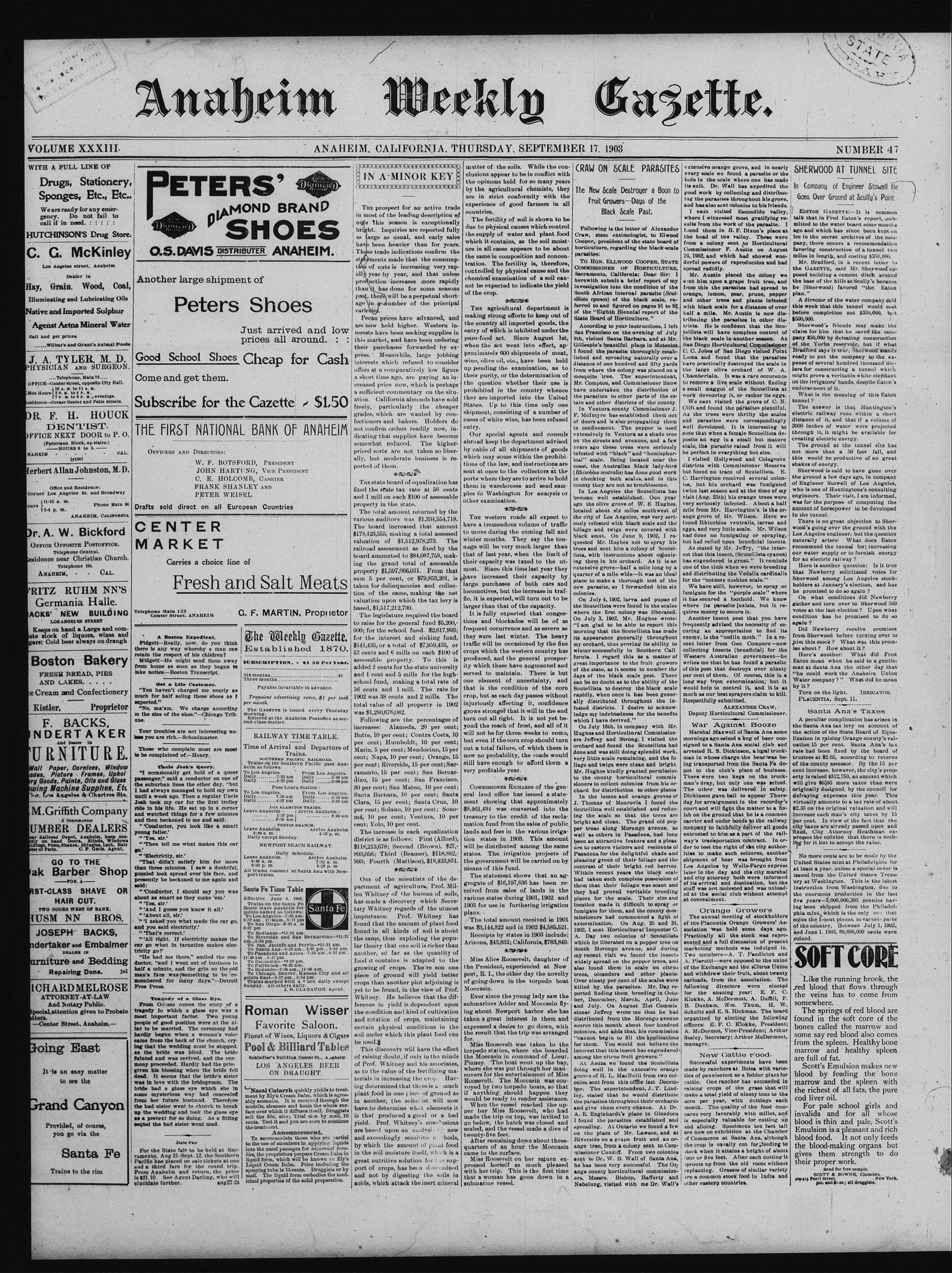
Searchable text
Anaheim
VOLUME XXXIII.
WITH A FULL LINE OF
Drugs, Stationery,
Sponges, Etc., Etc.,
We are ready for any emergency. Do not fail to call if in need. : : : : :
HUTCHINSON'S Drug Store.
C. G. McKinley
Los Angeles street, Anaheim
Dealer in
Hay, Grain. Wood, Coal,
Illuminating and Lubricating Oils
Native and Imported Sulphur
Agenst Aetna Mineral Water
Call and get prices.
.....Wilbur's and Grant's Animal Foods
J. A. TYLER, M. D.
PHYSICIAN AND SURGEON.
Telephone, Main 75...
OFFICE—Center street, opposite City Hall.
10 A.M. to 11 A.M.
Office Hours
2 P.M. to 4 P.M.
7 P.M. to 8 P.M., evenings.
Residence—Corner Center and Palm streets.
DR. F. H. HOUCK
DENTIST.
OFFICE NEXT DOOR to P. O.
(Federman Block, up stairs.)
HOURS 9 to 5.
NAHEIM CAL.
jy15tf
Herbert Allan Johnston, M.D.
PETERS'
DIAMOND BRAND
SHOES
O.S. DAVIS DISTRIBUTER ANAHEIM.
Another large shipment of
Peters Shoes
Just arrived and low prices all around. : : :
Good School Shoes Cheap for Cash
Come and get them.
Subscribe for the Gazette - $1.50
THE FIRST NATIONAL BANK OF ANAHEIM
OFFICERS AND DIRECTORS:
W. F. BOTSFORD, PRESIDENT
JOHN HARTUNG, VICE PRESIDENT
Come and get them.
Subscribe for the Cazette - $1.50
THE FIRST NATIONAL BANK OF ANAHEIM
OFFICERS AND DIRECTORS:
W. F. BOTSFORD, PRESIDENT
JOHN HARTUNG, VICE PRESIDENT
C. E. HOLCOMB, CASHIER
FRANK SHANLEY AND
PETER WEISEL
Drafts sold direct on all European Countries
CENTER MARKET
Carries a choice line of
Fresh and Salt Meats
Telephone Main 123
Center Street, Anaheim G. F. MARTIN, Proprietor
A Boston Expedient.
Fidgett—Really, now, do you think there is any way whereby a man can retain the respect of his children?
Midgett—He might send them away from home as soon as they began to take notice—Boston Transcript.
Get a Life Customer.
"You haven't charged me nearly as much for half soling these shoes as I expected."
"No, ma'am. We charge according to the size of the shoe."—Chicago Tribune.
Your troubles are not interesting unless you are rich.—Schoolmaster.
Those who complain most are most to be complained of.—Henry.
Uchele Josh's Query.
"I occasionally get hold of a queer passenger," said a conductor on one of the suburban lines the other day, "but I had always managed to hold my own until a week ago. Then a regular Uncle Josh took my car for the first trolley ride in his life. He sat up in a corner and watched things for a few minutes and then beckoned to me and said:
'Conductor, you look like a smart young feller.'
'Yes, sir.'
'Then tell me what makes this car go.'
'Electricity, sir.'
"That didn't satisfy him for more than three minutes. I saw a doubtful, puzzled look spread over his face, and presently he beckoned to me again and said:
'Conductor, I should say you was about as smart as they make 'em.'"
RAILWAY TIME TABLE.
Time of Arrival and Departure of Trains.
SOUTHERN PACIFIC RAILROAD.
Trains on the Southern Pacific pass Anaheim as follows:
To Los Angeles.
From Los Angeles.
Daily...7:52 am Daily...9:49 am
Daily...4:22 pm Daily...6:06 pm
Pass Loora Station:
To Los Angeles.
From Los Angeles.
Daily...7:56 am Daily...9:45 am
Daily...4:27 pm Daily...5:50 pm
LOS ALAMITOR TRAINS.
Leave Anaheim—Arrive Anaheim—
2:37 pm 8:30 am
9:35 am 8:30 am
TUSTIN BRANCH.
Leave Anaheim Arrive Anaheim
9:49 a.m 4:22 p.m,
Daily except Sunday.
NEWPORT BEACH RAILWAY.
Daily Schedule:
Leave Anaheim. Arrive Anaheim
9:49 a.m 7:52 a.m.
6:03 p.m 4:23 p.m
All trains connect at Santa Ana with Newport trains.
Santa Fe Time Table
Effective June 4, 1903
GO TO THE Oak Barber Shop — FOR A —
RST-CLASS SHAVE OR HAIR CUT.
TWO DOORS WEST OF BANK.
HUSM NN BROS.
JOSEPH BACKS, indertaker and Embalmer
DEALER IN
Furniture and Bedding
Repairing Done. jel
ICHARDMELROSE
ATTORNEY-AT-LAW
And Notary Public.
Special attention given to Probate matters.
—Center Street, Anaheim.—
Going East
It is an easy matter to see the Grand Canyon
Provided, of course, you go via the Santa Fe Trains to the rim
Tragedy of a Glass Eye.
From Odessa comes the story of a tragedy in which a glass eye was a most important factor. Two young people of good position were at the altar to be married. The ceremony had hardly begun when a woman's voice came from the back of the church, crying that the wedding must be stopped as the bride was blind. The bride fainted and was revived, and the ceremony proceeded. Hardly had the priest given his blessing when the bride fell dead. It seems that the bride's sister was in love with the bridegroom. The bride had a glass eye which she in some mysterious way had concealed from her future husband. Therefore the bad sister went to church to break up the wedding and took the glass eye as a pretext for so doing. As a fitting sequel the bad sister went mad.
State Fair
For the State fair to be held at Sacramento, Aug 31–Sept. 12, the Southern Pacific has placed on sale tickets at one and a third fare for the round trip. From Anaheim and return, the price is $21.10. See Agent Darling, who will elucidate further.
Josh took my car for the first trolley ride in his life. He sat up in a corner and watched things for a few minutes and then beckoned to me and said:
"Conductor, you look like a smart young feller."
"Yes, sir."
"Then tell me what makes this car go."
"Electricity, sir."
"That didn't satisfy him for more than three minutes. I saw a doubtful, puzzled look spread over his face, and presently he beckoned to me again and said:
'Conductor, I should say you was about as smart as they make 'em.'
'Yes, sir.'
'And I guess you know it all.'
'About all, sir.'
'I asked you what made the car go, and you said electricity.'
'That's correct.'
'All right. If electricity makes the car go what in tarnation makes electricity go?'
"He had me there," smiled the conductor, "and I went out of business in half a minute, and the grin on the old man's face was something to be remembered for many days."—Detroit Free Press.
Roman Wisser
Favorite Saloon.
Finest of Wines, Liquors & Cigare Pool & Billiard Tables
Schindler's Building, Center St., Anaheim
LOS ANGELES BEER ON DRAUGHT.
Nasal Catarrh quickly yields to treatment by Ely's Cream Balm, which is agreeably aromatic. It is received through the nostrils, cleanses and heals the whole surface over which it diffuses itself. Druggists sell the 50c size; Trial size by mail, 10 cents. Test it and you are sure to continue the treatment.
Announcement.
To accommodate those who are partial to the use of atomizers in applying liquids into the nasal passages for catarrhal troubles, the proprietors prepare Cream Balm in liquid form, which will be known as Ely's Liquid Cream Balm. Price including the spraying tube is 75 cents. Druggists or by mail. The liquid form embodies the medicinal properties of the solid preparation.
IN A MINOR KEY
The prospect for an active trade in most of the leading description of nuts this season is exceptionally bright. Inquiries are reported fully as large as usual, and early sales have been heavier than for years. These trade indications confirm the statements made that the consumption of nuts is increasing very rapidly year by year, and that unless production increases more rapidly than it has done for some seasons past, there will be a perpetual shortage in a number of the principal varieties.
Pecan prices have advanced, and are now held higher. Western interests have been seeking supplies in this market, and have been ordering their purchases forwarded by express. Meanwhile, large jobbing interests which refused to consider offers at a comparatively low figure a short time ago, are paying an increased price now, which is perhaps a sufficient commentary on the situation. California almonds have sold freely, particularly the cheaper grades, which are wanted by confectioners and bakers. Holders do not confirm orders readily now, indicating that supplies have become somewhat reduced. The higher-priced sorts are not taken so liberally, but moderate business is reported of them.
matter of the soils. While the conclusions appear to be in conflict with the opinions held for so many years by the agricultural chemists, they are in strict conformity with the experience of good farmers in all countries.
The fertility of soil is shown to be due to physical causes which control the supply of water and plant food which it contains, as the soil moisture in all cases appears to be about the same in composition and concentration. The fertility is, therefore, controlled by physical cause and the chemical examination of a soil cannot be expected to indicate the yield of the crop.
The agricultural department is making strong efforts to keep out of the country all imported goods, the entry of which is inhibited under the pure-food act. Since August 1st, when the act went into effect, approximately 600 shipments of meat, wine, olive oil, etc., have been held up pending the examination, as to their purity, or the determination of the question whether their use is prohibited in the country whence they are imported into the United States. Up to this time only one shipment, consisting of a number of cases of white wine, has been refused entry.
Our special agents and consuls abroad keep the department advised by cable of all shipments of goods which may come within the prohibitions of the law, and instructions are sent at once to the collectors at the CRAW ON SCALE PARASITES
The New Scale Destroyer a Boon Fruit Growers—Days of the Black Scale Past.
Following is the letter of Alexander Craw, state entimologist, to Elwol Cooper, president of the state board of horticulture, regarding the black-scale parasites:
TO HON. ELLWOOD COOPER, STATE COMMISSIONER OF HORTICULTURE
Sacramento, California; Dear Sir:
herewith submit a brief report of my investigation into the condition of the South African internal parasite (Scellista cyanea) of the black scale, referred to and figured on pages 91 to 94 of the "Eighth Biennial report of the State Board of Horticulture."
According to your instructions, I led San Francisco on the evening of June 9th, visited Santa Barbara, and at Mr. Gillespie's beautiful place in Moteci I found the parasite thoroughly established and spreading naturally over a distance of one hundred and fifty yards from where the colony was placed on mesquite tree. The superintendent Mr. Compton, and Commissioner Snow have undertaken the distribution of the parasites to other parts of the estate and other districts of the county.
In Ventura county Commissioner J. F. McIntyre has established them out of doors and is also propagating them in confinement. The pepper is used extensively in Ventura as a shade tree on the streets and avenues, and a few years ago these trees were seriously infested with "black" and "hemispherical" scale. Being located near the coast, the Australian black lady-bird (Rhizobius ventralis) has done good work.
a short time ago, are paying an increased price now, which is perhaps a sufficient commentary on the situation. California almonds have sold freely, particularly the cheaper grades, which are wanted by confectioners and bakers. Holders do not confirm orders readily now, indicating that supplies have become somewhat reduced. The higher-priced sorts are not taken so liberally, but moderate business is reported of them.
The state board of equalization has fixed the state tax rate at 56 cents and 1 mill on each $100 of assessable property in the state.
The total amount returned by the various auditors was $1,334,554,718. The board increased that amount $178,423,555, making a total assessed valuation of $1,512,978,273. The railroad assessment as fixed by the board amounted to $84,087,758, making the grand total of assessable property $1,597,066,031. From that sum 5 per cent, or $79,853,201, is taken for delinquencies and collection of the same, making the net valuation upon which the tax levy is based, $1,517,212,730.
The legislature required the board to raise for the general fund $5,200,000; for the school fund. $2,617,993; for the interest and sinking fund, $141,435, or a total of $7,959,435, or 52 cents and 6 mills on each $100 of assessable property. To this is added 2 cents for the state university and 1 cent and 5 mills for the high-school fund, making a total rate of 56 cents and 1 mill. The rate for 1902 was 38 cents and 2 mills. The total value of all property in 1902 was $1,280,676,082.
Following are the percentages of increases: Alameda, 20 per cent; Butte, 10 per cent; Contra Costa, 10 per cent; Humboldt, 10 per cent; Marin, 5 per cent; Mendocino, 15 per cent; Napa, 10 per cent; Orange, 15 per cent; Riverside, 15 per cent; Sacramento, 15 per cent; San Bernardino, 15 per cent; San Francisco, 30 per cent; San Mateo, 10 per cent; Santa Barbara, 10 per cent; Santa Clara, 15 per cent; Santa Cruz, 10 per cent; Solano, 10 per cent; Sonoma, 10 per cent; Ventura, 10 per cent; Yolo, 10 per cent.
The increase in each equalization district is as follows: First (Alford), $118,213,678; Second (Brown), $27,-893,056; Third (Beamer), $118,882,-993; Fourth (Mattison), $18,433,831.
One of the scientists of the department of agriculture, Prof. Millen Whitney of the bureau of soils,
their purity, or the determination of the question whether their use is prohibited in the country whence they are imported into the United States. Up to this time only one shipment, consisting of a number of cases of white wine, has been refused entry.
Our special agents and consuls abroad keep the department advised by cable of all shipments of goods which may come within the prohibitions of the law, and instructions are sent at once to the collectors at the ports where they are to arrive to hold them in warehouses and send samples to Washington for analysis or other examination.
The western roads all expect to have a tremendous volume of traffic to move during the coming fall and winter months. They say the tonnage will be very much larger than that of last year, when the limit of their capacity was taxed to the utmost. Since this time last year they have increased their capacity by large purchases of both cars and locomotives, but the increase in traffic, it is expected, will turn out to be larger than that of the capacity.
It is fully expected that congestions and blockades will be of as frequent occurrence and as severe as they were last winter. The heavy traffic will be occasioned by the fine crops which the western country has produced, and the general prosperity which these have augmented and served to maintain. There is but one element of uncertainty, and that is the condition of the corn crop, but as each day passes without injuriously affecting it, confidence grows stronger that it will in the end turn out all right. It is not yet beyond the reach of frost, and all of it will not be for three weeks to come, but even if the corn crop should turn out a total failure, of which there is now no probability, the roads would still have enough to afford them a very profitable year.
Commissioner Richards of the general land office has issued a statement showing that approximately $8,461,494 was converted into the treasury to the credit of the reclamation fund from the sales of public lands and fees in the various irrigation states in 1903. This amount will be distributed among the same states. The irrigation projects of the government will be carried on by means of this fund.
The statement shows that an aggregate of $16,197,836 has been received from sales of lands in the various states during 1901, 1902 and mesquite tree. The superintendent Mr. Compton, and Commissioner Snow have undertaken the distribution of the parasites to other parts of the county and other districts of the county.
In Ventura county Commissioner F. McIntyre has established them out of doors and is also propagating them in confinement. The pepper is used extensively in Ventura as a shade tree on the streets and avenues, and a few years ago these trees were seriously infested with "black" and "hemispherical" scale. Being located near the coast, the Australian black lady-bird (Rhizobius ventralis) has done good work in checking both scales, and in the county they are not so troublesome.
In Los Angeles the Scutellista have become well established. One year ago the olive grove of W.E.Hughes located about six miles southwest of the city of Los Angeles was very severely infested with black scale and the foliage and twigs were covered with foliar smut. On June 9, 1902 I requested Mr. Hughes not to spray his trees and sent him a colony of Scutellista, with instructions about colonizing them in his orchard. As it is an extensive grove—half a mile long by quarter of a mile wide—it was an ideal place to make a thorough test of the new parasite, so I forwarded him six colonies.
On July 4, 1902, larvae and pupae of the Scutellista were found in the scales where the first colony was liberated. On July 3, 1902, Mr. Hughes wrote: "I am glad to be able to report this morning that the Scutellista has made its appearance generally throughout my orchard, thus proving its ability to winter successfully in Southern California. I regard this as a matter great importance to the fruit growers of the state, as it seems to number three days of the black scale pest. They can be no doubt as to the ability of the Scutellista to destroy the black scale rapidly, when once it has been genetically distributed throughout the infected districts. I desire to acknowledge my indebtedness for the benefit which I have derived."
On July 16th in company with Mr. Hughes and Horticultural Commissioners Jeffrey and Strong I visited their orchard and found the Scutellista had done and was still doing splendid work very little scale remaining, and the foliage and twigs were clean and bright. Mr. Hughes kindly granted permission to the county horticultural commissioners to collect colonies from his orchard for distribution to other places.
In the lemon and orange groves of J. Thomas of Monrovia I found that Scutellista well established and reducing the scale so that the trees are bright and clean. The grand old peppers along Morengo avenue were well as others in Pasadena, had long been an attractive feature and a pleasure to eastern visitors and residents at Pasadena for the delightful shade and pleasing green of their foliage and contrast of their bright red berries.
Within recent years the black scale had taken such complete possession them that their foliage was scant and they had proved veritable breeding places for the scale. Their size are
The increase in each equalization district is as follows: First (Alford), $118,213,678; Second (Brown), $27,893,056; Third (Beamer), $118,882,993; Fourth (Mattison), $18,433,831.
One of the scientists of the department of agriculture, Prof. Milen Whitney of the bureau of soils, has made a discovery which Secretary Whitney regards of the utmost importance. Prof. Whitney has found that the amount of plant food found in all kinds of soil is about the same, thus exploding the popular theory that one soil is richer than another, so far as the quantity of food it contains is adapted to the growing of crops. The re son one piece of ground will yield better crops than another plot adjoining is yet to be found, in the view of Prof. Whitney. He believes that the difference in yield is dependent upon the condition and kind of cultivation and rotation of crops, maintaining certain physical conditions in the soil under which this plant food can be used.
This discovery will have the effect of raising doubt, if only in the minds of Prof. Whitney and his associates, as to the value of the fertilizing materials in increasing the crop. Having determined that there is amuch plant food in one piece of ground as in another, the scientist will now have to determine what elements it is that produced a good or a bad yield. Prof. Whitney's conclusions are based upon an analysis new and exceedingly sensitive methods, by which the amount of plant food in the soil moisture itself, which is a great nutritive solution for the support of crops, has been determined and not by digesting the soils in acids, which attack the inert mineral content showing that approximately $8,461,494 was converted into the treasury to the credit of the reclamation fund from the sales of public lands and fees in the various irrigation states in 1903. This amount will be distributed among the same states. The irrigation projects of the government will be carried on by means of this fund.
The statement shows that an aggregate of $16,197,836 has been received from sales of lands in the various states during 1901, 1902 and 1903 for use in furthering irrigation plans.
The total amount received in 1901 was $3,144,822 and in 1902 $4,585,521.
Receipts by states in 1903 include: Arizona, $43,832; California, $783,849.
Miss Alice Roosevelt, daughter of the President, experienced at Newport, R.I., the other day the novelty of going down in the torpedo boat Moccasin.
Ever since the young lady saw the submarines Adder and Moccasin flying about Newport harbor she has taken a great interest in them and expressed a desire to go down with the result that the trip was arranged for.
Miss Roosevelt was taken to the torpedo station, where she boarded the Moccasin in command of Lieut. Pinney. The boat went up the bay, where she was put through her maneuvers for the entertainment of Miss Roosevelt. The Moccasin was conveyed by two torpedo boats, so that if anything should happen they would be ready to render assistance.
When the vessel reached the upper bay Miss Roosevelt, who had made the trip on top, was invited to go below, the hatch was closed and sealed, and the vessel made a dive of twenty-five feet.
After remaining down about three-quarters of an hour the Moccasin came to the surface.
Miss Roosevelt on her return expressed herself as much pleased with her trip. This is the first time that a woman has gone down in a submarine vessel.
Within recent years the black scars had taken such complete possession of them that their foliage was scant and they had proved veritable breeding places for the scale. Their size and location made it difficult to spray or fumigate for them, and the county commissioners had commenced a fight extermination. On Aug. 25 and 30, 1902, I sent Horticultural Inspector A. Day two colonies of Scutellista which he liberated on a pepper tree in South Morengo avenue, and during my recent visit we found the insect widely spread on the pepper trees, also found them in scale on citrus trees, oleanders and other plants. Over ninety per cent of the scales were killed by the parasites. Mr. Day reported finding them breeding in October, December, March, April, July and July. On August 21st Commissioner Jeffrey wrote me that he had distributed from the Morengo avenue source this month about four hundred colonies, and adds that his commission "cannot begin to fill the application for them. You would not believe that interest that this insect has engendered among the citrus fruit growers."
At Asuza we found Scutellista doing well in the extensive orange groves of H. L. MacNeill from two colonies sent from this office last December. The superintendent, J. T. Linley, stated that he would distribute the parasites throughout their orchard and give them every chance. At D. A. E. Englehardt's place in Glendora I found the parasites established and spreading. At Ontario we found a feeder on the place of Mr. Lawson, and at Riverside on a grape fruit and an orange tree from a colony sent to Commissioner Cundiff. From two colonies sent to Dr. W. B. Wall of Santa Ana he has been very successful. The Orange county horticultural commissioners, Messrs. Bishop, Rafferty and Nebelung, visited with me Dr. Wall.
ON SCALE PARASITES
New Scale Destroyer a Boon to Growers—Days of the Black Scale Past.
Being is the letter of Alexander State entimologist, to Elwood president of the state board of nature, regarding the black-scale parasites:
ON. ELLWOOD COOPER, STATE DESIGNER OF HORTICULTURE, Santa, California; Dear Sir: I submit a brief report of my observation into the condition of the African internal parasite (Scutellina) of the black scale, reared and figured on pages 91 to 92 in Eighth Biennial report of the Board of Horticulture."
Liking to your instructions, I left Nocisco on the evening of July 1st and Santa Barbara, and at Mr.'s beautiful place in Moteciot the parasite thoroughly established spreading naturally over a field of one hundred and fifty yards where the colony was placed on a tree. The superintendent,pton, and Commissioner Snow undertaken the distribution of sites to other parts of the esoteric districts of the county. Santa County Commissioner J. Ayre has established them out and is also propagating themement. The pepper is used only in Ventura as a shade tree streets and avenues, and a few of these trees were seriously with "black" and "hemispherale." Being located near the Australian black lady-bird ventralis) has done good work extensive orange grove, and in nearly every scale we found a parasite or the hole in the scale where one has made its exit. Dr. Wall has expedited the good work by collecting and distributing the parasites throughout his grove, and has also sent colonies to his friends.
I next visited Escondido valley, where I witnessed most gratifying results from the work of the parasite. I found them in B. F. Dixon's place at the head of the valley. These were from a colony sent to Horticultural Commissioner F. Austin on August 28, 1902, and which had showed wonderful powers of reproduction and had spread radially.
Mr. Austin placed the colony we sent him upon a grape fruit tree, and from this the parasites had spread to orange, lemon, pear, prune, pepper and other trees and plants infested with black scale for a distance of over half a mile. Mr. Austin is now distributing the parasites in other districts. He is confident that the Scutellista will have complete control of the black scale in another season. At San Diego Horticultural Commissioner C. C. Jobes of San Diego visited Point Loma and found that the parasites have practically destroyed the scale in the large olive orchard of W. A. Chamberlain. It was a rare occurrence to remove a live scale without finding a small maggot of the Scutellista at work devouring it, or rather its eggs.
We next visited the grove of C. N. Clift and found the parasites plentiful. As the trees were thrifty the scales and parasites were correspondingly well developed. It is interesting to note that when a female Scutellista deposits an egg in a small but mature scale, the parasite raised from it will be perfect in everything but size.
I visited Hollywood and Colegrove districts with Commissioner Meserve but found no trace of Scutellista. E.
SHERWOOD AT TUNNEL SITE
In Company of Engineer Stowell He Goes Over Ground at Sculfy's Point
EDITOR GAZETTE:—It is common talk that in Fred Eaton's report, submitted to the water board some months ago and which has since been kept on ice in the secret archives of the company, there occurs a recommendation favoring construction of a tunnel two miles in length, and costing $350,000.
Mr. Bradford, in a recent letter to the Gazette, said Mr. Sherwood opposed building a cement ditch around the base of the hills at Sculfy's because he (Sherwood) favored "the Eaton plan."
A director of the water company said this week that this tunnel would cost before completion not $350,000, but $500,000.
Sherwood's friends may make the claim for him that he saved the company $50,000 by defeating construction of the Yorba reservoir, but if what Bradford says is true, Sherwood stands ready to put the company to the expense of several hundred thousand dollars for constructing a tunnel which might prove a veritable white elephant on the irrigators' hands, despite Eaton's endorsement of it.
What is the meaning of this Eaton tunnel?
The answer is that Huntington's electric railway runs within a short distance of it, and that if a volume of 3000 inches of water were projected through it, it might be available for creating electric energy.
The ground at the tunnel site has not more than a 50 foot fall, and this would be productive of no great shakes of energy.
Sherwood is said to have gone over
The superintendent, Benton, and Commissioner Snow undertaken the distribution of sites to other parts of the esoteric districts of the county. Bayreye has established them out and is also propagating themement. The pepper is used largely in Ventura as a shade tree directs and avenues, and a few so these trees were seriously with "black" and "hemispherale." Being located near the Australian black lady-bird (Scentellista) has done good work using both scales, and in this they are not so troublesome.
The Angeles the Scutellista has well established. One year Solive grove of W. E Hughes about six miles southwest of Los Angeles, was very seriated with black scale and the sound twigs were covered with about. On June 9, 1902, I received him a colony of Scutellish instructions about colonization in his orchard. As it is an grove—half a mile long by a mile wide—it was an ideal make a thorough test of the asite, so I forwarded him six July 4, 1902, larva and pupae of Scutellista were found in the scales the first colony was liberated.
July 3, 1902, Mr. Hughes wrote: had to be able to report this that the Scutellista has made assurance generally throughoutward, thus proving its ability to successfully in Southern California I regard this as a matter of importance to the fruit growers state, as it seems to number the black scale pest. There no doubt as to the ability of theta to destroy the black scale when once it has been generatd throughout the instricts. I desire to acknowldeedness for the benefits have derived."
July 16th, in company with Mr. and Horticultural Commissioney and Strong. I visited the land found the Scutellista had was still doing splendid work, the scale remaining, and the foottwigs were clean and bright. These kindly granted permission county horticultural commissio collect colonies from his or distribution to other places lemon and orange groves of lasa of Monrovia I found theta well established and reducscale so that the trees are and clean. The grand old peps along Morengo avenue, as others in Pasadena, had long attractive feature and a pleasant visitors and residents of la for the delightful shade and green of their foliage and of their bright red berries. recent years the black scale can such complete possession of that their foliage was scant and proved veritable breeding for the scale. Their size and Chamberlain. It was a rare occurrence to remove a live scale without finding a small maggot of the Scutellista at work devouring it, or rather its eggs.
We next visited the grove of C. N. Clift and found the parasites plentiful. As the trees were thrifty the scales and parasites were correspondingly well developed. It is interesting to note that when a female Scutellista deposits an egg in a small but mature scale, the parasite raised from it will be perfect in everything but size.
I visited Hollywood and Colegrove districts with Commissioner Meserve but found no trace of Scutellista. E. C. Harrington received several colonies, but his orchard was fumigated twice last season and at the time of my visit (Aug. 25th) his orange trees were very seriously infected. About a half mile from Mr. Harrington's is the orange grove of Mr. Wilson. Here we found Rhizobius ventralis, larvae and eggs, and very little scale. Mr. Wilson had done no fumigating or spraying, but had relied upon beneficial insects.
As stated by Mr. Jeffry, "the interest that this insect, (Scutellista cyanea) has engendered is great." It reminds one of the time when we were breeding and distributing the Vedalia cardinalis for the "cottony cushion scale."
We have still, however, to spray or fumigate for the "purple scale" where it has secured a foothold. We know where its parasite exists, but it requires money to secure it.
Another insect pest that you have frequently advised the necessity of securing an appropriation to find its enemy, is the "codlin moth." In a recent letter from Geo. Compere—now collecting insects (beneficial) for the Western Australian government—he writes me that he has found a parasite of this pest that destroys over ninety per cent of them. Of course, this is a long way from extermination; but it would help to control it, and it is as much as our best sprayers claim to kill. Respectfully submitted.
ALEXANDER CRAW,
Deputy Horticultural Commissioner.
War Against Booze
Marshal Maxwell of Santa Ana some mornings ago seized a keg of beer consigned to a Santa Ana social club and arrested R. S. Dickinson, a local truckman in whose charge the beer was being transported from the Santa Fe depot to the club's place of business.
There were two kegs on the truckman's dray, but only one was seized. The other was delivered in safety. Dickinson gave bail to appear Thursday for arraignment in the recorder's court and will fight the matter to a finish on the ground that he is a common carrier and under bonde to the railway company to faithfully deliver all goods entrusted to him as part of the railway's transportation contract. In order to test the right of the city authorities to make such seizures, another shipment of beer was brought from Los Angeles by Wells-Fargo express later in the day and the city marshal and city attorney both were informed of its arrival and destination, but the stuff was not molested and was unloaded at the social club without attempt at concealment.
Santa Ana's Taxes
A peculiar complication has arisen in the Santa Ana tax levy on account of the action of the State Board of Equalization in raising Orange county's valuation 15 per cent. Santa Ana's tax rate had been fixed by the board of trustees at $2.05, according to returns of the county assessor. By the 15 per cent increase, however, the city's property is raised $312,750, an amount which will give $6595 more taxes than were originally designed, by the council for defraying expenses this year. This virtually amounts to a tax rate of about $2.35 on the original valuation and will increase each man's city taxes by 15 per cent. In view of the fact that the city taxes are already passed upon and fixed, City Attorney Heathman expresses the opinion that there is nothing for it but to accept the raise.
No more cents are to be made by the United States mint at Philadelphia for at least a year, unless a special order is issued from the United States Treasury at Washington. This is the latest instruction from Washington, due to the enormous production in the last five years.
as of Monrovia I found the estate well established and reduced scale so that the trees are and clean. The grand old peppers along Morengo avenue, as others in Pasadena, had long attractive feature and a pleasant eastern visitors and residents of it for the delightful shade and green of their foliage and the bright red berries. Recent years the black scale often such complete possession of their foliage was scant and proved veritable breeding for the scale. Their size and made it difficult to spray or be for them, and the county commens had commenced a fight of nation. On Aug. 25 and 31, Cent Horticultural Inspector C. two colonies of Scutellista were liberated on a pepper tree on Morengo avenue, and during that visit we found the insects spread on the pepper trees, and them in scale on citrus landers and other plants. Nearly per cent of the scales were by the parasites. Mr. Day re-reading them breeding in October, March, April, June. On August 21st Commissy Jeffrey wrote me that he had been from the Morengo avenue this month about four hundred and adds that, his commission begins to fill the applications. You would not believe the fact that this insect has engendered the citrus fruit growers."
Orange Growers
The annual meeting of stockholders of the Placentia Orange Growers' Association was held some days ago. Practically all the stock was represented and a full discussion of present marketing methods was indulged in. Two members—A. T. Pendleton and A. Pierotti—were opposed to the union of the Exchange and the Citrus Union and withdrew their fruit, about twenty carloads, from the association. The following directors were elected for the ensuing year: E. F. C. Klokke, A. McDermott, A. Duffill, F. B. Dunham, Wm. Thum, H. W. Schultz and E. S. Richman. The board organized by electing the following officers: E. F. C. Klokke, President; A. McDermot, Vice-President; Arthur Staley, Secretary; Arthur MoDermont, manager.
New Cattle Food.
Successful experiments have been made by ranchers at Bolsa with varieties of pennisetum as a fodder plant for cattle. One rancher has succeeded in raising crops of the grass that will make a total yield of ninety tons to the acre per year, with cuttings each month. The quality of the food compares very favorably with millet, and is especially valuable for cutting up and siloing. Specimens ten feet tall are now on exhibition at the Chamber of Commerce at Santa Ana, although the crop is usually cut for feeding to stock when it attains a height of about four or five feet. After each cutting it sprouts up from the old roots without replanting. Grasses of similar variety are a common stock food in India and other eastern countries.
No more cents are to be made by the United States mint at Philadelphia for at least a year, unless a special order is issued from the United States Treasury at Washington. This is the latest instruction from Washington, due to the enormous production in the last five years—3,000,000,393 pennies having been shipped from the Philadelphia mint, which is the only one that coins the 1-cent pieces, to various parts of the country. Between July 1, 1902, and June 1, 1903, 89,600,000 cents were coloned.
SOFT CORE
Like the running brook, the red blood that flows through the veins has to come from somewhere.
The springs of red blood are found in the soft core of the bones called the marrow and some say red blood also comes from the spleen. Healthy bone marrow and healthy spleen are full of fat.
Scott's Emulsion makes new blood by feeding the bone marrow and the spleen with the richest of all fats, the pure cod liver oil.
For pale school girls and invalids and for all whose blood is thin and pale, Scott's Emulsion is a pleasant and rich blood food. It not only feeds the blood-making organs but gives them strength to do their proper work.
Send for free sample.
SCOTT & BOWNE, Chemists,
409-415 Pearl Street,
New York,
gcc.and $1.00; all druggists,