anaheim-gazette 1903-09-10
Scanned page
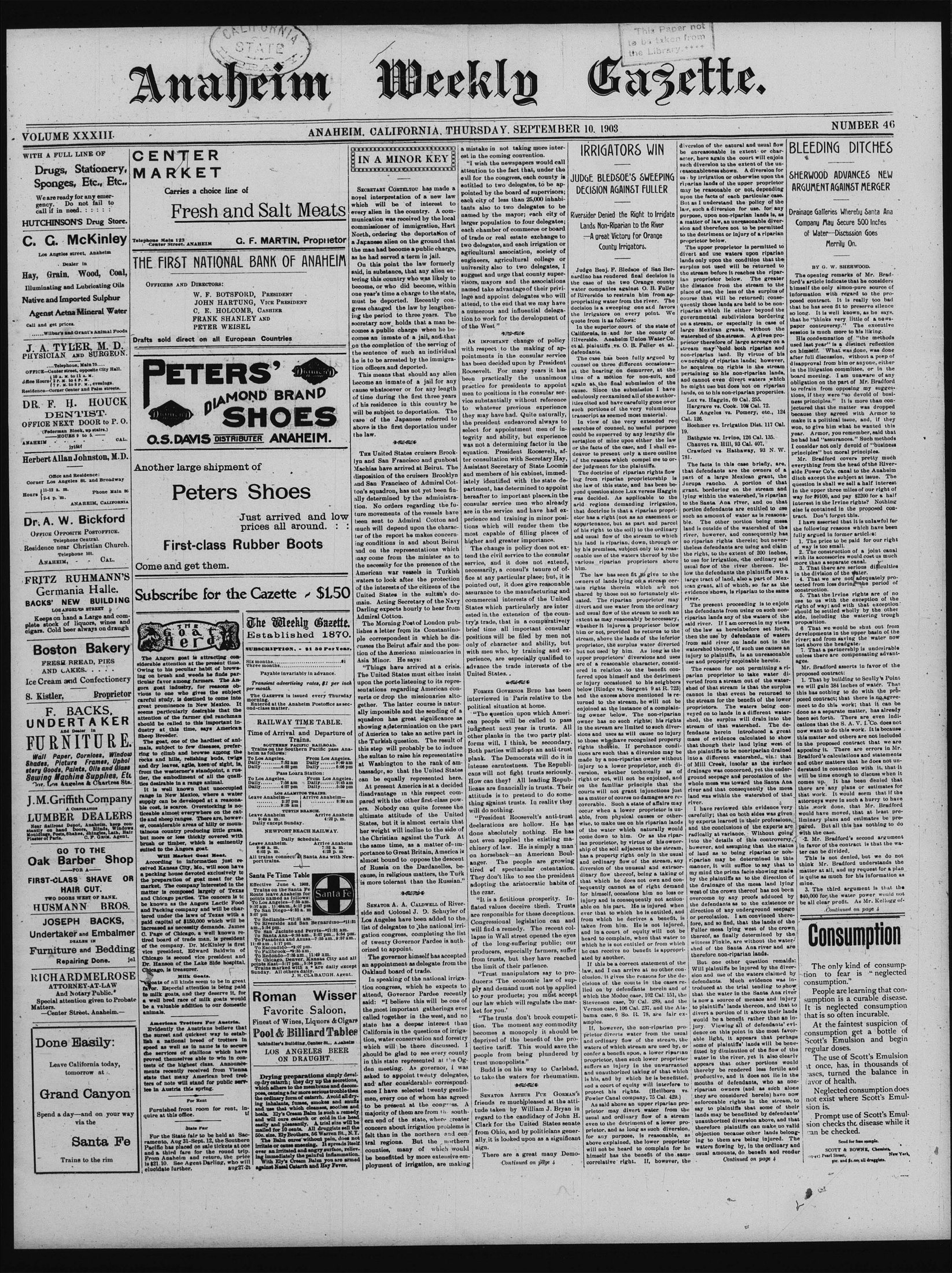
Searchable text
Anaheim
VOLUME XXXIII.
WITH A FULL LINE OF
Drugs, Stationery,
Sponges, Etc., Etc.,
We are ready for any emergency. Do not fail to call if in need. : : : : :
HUTCHINSON'S Drug Store.
C. G. McKinley
Los Angeles street, Anaheim
Dealer in
Hay, Grain, Wood, Coal,
Illuminating and Lubricating Oils
Native and Imported Sulphur
Agent Aetna Mineral Water
Call and get prices.
...Wilbur's and Grant's Animal Foods
J. A. TYLER, M. D.
PHYSICIAN AND SURGEON.
Telephone, Main 75...
OFFICE—Center street, opposite City Hall.
10 A.M. to 11 A.M.
Office Hours: 2 P.M. to 4 P.M.
7 P.M. to 8 P.M., evenings.
Residence—Corner Center and Palm streets.
DR. F. H. HOUCK
DENTIST.
OFFICE NEXT DOOR to P. O.
(Federman Block, up stairs.)
HOURS 9 to 5
ANAHEIM
CAL.
jy154f
CENTER MARKET
Carries a choice line of
Fresh and Salt Meats
Telephone Main 123
Center Street, ANAHEIM
G. F. MARTIN, Prophetor
THE FIRST NATIONAL BANK OF ANAHEIM
OFFICERS AND DIRECTORS:
W. F. BOTSFORD, PRESIDENT
JOHN HARTUNG, VICE PRESIDENT
C. E. HOLCOMB, CASHIER
FRANK SHANLEY AND
PETER WEISEL
Drafts sold direct on all European Countries
PETERS'
DIAMOND BRAND SHOES
O.S.DAVIS DISTRIBUTER ANAHEIM.
Another large shipment of
DR. F. H. HOUCK
DENTIST.
OFFICE NEXT DOOR to P. O.
(Federman Block, up stairs.)
HOURS 9 to 5.
ANAHEIM
CAL.
jy1641
Herbert Allan Johnston, M.D.
Office and Residence:
Corner Los Angeles St. and Broadway
Hours 11-12 a.m.
2-4 p.m.
ANAHEIM, CALIFORNIA
Dr. A. W. Bickford
OFFICE OPPOSITE POSTOFFICE.
Telephone Central.
Residence near Christian Church.
Telephone 101.
ANAHEIM, CAL.
FRITZ RUHMANN'S
Germania Halle.
BACKS' NEW BUILDING
LOS ANGELES STREET
Keeps on hand a Large and complete stock of liquors, wines and cigars. Cold beer always on draught
Boston Bakery
FRESH BREAD, PIES AND CAKES.
Ice Cream and Confectionery
S. Kistler, Proprietor
F. BACKS,
UNDERTAKER
And Desier in
FURNITURE.
Wall Paper, Cornices, Window Shades, Picture Frames, Upholstery Goods, Pallets, Oils and Glass Sewing Machine Supplies, Etc.
Mr. Los Angeles & Chartres Sts.
J.M.Griffith Company
A CORPORATION
LUMBER DEALERS
Near Railroad Depot, Anaheim, keep constantly on hand Doors, Blinds, Windows Mouldings, Posts, Shakes, Shingles, Lath, Hair Plaster of Paris.
GO TO THE Oak Barber Shop
FOR A
FIRST-CLASS SHAVE OR HAIR CUT.
TWO DOORS WEST OF BANK.
The Angora goat is attracting considerable attention at the present time. Owing to his peculiar habit of browsing on brush and weeds he finds particular favor among farmers. The Angora goat industry, for reasons obvious to one who gives the subject careful study, is destined to come into great prominence in New Mexico. It seems particularly desirable that the attention of the farmer and ranchman should be called to this important industry at this time, says American Sheep Breeder.
The goat, one of the hardiest of animals, subject to few diseases, preferring to climb and browse among the rocks and hills, relishing buds, twigs and dry leaves, agile, keen of sight, is from the westerner's standpoint, a rustler, the embodiment of all the qualities desirable in a range animal.
It is well known that unoccupied range in New Mexico, where a water supply can be developed at a reasonable cost, is scarce. Overstocking is noticeable almost everywhere on the cattle and sheep ranges. There are, however, considerable areas of hilly or mountainous country producing little grass, but more or less thickly covered with brush or timber, which is eminently suited to the Angora goat.
Will Market Goat Meat.
According to information just received Kansas City, Mo., will soon have a packing house devoted exclusively to the preparation of goat meat for the market. The company interested in the matter is composed largely of Texas and Chicago parties. The concern is tc
PETERS DIAMOND BRAND SHOES
O.S.DAVIS DISTRIBUTER ANAHEIM.
Another large shipment of Peters Shoes
Just arrived and low prices all around. ::
First-class Rubber Boots
Come and get them.
Subscribe for the Cazette - $1.50
The Weekly Gazette.
Established 1870.
SUBSCRIPTION - $1.50 Per Year.
Six months...$1
Three months...$1
Payable invariably in advance.
Transient advertising rates,$1 per inch per month.
The GAZETTE is issued every Thursday morning.
Entered at the Anaheim Postoffice as second-class matter.
RAILWAY TIME TABLE.
Time of Arrival and Departure of Trains.
SOUTHERN PACIFIC RAILROAD.
Trains on the Southern Pacific pass Anaheim as follows:
To Los Angeles
Daily...7:52 a.m. Dally...9:49 am
Pass Loara Station:
To Los Angeles
Daily...7:56 a.m Dally...9:45 am
Los ALAMITOS TRAINS.
Leave Anaheim—Arrive Anaheim—2:37 pm 8:30 am
TUSTIN BRANCH.
Leave Anaheim 9:49 a.m. 4:22 p.m.
Daily except Sunday.
NEWPORT BEACH RAILWAY.
Daily Schedule.
Leave Anaheim 9:49 a.m. 7:52 a.m.
6:03 p.m. 4:23 p.m.
All trains connect at Santa Ana with Newport trains.
Santa Fe Time Table
Effective June 4, 1903.
Trains on the Santa Fe Route leave Anaheim for points named as follows:
GO TO THE Oak Barber Shop
FOR A FIRST-CLASS SHAVE OR HAIR CUT.
TWO DOORS WEST OF BANK.
HUSMANN BROS.
JOSEPH BACKS,
Undertaker and Embalmer
DEALER IN
Furniture and Bedding
Repairing Done.
JEL
RICHARDMELROSE
ATTORNEY-AT-LAW
And Notary Public.
Special attention given to Probate Matters.
—Center Street. Anaheim.
Done Easily:
Leave California today, tomorrow at Grand Canyon
Spend a day—and on your way via the Santa Fe
Trains to the rim
American Trotters For Austria.
Evidently the Austrians believe that the surest and quickest way to establish a national breed of trotters in speed as well as in name is to secure the services of stallions which have proved themselves able to win in contests of the highest class. Announcements recently received from Vienna state that many American bred trotters of note will stand for public service in Austria this spring.
For Rent
Furnished front room for rent, inquire at this office.
State Fair
For the State fair to be held at Sacramento, Aug 31-Sept. 12, the Southern Pacific has placed on sale tickets at one and a third fare for the round trip. From Anaheim and return, the price is $21.10. See Agent Darling, who will elucidate further.
supply can be developed at a reasonable cost, is scarce. Overstocking is noticeable almost everywhere on the cattle and sheep ranges. There are, however, considerable areas of hilly or mountainous country producing little grass, but more or less thickly covered with brush or timber, which is eminently suited to the Angora goat.
Will Market Goat Meat.
According to information just received Kansas City, Mo., will soon have a packing house devoted exclusively to the preparation of goat meat for the market. The company interested in the matter is composed largely of Texas and Chicago parties. The concern is to be known as the Angora Lactic Food and Packing company and will be chartered under the laws of Texas with a paid capital of $150,000 which will be increased as necessity demands. James C. Page of Chicago, a well known retired board of trade man, is president of the company. Dr. McKinley is first vice president, Edward Baldwin of Chicago is second vice president and Dr. Hanson of the Lake Side hospital, Chicago, is treasurer.
Milk Goats.
Goats of all kinds seem to be in great favor. Especial attention is being paid to milk goats, and they deserve it, for a well bred race of milk goats would be a valuable addition to our domestic animals.
Drying preparations simply develop op dry catarrh; they dry up the secretion which adhere to the membrane and decompose, causing a far more serious trouble than the ordinary form of catarrh. Avoid all dry ing inhalants, fumes, smokes and smoke and use that which cleanses, soothes and heals. Ely's Cream Balm is such a remedy and will cure catarrh or cold in the heat easily and pleasantly. A trial size will be mailed for 10 cents. All druggists sell the 50c. size, Ely Brothers, 56 Warren St., N.Y.
The Balm cures without pain, does not irritate or cause sneezing. It spreads itself over an irritated and angry surface, relieving immediately the painful inflammation.
With Ely's Cream Balm you are armed against Nasal Catarrh and Hay Fever.
IN A MINOR KEY
SECRETARY CORTELYOU has made a novel interpretation of a new law which will be of interest to every alien in the country. A communication was received by the local commissioner of immigration, Hart North, ordering the deportation of a Japanese alien on the ground that the man had become a public charge, as he had served a term in jail.
On this point the law formerly said, in substance, that any alien entering this country who was likely to become, or who did become, within one year’s time a charge to the state, must be deported. Recently congress changed the law by lengthening the period to three years. The secretary now holds that a man becomes a public charge when he becomes an inmate of a jail, and that on the completion of the serving of the sentence of such an individual he is to be arrested by the immigration officers and deported.
This means that should any alien become an inmate of a jail for any cause whatsoever or for any length of time during the first three years of his residence in this country he will be subject to deportation. The case of the Japanese referred to above is the first deportation under the law.
The United States cruisers Brooklyn and San Francisco and gunboat Machias have arrived at Beirut. The disposition of the advisors Brooklyn a mistake in not taking more interest in the coming convention.
"I wish the newspapers would call attention to the fact that, under the call for the congress, each county is entitled to two delegates, to be appointed by the board of supervisors; each city of less than 25,000 inhabitants also to two delegates to be named by the mayor; each city of larger population to four delegates; each chamber of commerce or board of trade or real estate exchange to two delegates, and each irrigation or agricultural association, society of engineers, agricultural college or university also to two delegates, I suggest and urge that county supervisors, mayors and the associations named take advantage of their privilege and appoint delegates who will attend, to the end that we may have a numerous and influential delegation to work for the development of of the West."
AN IMPORTANT change of policy with respect to the making of appointments in the consular service has been decided upon by President Roosevelt. For many years it has been practically the unanimous practice for presidents to appoint men to positions in the consular service substantially without reference to whatever previous experience they may have had. Quite naturally, the president endeavored always to select for appointment men of integrity and ability, but experience was not a determining factor in the equation. President Roosevelt, after consultation with Secretary Hay, Assistant Secretary of State Loomis and members of his cabinet, immed-
IRRIGATORS WIN
JUDGE BLEDSOE'S SWEEPING DECISION AGAINST FULLER
Riversider Denied the Right to Irrigate Lands Non-Riparian to the River —A great Victory for Orange County Irrigators.
Judge Benj. F. Bledsoe of San Bernardino has rendered final decision in the case of the two Orange county water companies against O. B. Fuller of Riverside to restrain him from appropriating water from the river. The decision is a sweeping one and favor the irrigators on every point. We quote from it as follows:
In the superior court of the state of California, in and for the county of Riverside. Anaheim Union Water Co. et al. plaintiffs vs. O. B. Fuller et al defendants.
The case has been fully argued by counsel on three different occasions—at the hearing on demurrer, at the time of a motion for non-suit, and again at the final submission of the cause. Since the submission I have sedulously reexamined all of the authorities cited and have carefully gone over such portions of the very voluminous transcript as seemed most material.
In view of the very extended searches of counsel, no useful purpose could be superserved by any lengthy dissertation of mine upon either the law or the facts of the case, and I shall endeavor to present only a mere outline of the reasons which compel me to order judgment for the plaintiffs.
The doctrine of riparian rights flow
The United States cruisers Brooklyn and San Francisco and gunboat Machias have arrived at Beirut. The disposition of the cruisers Brooklyn and San Francisco of Admiral Cotton's squadron, has not yet been finally determined by the administration. No orders regarding the future movements of the vessels have been sent to Admiral Cotton and much will depend upon the character of the report he makes concerning conditions in and about Beirut and on the representations which may come from the minister as to the necessity for the presence of the American war vessels in Turkish waters to look after the protection of the interests of the citizens of the United States in the sultan's domain. Acting Secretary of the Navy Darling expects hourly to hear from Admiral Cotton.
The Morning Post of London publishes a letter from its Constantinople correspondent in which he discusses the Beirut affair and the position of the American missionaries in Asia Minor. He says:
"Things have arrived at a crisis. The United States must either insist upon the porte listening to its representations regarding American converts or drop the missionaries altogether. The latter course is naturally impossible and the sending of a squadron has great significance as showing a determination on the part of America to take an active part in the Turkish question. The result of this step will probably be to induce the sultan to raise his representative at Washington to the rank of ambassador, so that the United States can be equally represented here.
At present America is at a decided disadvantage in this respect compared with the other first-class powers. Nobody can quite foresee the ultimate attitude of the United States, but it is almost certain that her weight will incline to the side of the Christian against the Turk At the same time, as a matter of importance to Great Britain, America is almost bound to oppose the descent of Russia on the Dardanelles, because, in religious matters, the Turk is more tolerant than the Russian."
This means that should any alien become an inmate of a jail for any cause whatsoever or for any length of time during the first three years of his residence in this country he will be subject to deportation. The case of the Japanese referred to above is the first deportation under the law.
The President Roosevelt, after consultation with Secretary Hay, Assistant Secretary of State Loomis and members of his cabinet, immediately identified with the state department, has determined to appoint hereafter to important places in the consular service men who already are in the service and have had experience and training in minor positions which will render them the most capable of filling places of higher and greater importance.
The change in policy does not extend the civil service to the consular service, and it does not extend, necessarily, a consul's tenure of office at any particular plaee; but, it is pointed out, it does give reasonable assurance to the manufacturing and commercial interests of the United States which particularly are interested in the extension of the country's trade, that in a comparatively brief time all important consular positions will be filed by men not only of character and ability, but with men who, by training and experience, are especially qualified to advance the trade interests of the United States.
Former Governor Budd has been interviewed in Paris relative to the political situation at home.
"The question upon which American people will be called to pass judgment next year is trusts. All other planks in the two party platforms will, I think, be secondary. Both parties will adopt an anti-trust plank. The Democrats will do it in intense eartestness. The Republicans will not fight trusts seriously. How can they? All leading Republicans are financially in trusts. Their attitude is to pretend to do something against trusts. In reality they will do nothing.
"President Roosevelt's anti-trust declarations are hollow. He has done absolutely nothing. He has not even applied the existing machinery of law. He is simply a man on horseback—an American Boulanger. The people are growing tired of spectacular ostentation. They don't like to see the president adopting the aristocratic habits of the czar."
"It is a factious prosperity. In practice the unanimous practice for presidents to appoint men to positions in the consular service substantially without reference to whatever previous experience they may have had. Quite naturally, the president endeavored always to select for appointment men of integrity and ability, but experience was not a determining factor in the equation. President Roosevelt, after consultation with Secretary Hay, Assistant Secretary of State Loomis and members of his cabinet, immediately identified with the state department, has determined to appoint hereafter to important places in the consular service men who already are in the service and have had experience and training in minor positions which will render them the most capable of filling places of higher and greater importance."
The doctrine of riparian rights flowing from riparian proprietorship is the law of this state, and has been beyond question since Lux versus Haggerty was decided. As applicable to this arid regions demanding irrigation that doctrine is that a riparian proprietor has a right (not as an easement or appurtenance, but as part and parcel of his right to the soil) to the ordination and usual flow of the stream to which his land is riparian, down through by his premises, subject only to a reasonable use of the waters thereof by various riparian proprietors about him.
The law has seen fit to give to owners of lands lying on a stream certain rights therein which are not shared by those not so fortunately seated. The riparian proprietor must divert and use water from the ordinance and usual flow of the stream to such extent as may reasonably be necessary whether it injures a proprietor below him or not, provided he returns to the stream, above the lands of the inferior proprietor, the surplus water diversion but not used by him. As long as this upper proprietors' diversions and use are of a reasonable character, considered in relation to the benefit offered upon himself and the detriment or injury occasioned to his neighbor below (Rindge vs. Sargent 9 at R.7) and the excess mentioned 9 at turnover to the stream, he will not enjoined at the instance of a complaining owner below. The non-riparian owner has no such rights; his right in the stream are limited to such divisions and uses as will cause no injury to those who have recognized proper rights therein. If perchance conditions are such that a diversion may made by a non-riparian owner with injury to a lower proprietor, such version, whether technically as right or not, will not be enjoined on the familiar principle that courts will not grant injunctions as a matter of course no damages are coverable. Such a state of affairs may occur when a lower proprietor is able, from physical causes or otherwise, to make use on his riparian land of the water which naturally wades down to him. Or as the riparian proprietor, by virtue of his own ship of the soil adjacent to the stream has a property right only in the upland ordinary flow of the stream, diversion of the unusual and extraordinary flow thereof, being a taking that which he does not own and sequentially cannot as of right deny for himself, occasions him no loss
SENATOR A. A. CALDWELL of River-side and Colonel J. D. Schuyler of Los Angeles have been added to the list of delegates to the national irrigation congress, completing the list of twenty Governor Pardee is authorized to appoint.
The governor himself has accepted an appointment as delegate from the Oakland board of trade.
In speaking of the national irrigation congress, which he expects to attend, Governor Pardee recently said: "I believe this will be one of the most important gatherings ever called together in the west, and no state has a deeper interest than California in the questions of irrigation, water conservation and forestry which will be there discussed. I should be glad to see every county in this state represented at the Ogden meeting. As governor, I was asked to appoint twenty delegates, and after considerable correspondence I have selected twenty gentlemen, every one of whom has agreed to be present at the congress. A majority of them are from the southern end of the state, where greater concern about irrigation problems is felt than in the northern and central regions. But the northern counties, many of which would be benefitted by more extensive employment of irrigation, are making
"President Roosevelt's anti-trust declarations are hollow. He has done absolutely nothing. He has not even applied the existing machinery of law. He is simply a man on horseback—an American Boulanger. The people are growing tired of spectacular ostentation. They don't like to see the president adopting the aristocratic habits of the czar.
"It is a fictitious prosperity. Inflated values deceive them. Trusts are responsible for these deceptions. Congressional legislation can and will find a remedy. The recent collapse in Wall street opened the eyes of the long-suffering public; our producers, especially farmers, suffer from trusts, but they have reached the limit of their patience.
"Trust manipulators say to producer: 'The economic law of supply and demand must not be applied to your products; you must accept our law which will regulate the market for you.'"
"The trusts don't brook competition. The moment any commodity becomes a monopoly it should be deprived of the benefit of the protective tariff. This would save the people from being plundered by trust monopolists."
Budd is on his way to Carlsbad, to take the waters for rheumatism.
SENATOR ARTHUR PUE GORMAN's friends re much pleased at the attitude taken by William J. Bryan in regard to the candidacy of John H. Clark for the United States senate from Ohio, and by politicians generally it is looked upon as a significant sign.
There are a great many Demo-continued on page 4
As said above an upper riparian prietor may divert water from usual and ordinary flow of a river even to the detriment of a lower prietor, and as long as such diver for any purpose, is reasonable above explained, the lower prop will not be heard to complain himself has the benefit of the correlative right. If, however
Gazette.
1903 NUMBER 46
BIGATORS WIN
BLEEDSOE'S SWEEPING
ION AGAINST FULLER
Denied the Right to Irrigate
Non-Riparian to the River
Great Victory for Orange
County Irrigators.
Benj. F. Bledsoe of San Bernardo rendered final decision in favor of the two Orange county companies against O. B. Fuller, who had to restrain him from applying water from the river. The company was a sweeping one and favors irrators on every point. We can it as follows:
Superior court of the state of California, in and for the county of Anaheim Union Water Co., sentiffs vs. O. B. Fuller et al.
The has been fully argued by three different occasions—hearing on demurrer, at the motion for non-suit, and in the final submission of the case the submission I have reexamined all of the authorizations and have carefully gone over portions of the very voluminous material as seemed most material.
Now of the very extended relief counsel, no useful purpose was served by any lengthy discussion of mine upon either the law acts of the case, and I shall endeavor to present only a mere outline reasons which compel me to order for the plaintiffs.
ctrine of riparian rights flow diversion of the natural and usual flow be unreasonable in extent or character, here again the court will enjoin such diversion to the extent of the unreasonableness shown. A diversion for use by irrigation or otherwise upon the riparian lands of the upper proprietor may be reasonable or not, depending upon the facts of each particular case. But as I understand the policy of the law, such a diversion for use, for any purpose, upon non-riparian lands is, as a matter of law, an unreasonable diversion and therefore not to be permitted to the detriment or injury of a riparian proprietor below.
The upper proprietor is permitted to divert and use waters upon riparian lands only upon the condition that the surplus not used will be returned to the stream before it reaches the riparian proprietor below. The greater distance from the stream to the place of use, the less of the surplus of course that will be returned; consequently those lands are held to be non-riparian which lie either beyond the governmental subdivisions bordering on a stream, or especially in case of large Mexican grants, without the watershed of the stream. A given proprietor therefore of large acreage on a stream may hold both riparian and non-riparian land. By virtue of his ownership of riparian lands; however, he acquires no rights in the stream pertaining to his non-riparian lands, and cannot even divert waters which he might use but does not on riparian lands, on to his non-riparian properties.
Lux vs. Haggin, 69 Cal. 255.
Hargrave vs. Cook, 108 Cal. 72.
Los Angeles vs. Pomery, etc., 124 Cal. 126.
Boehmer vs. Irrigation Dist. 117 Cal. 19.
Bathgate vs. Irvine, 126 Cal. 135.
Chauvet vs. Hill, 93 Cal. 407.
Crawford vs. Hathaway, 93 N.W. 781.
The facts in this case briefly, are that defendants are the owners of a
BLEEDING DITCHES
SHERWOOD ADVANCES NEW ARGUMENT AGAINST MERGER
Drainage Gafferies Whereby Santa Ana Company May Secure 500 Inches of Water—Discussion Goes Merrily On.
BY G. W. SHERWOOD.
The opening remarks of Mr. Bradford's article indicate that he considers himself the onlyimon-pure source of information with regard to the proposed contract. It is really too bad that he has seen fit to preserve silence so long. It is well known, as he says, that he "thinks very little of a newspaper controversy." The executive session is much more to his liking.
His condemnation of "the methods used last year" is a distinct reflection on himself. What was done, was done after full discussion, without a peep of disapproval from him or anyone, either in the litigation committee, or in the board meeting. I am unaware of any obligation on the part of Mr. Bradford to refrain from opposing my suggestions, if they were "so devoid of business principles." It is more than conjectured that the matter was dropped because they agreed with Armor to make it a political issue, and, if they won, to give him what he wanted this year. Armor, you remember, said that he had had "assurances." Such methods I consider not only devoid of "business principles" but moral principles.
Mr. Bradford covers pretty much everything from the head of the River-side Power Co.'s canal to the Anaheim
A motion for non-suit, and
the final submission of the
since the submission I have
may reexamined all of the authorand have carefully gone over
elections of the very voluminous
as seemed most material.
Law of the very extended reof counsel, no useful purpose
superseded by any lengthy disof mine upon either the law
sets of the case, and I shall ento present only a mere outline
reasons which compel me to ordment for the plaintiffs.
Detrine of riparian rights flow
in riparian proprietorship is
of this state, and has been bestion since Lux versus Haggin
included. As applicable to the
regions demanding irrigation,
detrine is that a riparian propriright (not as an easement or
advance, but as part and parcel
right to the soil) to the ordinary
flow of the stream to which
is riparian; down, through or
remises, subject only to a reassease of the waters thereof by the
riparian proprietors above
Law has seen fit to give to the
of lands lying on a stream cerrights therein which are not
by those not so fortunately sittled. The riparian proprietor may
and use water from the ordinary
flow of the stream to such an
as may reasonably be necessary,
if it injures a proprietor below
not, provided he returns to the
above the lands of the inferior
ator, the surplus water diverted
used by him. As long as the
proprietors' diversions and uses
are reasonable character, considration to the benefit conpromise himself and the detriment
may occasioned to his neighbors
(Ridge vs. Sargent 9 at R. 723)
the excess above mentioned is reduced to the stream, he will not be
ad at the instance of a complainner below. The non-riparian
has no such rights; his rights
stream are limited to such divernd uses as will cause no injury
who have recognized property
therein. If perchance condirence such that a diversion may be
by a non-riparian owner without
to a lower proprietor, such difer, whether technically as of
nor not, will not be enjoined, and
the familiar principle that the
will not grant injunctions just
letter of course no damages are reable. Such a state of affairs may
when a lower proprietor is unfrom physical causes or otherto make use on his riparian lands
in water which naturally would
down to him. Or as the riparipr俏itor, by virtue of his owner,
of the soil adjacent to the stream,
property right only in the usual
ordinary flow of the stream, any
ion of the unusual and extraorflow thereof, being a taking of
which he does not own and contains cannot as of right demand
him, occasions him no loss or
is consequently not action-
The facts in this case briefly, are,
that defendants are the owners of a
part of a large Mexican grant, the
Jurupa rancho. A portion of that
grant, bordering on the stream and
lying within the watershed, is riparian
to the Santa Ana river, and on that
portion defendants are entitled to use
such an amount of water as is reasonable.
The other portion being mesa land is outside of the watershed of the river, however, and consequently has no riparian rights therein; but nevertheless defendants are using and claim the right, to the extent of 200 inches,
to use for irrigation, the ordinary and usual flow of the river thereon. Below the defendants the plaintiffs own a large tract of land, also a part of Mexican grant, all of which, so far as the evidence shows, is riparian to the same river.
The present proceeding is to enjoin
the defendants from using on such nonriparian lands any of the waters of the said river. If I am correct in my views of the law as hereinbefore set forth,
then the use by defendants of waters from said river on lands not in the watershed thereof, if such use causes an injury to plaintiffs, is an unreasonable use and properly enjoainable herein.
The reason for not permitting a riparian proprietor to take water diverted from a stream out of the watershed of that stream is that the surplus cannot in that event be returned to the stream for the benefit of the lower proprietors. The waters being conveyed on to lands in a different watershed, the surplus will drain into the stream of that watershed. The defendants herein introduced a great mass of evidence calculated to show that though their land lying west of the plaintiffs to be nonriparian drained into a different watershed, viz.: that Mill Creek, insolar as the surface drainage was concerned, yet the underground seepage and percolation of the whole mesa was toward the Santa Ana river and that consequently the mesa land was within the watershed of that river.
I have reviewed this evidence very carefully; that on both sides was given by experts learned in their professions, and the conclusions of the experts are radically at variance. Without going into the details of this controversy, however, and assuming that the status of land as to being riparian or nonriparian may be determined in this manner, it will suffice to say that to my mind the prima facie showing made by the plaintiffs as to the direction of the drainage of the mesa land lying west of the crown thereof has not been overcome by any proofs adduced by board meeting. I am unaware of any obligation on the part of Mr. Bradford to refrain from opposing my suggestions, if they were "so devoid of business principles." It is more than conjectured that the matter was dropped because they agreed with Armor to make it a political issue, and, if they won, to give him what he wanted this year. Armor, you remember, said that he had had "assurances." Such methods I consider not only devoid of "business principles" but moral principles.
Mr. Bradford covers pretty much everything from the head of the River-side Power Co's canal to the Anaheim ditch except the subject at issue. The question is shall we sell a half interest in the upper three miles of our right of way for $9100, and pay $2200 for a half interest in the Irvine rights? Nothing else is contained in the proposed contract. Don't forget this.
I have asserted that it is unlawful for the following reasons which have been fully argued in former articles:
1. The price to be paid for our right of way is too small.
2. The construction of a joint canal with its accessories would cost us much more than a separate canal.
3. That there are serious difficulties in the division of the water.
4. That we are not adequately protected from loss during the period of construction.
5. That the Irvine rights are of no use to us with the exception of the right of way; and with that exception should be settled wholly by the other side, including the watering trough proposition.
6. That we would be shut out from developments in the upper basin of the river; and from saving the water now lost above the headgate.
7. That a partnership is undesirable unless there are compensating advantages.
Mr. Bradford asserts in favor of the proposed contract:
1. That by building Scully's Point we will gain 384 inches of water. That this has nothing to do with the proposed contract; that there is no agreement to do this work; that it can be done as a separate matter, has already been set forth. There are even indications that the S.A.V.I.Co does not now want to do this work. It is because this matter and others are not included in the proposed contract that we are apposing it. There are errors in Mr. Bradford's calculations and statements and other matters that he does not understand in connection with it; that it will be time enough to discuss when it comes up. It has been denied that there are any plans or estimates for that work. It would seem that if the attorneys were in such a hurry to have this work done, that Mr. Bradford would have moved, that at least preliminary plans and estimates be prepared. But all this has nothing to do with the case.
2. Mr. Bradford's second argument in favor of the contract is that the water can be divided.
This is not denied, but we do not think Mr. Bradford understands the matter at all, and my request for a plan is quite as much for his information as mine.
3. The third argument is that the $40,000 for the water power would not
Consumption
The only kind of consumption to fear is "neglected consumption."
People are learning that consumption is a curable disease. It is neglected consumption that is so often incurable.
At the faintest suspicion of consumption get a bottle of Scott's Emulsion and begin regular doses.
The use of Scott's Emulsion at once, has, in thousands of cases, turned the balance in favor of health.
Neglected consumption does not exist where Scott's Emulsion is.
Prompt use of Scott's Emulsion checks the disease while it can be checked.
Send for free sample.
SCOTT & BOWNE, Chemists,
90415 Pearl Street,
New York,
pcc. and $1.00 all draggists.