anaheim-gazette 1903-05-07
Scanned page
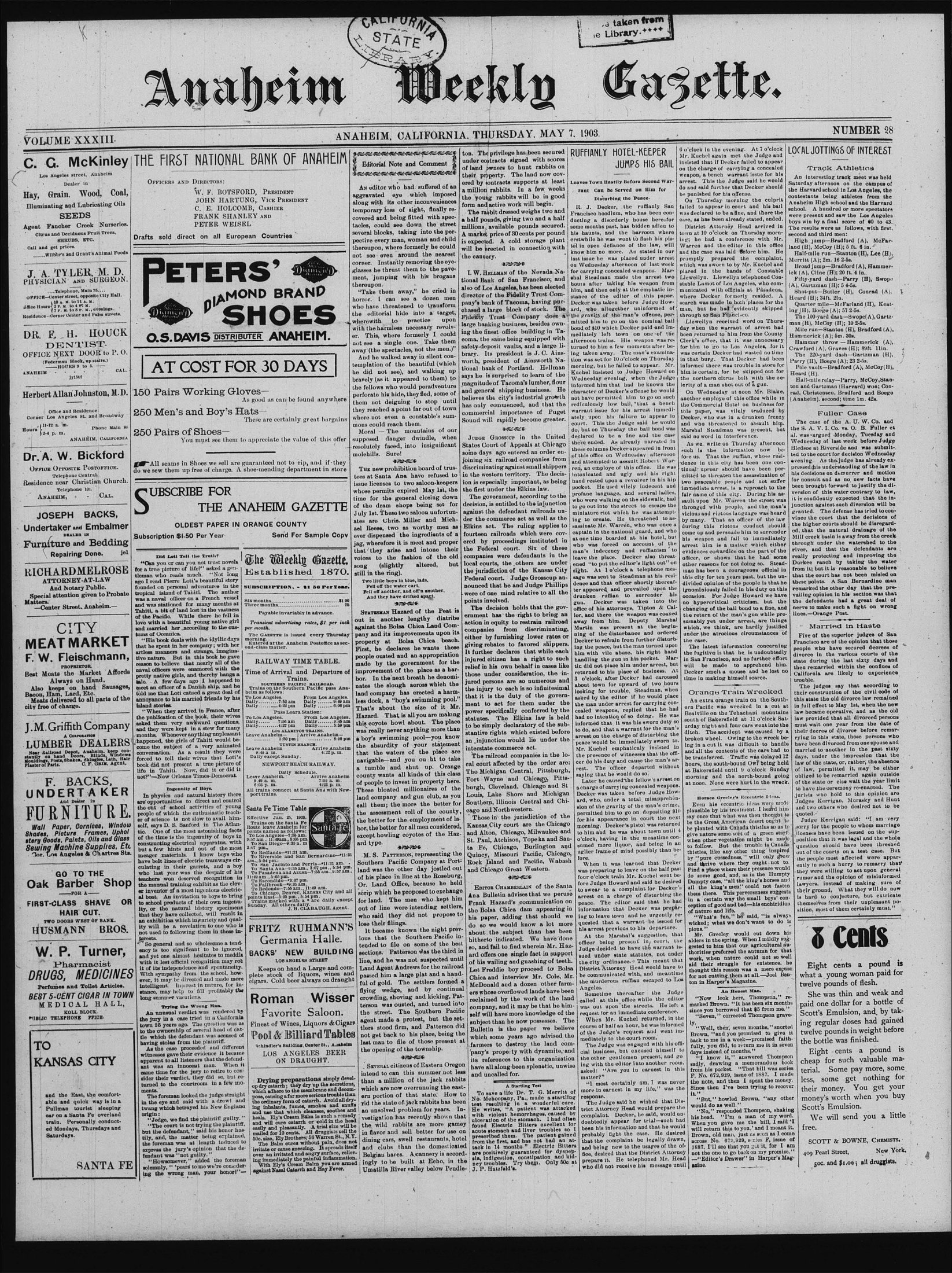
Searchable text
Anaheim
VOLUME XXXIII.
C. G. McKinley
Los Angeles street, Anaheim
Dealer in
Hay, Grain, Wood, Coal,
Illuminating and Lubricating Oils
SEEDS
Agent Fancher Creek Nurseries.
Citrus and Deciduous Fruit Trees,
SHRUBS, ETC.
Call and get prices.
...Wilbur's and Grant's Animal Foods
J. A. TYLER, M. D.
PHYSICIAN AND SURGEON.
Telephone, Main 75...
OFFICE—Center street, opposite City Hall.
10 A.M. to 11 A.M.
2 P.M. to 4 P.M.
7 P.M. to 8 P.M., evenings.
Residence—Corner Center and Palm streets.
DR. F. H. HOUCK
DENTIST.
OFFICE NEXT DOOR to P. O.
(Federman Block, up stairs.)
HOURS 9 to 6
ANAHEIM CAL.
jy15tt
Herbert Allan Johnston, M.D.
Office and Residence:
Corner Los Angeles St. and Broadway
Hours
11-12 a.m.
2-4 p.m.
ANAHEIM, CALIFORNIA
Dr. A. W. Bickford
OFFICE OPPOSITE POSTOFFICE.
THE FIRST NATIONAL BANK OF ANAHEIM
OFFICERS AND DIRECTORS:
W. F. BOTSFORD, President
JOHN HARTUNG, Vice President
C. E. HOLCOMB, Cashier
FRANK SHANLEY AND
PETER WEISEL
Drafts sold direct on all European Countries
PETERS'
DIAMOND BRAND
SHOES
O.S. DAVIS DISTRIBUTER ANAHEIM.
AT COST FOR 30 DAYS
150 Pairs Working Gloves—As good as can be found anywhere
250 Men’s and Boy’s Hats—These are certainly great bargains
250 Pairs of Shoes—You must see them to appreciate the value of this offer
All seams in Shoes we sell are guaranteed not to rip, and if they do we sew them up free of charge. A shoe-mending department in store
Herbert Allan Johnston, M.D.
Office and Residence:
Corner Los Angeles St. and Broadway
Hours 11-12 a.m.
2-4 p.m.
Phone Main 80
ANAHEIM, CALIFORNIA
Dr. A. W. Bickford
OFFICE OPPOSITE POSTOFFICE.
Telephone Central.
Residence near Christian Church.
Telephone 101.
ANAHEIM, CAL.
JOSEPH BACKS,
Undertaker and Embalmer
DEALER IN
Furniture and Bedding
Repairing Done.
RICHARDMELROSE
ATTORNEY-AT-LAW
And Notary Public.
Special attention given to Probate Matters.
—Center Street, Anaheim.
CITY MEAT MARKET
F. W. Fleischmann,
PROPRIETOR
Best Moats the Market Affords Always on Hand.
Also keeps on hand Sausages, Bacon, Ham, Lard, Etc.
Meats delivered to all parts of the city free of charge.
J.M. Griffith Company
A CORPORATION
LUMBER DEALERS
Near Railroad Depot, Anaheim, keep constantly on hand Doors, Blinds, Windows Mountings, Posts, Shakes, Shingles, Lath, Hair Plaster of Paris.
F. BACKS,
UNDERTAKER
And Desier in FURNITURE.
Wall Paper, Cornices, Window Shades, Picture Frames, Upholstery Goods, Paints, Oils and Glass Sewing Machine Supplies, Etc.
Dr. Los Angeles & Chartres Sts.
GO TO THE Oak Barber Shop — FOR A —
150 Pairs Working Gloves—
As good as can be found anywhere
250 Men’s and Boy’s Hats—
These are certainly great bargains
250 Pairs of Shoes—
You must see them to appreciate the value of this offer
All seams in Shoes we sell are guaranteed not to rip, and if they do we sew them up free of charge. A shoe-mending department in store
SUBSCRIBE FOR THE ANAHEIM GAZETTE
OLDEST PAPER IN ORANGE COUNTY
Subscription $1.50 Per Year
Send For Sample Copv
Did Leti Tell the Truth?
"Can you or can you not trust novels for a true picture of life?" asked a gentleman who reads much. "Not long ago I read Pierre Loti's beautiful story founded on personal adventures in the tropical island of Tahiti. The author was a naval officer on a French vessel and was stationed for many months at Tahiti, a bit of land lost in the vastness of the Pacific. While there he fell in love with a beautiful young native girl and married her according to the customs of Oceanica.
"His book deals with the idyllic days that he spent in her company; with her artless manners and strange, imaginative nature. But in this book he gave reason to believe that nearly all of the naval officers were enamored with the pretty native girls, and thereby hangs a tale. A few days ago I happened to meet an officer of a Danish ship, and he told me that Loti caused a great deal of annoyance to his married friends by his island stories.
"When they arrived in France, after the publication of the book, their wives asked them very awkward questions, and they were kept in a stew for many months. Whenever anything unpleasant happened, the girls of Tahiti would become the subject of a very animated conversation. As a result they were forced to tell their wives that Loti's book did not present a true picture of life in Tahiti. Now, did it or did it not?"—New Orleans Times-Democrat.
Ingenuity of Boys.
In physics and natural history there are opportunities to direct and control the out of school activities of young people of which the enthusiastic teacher of science is not slow to avail himself, says D. S. Sanford in The Atlantic. One of the most astonishing facts of the time is the ingenuity of boys in constructing electrical apparatus, with but a few hints and out of the most menagerial materials. I know boys who have belt lines of electric tramways circulating in their garrets, and a boy who last year was the despair of his teachers won deserved recognition in the manual training exhibit as the clever inventor of a most ingenious electrical boat. An invitation to boys to bring
The Weekly Gazette.
Established 1870.
SUBSCRIPTION - $1.50 Per Year.
Six months...$1.00
Three months...75
Payable invariably in advance.
Transient advertising rates,$1 per inch per month.
The GAZETTE is issued every Thursday morning.
Entered at the Anaheim Postoffice as second-class matter.
RAILWAY TIME TABLE.
Time of Arrival and Departure of Trains.
SOUTHERN PACIFIC RAILROAD.
Trains on the Southern Pacific pass Anaheim as follows:
To Los Angeles.
Daily...7:52 am Daily...9:49 am Daily...4:22 pm Daily...6:06 pm
Pass Loara Station:
To Los Angeles.
Daily...7:56 am Daily...9:48 am Daily...4:27 pm Daily...5:59 pm
Los ALAMITOS TRAINS.
Leave Anaheim...5:50 pm Leave Anaheim...8:00 pm
TUSTIN BRANCH.
Leave Anaheim...4:29 p.m. Daily except Sunday.
NEWPORT BEACH RAILWAY.
Daily Schedule.
Leave Anaheim...Arrive Anaheim
9:49 a.m. 7:52 a.m. 6:08 p.m. 4:23 p.m.
All trains connect at Santa Ana with Newport trains.
Santa Fe Time Table
Effective Jan. 25, 1903.
Trains on the Santa Fe Route leave Anaheim for points named as follows:
To Los Angeles...7:58 am 9:07 am 11:48 am 11:49 am 5:05 pm 5:06 pm 3:07 pm.
To Redlands...11:31 am To Riverside and San Bernardino...11:31 am 5:54 pm.To San Jacinto and Perris...11:31 am 5:54 pm.To Santa Ana...9:35 am 3:07 am 5:54 pm.To Pasadena and Azusa...7:55 am 9:57 am 11:49 am 5:05 pm.To Easondillo...3:07 pm.To Fallbrook...9:35 am To Redondo...7:55 am 11:49 am To Chicago, Denver, Kansas City and all points East...5:05 pm 5:54 pm.
GO TO THE Oak Barber Shop
FOR A
FIRST-CLASS SHAVE OR HAIR CUT.
TWO DOORS WEST OF BANK.
HUSMANN BROS.
W. P. Turner,
Pharmacist
DRUGS, MEDICINES
Perfumes and Toilet Articles.
BEST 5-CENT CIGAR IN TOWN
MEDICAL HALL,
KOLL BLOCK.
PUBLIC TELEPHONE FFICE.
TO KANSAS CITY
and the East, the comfortable and quick way is in a Pullman tourist sleeping car on a Santa Fe overland train. Personally conducted Mondays, Thursdays and Saturdays.
SANTA FE
are opportunities to direct and control the out of school activities of young people of which the enthusiastic teacher of science is not slow to avail himself, says D. S. Sanford in The Atlantic. One of the most astonishing facts of the time is the ingenuity of boys in constructing electrical apparatus, with but a few hints and out of the most meager materials. I know boys who have belt lines of electric tramways circulating in their garrets, and a boy who last year was the despair of his teachers won deserved recognition in the manual training exhibit as the clever inventor of a most ingenious electrical boat. An invitation to boys to bring to school products of their own ingenuity, or the natural history specimens that they have collected, will result in an exhibition which invariety and quality will be a revelation to one who is not used to following them in these interests.
So general and so wholesome a tendency is too significant to be ignored, and yet one almost hesitates to meddle with it lest official recognition may rob it of its independence and spontaneity. With sympathy from the school, however, it may be directed and made more intelligent. Interest in nature, for instance, may help to fill profitably the long summer vacations.
Trying the Wrong Man.
An unusual verdict was rendered by the jury in a case tried in a California town 25 years ago. The question was as to the ownership of several head of cattle which the defendant was accused of having stolen from the plaintiff.
As the case proceeded and different witnesses gave their evidence it became apparent to all listeners that the defendant was an innocent man. When it came time for the jury to retire to consider their verdict, they did so, but returned to the courtroom in a few moments.
The foreman looked the judge straight in the eye and said with a drawl and twang which betrayed his New England origin:
"Judge, we find the plaintiff guilty."
"The court is not trying the plaintiff, but the defendant," said his honor hastily, and, the matter being explained, the foreman was at length induced to express the jury's opinion that the defendant was "not guilty."
"Howsomever," added the foreman solemnly, "'pears to me we're considering the wrong man, your honor!"—
Santa Fe Time Table
Effective Jan. 25, 1903.
Trains on the Santa Fe Route leave Anaheim for points named as follows:
To Los Angeles—7:55 am.
9:57 am.
11:49 am.
5:06 pm.
To San Diego—9:35 a.m.
3:07 pm.
To Redlands—11:31 am.
To Riverside and San Bernardino—11:31 am.
To San Jacinto and Perris—11:31 am.
To Santa Ana—9:35 am.
3:07 pm.
To Pasadena and Azusa—7:55 am.
9:57 am.
11:49 am.
5:06 pm.
To Escondido—3:07 pm.
To Fallbrook—9:35 am.
To Redondo—7:55 am.
11:49 am.
To Chicago, Denver, Kansas City and all points East—5:06 pm.
5:54 pm.
Trains marked with a * are daily except Sunday. All others daily.
FRITZ RUHMANN'S Germania Halle.
BACKS' NEW BUILDING
LOS ANGELES STREET
Keeps on hand a Large and complete stock of liquors, wines and cigars. Cold beer always on draught
Roman Wisser
Favorite Saloon.
Finest of Wines, Liquors & Cigars
Pool & Billiard Tables
Sahindler's Building, Center St., Anaheim
LOS ANGELES BEER ON DRAUGHT.
Drying preparations simply develop dry catarrh; they dry up the secretions, which adhere to the membrane and decompose, causing a far more serious trouble than the ordinary form of catarrh. Avoid all drying inhalants, fumes, smokes and snuffs and use that which cleanses, soothes and heals. Ely's Cream Balm is such a remedy and will cure catarrh or cold in the head easily and pleasantly. A trial size will be mailed for 10 cents. All druggists sell the 50c size, Ely Brothers; 56 Warren St., N.Y.
The Balm cures without pain, does not irritate or cause sneezing. It spreads itself over an irritated and angry surface, relieving immediately the painful inflammation.
With Ely's Cream Balm you are armed against Nasal Catarrh and Hay Fever.
Weekly Gazette
ANAHEIM, CALIFORNIA, THURSDAY, MAY 7, 1903.
Editorial Note and Comment
An editor who had suffered of an aggravated eye which imposed along with its other inconveniences temporary loss of sight, finally recovered and being fitted with spectacles, could see down the street several blocks, taking into the perspective every man, woman and child thereupon, where formerly he could not see even around the nearest corner. Instantly removing the eyeglasses he thrust them to the pavement, jumping with his brogans thereupon.
"Take them away," he cried in horror. I can see a dozen men who have threatened to transform the editorial hide into a target, wherewith to practice upon with the harmless necessary revolver. This, where formerly I could not see a single one. Take them away (the spectacles, not the men.)"
And he walked away in silent contemplation of the beautiful (which he did not see), and walking up bravely (as it appeared to them) to the fellows who would peradventure perforate his hide, they fled, some of them not deigning to stop until they reached a point far out of town where not even a constable's summons could reach them.
Moral — The mountains of our supposed danger dwindle, when resolutely faced, into insignificant molehills. Sure!
The new prohibition board of trusts ton. The privilege has been secured under contracts signed with scores of land owners to hunt rabbits on their property. The land now covered by contracts supports at least a million rabbits. In a few weeks the young rabbits will be in good form and active work will begin.
The rabbit dressed weighs two and a half pounds, giving two and a half millions available pounds secured. A market price of 30 cents per pound is expected. A cold storage plant will be erected in connection with the canery.
I.W. HELLMAN of the Nevada National Bank of San Francisco, and also of Los Angeles, has been elected director of the Fidelity Trust Company's bank of Tacoma, having purchased a large block of stock. The Fidelity Trust Company does a large banking business, besides owning the finest office building in Tacoma, the same being equipped with safety-deposit vaults, and a large library. Its president is J.C.Ainsworth, president of Ainsworth National bank of Portland. Hellman says he is surprised to learn of the magnitude of Tacoma's lumber, flour and general shipping business. He believes the city's industrial growth has only commenced, and that the commercial importance of Puget Sound will rapidly become greater.
JUDGE GROSSOUP in the United States Court of Appeals at Chicago some days ago entered an order enjoining six railroad companies from discriminating against small shippers in the western territory. The decision
RUFFIANLY HOTEL-KEEPER JUMPS HIS BAIL
Leaves Town Hastily Before Second Warrant Can be Served on Him for Disturbing the Peace.
R. J. Decker, the ruffianly San Francisco hoodlum, who has been conducting a disorderly house here for some months past, has bidden adieu to his haunts, and the barroom where erstwhile he was wont to flash his pistol in open defiance of the law, will know him no more. As stated in our last issue he was placed under arrest on Wednesday afternoon of last week for carrying concealed weapons. Marshal Steadman made the arrest two hours after taking his weapon from him, and then only at the emphatic instance of the editor of this paper. Decker was taken before Judge Howard, who altogether uninformed on the gravity of the man's offense, permitted him to go on the nominal bail bond of $10 which Decker paid and immediately left town on one of the afternoon trains. His weapon was returned to him a few moments after being taken away. The man's examination was set for 10 o'clock on Thursday morning, but he failed to appear. Mr. Kuchel insisted to Judge Howard on Wednesday evening, when the Judge informed him that had he known the character of Decker's offense he would not have permitted him to go on such rediculously low bail; that a bench warrant issue for his arrest immediately upon his failure to appear in court. This the Judge said he would do, but on Thursday the bail bond was declared to be a fine and the case there ended. As already narrated in these columns Decker appeared in front of this office on Wednesday afternoon and attempted to assault Robert Warren, an employee of this office. He was interrogated and ugly and his right...
The new prohibition board of trustees at Santa Ana have refused to issue licenses to two saloon-keepers whose permits expired May 1st, the time for the general closing down of the dram shops being set for July 1st. These two saloon unfortunates are Chris Miller and Michael Reese, two as worthy men as ever dispensed the ingredients of a jag, wherefore it is meet and proper that they arise and intone their voices to the fashion of the old song (slightly altered, but still in the ring).
Two little boys in blue, lads,
Fell off the water cart,
Fell off another, and off another,
And they have drifted apart.
STATESMAN Hazard of the Peat is out in another lengthy diatribe against the Bolsa Chica Land Company and its improvements upon its property at Bolsa Chica beach. First, he declares he wants these people ousted and an appropriation made by the government for the improvement of the place as a harbor. In the next breath he denominates the slough across which the land company has erected a harmless dock, a "boy's swimming pool." That’s about the size of it Mr. Hazard. That is all you are making this coyote howl about. The place was really never anything more than a boy’s swimming pool—you know the absurdity of your statement that the waters of the place are navigable—and you ou ht to take a tumble and shut up. Orange county wants all kinds of this class of people to invest in property here. These bloated millionaires of the land company and gun club, as you call them; the more the better for the assessment roll of the county, the better for the employment of labor, the better for all men considered, except howling coyotes of the Hazard type.
M.S. PATTerson, representing the Southern Pacific Company at Portland was the other day jostled out of his place in line at the Roseburg, Or. Land Office, because he held script which he proposed to exchange for land. The man who kept him bravely (as it appeared to them) to the fellows who would peradventure perforate his hide, they fled, some of them not designing to stop until they reached a point far out of town where not even a constable’s summons could reach them.
Moral — The mountains of our supposed danger dwindle, when resolutely faced, into insignificant molehills. Sure!
The new prohibition board of trustees at Santa Ana have refused to issue licenses to two saloon-keepers whose permits expired May 1st, the time for the general closing down of the dram shops being set for July 1st. These two saloon unfortunates are Chris Miller and Michael Reese, two as worthy men as ever dispensed the ingredients of a jag, wherefore it is meet and proper that they arise and intone their voices to the fashion of the old song (slightly altered, but still in the ring).
Two little boys in blue, lads,
Fell off the water cart,
Fell off another, and off another,
And they have drifted apart.
JUDGE GROSSCUP in the United States Court of Appeals at Chicago some days ago entered an order enjoining six railroad companies from discriminating against small shippers in the western territory. The decision is especially important, as being the first under the Elkins law.
The government, according to the decision, is entitled to the injunction against the defendant railroads under the commerce act as well as the Elkins act. The ruling applies to fourteen railroads which were covered by proceedings instituted in the Federal court. Six of these companies were defendants in the local courts, the others are under the jurisdiction of the Kansas City Federal court. Judge Grosscup announced that he and Judge Phillips were of one mind relative to all the points involved.
The decision holds that the government has the right to bring an action in equity to restrain railroad companies from discriminating, either by furnishing lower rates or giving rebates to favored shippers. It further declares that while each injured citizen has a right to such relief in his own behalf in cases like those under consideration, the injured persons are so numerous and the injury to each is so infinitesimal that it is the duty of the government to act for them under the power specifically conferred by the statutes. The Elkins law is held to be simply declaratory of the substantive rights which existed before an injunction would lie under the interstate commerce act.
The railroad companies in the local court affected by the order are: The Michigan Central, Pittsburgh, Fort Wayne and Chicago, Pittsburgh, Cleveland, Chicago and St. Louis, Lake Shore and Michigan Southern, Illinois Central and Chicago and Northwestern.
Those in the jurisdiction of the Kansas City court are the Chicago and Alton, Chicago, Milwaukee and St. Paul, Atchison, Topeka and Santa Fe, Chicago, Burlington and Quincy, Missouri Pacific, Chicago, Rock Island and Pacific, Wabash and Chicago Great Western.
EDITOR CHAMBERLAIN of the Santa Ana Bulletin advises that we peruse says he is surprised to learn of the magnitude of Tacoma’s lumber, flour and general shipping business. He believes the city’s industrial growth has only commenced, and that the commercial importance of Puget Sound will rapidly become greater.
Wednesday evening, when the Judge informed him that had he known that character of Decker’s offense he would not have permitted him to go on such ridiculously low bail, that a bencht warrant issue for his arrest immediately upon his failure to appear in court. This the Judge said he would do, but on Thursday the bail bond was declared to be a fine and the case there ended. As already narrated in these columns Decker appeared in front of this office on Wednesday afternoon and attempted to assault Robert Warren, an employee of this office. He was intoxicated and ugly and his right hand rested upon a revolver in his hip pocket. He used vilely indecent and profane language, and several ladies who were walking on the sidewalk, had to go out into the street to escape the miniature riot which he was attempting to create. He threatened to assinate Mr. Warren, who was once captain in the national guard, and who at one time boarded at his hotel, but who was forced on account of the man’s indecency and ruffianism ‘to leave the place. Decker also threaten “to put the editor’s light out” on sight. At 1 o’clock a telephone message was sent to Steadman at his residence and that officer shortly thereafter appeared and prevailed upon the drunken ruffian to surrender his gun. Decker was taken into his office of his attorneys, Tipton & Caylor, and there the weapon was coaxed away from him. Deputy Marsh Martin was present at the beginning of the disturbance and ordered Decker to refrain from further disturbing the peace, but the man turned up him with vile abuse, his right hand handling the gun in his pocket. Marsh did not place him under arrest, but returned to his place of business.
3 o’clock after Decker had caroused about town for upward of two hours looking for trouble. Steadman, who asked by the editor if he would play the man under arrest for carrying cooled weapons, replied that he had no intention of so doing. He was informed that it was his sworn duty to do, and that a warrant for the man arrest on the charge of disturbing this peace would be immediately sworn by Mr. Kuchel emphatically insisted that he do his duty and cause man’s rest. The officer departed without saying that he would do so.
Later he caused’the fellow’s arrest a charge of carrying concealed weapon. Decker was taken before Judge Howard, who, under a total misapprehension of the gravity of man’s crime permitted him to go on depositing for his appearance in court then morning. Decker’s pistol was returned to him and he was about town until o’clock, having in the meantime summed more liquor, and being in uglier frame of mind possibly than fore.
When it was learned that Decker was preparing to leave on half four o’clock train Mr. Kuchel went forth Judge Howard and said he desired to swear to a complaint for Decker arrest on a charge of disturbing
M. S. PATTerson, representing the Southern Pacific Company at Portland was the other day jostled out of his place in line at the Roseburg, Or. Land Office, because he held script which he proposed to exchange for land. The men who kept him out of line were intending settlers, who said they did not propose to lose their filings.
It became known the night previous that the Southern Pacific intended to file on some of the best sections. Patterson was the third in line, and he was not suspected until Land Agent Andrews for the railroad passed him a large plat and a handful of gold. The settlers formed a flying wedge, and by continual crowding, shoving and kicking, Patterson was ousted, and turned into the street. The Southern Pacific agent made a protest, but the settlers stood firm, and Patterson did not get back to his place, being the last man to file of those present at the opening of the township.
Several citizens of Eastern Oregon intend to can this summer not less than a million of the jack rabbits which are now overrunning the eastern portion of that state. How to rid the state of jack rabbits has been an unsolved problem for years. Investigation has recently shown that the wild rabbits are more gamey in flavor and sell better for use on dining cars, swell restaurants, hotel and clubs than the domesticated Belgian hares. A cannery is accordingly to be built at Echo, in the Umatilla River valley below Pendle-Southern, Illinois Central and Chicago and Northwestern.
Those in the jurisdiction of the Kansas City court are the Chicago and Alton, Chicago, Milwaukee and St. Paul, Atchison, Topeka and Santa Fe, Chicago, Burlington and Quincy, Missouri Pacific, Chicago, Rock Island and Pacific, Wabash and Chicago Great Western.
EDITOR CHAMBERLAIN of the Santa Ana Bulletin advises that we peruse Frank Hazard's communication on the Bolsa Chica dam appearing in his paper, adding that should we do so we would know a lot more about the subject than has been hitherto indicated. We have done so, and fail to find wherein Mr. Hazard offers one single fact in support of his wailing and gnashing of teeth. Let Freddie boy proceed to Bolsa Chica and interview Mr. Cole, Mr. McDonald and a dozen other farmers whose overflowed lands have been reclaimed by the work of the land company, and it may be that he himself will have more knowledge of the subject than he now possesses. The Bulletin is the paper we believe which some years ago advised the farmers to destroy the land company's property with dynamite; and its references to this organization have all along been splenetic, unwise and uncalled for.
A Startling Test
To save a life Dr. T. G. Merritt of No. Mehoopany, Pa., made a startling test resulting in a wonderful cure. He writes, "A patient was attacked with violent hemorrhages, caused by ulceration of the stomach. I had often found Electric Bitters excellent for acute stomach and liver troubles so I prescribed them. The patient gained from the first, and has not had an attack in 14 months." Electric Bitters are positively guaranteed for dyspepsia, indigestion, constipation and kidney troubles. Try them. Only 50c at J. P. Hatzfeld's.
When it was learned that Decker was preparing to leave on the half pear o'clock train Mr. Kuchel went before Judge Howard and said he desired to swear to a complaint for Decker arrest on a charge of disturbing peace. The editor said that he information that Decker was preparing to leave town and he urgently questioned that a warrant be issued his arrest previous to his departure.
At the Marshal's suggestion, the officer being present in court, Judge decided to have the warrant sued under state statutes, not under the city ordinance. This meant that District Attorney Head would have be communicated with, and meant the murderous rufflan escaped to Angeles.
Sometime thereafter the Judicial office while the edifice was out upon the streets. He left request for an immediate conference.
When Mr. Kuchel returned in course of half an hour, he was informed of the Judge's request and went mediately to the court room.
The Judge was engaged with his social business, but excused himself the other gentlemen present, and ing with the editor into another reason asked: "Are you in earnest in matter?"
"I most certainly am, I was no more in earnest in my life," was response.
The Judge said he wished that strict Attorney Head would prepare complaint. Decker, he said, would doubtedly appear for trial—such been his information and that he would probably fight the case. He desired that the complaint be legally dredged and being new to the usages of the floor, desired that the District Attorney prepare it. He telephoned Mr. Kuchel who did not receive his message
ONLY HOTEL-KEEPER JUMPS HIS BAIL
Down Hastily Before Second War, man be Served on Him for Disturbing the Peace.
Decker, the ruffianly Sanhoodlum, who has been conspiracy disorderly house here for this past, has bidden adieu to us, and the barroom where he was wont to flash his piston defiance of the law, will no more. As stated in our thesis was placed under arrest yesterday afternoon of last week using concealed weapons. Marshman made the arrest two days after taking his weapon from then only at the emphatic inquiry of the editor of this paper. It was taken before Judge Howard altogether uninformed of any of the man's offense, per him to go on the nominal bail 10 which Decker paid and impled town on one of the trains. His weapon was re-him a few moments after being away. The man's examina-tet for 10 o'clock on Thursday but he failed to appear. Mr. assisted to Judge Howard on day evening, when the Judge him that had he known the name of Decker's offense he would permitted him to go on such low bail, that a bench issue for his arrest immediately his failure to appear in this the Judge said he would be Thursday the bail bond was due to be a fine and the case need. As already narrated in annals Decker appeared in front office on Wednesday afternoon apted to assault Robert War-employee of this office. He was agitated and ugly and his right 6 o'clock in the evening. At 7 o'clock Mr. Kuchel again met the Judge and insisted that if Decker failed to appear on the charge of carrying a concealed weapon, a bench warrant issue for his arrest. This the Judge said he would do and said further that Decker should be punished for his offense.
On Thursday morning the culprit failed to appear in court and his bail was declared to be a fine, and there the case, as has been already stated, ended.
District Attorney Head arrived in town at 10 o'clock on Thursday morning; he had a conference with Mr. Warren and the editor in this office and the case was laid before him. He promptly prepared the complaint, which was sworn to by Mr. Kuchel and placed in the hands of Constable Llewellyn. Llewellyn telephoned Constable Lamot of Los Angeles, who communicated with officials at Pásadena, where Decker formerly resided. A search was made in both places for the man, but he had evidently skipped through to San Francisco.
Llewellyn received word on Thursday when the warrant of arrest had been returned to him from the County Clerk's office, that it was unnecessary for him to go to Los Angeles, for it was certain Decker had wasted no time in that burg. That Decker had been informed there was trouble in store for him is certain, for he skipped out for the northern citrus belt with the celerity of a man shot out of a gun.
On Wednesday at noon Mr. Blake, another employee of this office while in the Commercial Hotel on business for this paper, was vilely traduced by Decker, who was in a drunken frenzy and who threatened to assault him. Marshal Steadman was present, but said no word in interference.
As we write on Thursday afternoon such is the information now before us. That the ruffian, whose residence in this city has been one continual uproar should have been permitted to threaten the assassination of
LOCAL JOTTINGS OF INTEREST
Track Athletics
An interesting track meet was held Saturday afternoon on the campus of the Harvard school in Los Angeles, the contestants being athletes from the Anaheim High school and the Harvard school. A hundred or more spectators were present and saw the Los Angeles boys win by a final score of 40 to 43. The results were as follows, with first, second and third men:
High jump—Bradford (A), McFarland (H), McCoy (H); 5 ft. 6 in.
Half-mile run—Stanton (H), Lee (H), Merritt (A); 2m. 16 2-5s.
Broad jump—Bradford (A), Hammerick (A), Cline (H); 20 ft. 4 in.
Fifty-yard dash—Parry (H), Swope (A), Gartzman (H); 5 4-5s.
Shot-put—Butler (H), Conrad (A), Heard (H); 34ft. 2ln.
Quarter mile—McFarland (H), Keating (H), Boege (A); 57 2-5s.
The 100-yard dash—Swope (A), Gartzman (H), McCoy (H); 10 2-5s.
Mile run—Stanton (H), Bradford (A), Hammerick (A); 5m. 30s.
Hammar throw—Hammerick (A), Crawford (A), Graves (H); 89ft 11in.
The 220-yard dash—Gartzman (H), Parry (H), Boege (A); 23 2-5s.
Pole vault—Bradford (A), McCoy(H), Heard (H).
Half-mile relay—Parry, McCoy, Stanton and Gartzman (Harvard) won; Conrad, Christensen, Bradford and Boege (Anaheim). second; time 1m. 42s.
Fuller Case
The case of the A. U. W. Co. and the S. A. V. I. Co. vs. O. B. Fuller et al. was argued Monday, Tuesday and Wednesday of last week before Judge Bledsoe at Riverside and was submitted to the court for decision Wednesday evening. As the judge has already expressed his understanding of the law in his decisions on demurrer and motion
Half-mile relay—Parry, McCoy, Stanton and Gartzman (Harvard) won; Conrad, Christensen, Bradford and Boege (Anaheim). second; time 1m. 42s.
Fuller Case
The case of the A. U. W. Co. and the S. A. V. I. Co. vs. O. B. Fuller et al. was argued Monday, Tuesday and Wednesday of last week before Judge Bledsoe at Riverside and was submitted to the court for decision Wednesday evening.
As the judge has already expressed his understanding of the law in his decisions on demurrer and motion for nonsuit and as no new facts have been brought forward to justify the diversion of this water contrary to law, it is confidently expected that the injunction against such diversion will be granted.
The defense has tried to convince the court that the decisions of the higher courts should be disregarded, that the natural drainage of the Mill creek basin is away from the creek through under the watershed to the river, and that the defendants are really protecting and improving the Durkee ranch by taking the water from it; but it is reasonable to believe that the court has not been misled on these points. A San Bernardino man remarked the other day that the prevailing opinion in his section was that the defendants had a great deal of nerve to make such a fight on wrong lines.
Married in Haste
Five of the superior judges of San Francisco are of the opinion that those people who have secured decrees of divorce in the various courts of the state during the last sixty days and then remarried within the confines of California are likely to experience trouble.
The judges say that according to their construction of the civil code of this state the old divorce law remained in full effect to May 1st, when the new law became operative, and as the old law provided that all divorced persons must wait one year from the date of their decree of divorce before remarrying in this state, those persons who have been divorced from one spouse and married another in the past sixty days, under the impression that the law of the state, or rather, the absence of law, permitted it, may be either obliged to be remarried again outside of the state or else wait the year limit to have the ceremony re-enacted. The jurists who hold to this opinion are Judges Kerrigan, Murasky and Hunt and two others who desired not to be quoted.
Judge Kerrigan said: "I am very sorry for the people to whom marriage licenses have been issued on the supposition that it was legal and the whole question should have been threshed out of the courts on a test case. But the people most affected were apparently in such a hurry to remarry that they were willing to act upon general rumor and the opinion of misinformed lawyers, instead of making sure of their ground. What they will do now is hard to conjecture, but extricate...
Even his eccentric ideas were made plausible by his treatment. I heard him say once that what was then thought to be the Great American desert ought to be planted with Canada thistles so as to give nature some sort of a green start when other vegetation might be made to follow. But the trouble is Canada thistles, like any other thing inspired by "pure cussedness," will only grow and thrive where they ought not to. Find a place where their presence would do some good, and, as in the Humpty Dumpty case, "all the king's horses and all the king's men" could not fasten them there. This perverseness suggests in a certain way the small boys' conception of good and bad—his enchiridion of nature and life.
"What's fun," he said, "is always wicked; what we don't want to do is pious."
Mr. Greeley would cut down his alders in the spring. When I mildly suggested to him that our agricultural authorities preferred the autumn for that work, when nature could not so well aid their struggle for existence, he thought this reason was a mere excuse for not cutting them at all.—Joel Benton in Harper's Magazine.
An Honest Man.
"Now look here, Thompson," remarked Brown. "It has been six months since you borrowed that $5 from me."
"Seven," corrected Thompson gravely.
"Well, then, seven months," snorted Brown, "and you promised to give it back to me in a week—promised faithfully, you did, to return me it in seven days instead of months."
"I know it," answered Thompson sadly, drawing a memorandum book from his pocket. "That bill was series F, No. 672,929, issue of 1887. I made the note, and then I spent the money. Since then I've been trying to recover it."
"But," howled Brown, "any other would do as well."
No," responded Thompson, shaking his head. "I'm a man of my word. When you gave me the bill, I said 'I will return this to you,' and I meant it. Brown, old man, just as soon as I come across No. 672,929, series F, issue of 1887. I'll see that you got it, for I am not the one to go back on my promise." — "Editor's Drawer" in Harper's Magazine.
Eight cents a pound is what a young woman paid for twelve pounds of flesh.
She was thin and weak and paid one dollar for a bottle of Scott's Emulsion, and by taking regular doses had gained twelve pounds in weight before the bottle was finished.
Eight cents a pound is cheap for such valuable material. Some pay more, some less, some get nothing for their money. You get your money's worth when you buy Scott's Emulsion.
We will send you a little free.
SCOTT & BOWNE, CHEMISTS,
409 Pearl Street, New York,
50c. and $1.00; all druggists.