anaheim-gazette 1903-04-23
Scanned page
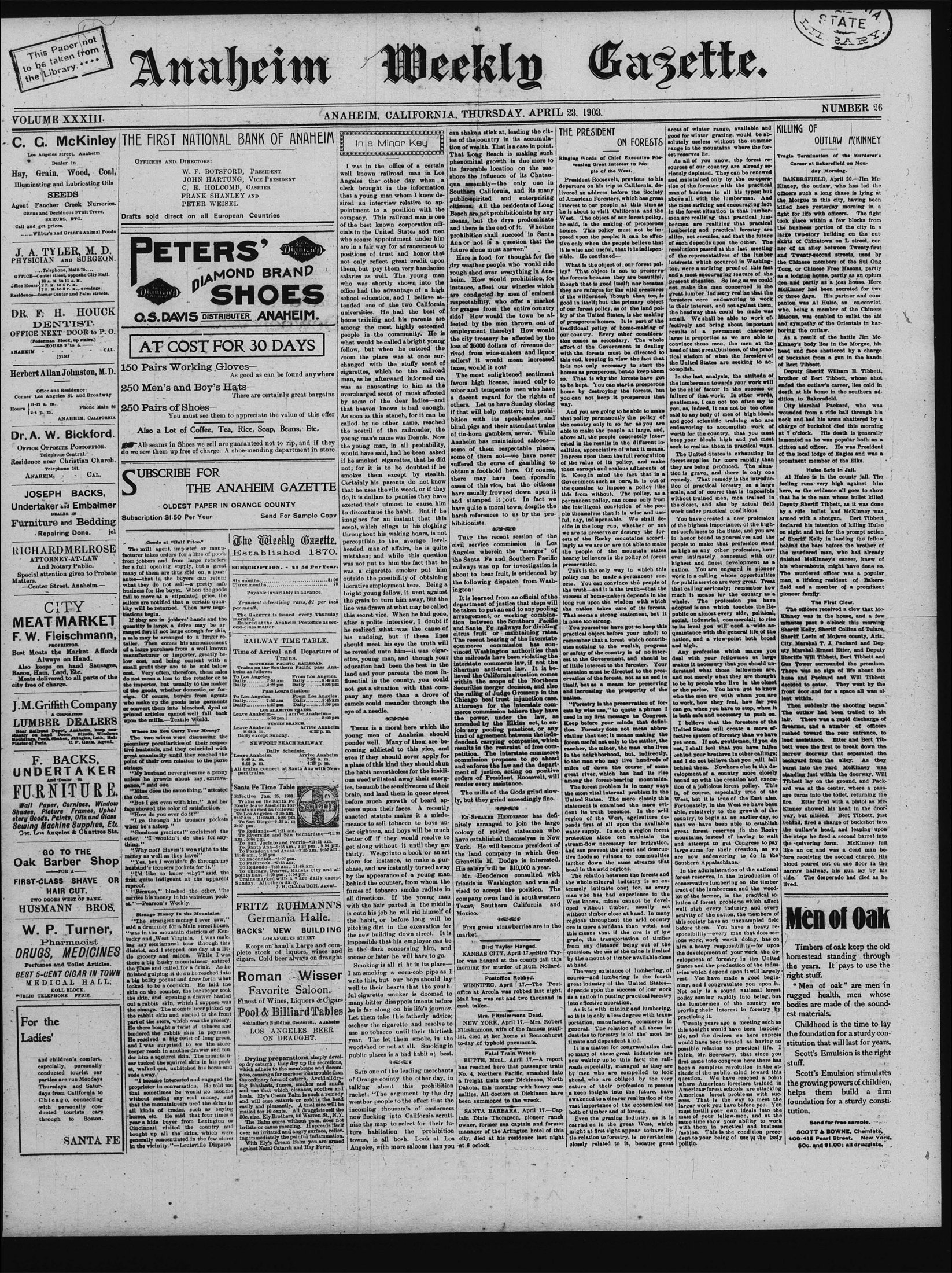
Searchable text
This Paper not to be taken from the Library.
Anaheim
VOLUME XXXIII.
C. G. McKinley
Los Angeles street, Anaheim
Dealer in
Hay, Grain, Wood, Coal,
Illuminating and Lubricating Oils
SEEDS
Agent Fancher Creek Nurseries.
Citrus and Deciduous Fruit Trees,
SHRUBS, ETC.
Call and get prices.
...Wilbur's and Grant's Animal Foods
J. A. TYLER, M. D.
PHYSICIAN AND SURGEON.
Telephone, Main 75...
OFFICE—Center street, opposite City Hall.
Office Hours 10 A.M. to 11 A.M.
2 P.M. to 4 P.M.
7 P.M. to 8 P.M., evenings.
Residence—Corner Center and Palm streets.
DR. F. H. HOUCK
DENTIST.
OFFICE NEXT DOOR to P. O.
(Federman Block, up stairs.)
HOURS 9 to &
ANAHEIM CAL.
jy154f
Herbert Allan Johnston, M.D.
Office and Residence:
Corner Los Angeles St. and Broadway
Hours 11-12 a.m.
2-4 p.m.
ANAHEIM, CALIFORNIA
Dr. A. W. Bickford.
OFFICE OPPOSITE POSTOFFICE.
Telephone Central.
Residence near Christian Church.
Telephone 101.
THE FIRST NATIONAL BANK OF ANAHEIM
OFFICERS AND DIRECTORS:
W. F. BOTSFORD, President
JOHN HARTUNG, Vice President
C. E. HOLCOMB, Cashier
FRANK SHANLEY AND
PETER WEISEL
Drafts sold direct on all European Countries
PETERS'
DIAMOND BRAND
SHOES
O.S. DAVIS DISTRIBUTER ANAHEIM.
AT COST FOR 30 DAYS
150 Pairs Working Gloves—
As good as can be found anywhere
250 Men's and Boy's Hats—
These are certainly great bargains
250 Pairs of Shoes—
You must see them to appreciate the value of this offer
Also a Lot of Coffee, Tea, Rice, Soap, Beans, Etc.
All seams in Shoes we sell are guaranteed not to rip, and if they do we sew them up free of charge. A shoe-mending department in store
Dr. A. W. Bickford.
Office and Residence:
Corner Los Angeles St. and Broadway
Hours 11:12 a.m.
Phone Main 86
2-4 p.m.
ANAHEIM, CALIFORNIA
JOSEPH BACKS,
Undertaker and Embalmer
DEALER IN
Furniture and Bedding
Repairing Done.
RICHARDMELROSE
ATTORNEY-AT-LAW
And Notary Public.
Special attention given to Probate Matters.
—Center Street, Anaheim.
CITY MEAT MARKET
F. W. Fleischmann,
PROPRIETOR
Best Meats the Market Affords Always on Hand.
Also keeps on hand Sausages, Bacon, Ham, Lard, Etc.
Meats delivered to all parts of the city free of charge.
J.M. Griffith Company
A CORPORATION
LUMBER DEALERS
Near Railroad Depot, Anaheim, keep constantly on hand Doors, Blinds, Windows Mouldings, Posts, Shakes, shingles, Hair Plaster of Paris.
F. BACKS,
UNDERTAKER
AND Dealer in FURNITURE.
Wall Paper, Cornices, Window Shades, Picture Frames, Upholstery Goods, Paints, Oils and Glass Sewing Machine Supplies, Ett.
Dor. Los Angeles & Chartres Sta.
GO TO THE Oak Barber Shop FOR A FIRST-CLASS SHAVE OR HAIR CUT.
GOODS at "Half Price."
The mill agent, importer or manufacturer takes orders for a line of goods from jobbers and from large retailers for a full opening supply, but a great many of them are thus sold on a guarantee—that is, the buyers can return what they do not sell—a pretty safe business for the buyer. When the goods fall to move at a stipulated price, the sellers are notified that a certain quantity will be returned. Then new negotiations begin.
If they are in jobbers' hands and the quantity is large, a drive may be arranged for; if not large enough for this, a sale may be arranged to a larger retailer. Then comes his announcement of a large purchase from a well known manufacturer or importer, greatly below cost, and being content with a small profit they are to be sold below cost. Very often, therefore, these sales do not mean a loss to the retailer or to the importer, but usually to the maker of the goods, whether domestic or foreign. Of course, buyers from agents who make up the goods into garments or convert them into bleached, dyed or printed articles cannot well fall back upon the mills—Textile World.
Where Do You Carry Your Money?
The two wives were discussing the peculiar peculiarities of their respective husbands, and they coincided with great unanimity until they reached the point of their own relation to the purse strings.
"My husband never gives me a penny unless he grows about my extravagance," said one.
"Mine does the same thing," attested the other.
"But I get even with him." And her face showed the color of satisfaction.
"How do you ever do it?"
"I go through his trousers pockets when he's asleep."
"Goodness gracious!" exclaimed the other. "I wouldn't do that for anything."
"Why not? Haven't we waived to the money as well as they have?"
"Yes, but I wouldn't go through my husband's trousers pockets for it."
"I'd like to know why?" said the first, quite indignant at the apparent reproof.
"Because," blushed the other, "the carries his money in his waistcoat pocket."
250 Men's and Boy's Hats—These are certainly great bargains
250 Pairs of Shoes—You must see them to appreciate the value of this offer
Also a Lot of Coffee, Tea, Rice, Soap, Beans, Etc.
All seams in Shoes we sell are guaranteed not to rip, and if they do we sew them up free of charge. A shoe-mending department in store
SUBSCRIBE FOR THE ANAHEIM GAZETTE
OLDEST PAPER IN ORANGE COUNTY
Subscription $1.50 Per Year
Send For Sample Copv
The Weekly Gazette.
Established 1870.
SUBSCRIPTION. - $1.50 Per Year.
Six months....$1.00
Three months....75
Payable invariably in advance.
Transient advertising rates, $1 per inch per month.
The Gazette is issued every Thursday morning.
Entered at the Anaheim Postoffice as second-class matter.
RAILWAY TIME TABLE.
Time of Arrival and Departure of Trains.
SOUTHERN PACIFIC RAILROAD.
Trains on the Southern Pacific pass Anaheim as follows:
To Los Angeles...From Los Angeles.
Daily.....7:52 am Dally.....9:49 am
Daily.....4:22 pm Dally.....6:06 pm
Pass Loara Station:
To Los Angeles...From Los Angeles.
Daily.....7:56 am Dally.....9:45 am
Daily.....4:27 pm Dally.....5:39 pm
LOSLAMITOS TRAINS.
Leave Anaheim....Arrive Anaheim....8:00 pm
TUSTIN BRANCH.
Leave Anaheim....Arrive Anaheim
Daily except Sunday.
NEWPORT BEACH RAILWAY.
Daily Schedule.
Leave Anaheim....Arrive Anaheim
9:49 a.m. 7:52 a.m. 6:03 p.m. 4:22 p.m.
All trains connect at Santa Ana with Newport trains.
Santa Fe Time Table
Effective Jan. 25, 1908.
Trains on the Santa Fe Route leave Anaheim for points named as follows:
To Los Angeles...7:55 am 9:57 am 11:49 am 5:05 pm
To Pasadena and Azusa...7:55 am 9:57 am 11:49 am 5:05 pm
To Escondido...7:07 pm
To Riverbrook...9:35 am
To Redondo...7:56 am 11:49 am
To Chicago, Denver, Kansas City and all points East...5:05 pm 5:54 pm
Trains marked with a * are daily except Sunday. All others daily.
GO TO THE Oak Barber Shop
FOR A FIRST-CLASS SHAVE OR HAIR CUT.
TWO DOORS WEST OF BANK.
HUSMANN BROS.
W. P. Turner,
Pharmacist
DRUGS, MEDICINES
Perfumes and Toilet Articles.
BEST 5-CENT CIGAR IN TOWN MEDICAL HALL,
KOLL BLOCK.
PUBLIC TELEPHONE FEICE.
For the Ladies'
and children's comfort, especially, personally conducted tourist car parties are run Mondays Thursdays and Saturdays from California to Chicago, connecting with personally conducted tourists cars through to Boston.
SANTA FE
"But I get even with him." And her face showed the color of satisfaction.
"How do you ever do it?"
"I go through his trousers pockets when he's asleep."
"Goodness gracious!" exclaimed the other. "I wouldn't do that for anything."
"Why not? Haven't we right to the money as well as they have?"
"Yes, but I wouldn't go through my husband's trousers pockets for it."
"I'd like to know why?" said the first, quite indignant at the apparent reproof.
"Because," blushed the other, "he carries his money in his waistcoat pocket."—Pearson's Weekly.
Strange Money In the Mountains.
"The strangest money I ever saw," said a drummer for a Main street house, "was in the mountain districts of Kentucky and West Virginia. I was making my semiannual tour through this district, and I stopped one day at a little grocery and saloon. While I was there a big husky mountaineer entered the place and called for a drink. As he finished gulping it down he reached into a big bulky pocket and drew forth what looked to be a coonskin. He laid the skin on the counter, the barkeeper took the skin, and opening a drawer hauled out a rabbit skin, which I suppose was the change. The mountaineer picked up the rabbit skin and started to the front part of the store, which was the grocery. He there bought a twist of tobacco and tendered the rabbit skin in payment. He received a big twist of long green, and I was surprised to see the storekeeper reach in another drawer and tender him a squirrel skin. The mountaineer tucked the squirrel skin in his pocket, walked out, unhitched his horse and rode away.
"I became interested and engaged the proprietor in conversation. He told me that sometimes he would go months without seeing any real money, and that the mountaineers used the skins in all kinds of trades, such as buying horses, etc. He said that four times a year a hide buyer from Lexington or Cincinnati visited the country and bought up all the skins, which were generally concentrated in the few stores in the vicinity."—Louisville Dispatch
FRITZ RUHMANN'S Germania Halle.
BACKS' NEW BUILDING
LOS ANGELES STREET
Keeps on hand a Large and complete stock of liquors, wines and cigars. Cold beer always on draught
Roman Wisser
Favorite Saloon.
Finest of Wines, Liquors & Cigars
Pool & Billiard Tables
Schindler's Building, Center St., Anaheim
LOS ANGELES BEER ON DRAUGHT.
Drying preparations simply develop dry catarrh; they dry up the secretions, which adhere to the membrane and decompose, causing a far more serious trouble than the ordinary form of catarrh. Avoid all drying inhalants, fumes, smokes and snuffs and use that which cleanses, soothes and heals. Ely's Cream Balm is such a remedy and will cure catarrh or cold in the head easily and pleasantly. A trial size will be mailed for 10 cents. All druggists sell the 50c. size. Ely Brothers, 56 Warren St., N.Y.
The Balm cures without pain, does not irritate or cause sneezing. It spreads itself over an irritated and angry surface, relieving immediately the painful inflammation.
With Ely's Cream Balm you are armed against Nasal Catarrh and Hay Fever.
ANAHEIM, CALIFORNIA, THURSDAY, APRIL 23, 1903.
IN A MINOR KEY
I was in the office of a certain well known railroad man in Los Angeles the other day when a clerk brought in the information that a young man whom I knew desired an interview relative to appointment to a position with the company. This railroad man is one of the best known corporation officials in the United States and men who secure appointment under him are in a fair way for advancement to positions of trust and honor that not only reflect great credit upon them, but pay them very handsome salaries as well. The young man who was shortly shown into the office had the advantage of a high school education, and I believe attended one of the two California universities. He had the best of home training and his parents are among the most highly esteemed people in the community. He is what would be called a bright young fellow, but when he entered the room the place was at once surcharged with the stuffy scent of cigarettes, which to the railroad man, as he afterward informed me, was as nauseating to him as the overcharged scent of musk affected by some of the dear ladies—and that heaven knows is bad enough. As soon as this stench, for it can be called by no other name, reached the nostril of the railroader, the young man's name was Dennis. Now the young man, in all probability, would have said, had he been asked if he smoked cigarettes, that he did not; for it is to be doubted if he smokes them except by stealth can shake a stick at, leading the cities of the country in its accumulation of wealth. That is a case in point. That Long Beach is making such phenominal growth is due more to its favorable location on the seashore the influence of its Chatauqua assembly—the only one in Southern California, and its many public spirited and enterprising citizens. All the residents of Long Beach are not prohibitionists by any means, but the drys predominate and there is the end of it. Whether prohibition shall succeed in Santa Ana or not is a question that the future alone must answer."
Here is food for thought for the dry weather people who would ride rough shod over everything in Anaheim. How would prohibition, for instance, affect our wineries which are conducted by men of eminent respectability, who offer a market for grapes from the entire country side? How would the town be affected by the men thrown out of employment thereby? How would the city treasury be affected by the loss of $5000 dollars of revenue derived from wine-makers and liquor sellers? It would mean increased taxes, would it not?
The most enlightened sentiment favors high license, issued only to sober and temperate men who have a decent regard for the rights of others. Let us have Sunday closing if that will help matters; but prohibition with its speak-easy and blind pigs and their attendant trains of tin-horn gamblers, never. While Anaheim has maintained saloons—some of them respectable places, some of them not—we have never suffered the curse of gambling to obtain a foothold here. Of course,
THE PRESIDENT ON FORESTS
Ringing Words of Chief Executive Possessing Great Interest to People of the West.
President Roosevelt, previous to his departure on his trip to California, delivered an address before the Society of American Foresters, which has great interest to our people at this time as he is about to visit California and the West. The object of our forest policy, he said, is the making of prosperous homes. This policy must not be imposed upon the people; it can be effective only when the people believe that it is wise and useful, that it is indispensable. He continued—
What is the object of our forest policy? That object is not to preserve the forests because they are beautiful, though that is good itself; nor because they are refugees for the wild creatures of the wilderness, though that, too, is good in itself; but the primary object of our forest policy, as of the land policy of the United States, is the making of prosperous homes. It is part of the traditional policy of home-making of our country. Every other consideration comes as secondary. The whole effort of the Government in dealing with the forests must be directed to this end, keeping in view the fact that it is not only necessary to start the homes as prosperous, but to keep them so. That is why the forests have got to be kept. You can start a prosperous home by destroying the forests, but you cannot keep it prosperous thus way.
And you are going to be able to make that policy permanently the policy of the country only in so far as you are able to make the people at large, and above all, the people concretely interested in the results in the different localities, appreciative of what it means. Impress upon them the full recognition of the value of its policy, and make them earnest and zealous adherents of it. Keep in mind the fact that in a
The most enlightened sentiment favors high license, issued only to sober and temperate men who have a decent regard for the rights of others. Let us have Sunday closing if that will help matters; but prohibition with its speak-easies and blind pigs and their attendant trains of tin-horn gamblers, never. While Anaheim has maintained saloons—some of them respectable places, some of them not—we have never suffered the curse of gambling to obtain a foothold here. Of course, there may have been sporadic cases of this vice, but the citizens have usually frowned down upon it and stamped it out. In fact we have quite a moral town, despite the harsh references to us by the prohibitionists.
That the recent session of the civil service commission in Los Angeles wherein the "merger" of the Santa Fe and Southern Pacific railways was up for investigation is about to bear fruit, is evidenced by the following dispatch from Washington:
It is learned from an official of the department of justice that steps will be taken to put an end to any pooling arrangement, or working combination between the Southern Pacific and Santa Fe railways for dividing citrus fruit or maintaining rates. The recent hearing of the interstate commerce commission has convinced Washington authorities that the railroads have been violating the interstate commerce law, if not the Sherman anti-trust law. It is believed the California situation comes within the scope of the Northern Securities merger decision, and also the ruling of Judge Grosscup in the Chicago beef trust injunction case. Attorneys for the interstate commerce commission believe they have the power, under the law, as amended by the Elkins act, to join any pooling practices, or any kind of agreement between the independent carrying companies, which results in the restraint of free competition. The interstate commerce commission proposes to go ahead and enforce the law and the department of justice, acting on positive orders of President Roosevelt, will render every assistance.
The mills of the Gods grind slowly, but they grind exceedingly fine.
Ex-Speaker Henderson has definitively arranged to join the large colony of retired statesmen who have established themselves in New York. He will become president of the land company in which Gen-Grenville M. Dodge is interested. His salary will be $10,000 a year.
Mr. Henderson consulted with friends in Washington and was advised to accept the position. The company owns land in southwestern
That is why the forests have got to be kept. You can start a prosperous home by destroying the forests, but you cannot keep it prosperous that way.
And you are going to be able to make that policy permanently the policy of the country only in so far as you are able to make the people at large, and above all, the people concretely interested in the results in the different localities, appreciative of what it means. Impress upon them the full recognition of the value of its policy, and make them earnest and zealous adherents of it. Keep in mind the fact that in a Government such as ours, it is out of the question to impose a policy like this from without. The policy, as a permanent policy, can come only from the intelligent conviction of the people themselves that it is wise and useful, nay, indispensable. We shall decide in the long run, whether or not we are to preserve or destroy the forests of the Rocky mountains accordingly as we are or are not able to make the people of the mountain states hearty believers in the policy of forest preservation.
That is the only way in which this policy can be made a permanent success. You can convince the people of the truth—and it is the truth—that the success of home-makers depends in the long run upon the wisdom with which the nation takes care of its forests. That seems a strong statement, but it is none too strong.
You yourselves have got to keep this practical object before your mind; to remember that a forest which contributes nothing to the wealth, progress or safety of the country is of no interest to the Government, and should be of little interest to the forester. Your attention must be directed to the preservation of the forests, not as an end in itself, but as a means for preserving and increasing the prosperity of the nation.
"Forestry is the preservation of forests by wise use," to quote a phrase I used in my first message to Congress. Keep before your minds that definition. Forestry does not mean abbreviating that use; it means making the forest useful not only to the settler, the rancher, the miner, the man who lives in the neighborhood, but indirectly, to the man who may live hundreds of miles off down the course of some great river, which has had its rise among the forest-bearing mountains.
The forest problem is in many ways the most vital internal problem in the United States. The more closely this statement is examined the more evident its truth becomes. In the arid region of the West, agriculture depends first of all upon the available water supply. In such a region forest protection alone can maintain the stream-flow necessary for irrigation, and can prevent the great and destructive floods so ruinous to communities farther down the same streams that head in the arid regions.
The relation between the forests and the whole mineral industry is an extremely intimate one; for, as every man who has had experience in
before much growth of beard appears upon their faces. A recently enacted statute makes it a misdemeanor to sell tobacco to boys under eighteen, and boys will be much better off if they would resolve to get along without it until they are thirty. We go into a book or an art store for instance, to make a purchase, and are instantly turned away by the appearance of a young man behind the counter, from whom the fumes of tobacco smoke radiate in all directions. If the young man with the hair parted in the middle is onto his job he will rid himself of the habit, or before long will be pitching dirt in the excavation for the new building down street. It is impossible that his employer can be in the dark concerning him, and sooner or later he will have to go.
Smoking is all right in its place—I am smoking a corn-cob pipe as I write this, but our boys should lay well to their hearts that the youthful cigarette smoker is doomed to many bitter disappointments before he is far along on his life's journey. Let them take this fatherly advice; eschew the cigarette and resolve to use no tobacco until their thirtieth year. The let them smoke, in the woodshed or not at all. Smoking in public places is a bad habit at best.
Said one of the leading merchants of Orange county the other day, in talking about this prohibition racket: "The argument by the dry weather people to the effect that the incoming thousands of easterners now flocking into California scrutinize the map to select for their future habitation the prohibition towns, is all bosh. Look at Los Angeles, with more saloons than you
Ex-Speaker Henderson has definitely arranged to join the large colony of retired statesmen who have established themselves in New York. He will become president of the land company in which Gen-Grenville M. Dodge is interested. His salary will be $10,000 a year.
Mr. Henderson consulted with friends in Washington and was advised to accept the position. The company owns land in southwestern Texas, Southern California and Mexico.
Fine green strawberries are in the market.
Bird Tayler Hanged.
KANSAS CITY, April 17. Bird Taylor was hanged at the county jail this morning for murder of Ruth Nollard.
Postoffice Robbed.
WINNIPEG, April 17. The Post-office at Arcola was robbed last night. Mall bag was cut and two thousand in cash taken.
Mrs. Fitzsimmons Dead.
NEW YORK, April 17. Mrs. Robert Fitzsimmons, wife of the famous pugilist, died at her home at Bensonhurst to-day of typhoid pneumonia.
Fatal Train Wreck.
BUTTE, Mont., April 17. A report has reached here that passenger train No. 4, Northern Pacific, smashed into a freight train near Dickinson, North Dakota, this morning with heavy casualties. All doctors at Dickinson have been summoned to the wreck.
SANTA BARBARA, April 17. Captain Dixie Thompson, pioneer ranch owner, former sea captain and former manager of the Arlington hotel of this city, died at his residence last night at 6 oclock.
The relation between the forests and the whole mineral industry is an extremely intimate one; for, as every man who has had experience in the West knows, mines cannot be developed without timber, usually not without timber close at hand. In many regions throughout the arid country ore is more abundant than wood, and this means that if the ore is of low grade, the transportation of timber from any distance being out of the question, the use of the mine is limited by the amount of timber available close at hand.
The very existence of lumbering, of course—and lumbering is the fourth great industry of the United States—depends upon the success of our work as a nation in putting practical forestry into effective operation.
As it is with mining and lumbering, so it is in only a less degree with transportation, manufacture, commerce in general. The relation of all these industries to forestry is of the most intimate and dependent kind.
It is a matter for congratulation that so many of these great industries are now waking up to this fact; the railroads especially, managed as they are by men who are compelled to look ahead, who are obliged by the very nature of their profession to possess a keen insight into the future, have awakened to a clearer realization of the vast importance of the economical use both of timber and of forests.
Even the grazing industry, as it is carried on in the great West, which might at first sight appear to have little relation to forestry, is nevertheless closely related to it, because great
PRESIDENT ON FORESTS
Moosevelt, previous to his trip to California, deserves before the Society of Foresters, which has great people at this time as visit California and the object of our forest policy, the making of prosperous policy must not be immeasurable; it can be effected on the people believe that useful, that it is indispensable—
The object of our forest policy is not to preserve because they are beautiful, nor itself; nor because acres for the wild creatures unless that too is but the primary object policy, as of the land polished States, is the making homes. It is part of the policy of home-making of Every other considerate secondary. The whole Government in dealing with forests must be directed to bring in view the fact that necessary to start the prosperous, but to keep them why the forests have got you can start a prosperous destroying the forests, but keep it prosperous that going to be able to make permanently the policy of only in so far as you are the people at large, and, no people concretely intermittent in the different legislative of what it means, them the full recognition of its policy, and make and zealous adherents of mind the fact that in a areas of winter range, available and good for winter grazing, would be absolutely useless without the summer range in the mountains where the forest reserves lie.
As all of you know, the forest resources of our country are already seriously depleted. They can be renewed and maintained only by the co-operation of the forester with the practical man of business in all his types; but above all, with the lumberman. And the most striking and encouraging fact in the forest situation is that lumbermen are realizing that practical lumbermen are realizing that practical lumbering and practical forestry are allies, not enemies, and that the future of each depends upon the other. The resolutions passed at the last meeting of the representatives of the lumber interests, which occurred in Washington, were a striking proof of this fact and a most encouraging feature of the present situation. So long as we could not make the men concerned in the great lumber industry realize that the foresters were endeavoring to work in their interest, and not against them, the headway that could be made was small. We shall be able to work effectively and bring about important results of a permanent character large in proportion as we are able to convince those men, the men at the head of that great business, of the practical wisdom of what the foresters of the United States are seeking to accomplish.
In the last analysis, the attitude of the lumbermen towards your work will be the chief factor in the success or failure of that work. In other words, gentlemen, I can not too often say to you, as, indeed, it cannot be too often said to any body of men of high ideals and good scientific training who are endeavoring to accomplish work worth for the country, that you must keep your ideals high and yet must seek to realize them in practical ways.
The United States is exhausting its forest supplies far more rapidly than they are being produced. The situation is grave, and there is only one
KILLING OF OUTLAW M'KINNEY
Tragic Termination of the Murderer's Career at Bakersfield on Monday Morning.
BAKERSFIELD, April 20.—Jim McKinney, the outlaw, who has led the officers such a long chase is lying at the Morgue in this city, having been killed here yesterday morning in a fight for life with officers. The fight took place within a few blocks from the business portion of the city in a large two-story building on the outskirts of Chinatown on L street, corner of an alley between Twenty-first and Twenty-second streets, used by the Chinese members of the Sul Ong Tong, or Chinese Free Masons, partly as a lodging house, partly as an opium den and partly as a joss house. Here McKinney had been secreted for two or three days. His partner and companion was Al Hulse, an ex-convict, who, being a member of the Chinese Masons, was enabled to enlist the aid and sympathy of the Orientals in harboring the outlaw.
As a result of the battle Jim McKinney's body lies in the Morgue, his head and face shattered by a charge of buckshot from a gun in the hands of Bert Tibbett.
Deputy Sheriff William E. Tibbett, brother of Bert Tibbett, whose shot ended the outlaw's career, lies cold in death at his home in the southern addition to Bakersfield.
City Marshal Packard, who was wounded from a rifle ball through his neck and had his arms shattered by a charge of buckshot died this morning at 7 o'clock. His death is generally lamented as he was popular both as a citizen and officer. He was President of the local lodge of Eagles and was a prominent member of the Elks.
Huise Safe in Jail.
The forests have got you can start a prosperous destroying the forests, but keep it prosperous that
We going to be able to make permanently the policy of only in so far as you are the people at large, and, people concretely intermittent in the different associative of what it means, them the full recognition of its policy, and make and zealous adherents of remind the fact that in such as ours, it is out of to impose a policy like without. The policy, as a policy, can come only from that conviction of the peoples that it is wise and use-sponsible. We shall de-ing run, whether or not reserve or destroy the Rocky mountains accord-ure or are not able to make of the mountain states rivers in the policy of forest
only way in which this made a permanent success convince the people of and it is the truth—that the home-makers depends in the wisdom with which takes care of its forests.
A strong statement, but it strong.
Belves have got to keep this direct before your mind; to that a forest which contrib-utes to the wealth, progress the country is of no inter-government, and should be nearest to the forester. Your dest be directed to the pres-sive forests, not as an end in a means for preserving the prosperity of the
Is the preservation of for-ouse," to quote a phrase I first message to Congress. To your minds that defin-ience does not mean abbrevise; it means making the not only to the settler, the miner, the man who lives neighborhood, but, indirectly, who may live hundreds of down the course of some which has had its rise forest-bearing mountains. Problem is in many ways internal problem in these. The more closely this examined the more evi-enth becomes. In the arid West, agriculture de-od all upon the available dry. In such a region forest alone can maintain the necessary for irrigation, event the great and destructive ruinous to communities own the same streams that harried regions.
Union between the forests and mineral industry is an ex- estimate one; for, as every was had experience in the
In the last analysis, the attitude of the lumbermen towards your work will be the chief factor in the success or failure of that work. In other words, gentlemen, I can not too often say to you, as, indeed, it can not be too often said to any body of men of high ideals and good scientific training who are endeavoring to accomplish work of worth for the country, that you must keep your ideals high and yet must seek to realize them in practical ways.
The United States is exhausting its forest supplies far more rapidly than they are being produced. The situation is grave, and there is only one remedy. That remedy is the introduction of practical forestry on a large scale, and of course that is impossible without trained men, men trained in the closet, and also by actual field work under practical conditions.
You have created a new profession of the highest importance, of the highest usefulness to the State, and you are in honor bound to yourselves and the people to make that profession stand as high as any other profession, however intimately connected with our highest and finest development as a nation. You are engaged in pioneer work in a calling whose opportunities for public service are very great. Treat that calling seriously; remember how much it means for the country as a whole. The profession you have adopted is one which touches the Republic on almost every side, political, social, industrial, commercial; to rise to its level you will need a wide acquaintance with the general life of the nation, and a view-point both broad and high.
Any profession which makes you deal with your fellowmen at large makes it necessary that you should understand what those fellowmen are, and not merely what they are thought to be by people who live in the closet or the parlor. You have got to know who the men are with whom you are to work, how they feel, how far you can go, when you have to stop, when it is both safe and necessary to push on.
I believe that the foresters of the United States will create a more effective system of forestry than we have yet seen. If not, gentlemen, if you do not, I shall feel that you have fallen behind your breathen in other callings; and I do not believe that you will fall behind them. Nowhere else is the development of a country more closely bound up with the creation and execution of a judicious forest polley. This is, of course, especially true of the West, but it is true of the East also. Fortunately, in the West we have been able, relatively to the growth of the country, to begin at an earlier day, so that we have been able to establish great forest reserves in the Rocky mountains, instead of having to wait and attempt to get Congress to pay large sums for their creation, as we are now endeavoring to do in the Southern Appalachians.
In the administration of the national forest reserves, in the introduction of conservative lumbering on the timber tract of the lumberman and the wood-lot of the farmer, in the practical so-brother of Bert Tibbett, whose shot ended the outlaw's career lies cold in death at his home in the southern addition to Bakersfield.
City Marshal Packard, who was wounded from a rifle ball through his neck and had his arms shattered by a charge of buckshot died this morning at 7 o'clock. His death is generally lamented as he was popular both as a citizen and officer. He was President of the local lodge of Eagles and was a prominent member of the Elks.
Hulse Safe in Jail.
Al Hulse is in the county jail. The feeling runs very high against him here, as the evidence all goes to show that he is the man whose bullet killed Deputy Sheriff Tibbett, as it was done by a rifle bullet and McKinney was armed with a shotgun. Bert Tibbett declared his intention of killing Hulse on sight and but for the prompt action Sheriff Kelly in landing the fellow behind the bars before the brother of the murdered man, who had already finished McKinney's career, knew of his whereabouts, might have done so. The murdered officer was a popular man, a lifelong resident of Bakers-field and a member of a prominent pioneer family.
The First Clew.
The officers received a clew that McKinney was in the house, and a few minutes past 9 o'clock this morning Sheriff Kelly, Sheriff Collins of Tulare, Sheriff Lovin of Mojave county, Ariz., City Marshal T. J. Packard and Deputy Marshal Ernest Etter, and Deputy Sheriff Will Tibbett, Bert Tibbett and Gus Tower surrounded the premises. There was no sign of life about the huse and Packard and Will Tibbett decided to enter. They went by the front door and for a space all was silent within.
Then suddenly the shooting began. The outlaw had been trailed to his lair. There was a rapid discharge of firearms, and a number of officers rushed toward the rear entrance, to lend assistance. Etter and Bert Tibbett were the first to break down the narrow doorway that separated the backyard from the alley. As they burst into the yard McKinney was standing just within the doorway. Will Tibbett lay on ground, and Packard was at the center, where a passage turns into the toilet, returning the fire. Etter fired with a pistol as McKinney showed his head in the doorway, but missed. Bert Tibbett just behind fired a charge of buckshot into the outlaw's head, and leaping upon the steps he fired a second barrel into the quivering form. McKinney fell like an ox and was a dead man before receiving the second charge. His blood poured out on one floor in the narrow hallway, his gun lay by his side. The desperado died as he lived.
Men of Oak
Timbers of oak keep the old homestead standing through the years. It pays to use the right stuff.
"Men of oak" are men in rugged health, men whose bodies are made of the soundest materials.
Childhood is the time to lay the foundation for a sturdy constitution that will last for years.
Scott's Emulsion is the right stuff.
Scott's Emulsion stimulates the growing powers of children, helps them build a firm foundation for a sturdy constitution.
Send for free sample.
SCOTT & BOWNE, Chemists,
409-415 Pearl Street, New York,
50c. and $1.00; all druggists.