anaheim-gazette 1903-03-05
Scanned page
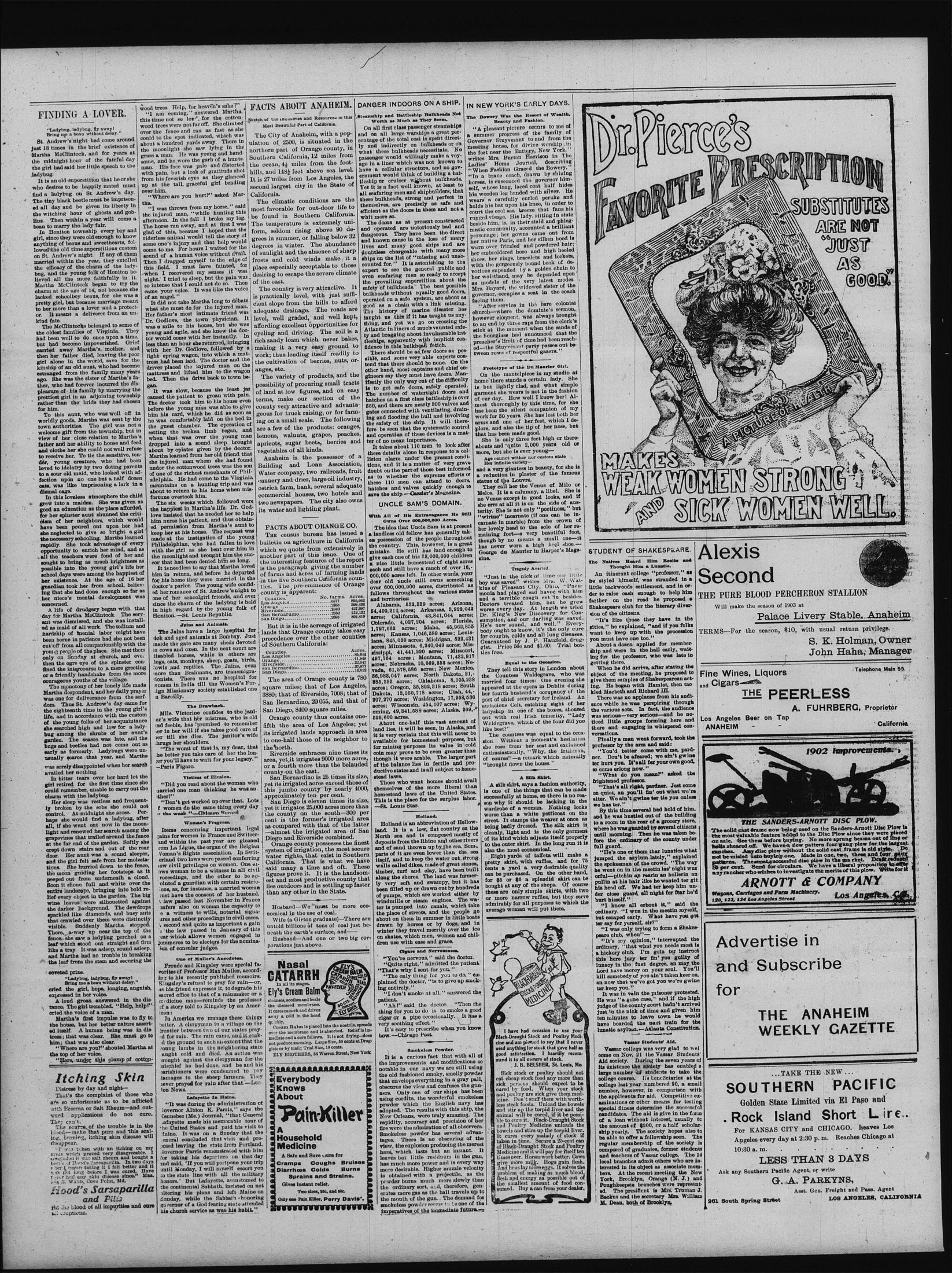
Searchable text
FINDING A LOVER.
"Ladybug, ladybug, fly away!
Bring me a beau without delay."
St. Andrew's night had come around just 18 times in the brief existence of Martha McClintock, and for years at the midnight hour of the fateful day the girl had said her little speech to the ladybug.
It is an old superstition that he or she who desires to be happily mated must find a ladybug on St. Andrew's day. The tiny black beetle must be imprisoned all day and be given its liberty in the witching hour of ghosts and goblins. Then within a year will come a bean to marry the lady fair.
In Honiton township every boy and girl, since they were old enough to know anything of beaus and sweethearts, followed the old time superstitious custom on St. Andrew's night. If any of them married within the year, they extolled the efficacy of the charm of the ladybug, and the young folk of Honiton believed all the more faithfully in it. Martha McClintock began to try the charm at the age of 14, not because she lacked schoolboy beaus, for she was a pretty girl, but because marriage meant to her more than a lover and a protector. It meant a deliverer from an unkind fate.
The McClintocks belonged to some of the oldest families of Virginia. They had been well to do once upon a time, but had become impoverished. Grief carried away Martha's mother, and then her father died, leaving the poor girl alone in the world, save for the kinship of an old aunt, who had become estranged from the family many years ago. She was the sister of Martha's father, who had forever incurred the displeasure of his family by marrying the prettiest girl in an adjoining township rather than the bride they had chosen for him.
To this aunt, who was well off in worldly goods, Martha was sent by the town authorities. The girl was not a welcome gift from the township, but in view of her close relation to Martha's father and her ability to house and feed and clothe her she could not well refuse to receive her. To tie the sensitive, tender, young creature, who had been loved to idolatry by two doting parents to a sour old maid, who looked with affection.
wood trees Help, for heaven's sake"
"I am coming," answered Martha. this time not so low", for the cottonwood trees were not far off. She climbed over the fence and ran as fast as she could to the spot indicated, which was about a hundred yards away. There in the moonlight she saw lying in the grass a man. He was young and handsome, and he wore the garb of a huntsman. His face was pale and distorted with pain, but a look of gratitude shot from his feverish eyes as they glanced up at the tall, graceful girl bending over him.
"Where are you hurt?" asked Martha.
"I was thrown from my horse," said the injured man, "while hunting this afternoon. In the fall I broke my leg. The horse ran away, and at first I was glad of this, because I hoped that the riderless animal would tell the story of some one's injury and that help would come to me. For hours I waited for the sound of a human voice without avail. Then I dragged myself to the edge of this field. I must have fainted, for when I recovered my senses it was night. I tried to sleep, but the pain was so intense that I could not do so. Then came your voice. It was like the voice of an angel."
It did not take Martha long to debate what she must do for the injured man. Her father's most intimate friend was Dr. Godlove, the town physician. It was a mile to his house, but she was young and agile, and she knew the doctor would come with her instantly. In less than an hour she returned, bringing with her Dr. Godlove, followed by a light spring wagon, into which a mattress had been laid. The doctor and the driver placed the injured man on the mattress and lifted him to the wagon bed. Then the drive back to town began.
It was slow, because the least jar caused the patient to groan with pain. The doctor took him to his house even before the young man was able to give him his card, which he did as soon as he was comfortably laid on the bed in the guest chamber. The operation of setting the broken limb began, and when that was over the young man dropped into a sound sleep brought about by opiates given by the doctor. Martha learned from her old friend that the injured man whom she had found under the cottonwood trees was the son of one of the richest merchants of Philadelphia.
FACTS ABOUT ANAHEIM.
Sketch of the industries and resources or this Most Beautiful Part of California.
The City of Anaheim, with a population of 2500, is situated in the northern part of Orange county, in Southern California, 12 miles from the ocean, 4½ miles from the foothills, and 148½ feet above sea level. It is 27 miles from Los Angeles, the second largest city in the State of California.
The climatic conditions are the most favorable for out-door life to be found in Southern California. The temperature is extremely uniform, seldom rising above 90 degrees in summer, or falling below 32 degrees in winter. The abundance of sunlight and the absence of sharp frosts and cold winds make it a place especially acceptable to those desiring to escape the severe climate of the east.
The country is very attractive. It is practically level, with just sufficient slope from the hills to afford adequate drainage. The roads are level, well graded, and well kept; affording excellent opportunities for cycling and driving. The soil is a rich sandy loam which never bakes making it a very easy ground to work; thus lending itself readily to the cultivation of berries, nuts, oranges, etc.
The variety of products, and their possibility of procuring small tracts of land at low figures, and on easy terms, make our section of this county very attractive and advantageous for truck raising, or for farming on a small scale. The following are a few of the products: orange lemons, walnuts, grapes, peaches apricots, sugar beets, berries and vegetables of all kinds.
Anaheim is the possessor of Building and Loan Association Water company, two railroads, fruit
She was the sister of Martha's father, who had forever incurred the pleasure of his family by marrying the prettiest girl in an adjoining township rather than the bride they had chosen for him.
To this aunt, who was well off in worldly goods, Martha was sent by the town authorities. The girl was not a welcome gift from the township, but in view of her close relation to Martha's father and her ability to house and feed and clothe her she could not well refuse to receive her. To tie the sensitive, tender, young creature, who had been loved to idolatry by two doting parents to a sour old maid, who looked with affection upon no one but a half dozen oats, was like imprisoning a lark in a dismal cage.
In this loveless atmosphere the child grew into a maiden. She was given as good an education as the place afforded, for her spinster aunt shunned the criticism of her neighbors, which would have been poured out upon her had she neglected to give so bright a girl the necessary schooling. Martha learned rapidly. She took advantage of every opportunity to enrich her mind, and as all the teachers were fond of her and sought to bring as much brightness as possible into the young girl's life her school days were among the happiest of her existence. At the age of 16 her guardian took her from school, believing that she had done enough so far as her niece's mental development was concerned.
A life of drudgery began with that day for Martha McClintock. The servant was dismissed, and she was installed as maid of all work. The tedium and hardship of menial labor might have been borne in patience had she not been cut off from all companionship with the young people of the place. She met them only on Sunday at church, and even then the ogre eye of the spinster confined the intercourse to a mere greeting or a friendly handshake from the more courageous youths of the village.
The monotony of her lonely life made Martha despondent, and her daily prayer was one for deliverance from the serfdom. Thus St. Andrew's day came for the eighteenth time in the young girl's life, and in accordance with the custom of the young folks of her acquaintance she searched high and low for a ladybug among the shrubs of her aunt's garden. The season was late, and the bugs and beetles had not come out as early as formerly. Ladybugs were unusually scarce that year, and Martha was sorely disappointed when her search availed her nothing.
In bitter tears over her hard lot the girl retired for the first time since she could remember, unable to carry out the charm with the ladybug.
Her sleep was restless and frequently broken by the sobs she could not control. At midnight she arose. Perhaps she would find a ladybug, after all, if she went out now in the moonlight and renewed her search among the grapevines that trailed around the fence at the far end of the garden. Softly she crept down stairs and out of the rear door. Her aunt was a sound sleeper, and the girl felt safe from her molestations. She hurried down to the fence, the moon guiding her footsteps as it peeped out from underneath a cloud. Soon it shone full and white over the entire landscape, bringing into bold relief every object in the garden. The big mattress and iron bed. Then the drive back to town began.
It was slow, because the least jar caused the patient to groan with pain. The doctor took him to his house even before the young man was able to give him his card, which he did as soon as he was comfortably laid on the bed in the guest chamber. The operation of setting the broken limb began, and when that was over the young man dropped into a sound sleep brought about by opiates given by the doctor. Martha learned from her old friend that the injured man whom she had found under the cottonwood trees was the son of one of the richest merchants of Philadelphia. He had come to the Virginia mountains on a hunting trip and was about to return to his home when misfortune overtook him.
The six weeks which followed were the happiest in Martha's life. Dr. Godlove insisted that he needed her to help him nurse his patient, and thus obtained permission from Martha's aunt to keep her at his house. The request was made at the instigation of the young Philadelphian, who had fallen in love with the girl as she bent over him in the moonlight and brought him the succor that had been denied him so long.
It is needless to say that Martha loved him in return, and before he departed for his home they were married in the doctor's parlor. The young wife confirmed her romance of St. Andrew's night to one of her schoolgirl friends, and over since the charm of the ladybug is held in high regard by the young folk of Honiton.—St. Louis Republic.
Jains and Animals.
The Jains have a large hospital for dek and aged animals at Bombay. Just inside the gate are many sheds devoted to cows and oxen. In the next court are disabled horses, while in others are logs, cats, monkeys, sheep, goats, birds, owls and reptiles. The Jains, even more than Brahmans, are transmigrationists. There was no hospital for women in India till the Women's Foreign Missionary society established one in Bareilly.
The Drawback.
Mlle. Victorine confides to the junior's wife that her mistress, who is old and feeble, has promised to remember her in her will if she takes good care of her till she dies. The janitor's wife shrugs her shoulders.
"The worst of that is, my dear, that he better you take care of her longer you'll have to wait for your legacy."—Paris Figaro.
Victims of Illusion.
"Did you read about the woman who married one man thinking he was another?"
"Don't get worked up over that. Lots of women do the same thing every day in the week."—Chicago Record
Woman's Progress.
Items concerning important legal gains for women in France and Switzerland within the past year are gleaned from La Ligue, the organ of the Belgian Woman's Rights association. In Switzerland two laws were passed conferring new civil privileges on women. One allows woman to be a witness in all civil proceedings, and the other to be appointed a guardian with certain restrictions, as for instance, a married woman must have the consent of her husband.
The variety of products, and their possibility of procuring small tracts of land at low figures, and on easy terms, make our section of the county very attractive and advantageous for truck raising, or for farming on a small scale. The following are a few of the products: orange lemons, walnuts, grapes, peaches apricots, sugar beets, berries and vegetables of all kinds.
Anaheim is the possessor of Building and Loan Association Water company, two railroads, fruit cannery and drier, large oil industry ostrich farm, bank, several adequate commercial houses, two hotels and two newspapers. The city also owns its water and lighting plant.
FACTS ABOUT ORANGE COUNTY
The census bureau has issued bulletin on agriculture in California which we quote from extensively another part of this issue. One interesting feature of the report is the paragraph giving the number of farms and acres of farming land in five Southern California counties. The pre-eminence of Orange County is apparent:
Counties No. farms Acres Los Angeles 6577 800 Orange 2288 800 Riverside 2440 421 San Bernardino 2550 211 San Diego 2998 800
But it is in the acreage of irrigated lands that Orange county takes precedence over the other county of Southern California:
Counties No. farms Acres Los Angeles 6577 800 Orange 2288 800 Riverside 2440 421 San Bernardino 2550 211 San Diego 2998 800
Orange county thus contains fivethe area of Los Angeles; its irrigated lands approach in one-half those of its neighborthe north.
Riverside embraces nine time area; yet it irrigates 9000 more acres or a fourth more than the belaw county on the east.
San Bernardino is 25 times its yet its irrigated acres exceed those this jumbo county by nearly four percent is the former's irrigated areas compared with that of the last—almost the irrigated area of Diego and Riverside combined.
Orange county possesses the first system of irrigation, the most sew water rights; that exist in South California. That is what we said many a time and oft. The figures prove it. It is the hands best and most productive county lies outdoors and is settling up far than any other in the State.
Her sleep was restless and frequently broken by the sobs she could not control. At midnight she arose. Perhaps she would find a ladybug, after all, if she went out now in the moonlight and renewed her search among the grapevines that trailed around the fence at the far end of the garden. Softly she crept down stairs and out of the rear door. Her aunt was a sound sleeper, and the girl felt safe from her molestations. She hurried down to the fence, the moon guiding her footsteps as it peeped out from underneath a cloud. Soon it shone full and white over the entire landscape, bringing into bold relief every object in the garden. The big wine leaves were silhouetted against the darker background. The dewdrops sparkled like diamonds, and busy ants that crawled over them were distinctly visible. Suddenly Martha stopped. There, a-way up near the top of the fence, she saw a ladybug perched on a leaf which stood out straight and firm like a tray. It was asleep, sound asleep, and Martha had no trouble in breaking the leaf from the stem and securing the coveted prize.
"Ladybug, ladybug, fly away! Bring me a beau without delay." cried the girl, hope, longing, anguish, expressed in her voice.
A loud groan answered in the distance. The girl trembled. "Help, help!" cried the voice of a man.
Martha's first impulse was to fly to the house, but her better nature asserted itself. A human being was in distress; that was clear. She must go to him; that was also clear.
"Where are you?" shouted Martha at the top of her voice.
"Here, under this clump of cotton-
Itching Skin
Distress by day and night—
That's the complaint of those who are so unfortunate as to be afflicted with Eczema or Salt Rheum—and outward applications do not cure. They can't.
The source of the trouble is in the blood—make that pure and this scaling, burning, itching skin disease will disappear.
"I was taken with an itching on my arms which proved very disagreeable. I concluded it was salt rheum and bought a bottle of Bood's Sarsaparilla. In two days later I began taking it I felt better and it was not long before I was cured. Have never had any skin disease since." Mrs. J.E. Ward, Cove Point, Md.
Hood's Sarsaparilla and Pills
rid the blood of all impurities and cure all eruptions.
"Don't get worked up over that. Lots of women do the same thing every day on the weak." — Chicago Record
Woman's Progress.
Items concerning important legal gains for women in France and Switzerland within the past year are gleaned from La Ligue, the organ of the Belgian Woman's Rights association. In Switzerland two laws were passed conferring new civil privileges on women. One allows woman to be a witness in all civil proceedings, and the other to be appointed a guardian with certain restrictions, as, for instance, a married woman must have the consent of her husband.
Law passed last November in France confers also on woman the capacity to be a witness to wills, notarial signatures and other proceedings in civil cases.
Second and quite as important a gain is the law passed in January of this year which allows women engaged in commerce to be electors for the nomination of consular judges.
One of Muller's Anecdotes.
Froude and Kingsley were special favorites of Professor Max Muller, according to his recently published memoirs. Kingsley's refusal to pray for rain—or, as his friend expresses it, to degrade his sacred office to that of a rainmaker or a medicine man—reminds the professor of a story told to Kingsley by an American:
In America we manage these things better. A clergyman in a village on the frontier between two of our states prayed for rain. The rain came, and it soaked the ground to such an extent that the young lambs in the neighboring state caught cold and died. An action was brought against the clergyman for the mischief he had done, and he and his parishioners were condemned to pay damages to the sheep farmers. They never prayed for rain after that. London News.
Lafayette In Maine.
"It was during the administration of Governor Albion K. Parris," says the Gennebec (Me.) Journal, "that General Lafayette made his memorable tour of the United States and paid his visit to Maine. It was on a Sunday that the general concluded that visit and proposed leaving the state from Portland. Governor Parris demonstrated with him for taking his departure on that day and said,'If you will postpone your trip until Monday, I will myself escort you to the state line with all the military honors.' But Lafayette, accustomed to the continental Sabbath, insisted on not altering his plans and left Maine on Sunday, while the Sabbath-honoring governor of a God fearing state attended his church service as was his habit."
ABOUT ANAHEIM.
Of Anaheim, with a popage of 2500, is situated in the
heart of Orange county, in
California, 12 miles from
4½ miles from the foot14½ feet above sea level.
Miles from Los Angeles, the
biggest city in the State of
matic conditions are the
durable for out-door life to
be in Southern California.
Temperature is extremely unidom rising above 90 desummer, or falling below 32
in winter. The abundance
that and the absence of sharp
and cold winds make it a
especially acceptable to those
to escape the severe climate
storm.
Country is very attractive. It
is really level, with just sufficence from the hills to afford
drainage. The roads are
well graded, and well kept,
for excellent opportunities for
and driving. The soil is a
very loam which never bakes,
but it a very easy ground to
us lending itself readily to
aviation of berries, nuts, orrace.
Variety of products, and the
quality of procuring small tracts
at low figures, and on easy
make our section of the
very attractive and advantageous truck raising, or for farmsmall scale. The following
new of the products: oranges,
walnuts, grapes, peaches,
sugar beets, berries and
tales of all kinds.
Anemim is the possessor of a
long and Loan Association,
company, two railroads, fruit
DANGER INDOORS ON A SHIP.
Steamship and Battleship Bulkheads Not Worth as Much as They Seem.
On all first class passenger steamships
and on all large warships a great percentage of the total cost is spent direcly and indirectly on bulkheads or on
what these bulkheads necessitate. No
passenger would willingly make a voyage in a liner which was not known to
have a cellular structure, and no政
vernment would think of building a battship or cruiser without bulkheads.
Yet it is a fact well known, at least to
all seafaring men and shipbuilders, that
these bulkheads, strong and perfect in
themselves, are precisely as safe and
efficient as the doors in them and not a
whit more so.
The doors as at present constructed
and operated are notoriously bad and
dangerous. They have been the direct
and known cause in the loss of many lives and many good ships and are doubtless chargeable with many more ships on the list of "missing and unaccounted for." It is astonishing to the expert to see the general public and even seafaring men so ready to accept the prevailing superstition about the safety of bulkheads. The best possible bulkheads without equally good doors, operated on a safe system, are about as good as a chain with a link missing.
The history of marine disaster has taught us this if it has taught us anything, and yet we go on crossing the Atlantic in liners of much vaunted safety and bragging about invulnerable battleships, apparently with implicit confidence in this bulkhead fetich.
There should be as few doors as posible, and some very able experts contend that there should be none. On the other hand, most captains and chief engineers say they must have doors. Manifestly the only way out of the difficulty is to get safe doors, safely operated. The number of watertight doors and hatches on a first class battleship is over 850, and there are nearly 800 valves and gates connected with ventilating, draining and flooding the hull and involving the safety of the ship. It will therefore be seen that the systematic control and operation of these devices is a matter of no mean importance.
It takes about 110 men to look after these details alone in response to a collision alarm under the present conditions, and it is a matter of very grave doubt on the part of those best informed by the immense efforts of
IN NEW YORK'S EARLY DAYS.
The Bowery Was the Resort of Wealth,
Beauty and Fashion.
"A pleasant picture occurs to me of a summer progress of the family of Governor Stuyvesant to and from the meeting house, for divine worship in the fort near the Battery, New York."
writes Mrs. Burton Harrison in The Ladies' Home Journal, describing "When Fashion Graced the Bowery."
"In a brave coach, drawn by shining horses, is ensconced the governor himself, whose long, laced coat half hides his wooden leg banded with silver. He wears a carefully curled peruke and holds his hat upon his knee, in order to court the cool sea breeze that fans his rugged visage. His lady, sitting in state beside him, is, in their staid and phlegmatic community, accounted a brilliant personage; her gowns came out from her native Paris, and her silken hood is worn over frizzled and powdered hair; her embroidered hose and high heeled shoes, her rings, bracelets and lockets, with the gorgeously bound book of devotions suspended by a golden chain to her waistband, may be depended upon as models of the very latest modes. Mrs. Bayard, the widowed sister of the governor, occupies a seat in the coach facing them.
"After service in the bare colonial church—where the dominie's sermon, however eloquent, was always brought to an end by three raps from the clerk's stick at the moment when the sands of the hourglass had announced that the preacher's limit of time had been reached—the Stuyvesant party passes out between rows of respectful gazers."
Prototype of the Du Maurier Girl.
On the mantelpiece in my studio at home there stands a certain lady. She is but lightly clad, and what simple garment she wears is not in the fashion of our day. How well I know her! Almost thoroughly by this time, for she has been the silent companion of my work for 80 years. She has lost both her arms and one of her feet, which I deplore, and also the tip of her nose, but that has been made good.
She is only three feet high or there-abouts and quite 2,000 years old or more, but she is ever young—
Age cannot wither nor custom stale
Her infinite variety—
and a very giantess in beauty, for she is a reduction in plaster of the famous
A variety of products, and the city of procuring small tracts that at low figures, and on easy make our section of the very attractive and advantageous truck raising, or for farm-land small scale. The following row of the products: oranges, walnuts, grapes, peaches, sugar beets, berries and milled of all kinds.
Heim is the possessor of a king and Loan Association, company, two railroads, fruit and drier, large oil industry, farm, bank, several adequate special houses, two hotels and newspapers. The city also owns river and lighting plant.
ITS ABOUT ORANGE CO.
The census bureau has issued a report on agriculture in California in part of this issue. One of interesting features of the report paragraph giving the number and acres of farming lands in Southern California county is the pre-eminence of Orange is apparent:
It is in the acreage of irrigated that Orange county takes easy influence over the other counties in northern California:
Alabama, 532,889 acres; Arizona, 54,400,211 acres; Arkansas, 3,922,042 acres; California, 48,841,044 acres; Colorado, 4,037,204 acres; Florida, 1,797,662 acres; Idaho, 45,962,855 acres; Kansas, 1,046,589 acres; Louisiana, 845,020 acres; Michigan, 522,431 acres; Minnesota, 6,240,049 acres; Mississippi, 41,441,220 acres; Missouri, 497,764 acres; Montana, 71,432,917 acres; Nebraska, 10,669,853 acres; Nevada, 61,578,586 acres; New Mexico, 56,988,047 acres; North Dakota, 21,885,298 acres; Oklahoma, 8,105,388 acres; Oregon, 35,892,818 acres; South Carolina, 13,250,718 acres; Utah, 44.207,270 acres; Washington, 17,958,586 acres; Wisconsin, 454,107 acres; Wyoming, 49,341,588 acres; Alaska, 369,-529,600 acres.
About one-half this vast amount of land lies it will be seen in Alaska and it is very certain that this will never be available for homestead purposes but for mining purposes its value in cold coin may prove to be even greater than though it were arable. The larger part of the balance lies in fertile and productive states and is all subject to homestead laws.
Those who want homes should avail themselves of the more liberal than homestead laws of the United States. This is the place for the surplus labor—St. Louis Star.
Holland.
Holland is an abbreviation of Hollowland. It is a low, flat country on the North sea and is composed mostly of deposits from the Rhine and other rivers and of sand thrown up by the sea. Som parts of it are even lower than the sea itself, and to keep the water out strong walls called dikes, made of great stones, timber and clay, have been built along the shores. The land was formerly very soft and swampy, but it has been filled up or drawn out by hundreds of pumps which are worked either by the waver says they must have doors. Manifestly the only way out of the difficulty is to get safe doors safely operated. The number of watertight doors and hatches on a first class battleship is over 850, and there are nearly 800 valves and gates connected with ventilating, draining and flooding the hull and involving the safety of the ship. It will therefore be seen that the systematic control and operation of these devices is a matter of no mean importance.
It takes about 110 men to look after these details alone in response to a collision alarm under the present conditions, and it is a matter of very grave doubt on the part of those best informed as to whether the supreme efforts or these 110 men can attend to doors hatches and valves quickly enough to save the ship—Cassier's Magazine.
UNCLE SAM'S DOMAIN.
With All of His Extravagance He Still Owns Over 600,000,000 Acres.
The idea that Uncle Sam is at present a landless old fellow has generally taken possession of the people throughout the country. This, however, is a great mistake. He still hand enough to give each one his 78,000,000 children a nice little homestead of eight acres each and still have a ranch of over 16-,000,000 acres left. In other words your dear old uncle still owns something over 600,000,000 acres distributed as follows throughout the various states and territories:
Alabama, 532,889 acres; Arizona, 54,400,211 acres; Arkansas, 3,922,042 acres; California, 48,841,044 acres; Colorado, 4,037,204 acres; Florida,1,797,662 acres;Idaho,45,962,855 acres;Kansas,1,046,589 acres;Louisiana,845,020 acres;Michigan,522,431 acres;Minnesota,6,240,049 acres;Mississippi,41,441,220 acres;Missouri,497,764 acres;Montana,71,432,917 acres;Nebraska,10,669,853 acres;Nevada,61,578,586 acres;New Mexico,56,988,047 acres;North Dakota,21.,885,298 acres;Oklahoma,8,105,388 acres;Oregon,35,892,818 acres;South Carolina,13,250,718 acres;Utah,44.,207,270 acres;Washington,17,958,586 acres;Wisconsin,454,107 acres;Wyoming,49,341,588 acids;Alaska,369,-529,600 acids.
About one-half this vast amount of land lies it will be seen in Alaska and it is very certain that this will never be available for homestead purposes but for mining purposes its value in cold coin may prove to be even greater than though it were arable. The larger part of the balance lies in fertile and productive states and is all subject to homestead laws.
Those who want homes should avail themselves of the more liberal than homestead laws of the United States. This is the place for the surplus labor—St. Louis Star.
HOLLAND.
Holland is an abbreviation of Hollowland. It is a low flat country on the North sea and is composed mostly of deposits from the Rhine and other rivers and of sand thrown up by the sea. Som parts of it are even lower than the sea itself,and to keep the water out strong walls called dikes,made of great stones,timber,turf and clay,have been built along the shores.The land was formerly very soft and swampy,但它 has been filled up or drawn out by hundreds of pumps which are worked either by the waver says they must have doors.Manifestly the only way out of the difficulty is to get safe doors,safely operated.The number of watertight doors and hatches on a first class battleship is over 850,and there are nearly 800 valves and gates connected with ventilating,draining and flooding the hull and involving the safety of the ship.It will therefore be seen that the systematic control and operatian of these devices is a matter of no mean importance.
It takes about 110 men to look after these details alone in response to a collision alarm under the present conditions,and it is a matter of very grave doubt on the part of those best informed as to whether the supreme efforts or these 110 men can attend to doors hatches and valves quickly enough to save the ship—Cassier's Magazine.
UNCLE SAM'S DOMAIN.
With All of His Extravagance He Still Owns Over 600,000,000 Acres.
The idea that Uncle Sam is at present a landless old fellow has generally taken possession of the people throughout the country.This however,these are great mistakes.Hen still hand enough to give each one his 78,000,000 children a nice little homestead cf eight acres each and still have a ranch of over 16-,000,000 acres left.In other words,your dear old uncle still owns something over 600,000,000 acres distributed as follows throughout the various states and territories:
Alabama ,532,889 acres ; Arizona ,54,400,211 acres ; Arkansas ,3,922,042 acres ; California ,48,841,044 acres ; Colorado ,4,037 ,204 acres ; Florida ,1 ,797 ,662 acres ; Idaho ,45 ,962 ,855 acrs ; Kansas ,1 ,046 ,589 acrs ; Louisiana ,845 ,020 acrs ; Michigan ,522 ,431 acrs ; Minnesota ,6 ,240 ,o49 acrs ; Mississippi ,41 ,441 ,22O acrs ; Missouri ,497 ,764 acrs ; Montana ,71 ,432 ,917 acrs ; Nebraska ,1 ,066 ,853 acrs ; Nevada ,61 ,578 ,586 acrs ; New Mexico ,56 ,988 ,o47 acrs ; North Dakota ,21.,885 ,298 acrs ; Oklahoma ,8 ,105 ,388 acrs ; Oregon ,35 ,892 ,818 acrs ; South Carolina ,13 ,250 ,718 acrs ; Utah ,44.,207 ,27O acrs ; Washington ,17 ,958 ,586 acrs ; Wisconsin ,454 ,107 acrs ; Wyoming ,49 ,341 ,588 acrs ; Alaska ,369,-529 ,6O acrs ; Mississippi ,41 ,441 ,22O acrs ; Missouri ,497 ,764 acrs ; Montana ,71 ,432 ,917 acrs ; Nebraska ,1 ,066 ,853 acrs ; Nevada ,61 ,578 ,586 acrs ; New Mexico ,56 ,988 ,o47 acrs ; North Dakota ,21.,八85 ,298 acrs ; Oklahoma ,8 ,105 ،388 acrs ; Oregon ,35 ,八92 、八18 acrs ; Pennsylvania ,c ; You now sound like you want to keep up with the program you must have one too.
About a dozen applied for m ship and wore in the hall early ing for the professor who was getting there.
When he did arrive,after sta object of the meeting,here pro give them samples of Shakespear ing.He began with Hamlet kled Macbeth and Richard III.
There was no applause from he once while he was perspiring ther various acts.In fact,the he was serious--very serious-and ticed little groups forming here and engaging in whisper versions.
Finally a man went forward,n professor by the arm and said: "You'd better come with me ner.Don't be afareed;we aim ter hurt you.It's all far for your own so e尔rong now."
"What do you mean?" as frightened professor.
"That's all right,pardner.J on quiet,n you'll fin' out what after.We ain't gwine ter tie ye we has ter."
By this time several had holde and he was hustled out of ther room in the rear of a groove where he was guarded by several until morning.Then he was fore der ordinary of the coun full guard.
"He's one or them thar lunap jumped the asylum lately."the spokesman of the crowd."he went on in meetin las'n orful-pitchin ap rearin an he pullin at his hair like be want his head off.We had ter keep der close guard all night fer besself."
This is the place for the surplus labor—St. Louis Star.
Holland.
Holland is an abbreviation of Hollow-land. It is a low, flat country on the North sea and is composed mostly of deposits from the Rhine and other rivers and of sand thrown up by the sea. Some parts of it are even lower than the sea itself, and to keep the water out, strong walls called dikes, made of great stones, timber, turf and clay, have been built along the shores. The land was formerly very soft and swampy, but it has been filled up or drawn out by hundreds of pumps, which are worked either by windmills or steam engines. The water is pumped into canals, which take the place of streets, and the people go about on them in summer in little boats drawn by horses or by dogs, and in winter they travel merrily over the ice on skates, which men, women and children use with ease and grace.
Cigars and Nervousness.
"You're nervous," said the doctor.
"Quite right," admitted the patient.
"That's why I sent for you."
"The only thing for you to do," explained the doctor, "is to give up smoking entirely."
"I don't smoke at all." answered the patient.
"Ah!" said the doctor. "Then the thing for you to do is to smoke a good cigar or a pipe occasionally. It has a very soothing effect."
It's easy to prescribe when you know how.—Chicago Post.
Smokeless Powder.
It is a curious fact that with all of the improvements and modifications so notable in our navy we are still using the old fashioned smoky, smelly powder that envelops everything in a gray pall, obscures the view and confuses the gunners. Only one of our ships has been using cordite, the wonderful smokeless powder which the English navy has adopted. The results with this ship, the New Orleans, were truly amazing. The rapidity, accuracy and precision of her fire were the admiration of all observers. Smokeless powder has several advantages. There is no obscuring of the view, the explosion producing the merest haze, which lasts but an instant. It leaves but little residuum in the gun, has much more power and is every way more desirable. Higher muzzle velocity is obtained with a projectile, as the powder burns much more slowly than the ordinary sort, and, therefore, generates more gas as the ball travels up to the mouth of the gun. The demand for smokeless powder seems to be one of the imperatives of the immediate future—
I have had occasion to use your Black-Draught Stock and Poultry Medicine and am pleased to say that I never used anything for stock that gave half as good satisfaction. I heartily recommend it to all owners of stock.
J. B. BELSHER, St. Louis, Mo.
Sick stock or poultry should not eat cheap stock food any more than sick persons should expect to be cured by food. When your stock and poultry are sick give them medicine. Don't stuff them with worthless stock foods. Unload the bowels and stir up the torpid liver and the animal will be cured, if it be possible to cure it. Black-Draught Stock and Poultry Medicine unloads the bowels and stirs up the torpid liver. It cures every malady of stock if taken in time. Secure a 25-cent can of Black-Draught Stock and Poultry Medicine and it will pay for itself ten times over. Horses work better. Cows give more milk. Hogs gain flesh. And hens lay more eggs. It solves the problem of making as much blood, flesh and energy as possible out of the smallest amount of food consumed. Buy a can from your dealer.
Vassar Students' Aid
Vassar college was very glorious come on Nov. 21 the Vassar Aid society. During the seven its existence the society has large number of students to college course. Its beneficiary college last year numbered 80 number, however, in comparison the applicants for aid. Comaminations or other means special fitness determine their candidates. The aid is given of a loan without interest, the amount of $200, or a hardship yearly. The society hope be able to offer a fellowship regular membership of the composed of graduates, formers and teachers of Vassar college local branches admit others interested in its object as assbers. At the recent meeting York, Brooklyn, Orange (Poughkeepsie) branches were ed. The president is Mrs. Backus and the secretary M.M. Dean, both of Brooklyn.
Dr. Pierce's
FAVORITE PRESCRIPTION
SUBSTITUTES
ARE NOT
"JUST
AS
GOOD."
A PICTURE OF HEALTH
MAKES
WOMEN STRONG
MAKES WEAK WOMEN STRONG AND SICK WOMEN WELL.
STUDENT OF SHAKESPEARE.
Natives Heard Him Recite and Thought Him a Lunatic.
An itinerant college "professor," as styled himself, was stranded in a backwoods settlement, and in order to raise cash enough to help him either on the road he proposed a Shakespeare club for the literary diversion of the citizens.
"It's like those they have in the fires," he explained, "and if you folks want to keep up with the procession we must have one too."
About a dozen applied for membership and were in the hall early, waiting for the professor, who was late in setting there.
When he did arrive, after stating the subject of the meeting, he proposed to give them samples of Shakespearean acting. He began with Hamlet, then tasted Macbeth and Richard III.
There was no applause from his audience while he was perspiring through the various acts. In fact, the audience was serious—very serious—and he needed little groups forming here and there and engaging in whispered conversations.
Finally a man went forward, took the professor by the arm and said:
"You'd better come with me, pardner. Don't be afraid; we ain't gwine or hurt you. It's all for your own good, come erlong now."
"What do you mean?" asked the lightened professor.
"That's all right, pardner. Just come in quiet, an you'll fin' out what we're later. We ain't gwine ter tie you unless he has ter."
By this time several had hold of him, and he was hustled out of the building to a room in the rear of a grocery store, where he was guarded by several citizens until morning. Then he was taken before the ordinary of the county under all guard.
"He's one or them thar lunatics what pumped the asylum lately," explained the spokesman of the crowd. "The way he went on in the meetin las' night was painful—pitchin an rearin an hollerin an bullin at his hair like he wanted ter git his head off. We had ter keep him under close guard all night for fear he'd not himself."
Alexis Second
THE PURE BLOOD PERCHERON STALLION
Will make the season of 1903 at Palace Livery Stable. Anaheim
TERMS—For the season, $10, with usual return privilege.
S. K. Holman, Owner
John Haha, Manager
Fine Wines, Liquors and Cigars
THE PEERLESS
A. FUHRBERG, Proprietor
Los Angeles Beer on Tap
ANAHEIM - California
1902 Improvements.
THE SANDERS-ARNOTT DISC PLOW.
The solid cast frame now being used on the Sanders-Arnott Disc Plow is the most valuable feature added to the Disc Plow since they were placed on sale. See them before buying. No more sprung beams out of line or bolls sheared off. We have a new pattern four gang plow for the largest manches. Any disc plow without the solid cast frame is old style. Do not be misled into buying one. Made in one, two, three and four gang patterns. The most successful disc plow in the ma rket. Draft reduced 50 per cent. Send for circulars. We have a liberal proposition to offer any rancher who wishes to investigate the merits of this plow. Write for if ARNOTT & COMPANY
Wagons, Carriages and Farm Machinery.
Los Angeles, CA
By this time several had hold of him,
and he was hustled out of the building
to a room in the rear of a grocery store,
where he was guarded by several citizens
until morning. Then he was taken before the ordinary of the county under
mil guard.
"He's one er them thar lunatics what
pumped the asylum lately," explained
the spokesman of the crowd. "The way
he went on in the meetin las' night wuz
furful—pitchin an rearin an hollerin an
bullin at his hair like be wanted ter git
his head off. We had ter keep him under close guard all night fer fear he'd
court himself."
"I know all er bout it," said the
ordinary. "I wuz in the meetin myself,
but escaped early. What have you got
ever say fer yerself, sir?"
"I was only trying to form a Shakepeare club, when'"—
"It's my opinion," interrupted the
ordinary, "that what you needs most is
a hickory club. I'm goin ter instruct
this here jury ter fin' you guilty of
lunacy in the fust degree, an may the
Lord have mercy on your soul. You'll
kill somebody of you aln't taken keer on,
an now that we've got you we're gwine
ter keep you."
It was in vain the prisoner protested.
He was "a gone case," and if the high
judge of the county court hadn't arrived
just in the nick of time and given him
ten minutes to leave town he would
have boarded the nart train for the
lunatic asylum. — Atlanta Constitution.
Vassar Students' Aid.
Vassar college was very glad to welcome on Nov. 21 the Vassar Students'
Aid society. During the seven years of
its existence the society has enabled a large number of students to take the college course. Its beneficiaries at the college last year numbered 20, a small number, however, in comparison with the applicants for aid. Competitive examinations or other means for testing special fitness determine the successful candidates. The aid is give in the form of a loan without interest, usually to the amount of $200, or a half scholarship yearly. The society hopes also to be able to offer a fellowship soon. The regular membership of the society is composed of graduates, former students and teachers of Vassar college. The 14 local branches admit others who are interested in its object as associate members. At the recent meeting the New York, Brooklyn, Orange (N. J.) and Poughkeepsie branches were represented. The president is Mrs. Truman J.
Backus and the secretary Mrs. William M. Dean, both of Brooklyn.
THE SANDERS-ARNOTT DISC PLOW.
The solid cast frame now being used on the Sanders-Arnott Disc Plow is the most valuable feature added to the Disc Plow since they were placed on sale. See them before buying. No more sprung beams out of line or holes sheared off. We have a new pattern four gang plow for the largestanches. Any disc plow without the solid cast frame is old style. Do not be misled into buying one. Made in one, two, three and four gaug patterns. The most successful disc plow in the market. Draft reduced 50 per cent. Send for circulars. We have a liberal proposition to offer any rancher who wishes to investigate the merits of this plow. Write for if ARNOTT & COMPANY
Wagona, Carriages and Farm Machincry.
120, 122, 124 Los Angeles Street
Advertise in
and Subscribe
for
THE ANAHEIM
WEEKLY GAZETTE
...TAKE THE NEW...
SOUTHERN PACIFIC
Golden State Limited via El Paso and
.Rock Island Short Lire..
For KANSAS CITY and CHICAGO. Leaves Los Angeles every day at 2:30 p.m. Reaches Chicago at 10:30 a.m.
LESS THAN 3 DAYS
Ask any Southern Pacific Agent, or write
G. A. PARKNS,
Asst. Gen. Freight and Pass. Agent
261 South Spring Street
LOS ANGELES, CALIFORNIA