anaheim-gazette 1903-02-12
Scanned page
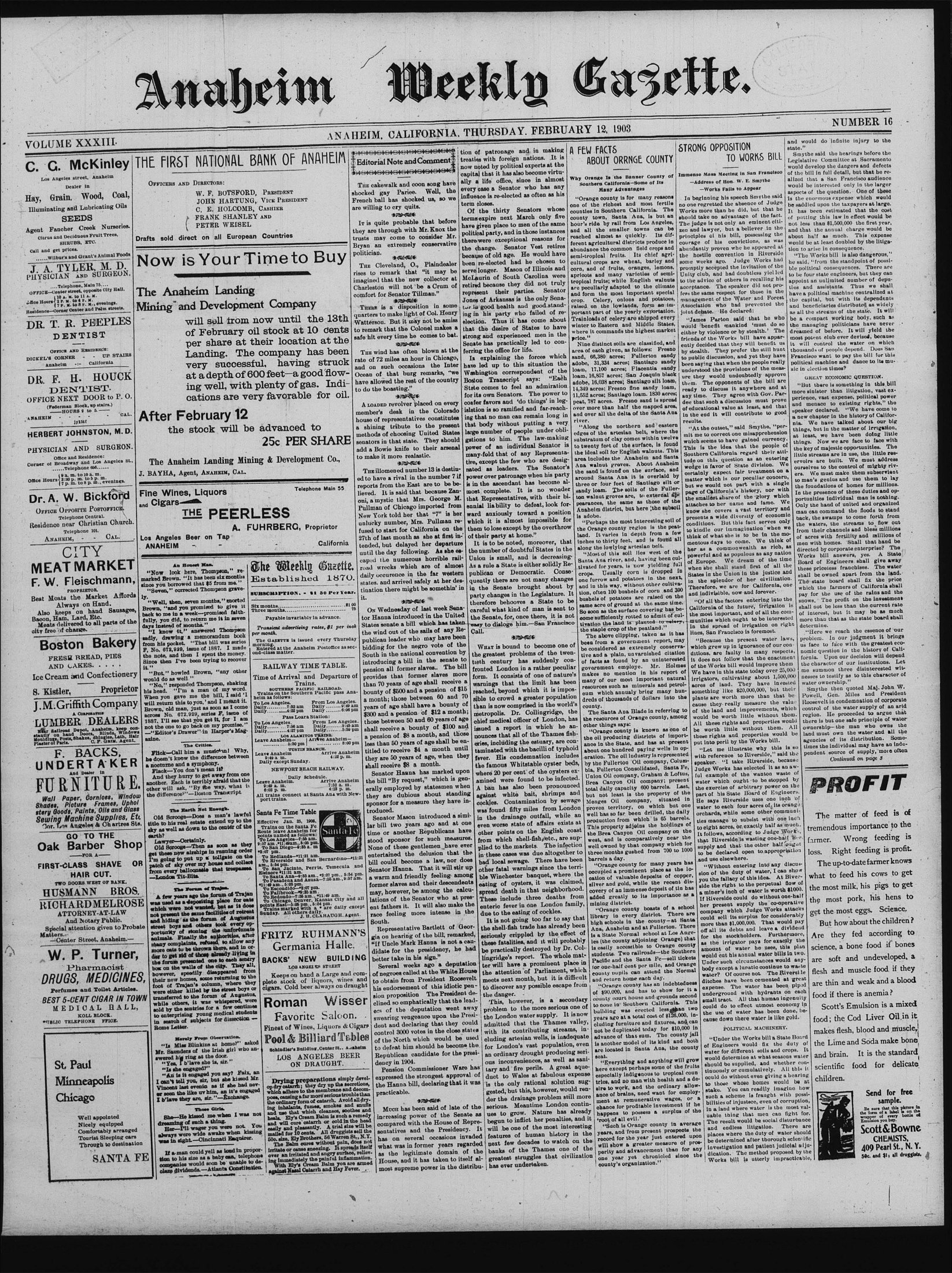
Searchable text
Anaheim
VOLUME XXXIII.
C. G. McKinley
Los Angeles street, Anaheim
Dealer in
Hay, Grain, Wood, Coal,
Illuminating and Lubricating Oils
SEEDS
Agent Fancher Creek Nurseries.
Citrus and Deciduous Fruit Trees,
SHRUBS, ETC.
Call and get prices.
...Wilbur's and Grant's Animal Foods
J. A. TYLER, M. D.
PHYSICIAN AND SURGEON.
Telephone, Main 75...
OFFICE—Center street, opposite City Hall.
10 A.M. to 11 A.M.
2 F.M. to 4 F.M.
7 F.M. to 8 F.M., evenings.
Residence—Corner Center and Palm streets.
DR. T. R. PEEPLES
DENTIST
Office and Residence:
DICKEL'S CORNER - UP STAIRS
Anaheim - California
DR. F. H. HOUCK
DENTIST.
Office NEXT DOOR to P.O.
(Federman Bloek, up stairs.)
HOURS 9 to 6.
ANAHEIM - CAL.
jy154f
HERBERT JOHNSTON, M.D.
PHYSICIAN AND SURGEON.
Office and Residence:
Corner of Broadway and Los Angeles St.
Telephone 606...
THE FIRST NATIONAL BANK OF ANAHEIM
OFFICERS AND DIRECTORS:
W. F. BOTSFORD, President
JOHN HARTUNG, Vice President
C. E. HOLCOMB, Cashier
FRANK SHANLEY AND
PETER WEISEL
Drafts sold direct on all European Countries
Now is Your Time to Buy
The Anaheim Landing
Mining and Development Company
will sell from now until the 13th of February oil stock at 10 cents per share at their location at the Landing. The company has been very successful, having struck at a depth of 600 feet—a good flowing well, with plenty of gas. Indications are very favorable for oil.
After February 12
the stock will be advanced to
25c PER SHARE
The Anaheim Landing Mining & Development Co., J. BAYHA, Agent, Anaheim, Cal.
DR. F. H. HOUCK
DENTIST.
OFFICE NEXT DOOR to P. O.
(Federman Block, up stairs.)
HOURS 9 to 6.
ANAHEIM
Jy1541
HERBERT JOHNSTON, M.D.
PHYSICIAN AND SURGEON.
Office and Residence:
Corner of Broadway and Los Angeles St.
Telephone 666.....
9 a.m. to 10 a.m.
Office Hours
3:30 p.m. to 5 p.m.
7 p.m. to 8 p.m., evenings.
Dr. A. W. Bickford
OFFICE OPPOSITE POSTOFFICE.
Telephone Central.
Residence near Christian Church.
Telephone 101.
ANAHEIM,
CAL.
CITY
MEAT MARKET
F. W. Fleischmann,
PROPRIETOR.
Best Moats the Market Affords
Always on Hand.
Also keeps on hand Sausages,
Bacon, Ham, Lard, Etc.
Meats delivered to all parts of the city free of charge.
Boston Bakery
FRESH BREAD, PIES
AND CAKES.
Ice Cream and Confectionery
S. Kistler, Proprietor
J.M.Griffith Company
A CORPORATION
LUMBER DEALERS
Near Railroad Depot, Anaheim, keep constantly on hand Doors, Blinds, Windows Mouldings, Posts, Shakes, Shingles, Lath, Hair Plaster of Paris.
F. BACKS,
UNDERTAKER
And Dealer in FURNITURE.
Wall Paper, Cornices, Window Shades, Picture Frames, Upholstery Goods, Paints, Oils and Glass Sewing Machine Supplies, Etc.
Cor. Los Angeles & Chartres Sts.
GO TO THE Oak Barber Shop
FOR A
FIRST-CLASS SHAVE OR HAIR CUT.
TWO DOORS WEST OF BANK.
HUSMANN BROS.
An Honest Man.
"Now look here, Thompson," remarked Brown. "It has been six months since you borrowed that $5 from me."
"Seven," corrected Thompson gravely.
"Well, then, seven months," morted Brown, "and you promised to give it back to me in a week—promised faithfully, you did, to return me it in seven days instead of months."
"I know it," answered Thompson sadly, drawing a memorandum book from his pocket. "That bill was series F, No. 672,929, issue of 1887. I made the note, and then I spent the money. Since then I've been trying to recover it."
"But," howled Brown, "any other would do as well."
"No," responded Thompson, shaking his head. "I'm a man of my word. When you gave me the bill, I said 'I will return this to you,' and I meant it. Brown, old man, just as soon as I come across No. 672,929, series F, issue of 1887. I'll see that you get it, for I am not the one to go back on my promise.'"
"'Editor's Drawer'" in Harper's Magazine.
The Critics.
Flick—Call him a musician! Why, he doesn't know the difference between a nocturne and a symphony.
Flack—You don't mean it?
And they hurry to get away from one another. Each is terribly afraid that the other will ask, "'By the way, what is the difference?" — Boston Transcript.
The Earth Net Enough.
Old Scrooge—Does a man's lawful title to his real estate extend up to the sky as well as down to the center of the earth?
Lawyer—Certainly.
Old Scrooge—Then as soon as they get these new airships in running order I'm going to put up a tollgate on the patch of sky over my house and collect from every balloon that trespasses—London Tit-Bita.
The Forum of Trajan.
A few years ago the forum of Trajan
After February 12
the stock will be advanced to
25c PER SHARE
The Anaheim Landing Mining & Development Co., J. BAYHA, Agent, Anaheim, Cal.
Fine Wines, Liquors and Cigars
THE PEERLESS
A. FUHRBERG, Proprietor
Los Angeles Beer on Tap
ANAHEIM
California
The Weekly Gazette,
Established 1870.
SUBSCRIPTION - $150 Per Year.
Six months...$100
Three months...$75
Payable invariably in advance.
Transient advertising rates,$1 per inch per month.
The GAZETTE is issued every Thursday morning.
Entered at the Anaheim Postoffice as second-class matter.
RAILWAY TIME TABLE.
Time of Arrival and Departure of Trains.
SOUTHERN PACIFIC RAILROAD.
Trains on the Southern Pacific pass Anaheim as follows:
To Los Angeles...
Daily...7:52 am Dally...9:49 am Dally...4:22 pm Dally...6:06 pm
Pass Loara Station:
To Los Angeles...
Daily...7:56 am Dally...9:45 am Dally...4:27 pm Dally...5:59 pm
LOS ALAMITOS TRANSIT.
Leave Anaheim...6:50 pm Arrive Anaheim...8:00 pm
TUSTIN BRANCH.
Leave Anaheim...Arrive Anaheim...9:49 a.m Dally except Sunday.
NEWPORT BEACH RAILWAY.
Daily Schedule.
Leave Anaheim...Arrive Anaheim...9:49 a.m Dally except Sunday.
All trains connect at Santa Ana with Newport trains.
Santa Fe Time Table
Effective Jan. 25, 1908.
Trains on the Santa Fe Route leave Anaheim for points named as follows:
To Los Angeles-7:58 am 9:57 am 9:57 am 9:57 am 9:57 am 9:57 am 9:57 am 9:57 am 9:57 am 9:57 am 9:57 am 9:57 am 9:57 am 9:57 am 9:57 am 9:57 am 9:57 am 9:57 am 9:57 am 9:57 am 9:57 am 9:57 am
To Redlands*11:31 am To Riverside and San Bernardino*11am..5:54 pm.To San Jacinto,Perris,Temecula Elmore*11:31 am To Santa Ana*9:35 am.*3:07 pm..5:54 pm.To Pasadena and Azusa*7:55 am..9:57 am.*11:49 am..5:05 pm.To Escondido*3:07 pm.To Fallbrook*3:35 am.To Redondo*7:55 am..11:49 am..
GO TO THE Oak Barber Shop
FIRST-CLASS SHAVE OR HAIR CUT.
TWO DOORS WEST OF BANK.
HUSMANN BROS.
RICHARDMELROSE
ATTORNEY-AT-LAW
And Notary Public.
Special attention given to Probate Matters.
—Center Street, Anaheim.
W. P. Turner,
Pharmacist
DRUGS, MEDICINES,
Perfumes and Toilet Articles.
BEST 5-CENT CIGAR IN TOWN
MEDICAL HALL,
KOLL BLOCK.
PUBLIC TELEPHONE FFICE.
St. Paul
Minneapolis
Chicago
Well appointed
Nicely equipped
Comfortably arranged
Tourist Sleeping cars
Through to destination
SANTA FE
The Earth Not Enough.
Old Scrooge—Does a man's lawful title to his real estate extend up to the sky as well as down to the center of the earth?
Lawyer—Certainly.
Old Scrooge—Then as soon as they get these new airships in running order I'm going to put up a tollgate on the patch of sky over my house and collect from every ballooncase that trespasses—London Tit-Bits.
The Forum of Trajan.
A few years ago the forum of Trajan was used as a depositing place for cats which were not wanted, but as it does not present the same facilities of retreat and hiding as the forum of Augustus street boys and others took every opportunity of stoning the unfortunate animals. Finally the authorities, after many complaints, refused to allow any more cats to be thrown there, and in order to get rid of those already living in the forum presented one to each sentry box on the walls of the city. They all, however, speedily disappeared from their new homes, some returning to the foot of Trajan's column, where they were either killed by the street boys or transferred to the forum of Augustus, while others, it was whispered, were sold by the sentries for a few centimes to enterprising young medical students in search of subjects for dissection — Rome Letter.
Merely From Observation.
"Is Miss Blinkins at home?" asked Mr. Saunders of the Irish girl who answered his ring at the door.
"Yes, I b'love she is, sir."
"Is she engaged?"
"An is it engaged you say? Faix, an I can't tell you, sir, but she kissed Mr. Vincent last evening as if she had never seen the like uv him, an it's engaged I b'love they are, sir." — Exchange.
Those Girls.
She—He kissed me when I was not dreaming of such a thing.
Her—I'll wager you were not. You always were wide awake when kissing was in sight. —Cincinnati Esqirer.
If a man could yell as loud in proportion to his size as a baby can, telephone companies would soon be unable to declare dividends. —Atlanta Constitution.
FRITZ RUHMANN
Germania Halle.
BACKS' NEW BUILDING
LOS ANGELES STREET
Keeps on hand a Large and complete stock of liquors, wines and cigars. Cold beer always on draught.
Roman WissFavorite Saloon.
Finest of Wines, Liquors & Oil Pool & Billiard Table
Schindler's Building, Center St., Avalanche LOS ANGELES BEER ON DRAUGHT.
Drying preparations simply dry on dry catarrh; they dry up the secret which adheres to the membrane and douse, causing a far more serious trouble the ordinary form of catarrh. Avoid ing inhalants, fumes, smokes and dust use that which cleanses, soothes heals. Ely's Cream Balm is such a remedy and will cure catarrh or cold in the easily and pleasantly. A trial size is mailed for 10 cents. All druggists with 50c. size, Ely Brothers, 56 Warren St. The Balm cures without pain, does irritate or cause sneezing. It spreads over an irritated and angry surface, imaging immediately the painful inflamment With Ely's Cream Balm you are against Nasal Catarrh and Hay Fever.
Weekly Gazette
ANAHEIM, CALIFORNIA. THURSDAY. FEBRUARY 12, 1903
OF ANAHEIM
The cakewalk and coon song have shocked gay Pariee. Well, the French ball has shocked us, so we are willing to cry quits.
It is quite probable that before they are through with Mr. Knox the trusts may come to consider Mr. Bryan an extremely conservative politician.
The Cleveland, O., Plaindealer rises to remark that "it may be imagined that the new collector at Charleston will not be a Crum of comfort for Senator Tillman."
There is a disposition in some quarters to make light of Col. Henry Watterson. But it may not be amiss to remark that the Colonel makes a safe hit every time he comes to bat.
The wind has often blown at the rate of 72 miles an hour in Chicago, and on such occasions the Inter Ocean of that burg remarks, "we have allowed the rest of the country to do the boasting."
A loaded revolver placed on every member's desk in the Colorado house of representatives constitutes a shining tribute to the present methods of choosing United States senators in that state. They should add a Bowie knife to their arsenal to make it more realistic.
The illomened number 13 is destin-tion of patronage and in making treaties with foreign nations. It is now noted by political experts at the capital that it has also become virtually a life office, since in almost every case a Senator who has any influence is re-elected as often as his term closes.
Of the thirty Senators whose terms expire next March only five have given place to men of the same political party, and in those instances there were exceptional reasons for the change. Senator Vest retires because of old age. He would have been re-elected had he chosen to serve longer. Mason of Illinois and McLaurin of South Carolina were retired because they did not truly represent their parties. Senator Jones of Arkansas is the only Senator in good health and good standing in his party who failed of re-election. Thus it has come about that the desire of States to have strong and experienced men in the Senate has practically led to conferring the office for life.
In explaining the forces which have led up to this situation the Washington correspondent of the Boston Transcript says: "Each State comes to feel an admiration for its own Senators. The power to confer favors and 'do things' in legislation is so ramified and far-reaching that no man can remain long in that body without putting a very large number of people under obligations to him. The law-making power of an individual Senator is many-fold that of any Representative, except the few who are designated as leaders. The Senator's A FEW FACTS
ABOUT ORRNGE COUNTY
Why Orange Is the Banner County of Southern California—Some of Its Many Advantages
"Orange county is for many reasons one of the richest and most fertile counties in Southern California. The county town, Santa Ana, is but an hour's ride by rail from Los Angeles, and all the smaller towns can be reached almost as quickly. Its different agricultural districts produce in abundance the common field crops and semi-tropical fruits. Its chief agricultural crops are wheat, barley and corn, and of fruits, oranges, lemons, apricots and many varieties of semi-tropical fruits; while English walnuts are peculiarly adapted to the climate and form the most important species crop. Celery, onions and potatoes raised on the lowlands, form an important part of the yearly exportation Trainloads of celery are shipped every winter to Eastern and Middle States where it commands the highest market price."
Nine distinct soils are classified, and area of each given, as follows: Fresh sand, 66,380 acres; Fullerton sand adobe, 31,334 acres; Santiago sand loam, 17,100 acres; Flacentia sand loam, 16,857 acres; San Joaquin black adobe, 16,038 acres; Santiago silt loam, 14,349 acres; Fresno fine sandy loam, 11,552 acres; Santiago loam. 1830 acres peat, 787 acres. Fresno sand is sparse over more than half the mapped area and over all the delta of the Santa An river.
"Along the northern and eastern edges of the artesian belt, where the substratum of clay comes within twelve to twenty feet of the surface, is found the ideal soil for English walnuts. The area includes the Anaheim and San Ana walnut groves. About Anahei the sand is found on the surface, a
A LOADED revolver placed on every member's desk in the Colorado house of representatives constitutes a shining tribute to the present methods of choosing United States senators in that state. They should add a Bowie knife to their arsenal to make it more realistic.
The illomened number 13 is destined to have a rival in the number 7 if reports from the East are to be believed. It is said that because Zanoni, a mystic that Mrs. George M. Pullman of Chicago imported from New York told her that "7" is her unlucky number, Mrs. Pullman refused to start for California on the 27th of last month as she at first intended, but delayed her departure until the day following. As she escaped the numerous horrible railroad wrecks which are of almost daily occurrence in the far western states, and arrived safely at her destination there might be somethin' in it.
On Wednesday of last week Senator Hanna introduced in the United States senate a bill which has taken the wind out of the sails of any Republican leader who may have been bidding for the negro vote of the South in the national convention by introducing a bill in the senate to pension all former slaves.. The bill provides that former slaves more than 70 years of age shall receive a bounty of $500 and a pension of $15 a month; those between 60 and 70 years of age shall have a bounty of $300 and a pension of $12 a month; those between 50 and 60 years of age shall receive a bounty of $100 and a pension of $8 a month, and those less than 50 years of age shall be entitled to receive $4 a month until they are 50 years of age, when they shall receive $8 a month.
Senator Haana has marked upon the bill "By request," which is generally employed by statesmen when they are dubious about standing sponsor for a measure they have introduced.
Senator Mason introduced a similar bill two years ago and at one time or another Republicans have stood sponsor for such measures. None of these gentlemen have ever entertained the delusion that the bill could become a law, nor does Senator Hanna. That it will stir up a warm and friendly feeling among former slaves and their descendants may, however, be among the calculations of the Senator who at presided over the rest of the country to do the boasting."
Boston Transcript says: "Each State comes to feel an admiration for its own Senators. The power to confer favors and 'do things' in legislation is so ramified and far-reaching that no man can remain long in that body without putting a very large number of people under obligations to him. The law-making power of an individual Senator is many-fold that of any Representative, except the few who are designated as leaders. The Senator's power over patronage when his party is in the ascendant has become almost complete. It is no wonder that Representatives, with their biennial liability to defeat, look forward anxiously toward a position which it is almost impossible for them to lose except by the overthrow of their party at home."
It is to be noted, moreover, that the number of doubtful States in the Union is small, and is decreasing. As a rule a State is either solidly Republican or Democratic. Consequently there are not many changes in the Senate brought about by party changes in the Legislature. It therefore behooves a State to be careful what kind of man is sent to the Senate, for, once there, it is not easy to dialogue him.—San Francisco Call.
What is bound to become one of the greatest problems of the twentieth century has suddenly confronted London in a rather peculiar form. It consists of one of nature's warnings that the limit has been reached, beyond which it is impossible to crowd a greater population than is now comprised in the world's metropolis. Dr. Collingridge, the chief medical officer of London, has issued a report in which he announces that all of the Thames fisheries, including the estuary, are contaminated with the bacilli of typhoid fever. His condemnation includes the famous Whitstable oyster beds, where 20 per cent of the oysters examined were found to be infected. A ban has also been pronounced against white bait, shrimps and cockles. Contamination by sewage was found fifty miles from London in the drainage outfall, while an even worse state of affairs exists at other points on the English coast from which shell-fish etc., are supplied to the markets. The infection in these cases was due altogether to bad local sewage. There have been other fatal warnings since the terrible Winchester banquet, where the eating of oysters, it was claimed, spread death in that neighborhood. These include three deaths from Washington correspondence.
Boston Transcript says: "Each State comes to feel an admiration for its own Senators. The power to confer favors and 'do things' in legislation is so ramified and far-reaching that no man can remain long in that body without putting a very large number of people under obligations to him. The law-making power of an individual Senator is many-fold that of any Representative, except the few who are designated as leaders. The Senator's power over patronage when his party is in the ascendant has become almost complete. It is no wonder that Representatives, with their biennial liability to defeat, look forward anxiously toward a position which it is almost impossible for them to lose except by the overthrow of their party at home."
It is to be noted, moreover, that the number of doubtful States in the Union is small, and is decreasing. As a rule a State is either solidly Republican or Democratic. Consequently there are not many changes in the Senate brought about by party changes in the Legislature. It therefore behooves a State to be careful what kind of man is sent to the Senate, for, once there, it is not easy to dialogue him.—San Francisco Call.
What is bound to become one of the greatest problems of the twentieth century has suddenly confronted London in a rather peculiar form. It consists of one of nature's warnings that the limit has been reached, beyond which it is impossible to crowd a greater population than is now comprised in the world's metropolis. Dr. Collingridge, the chief medical officer of London, has issued a report in which he announces that all of the Thames fisheries, including the estuary, are contaminated with the bacilli of typhoid fever. His condemnation includes the famous Whitstable oyster beds, where 20 per cent of the oysters examined were found to be infected. A ban has also been pronounced against white bait, shrimps and cockles. Contamination by sewage was found fifty miles from London in the drainage outfall, while an even worse state of affairs exists at other points on the English coast from which shell-fish etc., are supplied to the markets. The infection in these cases was due altogether to bad local sewage. There have been other fatal warnings since the terrible Winchester banquet, where the eating of oysters, it was claimed, spread death in that neighborhood. These include three deaths from Washington correspondence.
Boston Transcript says: "Each State comes to feel an admiration for its own Senators. The power to confer favors and 'do things' in legislation is so ramified and far-reaching that no man can remain long in that body without putting a very large number of people under obligations to him. The law-making power of an individual Senator is many-fold that of any Representative, except the few who are designated as leaders. The Senator's power over patronage when his party is in the ascendant has become almost complete. It is no wonder that Representatives, with their biennial liability to defeat, look forward anxiously toward a position which it is almost impossible for them to lose except by the overthrow of their party at home."
It is to be noted, moreover, that the number of doubtful States in the Union is small, and is decreasing. As a rule a State is either solidly Republican or Democratic. Consequently there are not many changes in the Senate brought about by party changes in the Legislature. It therefore behooves a State to be careful what kind of man is sent to the Senate, for, once there, it is not easy to dialogue him.—San Francisco Call.
What is bound to become one of the greatest problems of the twentieth century has suddenly confronted London in a rather peculiar form. It consists of one of nature's warnings that the limit has been reached, beyond which it is impossible to crowd a greater population than is now comprised in the world's metropolis. Dr. Collingridge, the chief medical officer of London, has issued a report in which he announces that all of the Thames fisheries, including the estuary, are contaminated with the bacilli of typhoid fever. His condemnation includes the famous Whitstable oyster beds, where 20 per cent of the oysters examined were found to be infected. A ban has also been pronounced against white bait, shrimps and cockles. Contamination by sewage was found fifty miles from London in the drainage outfall, while an even worse state of affairs exists at other points on the English coast from which shell-fish etc., are supplied to the markets. The infection in these cases was due altogether to bad local sewage. There have been other fatal warnings since the terrible Winchester banquet, where the eating of oysters, it was claimed, spread death in that neighborhood. These include three deaths from Washington correspondence.
Boston Transcript says: "Each State comes to feel an admiration for its own Senators. The power to confer favors and 'do things' in legislation is so ramified and far-reaching that no man can remain long in that body without putting a very large number of people under obligations to him. The law-making power of an individual Senator is many-fold that of any Representative, except the few who are designated as leaders. The Senator's power over patronage when his party is in the ascendant has become almost complete. It is no wonder that Representatives, with their biennial liability to defeat, look forward anxiously toward a position which it is almost impossible for them to lose except by the overthrow of their party at home."
It is to be noted, moreover, that the number of doubtful States in the Union is small, and is decreasing. As a rule a State is either solidly Republican or Democratic. Consequently there are not many changes in the Senate brought about by party changes in the Legislature. It therefore behooves a State to be careful what kind of man is sent to the Senate, for, once there, it is not easy to dialogue him.—San Francisco Call.
What is bound to become one of the greatest problems of the twentieth century has suddenly confronted London in a rather peculiar form. It consists of one of nature's warnings that the limit has been reached, beyond which it is impossible to crowd a greater population than is now comprised in the world's metropolis. Dr. Collingridge, the chief medical officer of London, has issued a report in which he announces that all of the Thames fisheries, including the estuary, are contaminated with the bacilli of typhoid fever. His condemnation includes the famous Whitstable oyster beds, where 20 per cent of the oysters examined were found to be infected. A ban has also been pronounced against white bait, shrimps and cockles. Contamination by sewage was found fifty miles from London in the drainage outfall, while an even worse state of affairs exists at other points on the English coast from which shell-fish etc., are supplied to the markets. The infection in these cases was due altogether to bad local sewage. There have been other fatal warnings since the terrible Winchester banquet, where the eating of oysters, it was claimed, spread death in that neighborhood. These include three deaths from Washington correspondence.
Boston Transcript says: "Each State comes to feel an admiration for its own Senators. The power to confer favors and 'do things' in legislation is so ramified and far-reaching that no man can remain long in that body without putting a very large number of people under obligations to him. The law-making power of an individual Senator is many-fold that of any Representative, except the few who are designated as leaders. The Senator's power over patronage when his party is in the ascendant has become almost complete. It is no wonder that Representatives, with their biennial liability to defeat, look forward anxiously toward a position which it is almost impossible for them to lose except by the overthrow of their party at home."
It is to be noted, moreover, that the number of doubtful States in the Union is small, and is decreasing. As a rule a State is either solidly Republican or Democratic. Consequently there are not many changes in the Senate brought about by party changes in the Legislature. It therefore behooves a State to be careful what kind of man is sent to the Senate, for, once there, it is not easy to dialogue him.—San Francisco Call.
What is bound to become one of the greatest problems of the twentieth century has suddenly confronted London in a rather peculiar form. It consists of one of nature's warnings that the limit has been reached, beyond which it is impossible to crowd a greater population than is now comprised in the world's metropolis. Dr. Collingridge, the chief medical officer of London, has issued a report in which he announces that all of the Thames fisheries, including the estuary, are contaminated with the bacilli of typhoid fever. His condemnation includes the famous Whitstable oyster beds, where 20 per cent of the oysters examined were found to be infected. A ban has also been pronounced against white bait, shrimps and cockles. Contamination by sewage was found fifty miles from London in the drainage outfall, while an even worse state of affairs exists at other points onthe English coast from which shell-fish etc., are supplied tothe markets. The infection in these cases was due altogether to bad local sewage. There have been other fatal warnings since the terrible Winchester banquet, wherethe eatingof oystersitwasclaimedspreaddeathinthatneighborhood.Theoceannowhasbeenoccupiedaprominentplaceasocationofvaluabledepositsofsilverandgoldwhilethecoeverycoveryofanimmense depositofthedadded greatlytoitsimportantness."
Senator Mason introduced a similar bill two years ago and at one time or another Republicans have stood sponsor for such measures. None of these gentlemen have ever entertained the delusion that the bill could become a law, nor does Senator Hanna. That it will stir up a warm and friendly feeling among former slaves and their descendants may, however, be among the calculations of the Senator who at present fathers it. It will also make the race feeling more intense in the South.
Representative Bartlett of Georgia on hearing of the bill, remarked, "If Uncle Mark Hanna is not a candidate for the presidency, he had better take in his sign."
Several weeks ago a deputation of negroes called at the White House to obtain from President Roosevelt his endorsement of this idiotic pension proposition The President declined so emphatically that the leaders of the deputation went away swearing vengeance upon the President and declaring that they could control 3000 votes in the close states of the North which would be used to defeat him should he become the Republican candidate for the presidency in 1904.
Pension Commissioner Ware has expressed the strongest approval of the Hanna bill, declaring that it was practicable.
Much has been said of late of the increasing power of the Senate as compared with the House of Representatives and the Presidency. It has on several occasions invaded what was in former years regarded as the legitimate domain of the House, and it has taken to itself almost supreme power in the distribu-
Contamination by sewage was found fifty miles from London in the drainage outfall, while an even worse state of affairs exists at other points on the English coast from which shell-fish, etc., are supplied to the markets. The infection in these cases was due altogether to bad local sewage. There have been other fatal warnings since the terrible Winchester banquet, where the eating of oysters, it was claimed, spread death in that neighborhood. These include three deaths from enteric fever in one London family, due to the eating of cockles.
It is not going too far to say that the shell-fish trade has already been seriously crippled by the effect of these fatalities, and it will probably be practically destroyed by Dr. Collingridge's report. The whole matter will have a prominent place in the attention of Parliament, which meets next month, but it is difficult to discover any possible escape from the danger.
This, however, is a secondary problem to the more serious one of the London water supply. It is now admitted that the Thames valley, with its contributing streams, including artesian wells, is inadequate for London's vast population, even an ordinary drought producing serious inconveniences, as well as sanitary and fire perils. A great aqueduct to Wales at fabulous expense is the only rational solution suggested, but this, however, would render the drainage problem still more serious. Meantime London continues to grow. Nature has already begun to inflict her penalties, and it will be one of the most interesting features of human history in the next few decades to watch on the banks of the Thames one of the greatest struggles that civilization has ever undertaken.
Menges Oil company, situated proven territory, on which well has so far been drilled, the production from which is 65 bbl. This property adjoins the holding of Brea Canyon Oil company west, and is comparatively new well owned by that company whose three months gushed from 700 barrels a day.
"Orange county for many years occupied a prominent place as location of valuable deposits of silver and gold, while the recovery of an immense deposit of added greatly to its important mining district.
"Orange county boasts of a library in every district. The high schools in the county—Santa Ana, Anaheim and at Fullerton is a State Normal school at Lakes (the county adjoining Orange is easily accessible to Orange students. Two railroads—the Sacrific and the Santa Fe—serve for one-half cent per mile, and county pupils can attend them and return home each day.
"Orange county has an index of $90,000, and has to show county court house and ground to none in Southern California building was erected less than years ago at a total cost of $12 cluding furniture and fixtures not be duplicated today for advance of that sum. The city is another model of its kind are located in Santa Ana, the seat.
"Everything and anything here except perhaps some of especially indigenous to tropics, and no man with health sire to work, and the ordinance of brains need want moment at remunerative wage chance for profitable investment happens to possess a surplus 'root of all evil.'"
"Such is Orange county if years, and from present pro record for the year just entitle will show a greater measure perity and advancement there one year yet chronicled county's organization."
FACTS ABOUT ORRNGE COUNTY
Is the Banner County of Southern California—Some of Its Many Advantages
The county is for many reasons the richest and most fertile in Southern California. The town, Santa Ana, is but an edge by rail from Los Angeles, the smaller towns can be almost as quickly. Its difficult cultural districts produce in the common field crops and local fruits. Its chief agri-irrrops are wheat, barley and of fruits, oranges, lemons, and many varieties of semisuits; while English walnuts early adapted to the climate the most important special cereal, onions and potatoes, the lowlands, form an important of the yearly exportation. Its of celery are shipped every Eastern and Middle States, commands the highest market distinct soils are classified, and each given, as follows: Fresno 1380 acres; Fullerton sandy 11,334 acres; Santiago sandy 1100 acres; Flacentia sandy 1857 acres; San Joaquin black 1038 acres; Santiago silt loam, acres; Fresno fine sandy loam, acres; Santiago loam. 1830 acres; acres. Fresno sand is spread more than half the mapped area, all the delta of the Santa Ana.
In the northern and eastern the artesian belt, where the sum of clay comes within twelve feet of the surface, is found soil for English walnuts. This includes the Anaheim and Santa Clare groves. About Anaheim is found on the surface, and the northern and eastern the artesian belt, where the sum of clay comes within twelve feet of the surface, is found soil for English walnuts. This includes the Anaheim and Santa Clare groves. About Anaheim is found on the surface, and
the northern and eastern
of the artesian belt, where the
sum of clay comes within twelve
feet of the surface, is found
in soil for English walnuts. This
includes the Anaheim and Santa
Nut groves. About Anaheim
is found on the surface, and
Santa Ana it is overlaid by
four feet of Santiago silt or
soam. The soils of the Fullerbut groves are, to external appears, the same as those of the
lowlying artesian belt.
Out of this soil lies west of the
Ana river, and, having been cultivated for years, is now yielding full
usually corn is dropped in
arrow and potatoes in the next,
this way, without other cultivations as found by an unintereted government employee. Mr. Holmes
has no mention in his report of
one of our most important natural
resources such as minerals and petrolwhich annually bring many hundreds of dollars into the city.
The Santa Ana Blade in referring to
resources of Orange county, among
the things says:
Orange county is known as one of
oil producing districts of importation in the State, and has at present
one hundred paying wells in opion. The oil industry is represented
by the Fullerton Oil company, ColumFullerton Consolidated, Santa Fe,
Bronx Oil company, Graham & Loftus,
Canyon Oil company; present
and daily capacity 600 barrels. Last,
not least is the property of the
Juges Oil company, situated in
even territory, on which but one
has so far been drilled, the daily
production from which is 65 barrels.
This property adjoins the holdings of
Brea Canyon Oil company on the
est, and is comparatively near the
own owned by that company which for
three months gushed from 700 to 1000
barrels a day.
Orange county for many years has
cupied a prominent place as the lodon of valuable deposits of copper,
water and gold, while the recent discovery of an immense deposit of tin has
added greatly to its importance as a
they would undoubtedly approve
them. The opponents of the bill are
ready to discuss it anywhere and at any time. They agree with Gov. Pardee that such a discussion must prove educational value at least, and that in the end it will contribute to good results.
"At the outset," said Smythe, "permit me to correct one misapprehension which seems to have gained currency. This is the idea that the people of Southern California regard their attitude on this question as an entering wedge in favor of State division. We certainly expect fair treatment on a matter which is our peculiar concern, but we would not part with a single page of California's history, nor with the smallest share of the glory which attaches to her name and fame. We know she covers a vast territory and presents a wide diversity of economic conditions. But this fact serves only to kindle our imagination when we think of what she is to be in the momentous days to come. We think of her as a commonwealth as rich, as powerful and as populous as any nation of Europe. We dream of the time when she shall stand first of all the States in the Union in the justice and in the splendor of her civilization. Therefore, we are for California, one and indivisible, now and forever.
"Of all the factors entering into the California of the future, irrigation is the most important, and of all the communities which ought to be interested in the spread of irrigation on right lines, San Francisco is foremost.
"Because the present water laws, which grew up in ignorance of our conditions, are faulty in many respects, it does not follow that the enactment of the Works bill would improve them. We have in this state today over 25,000 irrigators, cultivating about 1,500,000 acres of land. They have invested something like $20,000,000, but their plants are worth more than that because they really measure the value of the land and improvements, which would be worth little without them. All these rights and properties would be worth little without them. All these rights and properties would be put into peril by the Works bill.
"Let me illustrate why this is so with reference to Riverside," said the speaker. "I take Riverside, because Judge Works has selected it as an awful example of the wanton waste of water which ought to be stopped by the exercise of arbitrary power on the part of his State Board of Engineers. He says Riverside uses one inch of water to each four acres of its orange orchards, while some other communities manage to subsist with one inch to eight acres, or exactly half as much. It follows, according to Judge Works, that Riverside is wasting one-half bus supply and that the other half ought to be declared open to appropriation and use elsewhere.
Without entering into any discussion of the duty of water, I can show you the fallacy of this idea. At Biver-side the right to the perpetual flow of a miner's inch of water is worth $1000. If Riverside could do without one-half
GREAT ECONOMIC QUESTION.
"But there is something in this bill more sinister than litigation, vast experience, vast expense, political power and menace to existing rights," the speaker declared. "We have come to a new chapter in the history of California. We have talked about our big things, but in the matter of irrigation, at least, we have been doing little things. Now we are face to face with the key of majestic opportunities. The little streams are in use, the little reservoirs are built. We must address ourselves to the control of mighty rivers. We must make them subservient to man's genius and use them to lay the foundations of homes for millions. In the presence of these duties and opportunities individual man is nothing. Only the hand of united and organized man can command the floods to stand back, the swamps to come forth from the waters, the streams to flow out from their channels and bless millions of acres with fertility and millions of men with homes. Shall that hand be directed by corporate enterprise? The Works bill answers, yes. A State Board of Engineers shall give away these priceless franchises. The water shall be owned apart from the land. The state board shall fix the price which the farmers of California shall pay for the use of the rains and the snows. The profit on the investments shall not be less than the current rate of interest, but it may be as much more than that as the state board shall determine.
"Here we reach the essence of our problem. In our judgment it brings us face to face with the greatest economic question in the history of California. Upon our decision will depend the character of our institutions. Let me summon three disinterested witnesses to testify as to this character of water ownership."
Smythe then quoted Maj. John W. Powell, Gen. Miles and President Roosevelt in condemnation of corporate control of the water supply of an arid region. He proceeded to argue that there is but one safe principle of water ownership—the man who owns the land must own the water and all the agencies of its distribution. Sometimes the individual may have an independent source of supply, more often
Continued on page 3
Orange county for many years has occupied a prominent place as the location of valuable deposits of copper, silver and gold, while the recent discovery of an immense deposit of tin has added greatly to its importance as a mining district.
Orange county boasts of a school library in every district. There are high schools in the county—at Santa Ana, Anaheim and at Fullerton. There is a State Normal school at Los Angeles (the county adjoining Orange) that is easily accessible to Orange county students. Two railroads—the Southern Pacific and the Santa Fe—sell tickets for one-half cent per mile, and Orange county pupils can attend the Normal School and return home each day.
Orange county has an indebtedness of $90,000, and has to show for it a county court house and grounds second to none in Southern California. This building was erected less than two years ago at a total cost of $126,000, including furniture and fixtures, and can not be duplicated today for $10,000 in advance of that sum. The county jail is another model of its kind and both are located in Santa Ana, the county seat.
Everything and anything will grow here except perhaps some of the fruits especially indigenous to tropical countries, and no man with health and a desire to work, and the ordinary allowance of brains, need want for employment at remunerative wages, or a chance for profitable investment if he happens to possess a surplus of the root of all evil.
Such is Orange county in average years, and from present prospects the record for the year just entered upon will show a greater measure of prosperity and advancement than for any one year yet chronicled since the county's organization."
He says Riverside uses one inch of water to each four acres of its orange orchards, while some other communities manage to subsist with one inch to eight acres, or exactly half as much. It follows, according to Judge Work, that Riverside is wasting one-half her supply and that the other half ought to be declared open to appropriation and use elsewhere.
Without entering into any discussion of the duty of water, I can show you the fallacy of this idea. At Biverside the right to the perpetual flow of a miner's inch of water is worth $1000. If Riverside could do without one-half her present supply the co-operative company which Judge Works attacks could sell its surplus for considerably more than $1,000,000. That would pay off all its debts and leave a dividend for the stockholders. Furthermore, as the irrigator pays for exactly the amount of water he uses, this plan would cut his annual water bills in two. Under such circumstances would anybody except a lunatic continue to waste water? Of course not. The Riverside ditches have been cemented at great expense. The water has been piped underground with hydrants on each small tract. All that human ingenuity could do to effect utmost economy in the use of water has been done, because down there water is like gold.
POLITICAL MACHINERY.
Under the Works bill a State Board of Engineers would fix the duty of water for different soils and crops. It would determine at what seasons water should be supplied, and whether continuously or cumulatively. All this it could do without even giving a hearing to those whose homes would be at stake. You can readily imagine how such a scheme is fraught with possibilities of injustice, even of corruption, in a land where water is the most valuable thing that men can fight for. The result would be social disturbance and endless litigation. There are places where the duty of water should be determined after thorough scientific investigation and patient judicial adjudication. The method proposed by the Works bill is utterly impracticable,
Send for free sample.
Be sure that this picture in the form of a label is on the wrapper of every bottle of Emulsion you buy.
Scott & Bowne CHEMISTS,
409 Pearl St., N.Y.
50c. and $1; all druggists.