anaheim-gazette 1903-02-05
Scanned page
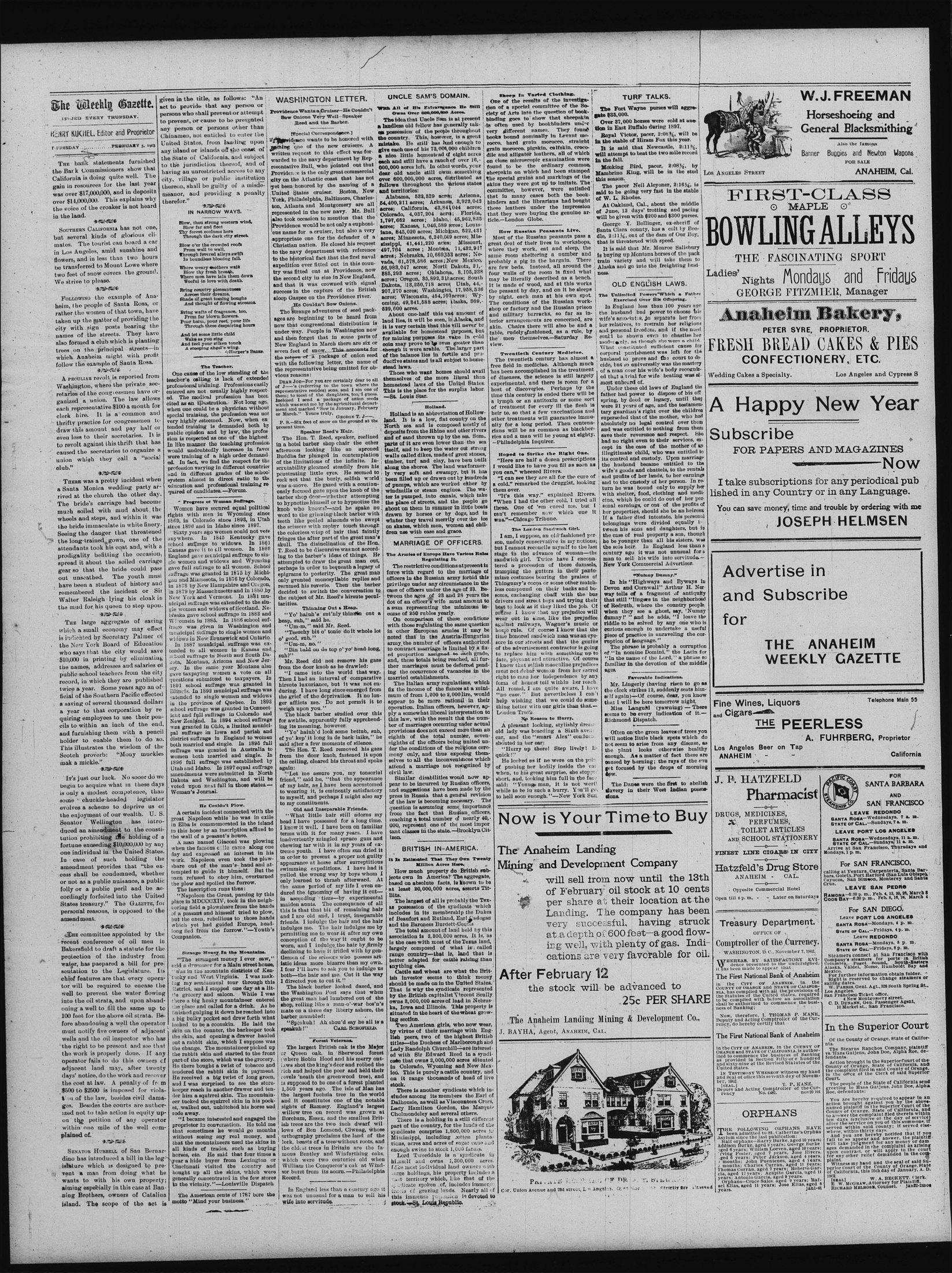
Searchable text
The Weekly Gazette.
ISSUED EVERY THURSDAY.
HENRY KUCHEL, Editor and Proprietor
THURSDAY... FEBRUARY 5, 1803
The bank statements furnished the Bark Commissioners show that California is doing quite well. The gain in resources for the last year was over $17,000,000, and in deposits over $14,000,000. This explains why the voice of the croaker is not heard in the land.
SOUTHERN CALIFORNIA has not one, but several kinds of glorious climates. The tourist can board a car in Los Angeles, amid sunshine and flowers, and in less than two hours be transferred to Mount Lowe where two feet of snow covers the ground. We strive to please.
FOLLOWING the example of Anaheim, the people of Santa Rosa, or rather the women of that town, have taken up the matter of providing the city with sign posts bearing the names of the streets. They have also formed a club which is planting trees on the principal streets—in which Anaheim might with profit follow the example of Santa Rosa.
A peculiar revolt is reported from Washington, where the private secretaries of the congressmen have organized a union. The law allows each representative $100 a month for clerk hire. It is a common and thrifty practice for congressmen to draw this amount and pay half or even less to their secretaries. It is to revolt against this thrift that has caused the secretaries to organize a union which they call a "social club."
given in the title, as follows: "An act to provide that any person or persons who shall prevent or attempt to prevent, or cause to be prevented any person or persons other than Chinamen, not entitled to enter the United States, from landing upon any island or islands off the coast of the State of California, and subject to the jurisdiction thereof, and of having an unrestricted access to any city, village or public institution thereon, shall be guilty of a misdemeanor, and providing a penalty therefor."
IN NARROW WAYS.
Blow, thou strong western wind,
Blow far and fleet
Thy forest coolness here
Through the dark city street.
Blow o'er the crowded roofs
From wall to wall,
Through fevered alleys swift
In boundless blessing fall.
Where weary mothers wait
Blow thy fresh breath,
Where men have lain them down
Woeful in love with death.
Bring country pleasantness
Across their dreams,
Shade of great tossing boughs
And thought of flowing streams.
Bring wafts of fragrance, too.
From far blown flowers.
Pour balm, pour rest, pour life
Through these despairing hours.
And let some little child
Wake as you sing
And feel your silken touch
A stooping angel's wing.
Harper's Bazar.
The Teacher.
One cause of the low standing of the teacher's calling is lack of extended professional training. Professions easily entered are not usually highly respected. The medical profession has been cited as an illustration. Not long ago, when one could be a physician without special training, the profession was not very highly esteemed. Now, when extended training is demanded both by public opinion and by law, the profession is respected as one of the highest. In like manner the teaching profession would undoubtedly increase in favor were training of a high order demanded. In fact, we find the respect for the profession varying in different countries and in different grades of the school.
WASHINGTON LETTER
Providence wants a Cruiser—He Can Sow Onions Very Well—Speak Reed and the Barber.
[Special Correspondence.]
Providence wants to be honored paying one of the new cruisers written request to this effect warded to the navy department by presentative Bull, who pointed out Providence is the only great community on the Atlantic coast that yet been honored by the naming United States cruiser. Boston York, Philadelphia, Baltimore, Otton, Atlanta and Montgomery represented in the new navy. Mr. also took occasion to mention that Providence would be not only a eous name for a cruiser, but also appropriate one for the defender Christian nation. He closed his door to the navy department with regard to the historical fact that the first expedition ever fitted out in the try was fitted out at Providence; the second city in size in New England and that it was crowned with success in the capture of the sloop Gaspee on the Providence.
He Couldn't Sow Onions
The strange adventures of seagages are beginning to be heard now that congressional district under way. People in Washington and then forget that in some New England in March there are seven feet of snow. This accords the return of a package of oil with the following letter, the representative being omitted various reasons:
DEAR JOE—For you are certainly of J.-s (referring to the town representative residues) sons, and I them; to most of the daughters, to Inclosed I send a package of oil which was sent me by the agriculture and marked "Sow in January," or March." Yours truly.
P. S.—Six feet of snow on the grove present time.
Speaker Reed's Hair.
The Hon. T. Reed, speaker, in a hotel barber shop chair at afternoon looking like an Buddha far plunged in content of the limitations of the infirm scrutability gleamed steadily penetrating little eyes. He
A peculiar revolt is reported from Washington, where the private secretaries of the congressmen have organized a union. The law allows each representative $100 a month for clerk hire. It is a common and thrifty practice for congressmen to draw this amount and pay half or even less to their secretaries. It is to revolt against this thrift that has caused the secretaries to organize a union which they call a "social club."
There was a pretty incident when a Santa Monica wedding party arrived at the church the other day. The bride's carriage had become much soiled with mud about the wheels and steps, and within it was the bride immaculate in white finery. Seeing the danger that threatened the long-trained gown, one of the attendants took his coat and, with a prodigality befitting the occasion, spread it about the soiled carriage gear so that the bride could pass out unscathed. The youth must have been a student of history and remembered the incident or Sir Walter Raleigh lying his cloak in the mud for his queen to step upon.
The large aggregate of saving which a small economy may effect is indicated by Secretary Palmer of the New York Board of Education who says that the city would save $10,000 in printing by eliminating the names, addresses and salaries of public school teachers from the city record, in which they are published twice a year. Some years ago an official of the Southern Pacific effected a saving of several thousand dollars a year to that corporation by requiring employees to use their pencils to within an inch of the end, and furnishing them with a pencil holder to enable them to do so. This illustrates the wisdom of the Scotch proverb: "Mony muckles mak a mickle."
It's just our luck. No sooner do we begin to acquire what in these days is only a modest competence, than some chuckle-headed legislator evolves a scheme to deprive us of the enjoyment of our wealth. U.S. Senator Wellington has introduced an amendment to the constitution prohibiting the holding of a fortune exceeding $10,000,000 by any one individual in the United States. In case of such holding the amendment provides that "the excess shall be condemned, whether or not as a public nuisance, a public folly or a public peril and be accordingly forfeited into the United
Progress of Woman Suffrage
Women have secured equal political rights with men in Wyoming since 1869, in Colorado since 1898, in Utah since 1896 and in Idaho since 1897.
Sixty years ago women could not vote anywhere. In 1845 Kentucky gave school suffrage to widows. In 1861 Kansas gave it to all women. In 1869 England gave municipal suffrage to single women and widows and Wyoming gave full suffrage to all women. School suffrage was granted in 1875 by Michigan and Minnesota, in 1876 by Colorado, in 1878 by New Hampshire and Oregon, in 1879 by Massachusetts and in 1880 by New York and Vermont. In 1881 municipal suffrage was extended to the single women and widows of Scotland. Nebraska gave school suffrage in 1883 and Wisconsin in 1885. In 1886 school suffrage was given in Washington and municipal suffrage to single women and widows in New Brunswick and Ontario.
In 1887 municipal suffrage was extended to all women in Kansas and school suffrage in North and South Dakota, Montana, Arizona and New Jersey. In the same year Montana also gave taxpaying women a vote on all questions submitted to taxpayers. In 1891 school suffrage was granted in Illinois. In 1892 municipal suffrage was extended to single women and widows in the province of Quebec. In 1893 school suffrage was granted in Connecticut and full suffrage in Colorado and New Zealand. In 1894 school suffrage was granted in Ohio, a limited municipal suffrage in Iowa and parish and district suffrage in England to women both married and single. In 1895 full suffrage was granted in Australia to women both married and single. In 1896 full suffrage was established by Utah and Idaho. In 1897 equal suffrage amendments were submitted in North Dakota and Washington, and will be voted upon next fall in those states.
He Couldn't Plow.
A certain incident connected with the great Napoleon while he was in exile in Elba is commemorated in the island to this hour by an inscription affixed to the wall of a peasant's house.
A man named Giacconi was plowing when the famous eagle came along one day and expressed an interest in his work. Napoleon even took the plow-share out of the man's hand and attempted to guide it himself. But the oxen refused to obey him, overturned the plow and spoiled the furrow.
The inscription runs thus:
"Napoleon the Great, passing by this teacher's calling is lack of extended professional training. Professions easily entered are not usually highly respected. The medical profession has been cited as an illustration. Not long ago, when one could be a physician without special training, the profession was not very highly esteemed. Now, when extended training is demanded both by public opinion and by law, the profession is respected as one of the highest. In like manner the teaching profession would undoubtedly increase in favor were training of a high order demanded. In fact, we find the respect for the profession varying in different countries and in different grades of the school system almost in direct ratio to the education and professional training required of candidates." - Forum
Dear Joe—For you are certainly of J.-s's (referring to the town representative resides) sons, and I them; to most of the daughters, too! Induced I send a package of oil which was sent me by the agricultural ment and marked "Sow in January, or March." Yours truly.
P.S.-Six feet of snow on the ground present time.
Speaker Reed's Hair.
The Hon. T. Reed, speaker, in a hotel barber shop chair afternoon looking like an Buddha far plunged in context of the limitations of the infirm scrutability gleamed steadily as penetrating little eyes. He sreck not that the burly self was a-move. He gazed with an ousely focused gaze upon the knob barber shop door—whether attentive to hypnotize himself or to hypnotize knob who knows?—and word to the grinning-black beard teeth like peeled almonds with the scissors with zephyr touch the colorless wisp of hair fringes after part of the gray skull. The disinclination of T. Reed to be discursive was no longer to the barber's ideas of this attempt to draw the great perhaps in order to bequeath an epigrams to posterity. The only grunted monosyllabic rewritten his reverie. Then decided to switch the convex subject of Mr. Reed's hirsutities.
Thinning Out A Heart
"Yo' haiuh's sut'nly thinng heap, suh," said he.
"Um-m," said Mr. Reed.
"Teenchy bit o' tonic do it o' good, suh."
"Um-m, no."
"Bin bald on de top o' yo' lo suh?" Mr. Reed did not remove from the door knob as he drew "I came into the world Then I had an interval of co-hirsute luxuriance, but it was during. I have long since emitted the grief of the deprivation ger afflicts me. Do not perish upon you."
The black barber studied for awhile, apparently fully understanding its meaning, however.
"Yo' haiuh'd look some beef yo' kep' it long in de back said after a few moments of sleep The Hon. T. Reed removed from the door knob, fastened the ceiling, cleared his throat again:
"Let me assure you, my friend," said he, "that the son of my hair, as I have been able to wear it, is eminently suitable myself, and perhaps I might try my constituents.
Old and Inspeable Friend
"What little hair still head I have possessed for a year I know it well. I have been on terms with it for many years inadvertently mingled spruce chewing tar with it in my treme youth. I have often seen in order to present a proper appearance at home after swimming expeditions. I have pulled the wrong way by boy only learned to thrash after the same period of my life duried the ignominy of having ascended tiers—by ex-
some chuckle-headed legislator evolves a scheme to deprive us of the enjoyment of our wealth. U. S. Senator Wellington has introduced an amendment to the constitution prohibiting the holding of a fortune exceeding $10,000,000 by any one individual in the United States. In case of such holding the amendment provides that "the excess shall be condemned, whether or not as a public nuisance, a public folly or a public peril and be accordingly forfeited into the United States treasury." The Gazette, for personal reasons, is opposed to the amendment.
The committee appointed by the recent conference of oil men in Bakersfield to draft a statute for the protection of the industry from water, has paired a bill for presentation to the Legislature. Its chief features are that every operator will be required to encase the well to prevent the water flowing into the oil strata, and upon abandoning a well to fill the same up to 100 feet for the above oil strata. Before abandoning a well the operator must notify five owners of adjacent wells and the oil inspector who has the right to be present and see that the work is properly done. If any operator fails to do this owners of adjacent land may, after twenty days' notice, do the work and recover the cost at law. A penalty of from $500 to $2500 is imposed for violation of the law, besides civil damages. Besides the courts are authorized not to take action in equity upon the petition of any operator within one mile of the well complained of.
Senator Hubbell of San Bernardino has introduced a bill in the legislature which is designed to prevent a man from doing what he wants to with his own property; aiming especially in this case at Banning Brothers, owners of Catalina island. The scope of the act is
He Couldn't Plow.
A certain incident connected with the great Napoleon while he was in exile in Elba is commemorated in the island to this hour by an inscription affixed to the wall of a peasant's house.
A man named Giacconi was plowing when the famous cattle came along one day and expressed an interest in his work. Napoleon even took the plowshare out of the man's hand and attempted to guide it himself. But the oxen refused to obey him, overturned the plow and spoiled the furrow.
The inscription runs thus:
"Napoleon the Great, passing by this place in MDCCCXIV, took in the neighboring field a plowshare from the hands of a peasant and himself tried to plow, but the oxen, rebellious to those hands which yet had guided Europe, headlong fled from the furrow."—Youth's Companion.
Strange Money In the Mountains.
"The strangest money I ever saw," said a drummer for a Main street house, "was in the mountain districts of Kentucky and West Virginia. I was making my semiannual tour through this district, and I stopped one day at a little grocery and saloon. While I was there a big husky mountaineer entered the place and called for a drink. As he finished gulping it down he reached into a big bulky pocket and drew forth what looked to be a coonskin. He laid the skin on the counter, the barkeeper took the skin, and opening a drawer hauled out a rabbit skin, which I suppose was the change. The mountaineer picked up the rabbit skin and started to front part of the store, which was the grocery. He there bought a twist of tobacco and tendered the rabbit skin in payment. He received a big twist of long green, and I was surprised to see the storekeeper reach in another drawer and tender him a squirrel skin. The mountaineer tucked the squirrel skin in his pocket, walked out, unhitched his horse and rode away.
"I became interested and engaged the proprietor in conversation. He told me that sometimes he would go months without seeing any real money, and that the mountaineers used the skins in all kinds of trades, such as buying horses, etc. He said that four times a year a hide buyer from Lexington or Cincinnati visited the country and bought up all the skins, which were generally concentrated in the few stores in the vicinity."—Louisville Dispatch.
The American cents of 1787 bore the motto "Mind your business."
Old and Inseparable Friend
"What little hair still lies on head I have possessed for a year I know it well. I have been on terms with it for many years inadvertently mingled spruce chewing tar with it in my treme youth. I have often seen in order to present a proper appearance at home after such swimming expeditions. I have pulled the wrong way by boy only learned to thrash after the same period of my life dured the ignominy of having in ascending tiers—by exe maiden ants. The consequence this is that that bit of remain and I are old and, I trust, in friends. I indulge the hair and indulges me. The hair induces permitting me to wear it after conception of the way it owes worn, and I indulge the hair declining to have it trifled w tilemen of the scissors who possess logic ideas more bizarre than I fear I'll have to ask you to both—the hair and me. Cut I directed you to cut it."
The black barber looked at the Washington Post says that the great man had lumbered shop, rolling like a man-o'-winkle on a three day liberty barber mumbled:
"Speakuh! Ah shou'd say speakuh!" CARL SCOTT
Forest Veterans
The largest British oak is or Queen oak, in Sherwood where Robin Hood and his laws shot the king's deer and rich and helped the poor and revels 'neath the greenwood is supposed to be one of a for 1,500 years ago. The island is the largest fuchsia tree in England willow tree on record was Borcham, Essex, and the small trees are the two inch lows of Ben Lomond, Clwr orthography proclaims the laek beaks of a tree without the oldest trees in Britain are mous Bentley and Winfard which were two centuries William the Conqueror's oak sor burst from its acorn.—P.R. Record.
In England less than a cent was not unusual for a man wife into servitude.
WASHINGTON LETTER.
Evidence wants a Cruiser—He Couldn't Sow Onions Very Well—Speaker Reed and the Barber.
[Special Correspondence.]
Evidence wants to be honored with being one of the new cruisers. A written request to this effect was forwarded to the navy department by Representative Bull, who pointed out that evidence is the only great commercial by on the Atlantic coast that has not been honored by the naming of a United States cruiser. Boston, New York, Philadelphia, Baltimore, Charles, Atlanta and Montgomery are all represented in the new navy. Mr. Bull took occasion to mention that the evidence would be not only a euphonious name for a cruiser, but also a very appropriate one for the defender of a Christian nation. He closed his request to the navy department with reference to the historical fact that the first naval expedition ever fitted out in this country was fitted out at Providence, now the second city in size in New England, and that it was crowned with signal access in the capture of the British Gaspee on the Providence river.
He Couldn't Sow Onions.
The strange adventures of seed packages are beginning to be heard from now that congressional distribution is under way. People in Washington now and then forget that in some parts of New England in March there are six or even feet of snow. This accounts for the return of a package of onion seed with the following letter, the name of the representative being omitted for obvious reasons:
DEAR JOE—For you are certainly dear to all J.-s (referring to the town where the representative resides) sons, and I am one of them; to most of the daughters, too, I guess. Deployed I send a package of onion seeds which was sent me by the agricultural department and marked "Sow in January, February or March." Yours truly.
GEORGE T. J.
P. S.—Six feet of snow on the ground at the present time.
Speaker Reed's Hair.
The Hon. T. Reed, speaker, reclaimed a hotel barber shop chair the other afternoon looking like an aproned buddha far plunged in contemplation of the limitations of the infinite. Incrustability gleamed steadily from his conceiving little eyes. He seemed to
UNCLE SAM'S DOMAIN.
With All of His Extravagance He Still Owns Over 600,000,000 Acres.
The idea that Uncle Sam is at present a landless old fellow has generally taken possession of the people throughout the country. This, however, is a great mistake. He still has had enough to give each one of his 73,000,000 children a nice little homestead of eight acres each and still have a ranch of over 16,000,000 acres left. In other words, your dear old ancle still owns something over 600,000,000 acres, distributed as follows throughout the various states and territories:
Alabama, 582,839 acres; Arizona, 54,400,211 acres; Arkansas, 8,922,043 acres; California, 43,841,044 acres; Colorado, 4,037,204 acres; Florida, 1,797,662 acres; Idaho, 45,962,855 acres; Kansas, 1,046,589 acres; Louisiana, 845,020 acres; Michigan, 522,431 acres; Minnesota, 6,240,049 acres; Mississippi, 41,441,220 acres; Missouri, 497,764 acres; Montana, 71,432,917 acres; Nebraska, 10,669,353 acres; Nevada, 61,578,586 acres; New Mexico, 56,983,047 acres; North Dakota, 21,-885,293 acres; Oklahoma, 8,105,238 acres; Oregon, 35,892,315 acres; South Dakota, 18,-250,718 acres; Utah, 44,-207,270 acres; Washington, 17,-958,536 acres; Wisconsin, 454,107 acres; Wyoming, 49,-841,588 acres; Alaska, 369,-529,600 acres.
About one-half this vast amount of land lies, it will be seen in Alaska, and it is very certain that this will never be available for homestead purposes, but for mining purposes its value in cold coin may prove to be even greater than though it were arable. The larger part of the balance lies in fertile and productive states and is all subject to home-stead laws.
Those who want homes should avail themselves of the more liberal than homestead laws of the United States. This is the place for the surplus labor. —St. Louis Star.
Holland.
Holland is an abbreviation of Hollowland. It is a low, flat country on the North sea and is composed mostly of deposits from the Rhine and other rivers and of sand thrown up by the sea. Some parts of it are even lower than the sea itself, and to keep the water out strong walls called dikes made of great stones, timber, turf and clay have been built along the shores. The land was formerly very soft and swampy, but it has sheep In Varied Clothing.
One of the results of the investigation of a special committee of the Society of Arts into the question of book-binding goes to show that sheepskin is often used by bookbinders univer different names. They found books bound nominally in Levant morocco, hard grain morocco, straight grain morocco, pligskin, calfskin, crocodile and alligator leathers, all of which on close microscopic examination were found to be the ordinary common sheepskin on which had been stamped the special grains and markings of the skins they were got up to limitate. The committee, however, were satisfied that in many cases both the book-binders and the librarians had bought these leathers under the impression that they were buying the genuine article.—London Globe.
How Russian Peasants Live.
Most of the Russian peasants pass a great deal of their lives in workshops where they work, eat and sleep,the same room sheltering a number and probably a pig in the bargain. There are few beds. Instead all around four walls of the room is fixed what may be literally described as a bench. It is made of wood,and at this works the peasant by day,and on it he sleeps by night.each man at his own spot.The conditions of the Russian workshop or factory and the Russian prison and military barracks,sso far as interior arrangements are concerned,a skn. Chairs there will also be and a table,rudely fashioned,a rule,bylem themselves.—Saturday Review.
Twentieth Century Medicine.
The twentieth century has almost a free field in medicine.Although much has been accomplished in the treatment of diseases,the science is still largely experimental,and there is room for a host of discoveries.Perhaps by the time this century is ended there will be a lymph or an antitoxin or some sort of treatment for every illthe flesh is heir to.so that a few vaccinations and other treatments will guarantee immunity for a long period.Then centenarlans will be as common as blackberries and a man will be young at eighty.—Philadelphia Inquirer.
Hoped to Strike the Right One.
"Here are half a dozen prescriptions I would like to have you fill as soon as you can," wheezed Rivers.
DEAR JOE—For you are certainly dear to all J.’s (referring to the town where the resides resides) sons, and I am one of them; to most of the daughters, too. I guess, I send a package of onion seeds which was sent me by the agricultural department and marked "Sow in January, February or March." You’re truly.
P. S.—Six feet of snow on the ground at the present time.
Speaker Reed’s Hair.
The Hon. T. Reed, speaker, reclined in a hotel barber shop chair the other afternoon looking like an aproned buddha far plunged in contemplation of the limitations of the infinite. Incurability gleamed steadily from his cucetrating little eyes. He seemed to be not that the burly, selfish world was a move. He gazed with a continuously focused gaze upon the knob of the barber shop door—whether attempting to hypnotize himself or to hypnotize the knob who knows?—and he spake no word to the grinning black barber with teeth like peeled almonds who swept the scissors with zephyr touch through the colorless wisp of hair that faintly brings the after part of the great man’s skull. The disinlination of the Hon. T. Reed to be discursive was not according to the barber’s ideas of things. He attempted to draw the great man out, perhaps in order to bequeath a legacy of epigrams to posterity. The great man only grunted monosyllabic replies and recumed his reverie. Then the barber decided to switch the conversation to the subject of Mr. Reed’s hirsute peculiarities.
Thinning Out a Heap.
“Yo’ hailuh’s sut'nly thinin’ out a heap, suh,” said he.
“Um-m,” said Mr. Reed.
“Teenchy bit o’ tonic do it whole lot o’ good, suh.”
“Um-m, no.”
“Bald on de top o’ yo’ head long, suh?”
Mr. Reed did not remove his gaze from the door knob as he drew: “I came into the world that way. Then I had an interval of comparative hirsute luxuriance, but it was not enduring. I have long since emerged from the grief of the deprivation. It no longer afflicts me. Do not permit it to weigh upon you.”
The black barber studied over this for awhile, apparently fully apprehending its meaning, however.
“Ye’ hailuh’d look some bettub, suh, ef ye’ kep it long in de back lake,” he said after a few moments of silence.
The Hon. T. Reed removed his gaze from the door knob, fastened it upon the ceiling, cleared his throat and spoke again:
“Let me assure you, my tonsorial friend,” said he, “that the appearance of my hair, as I have been accustomed to wearing it, is eminently satisfactory to myself, and perhaps I might also say to my constituents.
Old and Inseparable Friends.
“What little hair still adorns my head I have possessed for a long time. I know it well. I have been on familiar terms with it for many years. I have inadvertently mingled spruce gum and chewing tar with it in my years of extreme youth. I have often sun dried it in order to present a proper not guilty appearance at home after surreptitious swimming expeditions. I have had it pulled the wrong way by boys whom I only learned to thrash afterward. At the same period of my life I even endured the ignominy of having it cut-in ascending titers—by experimental themselves of the more liberal than homestead laws of the United States. This is the place for the surplus labor.
—St. Louis Star.
Holland.
Holland is an abbreviation of Hollow-land. It is a low, flat country on the North sea and is composed mostly of deposits from the Rhine and other rivers and of sand thrown up by the sea. Som-parts of it are even lower than the sea itself, and to keep the water out strong walls called dikes, made of great stones, timber, turf and clay, have been built along the shores. The land was formerly very soft and swampy, but it has been filled up or drawn out by hundreds of pumps, which are worked either by windmills or steam engines. The water is pumped into canals, which take the place of streets, and the people go about on them in summer in little boats drawn by horses or by dogs, and in winter they travel merrily over the ice on skates, which men, women and children use with ease and grace.
MARRIAGE OF OFFICERS.
The Armies of Europe Have Various Rules Regulating It.
The restrictive conditions at present in force with regard to the marriage of officers in the Russian army forbid this privilege under any circumstance in the case of officers under the age of 23. Between the ages of 28 and 28 years the dot of an officer’s wife must amount to a sum representing the minimum income of 250 rubles yearly.
On comparison of these conditions with those regulating the same question in other European armies it may be noted that in the Austria-Hungarian army, the number of officers authorized to contract marriage is limited by a fixed proportion assigned to each grade, and these totals being reached, all further marriages must be deferred pending the occurrence of vacancies in the married establishments.
The Italian army regulations, which fix the income of the flames at a minimum of from 1,200 to 2,000 lire, would appear to be more rational in their operation. Italian officers, however, apply a somewhat liberal interpretation to this law, with the result that the number of marriages occurring under actual provisions does not exceed more than an eighth of the total number, seven-eighths of the officers being united under the conditions of the religious ceremony only, and thus exposing themselves to all the inconveniences which attend a marriage not recognized by civil law.
Similar disabilities would now appear to be incurred by Russian officers, and suggestions have been made by the press in Russia that a general revision of the law is becoming necessary. The question is assuming some importance from the fact that Russian officers, reaching a total number of nearly 40,000, represent one of the most important classes in the state.
BRITISH IN AMERICA.
It Is Estimated That They Own Twenty Million Acres Here.
How much property do British subjects own in America? The aggregate based on absolute facts, is known to be at least 20,000,000 acres, asserts Tit-Bits.
Now is Your Time to
The Anaheim Landing Mining and Development Company will sell from now until tuesday oil stock at 10%
Old and Inseparable Friends.
"What little hair still adorns my head I have possessed for a long time. I know it well. I have been on familiar terms with it for many years. I have inadvertently mingled spruce gum and chewing tar with it in my years of extreme youth. I have often sun dried it in order to present a proper not guilty appearance at home after surreptitious swimming expeditions. I have had it pulled the wrong way by boys whom I only learned to thrash afterward. At the same period of my life I even endured the ignominy of having it cut—in ascending tiers—by experimental maiden ants. The consequence of all this is that that bit of remaining hair and I are old and, I trust, inseparable friends. I indulge the hair and the hair indulges me. The hair indulges me by permitting me to wear it after my own conception of the way it ought to be worn, and I indulge the hair by firmly declining to have it trifled with by gentlemen of the scissors who possess artistic ideas more bizarre than my own. I fear I'll have to ask you to indulge us both—the hair and me. Cut it the way I directed you to cut it."
The black barber looked dazed, and the Washington Post says that when the great man had lumbered out of the shop, rolling like a man-o'-war bos'n's mate on a three day liberty ashore, the barber mumbled:
"Speakuh! Ah shou'd say he all is a speakuh!" CARL SCHOFIELD.
Forest Veterans.
The largest British oak is the Major or Queen oak, in Sherwood forest (where Robin Hood and his merry outlaws shot the king's deer and robbed the rich and helped the poor and held their revels 'neath the greenwood tree), and is supposed to be one of a forest planted 1,500 years ago. The isle of Man has the largest fuchsia tree in the world and it constitutes one of the notable sights of Ramsey. England's largest willow tree on record was grown at Borcham, Essex, and the smallest British trees are the two inch dwarf willows of Ben Lomond, Clwnag, whose orthography proclaims the land of the leek, boasts of a tree without roots, and the oldest trees in Britain are the famous Bentley and Winfarthing oaks, which were two centuries old when William the Conqueror's oak at Windsor burst from its acorn.—Philadelphia Record.
In England less than a century ago it was not unusual for a man to sell his wife into servitude.
BRITISH IN AMERICA.
It Is Estimated That They Own Twenty Million Acres Here.
How much property do British subjects own in America? The aggregate, based on absolute facts, is known to be at least 20,000,000 acres, asserts Tit-Bits.
The largest of all is probably the Texas possession of the syndicate which includes in its membership the Dukes of Beaufort and Rutland, Earl Cadogan and the Baroness Burdett-Coutis.
The total amount of land held by this association is 3,800,000 acres. It is, as is the case with most of the Texas land, largely composed of what is called range country—that is, land that is better adapted for cattle raising than anything else.
Cattle and wheat are what the British investor seems to think money should be made on in the United States. That is why the syndicate represented by the British capitalist Vincent Scully owns 3,000,000 acres of land in Nebraska, Iowa and Illinois. This property is situated in the heart of the wheat growing section.
Two American girls, who now wear, by virtue of their marriage with English peers, two of the highest British titles—the Duchess of Marlborough and Lady Randolph Churchill—are interested with Sir Edward Reed in a syndicate that owns 2,000,000 acres situated in Colorado, Wyoming and New Mexico. This is purely a cattle country, and on it range thousands of head of live stock.
There is another syndicate which includes among its members the Earl of Dalhousie, as well as Viscountess Cross, Lady Hamilton Gordon, the Marquis Cholmondeley and several others.
There is a holding in a still different part of the country, for the lands of the syndicate comprise 1,800,000 acres in Mississippi, including cotton plantations, acres and acres of sugar cane and enough swine to stock 1,000 farms.
Lord Twededdale is a syndicate in himself and owns 1,800,000 acres. Like most individual land owners with large holdings, his property includes a vast territory which, like that of the syndicate spoken of, includes immense tracts of grazing lands. Nearly all of this immense population is devoted to stock.—St. Louis Republic.
TURF TALKS.
The Fort Wayne purses will aggregate $35,000.
Over 37,000 horses were sold at auction in East Buffalo during 1897.
Royal Victor, pacer, 2:08½, will be in the stable of Hiram Fox this year.
It is said that Newcastle, 2:11¼, will attempt to beat the two mile record in the fall.
Mocking Bird, pacer, 2:08½, by Mambrino King, will be in the stud this season.
The pacer Neil Aloyoner, 2:16¼, is said to be going very fast in the stable of W. L. Rhodes.
At Oakland, Cal., about the middle of June, 12 days' trotting and pacing will be given with $200 and $300 purses.
George Y. Bollinger, ex-sheriff of Santa Clara county, has a colt by Boodd, 2:11¼, out of the dam of Our Boy, that is threatened with speed.
It is said that Mr. Monroe Salisbury is buying up Montana horses of the pack train variety and will take them to Alaska and go into the freighting business.
OLD ENGLISH LAWS.
The Unlimited Powers Which a Father Exercised Over His Offspring.
In England less than 100 years ago the husband had power to choose his wife's associates, to separate her from her relatives, to restrain her religious and personal freedom, and if the need could be shown even to chastise her moderately, as though she were a child. What constituted sufficient cause for corporal punishment was left for the husband to prove and the court to decide, but so universally was the mastery of a man over his wife's body recognized that a trial for wife beating was almost unheard of.
Under these old laws of England the father had power to dispose of his offspring, by deed or legacy, until they were 21 years of age, and the testamentary guardian's right over the children superseded that of the mother, who had absolutely no legal control over them and was entitled to nothing from them save their reverence and respect. She had no right even to their services, except in the case of the mother of an illegitimate child, who was entitled to its control and custody. Upon marriage the husband became entitled to the wife's goods and chattels, to the rentals
W.J.FREEMAN
Horseshoeing and General Blacksmithing
Also the famous
Banner Buggies and Newton Wagons
FOR SALE
ANAHEIM, Cal.
FIRST-CLASS
MAPLE
BOWLING ALLEYS
THE FASCINATING SPORT
Ladies' Nights Mondays and Fridays
GEORGE FITZMIER, Manager
Anaheim Bakery,
PETER SYRE, PROPRIETOR.
FRESH BREAD CAKES & PIES CONFECTIONERY, ETC.
Wedding Cakes a Specialty. Los Angeles and Cypress S
A Happy New Year
Subscribe
FOR PAPERS AND MAGAZINES
Now
A Happy New Year
Subscribe
FOR PAPERS AND MAGAZINES
Now
I take subscriptions for any periodical published in any Country or in any Language.
You can save money, time and trouble by ordering with me
JOSEPH HELMSEN
Advertise in
and Subscribe
for
THE ANAHEIM
WEEKLY GAZETTE
Fine Wines, Liquors
and Cigars
THE PEERLESS
A. FUHRBERG, Proprietor
Los Angeles Beer on Tap
ANAHEIM - California
J. P. HATZFELD
Pharmacist
DRUGS, MEDICINES,
PERFUMES,
TOILET ARTICLES
AND SCHOOL STATIONERY
FINEST LINE CIGARS IN CITY
Hatzfeld’s Drug Store
ANAHEIM - CAL.
Opposite Commercial Hotel
FOR
SANTA BARBARA
AND
SAN FRANCISCO
LEAVE REDONDO
SANTA ROSA—Wednesdays, 7 a.m.
STATE OF CAL.—Sundays, 7 a.m.
LEAVE PORT LOS ANGELES
SANTA ROSA—Wednesdays, 11 a.m.
STATE OF CAL.—Sundays, 11 a.m.
Arrive at San Francisco, Thursdays and Mondays, 1 p.m.
For SAN FRANCISCO,
calling at Ventura, Carpenteria, Santa Barbara, Goleta, Port Harford (San Luis Obispo), Cayucos, San Simeon, Monterey and Santa Cruz.
LEAVE SAN PEDRO
RAMONA—6:30 p.m., Feb. 4, 12, 20, 28, March 8
DRUGS, MEDICINES,
PERFUMES,
TOILET ARTICLES
AND SCHOOL STATIONERY
FINEST LINE CIGARS IN CITY
Hatzfeld’s Drug Store
ANAHEIM - CAL.
Opposite Commercial Hotel
Open till 8 p.m. - Later on Saturdays
Treasury Department.
OFFICE OF
Comptroller of the Currency.
WASHINGTON, D.C., November 7, 1902.
WHEREAS, BY SATISFACTORY EVIDENCE presented to the undersigned, it has been made to appear that:
The First National Bank of Anaheim
in the CITY OF ANAHEIM, in the COUNTY OF ORANGE and STATE OF CALIFORNIA, has complied with all the provisions of the Statutes of the United States, required to be compiled with before an association shall be authorized to commence the business of Banking;
Now, therefore, I. THOMAS P. KANE, Deputy and Acting Comptroller of the Currency, do hereby certify that:
The First National Bank of Anaheim
in the CITY OF ANAHEIM, in the COUNTY OF ORANGE and STATE OF CALIFORNIA, is authorized to commence the business of Banking as provided in Section Fifty-ore hundred and sixty-nine of the Revised Statutes of the United States.
IN TESTIMONY WHEREOF witness my hand and Seal of office this seventh day of November, 1902.
[SEAL]
T. P. KANE.
Deputy and Acting Comptroller of the Currency
No. 6481.
nov20 10t
ORPHANS
THE FOLLOWING ORPHANS HAVE been admitted to St. Catherine’s Orphan Asylum since the last publication:
Half orphans—Harry Burke, aged 10 years;
Addison Burke, aged 9 years; George Burke, aged 6 years; William Loeven, aged 10 years;
Serving Foster, aged 7 years; Jose Riyers, aged 6 years; Peter Jackson, aged 4 years; months; John Phentes, aged 4 years; months; Charles Curran, aged 4 years; Thomas Curran, aged 7 years; Roberto Garcia, aged 12 years; Agapito Garcia, aged 11 years; Antonio Garcia, aged 9 years.
Orphans—Cruce Sales, aged 9 years; Rafael Ellias, aged 11 years; Jose Ellias, aged 8 years.
SAN FRANCISCO
LEAVE REDONDO
SANTA ROSA—Wednesdays, 7 a.m.
STATE OF CAL.—Sundays, 7 a.m.
LEAVE PORT LOS ANGELES
SANTA ROSA—Wednesdays, 11 a.m.
STATE OF CAL.—Sundays, 11 a.m.
Arrive at San Francisco, Thursdays and Mondays, 1 p.m.
For SAN FRANCISCO,
calling at Ventura, Carpenteria, Santa Barbara, Goleta, Port Harford (San Luis Obispo), Cayucos, San Simeon, Monterey and Santa Cruz.
LEAVE SAN PEDRO
RAMONA—6:30 p.m., Feb. 4, 12, 20, 28; March 8
COOS BAY—6:30 p.m., Feb. 8, 16, 24; March 4
For SAN DIEGO,
Leave PORT LOS ANGELES
SANTA ROSA—Mondays, 4 p.m.
STATE OF CAL.—Fridays, 4 p.m.
Leave REDONDO
SANTA ROSA—Mondays, 8 p.m.
STATE OF CAL.—Fridays, 8 p.m.
Steamers connect at San Francisco with Company's steamers for ports in British Columbia, Puget Sound, South-Eastern Alaska, Valdel, Nome, Humboldt Bay and Mexico.
For further information obtain folder.
Right is reserved to change steamers or sailing dates.
W. PARRIS, Genl. Agt., 328 South Spring St., Los Angeles.
San Francisco Ticket office.
C. D. DUNANN, Gen. Passenger Agent,
10 Market st., San Francisco.
In the Superior Court
Of the County of Orange, State of California.
The Stearns Ranchos Company, plaintiff vs. Hans Gatjens, John Doe, Alpha Roe, defendants.
Action brought in the Superior Court of the County of Orange, State of California, and the complaint filed in said County of Orange,
in the office of the Clerk of said Superior Court.
The people of the State of California send greeting to Hans Gatjens, John Doe, Alpha Roe, defendants:
You are hereby required to appear in an action brought against you by the above-named plaintiff in the Superior Court of the County of Orange, State of California, and to answer the complaint as arising upon contract, or will apply to the court for any other relief demanded in the complaint.
Witness my hand and the seal of said Superior Court of the County of Orange. State of California, this 25th day January, A. D. 1902.
[SEAL]
W. A. BECKETT, Clerk.
E W. McGRAW, Attorney for Plaintiff.
RICHARD MELHOSE, Counsel.