anaheim-gazette 1903-01-29
Scanned page
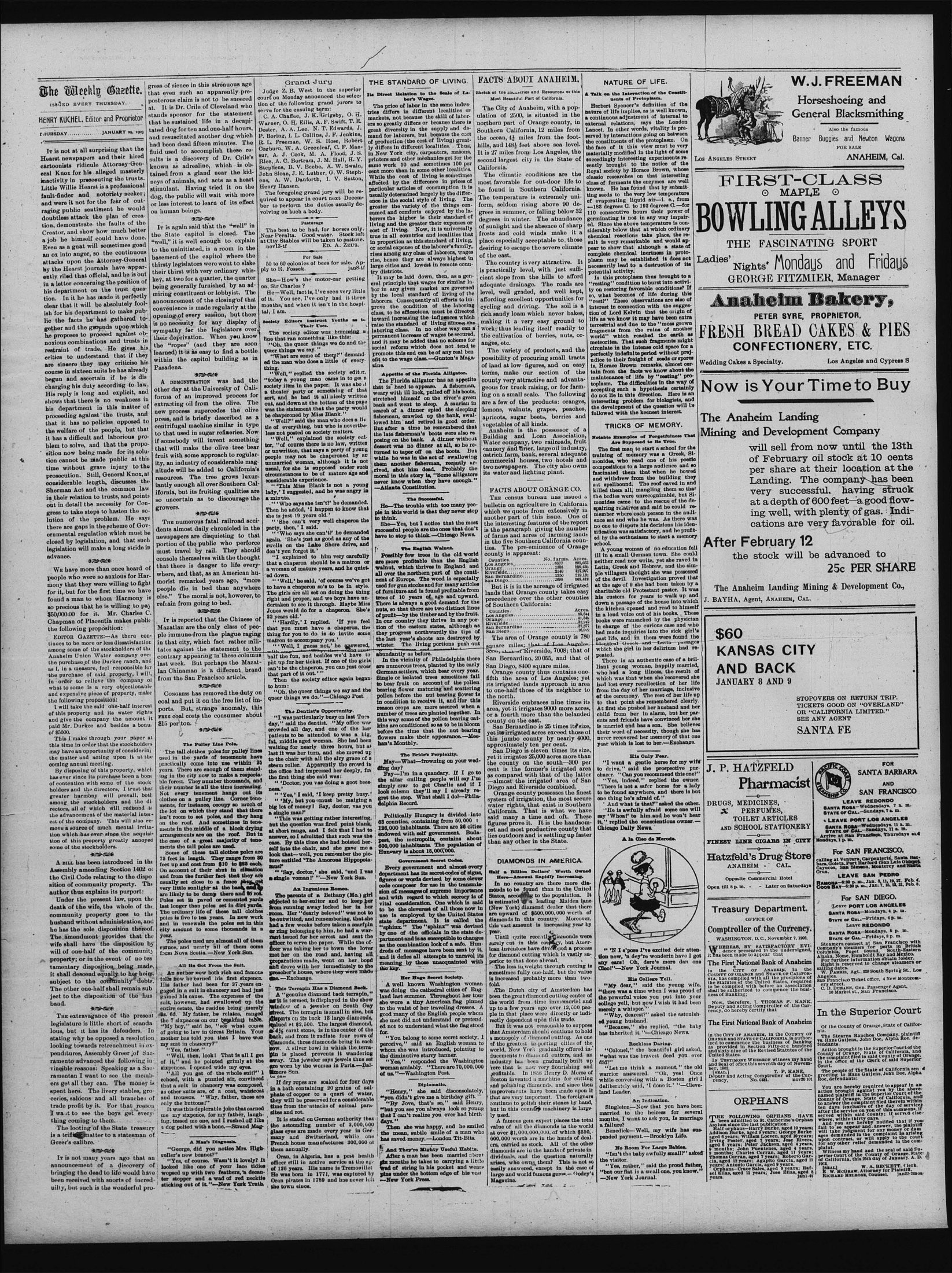
Searchable text
Ir is not at all surprising that the Hearst newspapers and their hired cartoonists ridicule Attorney-General Knox for his alleged masterly inactivity in prosecuting the trusts. Little Willie Hearst is a professional fault-finder and notoriety seeker; and were it not for the fear of outraging public sentiment he would doubtless attack the plan of creation, demonstrate the faults of the Creator, and show how much better a job he himself could have done. Even as a guat will sometimes goad an ox into anger, so the continuous attacks upon the Attorney-General by the Hearst journals have apparently riled that official, and he is but in a letter concerning the position of his department on the trust question. In it he has made it perfectly clear that it will be absolutely foolish for his department to make public the facts he has gathered together and the grounds upon which he proposes to proceed against obnoxious combinations and trusts in restraint of trade. He gives his critics to understand that if they are sincere they may criticise his course in sixteen suits he has already begun and ascertain if he is discharging his duty according to law. His reply is long and explicit, and shows that there is no weakness in his department in this matter of proceeding against the trusts, and that it has no policies opposed to the welfare of the people, but that it has a difficult and laborious problem to solve, and that the proposition now being made for its solution cannot be made public at this time without grave injury to the present.
Still General Knox atgress of silence in this strenuous age that even such an apparently preposterous claim is not to be sneered at. It is Dr. Crile of Cleveland who stands sponsor for the statement that he sustained life in a decapitated dog for ten and one-half hours, and resuscitated another dog which had been dead fifteen minutes. The fluid used to accomplish these results is a discovery of Dr. Crile's known as adrealine, which is obtained from a gland near the kidneys of animals, and acts as a heart stimulant. Having tried it on the dog, the public will wait with more or less interest to learn of its effect on human beings.
It is again said that the "well" in the State capitol is closed. The "well," it is well enough to explain to the uninitiated, is a room in the basement of the capitol where the thirsty legislators were wont to slake their thirst with very ordinary whiskey, at two for a quarter, the quarter being generally furnished by an admiring constituent or lobbyist. The announcement of the closing of that convenience is made regularly at the opening of every session, but there is no necessity for any display of sympathy for the legislators over their deprivation. When you know the "ropes" (and they are soon learned) it is as easy to find a bottle within the capitol building as in Pasadena.
A DDMONSTRATION was had the other day at the University of California of an improved process for extracting oil from the olive. The new process supercedes the olive press, and is briefly described as a centrifugal machine similar in type to that used in sugar refineries. Now if somebody will invent something that will make the olive tree bear fruit with some approach to regularity, an industry of considerable magnitude will be added to California's
begun and ascertain if he is discharging his duty according to law. His reply is long and explicit, and shows that there is no weakness in his department in this matter of proceeding against the trusts, and that it has no policies opposed to the welfare of the people, but that it has a difficult and laborious problem to solve, and that the proposition now being made for its solution cannot be made public at this time without grave injury to the prosecution. Still, General Knox, at considerable length, discusses the Sherman Act and the common law in their relation to trusts, and points out in detail the necessity for Congress to take steps to hasten the solution of the problem. He says there are gaps in the scheme of Governmental regulation which must be closed by legislation, and that such legislation will make a long stride in advance.
We have more than once heard of people who were so anxious for Harmony that they were willing to fight for it, but for the first time we have found a man to whom Harmony is so precious that he is willing to pay $50,000.00 for it. Mr. Charles C. Chapman of Placentia makes public the following proposition:
EDITOR GAZETTE:—As there continues to be more or less dissatisfaction among some of the stockholders of the Anaheim Union Water company over the purchase of the Durkee ranch, and as I, in a measure, feel responsible for the purchase of said property, I will, in order to relieve the company of what to some is a very objectionable and expensive piece of property, make the following proposition:
I will take the said one-half interest of this property and its water rights and give the company the amount it paid Mr. Durkee and besides a bonus of $5000.
This I make through your paper at this time in order that the stockholders may have an opportunity of considering the matter and acting upon it at the coming annual meeting.
By disposing of this property, which has ever since its purchase been a bone of contention with some of the stockholders and the directors, I trust that greater harmony will prevail, both among the stockholders and the directors, all of which will redound to the advancement of the material interest of the company. This will also remove a source of much mental irritation which has ever since the acquisition of this property greatly annoyed some of the stockholders.
A bill has been introduced in the Assembly amending Section 1402 of the Civil Code relating to the disposition of community property. The author thus explains its purport:
Under the present law upon the other day at the University of California of an improved process for extracting oil from the olive. The new process supercedes the olive press, and is briefly described as a centrifugal machine similar in type to that used in sugar refineries. Now if somebody will invent something that will make the olive tree bear fruit with some approach to regularity, an industry of considerable magnitude will be added to California's resources. The tree grows luxuriantly enough all over Southern California, but its fruiting qualities are so uncertain as to discourage the growers.
The numerous fatal railroad accidents almost daily chronicled in the newspapers are disquieting to that portion of the public who perforce must travel by rail. They should console themselves with the thought that there is danger to life everywhere, and that, as an American humorist remarked years ago, "more people die in bed than anywhere else." The moral is not, however, to retain from going to bed.
It is reported that the Chinese of Mazatlan are the only class of people immune from the plague raging in that city, which fact rather militates against the statement to the contrary appearing in these columns last week. But perhaps the Mazatlan Chinaman is a different brand from the San Francisco article.
Congress has removed the duty on coal and put it on the free list of imports. But, strange anomaly, this free coal costs the consumer about $15 per ton.
The Pulley Line Pole.
The tall clothes poles for pulley lines used in the yards of tenements have practically come into use within 25 years. There are enough of them standing in the city now to make a respectable forest. They number thousands, and their number is all the time increasing. Not every tenement hangs out its clothes on a pulley line. Corner tenements, for instance, occupy so much of the lot on which they stand that there isn't room to set poles, and they hang on the roof. And sometimes in tenements in the middle of a block drying arrangements are on the roof. But in the case of a great majority of tenements the tall poles are used.
Some of these tall clothes poles are 75 feet in length. They range from 80 feet up and cost from $10 to $25 each. On account of their shut in situation and from the further fact that they are usually set close to a fence then get very little sunlight at the base and are likely to be damp there and so rot.
Well, replied the society co-owner "today a young man came in to my society item in the paper. It was a theater party or something of sort, and he had it all nicely written out, and down at the bottom of the sheet was the statement that the party would be chaperoned by Miss Blank."
"Well?" said the man who does not post on society matters.
"Well," explained the society toror, "of course there is no law, written or unwritten, that says a party of y people may not be chaperoned by unmarried woman, although it is usual, for she is supposed under circumstances to be of mature age considerable experience."
"This Miss Blank is not a lady," I suggested, and he was angry a minute.
"Who says she isn't? he demands Then he added, 'I happen to know she is just 19 years old.'"
"She can't very well chaperon party, then," I said.
"Who says she can't?" he demanded again. "She's just as good as any o swells on the Lake Shore drive don't you forget it."
"I explained to him very care that a chaperon should be a matron a woman of mature years, and he ed down."
"Well," he said, "of course we'v to have a chaperon so's to be in The girls are all set on doing the right and proper, and we boys have dertaken to see it through. Maybe Jones would do for a chaperon 22 years old."
"Hardly," I replied. "If you that you must have a chaperon thing for you to do is to invite a matron to accompany you."
"Well, I guess not," he answered with empathy half the fun, and besides we'd have put up for her ticket. If one of them can't be the chaperon, you can just that part of it out."
Then the society editor again hum:
"Oh, the queer things we say any queer things we do."—Chicago Press
The Dentist's Opportunity.
"I was particularly busy on last day," said the dentist. "My office crowded all day, and one of those patients to be attended was a fat, middle aged woman. She had waiting for nearly three hours, last it was her turn, and she moved to the chair with all the airy grace steam roller. Apparently she crested the office had impressed her deepest first thing she said was:
"Doctor, you vas doing a goodness."
"Yes," I said, "I keep pretty."
"My, but you must be maid big lot of money! Say, doctor, v w a single man?"
"This was getting rather interesting but the question was fired point at short range, and I felt that I answer, so I admitted that such w case. By this time she had hoisted self into the chair, and she gave look that—well, you remember ture entitled 'The Amorous Hippie'."
"Say, doctor," she said, "unable single woman!"—New York
A bill has been introduced in the Assembly amending Section 1402 of the Civil Code relating to the disposition of community property. The author thus explains its purport:
Under the present law, upon the death of the wife, the whole of the community property goes to the husband without administration, and he has the sole disposition thereof. The amendment provides that the wife shall have the disposition by will of one-half of the community property; or in the event of no testamentary disposition being made, it shall descend equally to her heirs subject to the community debts. The other one-half shall remain subject to the disposition of the husband.
The extravagance of the present legislature is little short of scandalous, but it has its defenders. In stating why he opposed a resolution looking towards retrenchment in expenditures, Assembly Greer of Sacramento advanced the following invincible reasons: Speaking as a Sacramentan I want to see the members get all they can. The money is spent here. The livery stables, groceries, saloons and all branches of trade profit by it. For that reason I want to see the boys get everything coming to them.
The looting of the State treasury is a trifling matter to a statesman of Greer's calibre.
It is not many years ago that an announcement of a discovery of bringing the dead to life would have been received with snorts of incredulity, but such is the wonderful procluse on a pulley line. Corner tenements, for instance, occupy so much of the lot on which they stand that there isn't room to set poles, and they hang on the roof. And sometimes tenements in the middle of a block drying arrangements are on the roof. But in the case of a great majority of tenements the tall poles are used.
Some of these tall clothes poles are 75 feet in length. They range from 80 feet up and cost from $10 to $25 each. On account of their shut in situation and from the further fact that they are usually set close to a fence they get very little sunlight at the base and are likely to be damp there and 60 rods. Poles set in paved or cemented yards last longer than poles set in dirt yards. The ordinary life of these tall clothes poles is five to ten years. In new work and in renewals the poles set in this city amount to some thousands in a year.
The poles used are almost all of them syruce, and nearly all of them come from Nova Scotia.—New York Sun.
All He Got From the Suit.
An author now both rich and famous tells how he earned his first sixpence. His father had been for 27 years engaged in a suit in chancery and had just gained his cause. The expenses of the suit, however, had swallowed up the entire estate, the residue being merely 8s. 6d. My father, he relates, ranged the 7 sixpeaces on our breakfast table. "My boy," said he, "see what comes of going to law in Great Britain. Your mother has told you that I have won my suit in chancery?"
"Yes, father."
"Well, then, look! That is all I got of it," and he pointed grimly at the sixpences. I opened wide my eyes.
"All you get of the whole suit?" I echoed, with a puzzled air, convinced that a suit in chancery was composed, as other suits are, of a coat, waistcoat and trousers. "Why, father, those are only the buttons!"
It was this deplorable joke that earned me my sixpence, for my father, laughing, tossed me one, and I rushed off like a dog pelted with a bone.—Strand Mag.
A Men's Diagnosis.
"George, did you notice Mrs. Highroller's new bonnet?"
"Yes, of course. Wasn't it lovely? It looked like one of your lace tidies wopsed up with two feathers, a decanter stopper and a wad of red necktie sticking out of it."—New York Truth.
"My, but you must be made big lot of money! Say, doctor, vane a single man?"
"This was getting rather interest but the question was fired point at short range, and I felt that I answer, so I admitted that such wane case. By this time she had boisterated self into the chair, and she gave look that—well, you remember that entitled 'The Amorous Hippopus'?
"Say, doctor,' she said, 'unable single woman!'"—New York Sun.
An Ingenious Romeo.
The parents of a Bethany (M) objected to her suitor and to keep from running away locked her room. Her "dearly beloved" was be outwitted, and remembering, that had a few weeks before taken a seat or ring belonging to him, he had rent issued for her arrest and sent officer to serve the paper. While officer was taking her to town she met her on the road and, having preparations made, went on her and drove with her immediately preacher's house, where they were one.—Exchange.
This Terrapin Has a Diamond Pin
A "genuine diamond back terrapin it is termed, is displayed in the window of a jeweler on South Street. The terrapin is small in size disports on its back 18 large diamonds at $2,500. The largest disc is 4½ carat stone, is in the center back, and from it radiate four diamonds, three diamonds being row. A silver bowl in which the pin is placed prevents it warring away. The jeweler says jewels that are worn by the women in Paris. More Sun.
If dry ropes are soaked for four in a bath containing 20 grains of copper to a quart of water they will be preserved for a considerable time from the attacks of animal sites and rot.
It is stated on German authorities the astounding number of 2,000 glass eyes are made every year in many and Switzerland, while French house manufactures 300 them annually.
Oran, in Algeria, has a post-office still in active service at about 126 years. His name is Tremaine He was born in 1771, was captain Oran pirates in 1789 and has never been the town since.
Grand Jury
Z. B. West in the superior Monday announced the selecthe following grand jurors to
for the ensuing term:
Chaffee, J. K. Grigsby, O. H.
O. H. Ellis, A. F. Swift, T. E.
A. A. Lee, N. T. Edwards, J.
L. Collins, J. F. Jenkins,
Greeman, W. S. Rose, Robert
W. A. Greenleaf, C. F. ManJ. Cook, M. A. Flood, J. S.
C. Bertram, J. M. Hall, H. Y.
B. V. Beebe, A. W. Swain,
Joan, J. E. Luther, G. W. StephW. Danforth, I. V. Sutton,
Hansen.
Foregoing grand jury will be reto appear in court next December
perform the duties usually deon such a body.
Pasturage
best to be had, for horses only.
Peralta. Good water. Stock left
Stables will be taken to pasture.
B-ft.
ED. A. ZEUS.
For Sale
60 colonies of bees for sale.
ApR. Fossek.
jan8-tf
How's the motor-car getting Charles?
Well, fact is, I've seen very little
you see, I've only had it three
and when it isn't in the hospim.
Editors instruct Youths as to
Their Uses.
The society editor was humming at
what ran something like this:
the queer things we do and the
things we say."
What are some of them?" demand
man who does a little of every
Well," replied the society editor,
by a young man came in to get a
item in the paper. It was abowater party or something of that
and he had it all nicely written
and down at the bottom of the page
the statement that the party would
superior by Miss Blank."
Well?" said the man who does a lieverything, but who is neverbenot posted on society matters.
Well," explained the society ediof course there is no law, writes
written, that says a party of young
as may not be chaperoned by an
arrived woman, although it is not
for she is supposed under such
instances to be of mature age and
THE STANDARD OF LIVING.
Its Direct Relation to the Scale of Labor's Wages.
The price of labor in the same industries differs in different localities or
markets, not because the skill of laborers so greatly differs or because there is
great diversity in the supply and demand for laborers, but because the cost
of production (the cost of living) grealy differs in different localities. Thus,
in New York city, carpenters, masons,
printers and other mechanics get for the
same work 50 and sometimes 100 per
percent more than in some other localities.
While the cost of living is sometimes
affected by the difference in prices of
particular articles of consumption it is
usually determined largely by the difference in the social style of living. The
greater the variety of the things consumed and comforts enjoyed by the laborers the higher is their standard of living and the greater their expenses or cost of living. Now, it is universally true in all countries and localities that in proportion as this standard of living,
or social expense of the laborer's family,
rises among any class of laborers, wages rise, hence they are always highest in large cities and lowest in remote country districts.
It may be laid down then, as a general principle that wages for similar labor in any given market are governed by the local standard of living of the laborers. Consequently all efforts to improve the condition of the laboring class, to be efficacious, must be directed toward increasing the influences which raise the standard of living among the laboring class. In no other way can a permanent increase of wages be secured, and it may be added that no scheme for social reform which does not tend to promote this end can be of any real benefit to the wage class.
Appetite of the Florida Alligator.
The Florida alligator has an appetite that is hard to appease. A fisherman, weary with ill luck, pulled off his boots, stretched himself on the river's green bank and went to sleep. A saurian in search of a dinner spied the sleeping fisherman, crawled up the bank, swallowed him and retired in good order. But after a time he remembered that the late fisherman's boots were also re-positioning on the bank. A dinner without dessert was no dinner at all, so he returned to taper off on the boots. But while he was in the act of swallowing them another fisherman recently arrived, shot him dead. Probably the result in this story is "Some alligators"
FACTS ABOUT ANAHEIM.
Sketch of the industries and Resources of this Most Beautiful Part of California.
The City of Anaheim, with a population of 2500, is situated in the northern part of Orange county, in Southern California, 12 miles from the ocean, 4½ miles from the foothills, and 148½ feet above sea level. It is 27 miles from Los Angeles, the second largest city in the State of California.
The climatic conditions are the most favorable for out-door life to be found in Southern California. The temperature is extremely uniform, seldom rising above 90 degrees in summer, or falling below 32 degrees in winter. The abundance of sunlight and the absence of sharp frosts and cold winds make it a place especially acceptable to those desiring to escape the severe climate of the east.
The country is very attractive. It is practically level, with just sufficient slope from the hills to afford adequate drainage. The roads are level, well graded, and well kept, affording excellent opportunities for cycling and driving. The soil is a rich sandy loam which never bakes, making it a very easy ground to work; thus leading itself readily to the cultivation of berries, nuts, oranges, etc.
The variety of products, and the possibility of procuring small tracts of land at low figures, and on easy terms, make our section of the county very attractive and advantageous for truck raising, or for farming on a small scale. The following are a few of the products: oranges, lemons, walnuts, grapes, peaches, apricots, sugar beets, berries and vegetables of all kinds.
Anaheim is the possessor of a Building and Loan Association, Water company, two railroads, fruit cannery and drier, large oil industry, ostrich farm, bank, several adequate commercial houses, two hotels and two newspapers. The city also owns its water and lighting plant.
NATURE OF LIFE.
A Talk on the Interaction of the Coponents of Protoplasm.
Herbert Spencer's definition onature of life implies, as is well known a continuous adjustment of interternal relations, says the LeaLancet. In other words, vitality iinserved by interactions going on bethe constituents of the protoplasm,
the face of it this view must be
materially modified in the light oiexceedingly interesting experiment
c brought to the notice oi
Royal society by Horace Brown,
classic researches on that interclass of ferments the enzymes anknown. He has found that by suting seeds to the very low tempeof evaporating liquid air—i.e.
-188 degrees C. to 192 degrees C.
110 consecutive hours their pogrerminating is not in any way iindied Since the above temperature
siderably below that at which orechemical reactions take place,
suit is very remarkable and wowpear to show that although a eacomplete chemical inertness in plasm may be established it dnenecessarily lead to a destruction
potential activity.
Is this protoplasm thus bringuresting" condition to burst into ouentory on restoring favorable conditions so what becomes of life durinrest? These observations are interest in connection with thie oition Lord Kelvin that tho olife as we know it may have been terrestrial and due to thie "mosis fragments from thie ruins oi world" which reached thie e meteorites That such fragmentiate in thie intense cold space perfectly indefinite period without udice to their freight of seeds oi Horace Brown remarks almain from thie facts we know al maintenance of life by "restintoplasm The difficulties in thie accepting such a hypothesis oi do not lie in this direction.Hue interesting problem for biologiic development othe question followed with thie keenest intem
TRICKS OF MEMORIES
Notable Examples of Forgetfulliness Are Supposed To Be True
The first man to start a school training of memory was a Geomonides, who read one of his compositions to a large audience fascinated them when he
The Florida alligator has an appetite that is hard to appease. A fisherman, weary with ill luck, pulled off his boots, stretched himself on the river's green bank and went to sleep. A saurian in search of a dinner spied the sleeping fisherman, crawled up the bank, swallowed him and retired in good order. But after a time he remembered that the late fisherman's boots were also re-posing on the bank. A dinner without dessert was no dinner at all, so he returned to taper off on the boots. But while he was in the act of swallowing them another fisherman, recently arrived, shot him dead. Probably the moral in this story is, "Some alligators never know when they have enough." —Atlanta Constitution.
The Successful.
He—The trouble with too many people in this world is that they never stop to think.
She—Yes, but I notice that the most successful people are the ones that don't have to stop to think. —Chicago News.
The English Walnut.
Possibly few trees in the old world are more profitable than the English walnut, which thrives in England and all over the northern part of the continent of Europe. The wood is especially used for gun stocks and for many articles of furniture and is found profitable from trees of 10 years of age and upward. There is always a good demand for the nuts, so that there are two distinct lines of profit—by the timber and by the fruit. In our country they thrive in any portion of the eastern states, although as they progress northwardly the tips of the last year's shoots are destroyed by winter. The living portions push out abundantly as before.
In the vicinity of Philadelphia there are numerous trees, planted by the early German settlers, which bear every year. Single or isolated trees sometimes fail to bear fruit on account of the pollen bearing flower maturing and scattering pollen before the nut bearing flower is in condition to receive it, and if for this reason crops are more assured when a number of trees are planted together. In this way some of the pollen bearing catkins are conditioned so as to be in bloom before the time that the nut bearing flowers make their appearance. —Meehan's Monthly.
The Bride's Perplexity.
May—What—frowning on your wedding day?
Fay—I'm in a quandary. If I go to the altar smiling people will say I'm simply cran to get Charlie and if I look solemn they'll say I already regret the step. What shall I do? —Philadelphia Record.
Politically Hungary is divided into 68 counties, containing from 50,000 to 126,000 inhabitants. There are 26 cities endowed with self government. Budapest, the metropolis, contains about 600,000 inhabitants. The population of Hungary is about 15,000,000.
Government Secret Codes.
Every government and almost every department has its secret codes of signs, figures or words devised by some clever code composer for use in the transmission of messages of supreme importance and with regard to which secrecy is of county very attractive and advantageous for truck raising, or for farming on a small scale. The following are a few of the products: oranges, lemons, walnuts, grapes, peaches, apricots, sugar beets, berries and vegetables of all kinds.
Anaheim is the possessor of a Building and Loan Association, Water company, two railroads, fruit cannery and drier, large oil industry, ostrich farm, bank, several adequate commercial houses, two hotels and two newspapers. The city also owns its water and lighting plant.
FACTS ABOUT ORANGE CO.
The census bureau has issued a bulletin on agriculture in California which we quote from extensively in another part of this issue. One of the interesting features of the report is the paragraph giving the number of farms and acres of farming lands in the five Southern California counties. The pre-eminence of Orange county is apparent:
Counties. No. farms. Acres.
Los Angeles. 6577. 996,063
Orange. 2288. 599,436
Riverside. 2340. 427,097
San Bernardino. 2350. 219,137
San Diego. 2098. 809,419
But it is in the acreage of irrigated lands that Orange county takes easy precedence over the other counties of Southern California:
Counties. Acres.
Los Angeles. 88,644
Orange. 41,146
Riverside. 32,947
San Bernardino. 37,877
San Diego. 16,022
The area of Orange county is 780 square miles; that of Los Angeles, 320; that of Riverside, 708; that of San Diego, 8400 square miles.
Orange county thus contains one-fifth the area of Los Angeles; yet its irrigated lands approach in area to one-half those of its neighbor to the north.
Riverside embraces nine times its area, yet it irrigates 9000 more acres, or four more than the belaunded county on the east.
San Bernardino is 25 times its size, yet its irrigated acres exceed those of this jumbo county by nearly 4000, approximately ten per cent.
San Diego is eleven times its size, yet it irrigates 25,000 acres more than the county on the south—300 per cent is the former's irrigated area as compared with that of the latter—almost the irrigated area of San Diego and Riverside combined.
Orange county possesses the finest system of irrigation, the most secure water rights, that exist in Southern California. That is what we have said many a time and oft. These figures prove it. It is the handsomest and most productive county that lies outdoors and is settling up faster than any other in the State.
DIAMONDS IN AMERICA.
Half a Billion Dollars' Worth Owned Here—Amount Rapidly Increasing.
In no country there are more diamonds to be found than in the United States, according to the population.
maintenance of life by "resting toplasm. The difficulties in this accepting such a hypothesis owe not lie in this direction. His interesting problem for biology,the development of the question followed with the keenest interest.
TRICKS OF MEMORIES
Notable Examples of Forgetfulness
Are Supposed to Be True.
The first man to start a school training of memory was a Gymnoide, who read one of his compositions to a large audience fascinated them when he had withdrew from the building sat spellbound. The roof cave killed them all, mangling them—the bodies were unrecognizable monides came to the rescue; sparing relatives and said he be member where each person in once sat and who he was. As no one to dispute his decisions tiltation was satisfactory,and led by the enthiasiasm to start a school.
A young woman of no education in a small German town.She neither read nor write,yet she Latin,Greek and Hebrew,and ple villagers thought she was of the devil.In investigation prince at the age of 9 she had been charitable old Protestant past his custom for years to watch down a passage of the house left in the kitchen opened and read in a loud voice out of his books书籍 were ransacked by the in charge of the curious case had made inquiries into the past life,and in them were identical Greek and Latinwhich she girl in her delirious peated.
There is an authentic case liant young woman,happily who had a long illness,the which was that when she recoubld lost every recollection from the day of her marriageof the ceremony.The rest of it that point she remember.At first she pushed her husband child from her in alarm,bebents and friends have convincedis married and has a son.She their word of necessity,tought never recovered her memoryyears which is lost to her.E
His Only Fear.
"I want a gentle horse foer drive,"the prosperch."Can you recommend"Yes,i indeed." replied thie"There is not a safer horseto be found anywhere,and thie one thing he's afraid of."
And what is that?" asked"He is awfully afraid someway 'Whoa!' to him and heit," replied the conscientious Chicago Daily News."
An Ingenious Romeo.
the parents of a Bethany (Mo.) girl
An Ingenious Romeo.
the parents of a Bethany (Mo.) girl
An Ingenious Romeo.
the parents of a Bethany (Mo.) girl
"My, but you must be maiging a lot of money! Say, doctor, vas you single man!"
This was getting rather interesting, the question was fired point blank, short range, and I felt that I had to answer. By this time she had hoisted her arm into the chair, and she gave me a that—well, you remember the picture entitled 'The Amorous Hippopotamus!'"
"Say, doctor," she said, "und I was single woman!" — New York Sun.
An Ingenious Romeo.
The parents of a Bethany (Mo.) girl voted to her suitor and to keep her running away locked her in her room. Her "dearly beloved" was not to hurtwitted, and remembering, that she a few weeks before taken a scarfpin belonging to him, he had a war-issued for her arrest and sent the letter to serve the paper. While the officer was taking her to town the lover on the road and, having all preparations made, went on her bond drove with her immediately to the teacher's house, where they were made—Exchange.
This Terrapin Has a Diamond Back.
"The genuine diamond back terrapin," it is termed, is displayed in the show window of a jeweler on South Gay Street. The terrapin is small in size, but sports on its back 18 large diamonds, used at $2,500. The largest diamond, 65 carat stone, is in the center of the rock, and from it radiate four rows of diamonds, three diamonds being in each row. A silver bowl in which the terra-cra is placed prevents it wandering away. The jeweler says jewels thus set worn by the women in Paris.—Balmore Sun.
Of dry ropes are soaked for four days in bath containing 20 grains of saltate of copper to a quart of water, they will be preserved for a considerable amount from the attacks of animal parasites and rot.
It is stated on German authority that astounding number of 2,000,000 eyes are made every year in Germany and Switzerland, while one much house manufactures 300,000 of them annually.
Oran, in Algeria, has a port health still in active service at the age of 126 years. His name is Tremonillet was born in 1771, was captured by pirates in 1789 and has never left town since.
Politically Hungary is divided into 68 counties, containing from 50,000 to 126,000 inhabitants. There are 26 cities endowed with self government. Budapest, the metropolis, contains about 600,000 inhabitants. The population of Hungary is about 15,000,000.
Government Secret Codes.
Every government and almost every department has its secret codes of signs, figures or words devised by some clever code composer for use in the transmission of messages of supreme importance and with regard to which secrecy is of vital consideration. One which is said to be the clearest of all those now in use is employed by the United States state department. It is called the "sphinx." The "sphinx" was devised by one of the officials in the state department and is as susceptible to changes as the combination lock of a safe. Hundreds of messages have been sent by it, and it defies all attempts to unravel its meaning by those unaacquainted with the key.
Her Huge Secret Society.
A well known Washington woman was doing the cathedral cities of England last summer. Throughout her tour she wore a tiny American flag pinned to the waist of her traveling dresses. A good many of the English people whom she met did not understand or pretended not to understand what the flag stood for.
"You belong to some secret society," said an English woman to whom she was introduced, pointing to the diminutive starry banner.
"Yes," responded the Washington woman amiably. "There are 70,000,000 of us." — Washington Post.
Diplomatic.
"Henry," she said disconsolately, "you didn't give me a birthday gift."
"By Jove, that's so," said Henry, "but you see you always look so young that I can't realize you ever had birthdays."
Then she was happy, and he smiled the mean, subtle smile of a man who has saved money. — London Tit-Bits.
And They're Mighty Useful Habits.
After a man has been married about six months he takes to carrying a little wad of string in his pocket and wears pins under the bottom edge of his vest — New York Press.
DIAMONDS IN AMERICA.
Half a Billion Dollars Worth Owned
Here—Amount Rapidly Increasing.
In no country are there more diamonds to be found than in the United States, according to the population. It is estimated that a leading Maiden lane (New York) diamond dealer that there are upward of $500,000,000 worth of diamonds in this country. Moreover, this vast amount is increasing year by year.
Until quite recently diamonds were rarely cut in this country, but American inventors have developed a process for diamond cutting which is vastly superior to that done abroad.
The loss in weight through cutting is sometimes fully one-half, but the value is increased probably more than two-fold.
The Dutch city of Amsterdam has been the great diamond cutting center of the world from time immemorial and up to a few years ago over 12,000 people in that place were directly or indirectly dependent upon this trade.
But it was not reasonable to suppose that Amsterdam should continue to hold a monopoly of diamond cutting. As one of the greatest importing cities of the world, New York gradually offered inducements to diamond cutters, and an industry has been gradually built up there that is now very flourishing and profitable. In 1858 Henry D. Morse of Boston invented a machine for cutting and polishing diamonds, and since then improvements have been made upon it that are very important. The foreigners continue to polish their stones by hand, but in this country machinery is largely used.
A famous gem expert places the total value of all the diamonds in the world at over $1,000,000,000, of which $350,-400,000 worth are in the hands of dealers, carried as stock. All of the other diamonds are in the hands of private individuals, and the question naturally arises, who owns them? This is not so easily answered, except in the case of large and world famous gems. — Godey's Magazine.
"N I s'pose I've excited this notion now,' n dey're wondering any ears! Oh, dere's more Cleo!" — New York Journal.
His College Yell.
"My dear," said the year "there was a time when I was the powerful voice you put college yell, but now I wish merely a whisper."
"Why, dearest?" asked this young husband.
"Because," she replied, has inherited it." — Chicago
Reckless Daring.
"Colonel," the beautiful "what was the bravest deed did?"
"Let me think a moment warrior answered." "Oh, while conversing with a Boy deliberately said,' I done it.' land Leader.
An Indication.
Singleton—Now that you married to the heiress months, I want to ask you,
a failure?
Benedick—Well, my wife pended payment. — Brooklyn
No Room For Large Bags.
"Isn't the baby awfully sniffing the visitor."
"Yes, rather," said the prince "but our flat is a small one." — New York Journal.
NATURE OF LIFE.
Walk on the Interaction of the Constituents of Protoplasm.
Herbert Spencer's definition of the nature of life implies, as is well known, continuous adjustment of internal to external relations, says the London poet. In other words, vitality is preceded by interactions going on between constituents of the protoplasm. On surface of it this view must be very seriously modified in the light of some interesting experiments recently brought to the notice of the general society by Horace Brown, whose bio researches on that interesting series of ferments the enzymes are well known. He has found that by submitting seeds to the very low temperature evaporating liquid air—1. e., from 83 degrees C. to 192 degrees C.—for consecutive hours their power of germinating is not in any way impairing. Since the above temperature is considerably below that at which ordinary chemical reactions take place, the result is very remarkable and would appear to show that although a state of complete chemical inertness in protozoa may be established it does not necessarily lead to a destruction of its essential activity.
Is this protoplasm thus brought to a resting" condition to burst into activism restoring favorable conditions? If what becomes of life during this rest?" These observations are also of interest in connection with the suggestion of Lord Kelvin that the origin of life as we know it may have been extra terrestrial and due to the "moss grown fragments from the ruins of another world" which remahed the earth as meteorites. That such fragments might accumulate in the intense cold space for a perfectly indefinite period without prejudice to their freight of seeds or spores. Horace Brown remarks, almost certainly from the facts we know about the maintenance of life by "resting" protoplasm. The difficulties in the way of accepting such a hypothesis certainly do not lie in this direction. Here is an interesting problem for biologists, and the development of the question will be allowed with the keenest interest.
TRICKS OF MEMORY.
Notable Examples of Forgetfulness That Are Supposed to Be True.
The first man to start a school for the training of memory was a Greek, Simonides, who read one of his poetic compositions to a large audience and so associated them that when he bowed
W.J.FREEMAN
Horseshoeing and General Blacksmithing
Also the famous Banner Buggies and Newton Wagons FOR SALE
LOS ANGELES STREET
ANAHEIM, Cal.
FIRST-CLASS
MAPLE
BOWLING ALLEYS
THE FASCINATING SPORT
Ladies' Nights' Mondays and Fridays
GEORGE FITZMIER, Manager
Anaheim Bakery,
PETER SYRE, PROPRIETOR.
FRESH BREAD CAKES & PIES CONFECTIONERY, ETC.
Wedding Cakes a Specialty. Los Angeles and Cypress S
Now is Your Time to Buy
The Anaheim Landing Mining and Development Company
will sell from now until the 13th of February oil stock at 10 cents per share at their location at the
Now is Your Time to Buy
The Anaheim Landing Mining and Development Company will sell from now until the 13th of February oil stock at 10 cents per share at their location at the Landing. The company has been very successful, having struck at a depth of 600 feet—a good flow-well, with plenty of gas. Indications are very favorable for oil.
After February 12 the stock will be advanced to 25c PER SHARE
The Anaheim Landing Mining & Development Co., J. BAYHA, Agent, ANAHEIM, CAL.
$60
KANSAS CITY
AND BACK
JANUARY 8 AND 9
STOPOVERS ON RETURN TRIP.
TICKETS GOOD ON "OVERLAND"
OR "CALIFORNIA LIMITED."
SEE ANY AGENT
SANTA FE
J. P. HATZFELD Pharmacist
DRUGS, MEDICINES,
PERFUMES,
TOILET ARTICLES
AND SCHOOL STATIONERY
FINEST LINE CIGARS IN CITY
Hatzfeld's Drug Store
ANAHEIM - CAL.
Opposite Commercial Hotel
Open till 8 p.m. - Later on Saturdays
FOR
SANTA BARBARA
AND
SAN FRANCISCO
LEAVE REDONDO
SANTA ROSA—Wednesdays, 7 a.m.
STATE OF CAL.—Sundays, 7 a.m.
LEAVE PORT LOS ANGELES
SANTA ROSA—Wednesdays, 11 a.m.
STATE OF CAL.—Sundays, 11 a.m.
Arrive at San Francisco, Thursdays and Mondays, 1 p.m.
For SAN FRANCISCO,
calling at Ventura, Carpenteri, Santa Barbara, Goleta, Port Harford (San Luis Obispo), Cayucos, San Simon, Monterey and Santa Cruz.
LEAVE SAN PEDRO
RAMONA—6:30 p.m., Jan. 8, 11, 19, 27, Feb. 4.
COOS BAY—6:30 p.m., Jan. 7, 15, 23, 31, Feb. 8.
For SAN DIEGO.
"N I s'pose I've excited deir attention now, 'n dey're wonderin have I got any ears! Oh, dere's more dan one Cleol!"—New York Journal.
His College Yell.
"My dear," said the young wife,
"there was a time when I was proud of the powerful voice you put into your college yell, but now I wish it had been merely a whisper."
"Why, dearest?" asked the astonished young husband.
"Because," she replied, "the baby has inherited it."—Chicago News.
Reckless Daring.
"Colonel," the beautiful girl asked,
"what was the bravest deed you ever did?"
"Let me think a moment," the old warrior answered.
"Oh, yes! Once while conversing with a Boston girl I deliberately said, 'I done it.'"—Cleveland Leader.
An Indication.
Singleton—Now that you have been married to the heiress for several months, I want to ask you, Is marriage a failure?
Benedick—Well, my wife has suspended payment.—Brooklyn Life.
No Room For Large Babies.
"Isn't the baby awfully small?" asked the visitor.
"Yes, rather," said the proud father,
"but our flat is a small one, you know."—New York Journal.
DRUGS, MEDICINES,
PERFUMES,
TOILET ARTICLES
AND SCHOOL STATIONERY
FINEST LINE CIGARS IN CITY
Hatzfeld’s Drug Store
ANAHEIM - CAL.
Opposite Commercial Hotel
Open till 8 p.m. — Later on Saturdays
Treasury Department.
OFFICE OF
Comptroller of the Currency.
WASHINGTON, D.C., November 7, 1902.
WHEREAS, BY SATISFACTORY EVIDENCE presented to the undersigned, it has been made to appear that
The First National Bank of Anaheim
in the CITY OF ANAHEIM, in the COUNTY OF ORANGE and STATE OF CALIFORNIA, has compiled with all the provisions of the Statutes of the United States, required to be compiled with before an association shall be authorized to compence the business of Banking;
Now, therefore, I. THOMAS P. KANE,
Deputy and Acting Comptroller of the Currency, do hereby certify that
The First National Bank of Anaheim
in the CITY OF ANAHEIM, in the COUNTY OF ORANGE and STATE OF CALIFORNIA, is authorized to commence the business of Banking as provided in Section Fifty-one hundred and sixty-nine of the Revised Statutes of the United States.
IN TESTIMONY WHEREOF witness my hand and Seal of office this seventh day of November, 1902.
T. P. KANE.
Deputy and Acting Comptroller of the Currency.
No. 6481.
nov20 10t
ORPHANS
THE FOLLOWING ORPHANS HAVE been admitted to St. Catherine's Orphan Asylum since the last publication:
Half orphans—Harry Burke, aged 10 years;
Addison Burke, aged 9 years; George Burke, aged 6 years; William Loeven, aged 10 years;
Irving Foster, aged 7 years; Jose Rivera, aged 6 years; Peter Jackson, aged 4 years, 9 months; John Puntener, aged 4 years, 9 months; Charles Curran, aged 11 years;
Thomas Curran, aged 7 years; Roberto Garcia, aged 12 years; Agapito Garcia, aged 11 years; Antonio García, aged 9 years.
Orphans—Cruce Sales, aged 9 years; Rafael Ellas, aged 11 years; Jose Ellas, aged 8 years.
LEAVE REDONDO
SANTA ROSA—Wednesdays, 7 a.m.
STATE OF CAL—Sundays, 7 a.m.
LEAVE PORT LOS ANGELES
SANTA ROSA—Wednesdays, 11 a.m.
STATE OF CAL—Sundays, 11 a.m.
Arrive at San Francisco, Thursdays and Mondays, 1 p.m.
For SAN FRANCISCO,
calling at Ventura, Carpenteria, Santa Barbars, Goleta, Port Harford (San Luis Obispo), Cayucos, San Simmon, Monterey and Santa Cruz.
LEAVE SAN PEDRO
RAMONA—8:30 p.m., Jan. 3, 11, 19, 27, Feb. 4,
COOS BAY—8:30 p.m., Jan. 7, 15, 22, 31, Feb. 8.
For SAN DIEGO.
Leave PORT LOS ANGELES
SANTA ROSA—Mondays, 4 p.m.
STATE OF CAL—Fridays, 4 p.m.
Leave REDONDO
SANTA ROSA—Mondays, 8 p.m.
STATE OF CAL—Fridays, 8 p.m.
Steamers connect at San Francisco with Company's steamers for ports in British Columbia, Puget Sound, South-Eastern Alaska, Nome, Humboldt Bay and Mexico.
For further information obtain folder.
Right is reserved to change steamers or sailings dates.
W. PARRIS, Agt., 328 South Spring St., Los Angeles.
San Francisco Ticket office, 4 New Montgomery street.
C. D. DUNANN, Gen. Passenger Agent,
10 Market st., San Francisco.
In the Superior Court
Of the County of Orange State of California.
The Stearns Ranchos Company plaintiff vs. Hans Gatjens, John Doe, Alpha Roe, defendants.
Action brought in the Superior Court of the County of Orange State of California,and the complaint filed in said County of Orange,
in the office of the Clerk of said Superior Court.
The people of the State of California sent greeting to Hans Gatjens, John Doe, Alpha Roe, defendants:
You are hereby required to appear in an action brought against you by the above named plaintiff in the Superior Court of the County of Orange.State of California,and to answer the complaint filed therein within ten days (exclusive of the day of service) after the service on you of this summons. If served within said county; if served elsewhere within thirty days.
And you are hereby notified that if you fail to so appear and answer,the plaintiff will take judgment for any money or damage demanded in the complaint as arising upon contract;or will apply to the court for any other relief demanded in the complaint.
Witness my hand and the seal of said Superior Court of the County of Orange.State of California,his 25th day of January,A.D.1923.
[SEAL]
W. A. BECKETT,Clerk.
E. W. McGRAW, Attorney for Plaintiff.
RICHARD MELHOSE,Counsel. jan22-2mos