anaheim-gazette 1903-01-15
Scanned page
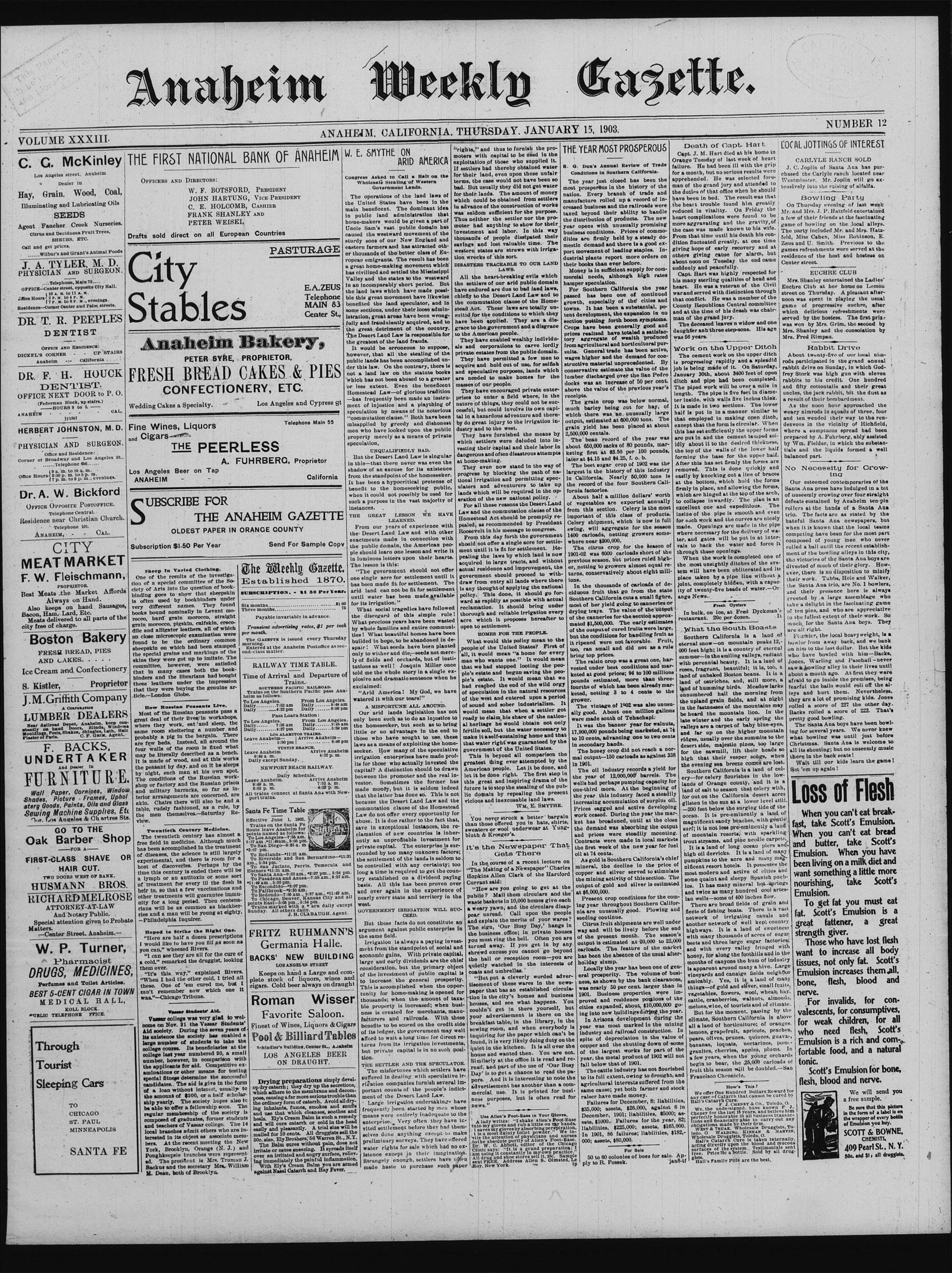
Searchable text
Anaheim
VOLUME XXXIII.
C. G. McKinley
Los Angeles street, Anaheim
Dealer in
Hay, Grain, Wood, Coal,
Illuminating and Lubricating Oils
SEEDS
Agent Fancher Creek Nurseries.
Citrus and Deciduous Fruit Trees,
SHRUBS, ETC.
Call and get prices.
...Wilbur's and Grant's Animal Foods
J. A. TYLER, M. D.
PHYSICIAN AND SURGEON.
Telephone, Main 75...
OFFICE—Center street, opposite City Hall.
10 A.M. to 11 A.M.
2 P.M. to 4 P.M.
7 P.M. to 8 P.M., evenings.
Residence—Corner Center and Palm streets.
DR. T. R. PEEPLES
DENTIST
Office and Residence:
DICKEL'S CORNER - UP STAIRS
Anaheim - California
DR. F. H. HOUCK
DENTIST.
OFFICE NEXT DOOR to P. O.
(Federman Block, up stairs.)
HOURS 9 to 5.
ANAHEIM - CAL.
jy15tt
HERBERT JOHNSTON, M. D.
PHYSICIAN AND SURGEON.
Office and Residence:
Corner of Broadway and Los Angeles St.
Telephone 656...
THE FIRST NATIONAL BANK OF ANAHEIM
OFFICERS AND DIRECTORS:
W. F. BOTSFORD, PRESIDENT
JOHN HARTUNG, VICE PRESIDENT
C. E. HOLCOMB, CASHIER
FRANK SHANLEY AND
PETER WEISEL
Drafts sold direct on all European Countries
PASTURAGE
City Stables
E.A.ZEUS
Telephone
MAIN 83
Center St,
Anaheim Bakery,
PETER SYRE, PROPRIETOR.
FRESH BREAD CAKES & PIES
CONFECTIONERY, ETC.
Wedding Cakes a Specialty. Los Angeles and Cypress St
Fine Wines, Liquors
and Cigars
THE PEERLESS
A. FUHRBERG, Proprietor
Los Angeles Beer on Tap
DR. F. H. HOOK
DENTIST.
OFFICE NEXT DOOR to P. O.
(Federman Block, up stairs.)
HOURS 9 to 5.
ANAHEIM
CAL.
jy184f
HERBERT JOHNSTON, M. D.
PHYSICIAN AND SURGEON.
Office and Residence:
Corner of Broadway and Los Angeles St.
...Telephone $60.....
Office Hours
9 a.m. to 10 a.m.
3:30 p.m. to 5 p.m.
7 p.m. to 8 p.m., evenings.
Dr. A. W. Bickford
OFFICE OPPOSITE POSTOFFICE.
Telephone Central.
Residence near Christian Church.
Telephone 101.
ANAHEIM,
CAL.
CITY MEAT MARKET
F. W. Fleischmann,
PROPRIETOR.
Best Meats the Market Affords
Always on Hand.
Also keeps on hand Sausages,
Bacon, Ham, Lard, Etc.
Meats delivered to all parts of the city free of charge.
Boston Bakery
FRESH BREAD, PIES
AND CAKES. . .
Ice Cream and Confectionery
S. Kistler, Proprietor
J.M.Griffith Company
A CORPORATION
LUMBER DEALERS
Near railroad Depot, Anaheim, keep constantly on hand Doors, Blinds, Windows Moulding, Posts, Shakes, Shingles, Lath, Hair Plaster of Paris.
C.F. GRIM. Agent.
F. BACKS,
UNDERTAKER
And Dealer in FURNITURE.
Wall Paper, Cornices, Window Shades, Picture Frames, Upholstery Goods, Paints, Oils and Glass Sewing Machine Supplies, Etc.
Dr. Los Angeles & Chartres Sts.
GO TO THE Oak Barber Shop
FOR A
FIRST-CLASS SHAVE OR HAIR CUT.
TWO DOORS WEST OF BANK.
HUSMANN BROS.
RICHARDMELROSE
Sheep In Varied Clothing.
One of the results of the investigation of a special committee of the Society of Arts into the question of book-binding goes to show that sheepskin is often used by bookbinders under very different names. They found books bound nominally in Levant morocco, hard grain morocco, straight grain morocco, pligskin, calfskin, crocodile and alligator leathers, all of which on close microscopic examination were found to be the ordinary common sheepskin on which had been stamped the special grains and markings of the skins they were got up to limitate. The committee, however, were satisfied that in many cases both the book-binders and the librarians had bought these leathers under the impression that they were buying the genuine article—London Globe.
How Russian Peasants Live.
Most of the Russian peasants pass a great deal of their lives in workshops, where they work, eat and sleep, the same room sheltering a number and probably a pig in the bargain. There are few beds. Instead, all around the four walls of the room is fixed what may be literally described as a bench. It is made of wood, and at this works the peasant by day, and on it he sleeps by night, each man at his own spot. The conditions of the Russian workshop or factory and the Russian prison and military barracks, so far as interior arrangements are concerned, are akin. Chairs there will also be and a table, rudely fashioned, as a rule, by the men themselves—Saturday Review.
Twentieth Century Medicine.
The twentieth century has almost a free field in medicine. Although much has been accomplished in the treatment of diseases, the science is still largely experimental, and there is room for a host of discoveries. Perhaps by the time this century is ended there will be a lymph or an antitoxin or some sort of treatment for every ill the flesh is heir to, so that a few vaccinations and other treatments will guarantee immu-
The Weekly Gazette.
Established 1870.
SUBSCRIPTION,- $1 50 Per Year.
Six months.....$1 00
Three months.....75
Payable invariably in advance.
Transient advertising rates,$1 per inch per month.
The Gazette is issued every Thursday morning.
Entered at the Anaheim Postoffice as second-class matter.
RAILWAY TIME TABLE.
Time of Arrival and Departure of Trains.
SOUTHERN PACIFIC RAILROAD.
Trains on the Southern Pacific pass Anaheim as follows:
To Los Angeles....From Los Angeles.
Daily.....7:52 am.Daily.....9:45 am.Daily.....4:22 pm.Daily.....6:06 pm
Pass Loara Station:
To Los Angeles....From Los Angeles.
Daily.....7:56 am.Daily.....9:45 am.Daily.....4:27 pm.Daily.....5:59 pm
LOSL ALAMITOR TRAINS.
Leave Anaheim----Arrive Anaheim----8:00 pm
TUSTIN BRANCH.
Leave Anaheim----Arrive Anaheim----4:22 p.m.Medium
NEWPORT BEACH RAILWAY.
Daily Schedule.
Leave Anaheim....Arrive Anaheim
9:49 a.m....7:52 a.m.
6:08 p.m....4:23 p.m.
All trains connect at Santa Ana with Newport trains.
Santa Fe Time Table
Effective June 1, 1902.
Trains on the Santa Fe Route leave Anaheim for points named as follows:
To Los Angeles----7:55 am.Northwest Coast----9:57 am.*11:49 am.*11:49 am.*5:05 pm.*11:49 am.*5:05 pm.*11:49 am.*5:05 pm.*11:49 am.*5:05 pm.*11:49 am.*5:05 pm.*11:49 am.*5:05 pm.*11:49 am.*5:05 pm.*11:49 am.*5:05 pm.*11:49 am.*5:05 pm.*11:49 am.*5:05 pm.*11:49 am.*5:05 pm.*11:49 am.*5:05 pm.*11:49 am.*5:05 pm.*11:49 am.*5:05 pm.*11:49 am.*5:05 pm.*11:49 am.*5:05 pm.*11:49 am.*5:05 pm.*11:49 am.*5:05 pm.*11:49 am.*5:05 pm.*11:49 am.*5:05 pm.*11:49 am.*5:05 pm.*11:49 am.*5:05 pm.*11:49 am.*5:05 pm.*11:49 am.*5:05 pm.*11:49 am.*5:05 pm.*11:49 am.*5:05 pm.$$
The Weekly Gazette,
Established 1870.
SUBSCRIPTION,- $1 50 Per Year.
Six months.....$1 00
Three months.....75
Payable invariably in advance.
Transient advertising rates,$1 per inch per month.
The Gazette is issued every Thursday morning.
Entered at the Anaheim Postoffice as second-class matter.
RAILWAY TIME TABLE.
Time of Arrival and Departure of Trains.
SOUTHERN PACIFIC RAILROAD.
Trains on the Southern Pacific pass Anaheim as follows:
To Los Angeles....From Los Angeles.
Daily.....7:52 am.Daily.....9:45 am.Daily.....4:22 pm.Daily.....6:06 pm
Pass Loara Station:
To Los Angeles....From Los Angeles.
Daily.....7:56 am.Daily.....9:45 am.Daily.....4:27 pm.Daily.....5:59 pm
LOSL ALAMITOR TRAINS.
Leave Anaheim----Arrive Anaheim----8:00 pm
TUSTIN BRANCH.
Leave Anaheim----Arrive Anaheim----4:22 p.m.Medium
NEWPORT BEACH RAILWAY.
Daily Schedule.
Leave Anaheim....Arrive Anaheim
9:49 a.m....7:52 a.m.
6:08 p.m....4:23 p.m.
All trains connect at Santa Ana with Newport trains.
Santa Fe Time Table
Effective June 1, 1902.
Trains on the Santa Fe Route leave Anaheim for points named as follows:
To Los Angeles----7:55 am.Northwest Coast----9:57 am.*11:49 am:*11:49 am:*5:05 pm:*11:49 am:*5:05 pm:*11:49 am:*5:05 pm:*11:49 am:*5:05 pm:*11:49 am:*5:05 pm:*11:49 am:*5;05 pm:*11;49 am:*5;05 pm:*11;49 am:*5;05 pm:*11;49 am:*5;05 pm:*11;49 am:*5;05 pm:*11;49 am:*5;05 mp:*
GO TO THE Oak Barber Shop FOR A FIRST-CLASS SHAVE OR HAIR CUT. TWO DOORS WEST OF BANK. HUSMANN BROS. RICHARDMELROSE ATTORNEY-AT-LAW And Notary Public. Special attention given to Probate Matters. —Center Street, Anaheim.
W. P. Turner, Pharmacist DRUGS, MEDICINES, Perfumes and Toilet Articles. BEST 5-CENT CIGAR IN TOWN MEDICAL HALL, KOLL BLOCK. PUBLIC TELEPHONE FFICE.
Through Tourist Sleeping Cars TO CHICAGO ST. PAUL MINNEAPOLIS SANTA FE
Twentieth Century Medicine. The twentieth century has almost a free field in medicine. Although much has been accomplished in the treatment of diseases, the science is still largely experimental, and there is room for a host of discoveries. Perhaps by the time this century is ended there will be a lymph or an antitoxin or some sort of treatment for every ill the flesh is heir to, so that a few vaccinations and other treatments will guarantee immunity for a long period. Then centenarians will be as common as blackberries and a man will be young at eighty.—Philladelphia Inquirer.
Hoped to Strike the Right One. "Here are half a dozen prescriptions I would like to have you fill as soon as you can," wheezed Rivers.
"I can see they are all for the cure of a cold," remarked the druggist, looking them over.
"It's this way," explained Rivers. "When I had the other cold, I tried all these. One of 'em cured me, but I can't remember now which one it was."—Chicago Tribune.
Vassar Students' Aid. Vassar college was very glad to welcome on Nov. 21 the Vassar Students' Aid society. During the seven years of its existence the society has enabled a large number of students to take the college course. Its beneficiaries at the college last year numbered 20, a small number, however, in comparison with the applicants for aid. Competitive examinations or other means for testing special fitness determine the successful candidates. The aid is give in the form of a loan without interest, usually to the amount of $200, or a half scholarship yearly. The society hopes also to be able to offer a fellowship soon. The regular membership of the society is composed of graduates, former students and teachers of Vassar college. The 14 local branches admit others who are interested in its object as associate members. At the recent meeting the New York, Brooklyn, Orange (N.J.) and Poughkeepsie branches were represented. The president is Mrs. Truman J. Backus and the secretary Mrs. William M. Dean, both of Brooklyn.
FRITZ RUHMANN'S Germania Halle. BACKS' NEW BUILDING LOS ANGELES STREET
Keeps on hand a Large and complete stock of liquors, wines and cigars. Cold beer always on draught.
Roman Wisser Favorite Saloon. Finest of Wines, Liquors & Cigars Pool & Billiard Tables
Schindler's Building, Center St., Anaheim LOS ANGELES BEER ON DRAUGHT.
Drying preparations simply develop dry catarrh; they dry up the secretions, which adhere to the membrane and decompose, causing a far more serious trouble than the ordinary form of catarrh. Avoid all drying inhalants, fumes, smokes and snuffs and use that which cleanses, soothes and heals. Ely's Cream Balm is such a remedy and will cure catarrh or cold in the head easily and pleasantly. A trial size will be mailed for 10 cents. All druggists sell the 50c. size. Ely Brothers, 56 Warren St., N.Y.
The Balm cures without pain, does not irritate or cause sneezing. It spreads itself over an irritated and angry surface, relieving immediately the painful inflammation.
With Ely's Cream Balm you are armed against Nasal Catarrh and Hay Fever.
W. E. SMYTHE ON ARID AMERICA
Congress Asked to Call a Halt on the Wholesale Stealing of Western Government Lands.
The operations of the land laws of the United States have been in the main beneficent. The dominant idea in public land administration that home-makers would be given a part of Uncle Sam's vast public domain has caused the westward movement of the sturdy sons of our New England and eastern farmers and has attracted other thousands of the better class of European emigrants. The result has been a great home-making movement which has civilized and settled the Mississippi Valley and the states to the westward in an incomparably short period. But the land laws which have made possible this great movement have likewise benefited the land speculator, and in some sections, under their loose administration, great areas have been wrongfully and fraudulently acquired, and to the great detriment of the country. The Desert Land Law is responsible for the greatest of the land frauds.
It would be erroneous to suppose, however, that all the stealing of the public lands has been accomplished under this law. On the contrary, there is not a land law on the statute books which has not been abused to a greater or less extent. Even the beneficent Homestead Law—of glorious tradition—has frequently been made an instrument of injustice and a plaything of speculation by means of its notorious "commutation clause." Both have been misapplied by greedy and dishonest men who have looked upon the public property merely as a means of private speculation.
UNQUALIFIEDLY BAD.
But the Desert Land Law is singular in this—that there never was even the shadow of an excuse for its existence from the point of view of the homeskeeper.
"rights," and thus to furnish the promoters with capital to be used in the exploitation of those who supplied it. If settlers had thereby obtained water for their land, even upon these unfair terms, the case would not have been so bad. But usually they did not get water for their lands. The amount of money which could be obtained from settlers in advance of the construction of works was seldom sufficient for the purpose. Thus neither the settler nor the promoter had anything to show for their investment and labor. In this way thousands of people dissipated their savings and lost valuable time. The western states are strewn with irrigation wrecks of this sort.
DISASTERS TRACEABLE TO OUR LAND LAWS.
All the heart-breaking evils which the settlers of our arid public domain have endured are due to bad land laws, chiefly to the Desert Land Law and to the commutation clause of the Homestead Act. These laws are totally unsuited for the conditions to which they have been applied. They are a disgrace to the government and a disgrace to the American people.
They have enabled wealthy individuals and corporations to carve lordly private estates from the public domain.
They have permitted a few men to acquire and hold out of use, for selfish and speculative purposes, lands which are needed to make homes for the masses of our people.
They have encouraged private enterprises to enter a field where, in the nature of things, they could not be successful, but could involve its own capital in a hazardous adventure and thereby do great injury to the irrigation industry and to the west.
They have furnished the means by which settlers were deluded into investing their capital and their labor in dangerous and often disastrous attempts at home-making.
They even now stand in the way of progress by blocking the path of na-
THE YEAR MOST PROSPEROUS
R. G. Dun's Annual Review of Trade Conditions in Southern California.
The year just closed has been the most prosperous in the history of the nation. Every branch of trade and manufacture rolled up a record of increased business and the railroads were taxed beyond their ability to handle the distribution of products. The new year opens with unusually promising business conditions. Prices of commodities are firmly held by a steady domestic demand and there is a good export movement of leading staples. Industrial plants report more orders on their books than ever before.
Money is in sufficient supply for commercial needs, although high rates hamper speculation.
For Southern California the year passed has been one of continued growth, especially of the cities and towns. It has been a substantial, potent development, the expansion in no section putting forth boom symptoms. Crops have been generally good and prices realized have totaled a satisfactory aggregate of wealth produced from agricultural and horticultural pursuits. General trade has been active, wages higher and the demand for constructive material unprecedented. By conservative estimate the value of the lumber discharged over the San Pedro docks was an increase of 50 per cent. above the value of the previous year's receipts.
The grain crop was below normal, much barley being cut for hay, of which there was an unusually large output, estimated at 600,000 tons. The grain yield has been placed at about 2,500,000 centals.
The bean record of the year was about 650,000 sacks of 80 pounds, marketing first at $3.50 per 100 pounds, later at $4.15 and $4.25, f. o. b.
The beet sugar crop of 1902 was the largest in the history of this industry
UNQUALIFIEDLY BAD.
But the Desert Land Law is singular in this—that there never was even the shadow of an excuse for its existence from the standpoint of the homeseeker. It has been a hypocritical pretense of benefit to the home-seeking public, when it could not possibly be used for such a purpose in the vast majority of instances.
THE GREAT LESSON WE HAVE LEARNED.
From our years of experience with the Desert Land Law and with other enactments made in connection with the public domain, the American people should learn one lesson and write it in luminous letters upon their hearts. The lesson is this:
"The government should not offer one single acre for settlement until it has been made fit for settlement. The arid land can not be fit for settlement until water has been made available for its irrigation."
What social tragedies have followed the disregard of this simple rule! What precious years have been wasted by whole families and entire communities! What beautiful homes have been built in hope, to be abandoned in despair! What seeds have been planted only to wither and die—seeds not merely of fields and orchards, but of institutions as well! Joaquin Miller once told me the whole story in a single explosive and dramatic sentence when he exclaimed:
"Arid America! My God, we have watered it with our tears!"
A MISFORTUNE ALL AROUND.
Our arid lands regulations has not only been such as to do an injustice to the homeseeker, but such as to bring little or no advantage in the end to those who have sought to use these laws as a means of exploiting the home-seeker. How many of the speculative irrigation enterprises have made profits for those who actually invested the capital? A distinction should be drawn between the promoter and the real investor. Sometimes the former has made money, but it is seldom indeed that the latter has done so. This is not because the Desert Land Law and the commutation clause of the Homestead Law do not offer every opportunity for abuse. It is due rather to the fact that, save in exceptional instances, the reclamation of new countries is inherently an unprofitable investment for private capital. The enterprise is surrounded by too many unknown factors; the settlement of the lands is seldom to be controlled with any certainty; too long a time is required to get the country established on a dividend paying basis. All this has been proven over and over again in the experience of nearly state and territory in the masses of our people.
They have encouraged private enterprises to enter a field where, in the nature of things, they could not be successful, but could involve its own capital in a hazardous adventure and thereby do great injury to the irrigation industry and to the west.
They have furnished the means by which settlers were deluded into investing their capital and their labor in dangerous and often disastrous attempts at home-making.
They even now stand in the way of progress by blocking the path of national irrigation and permitting speculators and adventurers to take up lands which will be required in the operation of the new national policy.
For all these reasons the Desert Land Law and the commutation clause of the Homestead Act should be promptly repealed, as recommended by President Roosevelt in his message to congress.
From this day forth the government should not offer a single acre for settlement until it is fit for settlement. Repealing the laws by which land is now acquired in large tracts, and without actual residence and improvement, the government should proceed to withdraw from entry all lands where there is any thought of applying the national policy. This done, it should go forward as rapidly as possible with actual reclamation. It should bring under thorough and reliable irrigation every acre which it proposes hereafter to open to settlement.
HOMES FOR THE PEOPLE.
What would this policy mean to the people of the United States? First of all, it would mean "a home for every man who wants one." It would mean that we had stopped looting the people's estate and begun saving the people's estate. It would mean that we had reached the end of the wild orgy of speculation in the natural resources of the west and entered upon a period of sound and sober industrialism. It would mean that when a settler got ready to claim his share of the national heritage he would obtain not only fertile soil, but the water necessary to make it self-sustaining home and that that water right was guaranteed by the government of the United States.
This is beyond all comparison the greatest thing ever attempted by the American people. Let it be done, and let it be done right. The first step in this great and inspiring drama of the future is to stop the stealing of the public domain by repealing the present vicious and inexcusable land laws.
WM. E. SMYTHE.
You never struck a better bargain than those offered you in hats, shirts, sweaters or wool underwear at Yungbluth & Kroeger's.
It's the Newspaper That Gets There
In the course of a recent lecture on "The Making of a Newspaper" Charles Hopkins Allen Clark of the Hartford Currant said:
"How are you going to get at the public? Mail them circulars and the lumber discharged over the San Pedro docks was an increase of 50 per cent, above the value of the previous year's receipts.
The grain crop was below normal, much barley being cut for hay, of which there was an unusually large output, estimated at 600,000 tons. The grain yield has been placed at about 2,500,000 cents.
The bean record of the year was about 650,000 sacks of 80 pounds, marketing first at $3.50 per 100 pounds, later at $4.15 and $4.25, f. o. b.
The beet sugar crop of 1902 was the largest in the history of this industry in California. Nearly 50,000 tons is the record of the four Southern California factories.
About half a million dollars' worth of vegetables are exported annually from this section. Celery is the most important of this class of products. Celery shipment, which is now in full swing, will aggregate for the season 1400 carloads, netting growers somewhere near $200,000.
The citrus crop for the season of 1901-02 was 6000 carloads short of the previous season, but prices ruled higher, netting to growers almost equal returns, conservatively about eight millions.
In the thousands of carloads of deciduous fruit that go from the state Southern California cuts a small figure, most of her yield going to canneries or drying trays. The value of the output of cured fruits were large, but the conditions for handling fruit as it ripened were not favorable. Fruit, too, ran small and did not as a rule bring top prices.
The raisin crop was a great one, harvested under best conditions and marketed at good prices; 94 to 100 million pounds estimated, more than three-fourths of which has been already marketed, netting 3 to 4 cents to the grower.
The vintage of 1902 was also unusually good. About one million gallons were made south of Tehachapi.
It was the banner year for walnuts 17,900,000 pounds being marketed, at 7 to 10 cents, advancing one to two cents in secondary hands.
The honey crop did not reach a normal output—150 carloads as against 33 in 1901.
The oil industry records a yield for the year of 12,000,000 barrels. The wells had perhaps pumping capacity for one-third more. At the beginning of the year this industry faced a steadily increasing accumulation of surplus oil. Prices sagged and active developing work ceased. During the year that market has broadened, until at close touch the demand was absorbing the output and prices were steadily mounting. Contracts were made in local markets first week of the new year for fuel oil at 74 cents.
As gold is Southern California's chili mineral, the decline in the price of copper and silver served to stimulate the mining activity of this section. The output of gold and silver is estimated at $8,000,000.
Present crop conditions for the co
because the Desert Land Law and the commutation clause of the Homestead Law do not offer every opportunity for abuse. It is due rather to the fact that, save in exceptional instances, the reclamation of new countries is inherently an unprofitable investment for private capital. The enterprise is surrounded by too many unknown factors; the settlement of the lands is seldom to be controlled with any certainty; too long a time is required to get the country established on a dividend paying basis. All this has been proven over and over again in the experience of nearly every state and territory in the west.
GOVERNMENT IRRIGATION WILL SUCEEED.
But these facts do not constitute an argument against public enterprise in the same field.
Irrigation is always a paying investment from the standpoint of social and economic gains. With private capital, large and early dividends are the chief consideration, but the primary object of the investment of public capital is to increase the general prosperity. This is accomplished when the opportunity for home-making is opened for thousands; when the amount of taxable property is increased; when business is created for merchants, manufacturers and railroads. With these benefits to be scored on the credit side of its ledger, the government may well afford to wait a long time for direct returns from its irrigation investments, but private capital is in no such position.
THE SETTLER AND THE SPECULATOR.
The misfortunes which settlers have suffered in dealing with speculative irrigation companies furnish several important counts of the people's indictment of the Desert Land Law.
Large irrigation undertakings have frequently been started by men whose means were entirely inadequate to the enterprise. Very often they have invited settlement before they had themselves done anything except to make preliminary surveys. They have offered water rights for sale which had no existence except in their imagination. Strangely enough, settlers have often made haste to purchase such paper
vicious and inexcusable land laws.
Wm. E. Smythe.
You never struck a better bargain than those offered you in hats, shirts, sweaters or wool underwear at Yungbluth & Kroeger's.
It's the Newspaper That Gets There
In the course of a recent lecture on "The Making of a Newspaper" Charles Hopkins Allen Clark of the Hartford Currant said:
"How are you going to get at the public? Mail them circulars and the waste baskets in 10,000 homes give each weary yawn, and the circulars disappear unread. Call upon the people and explain the merits of your wares? The sign, 'Our Busy Day,' hangs in the business office; in private houses you must ring the bell. Often you are turned away. If you get in by any shrewd excuse you cannot go beyond the hall or reception room—you are quietly watched in the interests of coats and umbrellas."
"But put a cleverly worded advertisement of these wares in the newspaper that has an established circulation in the city's homes and business houses, and see what happens. You couldn't get in there yourself, but your advertisement is there on the breakfast table, in the library, in the sewing room, and when everybody is inquiring for the paper which can't be found, it is very likely doing duty on the quiet in the kitchen. It is all over the house and wanted then. You are not. Similarly at the office it is read and re-read, and part of the use of 'Our Busy Day' is to get a chance to read the papers. And it is interesting to note the advertisement has another than a commercial use. It is printed for business purposes, but is often read for news."
Use Allen's Foot-Ease in Your Gloves.
A lady writes: "I shake Allen's Foot-Ease into my gloves and rub a little on my hands. I save my gloves and absorb perspiration. It is a most daunting toilet powder." We invite the attention of physicians and nurses to the absolute purity of Allen's Foot-Ease. Dr. W. C. Abbott, editor of the Chicago Clinic says: "It is a grand preparation; I am using it constantly in my own practice." All drug and shoe stores sell it, 25c. Sample sent FREE. Address Allen S. Olmsted, Le Roy, New York.
Increasing accumulation of surplus oil Prices sagged and active developing work ceased. During the year the market has broadened, until at the close the demand was absorbing the output and prices were steadily mounting. Contracts were made in local markets the first week of the new year for fuel oil at 74 cents.
As gold is Southern California's chic mineral, the decline in the price of copper and silver served to stimulate the mining activity of this section. The output of gold and silver is estimated at $6,000,000.
Present crop conditions for the coming year throughout Southern California are unusually good. Plowing and seeding continue.
Citrus fruit shipments are well under way and will be lively before the end of the present month. The season output is estimated at 20,000 to 22,000 carloads. The feature of the market has been the absence of usual holiday slump.
Locally the year has been one of great prosperity. The volume of business, as shown by the bank clearance was nearly 50 per cent larger than 1901. Business properties were proved and residence portions of cities expanded, about $10,000,000 ing into new buildings during the year.
In Arizona development during year was most marked in the mid-industry and railroad construction. spite of depreciation in the value copper and the shutting down of some of the largest works for part of year, the metal product of 1902 will fall below that of 1901.
The cattle industry has not flourished to its full extent, owing to droughts, agricultural interests suffered from same cause; yet both farmer and raiser have made money.
Failures for December, 8; liabilities $35,000; assets $26,000; against December, 1901; liabilities $5000 sets; $1000. Failures for the year liabilities $225,000; assets $165 In 1901, 86 failures; liabilities $200; assets $80,000.
For Sale
50 to 60 colonies of bees for sale.
ply to R. Fossek.
Gazette.
1903. NUMBER 12
THE MOST PROSPEROUS
Annual Review of Trade in Southern California.
Just closed has been the serious in the history of theinery branch of trade and rolled up a record of incess and the railroads were their ability to handle motion of products. The new with unusually promising conditions. Prices of commonly held by a steady demand and there is a good extent of leading staples. In its report more orders on San Juan ever before.
On sufficient supply for commodities, although high rates of circulation.
Southern California the year it been one of continued especially of the cities and has been a substantial, prominent, the expansion in no longer forth boom symptoms.
It been generally good and had have totaled a satisfac- tigate of wealth produced natural and horticultural pur- tral trade has been active, and the demand for con- material unprecedented. By estimate the value of the charged over the San Pedro can increase of 50 per cent. Value of the previous year's crop was below normal, being cut for hay, of which was an unusually large amount at 600,000 tons. The crop has been placed at about rentals.
The record of the year was 100 sacks of 80 pounds, mar- kets at $3.50 per 100 pounds, 55 and $4.25, f. o. b.
Sugar crop of 1902 was the history of this industry.
Death of Capt. Hart.
Capt. J. M. Hart died at his home in Orange Tuesday of last week of heart failure. He had been ill with the grip for a month, but no serious results were apprehended. He was selected foreman of the grand jury and attended to the duties of that office when he should have been in bed. The result was that the heart trouble found him greatly reduced in vitality. On Friday the heart complications were found to be more aggravating and the gravity of the case was made known to his wife. From that time until his death his condition fluctuated greatly, at one time giving hope of early recovery and at others giving cause for alarm, but about noon on Tuesday the end came suddenly and peacefully.
Capt. Hart was highly respected for his many sterling qualities of head and heart. He was a veteran of the Civil war and served with distinction through that conflict. He was a member of the County Republican Central committee and at the time of his deash was chairman of the grand jury.
The deceased leaves n widow and one daughter anh three step-sons. His age was 56 years.
Work on the Upper Ditch
The cement work on the upper ditch is progressing rapidly and a splendid job is being made of it. On Saturday, January 30th, about 3400 feet of open ditch and pipe had been completed. The piped work will be over a mile in length. The pipe is five feet in diameter inside, with walls five inches thick. It is made in two sections. The lower half is put in in a manner similar to that employed in making open ditch, except that the form is circular. When this has set sufficiently the upper forms are put in and the cement tamped solidly about it to the desired thickness, the top of the walls of the lower half forming the base for the upper half. After this has set firmly the forms are removed. This is done quickly and by knocking out a line of braces.
LOCAL JOTTINGS OF INTEREST
CARLYLE RANCH SOLD
J. C. Joplin of Santa Ana has purchased the Carlyle ranch located near Westminster. Mr. Joplin will go extensively into the raising of alfalfa.
Bowling Party
On Thursday evening of last week Mr. and Mrs. J. P. Hatzfeld entertained a few of their friends at the fascinating game of bowling on the local alleys. The party included Mr. and Mrs. Hatzfeld, Miss Caben, Miss Robinson, E. Zeus and U. Smith. Previous to the games refreshments were served at the residence of the host and hostess on Center street.
EUCHRE CLUB
Mrs. Shanley entertained the Ladies' Euchre Club at her home on Lemon street on Thursday. A pleasant afternoon was spent in playing the usual game of progressive euchre, after which delicious refreshments were served by the hostess. The first prize was won by Mrs. Grim, the second by Mrs. Shanley and the consolation by Mrs. Fred Rimpau.
Rabbit Drive
About twenty-five of our local nimrods participated in the grand annual rabbit drive on Sunday, in which Godfrey Stork was high gun with eleven rabbits to his credit. One hundred and fifty cottontails and their great uncles, the jack rabbit, bit the dust as a result of their bombardment.
As the noon hour approached the weary nimrods in squads of three, four and ten wended their way to the rendezvous in the vicinity of Richfield, where a sumptuous spread had been prepared by A. Fuhrberg, ably assisted by Wm. Fielder, in which the substantials and the liquids formed a well balanced part.
No Necessity for Crowning
In charge over the San Pedro farm increase of 50 per cent.
An increase of 50 per cent.
The crop was below normal,
being cut for hay, of
size was an unusually large
estimated at 600,000 tons. The
crop has been placed at about
montains.
On record of the year was
1000 sacks of 80 pounds, market at $3.50 per 100 pounds,
and $4.25, f. o. b.
Sugar crop of 1902 was the
history of this industry.
Nearly 50,000 tons is
of the four Southern Calilories.
Half a million dollars' worth
sales are exported annually.
Celery is the most
of this class of products.
Segment, which is now in full
aggregate for the season
bids, netting growers some
$200,000.
Crop for the season of
1905 6000 carloads short of the
season, but prices ruled highto growers almost equal reservatively about eight millthousands of carloads of deault that go from the state
California cuts a small figure,
for yield going to canneries or
boys. The value of the output
merries for the section approx100,000. The early estimates
out of cured fruits were large,
conditions for handling fruit as
were not favorable. Fruit,
small and did not as a rule
prices.
Crop was a great one, harder best conditions and married prices; 94 to 100 millions
estimated, more than threequarters which has been already martenting 3 to 4 cents to the
Vintage of 1902 was also unusuable. About one million gallons
in the south of Tehachapi.
The banner year for walnuts,
pounds being marketed, at 71%
advancing one to two cents
every hands.
Money crop did not reach a norout-150 carloads as against 338
Industry records a yield for
of 12,000,000 barrels. The
perhaps pumping capacity for
more. At the beginning of
this industry faced a steadily
accumulation of surplus oil.
Aged and active developing
food. During the year the marboarded, until at the close
and was absorbing the output
cases were steadily mounting.
Were made in local markets
week of the new year for fuel
cents.
And is Southern California's chief
the decline in the price of
and silver served to stimulate
activity of this section. The
of gold and silver is estimated
10,000.
Crop conditions for the community about normal,
being cut for hay, of
size was an unusually large
estimated at 600,000 tons. The
crop has been placed at about
montains.
On record of the year was
1000 sacks of 80 pounds, market at $3.50 per 100 pounds,
and $4.25, f. o. b.
Sugar crop of 1902 was the history of this industry.
Nearly 50,000 tons is of the four Southern Calilories.
Half a million dollars' worth
sales are exported annually.
Celery is the most
of this class of products.
Segment, which is now in full
aggregate for the season
bids, netting growers some
$200,000.
Crop for the season of
1905 6000 carloads short of the
season, but prices ruled highto growers almost equal reservatively about eight millthousands of carloads of deault that go from the state
California cuts a small figure,
for yield going to canneries or
boys. The value of the output
merries for the section approx100,000. The early estimates
out of cured fruits were large,
conditions for handling fruit as
were not favorable. Fruit,
small and did not as a rule
prices.
Crop was a great one, harder best conditions and marned prices; 94 to 100 millions
estimated, more than threequarters which has been already martenting 3 to 4 cents to the
Vintage of 1902 was also unusuable. About one million gallons
in the south of Tehachapi.
The banner year for walnuts,
pounds being marketed, at 71%
advancing one to two cents
every hands.
Money crop did not reach a norout-150 carloads as against 338
Industry records a yield for
of 12,000,000 barrels. The
perhaps pumping capacity for
more. At the beginning of
this industry faced a steadily
accumulation of surplus oil.
Aged and active developing
food. During the year the marboarded, until at the close
and was absorbing the output
cases were steadily mounting.
Were made in local markets
week of the new year for fuel
cents.
And is Southern California's chief
the decline in the price of
and silver served to stimulate
activity of this section. The
of gold and silver is estimated
10,000.
Crop conditions for the community about normal,
being cut for hay, of size was an unusually large
estimated at 600,000 tons. The
crop has been placed at about
montains.
On record of the year was
1000 sacks of 80 pounds, market at $3.50 per 100 pounds,
and $4.25, f. o. b.
Sugar crop of 1902 was the history of this industry.
Nearly 50,000 tons is of the four Southern Calilories.
Half a million dollars' worth
sales are exported annually.
Celery is the most
of this class of products.
Segment, which is now in full
aggregate for the season
bids, netting growers some
$200,000.
Crop for the season of
1905 6000 carloads short of the
season, but prices ruled highto growers almost equal reservatively about eight millthousands of carloads of deault that go from the state
California cuts a small figure,
for yield going to canneries or
boys. The value of the output
merries for the section approx100,000. The early estimates
out of cured fruits were large,
conditions for handling fruit as
were not favorable. Fruit,
small and did not as a rule
prices.
Crop was a great one, harder best conditions and marned prices; 94 to 100 millions
estimated, more than threequarters which has been already martenting 3 to 4 cents to the
Vintage of 1902 was also unusuable. About one million gallons
in the south of Tehachapi.
The banner year for walnuts,
pounds being marketed, at 71%
advancing one to two cents
every hands.
Money crop did not reach a norout-150 carloads as against 338
Industry records a yield for
of 12,000,000 barrels. The
perhaps pumping capacity for
more. At the beginning of
this industry faced a steadily
accumulation of surplus oil.
Aged and active developing
food. During the year the marboarded, until at the close
and was absorbing the output
cases were steadily mounting.
Were made in local markets
week of the new year for fuel
cents.
And is Southern California's chief
the decline in the price of
and silver served to stimulate
activity of this section. The
of gold and silver is estimated
10,
When you can't eat breakfast, take Scott's Emulsion. When you can't eat bread and butter, take Scott's Emulsion. When you have been living on a milk diet and want something a little more nourishing, take Scott's Emulsion.
To get fat you must eat fat. Scott's Emulsion is a great fattener, a great strength giver.
Those who have lost flesh want to increase all body tissues, not only fat. Scott's Emulsion increases them all, bone, flesh, blood and nerve.
For invalids, for convalescents, for consumptives, for weak children, for all who need flesh, Scott's Emulsion is a rich and comfortable food, and a natural tonic.
Scott's Emulsion for bone, flesh, blood and nerve.
We will send you a free sample.
Be sure that this picture in the form of a label is on the wrapper of every bottle of Emulsion you buy.
SCOTT & BOWNE,
CHEMISTS,
409 Pearl St., N.Y.
50c. and $1; all druggists.