anaheim-gazette 1903-01-08
Scanned page
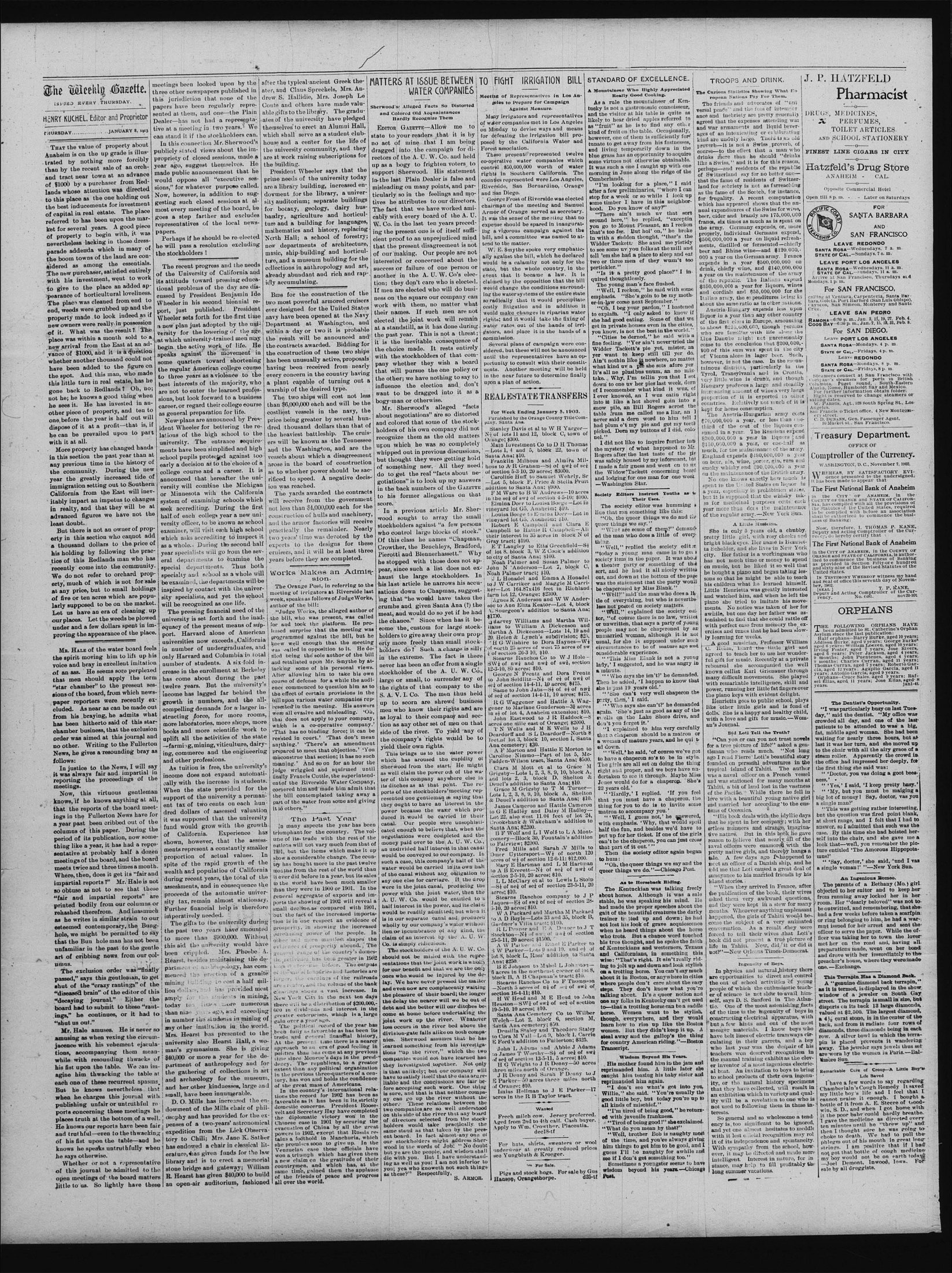
Searchable text
The value of property about Anaheim is on the up grade is illustrated by nothing more forcibly than by the recent sale of an orchard tract near town at an advance of $1000 by a purchaser from Redlands whose attention was directed to this place as the one holding out the best inducements for investment of capital in real estate. The place referred to has been upon the market for several years. A good piece of property to begin with, it was nevertheless lacking in those dress-parade addenda which in many of the boom towns of the land are considered as among the essentials. The new purchaser, satisfied entirely with his investment, went to work to give to the place an added appearance of horticultural loveliness. The place was cleaned from end to end, weeds were grubbed up and the property made to look indeed as if new owners were really in possession of it. What was the result? The place was within a month sold to a new arrival from the East at an advance of $1000, and it is a question whether another thousand could not have been added to the figure on the spot. And this man, who made this little turn in real estate, has he gone back to Redlands? Oh, no; not he; he knows a good thing when he sees it. He has invested in another piece of property, and ten to one before the year is half out will dispose of it at a profit—that is, if he can be prevailed upon to part with it at all.
More property has changed hands in this section the past year than at any previous time in the history of the community. During the new meetings been looked upon by the three other newspapers published in this jurisdiction that none of the papers have been regularly represented at them, and one—the Plain Dealer—has not had a representative at a meeting in two years. We can stand it if the stockholders can.
In this connection Mr. Sherwood's publicly stated views about the impropriety of closed sessions, made a year ago, suggest themselves. He made public announcement that he would oppose all "executive sessions," for whatever purpose called. Now, however, in addition to suggesting such closed sessions at almost every meeting of the board, he goes a step farther and excludes representatives of the local newspapers.
Perhaps if he should be re-elected he will pass a resolution excluding the stockholders!
The recent progress and the needs of the University of California and its attitude toward pressing educational problems of the day are discussed by President Benjamin Ide Wheeler in his second biennial report, just published. President Wheeler sets forth for the first time a new plan just adopted by the university for the lowering of the age at which university-trained men may begin the active work of life. He speaks against the movement in some quarters toward shortening the regular American college course to three years as a violence to the best interests of the majority, who are not to enter the learned professions, but look forward to a business career, or regard their college course as general preparation for life.
New plans are announced by President Wheeler for bettering the relations of the high school to the university. The entrance requirements have been simplified and high school pupils protected against too early a decision as to the choice of a college course and a career. It is after the typical ancient Greek theater, and Claus Spreckels, Mrs. Andrew S. Hallidie, Mrs. Joseph Coute and others have made valuable gifts to the library. The graduates of the university have pledged themselves to erect an Alumni Hall which shall serve as a student chapel and a center for the life of the university community, and they are at work raising subscriptions to the building.
President Wheeler says that prime needs of the university to are a library building, increased dovement for the library, a university auditorium; separate buildings for botany, geology, dairy bandry, agriculture and horticulture and a building for language mathematics and history, replace North Hall; a school of foreign new departments of architecture music, ship-building and horticulture, and a museum building for collections in anthropology and already abundant and rich and widely accumulating.
Bids for the construction of two most powerful armored cruisers ever designed for the United States navy have been opened at the Department at Washington, within a day or two it is probable that the result will be announced in the contracts awarded. Bidding on the construction of these two ships has been unusually active, propelling having been received from nearly every concern in the country having a plant capable of turning over warship of the desired type.
The two ships will cost not less than $6,000,000 each and will be costliest vessels in the navy price being greater by several hundred thousand dollars than those heaviest battleship. The bids will be known as the Tennyson and the Washington, and are vessels about which a disagreeablerose in the board of constructors as to whether power should be
More property has changed hands in this section the past year than at any previous time in the history of the community. During the new year the greatly increased tide of immigration setting out to Southern California from the East will inevitably impart an impetus to changes in realty, and that they will be at advanced figures we have not the least doubt.
But there is not an owner of property in this section who cannot add a thousand dollars to the price of his holding by following the practice of this Redlands man who has recently come into the community. We do not refer to orchard property, much of which is not for sale at any price, but to small holdings of five or ten acres which are popularly supposed to be on the market. Let us have an era of cleaning up our places. Let the weeds be plowed under and a few dollars spent in improving the appearance of the place.
Mr. Hale of the water board feels the spirit moving him to lift up his voice and bray in excellent imitation of an ass. He seems sore perplexed that men should apply the term "star chamber" to the present sessions of the board, from which newspaper reporters were recently excluded. As near as can be made out from his braying, he admits what has been hitherto said of this star chamber business, that the exclusion order was aimed at this journal and no other. Writing to the Fullerton News, he gives a resounding bray as follows:
In justice to the News, I will say it was always fair and impartial in reporting the proceedings of the meetings.
Now, this virtuous gentleman knows, if he knows anything at all, that the reports of the board meetings in the Fullerton News have for a year past been cribbled out of the columns of this paper. During the period of its publication, now something like a year, it has had a representative at probably half a dozen meetings of the board, and the board meets twice and three times a month. Where, then, does it get its "fair and impartial reports?" Mr. Hale is not so obtuse as not to see that these "fair and impartial reports" are
New plans are announced by President Wheeler for bettering the relations of the high school to the university. The entrance requirements have been simplified and high school pupils protected against too early decision as to the choice of a college course and a career. It is announced that hereafter the university will combine the Michigan or Minnesota with the California system of examining schools which seek accrediting. During the first half of each college year a new university officer, to be known as school examiner, will visit each high school which asks accrediting to inspect it as a whole. During the second half year specialists will go from the several departments to examine the special departments. Thus both specialty and school as a whole will be examined; the departments will be inspired by contact with the university specialists, and yet the school will be recognized as one life.
The pressing financial need of the university is set forth and the inadequacy of the present means of support. Harvard alone of American universities now exceeds California in number of undergraduate, and only Harvard and Columbia in total number of students. A six-fold increase in the enrollment at Berkeley has come about during the past twelve years. But the university's income has lagged far behind the growth in numbers, and the all-compelling demands for a larger instructing force, for more rooms, more laboratories, more shops, more books and more scientific work to uplift all the activities of the state—farming, mining, viticulture, dairying, commerce and the engineering and other professions.
As tuition is free, the university's income does not expand automatically with the increase in students. When the state provided for the support of the university a permanent tax of two cents on each hundred dollars of assessed valuation it was supposed that the university fund would grow with the growth of California. Experience has shown, however, that the assessments represent a constantly smaller proportion of actual values. In spite of the rapid growth of the wealth and population of California during recent years, the total of the assessments, and in consequence the proceeds of the automatic univer-
every concern in the country in a plant capable of turning on warship of the desired type.
The two ships will cost not than $6,000,000 each and will be costliest vessels in the navy; price being greater by several thousand dollars than the heaviest battleship. The vessels will be known as the Tennant and the Washington, and are vessels about which a disagreeable arrose in the board of construction as to whether power should be rificed to speed. A negative ion was reached.
The yards awarded the company will receive from the government not less than $4,000,000 each for construction of hulls and machining and the armor factories will practically remain the remainder. Two years' time was devoted by experts to the designs for cruisers, and it will be at least years before they are completed.
Works Makes an Adoption.
The Orange Post, in referring meeting of irrigators at Riverside week, speaks as follows of Judge author of the bill:
"Judge Works,"the alleged auditor, bill, who was present, was for and took the platform. He feared surprise that the meeting programmed against the bill, knew well enough that he was called in opposition to it. Nied being the sole author of it and retaliated upon Mr. Smythe tacking some of his personal After allowing him to take his course of defense for a while he commenced to question himthe effect of certain provisions bill upon various water companies presented in the meeting. His wife were evasive and misleading that does not apply to your co-which is a co-operative contract That has no binding force; it resisted in court." "That don't anything." "There's an americaprepared to meet that objection misconstrue that section; it has meaning." And so on for an hour judge wriggled and squirmed finally Francis Cuttle,the superintendent of the Riverside Water Co-cornered him and made him admitthe bill contemplated taking part of the water from some and it so others."
The Past Year
In many aspects the year has triumphant for the country. "Time of its trade with the nations will not vary much from 1901, but the items which may show a considerable change. The try has bought more in the past months from the rest of the world it ever did before in a year, but to the world have been much than they were in 1900 or 1901 general aggregate of exports."
knows, if he knows anything at all,
that the reports of the board meetings in the Fullerton News have for a year past been cribbed out of the columns of this paper. During the period of its publication, now something like a year, it has had a representative at probably half a dozen meetings of the board, and the board meets twice and three times a month. Where, then, does it get its "fair and impartial reports?" Mr. Hale is not so obtuse as not to see that these "fair and impartial reports" are printed bodily from our columns or rehashed therefrom. And inasmuch as he writes in similar strain to our esteemed contemporary, the Bung-hole, we might be permitted to say that the Bun hole man has not been unfamiliar in the past to the gentle art of cribbing news from our columns.
The exclusion order was "finally passed," says this gentleman, to get shut of the "crazy rentings" of the "diseased brain" of the editor of this "decaying journal." Either the board had to submit to these "rentings," he continues, or it had to "shut us out."
Mr. Hale amuses. He is never so amusing as when vexing the circumstance with his vehement ejaculations, accompanying them meanwhile with resounding thwacks of his fist upon the table. We can imagine him thwacking the table at each one of these recurrent spasms. But he knows nevertheless that when he charges this journal with publishing unfair or untruthful reports concerning these meetings he places truth at the bottom of a well. He knows our reports have been fair and truthful—even to the thwacking of his fist upon the table—and he knows he speaks untruthfully when he says otherwise.
Whether or not a representative of this journal be admitted to the open meetings of the board matters little to us. So lightly have these support tax of two cents on each hundred dollars of assessed valuation it was supposed that the university fund would grow with the growth of California. Experience has shown, however, that the assessments represent a constantly smaller proportion of actual values. In spite of the rapid growth of the wealth and population of California during recent years, the total of the assessments, and in consequence the proceeds of the automatic university tax, remain almost stationary. Further financial help is therefore imperatively needed.
The gifts to the university during the past two years have amounted to more than $900,000. Without this aid the university would have been crippled. Mrs. Phoebe A. Hearst, besides maintaining the department of anthropology, has commenced the erection of a granite mining building to cost a half million dollars, and has provided most amply for the students in mining, today ten times more numerous than nine years ago, and exceeding in number the students in mining of any other institution in the world. Mrs. Hearst has presented to the university also Hearst Hall, a woman's gymnasium. She is giving $40,000 or more a year for the department of anthropology and for the gathering of collections in art and archaeology for the museum, and her other kindnesses, large and small, have been innumerable.
D. O. Mills has increased the endowment of the Mills chair of philosophy and has provided for the expenses of a two-years' astronomical expedition from the Lick Observatory to Chili; Mrs. Jane K. Sather has endowed a chair in classical literature, has given funds for the law library and is to erect a memorial stone bridge and gateway; William R. Hearst has given $40,000 to build an open-air auditorium, fashioned
The past year
In many aspects the year has triumphant for the country. The time of its trade with the nations will not vary much from 1901, but the items which may show a considerable change. The try has bought more in the past months from the rest of the world it ever did before in a year, but to the world have been much than they were in 1900 or 1901. General aggregate of exports shows the showing of 1902 will be small decline as compared with but the fact of the increased infusion is in one respect an evidence prosperity, in showing the increasing purchasing power of the people other and more manifest evidence of prosperity about general range of the country's activities has been greater than it ever was before. The extent of its influence and factor larger, the earnings of the area greater, and the volume of clearings shows a vast increase New York City in the next ten there will be a distribution of $600 in dividends and interest greater enterprises, which is gain over a year ago.
The political record of the year been fully as favorable as has trade and general financial At the present time there is approach to an era of good politics than has come at any time since Monroe's days in dency. The republican, to an extent than any political organ in the previous three-quarters century, has won and holds the covetor of the great mass of American
In the country's international tions the record for 1902 has favorable as it has been in its domestic concerns. President velt and Secretary Hay have co-founded diplomatic victory won Chinese case in 1901 by secure evacuation of China by all their powers in 1902, except that Rattains a foederid in Manchuria she promises soon to give up. Venzuelan case these officials won a triumph which has given a new claim on the gratitude countrymen, and which has same time, gained them the part of the friends of peace and all over the world.
the typical ancient Greek theodora Claus Spreckels, Mrs. And S.S. Hallidie, Mrs. Joseph Le
and others have made valurious contributions to the library. The graduof the university have pledged
selves to erect an Alumni Hall,
which shall serve as a student club
and a center for the life of
university community, and they
work raising subscriptions for building.
President Wheeler says that the
needs of the university today
library building, increased entention for the library, a university auditorium; separate buildings
bootany, geology, dairy hustry, agriculture and horticuland a building for languages,
chematics and history, replacing
an Hall; a school of forestry;
departments of architecture,
船, ship-building and horticuland a museum building for the
reactions in anthropology and art,
body abundant and rich and rapaccumulating.
For the construction of the
most powerful armored cruisers
designed for the United States
have been opened at the Navy
portment at Washington, and
in a day or two it is probable
result will be announced and
contracts awarded. Bidding for
construction of these two ships
been unusually active, proposals
being received from nearly
concern in the country having
tant capable of turning out a
ship of the desired type.
The two ships will cost not less
$6,000,000 each and will be the
largest vessels in the navy, the
being greater by several hundred thousand dollars than that of
the heaviest battleship. The cruiswill be known as the Tennessee
of the Washington, and are the
mails about which a disagreement
in the board of construction
so whether power should be sac-
MATTERS AT ISSUE BETWEEN WATER COMPANIES
Sherwood's Alleged Facts So Distorted
and Colored Old Acquaintances
Hardly Recognize Them
EDITOR GAZETTE—Allow me to state to your readers that it is by no act of mine that I am being dragged into the campaign for directors of the A. U. W. Co. and held up as a bogey to frighten voters to support Sherwood. His statement in the last Plain Dealer is false and misleading on many points, and particularly so in the feelings and motives he attributes to our directors. The fact that we have worked amiably with every board of the A. U. W. Co. in the last ten years preceding the present one is of itself sufficient proof to an unprejudiced mind that the present disagreement is not of our making. Our people are not interested or concerned about the success or failure of one person or another in the A. U. W. Co.'s election; they don't care who is elected. If men are elected who will do business on the square our company can work with them, no matter what their names. If such men are not elected the joint work will remain at a standstill, as it has done during the past year. This is not a threat; it is the inevitable consequence of the choice made. It rests entirely with the stockholders of that company whether they wish a board that will pursue the one policy or the other; we have nothing to say to influence the election and don't want to be dragged into it as a boggy-man or otherwise.
Mr. Sherwood's alleged "facts about negotiations" are so distorted and colored that some of the stockholders of his own company did not recognize them as the old matters upon which he was so completely whipped out in previous discussions, but thought they were getting hold of something new. All they need do to get the real "facts about ne-
TO FIGHT IRRIGATION BILL
Meeting of Representatives in Los Angeles to Prepare for Campaign Against Measure.
Many irrigators and representatives of water companies met in Los Angeles on Monday to devise ways and means for defeating the irrigation bill proposed by the California Water and Forest association.
These present represented twelve co-operative water companies which control $50,000,000 worth of water rights in Southern California. The counties represented were Los Angeles, Riverside, San Bernardino, Orange and San Diego.
George Frost of Riverside was elected chairman of the meeting and Samuel Armor of Orange served as secretary. It was the sense of the meeting that no expense should be spared in inaugurating a vigorous campaign against the bill, and a committee was named to attend to the matter.
W. E. Smythe spoke very emphatically against the bill, which he declared would be a calamity not only for the state, but the whole country, in the event that it became a law. It is claimed by the opposition that the bill would change the conditions surrounding the water systems of the entire state so radically that it would precipitate costly litigation and in addition it would make changes in riparian water rights; and it would take the fixing of water rates out of the hands of irrigators, and place it in the hands of a commission.
Several plans of campaign were considered, but these will not be announced until the representatives have an opportunity to consult with their constituents. Another meeting will be held in the near future to determine finally upon a plan of action.
REAL ESTATE TRANSFERS
For Week Ending January 5, 1903.
Furnished by the Orange County Title Company, Santa Ana.
Stanley Davis et al to WH Yarger—No of lots 11 and 12, block C, town of Orange; $300.
Main Investment Co to D H Thomas—Lots 1, 4 and 5, block 22, town of Santa Ana; $10.
Franklin Milhous and Almira Milhous to A R Graham—Si of nwf of set of section 5-3-10, 20 acres; $3000.
STANDARD OF EXCELLED
A Mountaineer Who Highly Appreciates Really Good Cooking.
As a rule the mountaineer owes tucky is not a gastronomic connection and the visitor at his table is likely to hear dried apples referred as "fruit" as he is to find any kind of fruit on the table. Occasion however, one of them is sufficient to tune to get away from his fastness and living temporarily down in blue grass has an opportunity to enjoy some virtues not otherwise obtain. It was such a one I caught up with morning in June along the ridge Cumberlands.
"I'm looking for a place," after a few preliminaries, "when stop for a week or so while I am some timber I have in this wood. Do you know of any?"
There ain't much uv that surround here," he replied, "even you go to Mount Pleasant, an island that's too far. But hol' on," he in with a sudden thought, "that Widder Tackett. She axed me to see some uv you folks at the moll 'em she had a place to sleep two or three men if they wuz pertickler."
Is it a pretty good place? quired thoughtlessly.
The young man's face flushed "Well, I reckon," he said with emphasis. "She's goin to be more in-law come next September."
"Oh, I beg your pardon." I try to explain, "I only asked to she had good eating. Some of them get in private houses even in this you know, is not best in the "Cities be derned," he said fine feeling. "Yer ain't never Widder Tackett's pie yet, my mer want to keep still till Ain't nothin like it nowhere, nor what kind uv a pie she sets at It's all ne plusibus unum, an take. Why, I'm tellin you thou down to one uv her pies last wit if I ever knew, an I wuz cait into it like a hot shovel going snow pile, an Bill Rogers ad table from me called me a laker never said a dern word to him had plum e't my pie and got picked. Dern my buttons of I nel."
I did not like to inquire further about the mystery of what happened Rogers after the last taste of was safely housed by my informant I made a fair guess and went to the Widow'Tackett concerni-
WORKS Makes an Admission.
The Orange Post, in referring to the setting of irrigators at Riverside last year, speaks as follows of Judge Works, chair of the bill:
Judge Works, the alleged author of the bill, who was present, was called and took the platform. He provided surprise that the meeting was commenced to question him as to effect of certain provisions in the bill upon various water companies reported in the meeting. His answers are all evasive and misleading. 'Oh, you does not apply to your company, which is a co-operative company.' That has no binding force; it can be rested in court. 'That don't mean anything.' There's an amendment prepared to meet that objection. 'You construe that section; it has no such meaning.' And so on for an hour the waggled and squirmed until really Francis Cuttle, the superintendent of the Riverside Water Company, ordered him and made him admit that the bill contemplated taking away all of the water from some and giving so others."
The Past Year
In many aspects the year has been unanticipated for the country. The volume of its trade with the rest of the nations will not vary much from that of 1901, but the items which make it up now a considerable change. The counsellor has bought more in the past twelve months from the rest of the world than ever did before in a year, but its sales the world have been much smaller than they were in 1900 or 1901. In the general aggregate of exports and imports, we have nothing to say to influence the election and don't want to be dragged into it as a bogy-man or otherwise.
Mr. Sherwood's alleged "facts about negotiations" are so distorted and colored that some of the stockholders of his own company did not recognize them as the old matters upon which he was so completely whipped out in previous discussions, but thought they were getting hold of something new. All they need do get the real "facts about negotiations" is to look up my answers in the back numbers of the Gazette to his former allegations on that score.
In a previous article Mr. Sherwood sought to array the small stockholders against "a few persons who control large blocks of stock." Of this class he names "Chapman, Crowther, the Benchleys, Bradford, Pierotti and Biennerhassett." Why he stopped with those does not appear, since such a list does not exhaust the large stockholders. In his last article he narrows his accusations down to Chapman, suggesting that "he would have taken the crumbs and given Santa Ana (?) the meat, and would do so yet if he had chance." Since when has it become the custom for large stockholders to give away their own property more freely than small stockholders do? Such a charge is silly in the extreme. The fact is there never has been an offer from a single stockholder of the A. U. W. Co., large or small, to surrender any of the rights of that company to the S.A.V.I.Co. The men thus held up to scorn are shrewd business men who know their rights and are as loyal to their company and section as any other set of men on that side of the river. To yield any of the company's rights would be to yield their own rights.
This brings us to the water power which has aroused the cupidity of Sherwood from the start. He might as well claim the power out of the water of this company anywhere in its ditches as at that point. The reports of the stockholders' meeting represented one gentleman is saying that they ought to have an interest in the power because the water which produced it would be carried in their canal. Our people were unsophisticated enough to believe that, when the negotiations were completed and the money paid over to the A.U.W.Co., an undivided half interest in that canal would be conveyed to our company. In such a case, this company's half of the water would be carried in its own half of the canal without any obligation to any one else for carriage. If the drop were in the joint canal, producing the power with the joint water, then the A.U.W.Co. would be entitled to a
For Week Ending January 5, 1903.
Furnished by the Orange County Title Company, Santa Ana.
Stanley Davis et al to WH Yarger—N of lots 11 and 12, block C, town of Orange; $300.
Main Investment Co to DH Thomas—Lots 1, 4 and 5, block 22, town of Santa Ana; $10.
Franklin Milhous and Almira Milhous to A.R.Graham—S of nwf of set of section 5-3-10, 20 acres; $3000.
Caroline Huff to Samuel Wehrly, Sr—Lot 5, block F, Price & Stella Fruit addition to Santa Ana; $900.
F.M Ware to BW Andrews—10 acres in the set of swf of section 4-5-10; $900.
Elmina Dorr to Louisa Borge—Lot in vineyard lot G5, Anahiem; $10.
Louisa Boege to Emma Dorr—Lot in vineyard lot G5, Anahiem; $10.
Robert E Campbell and Clara E Campbell to Hattie R Campbell—All their interest in 35 acres in block N of Gray tract; $190.
E T Laugley to Etta Greenfield—S of lot 8, block 3, W Z Cook's addition to city of Santa Ana; $100.
Noah Palmer and Susan Palmer to John N Anderson—Lot 7, block C, Noah Palmer tract; $10.
J L Honadel and Emma A Honadel to J W Carriker and Maggie M Carriker—Lot 164.87x416 feet in Richland farm lot 12, Orange; $2300.
Agnes K Anderson and WW Anderson to Ann Eliza Keator—Lot 4, block N Spurgeon's addition to Santa Ana; $1700.
Harvey Williams and Martha Williams to William A Dickenson and Martha A Dickinson—Lots 14, 19 and 20. Helen & Lynch's subdivision; $25.
H G Wilshire to Dora Haynes—W of north 25 acres of west 75 acres of swf of section 26-3-10, $10.
Stearans Ranchos Co to WJ Hole—SWf of nwf and nwf of swf, section 12-3-10, 80 acres; $10.
George N Frentz and Dora Frentz to John Seidlitz—N of ef of nwf of set of section 14-4-11, 10 acres; $475.
Same to John Jabs—S of ef of nwf of set of section 14-4-11, 10 acres; $475.
RG Waggener and Hattie A Waggener to Marlane Gunderson—3 acres in lot 4, Anahiem extension; $10.
John Eastwood to J R Haddock—8 acres one mile east of Orange; $2000.
T N Wells and M E Wells to J H Deardorf and S L Deardorf—North 8 feet of lot 3, block 10, section I Santa Ana cemetery; $30.
A F Morton and Hattie E Morton to Caroline Nimmo—Part of lot 5, Me Fadden-Wilson tract, Santa Ana; $500.
Clara M Mott et al to Grace M Grigsby—Lots 1, 2, 3, 8, 9, 10, block A, and lots 2, 3, block D, Shelton & Deuel's addition to Santa Ana; $10.
Grace M Grigsby to T M Turner—Lots 1, 2, 3, 8, 9, 10, block A, Shelton & Deuel's addition to Santa Ana; $10.
James Cameron and Hattie Cameron to G E Hadley and Daisy M Hadley—Lot 22 also west 11.04 feet of lot 24, Crookshank & Wakeham's addition to Santa Ana; $2200.
B F Wolf and I Wolf to L A Montgomery—Block 30, Fountain's addition to Fairview; $2000.
Fred Mills and Sarah V Mills to Omer Uyttersport—Wf of north 120 acres of set of section 12-6-11; $12.000.
Mary E Hartman and L M Hartman to A B Everett—N of set of nwf of set of section 2-5-10, 20 acres; $10.
L L McClary et al to Lewis L Stolp—S of net of set of section 23-5-11, 20 acres; $10.
Stearans Ranchos company to J P
REAL ESTATE TRANSFERS
For Week Ending January 5, 1903.
Furnished by the Orange County Title Company, Santa Ana.
Stanley Davis et al to WH Yarger—N of lots 11 and 12, block C, town of Orange; $300.
Main Investment Co to DH Thomas—Lots 1, 4 and 5, block 22, town of Santa Ana; $10.
Franklin Milhous and Almira Milhous to A.R.Graham—S of nwf of set of section 5-3-10, 20 acres; $3000.
Caroline Huff to Samuel Wehrly, Sr—Lot 5, block F, Price & Stella Fruit addition to Santa Ana; $900.
F M Ware to BW Andrews—10 acres in the set of swf of section 4-5-10; $900.
Elmina Dorr to Louisa Borge—Lot in vineyard lot G5, Anahiem; $10.
Louisa Boege to Emma Dorr—Lot in vineyard lot G5, Anahiem; $10.
Robert E Campbell and Clara E Campbell to Hattie R Campbell—All their interest in 35 acres in block N of Gray tract; $190.
E T Laugley to Etta Greenfield—S of lot 8, block 3, W Z Cook's addition to Santa Ana; $1700.
Harvey Williams and Martha Williams to William A Dickinson and Martha A Dickinson—Lots 14, 19 and 20. Helen & Lynch's subdivision; $25.
H G Wilshire to Dora Haynes—W of north 25 acres of west 75 acres of swf of section 26-3-10, $10.
Stearans Ranchos Co to WJ Hole—SWf of nwf and nwf of swf, section 12-3-10, 80 acres; $10.
George N Frentz and Dora Frentz to John Seidlitz—N of ef of nwf of set of section 14-4-11, 10 acres; $475.
Same to John Jabs—S of ef of nwf of set of section 14-4-11, 10 acres; $475.
RG Waggener and Hattie A Waggener to Marlane Gunderson—3 acres in lot 4, Anahiem extension; $10.
John Eastwood to J R Haddock—8 acres one mile east of Orange; $2000.
T N Wells and M E Wells to J H Deardorf and S L Deardorf—North 8 feet of lot 3, block I North eight feet on that side of the river. To yield any of the company's rights would be to yield their own rights.
This Miss Blank is not lady,' I suggested, and he was a minute.
"Who says she isn't?' he began. Then he added,' I happen too! she is just十九 years old.'
"She can't very well chant," he said. "Who says she can't?' he again. She's just as good as she dwells on Lake Shore or doesn't you forget it."
"I explained to him very that a chaperon should be a woman of mature years," and down.
"Well,' he said,'of course you have a chaperon so it's best. The girls are all set on doing right and proper. By we boydertaken to see it through. My Jones would do for a chaperon二十 twenty old."
"Hardly,' I replied.' It that you must have a chaperon so you're matron to accompany you.'"
"Well,' I guess not,' he with emphasis.' Why that half the fun,and besides we put up for her ticket. If one can't be a chaperon you can that part off it out.'"
Then the society editor asked him: "Oh,the queer things we queer things we do."——Chicor
As To Horseback Ridg
The Past Year
In many aspects the year has been cumphant for the country. The volume of its trade with the rest of the nations will not vary much from that of 1901, but the items which make it up now a considerable change. The country has bought more in the past twelve months from the rest of the world than ever did before in a year, but its sales in the world have been much smaller than they were in 1900 or 1901. In the general aggregate of exports and imports the showing of 1902 will reveal a small decline as compared with 1901, but the fact of the increased importation is in one respect an evidence of prosperity, in showing the increased purchasing power of the people. In other and more manifest shapes the evidences of prosperity abound.
The general range of the country's domestic activities has been greater in 1902 than at other times before. The outputs of industrial foundries and factories are larger, the earnings of the railroads are greater, and the volume of the bank earnings shows a vast increase. In New York City in the next ten days there will be a distribution of $200,000 in dividends and interest in the greater enterprises, which is a large gain over a year ago.
The political record of the year has been fully as favorable as has been its trade and general financial history, but the present time there is a nearer approach to an era of good feeling in utilities than has come at any previous time since Monroe's days in the presidency. The republican, to a greater extent than any political organization, has the previous three-quarters of a century, has won and holds the confidence in the great mass of Americans.
In the country's international relations the record for 1902 has been as favorable as it has been in its strictly domestic concerns. President Roosevelt and Secretary Hay have completed the diplomatic victory won in the Chinese case in 1902, except that Russia remains a foothold in Manchuria, which he promises soon to give up. In the Gonzuelan case these officials have won a triumph which has given them new claim on the gratitude of their countrymen, and which has, at the same time, gained them the applause for the friends of peace and progress all over the world.
S. Armor.
James Cameron and Hattie Cameron to G E Hadley and Daisy M Hadley—Lot 22, also west 11.04 feet of lot 24, Crookebank & Wakeham's addition to Santa Ana; $2200.
B F Wolf and L I Wolf to A Montgomery—Block 30, Fountain's addition to Fairview; $2000.
Fred Mills and Sarah V Mills to Omer Uyttersport—W of north 120 acres of w of section 12-6-11: $12,000.
Mary E Hartman and L M Hartman to A B Everett—N of set of nw of section 2-5-10, 20 acres; $10.
L L McClary et al to Lewis L Stolp—S of net of set of section 23-5-11, 20 acres; $10.
Stearns Ranchos company to J P Jaques—E of sw of net of section 28-5-10, 20 acres; $10.
W A Packard and Martha M Packard to A D Boyle—Lots 33 and 35, block B, Gardner's Villa tract; $100.
R L Draper and E A Draper to J T Stockton—N of nw of nw of section 25-5-11, 20 acres; $1500.
A W Parker and Etnel E Parker to S W Parker—Lots 9 and 10, and e of lot 8, block L, Ross' addition to Santa Ana; $250.
B E Johnson to Mabel L Johnston—6 acres in the northeast corner of lot 8, block B, A B Chapman's tract; $10.
Stearns Ranchos Co to F Thompson—North 5 acres of n of set of sw of section 16-4-11; $10.
H W Head and M E Head to John Heaston—SW of sw of set of section 19-5-10, 10 acres; $10.
Santa Ana Cemetery Co to Wilber Welch—Lot 2, block 6, section M, Santa Ana cemetery; $50.
Drusilla Stailey and Theodore Staley to Cora M Vail—Lot 9, block 1, Carrie E Ford's addition to Fullerton; $325.
John L Adams and Abbie J Adams to James T Worthy—S of set of sw of set of section 13-5-11, 5 acres; $10.
H G Wright to J R Denny—50 acres three miles north of Orange.
J R Denny and Sarah F Denny to J E Parker—50 acres three miles north of Orange; $10.
Isalas Hellman to J E Parker—17 acres in the R B Taylor tract.
Wanted
Frech milch cow. Jersey preferred. Aged from 2nd to 4th calf. Cash buyer. Apply to Wm. Crowther. Placentia. decl8-tf
For hats, shirts, sweaters or wool underwear at greatly reduced prices see Yungbluth & Kroeger.
For Sale.
Pigs and stock hogs. For sale by Gus Hanson, Orangethorpe. d25-tf
& Deuel's addition to Santa Ana; $10.
James Cameron and Hattie Cameron to G E Hadley and Daisy M Hadley—Lot 22, also west 11.04 feet of lot 24, Crookebank & Wakeham's addition to Santa Ana; $2200.
B F Wolf and L I Wolf to A Montgomery—Block 30, Fountain's addition to Fairview; $2000.
Fred Mills and Sarah V Mills to Omer Uyttersport—W of north 120 acres of w of section 12-6-11: $12,000.
Mary E Hartman and L M Hartman to A B Everett—N of set of nw of section 2-5-10, 20 acres; $10.
L L McClary et al to Lewis L Stolp—S of net of set of section 23-5-11, 20 acres; $10.
Stearns Ranchos company to J P Jaques—E of sw of net of section 28-5-10, 20 acres; $10.
W A Packard and Martha M Packard to A D Boyle—Lots 33 and 35, block B, Gardner's Villa tract; $100.
R L Draper and E A Draper to J T Stockton—N of nw of nw of section 25-5-11, 20 acres; $1500.
A W Parker and Etnel E Parker to S W Parker—Lots 9 and 10, and e of lot 8, block L, Ross' addition to Santa Ana; $250.
B E Johnson to Mabel L Johnston—6 acres in the northeast corner of lot 8, block B, A B Chapman's tract; $10.
Stearns Ranchos Co to F Thompson—North 5 acres of n of set of sw of section 16-4-11; $10.
H W Head and M E Head to John Heaston—SW of sw of set of section 19-5-10, 10 acres; $10.
Santa Ana Cemetery Co to Wilber Welch—Lot 2, block 6, section M, Santa Ana cemetery; $50.
Drusilla Stailey and Theodore Staley to Cora M Vail—Lot 9, block 1, Carrie E Ford's addition to Fullerton; $325。
John L Adams and Abbie J Adams to James T Worthy—S of set of sw of set of section 13-5-11, 5 acres; $10.
H G Wright to J R Denny—50 acres three miles north of Orange.
J R Denny and Sarah F Denny to J E Parker—50 acres three miles north of Orange; $10.
Isalas Hellman to J E Parker—17 acres in the R B Taylor tract.
Wisdom Beyond His
His mother found him in reprimanded him. A little caught him teasing his baby reprimanded him again.
"I don't see what's go Willie," she said. "You're good little boy, but today I'm all kinds of mischief."
"I'm tired of being good ed with juvenile frankness." "Tired of being good!" she said. "What do you mean by that? Well, brother Bob is no time that you're all him things to get him to be guess I'll be naughty for see if I don't get something sometimes a youngster s wisdom beyond his year Post.
STANDARD OF EXCELLENCE.
Mountaineer Who Highly Appreciated Really Good Cooking.
As a rule the mountaineer of Kentucky is not a gastronomic connoisseur, but the visitor at his table is quite likely to hear dried apples referred to "fruit" as he is to find any other kind of fruit on the table. Occasionally, however, one of them is sufficiently fortunate to get away from his fastnesses, and living temporarily down in the grass has an opportunity to acquire some virtues not otherwise obtainable. Was such a one I caught up with one morning in June along the ridge of theumberlands.
"I'm looking for a place," I said after a few preliminaries, "where I can go for a week or so while I look up some timber I have in this neighborhood. Do you know of any?"
"There ain't much uv that sort found here," he replied, "exceptin' me go to Mount Pleasant, an I reckon it's too fer. But hol' on," he broke with a sudden thought, "thar's the mudder Tackett. She axed me yistidy because some uv you folks at the mill and I'em she had a place to sleep and eat no or three men ef they wuzn't too tartickler."
"Is it a pretty good place?" I insisted thoughtlessly.
The young man's face flushed. "Well, I reckon," he said with some emphasis. "She's goin to be my moth-in-law come next September."
"Oh, I beg your pardon," I hastened explain. "I only asked to know if he had good eating. Some of that we put in private houses even in the cities, you know, is not the best in the world." "Cities be dermed," he said with a une feeling. "Yer ain't never tried the Widder Tackett's pie yet, mister, an ever want to keep still till yer do. I'm not nothin like it nowhere, no matter that kind uv a pie she sets afore yer's all ne plusibus unum, an no misake. Why, I'm tellin you that I sot down to one uv her pies last week, dern if I recombem what kind it wuz, ef ever known, an I wuz eatin right into it like a hot shovel gain into a snow pile, an Bill Rogers acrost the table from me called me a liar, an I never said a dern word to him tell I and plum e't my pie and got my teeth ticked. Dern my buttons of I did, coloel."
I did not like to inquire further into the mystery of what happened to Mr. Rogers after the last taste of the pie was safely housed by my informant, but made a fair guess and went on to see the Widow Tackett concerning board
TROOPS AND DRINK.
The Curious Statistics Showing What European Nations Pay For Them.
The friends and advocates of "universal peace" and the fees of intemperance and inebriety are pretty generally agreed that the expenses attending war and war armaments and liquid beverages of an intoxicating or exhilarating kind are unduly large. There is an old proverb—it is not a Swiss proverb, of course—to the effect that a man who drinks more than he should "drinks like a Swiss," and it is for this reason, perhaps—and residents of the republic of Switzerland say for no better one—that the fame of residents of Switzerland for sobriety is not as farreaching as the fame of the Scotch, for instance, for frugality. A recent computation which has appeared shows that the annual expenditures of the Swiss for wine, beer, oider and brandy are 175,000,000 francs, six times as much as is spent on the army. Germany expends, or, more properly, individual Germans expend $500,000,000 a year on liquid refreshments, distilled or fermented—chiefly beer and Rhine wine—and $120,000,-000 a year on the German army. France expends in a year $500,000,000 on drink, chiefly wine, and $140,000,000 a year on the maintenance of the army of the republic. The Italians expend $250,000,000 a year for liquors, wines and cordials and $55,000,000 for the Italian army, the expenditures being in about the same ratio as in other nations.
Austria-Hungary expends less upon liquor in a year than any other country of the first class in Europe, amounting to about $225,000,000, though persons who are familiar with life along the Blue Danube might not unreasonably come to the conclusion that $200,000,-900 of this sum was spent in the city of Vienna alone in lager beer. Such, however, is not the case. In the mountainous districts, particularly in the Tyrol, Transylvania and in Croatia, very little wine is drunk, and though Hungary produces a large and steadily increasing amount of wine a very large proportion of it is exported to other countries. Relatively not much of it is kept for home consumption.
The Austria-Hungarian army costs $70,000,000 a year, or less than one-third of the cost of the liquors consumed in a year. The Russians expend $300,000,000 a year in liquors and $150,000,000 a year, or one-half as much, for the maintenance of the army. England expends $180,000,000 a year on beer ale, wine porter, gin, rum and smoky whisky and $90,000,000 a year on the maintenance of the British army.
J. P. HATZFELD Pharmacist
DRUGS, MEDICINES,
PERFUMES,
TOILET ARTICLES
AND SCHOOL STATIONERY
FINEST LINE CIGARS IN CITY
Hatzfeld's Drug Store
ANAHEIM - CAL.
Opposite Commercial Hotel
Open till 8 p.m. Later on Saturdays
FOR
SANTA BARBARA
AND
SAN FRANCISCO
LEAVE REDONDO
SANTA ROSA—Wednesdays, 7 a.m.
STATE OF CAL—Sundays, 7 a.m.
LEAVE PORT LOS ANGELES
SANTA ROSA—Wednesdays, 11 a.m.
STATE OF CAL—Sundays, 11 a.m.
Arrive at San Francisco; Thursdays and Mondays; 1 p.m.
For SAN FRANCISCO,
calling at Ventura; Carpenteria; Santa Barbara; Goleta; Port Harford (San Luis Obispo); Cayucos; San Simeon; Monterey and Santa Cruz.
LEAVE SAN PEDRO
RAMONA—6:20 p.m., Jan. 31, 19; 27. Feb. 4.
COOS BAY—6:30 p.m., Jan. 7, 15; 23; 21. Feb. 8.
For SAN DIEGO.
Leave PORT LOS ANGELES
SANTA ROSA—Mondays, 4 p.m.
STATE OF CAL—Fridays, 4 p.m.
Leave REDONDO
SANTA ROSA—Mondays, 8 p.m.
STATE OF CAL—Fridays, 8 p.m.
Steamers connect at San Francisco with Company's steamers for ports in British Columbia; Fugt Sound; South-Eastern Alaska; None; Humboldt Bay and Mexico. For further information obtain folder. Right is reserved to change steamers or sailing dates.
W. PARRIS, Agt., 328 South Spring St., Los Angeles.
San Francis o Ticket office; 4 New Montgomery street.
C.D. DUNANN; Gen. Passenger Agent;
10 Market st., San Francisco.
Treasury Department.
OFFICE OF
Comptroller of the Currency.
WASHINGTON; D.C.; November 7; 1902.
WHEREAS BY SATISFACTORY EVI-
Society Editors Instruct Youths as to Their Uses.
The society editor was humming a line that ran something like this:
"Oh, the queer things we do and the queer things we say."
What are some of them?" demanded the man who does a little of everything.
Well," replied the society editor today a young man came in to get a society item in the paper. It was about a theater party or something of that sort, and he had it all nicely written out, and down at the bottom of the page was the statement that the party would be chaperoned by Miss Blank."
Well," said the man who does a little of everything, but who is nevertheless not posted on society matters.
Well," explained the society editor, "of course there is no law, written or unwritten, that says a party of young people may not be chaperoned by an unmarried woman, although it is not usual, for she is supposed under such circumstances to be of mature age and considerable experience."
This Miss Blank is not a young lady,' I suggested, and he was angry in a minute.
Who says she isn't? he demanded. Then he added, 'I happen to know that she is just 19 years old.'
She can't very well chaperon the party, then,' I said.
Who says she can't? he demanded again. She's just as good as any of the swells on the Lake Shore drive, and don't you forget it?
I explained to him very carefully that a chaperon should be a matron or a woman of mature years, and he qui ted down.
Well," he said, 'of course we've got to have a chaperon so's to be in style. The girls are all set on doing the thing right and proper, and we boys have undertaken to see it through. Maybe Miss Jones would do for a chaperon. She's 23 years old.'
Hardly,' I replied. 'If you feel that you must have a chaperon, the thing for you to do is to invite some matron to accompany you.'
Well, I guess not,' he answered, with emphasis. 'Why, that would spoil half the fun, and besides we'd have to put up for her ticket. If one of the girls can't be the chaperon, you can just cross that part of it out.'"
Then the society editor again began to hun:
"Oh, the queer things we say and the queer things we do."—Chicago Post.
As to Horseback Riding.
The Kentuckian was talking freely about horses. Although it was a sale very awkward question,
"When they arrived in France, after the publication of the book, their wives asked them very awkward questions,
The Austria-Hungarian army costs $70,000,000 a year, or less than one-third of the cost of the liquores consumed in a year. The Russians expend $300,000,000 a year in liquors and $150,000,000 a year, or one-half as much, for the maintenance of the army. England expends $480,000,000 a year on beer, ale, wine, porter, gin, rum and smoky whiskey and $90,000,000 a year on the maintenance of the British army.
No one knows exactly how much is spent in the United States on liquor in a year, especially in prohibition states, but it is supposed that the whiskey taken for medicinal purposes costs each year more than dots the maintenance of the regular army.—New York Sun.
A Little Musician.
She is only 5 years old, a chunky pretty little girl, with rosy cheeks and bright black eyes. Her name is Henrietta Scholder, and she lives in New York City. Her father is a workingman who has not much time or money to spend on music, but he liked it so well that he bought a piano and began taking lessons so that he might be able to teach his children what he learned himself. Little Henrietta was greatly interested and watched him, and when he left the piano she tried to imitate his movements. No notice was taken of her for awhile, but one day her father was astonished to find that she could rattle off with perfect case from memory the exercises and tunes that he had been slowly learning for weeks.
A good musician, Professor William C. Rehn, heard the little girl and agreed to teach her to use her wonderful gift for music. Recently at a private rehearsal she accompanied the well known callist Karl Grionauer through many difficult movements. She played with remarkable intelligence, skill and power, running her little fat fingers over the piano keys with evident delight.
Henrietta goes to public school, plays like other little girls and is fond of dolls. She is a happy and healthy child, with a love and gift for music.—Woman's Journal.
Did Loti Tell the Truth?
Can you or can you not trust novels for a true picture of life?' asked a gentleman who reads much. "Not long ago I read Pierre Loti's beautiful story founded on personal adventures in the tropical island of Tahiti. The author was a naval officer on a French vessel and was stationed for many months at Tahiti, a bit of land lost in the vastness of the Pacific. While there he fell in love with a beautiful young native girl and married her according to the customs of Oceanica.
His book deals with the idyllic days that he spent in her company; with her artless manners and strange imaginative nature. But in this book he gave reason to believe that nearly all of the naval officers were enamored with the pretty native girls, and thereby hangs a tale. A few days ago I happened to meet an officer of a Danish ship, and he told me that Loti caused a great deal of annoyance to his married friends by his island stories.
When they arrived in France, after the publication of the book, their wives asked them very awkward questions,
Steamers connect at San Francisco with公司's steamers for ports in British Columbia. Puget Sound: South-Eastern Alaska: Home: Humboldt Bay and Mexico. Other information obtain folder.
Right dates are reserved to change steamers or sailing dates.
W. PARMIS, Agt., 328 South Spring St., Los Angeles.
San Francisci o Ticket office. 4 New Montgomery street.
C.D. DUNNAN, Gen., Passenger Agent.
10 Market st., San Francisco.
Treasury Department.
OFFICE OF Comptroller of the Currency.
WASHINGTON, D.C., November 7, 1902.
WHEREAS BY SATISFACTORY EVidence presented to the undersigned; it has been made to appear that
The First National Bank of Anaheim
in the CITY OF ANAHEIM, in the COUNTY OF ORANGE AND STATE OF CALIFORNIA, has compiled with all the provisions of the statutes of the United States; required to be complied with before an association shall authorize to commence the business of Banking;
Now, therefore, I. THOMAS P. KANE,
Deputy and Acting Comptroller of the Currency,
do hereby certify that
The First National Bank of Anaheim
in the CITY OF ANAHEIM, in the COUNTY OF ORANGE AND STATE OF CALIFORNIA, is authorized to commence the business of Banking as provided in Section Fifty-one hundred and sixty-nine of the Revised Statutes of the United States.
IN TESTIMONY WHEREOF witness my hand and seal of office this seventh day of November 1902.
T. P. KANE,
Deputy and Acting Comptroller of the Currency,
No. 641.
nov20-10t
ORPHANS
THE FOLLOWING ORPHANS HAVE been admitted to St. Catherine's Orphan Asylum since last publication:
Half orphans—Harry Burke, aged 10 years; Addison Burke, aged 15 years; George Burke, aged 19 years; Irving Foster, aged 7 years; Jose Rivers, aged 6 years; Peter Jackson, aged 4 years; 9 months; John Puenentes, aged 4 years; Thomas Curran, aged 7 years; Robert Garcia, aged 12 years; Antonio Garcia, aged 9 years.
Orphans—Cruce Sales, aged 9 years; Rafael Ellas, aged 11 years; Jose Ellas, aged 8 years.
The Dentist's Opportunity.
"I was particularly busy on last Tuesday," said the dentist. "My office war crowded all day, and one of the last patients to be attended to was a big,fat,middle aged woman. She had been waiting for nearly three hours, but at last it was her turn, and she moved up to the chair with all the airy grace of a steam roller. Apparently the crowd in the office had impressed her deeply;for the first thing she said was:
"Doctor,你 vas doing a goot beesness."
"Yes," I said, "I keep pretty busy."
"My,但你 must be maiging a big lot of money! Say doctor,vas you a single man?"
This was getting rather interesting,but the question was fired point blank.at short range,and I felt that I had to answer,so I admitted that such was the case.By this time she had hoisted herself into the chair,and she gave me a look that—well,you remember the picture entitled 'The Amorous Hippopotamus?'
"Say,d Doctor,'she said,'und I vas a single voman!" —New York Sun.
An Ingenious Romeo.
The parents of a Bethany (Mo.) girl objected to her suitor and to keep her from running away locked her in her
that you must have a chaperon, the thing for you to do is to invite some matron to accompany you.
"Well, I guess not," he answered, with emphasis. 'Why, that would spoil half the fun, and besides we'd have to put up for her ticket. If one of the girls can't be the chaperon, you can just cross that part of it out.'
Then the society editor again began to hum:
"Oh, the queer things we say and the queer things we do."—Chicago Post.
As to Horseback Riding.
The Kentuckian was talking freely about horses. Although it was a sale stable, he was speaking his mind. He had made the proper speeches about the gait of the beautiful creatures the darky trainer treated up and down; he had not lost his look of grave acquiescence when he heard things about the horse who trots. But a chance word touched his true thought, and he spoke the faith of Kentuckians and westerners, Texans and Californians, in something this wise: "That's right. It ain't really riding to jolt up and down and look stylish on a trotting horse. You can't say much about it in Boston, or anywhere in cities where people don't care about the easy steps. They don't know what you're talking about. It's a queer notion and one my folks in Kentucky can't get used to—that a trotting horse can be a saddle horse. Women want to be stylish, though, everywhere, and they would learn how to rise up like the Boston women. But they didn't keep it up. A steal away and the gallop's the thing for country American riding."—Boston Transcript.
Wisdom Beyond His Years.
His mother found him in the jam and reprimanded him. A little later she caught him teasing his baby sister and reprimanded him again.
"I don't see what's got into you, Willie," she said. "You're usually the good little boy, but today you're up to all kinds of mischief."
"I'm tired of being good," he returned with juvenile frankness.
"Tired of being good!" she exclaimed. "What do you mean by that?"
"Well, brother Bob is naughty most of the time, and you're always giving him things to get him to be good, and I guess I'll be naughty for awhile and see if I don't get something too."
Sometimes a youngster seems to have wisdom beyond his years.—Chicago Post.
His book deals with the idyllic days that he spent in her company; with her artless manners and strange imaginative nature. But in this book he gave reason to believe that nearly all of the naval officers were enamored with the pretty native girls, and thereby hangs a tale. A few days ago I happened to meet an officer of a Danish ship, and he told me that Loti caused a great deal of annoyance to his married friends by his island stories.
When they arrived in France, after the publication of the book, their wives asked them very awkward questions, and they were kept in a stew for many months. Whenever anything unpleasant happened, the girls of Tahiti would become the subject of a very animated conversation. As a result they were forced to tell their wives that Loti's book did not present a true picture of life in Tahiti. Now, did it or did it not?"—New Orleans Times-Democrat.
Ingenuity of Boys.
In physics and natural history there are opportunities to direct and control the out of school activities of young people of which the enthusiastic teacher of science is not slow to avail himself, says D. S. Sanford in The Atlantic. One of the most astonishing facts of the time is the ingenuity of boys in constructing electrical apparatus, with but a few hints and out of the most meager materials. I know boys who have belt lines of electric tramways circulating in their garrets, and a boy who last year was the despair of his teachers won deserved recognition in the manual training exhibit as the clever inventor of a most ingenious electrical boat. An invitation to boys to bring to school products of their own ingenuity, or the natural history specimens that they have collected, will result in an exhibition which in variety and quality will be a revelation to one who is not used to following them in these interests.
So general and so wholesome a tendency is, too significant to be ignored, and yet one almost hesitates to meddle with it lest official recognition may roll it of its independence and spontaneity. With sympathy from the school, however, it may be directed and made more intelligent. Interest in nature, for instance, may help to fill profitably the long summer vacations.
This Terrapin Has a Diamond Back.
A "genuine diamond back terrapin," as it is termed, is displayed in the show window of a jeweler on South Gay street. The terrapin is small in size, but disports on its back 13 large diamonds, valued at $2,500. The largest diamond, a 4½ carat stone, is in the center of the back, and from it radiate four rows of diamonds, three diamonds being in each row. A silver bowl in which the terrapin is placed prevents it wandering away. The jeweler says jewels thus set are wore by the women in Paris.—Baltimore Sun.
Remarkable Cure of Croup—a Little Boy's Life Saved
I have a few words to say regarding Chamberlain's Cough Remedy. It saved my little boy's life and I feel that I cannot praise it enough. I bought a bottle of it from A. E. Steere of Goodwin, S. D., and when I got home with it the poor baby could hardly breathe. I gave medicine as directed every ten minutes until he "threw up" and then I thought sure he was going to choke to death. We had to pull the phlegm out of his mouth in great long strings. I am positive that if I had not got that bottle of cough medicine my boy would not be on earth today—Joel Demont, Inwood, Iowa. For sale by all druggists.