anaheim-gazette 1902-11-27
Scanned page
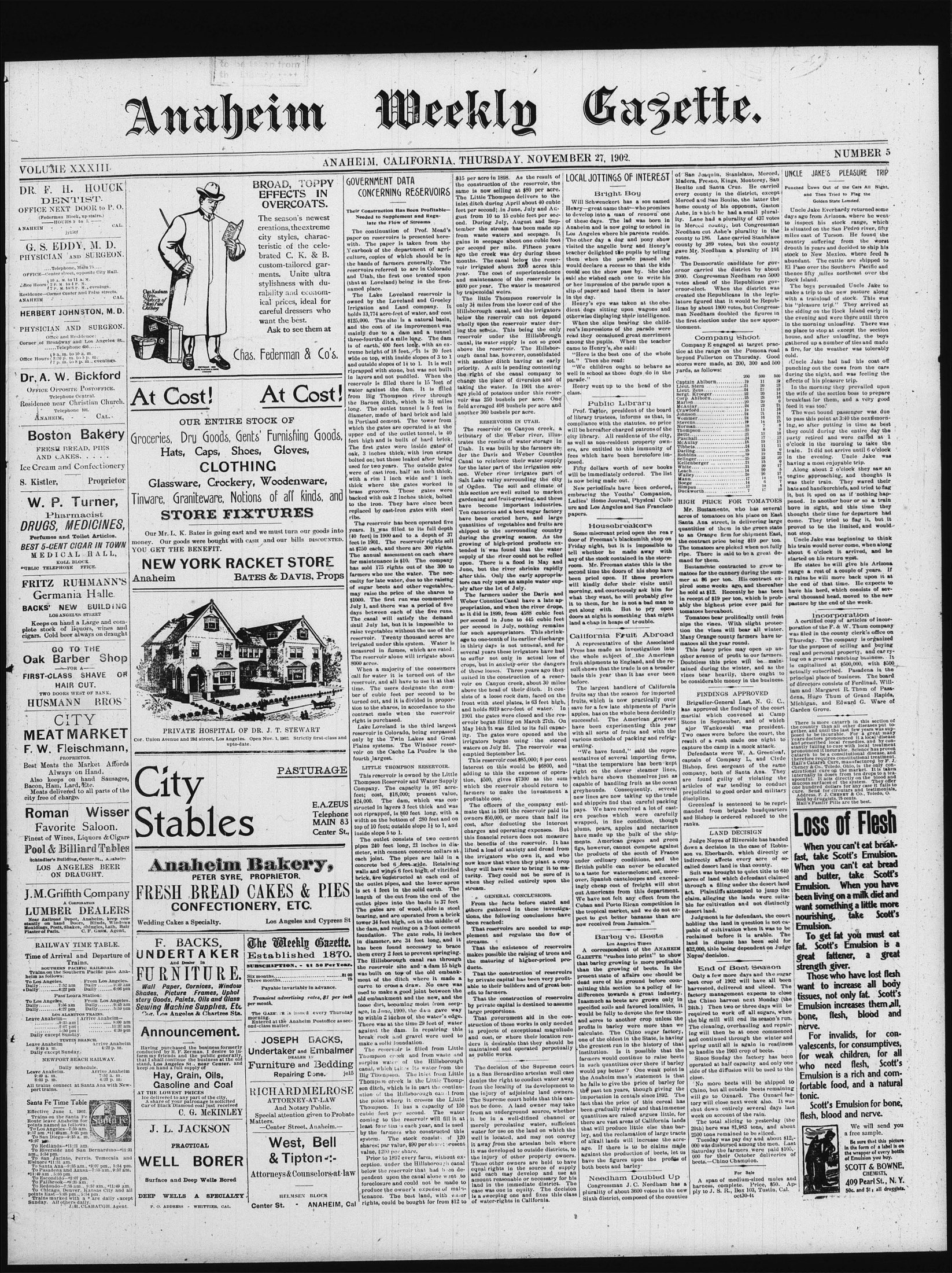
Searchable text
Anaheim
VOLUME XXXIII.
DR. F. H. HOUCK
DENTIST.
OFFICE NEXT DOOR to P. O.
(Federman Block, up stairs.)
HOURS 9 to 5
ANAHEIM CAL.
jy15tf
G. S. EDDY, M. D.
PHYSICIAN AND SURGEON.
Telephone, Main 75...
OFFICE—Center street, opposite City Hall.
10 A.M. to 11 A.M.
Office Hours 2 P.M. to 4 P.M.
7 P.M. to 8 P.M., evenings.
Residence—Corner Center and Palm streets.
ANAHEIM CAL.
HERBERT JOHNSTON, M. D.
PHYSICIAN AND SURGEON.
Office and Residence:
Corner of Broadway and Los Angeles St..
Telephone 656....
9 a.m. to 10 a.m.
Office Hours 3:30 p.m. to 5 p.m.
7 p.m. to 8 p.m., evenings.
Dr. A. W. Bickford
OFFICE OPPOSITE POSTOFFICE.
Telephone Central.
Residence near Christian Church.
Telephone 101.
ANAHEIM, CAL.
Boston Bakery
FRESH BREAD, PIES
AND CAKES.
Ice Cream and Confectionery
BROAD, TOPPY
EFFECTS IN
OVERCOATS.
The season's newest creations, the extreme city styles, characteristic of the celebrated C. K. & B. custom-tailored garments. Unite ultra stylishness with durability and economical prices, ideal for careful dressers who want the best.
Ask to see them at
Chas. Federman & Co's.
At Cost! At Cost!
OUR ENTIRE STOCK OF
Groceries, Dry Goods, Gents' Furnishing Goods,
Hats, Caps, Shoes, Gloves,
CLOTHING
Dr. A. W. Bickford
OFFICE OPPOSITE POSTOFFICE.
Telephone Central.
Residence near Christian Church.
Telephone 101.
ANAHEIM, CAL.
Boston Bakery
FRESH BREAD, PIES AND CAKES.
Ice Cream and Confectionery
S. Kistler, Proprietor
W. P. Turner,
Pharmacist
DRUGS, MEDICINES,
Perfumes and Toilet Articles.
BEST 5-CENT CIGAR IN TOWN MEDICAL HALL,
KOLL BLOCK.
PUBLIC TELEPHONE FFICE.
FRITZ RUHMANN'S
Germania Halle.
BACKS' NEW BUILDING
LOS ANGELES STREET
Keeps on hand a Large and complete stock of liquors, wines and cigars. Cold beer always on draught
GO TO THE Oak Barber Shop
FOR A FIRST-CLASS SHAVE OR HAIR CUT.
TWO DOORS WEST OF BANK.
HUSMANN BROS
CITY MEAT MARKET
F. W. Fleischmann,
PROPRIETOR.
Best Meats the Market Affords Always on Hand.
Also keeps on hand Sausages, Bacon, Ham, Lard, Etc.
Meats delivered to all parts of the city free of charge.
Roman Wisser
Favorite Saloon.
Finest of Wines, Liquors & Cigare Pool & Billiard Tables
Schindler's Building, Center St., Anaheim
LOS ANGELES BEER ON DRAUGHT.
J.M.Griffith Company
At Cost! At Cost!
OUR ENTIRE STOCK OF Groceries, Dry Goods, Gents' Furnishing Goods, Hats, Caps, Shoes, Gloves,
CLOTHING
Glassware, Crockery, Woodenware,
Tinware, Graniteware, Notions of all kinds, and STORE FIXTURES
Our Mr. L. K. Bates is going east and we must turn our goods into money. Our goods were bought with cash and our bills DISCOUNTED. YOU GET THE BENEFIT.
NEW YORK RACKET STORE
Anaheim BATES & DAVIS, Props
PRIVATE HOSPITAL OF DR. J. T. STEWART
Cor. Union Avenue and 23d street, Los Angeles. Open Nov. 1, 1902. Strictly first-class and upto-date.
PASTURAGE
E.A.ZEUS
Telephone
MAIN 83
Center St,
Anaheim Bakery,
PETER SYRE, PROPRIETOR.
FRESH BREAD CAKES & PIES
Roman Wisser
Favorite Saloon.
Finest of Wines, Liquors & Cigars
Pool & Billiard Tables
Schindler's Building, Center St., Anaheim
LOS ANGELES BEER ON DRAUGHT.
J.M.Griffith Company
A CORPORATION
LUMBER DEALERS
Near Railroad Depot, Anaheim, keep constantly on hand doors, Blinds, Windows Mouldings, Posts, Shakes, Shingles, Lath, Hair Plaster of Paris.
C. F. GRIM. Agent.
RAILWAY TIME TABLE.
Time of Arrival and Departure of Trains.
SOUTHERN PACIFIC RAILROAD.
Trains on the Southern Pacific pass Anaheim as follows:
To Los Angeles.
Daily... 7:52 am Daily... 9:49 am
Daily... 4:22 pm Daily... 6:06 pm
Pass Loara Station:
To Los Angeles.
Daily... 7:56 am Daily... 9:45 am
Daily... 4:27 pm Daily... 5:59 pm
LOS ALAMITOS TRAINS.
Leave Anaheim...
Arrive Anaheim...
9:35 am ... 8:00 am
2:07 pm ... 11:37 am
5:50 pm ... 4:30 pm
Daily except Sunday.
TUSTIN BRANCH.
Leave Anaheim Arrive Anaheim
9:49 a.m. 4:22 p.m.
Daily except Sunday.
NEWPORT BEACH RAILWAY.
Daily Schedule.
Leave Anaheim Arrive Anaheim
9:49 a.m. 7:52 a.m.
6:03 p.m. 4:23 p.m.
All trains connect at Santa Ana with Newport trains.
Santa Fe Time Table
Effective June 1, 1902.
Trains on the Santa Fe Route leave Anaheim for points named as follows:
To Los Angeles - 7:55 am
9:57 am *11:49am- 5:06 pm
To San Diego - 9:35 a.m.
*3:07 pm
To Redlands - *11:31 am.
To Riverside and San Bernardino - *11:31 am- 5:54 pm.
To San Jacinto, Perris, Temecula and Elsinore - *11:31 am.
To Santa Ana - 9:35 am- *3:07 pm- 5:54 pm.
To Pasadena and Azusa - 7:55 am- 9:57 am-
*11:49 am- 5:05 pm.
To Escondido - *9:07 pm.
To Railbrook - *9:05 am.
To Redondo - 7:58 am- 9:57 am- *11:49 am.
To Chicago, Denver, Kansas City and all points East - 5:08 pm- 5:54 pm.
Trains marked with a * are daily except Sunday. All others daily.
J.H. CLABAUGH. Agent.
Stables
Anaheim Bakery,
PETER SYRE, PROPRIETOR.
FRESH BREAD CAKES & PIES CONFECTIONERY, ETC.
Wedding Cakes a Specialty. Los Angeles and Cypress St
F. BACKS,
UNDERTAKER
And Dealer in
FURNITURE.
Wall Paper, Cornices, Window Shades, Picture Frames, Upholstery Goods, Paints, Oils and Glass Sewing Machine Supplies, Etc.
Cor. Los Angeles & Chartres Sts.
Announcement.
Having purchased the business formerly conducted by R.F. Zerman, I desire to inform my friends and the public generally that I shall continue the business at the old stand, Los Angeles St., near Center, and keep on hand a full supply of Hay, Grain, Oils, Gasoline and Coal
AT THE LOWEST PRICES
Ice delivered to any part of the city.
A share of your patronage is solicited Car of Black Diamond coal just received
C. G. McKINLEY
J. L. JACKSON
PRACTICAL
WELL BORER
Surface and Deep Wells Bored
DEEP WELLS A SPECIALTY
P.O. ADDRESS - WHITTIER, CAL.
The Weekly Gazette,
Established 1870.
SUBSCRIPTION,- $1.50 Per Year.
Six months... $1.00
Three months... 75
Payable invariably in advance.
Transient advertising rates, $1 per inch per month.
The GAZEVE is issued every Thursday morning.
Entered at the Anaheim Postoffice as second-class matter.
JOSEPH BACKS,
Undertaker and Embalmer
DEALER IN
Furniture and Bedding
Repairing Done. jel5
RICHARD MELROSE
ATTORNEY-AT-LAW
And Notary Public.
Special attention given to Probate Matters.
—Center Street, Anaheim—
West, Bell &
Tipton--
Attorneys&Counselors-at-law
HELMSEN BLOCK
Center St. - ANAHEIM, Cal
Weekly Gazette
ANAHEIM, CALIFORNIA, THURSDAY. NOVEMBER 27, 1902.
GOVERNMENT DATA CONCERNING RESERVOIRS
Their Construction Has Been Profitable—Needed to Supplement and Regulate the Flow of Streams
The continuation of Prof. Mead's paper on reservoirs is presented here with. The paper is taken from the Yearbook of the department of agriculture, copies of which should be in the hands of farmers generally. The reservoirs referred to are in Colorado and Utah, the first one treated upon (that at Loveland) being in the first-named place.
The Lake Loveland reservoir is owned by the Loveland and Greeley Irrigation and Land company. It holds 13,774 acre-feet of water, and cost $125,000. The site is a natural basin, and the cost of its improvement was mainly due to a dam and a tunnel three-fourths of a mile long. The dam is of earth, 400 feet long, with an extreme height of 18 feet. It is 20 feet wide on top, with inside slopes of 3 to 1 and outside slopes of 1¼ to 1. It is well riprapped with stone, but was not built in layers and not puddled. When the reservoir is filled there is 15 feet of water against the dam. It is filled from Big Thompson river through the Barnes ditch, which is 3¼ miles long. The outlet tunnel is 5 feet in diameter, made of hard brick and laid in Portland cement. The tower from which the gates are operated is at the upper end of the outlet tunnel, is 40 feet high and is built of hard brick. The first gates were inside gates of oak, 3 inches thick, with iron straps bolted on; but these leaked after being used for two years. The outside gates were of cast iron, half an inch thick,
$15 per acre in 1898. As the result of the construction of the reservoir, the same is now selling at $80 per acre. The Little Thompson delivers to the inlet ditch during April about 40 cubic feet per second; in June, July and August from 10 to 15 cubic feet per second. During July, August and September the stream has been made up from waste waters and seepage. It gains in seepage about one cubic foot per second per mile. Fifteen years ago the creek was dry during these months. The canal below the reservoir irrigated about 2000 acres this year. The cost of superintendence and maintenance of the reservoir is $600 per year. The water is measured by trapezoidal weirs.
The little Thompson reservoir is only 3¼ miles from the lower end of the Hillsborough canal, and the irrigators below the reservoir can not depend wholly upon the reservoir water during the season. This being the only reservoir under the Hillsborough canal, its water supply is not so good above the reservoir. The Hillsborough canal has, however, consolidated with another ditch having an early priority. A suit is pending contesting the right of the canal company to change the place of diversion and of taking the water. In 1901 the average yield of potatoes under this reservoir was 250 bushels per acre. One field averaged 408 bushels per acre and another 360 bushels per acre.
RESERVOIRS IN UTAH.
The reservoir on Canyon creek, a tributary of the Weber river, illustrates the results of water storage in Utah. It was built by the farmers under the Davis and Weber Counties Canal to reinforce their water supply for the later part of the irrigation season. Weber river irrigates part of
LOCAL JOTTINGS OF INTEREST
Bright Boy
Will Schwenckert has a son named Henry—great name that—who promises to develop into a man of renown one of these days. The lad was born in Anaheim and is now going to school in Los Angeles where his parents reside. The other day a dog and pony show visited the angelic burg and Henry's teacher delighted the pupils by telling them when the parade passed she would declare a recess so that the kids could see the show pass by. She also said she wished each one to write his or her impression of the parade upon a slip of paper and hand them in later in the day.
Henry's eye was taken at the obedient dogs sitting upon wagons and otherwise displaying their intelligence.
When the slips bearing the children's impressions of the parade were read they occasioned great merriment among the pupils. When the teacher came to Henry's, she said:
"Here is the best one of the whole lot." Then she read:
"We children ought to behave as well in school as those dogs do in the parade."
Henry went up to the head of the class.
Public Library
Prof. Taylor, president of the board of library trustees, informs us that, in compliance with the statutes, no price will be hereafter charged patrons of the city library. All residents of the city, as well as non-resident property owners, are entitled to this immunity of fees which have been heretofore imposed.
Fifty dollars worth of new books will be immediately ordered. The list
in layers and not puddled. When the reservoir is filled there is 15 feet of water against the dam. It is filled from Big Thompson river through the Barnes ditch, which is 3½ miles long. The outlet tunnel is 5 feet in diameter, made of hard brick and laid in Portland cement. The tower from which the gates are operated is at the upper end of the outlet tunnel, is 40 feet high and is built of hard brick. The first gates were inside gates of oak, 3 inches thick, with iron straps bolted on; but these leaked after being used for two years. The outside gates were of cast iron, half an inch thick, with a rim 1 inch wide and 1 inch thick where the gates worked in brass grooves. These gates were backed with oak 2 inches thick, bolted to the iron. They have since been replaced by cast-iron gates with steel ribs.
The reservoir has been operated five years. It was filled to its full depth 40 feet in 1900 and to a depth of 37 feet in 1901. The reservoir rights sell at $750 each, and there are 300 rights. The annual assessment on each share for maintenance is $10. The company has sold 175 rights out of the 300 to farmers who use the water. The necessity for late water, due to the raising of sugar beets and other vegetables, may raise the price of the shares to $1000. The first run was commenced July 1, and there was a period of five days between each of the five runs. The canal will satisfy the demand until July 1st, but it is impossible to raise vegetables without the use of the reservoir. Twenty thousand acres are irrigated under this system. Water is measured in flumes, which are rated. The reservoir alone will irrigate about 8000 acres.
When a majority of the consumers call for water it is turned out of the reservoir, and all have to use it at that time. The users designate the number of cubic feet per second to be turned out, and it is divided in proportion to the shares, in accordance to the contract made when the reservoir right is purchased.
Lake Loveland is the third largest reservoir in Colorado, being surpassed only by the Twin Lakes and Great Plains systems. The Windsor reservoir on the Cache La Poudre is the fourth largest.
LITTLE THOMPSON RESERVOIR.
This reservoir is owned by the Little Thompson Reservoir and Water Supply Company. The capacity is 987 acre-feet; cost, $18,000; present value, $24,000. The dam, which was constructed in layers 3 feet thick and was not riprappied, is 860 feet long, with a width on the bottom of 280 feet and on top of 10 feet; outside slope 1½ to 1, and inside slope 5 to 1.
The outlet consists of two cement pipes 240 feet long, 21 inches in diameter, with cement concrete collars at each joint. The pipes are laid in a concrete bed 6 feet wide. Retaining walls and wings 6 feet high, of vitrified brick, are constructed at each end of the outlet pipes, and the lower apron is set 4 feet in the solid earth. The length of the cut from the end of the layers and not puddled. When the reservoir is filled there is 15 feet of water against the dam. It is filled from Big Thompson river through the Barnes ditch, which is 3½ miles long. The outlet tunnel is 5 feet in diameter, made of hard brick and laid in Portland cement. The tower from which the gates are operated is at the upper end of the outlet tunnel, is 40 feet high and is built of hard brick. The first gates were inside gates of oak, 3 inches thick, with iron straps bolted on; but these leaked after being used for two years. The outside gates were of cast iron, half an inch thick, with a rim 1 inch wide and 1 inch thick where the gates worked in brass grooves. These gates were backed with oak 2 inches thick, bolted to the iron. They have since been replaced by cast-iron gates with steel ribs.
The reservoir has been operated five years. It was filled to its full depth 40 feet in 1900 and to a depth of 37 feet in 1901. The reservoir rights sell at $750 each, and there are 300 rights. The annual assessment on each share for maintenance is $10. The company has sold 175 rights out of the 300 to farmers who use the water. The necessity for late water, due to the raising of sugar beets and other vegetables, may raise the price of the shares to $1000. The first run was commenced July 1, and there was a period of five days between each of the five runs. The canal will satisfy the demand until July 1st, but it is impossible to raise vegetables without the use of the reservoir. Twenty thousand acres are irrigated under this system. Water is measured in flumes, which are rated. The reservoir alone will irrigate about 8000 acres.
When a majority of the consumers call for water it is turned out of the reservoir, and all have to use it at that time. The users designate the number of cubic feet per second to be turned out, and it is divided in proportion to the shares, in accordance to the contract made when the reservoir right is purchased.
Lake Loveland is the third largest reservoir in Colorado, being surpassed only by the Twin Lakes and Great Plains systems. The Windsor reservoir on the Cache La Poudre is the fourth largest.
LITTLE THOMPSON RESERVOIR.
This reservoir is owned by the Little Thompson Reservoir and Water Supply Company. The capacity is 987 acre-feet; cost, $18,000; present value, $24,000. The dam, which was constructed in layers 3 feet thick and was not riprappied, is 860 feet long, with a width on the bottom of 280 feet and on top of 10 feet; outside slope 1½ to 1, and inside slope 5 to 1.
The outlet consists of two cement pipes 240 feet long, 21 inches in diameter, with cement concrete collars at each joint. The pipes are laid in a concrete bed 6 feet wide. Retaining walls and wings 6 feet high, of vitrified brick, are constructed at each end of the outlet pipes, and the lower apron is set 4 feet in the solid earth. The length of the cut from the end of the layers and not puddled. When the reservoir is filled there is 15 feet of water against the dam. It is filled from Big Thompson river through the Barnes ditch, which is 3½ miles long. The outlet tunnel is 5 feet in diameter, made of hard brick and laid in Portland cement. The tower from which the gates are operated is at the upper end of the outlet tunnel, is 40 feet high and is built of hard brick. The first gates were inside gates of oak, 3 inches thick, with iron straps bolted on; but these leaked after being used for two years. The outside gates were of cast iron, half an inch thick, with a rim 1 inch wide and 1 inch thick where the gates worked in brass grooves. These gates were backed with oak 2 inches thick, bolted to the iron. They have since been replaced by cast-iron gates with steel ribs.
The reservoir has been operated five years. It was filled to its full depth 40 feet in 1900 and to a depth of 37 feet in 1901. The reservoir rights sell at $750 each, and there are 300 rights. The annual assessment on each share for maintenance is $10. The company has sold 175 rights out of the 300 to farmers who use the water. The necessity for late water, due to the raising of sugar beets and other vegetables, may raise the price of the shares to $1000. The first run was commenced July 1, and there was a period of five days between each of the five runs. The canal will satisfy the demand until July 1st, but it is impossible to raise vegetables without the use of the reservoir. Twenty thousand acres are irrigated under this system. Water is measured in flumes, which are rated. The reservoir alone will irrigate about 8000 acres.
When a majority of the consumers call for water it is turned out of the reservoir, and all have to use it at that time. The users designate the number of cubic feet per second to be turned out, and it is divided in proportion to the shares, in accordance to the contract made when the reservoir right is purchased.
Lake Loveland is the third largest reservoir in Colorado, being surpassed only by the Twin Lakes and Great Plains systems. The Windsor reservoir on the Cache La Poudre is the fourth largest.
LITTLE THOMPSON RESERVOIR.
This reservoir is owned by the Little Thompson Reservoir and Water Supply Company. The capacity is 987 acre-feet; cost, $18,000; present value, $24,000. The dam, which was constructed in layers 3 feet thick and was not riprappied, is 860 feet long, with a width on the bottom of 280 feet and on top of 10 feet; outside slope 1½ to 1, and inside slope 5 to 1.
The outlet consists of two cement pipes 240 feet long, 21 inches in diameter, with cement concrete collars at each joint. The pipes are laid in a concrete bed 6 feet wide. Retaining walls and wings 6 feet high, of vitrified brick, are constructed at each end of the outlet pipes, and the lower apron is set 4 feet in the solid earth. The length of the cut from the end of the layers and not puddled. When the reservoir is filled there is 15 feet of water against the dam. It is filled from Big Thompson river through the Barnes ditch, which is 3½ miles long. The outlet tunnel is 5 feet in diameter, made of hard brick and laid in Portland cement. The tower from which the gates are operated is at the upper end of the outlet tunnel, is 40 feet high and is built of hard brick. The first gates were inside gates of oak, 3 inches thick, with iron straps bolted on; but these leaked after being used for two years. The outside gates were of cast iron, half an inch thick, with a rim 1 inch wide and 1 inch thick where the gates worked in brass grooves. These gates were backed with oak 2 inches thick, bolted to the iron. They have since been replaced by cast-iron gates with steel ribs.
The reservoir has been operated five years. It was filled to its full depth 40 feet in 1900 and to a depth of 37.feet in 1901.The reservoir rights sell at $750 each,and there are three rights extended it was found thatthe water supplyofthe river could not be relied uponThereis a floodin MayandJune,bbuttheriver shrinks rapidlyafterthisOnlytheearlyappropriatorscan relyuponanamplewatersupplyafterthelstofJuly.
The farmers underthe DavisandWeberCountiesCanalhavealateappropriation,andwhentheriverdropsasit didin1899,从4588cubicfeetpersecondinJuneto445cubicfeetpersecondinJuly,nothingremainforsuchappropriatorsThis shrinkagetoone-tenthofits earlierdischargeinthirtydaysisnotunusual,andforseveralyearstheirrigatorshavehadto suffernotonlyinactuallossof crops,但in anxiety-overthe dangersoftheselossesThreeyearsagothey unitedintheconstructionofareservoironCanyoncreekabout30milesabovetheheadof theirditchItconsistsofalooserockdam,facedonthefrontwithsteelplates,is63feethigh,andholds8919acre-feetofwater.In1901thegateswereclosedandthereservoirbeganfillingonMarch27th.OnMay14thitwasfilledtoitsfullcapacity.Thegateswereopenedandtheirrigators beganusingthe storedwatersonJuly2d.ThereservoirwasemptiedSeptemberlst.
This reservoir cost$85,000;8percentinterestonthiswouldbe$6800,andaddingtothistheexpenseofoperation,$500,gives$7300assumwhichthereservoirshouldreturntofarmerstomaketheinvestmentaprofitableone.
The officersofthecompanyestimatethatin1901thereservoirpaiditsowners$50,000,或morethanhalfitscost,afterdeductingtheinterestchargesandoperatingexpensesButthisfinancialreturndoesnotmeasurethebenefitsofthereservoirIthas liftedaloadofanxietyanddreadfromtheirrigatorswhoownit,andnowknowthatwhen theyplanta croptheywillhavewaterbringittomaturityTheycouldnotbesureofitwhentheyreliedentirelyupothestream.
GENERAL CONCLUSIONS.
Prof.Taylor,presidentoftheboardoflibrarytrustees.informususthat.incompliancewiththestatutes.nopricewillbehereafterchargedpatronsofthecitylibrary.Allresidentsofthecityaswellasnon-residentpropertyownersare entitledtothisimmunityoffeedswhichhavebeenheretoforeimposed.
Fifty dollars worthofnewbookswill immediatelyordered.ArepresentativeoftheAssociatedPresshasmadean investigationinthewholesubjectoftheAmericanfruitshipmentstoEngland,andthereresultshowsthatthe tradeisonabroadbasisthisyear thanithaseverbeenbefore.
The largest handlersofCaliforniafruitssaythattheseasonforimportefruitswhichisnowpracticallyoversavefora few late shipmentsOfPari apples,hasonwholebeenedecidedsuccessful.TheAmericangrowerhavebeenexperimentingthisyearwithallsortsf fruitsandwiththevariousmethodsofpackingandrefrigerating."
"Wehavefound,"saidrepresentativesofseveralimporting firms"thatthe temperaturehasbeenkeptrightonthe slowersteamlinewhichisnowpracticallyoversavefora few late shipmentsOfPari apples,hasonwholebeenedecidedsuccessful.TheAmericangrowerhavebeenexperimentingthisyearwithallsortsf fruitsandwiththevariousmethodsofpackingandrefrigerating."
"Wehave felt any effect from themellowAmericansfromthisdepartmentwehavenot felt any effect from themellowAmericansfromthisdepartmentwehavenot felt any effect from themellowAmericansfromthisdepartmentwehavenot felt any effect from themellowAmericansfromthisdepartmentwehavenot felt any effect from themellowAmericansfromthisdepartmentwehavenot felt any effect from themellowAmericansfromthisdepartmentwehavenot felt any effect from themellowAmericansfromthisdepartmentwehavenot felt any effect from themellowAmericansfromthisdepartmentwehavenot felt any effect from themellowAmericansfromthisdepartmentwehavenot felt any effect from themellowAmericansfromthisdepartmentwehavenot felt any effect from themellowAmericansfromthisdepartmentwehavenot felt any effect from themellowAmericansfromthisdepartmentwehavenot felt any effect from themellowAmericansfromthisdepartmentwehavenot felt any effect from themellowAmericansfromthisdepartmentwehavenot felt any effect from themellowAmericansfromthisdepartmentwehavenot felt any effect from themellowAmericansfromthisdepartmentwehavenot felt any effect from themellowAmericansfromthisdepartmentwehavenot felt any effect from themellowAmericansfromthisdepartmentwehavenot felt any effect from themellowAmericansfromthisdepartmentwehavenot felt any effect from themellowAmericansfromthisdepartmentwehavenot felt any effect from themellowAmericansfromthisdepartmentwehavenot felt any effect from themellowAmericansfromthisdepartmentwehavenot felt any effect from themellowAmericansfromthisdepartmentwehavenot felt any effect from themellowAmericansfromthisdepartmentwehavenot felt any effect from themellowAmericansfromthisdepartmentwehavenot felt any effect from themellowAmericansfromthisdepartmentwehavenot felt any effect from themellowAmericansfromthisdepartmentwe have not felt any effect from themellowAmericansfromthisdepartmentwe have not felt any effect from themellowAmericansfromthisdepartmentwe have not felt any effect from themellowAmericansfromthisdepartmentwe have not felt any effect from themellowAmericansfromthis department we have not felt any effect from themellowAmericansfrom this department we have not felt any effect from themellowAmericansfrom this department we have not felt any effect from themellowAmericansfrom this department we have not felt any effect from themellowAmericansfrom this department we have not felt any effect from themellowAmericiansfrom this department we have not felt any effect from themellowAmericiansfrom this department we have not felt any effect from themellowAmericiansfrom this department we have not felt any effect from themellowAmericiansfrom this department we have not felt any effect from themellowAmericiansfrom this department we have not felt any effect from themellowAmericiansfrom this department we have not felt any effect from themellowAmericiansfrom this department we have not felt any effect from themellowAmericiansfrom this department we have not felt any effect from themellowAmericiansfrom this department we have not felt any effect from themellowAmericiansfrom this department we have not felt any effect from themellowAmericiansfrom this department we have not felt any effect from themellowAmericiansfrom this department we have not felt any effect from themellowAmericiansfrom this department we have not felt any effect from themellowAmericiansfrom this department we have not felt any effect from themellowAmericiansfrom this department we have not felt any effect from themellowAmericiansfrom this department we have not felt any effect from themellowAmericiansfrom this department we have not feel any effect from themellowAmericiansfrom this department we have not feel any effect from themellowAmericiansfrom this department we have not feel any effect从thenellowsaffectingyourselfwithoutbeinginterruptedbyothereventswithoutbeinginterruptedbyothereventswithoutbeinginterruptedbyothereventswithoutbeinginterruptedbyothereventswithoutbeinginterruptedbyothereventswithoutbeinginterruptedbyothereventswithoutbeinginterruptedbyothereventswithoutbeinginterruptedbyothereventswithoutbeinginterruptedbyothereventswithoutbeinginterruptedbyothereventswithoutbeinginterruptedbyothereventswithoutbeinginterruptedbyothereventswithoutbeinginterruptedbyothereventswithoutbeinginterruptedbyothereventswithoutbeinginterruptedbyothereventswithoutbeinginterruptedbyothereventswithoutbeinginterruptedbyothereventswithoutbeinginterruptedbyothereventswithoutbeinginterruptedbyothereventswithoutbeinginterruptedbyothereventswithoutbeinginterruptedbyothereventswithoutbeinginterruptedbyothereventswithoutbeinginterruptedbyothereventswithoutbeinginterruptedbyothereventswithoutbeinginterruptedbyothereventswithoutbeinginterruptedbyother eventswithoutbeinginterruptedbyother eventswithoutbeinginterruptedbyother eventswithoutbeinginterruptedbyother eventswithoutbeinginterruptedbyother eventswithoutbeinginterruptedbyother eventswithoutbeinginterruptedby其他事件与其他事件与其他事件与其他事件与其他事件与其他事件与其他事件与其他事件与其他事件与其他事件与其他事件与其他事件与其他事件与其他事件与其他事件与其他事件与其他事件与其他事件与其他事件与其他事件与其他事件与其他事件与其他事件与其他事件与其他事件与其他事件与其他事件与其他事件与其他事件与其他事件与其他事件与其他事件与其他事件与其他事件与其他事件与其他事件与其他事件与其他事及其他事及其他事及其他事及其他事及其他事及其他事及其他事及其他事及其他事及其他事及其他事及其他事及其他事及其他事及其他事及其他事及其他事及其他事及其他事及其他事及其他事及其他事及其他事及其他事及其他事及其他事及其他事及其他事及其他事及其他事及其他事及其他事及其他事及其他事及其他事及其他事及其他事及其他事及其他事及其他事及其他事及其他事及其他事及其他事及其他事及其他事及其他事及其他事及其他事及其他事及其他事及其他事及其他事及其他事及其他事及其他事及其他事及其他事及其他事或者其他事或者其他事或者其他事或者其他事或者其他事或者其他事或者其他事或者其他事或者其他事或者其他事或者其他事或者其他事或者其他事或者其他事或者其他事或者其他事或者其他事或者其他事或者其他事或者其他事或者其他事或者其他事或者其他事或者其他事或者其他事或者其他事或者其他事或者其他事或者其他事或者其他事或者其他事或者其他事或者其他事或者其他事或者其他事或者其他事或者其他事或者其他事业和其他事业和其他事业和其他事业和其他事业和其他事业和其他事业和其他事业和其他事业和其他事业和其他事业和其他事业和其他事业和其他事业和其他事业和其他事业和其他事业和其他事业和其他事业和其他事业和其他事业和其他事业和其他事业和其他事业和其他事业和其他事业和其他事业和其他事业和其他事业和其他事业和其他事业和其他事业和其他事业和其他事业和其他事业和其他事业和其他事业和其他事业和其他事业和其他事业和其他事业和其他事业和其他事业和其他事业和其他事业和其他事业和其他事业和其他事业和其他事业和其他事业的其他事务以及其他事务以及其他事务以及其他事务以及其他事务以及其他事务以及其他事务以及其他事务以及其他事务以及其他事务以及其他事务以及其他事务以及其他事务以及其他事务以及其他事务以及其他事务以及其他事务以及其他事务以及其他事务以及其他事务以及其他事务以及其他事务以及其他事务以及其他事务以及其他事务以及其他事务以及其他事务以及其他事务以及其他事务以及其他事务以及其他事务以及其他事务以及其他事务以及其他事务以及其他事务以及其他事务等等?"
These sentences are very complex and require careful reading comprehension to ensure they accurately reflect what was written or said during transcription.
They also need attention to punctuation (periods), capitalization (uppercase letters), word order (nouns followed by verbs), grammar (grammar rules), punctuation (commas), agreement (spelling), sentence structure (sentence formation), cohesion (cohesive words), flowability (flowering paragraphs), logicality (logical reasoning), coherence (coherence), clarity (clarity), brevity (brevity), conciseness (concision), accuracy (accuracy), precision (precision), correctness (correctness), completeness (completeness), consistency (consistency), unity (unity), diversity (diversity), variety (variety), uniqueness (unique), originality (originality), novelty (novelty), creativity (creativity), imagination (imagination), inspiration (inspiration), empathy (empathy), love (love), joy (joy), sadness (sadness), happiness (happiness), pleasure (pleasure), gratitude (gratitude), thankfulness (thankfulness), respect (respect), admiration (admiration), appreciation (appreciation), honor (honor), glory (glory),
grace (grace),
kindness (kindness),
compassion (compassion),
love (love),
peace (peace),
friendship (friendship),
helpfulness (helpfulness),
carefulness (carefulness),
welfare (welfare),
security (security),
protection (protection),
security保障(security保障),
security保障(security保障),
security保障(security保障),
security保障(security保障),
security保障(security保障),
security保障(security保障),
security保障(security保障),
security保障(security保障),
security保障(security保障),
security保障(security保障),
security保障(security保障),
security保障(security保障),
security保障(security保障),
security保障(security保障),
security保障(security保障),
security保障(security保障),
security保障(security保障),
security保障(security保障),
security保障(security保障),
security保障(security保障),
security保障(security保障),
security保障( security保障),
Security保障(Security保障),
Security保障(Security保障),
Security保障(Security保障),
Security保障(Security保障),
Security保障(Security保障),
Security保障(Security保障),
Security保障(Security保障),
Security保障(Security保障),
Security保障(Security保障),
Security保障(Security保障),
Security保障(Security保障),
Security保障(Security保障),
Security保障(Security保障),
Security保障(Security保障),
Security保障(Security保障),
Security保障(Security保障),
Security保障(Security保障),
Security保障(Security保障),
Security保障(Security保障),
Security保障(Security保障),
Security保障( Security确保),
Security确保( Security确保),
Security确保( Security确保),
Security确保( Security确保),
Security确保( Security确保),
Security确保( Security确保),
Security确保( Security确保),
Security确保( Security确保),
Security确保( Security确保),
Security确保( Security确保),
Security确保( Security确保),
Security确保( Security确保),
Security确保( Security确保),
Security确保( Security确保),
Security确保( Security确保),
Security确保( Security确保),
Security确保( Security确保),
Security确保( Security确保),
Security确保( Security确保),
Security确保( Security确保),
Security确保( Security确保),
Security确保( Security确保),
Security确保( Security确保),
Security确保( Security确保),
Security确保( Security确保),
Security确保( Security确保),
Security确保( Security确保),
Security确保( Security确保),
Security确保( Security确保),
Security确保( Security确保),
Security确保( Security确保),
Security确保( Security确保)
,
These sentences are very complex and require careful reading comprehension to ensure they accurately reflect what was written or said during transcription.
They also need attention to punctuation (periods), capitalization (uppercase letters), word order (nouns followed by verbs), phrase order (phrase order), sentence structure (sentence formation), cohesion (cohesion), emphasis (emphasis), focus (focus),
voice recognition (voice recognition),
text recognition (text recognition),
word recognition (word recognition),
phrase recognition (phrase recognition),
sentence recognition (sentence recognition),
paragraph recognition(paragraph recognition),
sentence structure(sentence structure),
cohesion(cohesion),
punctuation(punctuation),
sentence order(sentence order),
sentence alignment(sentence alignment),
sentence flow(sentence flow),
sentence repetition(sentence repetition),
sentence variation(sentence variation),
sentence range(sentence range),
sentence pattern(sentence pattern),
sentence style(sentence style),
sentence tone(sentence tone),
sentence level(sentence level),
sentence length(sentence length),
sentence width(sentence width),
sentence height(sentence height),
sentence margin(sentence margin),
sentence padding(sentence padding),
sentence spacing(sentence spacing),
sentence alignment(sentence alignment),
sentence flow(sentence flow),
sentence repetition(sentence repetition),
sentence variation(sentence variation),
sentence range(sent
The dam, which was constructed in layers 3 feet thick and was not riprapposed, is 860 feet long, with a width on the bottom of 280 feet and on top of 10 feet; outside slope 1½ to 1, and inside slope 5 to 1.
The outlet consists of two cement pipes 240 feet long, 21 inches in diameter, with cement concrete collars at each joint. The pipes are laid in a concrete bed 6 feet wide. Retaining walls and wings 6 feet high, of vitrified brick, are constructed at each end of the outlet pipes, and the lower apron is set 4 feet in the solid earth. The length of the cut from the end of the outlet pipes into the basin is 37 feet. The gates are of wood, slide in steel bearing, and are operated from a brick tower 34 feet high, set in the middle of the dam, and resting on a 2-foot cement foundation. The gate rods, 1¼ inches in diameter, are 34 feet long, and it has been found necessary to brace them every 2 feet to prevent springing. The Hillsborough canal ran through the reservoir site and a dam 15 high was built on top of the old embankment of the ditch where it made a curve to cross a draw. No care was used to make a good joint between the old embankment and the new, and the loose dirt, becoming moist from seepage, in June, 1900, the dam gave way to within 2 inches of the water's edge. There was at the time 29 feet of water against the dam. In repairing this break rock and gravel were used to make a solid foundation.
The reservoir is filled from Little Thompson creek and from waste and surplus water of the Hillsborough canal, which takes its water from the Big Thompson. The inlet from Little Thompson creek is the Little Thompson ditch, which is in part the continuation of the Hillsborough canal from the point where it crosses the Little Thompson. It has a capacity of 150 cubic feet per second. The water coming to the reservoir will fill it at least four times each year, and is used by the farmers who constructed this system. The stock consisted of 120 shares; par value, $90 per share; present value, $200 per share.
Prior to 1897 every farm, without exception, under the Hillsborough canal below the reservoir that had been dependent upon the canal alone went to foreclosure and could not be made to produce the owner's expense of maintenance. The best land, with water rights, could be bought for from $12 to $24,000. The officers of the company estimate that in 1901 the reservoir paid its owners $50,000, or more than half its cost, after deducting the interest charges and operating expenses. But this financial return does not measure the benefits of the reservoir. It has lifted a load of anxiety and dread from the irrigators who own it, and who now know that when they plant a crop they will have water to bring it to maturity. They could not be sure of it when they relied entirely upon the stream.
GENERAL CONCLUSIONS.
From the facts before stated and others gathered in these investigations, the following conclusions have been reached:
That reservoirs are needed to supplement and regulate the flow of streams.
That the existence of reservoirs makes possible the raising of trees and the maturing of higher-priced products.
That the construction of reservoirs by private capital has been very profitable to their builders and of great benefit to farmers.
That the construction of reservoirs by private capital is destined to assume large proportions.
That government aid in the construction of these works is only needed in projects of exceptional magnitude and cost, or where their location renders it desirable that they should be maintained and operated perpetually as public works.
The decision of the Supreme court in a San Bernardino artesian well case denies the right to conduct water away from the locality of its development to the injury of adjoining land owners. The Supreme court holds that this cannot be done. A land owner may take from an underground source, whether it be in a well-difined channel or merely percolating water, sufficient water for use on the land on which the well is located, and may not convey it away from the artesian belt where it was developed to outside districts, to the injury of other property owners. Those other owners are held to have equal rights in the source of supply and each may develop and use an amount reasonable or necessary for his land in the immediate district. The case was one in equity. The decision is a sweeping one and fixes this class of water-rights in California.
Barley vs. Beets
Los Angeles Times
A correspondent of the ANAHET GAZETTE "rushes into print" to show that barley growing is more profitable than the growing of beets. In present state of affairs one should dead sure of his ground before committing this section to a policy of difference towards a great industry. Inasmuch as beets are grown only specified soils and favored localities would be folly to devote the few thieves and acres to another crop unless profits in barley were more than calculate. The Chino sugar fact one of the oldest in the State is have the greatest run in the history of institution. Is it possible that farmers would continue to raise bales in such quantities over there if barley would pay better? One weak point the Anaheim man's statement is he fails to give the price of barley the past ten years, though giving importation in cents since 1892. Fact that the price of this cereal been gradually rising and that immature quantities are raised argues little there are vast areas of California lately that will produce little else than hay, and the reclamation of large tundra of alkali lands will increase the age. If there is to be claims against the production of beets, I have the figures upon the profit both beets and barley.
Needham Doubled Up
Congressman J.C. Needham has plurality of about 3600 votes in the Sixth district, composed of the countryside.
Gazette.
27, 1902.
TITTINGS OF INTEREST
Bright Boy
Wenckert has a son named that name—who promises to a man of renown one boy. The lad was born in and is now going to school in where his parents reside. Day a dog and pony show angelic burg and Henry's sighted the pupils by telling on the parade passed she were a recess so that the kids show pass by. She also helped each one to write his obsession of the parade upon a car and hand them in later eyes was taken at the obe-sitting upon wagons and displaying their intelligence. Slips bearing the child-sessions of the parade were occasioned great merriment pupils. When the teacher Henry's, she said: "the best one of the whole she read: children ought to behave as those dogs do in the event up to the head of the public library."
Prior, president of the board trustees, informs us that, in with the statutes, no price after charged patrons of the city. All residents of the city, non-resident property owned to this immunity of have been heretofore im-
of San Joaquin, Stanislaus, Merced, Madera, Fresno, Kings, Monterey, San Benito and Santa Cruz. He carried every county in the district, except Merced and San Benito, the latter the home county of his opponent, Gaston Ashe, in which he had a small plurality. Lane had a plurality of 437 votes in Merced county, but Congressman Needham cut Ashe's plurality in the county to 186. Lane carried Stanislaus county by 389 votes, but the county gave Mr. Needham a plurality of 191 votes.
The Democratic candidate for governor carried the district by about 2000. Congressman Needham ran 5000 votes ahead of the Republican governor-elect. When the district was created the Republicans in the legislature figured that it would be Republican by about 1800 votes, but Congressman Needham doubled the figures in the first election under the new apportionment.
Company Shoot
Company E engaged at target practice at the range on the Pomona road beyond Fullerton on Thursday. Good scores were made, at 200, 300 and 500 yards, as follows:
Captain Ahlborn...19 11 19
Lieut. Stern...21 20 23
Lieut. Zeus...24 22 13
Sergt. Kroeger...22 20 14
Corp. Ahlborn...25 28 16
Marlon...20 20 0
McAulay...24 23 21
Crawford...19 11 16
Johnson...24 21 14
Wommer...24 16 21
Stevens...19 14 15
Norman...18 7 8
Thompson...8 9
Betts...21 19 18
Paschall...24 17 22
McAulay...18 19 11
Tibbets...24 11 11
Darling...15 15 0
Robbins...19 12 22
Sellinger...25 23 20
Kellenberger...21 15 0
White...21 20 17
Leach...14 20 5
Walley...20 20 17
UNCLE JAKE'S PLEASURE TRIP
Punched Cows Out of the Cars All Night, and Then Tried to Flag the Golden State Limited.
Uncle Jake Everhardy returned some days ago from Arizona, where he went to inspect his stock range, which is situated on the San Pedro river, fifty miles east of Tucson. He found the country suffering from the worst drought in years and decided to ship his stock to New Mexico, where feed is abundant. The cattle are shipped to El Paso over the Southern Pacific and thence fifty miles northeast over the Rock Island.
The boys persuaded Uncle Jake to make a trip to the new pasture along with a trainload of stock. This was his "pleasure trip." They arrived at the siding on the Rock Island early in the evening and were there until three in the morning unloading. There was no place to stop at except the section house, and after unloading, the boys gathered up a number of ties and made a fire, for the weather was tolerably cold.
Uncle Jake had had his coat off punching out the cows from the cars during the night, and was feeling the effects of his pleasure trip.
In the morning they prevailed upon the wife of the section boss to prepare breakfast for them, and a very good feed it was too.
The west bound passenger was due to pass this point at 3:40 the next morning, so after putting in time as best they could during the entire day the party retired and were called at 1 o'clock in the morning to take the train. It did not arrive until 6 o'clock in the evening. Uncle Jake was having a most enjoyable trip.
Along about 2 o'clock they saw an interesting encounter and thought it
HIGH PRICE FOR TOMATOES
Mr. Bustamente, who has several acres of tomatoes on his place on East Santa Ana street, is delivering large quantities of them in the green state to an Orange firm for shipment East, the contract price being $19 per ton. The tomatoes are picked when not fully ripe. There is said to be a great demand for them.
Bustamente contracted to grow tomatoes for the cannery during the summer at $6 per ton. His contract expired some weeks ago, and thereafter he sold at $12. Recently he has been in receipt of $19 per ton, which is probably the highest price ever paid for tomatoes hereabout.
Tomatoes bear prolifically until frost nips the vines. With slight protection the vines will bear all winter. Many Orange county farmers have tomatoes all the year round.
This fancy price may open up another avenue of profit to our farmers. Doubtless this price will be maintained during the winter, and as the vines bear heavily, there ought to be considerable money in the business.
FINDINGS APPROVED
Brigadier-General Last, N. G. C., has approved the findings of the court martial which convened at Camp Stone in September, and of which major Wankowski was president. Two cases were before the court, the result of a rush made one night to capture the camp in a mock attack.
Defendants were W. A. Greenleaf, captain of Company L, and Clyde Bishop, first sergeant of the same company, both of Santa Ana. They are found guilty of violating the articles of war tending to conduct prejudicial to good order and military discipline.
Greenleaf is sentenced to be reprimanded from brigade headquarters and Bishop is ordered reduced to the ranks.
LAND DECISIGN
Judge Noyes of Riverside has handed down a decision in the case of Robinson vs. Eberhardt, which directly or indirectly affects every acre of so-called desert land in that county.
Suit was brought to quiet title to 640 acres of land which defendant claimed through a filing under the desert land act. Plaintiffs attempted to jump the claim, alleging the lands were suita-
Barley vs. Beets
Los Angeles Times
Correspondent of the ANAHEIM
Mere "rushes into print" to show barley growing is more profitable than growing of beets. In the state of affairs one should be sure of his ground before commencing this section to a policy of increase towards a great industry. Such as beets are grown only in soils and favored localities, it may folly to devote the few thousands to another crop unless the barley were more than we ate. The Chino sugar factory, the oldest in the State, is having greatest run in the history of that nation. Is it possible that the crops would continue to raise beets with quantities over there if barley pay better? One weak point in Anaheim man's statement is that he is to give the price of barley for last ten years, though giving the station in centals since 1892. The fact that the price of this cereal has gradually rising and that immense cities are raised argues little, for there are vast areas of California lands will produce little else than barley and the reclamation of large tracts of land will increase the acreage. If there is to be claims made just the production of beets, let us include the figures upon the profits of beets and barley.
Seedham Doubled Up
Aggressor J. C. Needham has a facility of about 3600 votes in the new district, composed of the counties
Land Decision
Judge Noyes of Riverside has handed down a decision in the case of Robinson vs. Eberhardt, which directly or indirectly affects every acre of so-called desert land in that county.
Suit was brought to quiet title to 640 acres of land which defendant claimed through a filing under the desert land act. Plaintiffs attempted to jump the claim, alleging the lands were suitable for cultivation and not distinctly desert land.
Judgment is for defendant, the court holding the land in question is not capable of cultivation when it was to be reclaimed before it is arable. The land in dispute has been sold for $32,000, title being dependent on Judge Noyes' decision.
End of Beet Season
Only a few more days and the sugar beet crop of 1902 will have all been harvested, delivered and sliced. The factory management expects to close the Chino harvest next Monday (the 24th.) Then two or three days will be required to work off all sugars, when the big mill will end its season's run. The cleaning, overhauling and repairing will then be at once commenced and continued through the winter and spring until all is again in readiness to handle the 1903 crop of beets.
Since Sunday the factory has been operated at half capacity and only one side of the diffusion will be used to the close.
No more beets will be shipped to Chino, but all outside beets remaining will go to Oxnard. The Oxnard factory will close next week also. It was shut down entirely several days last week on account of the rain.
The total slicing to yesterday (the 20th) here was 81,983 tons, and about 2500 tons remained to be sliced.
Tuesday was pay day and about $12,-000 was disbursed among the men. Last Saturday the farmers were paid $105,-000 for their October deliveries of beets.—Chino Champion.
For Sale
A span of medium-sized mules and harness, complete. Price, $50. Apply to J. S. R., Box 103, Tustin, Cal. oct30-4t
Loss of Flesh
When you can't eat breakfast, take Scott's Emulsion. When you can't eat bread and butter, take Scott's Emulsion. When you have been living on a milk diet and want something a little more nourishing, take Scott's Emulsion.
To get fat you must eat fat. Scott's Emulsion is a great fattener, a great strength giver.
Those who have lost flesh want to increase all body tissues, not only fat. Scott's Emulsion increases them all, bone, flesh, blood and nerve.
For invalids, for convalescents, for consumptives, for weak children, for all who need flesh, Scott's Emulsion is a rich and comfortable food, and a natural tonic.
Scott's Emulsion for bone, flesh, blood and nerve.
We will send you a free sample.
Be sure that this picture in the form of a label is on the wrapper of every bottle of Emulsion you buy.
SCOTT & BOWNE,
CHEMISTS,
409 Pearl St., N.Y.
50c. and $1; all druggists.