anaheim-gazette 1902-10-30
Scanned page
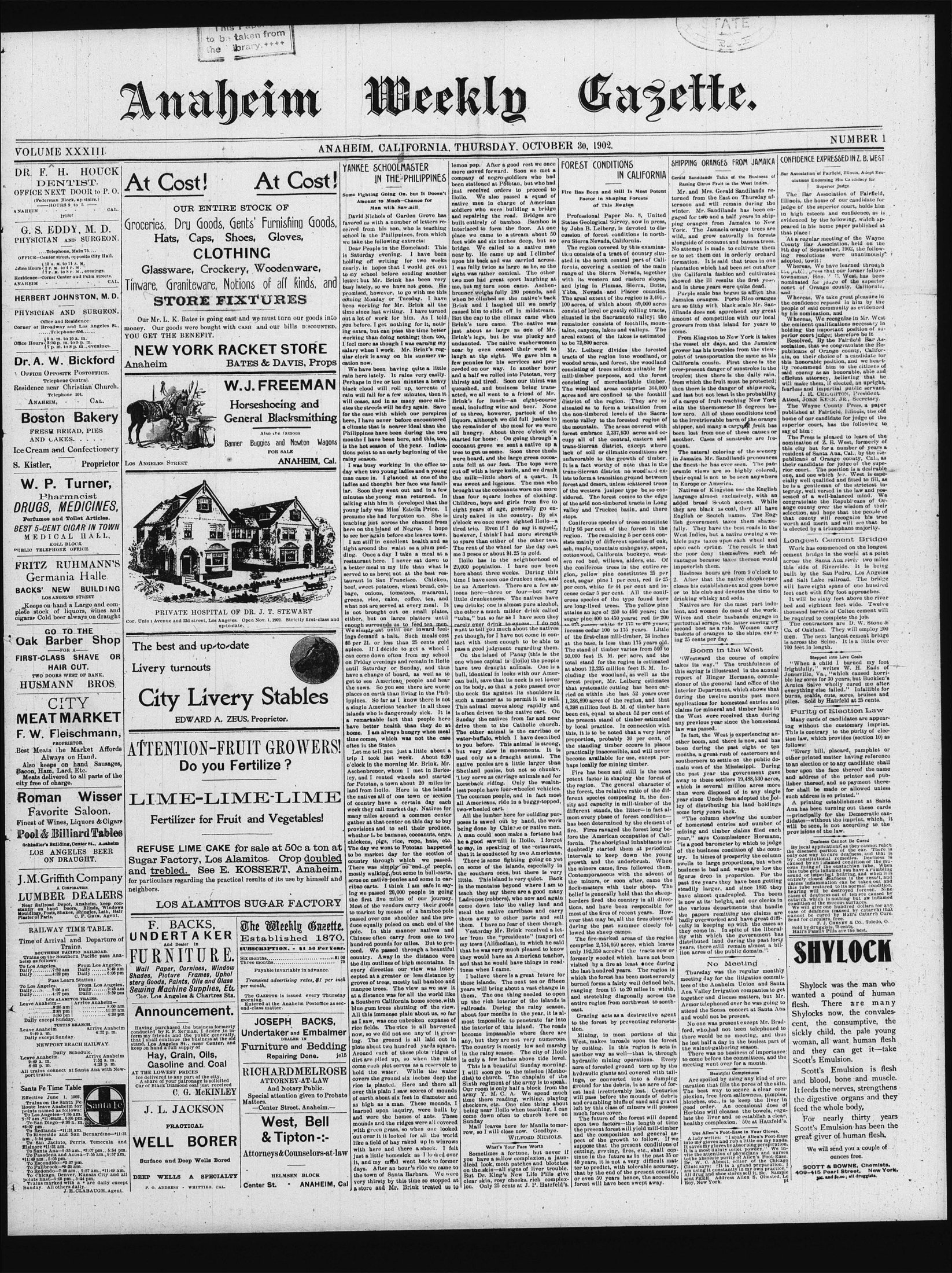
Searchable text
Anaheim
VOLUME XXXIII.
DR. F. H. HOUCK
DENTIST.
OFFICE NEXT DOOR to P. O.
(Federman Block, up stairs.)
HOURS 9 to 5.
ANAHEIM CAL.
G. S. EDDY, M. D.
PHYSICIAN AND SURGEON.
Telephone, Main 75...
OFFICE—Center street, opposite City Hall.
Office Hours:
10 A.M. to 11 A.M.
2 P.M. to 4 P.M.
7 P.M. to 8 P.M., evenings.
Residence—Corner Center and Palm streets.
ANAHEIM CAL.
HERBERT JOHNSTON, M. D.
PHYSICIAN AND SURGEON.
Office and Residence:
Corner of Broadway and Los Angeles St.
Telephone 656...
Office Hours:
9 a.m. to 10 a.m.
3:30 p.m. to 5 p.m.
7 p.m. to 8 p.m., evenings.
Dr. A. W. Bickford
OFFICE OPPOSITE POSTOFFICE.
Telephone Central.
Residence near Christian Church.
Telephone 101.
ANAHEIM, CAL.
Boston Bakery
FRESH BREAD, PIES
AND CAKES.
Ice Cream and Confectionery
S. Kistler, Proprietor
At Cost! At Cost!
OUR ENTIRE STOCK OF
Groceries, Dry Goods, Gents' Furnishing Goods,
Hats, Caps, Shoes, Gloves,
CLOTHING
Glassware, Crockery, Woodenware,
Tinware, Graniteware, Notions of all kinds, and
STORE FIXTURES
Our Mr. L. K. Bates is going east and we must turn our goods into money. Our goods were bought with cash and our bills discounted.
YOU GET THE BENEFIT.
NEW YORK RACKET STORE
Anaheim BATES & DAVIS, Props
W.J.FREEMAN
Horseshoeing and General Blacksmithing
Also the famous
Banner Buggies and Newton Wagons
FOR SALE
ANAHEIM, Cal.
Boston Bakery
FRESH BREAD, PIES AND CAKES.
Ice Cream and Confectionery
S. Kistler, Proprietor
W. P. Turner,
Pharmacist
DRUGS, MEDICINES,
Perfumes and Toilet Articles.
BEST 5-GENT CIGAR IN TOWN MEDICAL HALL,
KOLL BLOCK.
PUBLIC TELEPHONE OFFICE.
FRITZ RUHMANN'S Germania Halle.
BACKS' NEW BUILDING
LOS ANGELES STREET
Keeps on hand a Large and complete stock of liquors, wines and cigars. Cold beer always on draught
GO TO THE Oak Barber Shop
FOR A FIRST-CLASS SHAVE OR HAIR CUT.
TWO DOORS WEST OF BANK.
HUSMANN BROS.
CITY MEAT MARKET
F. W. Fleischmann,
PROPRIETOR.
Best Meats the Market Affords Always on Hand.
Also keeps on hand Sausages, Bacon, Ham, Lard, Etc.
Meats delivered to all parts of the city free of charge.
Roman Wisser
Favorite Saloon.
Finest of Wines, Liquors & Cigars
Pool & Billiard Tables
Schindler's Building, Center St., Anaheim
LOS ANGELES BEER ON DRAUGHT.
J.M. Griffith Company
A CORPORATION
LUMBER DEALERS
W.J. FREEMAN
Horseshoeing and General Blacksmithing
Also the famous Banner Buggies and Newton Wagons FOR SALE
ANAHEIM, Cal.
PRIVATE HOSPITAL OF DR. J. T. STEWART
Cor. Union Avenue and 23d street, Los Angeles. Open Nov. 1, 1902. Strictly first-class and up-to-date.
The best and up-to-date
Livery turnouts
City Livery Stables
EDWARD A. ZEUS, Proprietor.
ATTENTION-FRUIT GROWERS!
Do you Fertilize?
LIME-LIME-LIME
Fertilizer for Fruit and Vegetables!
REFUSE LIME CAKE for sale at 50c a ton at Sugar Factory, Los Alamitos. Crop doubled and trebled. See E. KOSSERT, Anaheim, for particulars regarding the practical results of its use by himself and neighbors.
Favorite Saloon.
Finest of Wines, Liquors & Cigars
Pool & Billiard Tables
Schindler's Building, Center St., Anaheim
LOS ANGELES BEER ON DRAUGHT.
J.M. Griffith Company
A CORPORATION
LUMBER DEALERS
Near Railroad Depot, Anaheim, keep constantly on hand Doors, Blinds, Windows Mouldings, Posts, Shakes, Shingles, Lath, Hair Plaster of Paris.
C. F. GRIM, Agent.
RAILWAY TIME TABLE.
Time of Arrival and Departure of Trains.
SOUTHERN PACIFIC RAILROAD.
Trains on the Southern Pacific pass Anaheim as follows:
To Los Angeles.
Daily...7:52 am Daily...9:49 am
Daily...4:22 pm Daily...6:06 pm
Pass Loara Station:
To Los Angeles.
Daily...7:56 am Daily...9:45 am
Daily...4:27 pm Daily...5:59 pm
LOS ALAMITOS TRAINS.
Leave Anaheim...
Arrive Anaheim...
9:35 am 8:00 am
2:07 pm 11:37 am
5:50 pm 4:30 pm
Daily except Sunday.
TUSTIN BRANCH.
Leave Anaheim Arrive Anaheim
9:49 a.m 4:22 p.m.
Daily except Sunday.
NEWPORT BEACH RAILWAY.
Daily Schedule.
Leave Anaheim Arrive Anaheim
9:49 a.m 7:52 a.m
6:08 p.m 4:23 p.m.
All trains connect at Santa Ana with Newport trains.
Santa Fe Time Table
Effective June 1, 1902.
Trains on the Santa Fe Route leave Anaheim for points named as follows:
To Los Angeles—7:58 am
9:57 am *11:49 am, 5:06 pm
To San Diego—9:35 a.m,
*8:07 pm
To Redlands—*11:31 am
To Riverside and San Bernardino—*11:31 am, 5:54 pm
To San Jacinto, Perris, Temecula and Elsinore *11:31 am
To Santa Ana—9:35 am, *8:07 pm, 5:54 pm
To Pasadena and Azusa—7:55 am, 9:57 am,
*11:49 am, 5:05 pm
To Escondido—*8:07 pm
To Fallbrook—*9:35 am
To Redondo—7:55 am, 9:57 am, *11:49 am
To Chicago, Denver, Kansas City and all points East—5:05 pm, 5:54 pm
Trains marked with a * are daily except Sunday. All others daily.
J.H. CLABAUGH, Agent.
LIME-LIME LIME
Fertilizer for Fruit and Vegetables!
REFUSE LIME CAKE for sale at 50c a ton at Sugar Factory, Los Alamitos. Crop doubled and trebled. See E. KOSSERT, Anaheim, for particulars regarding the practical results of its use by himself and neighbors.
LOS ALAMITOS SUGAR FACTORY
F. BACKS,
UNDERTAKER
And Dealer in
FURNITURE.
Wall Paper, Cornices, Window Shades, Picture Frames, Upholstery Goods, Paints, Oils and Glass Sewing Machine Supplies, Etc.
Cor. Los Angeles & Chartres Sts.
Announcement.
Having purchased the business formerly conducted by R.F. Zerman, I desire to inform my friends and the public generally that I shall continue the business at the old stand, Los Angeles St., near Center, and keep on hand a full supply of Hay, Grain, Oils, Gasoline and Coal
AT THE LOWEST PRICES
Ice delivered to any part of the city.
A share of your patronage is solicited Car of Black Diamond coal just received
C. G. McKINLEY
J. L. JACKSON
PRACTICAL
WELL BORER
Surface and Deep Wells Bored
DEEP WELLS A SPECIALTY
P.O. ADDRESS - WHITTIER, CAL.
The Weekly Gazette.
Established 1870.
SUBSCRIPTION - $1.50 Per Year.
Six months...$1.00
Three months...75
Payable invariably in advance.
Transient advertising rates,$1 per inch per month.
The GAZETTE is issued every Thursday morning.
Entered at the Anaheim Postoffice as second-class matter.
JOSEPH BACKS,
Undertaker and Embalmer
DEALER IN
Furniture and Bedding
Repairing Done. jel5
RICHARDMELROSE
ATTORNEY-AT-LAW
And Notary Public.
Special attention given to Probate Matters.
Center Street, Anaheim.
West, Bell & Tipton--Attorneys&Counselors-at-law
HELMSEN BLOCK
Center St. - ANAHEIM, Cal
ANAHEIM, CALIFORNIA, THURSDAY. OCTOBER 30, 1902.
YANKEE SCHOOLMASTER IN THE PHILIPPINES
Some Fighting Going On, but It Doesn't Amount to Much—Chance for Man with Savannah.
David Nichols of Garden Grove has favored us with a number of letters received from his son, who is teaching school in the Philippines, from which we take the following extracts:
Dear People in the Homeland: This is Saturday evening. I have been holding off writing for two weeks nearly, in hopes that I would get out to my school before sending another letter; but Mr. Brink has been very busy lately, so we have not gone. He promised, however, to go with me this coming Monday or Tuesday. I have been working for Mr. Brink all the time since last writing. I have turned out a lot of work for him. As I told you before, I get nothing for it, nothing extra, but can pass the time better working than doing nothing; then, too, I feel more as though I was earning my salary when I work. Mr. Brink's regular clerk is away on his summer vacation now.
We have been having quite a little rain here lately. It rains very easily. Perhaps in five or ten minutes a heavy black cloud will roll up, torrents of rain will fall for a few minutes, then it will cease, and in as many more minutes the streets will be dry again. Save for the ease with which one perspires here, I have never before encountered a climate that is nearer ideal than the Philippines have been during the two months I have been here, and this, too, is the hot season of the year. Indications point to an early beginning of the rainy season.
I was busy working in the office today when two young ladies and a young lemon pop. After a good rest we once more moved forward. Soon we met a company of negro soldiers who had been stationed at Pototan, but who had just received orders to proceed to Iloilo. We also passed a squad of native men in charge of American soldiers who were building a bridge and repairing the road. Bridges are built entirely of bamboo. Bamboo is interlaced to form the floor. At one place we came to a stream about 50 feet wide and six inches deep, but no bridge. We called to a native man near by. He came up and climbed upon his back and was carried across. I was fully twice as large as he, so the sight was rather comical. The other two men had great sport laughing at me, but my turn soon came. Aschenbruner weighs fully 180 pounds, and when he climbed on the native's back Brink and I laughed till we nearly caused him to slide off in midstream. But the cap to the climax came when Brink's turn came. The native was just about as large as one of Mr. Brink's legs, but he was plucky and undaunted. The native washerwomen near by even ceased their work to laugh at the sight. We gave him a few pennies for his services and proceeded on our way. In another hour and a half we rolled into Pototan, very thirsty and tired. Soon our thirst was quenched, and business being transacted, we all went to a friend of Mr. Brink's for lunch—an eight-course meal, including wine and beer. None of us three, however, partook of the liquors, although we did full justice to the remainder of the meal for we were all hungry. About three o'clock we started for home. On going through a cocoanut grove we sent a native up a tree to get us some. Soon three thuds were heard, and the large green cocoa nuts fell at our feet. The tops were cut off with a large knife, and we drank
FOREST CONDITIONS IN CALIFORNIA
Fire Has Been and Still Is Most Potent Factor in Shaping Forests of This Region
Professional Paper No. 8, United States Geological Survey, now in press, by John B. Leiberg, is devoted to discussion of forest conditions in northern Sierra Nevada, California.
The region covered by this examination consists of a tract of country situated in the north central part of California, covering a section of the main range of the Sierra Nevada, together with its western and eastern slopes, and lying in Plumas, Sierra, Butte, Yuba, Nevada and Placer counties. The area extent of the region is 3,491-100 acres, of which about 69,000 acres consist of level or gently rolling tracts, situated in the Sacramento valley; the remainder consists of foothills, mountains, canyons, lakes and valleys. The area extent of the lakes is estimated to be 72,800 acres.
Mr. Leiberg divides the forested tracts of the region into woodland, or wooded areas, and forest, the woodland consisting of trees seldom suitable for mill-timber purposes, and the forest consisting of merchantable timber. The woodland areas comprise 364,000 acres and are confined to the foothill district of the region. They are so situated as to form a transition from the non-timbered levels of the Sacramento valley to the forested region of the mountain. The areas covered with forest embrace 2,337,930 acres and occupy all of the central, eastern and trans-Sierran district, except where lack of soil or climatic conditions are unfavorable to the growth of timber. It is a fact worthy of note that in the trans-Sierran district no woodland ex-
rain here lately. It rains very easily. Perhaps in five or ten minutes a heavy cloud will roll up, torrents of rain will fall for a few minutes, then it will cease, and in as many more minutes the streets will be dry again. Save for the ease with which one perspires here, I have never before encountered a climate that is nearer ideal than the Philippines have been during the two months I have been here, and this, too, is the hot season of the year. Indications point to an early beginning of the rainy season.
I was busy working in the office today when two young ladies and a young man came in. I glanced at one of the ladies and thought her face was familiar. Soon they went out and in a few minutes the young man returned. In talking with him it developed that the young lady was Miss Estella Price. I presume she had forgotten me. She is teaching just across the channel from here on the island of Negros. I hope to see her again before she leaves town.
I am still in excellent health and as tight around the waist as a plum pudding. Once a day I take a meal at a restaurant here. I never sat down to a better meal in my life than what is served to us here; not at the best restaurant in San Francisco. Chicken, beef, sweet potatoes, wheat bread, cabbage, onions, tomatoes, macaroni, greens, rice, cake, coffee, tea, and what not are served at every meal. It is not brought out on small plates, either, but on large platters until enough surrounds us to feed ten men. We simply eat until our inward feelings demand a halt. Such meals cost $5 per 21, or less than 25 cents gold apiece. If I decide to get a wheel I can come down often from my school on Friday evenings and remain in Iloilo until Saturday or Sunday, and thus have a change of board, as well as to get to see American people and hear the news. So you see there are worse places on earth than living in the Philippines. So far as I know there is not a single American teacher in all these islands who is dangerously sick. It is a remarkable fact that people here have better health than they do at home. I am always hungry when meal time comes, which was not the case often in the States.
Let me tell you just a little about a trip I took last week. About 6:30 o'clock in the morning Mr. Brink, Mr. Aschenbrener, whom I met in Berkeley, and I rented wheels and started for Pototan, a town about 20 miles inland from Iloilo. Here in the islands the natives all of one town or section of country have a certain day each week they call market day. Natives for many miles around a common center gather at that center on this day to buy provisions and to sell their produce, whether it be bananas, cocoanuts, eggs, chickens, pigs, rice, rope, hate, etc. The day we went to Pototan happened to be market day for the section of country through which we passed. There was simply no end of people, mostly walking, but some in bull-carts, some on native ponies and some in caribao carts. I think I am safe in saying we passed 20,000 people in going the first five miles of our journey and a half we rolled into Pototan, very thirsty and tired. Soon our thirst was quenched, and business being transacted, we all went to a friend of Mr. Brink's for lunch—an eight-course meal, including wine and beer. None of us three, however, partook of the liquors, although we did full justice to the remainder of the meal for we were all hungry. About three o'clock we started for home. On going through a coconut grove we sent a native up a tree to get us some. Soon three thuds were heard, and the large green cocoa nuts fell at our feet. The tops were cut off with a large knife, and we drank the milk—little short of a quart. It was sweet and luscious. The man who brought us the cocoonuts wore not more than four square inches of clothing. Children, boys and girls from five to eight years of age, generally go entirely naked in the country. By six o'clock we once more sighted Iloilo—a tired trio. Even if I do say it myself, however, I think I had more strength to spare than either of the other two. The rent of the wheel for the day cost me 3 pesos or about $1.25 in gold.
Iloilo has in the neighborhood of 20,000 population. I have now been here about three weeks. During this time I have seen one drunken man, and he an American. There are a few saisons here—three or four—but very little drunkenness. The natives have two drinks; one is almost pure alcohol, the other a much milder drink called "tuba," but so far as I have seen they rarely ever drink to excess. I do not want to tell you much about the natives yet though, for I have not come in contact with them enough to be able to pass a good judgment regarding them.
On the island of Panay (this is the one whose capital is Iloilo) the people have two draught animals. One is a bull, identical in looks with our American bull, save that its neck is set lower on its body, so that a yoke passed over the neck fits against its shoulders in such a manner as to permit it to pull. This animal moves along rapidly and is often driven to the native cart. On Sunday the natives from far and near drive them to the Catholic church. The other animal is the carribao or water-buffalo, which I have described to you before. This animal is strong, but very slow in movements. It is used only as a draught animal. The native ponies are a little larger than Shetland ponies, but not so chunky. They serve as carriage animals and for horseback riding. Only the wealthiest people have four-wheeled vehicles. The common people, and in fact most Americans, ride in a buggy-topped, two-wheeled cart.
All the lumber here for building purposes is sawed out by hand, the work being done by Chinese or native men. A man could soon make a fortune had he a good sawnill in Iloilo. I forgot to say, in speaking of the restaurant, that it is conducted by two Americans.
There is some fighting going on yet on some of the islands, especially in the southern ones, but there is very little. This island is very quiet. Back in the mountains beyond where I am to teach they say there are a good many Ladrones (robbers), who now and again mill-timber purposes, and the forest consisting of merchantable timber. The woodland areas comprise 364,000 acres and are confined to the foothill district of the region. They are so situated as to form a transition from the non-timbered levels of the Sacra-mento valley to the forested region of the mountain. The areas covered with forest embrace 2,337,930 acres and occupy all of the central, eastern and trans-Sierra district, except where lack of soil or climatic conditions are unfavorable to the growth of timber. It is a fact worthy of note that in the trans-Sierra district no woodland exists to form a transition ground between forest and desert, unless scattered trees of the western juniper type be so considered. The forest comes to the edge of the arid non-timbered tracts in Long valley and Truckee basin, and there stops.
Coniferous species of trees constitute fully 95 per cent of the forest in the region. The remaining 5 per cent consists mainly of different species of oak, ash, maple, mountain mahogany, aspen, cottonwood, California buckeye, western red bud, willows, alders, etc. Of the coniferous trees in the entire region, yellow pine constitutes 25 per cent, sugar pine 1 per cent, red fir 25 per cent, white fir 44 per cent and incense cedar 5 per cent. All the coniferous species of the type found here are long-lived trees. The yellow pine attains an age of 250 to 450 years; the sugar pine 400 to 450 years; red fir 200 to 275 years; white fir 175 to 276 years; incense cedar 100 to 175 years. Little of the first-class mill-timber, 24 inches at the base, is less than 175 years old.
The stand of timber varies from 500 to 50,000 feet B.M. per acre, and the total stand for the region is estimated at about 12,235 million feet B.M., including the woodland as well as the forest proper; Mr. Leiberg estimates that systematic cutting has been carried on within the last 52 years over 1,386,890 acres of the region, and that 6,398 million feet B.M. of timber have been cut equal to about 52 per cent of the present stand of timber estimated by local practice. In connection with this, it is to be noted that a very large proportion, probably 30 per cent, of the standing timber occurs in places practically inaccessible, and will never become available for use, except perhaps locally for mining timber.
Fire has been and still is the most potent factor in shaping the forest of the region. The general character of the forest, the relative ratio of the different species composing it,the density and capacity in mill-timber of the different stands,the litter—in fact almost every phase of forest condition—has been determined by the element of fire.Fires ravaged the forest long before the American occupation of California.The aboriginal inhabitants undoubtedly started them at periodical intervals to keep down the young growth and underbrush。When the miners came,fires followed them。Contemporaneous with the advent of the miners,或 soon after,came the flock-masters with their sheep.The belief is generally held that the sheep
of country have a certain day each week they call market day. Natives for many miles around a common center gather at that center on this day to buy provisions and to sell their produce, whether it be bananas, cocoanuts, eggs, chickens, pigs, rice, rope, hats, etc. The day we went to Pototan happened to be market day for the section of country through which we passed. There was simply no end of people, mostly walking, but some in bull-carts, some on native ponies and some in carribo carts. I think I am safe in saying we passed 20,000 people in going the first five miles of our journey. Most of the vendors carry their goods to market by means of a bamboo pole passed over one shoulder and the produce equally poised on each end of the pole. In this manner natives and Chinese often carry from one to two hundred pounds for miles. But to proceed. We passed through a beautiful country. Away in the distance were the dim outlines of high mountains. In every direction our view was intercepted at a greater or less distance by groves of trees, mostly tall bamboo and mangoe trees. The view as we saw it at a distance was for all the world like a Southern California home scene, with blue gum trees shutting off the view. All this immense plain about us, so far as I saw, was one unbroken expanse of rice fields. The rice is all harvested now, so we did not see any of it growing. The ground is all laid out in plots about two hundred yards square. Around each of these plots ridges of dirt are piled up, so when the rains come each plot serves as a reservoir to hold the water. While the water covers the ground six inches deep the rice is planted. Here and there all over this plain I saw scores of mounds of earth about six feet in diameter and as high as a man. These mounds, I learned upon inquiry, were built by and were the homes of ants. These mounds and the ridges were all covered with green grass, so when one looked out over it it looked for all the world like a field of hay raked up in winrows with here and there a shock. I felt just a little homesick as I looked over it, and my mind went back to former days. After an hour's ride we came to the town of Santa Barbara. We were very thirsty by this time so stopped at a store and Mr. Brink treated us to all Americans, ride in a buggy-topped, two-wheeled cart.
All the lumber here for building purposes is sawed out by hand, the work being done by Chinese or native men. A man could soon make a fortune had he a good sawnill in Iloilo. I forgot to say, in speaking of the restaurant, that it is conducted by two Americans.
There is some fighting going on yet on some of the islands, especially in the southern ones, but there is very little. This island is very quiet. Back in the mountains beyond where I am to teach they say there are a good many Ladrones (robbers), who now and again come down into the valley land and steal the native carribaos and carry them away to other parts and sell them. I have no fear of them though.
Yesterday Mr. Brink received a letter from the "presidente" (mayor) of my town (Alimodian), in which he said that he was very much pleased to know they would have an American teacher, and that he would have things in readiness when I came.
I believe there is a great future for these islands. The next ten or fifteen years will bring about a vast change in them. The one thing needed to open up the rich interior of the islands is railroads. During the rainy season, about four months in the year, it is almost impossible to penetrate far into the interior of this island. The roads become impassable where there are any, but they are not very numerous. The country is mostly low and marshy in the rainy season. The city of Iloilo is only a few inches above tide level.
This is a beautiful Sunday morning. I will soon go to the mission (Methodist) to church. The chaplain of the Sixth regiment of the army is to speak. Our room is only half a block from the army Y. M. C. A. We spend much time there reading, writing, playing checkers, etc. One nice thing about being near Iloilo when teaching, I can come down often to church here on Sunday.
Mall leaves here for Manila tomorrow, so I will close now. Goodbye.
WILFORD NICHOLS.
What's Your Face Worth
Sometimes a fortune, but never if you have a sallow complexion, a jaundiced look, moth patches and blotches on the skin—all signs of liver trouble. But Dr. King's New Life Pills give clear skin, rosy cheeks, rich complexion. Only 25 cents at J. P. Hatzfeld's.
The fire-marked areas of the region comprise 2,754,660 acres, which leaves only 192,350 acres of the tracts now on formerly wooded which have not been visited by a fire at least once during the last hundred years. The region in which the forest has been most severely burned forms a fairly well defined belt ranging from 15 to 20 miles in width and stretching diagonally across the entire region from northwest to southeast.
Grazing acts as a destructive agent to the forest by preventing reforestation.
Mining, in most portions of the West, makes inroads upon the forests by cutting. In this region it acts another way as well—that is, through hydraulic mining operations. Every acre of forested ground torn up by the hydraulic giants and covered with tailings, or converted into a dumping ground for the debris, is an acre of forest land irretrievably lost. Centurions will pass before the mounds of debris and crumbling bluffs of sand and gravel left by this class of miners will possess much forest cover.
The future of the forest will depend upon two factors—the length of time the present forest will yield mill-timber and the composition and general aspect of the growth to follow. If we suppose that the present conditions cutting, grazing, fires, etc., shall continue in the future as in the past 35-40 years, it is not a very difficult matter to predict, with tolerable accuracy that by the end of the present century or even 50 years hence, the accessibility forest will have been swept away.
CONDITIONS IN CALIFORNIA
and Still Is Most Potent in Shaping Forests of This Region
Final Paper No. 8, United Medical Survey, now in press, Weiberg, is devoted to disrestricted conditions in north-evada, California.
covered by this examination of a tract of country situ- north central part of Cali- ning a section of the main Sierra Nevada, together western and eastern slopes, Plumas, Sierra, Butte, Dana and Placer counties.
cent of the region is 3,491,- which about 69,000 acres elk or gently rolling tracts, the Sacramento valley; the consists of foothills, mountains, lakes and valleys. The of the lakes is estimated acres.
arg divides the forested region into woodland, orchard and forest, the woodland trees seldom suitable for purposes, and the forest of merchantable timber. And areas comprise 364,000 he confined to the foothill region. They are so no form a transition from elevated levels of the Sacramento to the forested region of.
The areas covered with once 2,337,930 acres and oc- cidental, eastern and district, except where or climatic conditions are to the growth of timber. Worthy of note that in the district no woodland ex-
SHIPPING ORANGES FROM JAMAICA
Gerald Sandilands Talks of the Business of Raising Citrus Fruit in the West Indies.
Mr. and Mrs. Gerald Sandilands returned from the East on Thursday afternoon and will remain during the winter. Mr. Sandilands has been engaged for two and a half years in shipping oranges from Jamaica to New York. The Jamacia orange trees are wild, and grow naturally in forests alongside of cocoanut and banana trees. No attempt is made to cultivate them or to set them out in orderly orchard formation. It is said that trees in one plantation which had been set out after the California fashion and cultivated showed the ill results the first year, and in three years were quite dead.
Purple scale has begun to afflict the Jamaica oranges. Porto Rico oranges are so filthy with black scale Mr. Sandilands does not apprehend any great amount of competition with our local growers from that island for years to come.
From Kingston to New York it takes the vessel six days, and the Jamaica grower has his troubles from the viewpoint of transportation the same as his California cousin. First there is the ever-present danger of sunstroke in the tropics; then there is the daily rain, from which the fruit must be protected; then there is the danger of shipwreck, and last but not least is the probability of a cargo of fruit reaching New York with the thermometer 15 degrees below zero. All of these conditions tend to the irretrievable harm of the orange shipper, and many a cargo of fruit has been lost from one of these causes or another. Cases of sunstroke are frequent.
The natural coloring of the scenery in Jamaica Mr. Sandilands pronounces the finest she has ever seen. The panoramic views are so highly colored,
CONFIDENCE EXPRESSED IN Z. B. WEST
Bar Association of Fairfield, Illinois, Adopt Resolutions Endorsing His Candidacy for Superior Judge.
The Bar Association of Fairfield, Illinois, the home of our candidate for judge of the superior court, holds him in high esteem and confidence, as is evidenced by the following, which appeared in his home paper published at that place:
At a regular meeting of the Wayne County Bar Association, held on the 9th day of September, 1902, the following resolutions were unanimously adopted, toowit:
Whereas, We have learned through the public press that our former fellow-townman, Hon. J. B. West, has been nominated for judge of the superior court of Orange county, California,
and
Whereas, We take great pleasure in the confidence reposed in him by the people of said community as evidenced by his nomination, and
Whereas, We recognize in Mr. West the eminent qualifications necessary in holding the important position of superior court judge; therefore be it
Resolved, By the Fairfield Bar Association, that we congratulate the Republicans of Orange county, California, on their choice of a candidate for this honorable position, and we heartily recommend him to the citizens of said county as an honorable, able and efficient attorney, believing that he will make them, if elected, an upright, fearless and impartial public servant.
J. R. CREIGHTON, President.
Attest, JOHN KENN, JR., Secretary.
The Wayne County Press, a paper published at Fairfield, Illinois, the old home of our candidate for judge of the superior court, has the following to say of him:
The Press is pleased to learn of the nomination of Z. B. West, formerly of this city but for a number of years a resident of Santa Ana, Cal., by the Republicans of Orange county, Cal., as their candidate for judge of the superior court. The position is a desirable one and one which Mr. West is espe-
species of trees constitute
percent of the forest in the
remaining 5 per cent condifferent species of oak,
mountain mahogany, aspen,
California buckeye, westland willows, alders, etc.
Of these trees in the entire region constitutes 25 per
pine 1 per cent, red fir 25
white fir 44 per cent and increasing 55 per cent.
All the conifers of the type found here
and trees. The yellow pine
of 250 to 450 years; the
200 to 450 years; red fir 200
to white fir 175 to 276 years;
for 100 to 175 years. Little
class mill-timber, 24 inches
is less than 175 years old.
Timber varies from 500 to
B. M. per acre, and the
for the region is estimated
235 million feet B. M.
In woodland, as well as the
river, Mr. Leiberg estimates
static cutting has been carin the last 52 years over
areas of the region, and that
feet B. M. of timber have
unusual to about 52 per cent of
stand of timber estimated
practice. In connection with
the noted that a very large
probably 30 per cent, of
timber occurs in places
inaccessible, and will never
beable for use, except perfor mining timber.
been and still is the most
worry in shaping the forest of
The general character of
the relative ratio of the diffices composing it, the dencapacity in mill-timber of the
stands, the litter—in fact alphase of forest condition—
determined by the element of
ravaged the forest long bemerican occupation of Calistate aboriginal inhabitants unstarted them at periodical
to keep down the young
and the underbrush. When
came, fires followed them.
Unconscious with the advent of
or soon after, came the
ears with their sheep. The
generally held that the sheepspecies of trees constitute
percent of the forest in the
remaining 5 per cent condifferent species of oak,
mountain mahogany, aspen,
California buckeye, westland willows, alders, etc.
Of these trees in the entire region constitutes 25 per
pine 1 per cent, red fir 25
white fir 44 per cent and increasing 55 per cent.
All the conifers of the type found here
and trees. The yellow pine
of 250 to 450 years; the
200 to 450 years; red fir 200
to white fir 175 to 276 years;
for 100 to 175 years. Little
class mill-timber, 24 inches
is less than 175 years old.
Timber varies from 500 to
B. M. per acre, and the
for the region is estimated
235 million feet B. M.
In woodland, as well as the
river, Mr. Leiberg estimates
static cutting has been carin the last 52 years over
areas of the region, and that
feet B. M. of timber have
unusual to about 52 per cent of
stand of timber estimated practice. In connection with
the noted that a very large
probably 30 per cent, of
timber occurs in places
inaccessible, and will never
beable for use, except perfor mining timber.
been and still is the most
worry in shaping the forest of
The general character of
the relative ratio of the diffences composing it, the dencapacity in mill-timber of the
stands, the litter—in fact alphase of forest condition—
determined by the element of
ravaged the forest long bemerican occupation of Calistate aboriginal inhabitants unstarted them at periodical
to keep down the young
and the underbrush. When
came, fires followed them.
Unconscious with the advent of
or soon after, came the
ears with their sheep. The
generally held that the sheepspecies of trees constitute
percent of the forest in the
remaining 5 per cent condifferent species of oak,
mountain mahogany, aspen,
California buckeye, westland willows, alders, etc.
Of these trees in the entire region constitutes 25 per
pine 1 per cent, red fir 25
white fir 44 per cent and increasing 55 per cent.
All the conifers of the type found here
and trees. The yellow pine
of 250 to 450 years; the
200 to 450 years; red fir 200
to white fir 175 to 276 years;
for 100 to 175 years. Little
class mill-timber, 24 inches
is less than 175 years old.
Timber varies from 500 to
Boom in the West
"Westward the course of empire takes its way." The truthfulness of this saying is illustrated in the annual report of Binger Hermann, commissioner of the general land office of the Interior Department, which shows that during the twelve months past more applications for homestead entries and claims for mineral and timber lands in the West were received than during any previous year since the homestead law was passed.
In fact, the West is experiencing another boom, and there is now, and has been during the past eight or ten months, a great rush of easterners and southerners to settle on the public domain west of the Mississippi. During the past year the government gave away to these settlers 19,488,530 acres, which is several million acres more than were disposed of in any single year since Uncle Sam adopted the policy of distributing his land holdings some forty years back.
"The column showing the number of homestead entries and number of mining and timber claims filed each year," says Commissioner Hermann,
"is a good barometer by which to judge of the business condition of the country. In times of prosperity the column swells to large proportions, but when business is bad and wages are low the figures drop in proportion. For the past five years they have been getting steadily larger, and since 1895 they have almost quadrupled. The boom
"Westward the course of empire takes its way." The truthfulness of this saying is illustrated in the annual report of Binger Hermann, commissioner of the general land office of the Interior Department, which shows that during the twelve months past more applications for homestead entries and claims for mineral and timber lands in the West were received than during any previous year since the homestead law was passed.
In fact, the West is experiencing another boom, and there is now, and has been during the past eight or ten months, a great rush of easterners and southerners to settle on the public domain west of the Mississippi. During the past year the government gave away to these settlers 19,488,530 acres, which is several million acres more than were disposed of in any single year since Uncle Sam adopted the policy of distributing his land holdings some forty years back.
"The column showing the number of homestead entries and number of mining and timber claims filed each year," says Commissioner Hermann,
"is a good barometer by which to judge of the business condition of the country. In times of prosperity the column swells to large proportions, but when business is bad and wages are low the figures drop in proportion. For the past five years they have been getting steadily larger, and since 1895 they have almost quadrupled. The boom"
"Westward the course of empire takes its way." The truthfulness of this saying is illustrated in the annual report of Binger Hermann, commissioner of the general land office of the Interior Department, which shows that during the twelve months past more applications for homestead entries and claims for mineral and timber lands in the West were received than during any previous year since the homestead law was passed.
In fact, the West is experiencing another boom, and there is now, and has been during the past eight or ten months, a great rush of easterners and southerners to settle on the public domain west of the Mississippi. During the past year the government gave away to these settlers 19,488,530 acres, which is several million acres more than were disposed of in any single year since Uncle Sam adopted the policy of distributing his land holdings some forty years back.
"The column showing the number of homestead entries and number of mining and timber claims filed each year," says Commissioner Hermann,
"is a good barometer by which to judge of the business condition of the country. In times of prosperity the column swells to large proportions, but when business is bad and wages are low the figures drop in proportion. For the past five years they have been getting steadily larger, and since 1895 they have almost quadrupled. The boom"
"Westward the course of empire takes its way." The truthfulness of this saying is illustrated in the annual report of Binger Hermann, commissioner of the general land office of the Interior Department, which shows that during the twelve months past more applications for homestead entries and claims for mineral and timber lands in the West were received than during any previous year since the homestead law was passed.
In fact, the West is experiencing another boom, and there is now, and has been during the past eight or ten months, a great rush of easterners and southerners to settle on the public domain west of the Mississippi. During the past year the government gave away to these settlers 19,488,530 acres, which is several million acres more than were disposed of in any single year since Uncle Sam adopted the policy of distributing his land holdings some forty years back.
"The column showing the number of homestead entries and number of mining and timber claims filed each year," says Commissioner Hermann,
"is a good barometer by which to judge of the business condition of the country. In times of prosperity the column swells to large proportions, but when business is bad and wages are low the figures drop in proportion. For the past five years they have been getting steadily larger, and since 1895 they have almost quadrupled. The boom"
"Westward the course of empire takes its way." The truthfulness of this saying is illustrated in the annual report of Binger Hermann, commissioner of the general land office of the Interior Department, which shows that during the twelve months past more applications for homestead entries and claims for mineral and timber lands in the West were received than during any previous year since the homestead law was passed.
In fact, the West is experiencing another boom, and there is now, and has been during the past eight or ten months, a great rush of easterners and southerners to settle on the public domain west of the Mississippi. During the past yearthe government gave away to these settlers 19,488,530 acres which is several million acres more than were disposed of in any single year since Uncle Sam adoptedthe policyof distributinghis landholdingssome fortyyearsback."
"The column showingthenumberofhomesteadentriesandnumberofminingandtimberclaimsfiledeachyear,"saysCommissionerHermann,
"isagoodbarometerbywhichtodejudethebusinessconditionofthecountry.Intimesofprosperitythecolumnswellstolargeproportionsbutwhenbusinessisbadandwagesarelowthefiguresdropinproportion.Forestisowantedthanduringanypreviousyearsincethehomesteadlawwaspassed."
By local applicationsasthey cannotreachthedisased portionofthecarlthere.isonlyonewayt curedeafness,andisconstitutionalremotes.Deafinessiscausedbyinconstitutionalremotes.Deafinessiscausedbyinconstitutionalremotes.Deafinessiscausedbyinconstitutionalremotes.Deafinessiscausedbyinconstitutionalremotes.Deafinessiscausedbyinconstitutionalremotes.Deafinessiscausedbyinconstitutionalremotes.Deafinessiscausedbyinconstitutionalremotes.Deafinessiscausedbyinconstitutionalremotes.Deafinessiscausedbyinconstitutionalremotes.Deafinessiscausedbyinconstitutionalremotes.Deafinessiscausedbyinconstitutionalremotes.Deafinessiscausedbyinconstitutionalremotes.Deafinessiscausedbyinconstitutionalremotes.Deafinessiscausedbyinconstitutionalremotes.Deafinessiscausedbyinconstitutionalremotes.Deafinessiscausedbyinconstitutionalremotes.Deafinessiscausedbyinconstitutionalremotes.Deafinessiscausedbyinconstitutionalremotes.Deafinessiscausedbyinconstitutionalremotes.Deafinessiscausedbyinconstitutionalremotes.Deafinessiscausedbyinconstitutionalremotes.Deafinessiscausedbyinconstitutionalremotes.Deafinessiscausedbyinconstitutionalremotes.Deafinessiscausedbyinconstitutionalremotes.Deafnessiscausedbyinconstitutionalremotes.Deafnessiscausedbyinconstitutionalremotes.Deafnessiscausedbyinconstitutionalremotes.Deafnessiscausedbyinconstitutionalremotes.Deafnessiscausedbyinconstitutionalremotes.Deafnessiscausedbyinconstitutionalremotes.Deafnessiscausedbyinconstitutionalremotes.Deafnessiscausedbyinconstitutionalremotes.Deafnessiscausedbyinconstitutionalremotes.Deafnessiscausedbyinconstitutionalremotes.Deafnessiscausedbyinconstutionalremotes.Deafnessiscausedbyinconstutionalremotes.Deafnessiscausedbyinconstutionalremotes.Deafnessiscausedbyinconstutionalremotes.Deafnessiscausedbyinconstutionalremotes.Deafnessiscausedbyinconstutionalremotes.Deafnessiscausedbyinconstutionalremones.Deafnessiscausedbyinconstutionalremones.Deafnessiscausedbyinconstutionalremones.Deafnessiscausedbyinconstutionalremones.Deafnessiscausedbyinconstutionalremones.Deafnessiscausedbyinconstutionalremones.Deafnessiscausedbyinconstutionalremones.Deafnessiscausedbyinconstutionalremones.Deafnessiscausedbyinconstutionalremones.Deafnessiscausedbyinconstutionalremones.Deafnessiscausedbyinconstutionalremones.Deafnessiscausedbyinconstutionalremones.Deafnessiscausedbyinconstutionalremones.Deafnessiscausedbyinconstutionalremones.Deafnessiscausedbyinconstutionalremones.Deafnessiscausedbyinconstutionalremones.Deafnessiscausedbyinconstutionalremones.Deafnessiscausedbyinconstutionalremones.Deafnessiscausedbyin.constitutionlessandmorethanarepresentedwiththeforeignimportation.TheforeignimportationTheforeignimportationTheforeignimportationTheforeignimportationTheforeignimportationTheforeignimportationTheforeignimportationTheforeignimportationTheforeignimportationTheforeignimportationTheforeignimportationTheforeignimportationTheforeignimportationTheforeignimportationTheforeignimportationTheforeignimportationTheforeignimportationTheforeignimportationTheforeignimportationTheforeignimportationTheforeignimportationTheforeignimportationTheforeignimportationTheforeignimportationTheforeignimportationTheforeignimportationTheforeignimportationTheforeignimportationTheforeignimportationTheforeignimportationTheforeignimportationTheforeignimportationTheforeignimportationThe foreignimportationTheforeignimportationTheforeignimportationTheforeignimportationTheforeignimportationTheforeignimportationTheforeignimportationTheforeignimportationTheforeignimportationTheforeignimportationTheforeignimportationTheforeignimportationTheforeignimportationTheforeignimportationTheforeignimportationTheforeignimportationTheforeignimportationTheforeignimportationTheforeignimportationTheforeignimportationThe foreign importationThe foreign importationThe foreign importationThe foreign importationThe foreign importationThe foreign importationThe foregin importationThe foregin importationThe foregin importationThe foregin importationThe foregin importationThe foregin importationThe foregin importationThe foregin importationThe foregin importationThe foregin importationThe foregin importationThe foregin importationThe foregin importationThe foregin importationTHEFOREIGN IMPORTATIONTHEFOREIGN IMPORTATIONTHEFOREIGN IMPORTATIONTHEFOREIGN IMPORTATIONTHEFOREIGN IMPORTATIONTHEFOREIGN IMPORTATIONTHEFOREIGN IMPORTATIONTHEFOREIGN IMPORTATIONTHEFOREIGN IMPORTATIONTHEFOREIGN IMPORTATIONTHEFOREIGN IMPORTATIONTHEFOREIGN IMPORTATIONTHEFOREIGN IMPORTATIONTHEFOREIGN IMPORTATIONTHEFOREIGN IMPORTATION THEFOREIGN IMPORTATIONTHEFOREIGN IMPORTATIONTHEFOREIGN IMPORTATIONTHEFOREIGN IMPORTATIONTHEFOREIGN IMPORTATIONTHEFOREIGN IMPORTATIONTHEFOREIGN IMPORTATIONTHEFOREIGN IMPORTATIONTHEFOREIGN IMPORTATIONTHEFOREIGN IMPORTATIONTHEFOREIGN IMPORTATIONTHEFOREIGN IMPORTATIONTHEFOREIGN IMPORTATIONTHEFOREIGN IMPORTATION THEFOREIGN IMPORTATION THEFOREIGN IMPORTATION THEFOREIGN IMPORTATION THEFOREIGN IMPORTATION THEFOREIGN IMPORTATION THEFOREIGN IMPORTATION THEFOREIGN IMPORTATION THEFOREIGN IMPORTATION THEFOREIGN IMPORTATION THEFOREIGN IMPORTATION THEFOREIGN IMPORTATION THEFOREIGN IMPORTATION THEFOREIGN IMPORTATION THEFOREIGN IMPORTATION THE FOREIGN IMPORTATION THEFOREIGN IMPORTATION THEFOREIGN IMPPORTATION THEFOREIGN IMPPORTATION THEFOREIGN IMPPORTATION THEFOREIGN IMPPORTATION THEFOREIGN IMPPORTATION THEFOREIGN IMPPORTATION THEFOREIGN IMPPORTATION THEFOREIGN IMPPORTATION THEFOREIGN IMPPORTATION THEFOREIGN IMPPORTATION THEFOREIGN IMPPORTATION THEFOREIGN IMPPORTATION THEFOREGNIMPARTMENTTHEFOREGNIMPARTMENTTHEFOREGNIMPARTMENTTHEFOREGNIMPARTMENTTHEFOREGNIMPARTMENTTHEFOREGNIMPARTMENTTHEFOREGNIMPARTMENTTHEFOREGNIMPARTMENTTHEFOREGNIMPARTMENTTHEFOREGNIMPARTMENTTHEFOREGNIMPARTMENTTHEFOREGNIMPARTMENTTHEFOREGNIMPARTMENTTHEFOREGNIMPARTMENTTHEFOUREGNIMPARTMENTTHEFOUREGNIMPARTMENTTHEFOUREGNIMPARTMENTTHEFOUREGNIMPARTMENTTHEFOUREGNIMPARTMENTTHEFOUREGNIMPARTMENTTHEFOUREGNIMPARTMENTTHEHOUREGNIMPARTMENTTHEHOUREGNIMPARTMENTTHEHOUREGNIMPARTMENTTHEHOUREGNIMPARTMENTTHEHOUREGNIMPARTMENTTHEHOUREGNIMPARTMENTTHEHOUREGNIMPARTMENTTHEOUREGNIMPARTMENTTHEOUREGNIMPARTMENTTHEOUREGNIMPARTMENTTHEOUREGNIMPARTMENTTHEOUREGNIMPARTMENTTHEOUREGNIMPARTMENTTHEOUREGNIMPARTMENTTHEOUREGNIMPARTMENTTHEOUREGNIMPARTMENTTHEOUREGNIMPARTMENTTHEOUREGNIMPARTMENTTHEOUREGNIMPARTMENTTHEOUREGNIMPARTMENTTHEOUREGNIMPARTMENTTHOUREGNIMPARTMENTTHOUREGNIMPARTMENTTHOUREGNIMPARTMENTTHOUREGNIMPARTMENTTHOUREGNIMPARTMENTTHOUREGNIMPARTMENTTHOUREGNIMPARTMENTTHOUREGNIMPARTMENTTHOUREGNIMPARTMENTTHOUREGNIMPARTMENTTHOUREGNIMPARTMENTTHOUREGNIMPARTMENTTHOUREGNIMPARTMENTTHOUREGNIMPARTMENTTHOUREGNIPartmentTHOUREGNIPartmentTHOUREGNIPartmentTHOUREGNIPartmentTHOUREGNIPartmentTHOUREGNIPartmentTHOUREGNIPartmentTHOUREGNIPartmentTHOUREGNIPartmentTHOUREGNIPartmentTHOUREGNIPartmentTHOUSEGNIPartmentTHOUSEGNIPartmentTHOUSEGNIPartmentTHOUSEGNIPartmentTHOUSEGNIPartmentTHOUSEGNIPartmentTHOUSEGNIPartmentTHOUSEGNIPartmentTHOUSEGNIPartmentTHOUSEGNIPartmentTHOUSEGNIPartmentTHOUSEGNIPartmentTHOUSEGNIPartmentTHOUSEGNIPpartmentTHOUSEGNIPpartmentTHOUSEGNIPpartmentTHOUSEGNIPpartmentTHOUSEGNIPpartmentThoUSEGNIPpartmentThoUSEGNIPpartmentThoUSEGNIPpartmentThoUSEGNIPpartimentThoUSEGNIPpartimentThoUSEGNIPpartimentThoUSEGNIPpartimentThoUSEGNIPpartimentThoUSEGNIPpartimentThoUSEGNIPpartimentThoUSEGENPipartimentThoUSEGENPipartimentThoUSEGENPipartimentThoUSEGENPipartimentThoUSEGENPipartimentThoUSEGENPipartimentThoUSEGENPipartimentThoUSEGENPipartimentThoUSEGENPipartimentThoUSEGENPipartimentThoUSEGENPipartimentThoUSEGENPipartimentThoUSEGENPipartimentThoUSEGENPipartimentThoUSEGENPipartimentThoUSEGENPipartimentThoUSEGENPipartimentThoUSEGENPipartimentThoUSEGENPipartimentThoUSEGENPipartimentThoUSEGENPipartimentTho USEGENPipartimentTho USEGENPipartimentTho USEGENPipartimentTho USEGENPipartimentTho USEGENP_partimentTho USEGENP_partimentTho USEGENP_partimentTho USEGENP_partimentTho USEGENP_partimentTho USEGENP_partimentTho USEGENP_partimentTho USEGENP_partimentTho USEGENP_partimentTho USEGENP_partimentTho USEGENP_partimentTho USEGENP_partimentTho USEGENP_partiment Tho USEGENP_partimentTho USEGENP_partimentTho USEGENP_partimentTho USEGENP_partimentTho USEGENP_partimentTho USEGENP_partimentTho USEGENP_partientTho USEGENP_partientTho USEGENP_partientTho USEGENP_partientTho USEGENP_partientTho USEGENP_partientTho USEGENP_partientTho USEGENP_partientTho USEGENP_partientTho USEGENP_partientTho USEGENP_partient Tho USEGENP_partient Tho USEGENP_partient Tho USEGENP_partient Tho USEGENP_partient Tho USEGENP_partient Tho USEGENP_partient Tho USEGENP_partient Tho USEGENP_partient Tho USEGENP_partient Tho USEGENP_partient Tho USEGENPN partient Tho USEGENPN partient Tho USEGENPN partient Tho USEGENPN partient Tho USEGENPN partient Tho USEGENPN partient Tho USEGENPN partient Tho USEGENPN partient Tho USEGENPN partient Tho USEENPN partient Tho USEENPN partient Tho USEENPN partient Tho UseENPN partient Tho UseENPN partient Tho UseENPN partient Tho UseENPN partient Tho UseENPN partient Tho UseENPN partient Tho UseENPN partient Tho UseENPN partient Tho UseENPN partient Tho UseENPN partient ThoeUseENPN particient ThoeUseENPN particient ThoeUseENPN particient ThoeUseENPN particient ThoeUseENPN particient ThoeUseENPN particient ThoeUseENPN particient ThoeUseENPN particient ThoeUseENPN particient ThoeUseENPN particient ThoeUseENPN particient THoeUseENPN particient THoeUseENPN particient THoeUseENPN particient THoeUseENPN particient THoeUseENPN particient THoeUseENPN particient THoeUseENPN particient THoeUseENPN particient THoeUseENPN particient THoeUseENPN particient THoeUseENPN particient THoeUseENPN particient THoeUseENPN particient THoeUseENPN particient THoeUseENPN particient THoeUseENPN particient THoeUseENPN particient THoeUseENPN particient THoeUseENPN部分icient THoeUseENNP部分icient THoeUseENNP部分icient THoeUseENNP部分icient THoeUseENNP部分icient THoeUseENNP部分icient THoeUseENNP部分icient THoeUseENNP部分icient THoeUseENNP部分icient THoeUseENNP部分icient THoeUseENNP部分icient THoeUseENNP部分icient THoeUseENNP部分icient THoeUseENNP部分icient THoeUseENNP部分icient THoeuseENNP部分icient THoeuseENNP部分icient THoeuseENNP部分icient THoeuseENNP部分icient THoeuseENNP部分icient THoeuseENNP部分icient THoeuseENNP部分icient THоеuseЕНП部分icient_THоеuseЕНП部分icient_THоеuseЕНП部分icient_THоеuseЕНП部分icient_THоеuseЕНП部分icient_THоеuseЕНП部分icient_THоеuseЕНП部分icient_THоеuseЕНП部分icient_THоеuseЕНП部分icious_THоеuseЕНП部分icious_THоеuseЕНП部分icious_THоеuseЕНП部分icious_THоеuseЕНП部分icious_THоеuseЕНП部分icious_THоеuseЕНП部分icious_THоеuseЕНП部分icious_THоеuseЕНП部分icious_THоеuseЕНП部分icious_THоеuseЕНП部分icious_THоеuseЕНП部分icious_THоеuseЕНП部分icious_THоеuseЕНП部分的icious_THоеuseЕНП部分的icious_THоеuseЕНП部分的icious_THоеuseЕНП部分的icious_THоеuseЕНП部分的icious_THоеuseЕНП部分的icious_THоеuseЕНП部分的icious_THоеuseЕНП部分的icious_THоеuseЕНП部分的icious_THоеuseЕНП部分的icious_THоеuseЕНП部分的icious_THоеuseЕНП部分的icious_THоеuseЕНП
A printing establishment at Santa Ana has been turning out these cards—principally for the Democratic candidates—without the imprint, which it will be seen, is not according to the provisions of the law.
Deafness Cannot Be Cured
By local applications, as they cannot reach the diseased portion of the ear. There is only one way to cure deafness, and that is by constitutional remedies. Deafness is caused by an inflamed condition of the mucous lining of the eustachian tube. When this tube gets inflamed you have a rumbling sound or imperfect hearing, and when it is entirely closed deafness is the result, and unless inflammation can be taken out and this tube restored to its normal condition, hearing will be destroyed forever. Nine cases of deafness out of ten are caused by catarrh, which is nothing but an inflamed condition of the mucous surfaces.
We will give one hundred dollars for any case of deafness (caused by catarrh) that cannot be cured by Hall's Catarrh Cure. Send for circulators free.
F. J. CHENEY & Co., Toledo, O.
Sold by drugists, 75 cents.
Hall's Family Pills are the best.
SHYLOCK
Shylock was the man who wanted a pound of human flesh. There are many Shylocks now, the convalescent, the consumptive, the sickly child, the pale young woman, all want human flesh and they can get it—take Scott's Emulsion.
Scott's Emulsion is flesh and blood, bone and muscle. It feeds the nerves, strengthens the digestive organs and they feed the whole body.
For nearly thirty years Scott's Emulsion has been the great giver of human flesh.
We will send you a couple of ounces free.
SCOTT & BOWNE, Chemists,
409-415 Pearl Street, New York.
gcc. and $1.00; all druggists.