anaheim-gazette 1902-10-16
Scanned page
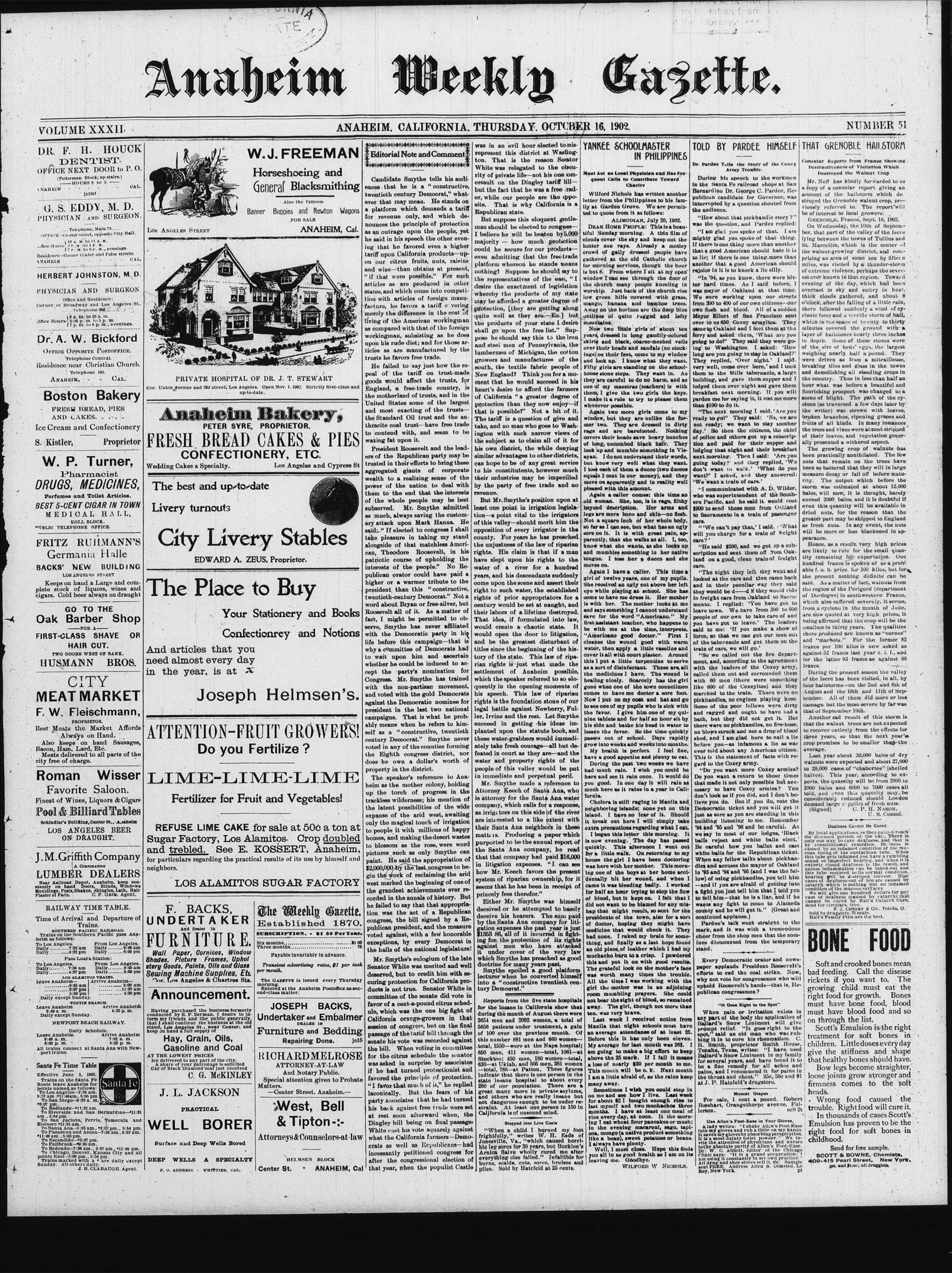
Searchable text
Anaheim
VOLUME XXXII.
DR. F. H. HOUCK
DENTIST.
OFFICE NEXT DOOR to P. O.
(Feterman Block; upstairs.)
HOURS 9 to 5.
ANAHEIM CAL.
G. S. EDDY, M. D.
PHYSICIAN AND SURGEON.
Telephone, Main 75...
OFFICE—Center street, opposite City Hall.
10 A.M. to 11 A.M.
Office Hours 2 P.M. to 4 P.M.
7 P.M. to 8 P.M., evenings.
Residence—Corner Center and Palm streets.
ANAHEIM CAL.
HERBERT JOHNSTON, M. D.
PHYSICIAN AND SURGEON.
Office and Residence:
Corner of Broadway and Los Angeles St..
Telephone 656...
9 a.m. to 10 a.m.
Office Hours 3:30 p.m. to 5 p.m.
7 p.m. to 8 p.m., evenings.
Dr. A. W. Bickford
OFFICE OPPOSITE POSTOFFICE.
Telephone Central.
Residence near Christian Church.
Telephone 101.
ANAHEIM, CAL.
Boston Bakery
FRESH BREAD, PIES
AND CAKES.
Ice Cream and Confectionery
S. Kistler, Proprietor
W. P. Turner,
Pharmacist
W.J.FREEMAN
Horseshoeing and
General Blacksmithing
Also the famous
Banner Buggies and Newton Wagon
FOR SALE
ANAHEIM, Ca
PRIVATE HOSPITAL OF DR. J. T. STEWART
Cor. Union Avenue and 23d street, Los Angeles. Open Nov. 1, 1902. Strictly first-class anup-to-date.
Anaheim Bakery,
PETER SYRE, PROPRIETOR.
FRESH BREAD CAKES & PIES
CONFECTIONERY, ETC.
Wedding Cakes a Specialty. Los Angeles and Cypress S
Boston Bakery
FRESH BREAD, PIES AND CAKES.
Ice Cream and Confectionery
S. Kistler, Proprietor
W. P. Turner,
Pharmacist
DRUGS, MEDICINES,
Perfumes and Toilet Articles.
BEST 5-CENT CIGAR IN TOWN MEDICAL HALL,
KOLL BLOCK.
PUBLIC TELEPHONE OFFICE.
FRITZ RUHMANN'S Germania Halle
BACKS' NEW BUILDING
LOS ANGELES STREET
Keeps on hand a Large and complete stock of liquors, wines and cigars. Cold beer always on draught
GO TO THE Oak Barber Shop
FOR A FIRST-CLASS SHAVE OR HAIR CUT.
TWO DOORS WEST OF BANK.
HUSMANN BROS.
CITY MEAT MARKET
F. W. Fleischmann,
PROPRIETOR.
Best Meats the Market Affords Always on Hand.
Also keeps on hand Sausages, Bacon, Ham, Lard, Etc.
Meats delivered to all parts of the city free of charge.
Roman Wisser
Favorite Saloon.
Finest of Wines, Liquors & Cigars
Pool & Billiard Tables
Schindler's Building, Center St., Anaheim
LOS ANGELES BEER ON DRAUGHT.
J.M. Griffith Company
A CORPORATION
LUMBER DEALERS
Near Railroad Depot, Anaheim, keep constantly on hand Doors, Blinds, Windows Mouldings, Posts, Shakes, Shingles, Lath, Hair Plaster of Paris.
PRIVATE HOSPITAL OF DR. J. T. STEWART
Cor. Union Avenue and 23d street, Los Angeles. Open Nov. 1, 1902. Strictly first-class and up-to-date.
Anaheim Bakery,
PETER SYRE, PROPRIETOR.
FRESH BREAD CAKES & PIES CONFECTIONERY, ETC.
Wedding Cakes a Specialty. Los Angeles and Cypress Street
The best and up-to-date
Livery turnouts
City Livery Stables
EDWARD A. ZEUS, Proprietor.
The Place to Buy
Your Stationery and Book
Confectionrey and Notion
And articles that you need almost every day in the year, is at Joseph Helmsen's
ATTENTION-FRUIT GROWERS
Do you Fertilize?
LIME-LIME-LIME
Fertilizer for Fruit and Vegetables!
REFUSE LIME CAKE for sale at 50¢ a ton a Sugar Factory, Los Alamitos. Crop double and trebled. See E. KOSSERT, Anaheim for particulars regarding the practical results of its use by himself and neighbors.
LOS ALAMITOS SUGAR FACTORY
F. BACKS,
UNDERTAKER
And Dealer in
FURNITURE.
Wall Paper, Cornices, Window
Shades, Picture Frames, Upholstery Goods, Paints, Oils and Glass
Sewing Machine Supplies, Etc.
Cor. Los Angeles & Chartres Sts.
Announcement.
Having purchased the business formerly conducted by R. F. Zerman, I desire to inform my friends and the public generally, that I shall continue the business at the old stand, Los Angeles St., near Center, and keep on hand a full supply of Hay, Grain, Oils, Gasoline and Coal
AT THE LOWEST PRICES
Ice delivered to any part of the city.
A share of your patronage is solicited
Car of Black Diamond coal just received
C. G. McKINLEY
J. L. JACKSON
PRACTICAL
WELL BORER
Surface and Deep Wells Bored
DEEP WELLS A SPECIALTY
P. O. ADDRESS - WHITTIER, CAL.
ANAHEIM, CALIFORNIA, THURSDAY, OCTOBER 16, 1902.
FREEMAN
shoeing and
of Blacksmithing
Also the famous
goggles and Newton Wagons
FOR SALE
ANAHEIM, Cal.
Editorial Note and Comment
Candidate Smythe tells his audiences that he is a "constructive, twentieth century Democrat," whatever that may mean. He stands on a platform which demands a tariff for revenue only, and which denounces the principle of protection as an outrage upon the people, yet he said in his speech the other evening that he favored even a higher tariff upon California products—upon our citrus fruits, nuts, raisins and wine—than obtains at present, "if that were possible." For such articles as are produced in other states, and which come into competition with articles of foreign manufacture, he favors a tariff covering merely the difference in the cost of living of the American workingman as compared with that of the foreign workingman, subsisting as he does upon his rude diet; and for those articles as are manufactured by the trusts he favors free trade.
He failed to say just how the repeal of the tariff on trust-made goods would affect the trusts, for England, a free-trade country, is the motherland of trusts, and in the United States some of the largest and most exacting of the trusts—the Standard Oil trust and the anthracite coal trust—have free trade to contend with, and seem to be waxing fat upon it.
President Roosevelt and the leaders of the Republican party may be trusted in their efforts to bring these aggregated giants of corporate was in an evil hour elected to misrepresent this district at Washington. That is the reason Senator White was relegated to the obscurity of private life—not his one somersault on the Dingley tariff till but the fact that he was a free rader, while our people are the opposite. That is why California is a Republican state.
But suppose this eloquent gentleman should be elected to congress—I believe he will be beaten by 5,000 majority — how much protection could he secure for our products—even admitting that the free-trade platform whereon he stands means nothing? Suppose he should say to the representatives of the east, "I desire the enactment of legislation whereby the products of my state may be afforded a greater degree of protection, [they are getting along quite well as they are.] Ed.] but the products of your state I desire shall go upon the free list." Suppose he should say this to the iron and steel men of Pennsylvania, the lumbermen of Michigan, the cotton growers and manufactures of the south, the textile fabric people of New England? Think you for a moment that he would succeed in his heart's desire to afford the farmers of California "a greater degree of protection than they now enjoy—if that is possible?" Not a bit of it. The tariff is a question of give and take, and no man who goes to Washington with such narrow views of the subject as to claim all of it for his own district, the while denying similar advantages to other districts, can hope to be of any great service to his constituents, however much
YANKEE SCHOOLMASTER IN PHILIPPINE
Must Act as Local Physician and Haitian Calls to Contribute Toward Charity
Wilford Nichols has written an letter from the Philippines to his sister at Garden Grove. We are pleased to quote from it as follows:
ALIMODIAN, July 20, 1902
DEAR HOME PEOPLE: This is a faithful Sunday morning. A thin cloud cover the sky and keep our hotter sun rays. Already a crowd of gaily dressed people gathered at the old Catholic church for morning services, though there is but 8. From where I sit at my window I can see through the door the church many people kneelin' worship. Just back of the church low green hills covered with mango, banana and bamboo. Away on the horizon are the deep outlines of quite rugged and mountainous.
Now two little girls of about years, dressed in long gaudilly-coats and black, coarse-meshed over their heads and sandals (no wings) on their feet, come to my window and look up. I know what they are: Fifty girls are standing on the seaside stone steps. They want in them they are careful to do no harm, one of my maestras (teachers) is them, I give the two girls the I make it a rule to try to please whenever possible.
Again two more girls come to window, but they are unlike their two. They are dressed in rags and are barefoot. No covers their heads save heavy wool of long, uncombed black hair. Look up and mumble something in ayan. I do not understand their but know very well what they I toss each of them a duco (two dumbbells).
President Roosevelt and the leaders of the Republican party may be trusted in their efforts to bring these aggregated giants of corporate wealth to a realizing sense of the power of the nation to deal with them to the end that the interests of the whole people may be best subserved. Mr. Smythe admitted as much, always saving the customary attack upon Mark Hanna. He said: "If elected to congress I shall take pleasure in taking my stand alongside of that matchless American, Theodore Roosevelt, in his patriotic course of upholding the interests of the people." No Republican orator could have paid a higher or a warmer tribute to the president than this "constructive, twentieth-century Democrat." Not a word about Bryan or free-silver, but Roosevelt all of it. As a matter of fact, I might be permitted to observe, Smythe has never affiliated with the Democratic party in his life before this campaign—that is why a committee of Democrats had to wait upon him and ascertain whether he could be induced to accept the party's nomination for Congress. Mr. Smythe has trained with the non-partisan movement, and voted with the gold Democrats against the Democratic nominee for president in the last two national campaigns. That is what he probably means when he refers to himself as a "constructive, twentieth century Democrat." Smythe never voted in any of the counties forming the Eighth congress district, nor does he own a dollar's worth of property in the district.
The speaker's reference to Anaheim as the mother colony, holding up the torch of progress in the trackless wilderness; his mention of the latent possibilities of the wide expanse of the arid west, awaiting only the magical touch of irrigation to people it with millions of happy homes, and making the desert wastes to blossom as the rose, were word pictures such as only Smythe can paint. He said the appropriation of $2,000,000 by the last congress to begin the work of reclaiming the arid west marked the beginning of one of the grandest achievements ever recorded in the annals of history. But New England? Think you for a moment that he would succeed in his heart's desire to afford the farmers of California "a greater degree of protection than they now enjoy—if that is possible?" Not a bit of it. The tariff is a question of give and take, and no man who goes to Washington with such narrow views of the subject as to claim all of it for his own district, the while denying similar advantages to other districts, can hope to be of any great service to his constituents, however much their industries may be imperilled by the party of free trade and no revenue.
But Mr. Smythe's position upon at least one point in irrigation legislation—a point vital to the irrigators of this valley—should merit him the opposition of every irigator in the county. For years he has preached the unjustness of the law of riparian rights. His claim is that if a man have slept upon his rights to the water of a river for a hundred years, and his descendants suddenly come upon the scene and assert their right to such water, the established rights of prior appropriators for a century would be set at naught, and their labors of a lifetime destroyed. That idea, if formulated into law, would create a chaotic state. It would open the door to litigation, and be the greatest disturbant of titles since the beginning of the history of the state. This law of riparian rights is just what made the settlement of Anaheim possible, which the speaker referred to so eloquently in the opening moments of his speech. This law of riparian rights is the foundation stone of our legal battle against Newberry, Fuller, Irvine and the rest. Let Smythe succeed in getting his ideas implanted upon the statute book, and these water-grabbers would immediately take fresh courage—all but defeated in court as they are—and the water and property rights of the people of this valley would be put in immediate and perpetual peril.
Mr. Smythe made a reference to Attorney Keech of Santa Ana, who is attorney for the Santa Ana water company, which calls for a response, as irrigators on this side of the river are interested to a like extent with their Santa Ana neighbors in these matters. Producing a paper which purported to be the annual report of the Santa Ana company, he read that that company had paid $16,000 in litigation expenses. "I can see how Mr. Keech favors the present system of riparian ownership, for it seems that he has been in receipt of princely fees therefor."
Again two more girls come to window, but they are unlike those mer two. They are dressed in rags and are barefooted. No covers their heads save heavy bullets for long, uncombed black hair. Look up and mumble something in ayan. I do not understand their way but know very well what they say. I toss each of them a duco (two equals I count in our money), and move on apparently and in reality pleased with this amount.
Again a caller comes; this time old woman. She, too, is rags, beyond description. Her arms legs are mere bone and skin—not. Not a square inch of her whole body so far as I can see, but what has an sore on it. It is with great pain parentily, that she walks at all. I know what she wants, as she looks and mumbles something in her tongue. I toss her a ducco and moves on.
Again I have a caller. This girl of twelve years, one of my pts She received an ugly cut above her eye while playing at school. She come to have me dress it. Her m is with her. The mother looks at and says something I cannot under save for the word "Americano." First assistant teacher, who happens be with me at the time, intere "Americano good doctor." Ff cleanse the wound good with water, then apply a little vaseline cover it all with court plaster. After this I put a little turpentine to as a sort of disinfectant. These are the medicines I have. The wounds healing nicely. Scarcely has tha gone when one of the town councils comes to have me doctor a sorrel Now I put on my coat and hat as to see one of my pupils who is sick fever. I give him one of mine tablets and for half an hour his side and bathe his head in water lessen the fever. So the time quares out of school. Days grow into weeks and weeks into new.
My health is perfect. I feel have a good appetite and plenty t
During the past two weeks we had much rain. I wish you couch here and see it rain once. It wou you good. In one day it will r much here as it rains in a year in fornis.
Cholera is still raging in Manila neighboring islands; none yet on island. I have no fear of it. It break out here I will simply extra precautions regarding what I began letter this morning is now evening. The day has quickly. This afternoon I went for a little walk. On returning house the girl I have been doc was here with her mother. This ing one of the boys at her home dentally hit her wound, and w came it was bleeding badly. I for half an hour trying to stop tha blood, but it kept on. I felt
Mr. Smythe's eulogium of the late Senator White was merited and well deserved, but to credit him with securing protection for California products is not true. Senator White in committee of the senate did vote in favor of a cent-a-pound citrus schedule, which was the one big fight of California orange-growers in that session of congress, but on the final passage of the tariff bill through the senate his vote was recorded against the bill. When voting in committee for the citrus schedule the senator was asked in surprise by associates if he had turned protectionist and favored the principle of protection. "I favor that much of it," he replied laconically. But the fears of his party associates that he had turned his back against free trade were set at rest soon afterward when, the Dingley bill being on final passage, White cast his vote squarely against what the California farmers—Democrats as well as Republicans—had incessantly petitioned congress for after the congressional election of that year, when the populist Castle trackless wilderness; his mention of the latent possibilities of the wide expanse of the arid west, awaiting only the magical touch of irrigation to people it with millions of happy homes, and making the desert wastes to blossom as the rose, were word pictures such as only Smythe can paint. He said the appropriation of $2,000,000 by the last congress to begin the work of reclaiming the arid west marked the beginning of one of the grandest achievements ever recorded in the annals of history. But he failed to say that that appropriation was the act of a Republican congress, the bill signed by a Republican president, and the measure voted against, with a few honorable exceptions, by every Democrat in the halls of the national legislature!
Mr. Smythe's eulogium of the late Senator White was merited and well deserved, but to credit him with securing protection for California products is not true. Senator White in committee of the senate did vote in favor of a cent-a-pound citrus schedule, which was the one big fight of California orange-growers in that session of congress, but on the final passage of the tariff bill through the senate his vote was recorded against the bill. When voting in committee for the citrus schedule the senator was asked in surprise by associates if he had turned protectionist and favored the principle of protection. "I favor that much of it," he replied laconically. But the fears of his party associates that he had turned his back against free trade were set at rest soon afterward when, the Dingley bill being on final passage, White cast his vote squarely against what the California farmers—Democrats as well as Republicans—had incessantly petitioned congress for after the congressional election of that year, when the populist Castle trackless wilderness; his mention of the latent possibilities of the wide expanse of the arid west, awaiting only the magical touch of irrigation to people it with millions of happy homes, and making the desert wastes to blossom as the rose, were word pictures such as only Smythe can paint. He said the appropriation of $2,000,000 by the last congress to begin the work of reclaiming the arid west marked the beginning of one of the grandest achievements ever recorded in the annals of history. But he failed to say that that appropriation was the act of a Republican congress, the bill signed by a Republican president, and the measure voted against, with a few honorable exceptions, by every Democrat in the halls of the national legislature!
Mr. Smythe's eulogium of the late Senator White was merited and well deserved, but to credit him with securing protection for California products is not true. Senator White in committee of the senate did vote in favor of a cent-a-pound citrus schedule, which was the one big fight of California orange-growers in that session of congress, but on the final passage of the tariff bill through the senate his vote was recorded against the bill. When voting in committee for the citrus schedule the senator was asked in surprise by associates if he had turned protectionist and favored the principle of protection. "I favor that much of it," he replied laconically. But the fears of his party associates that he had turned his back against free trade were set at rest soon afterward when, the Dingley bill being on final passage, White cast his vote squarely against what the California farmers—Democrats as well as Republicans—had incessantly petitioned congress for after the congressional election of that year, when the populist Castle trackless wilderness; his mention of the latent possibilities of the wide expanse of the arid west, awaiting only the magical touch of irrigation to people it with millions of happy homes, and making the desert wastes to blossom as the rose, were word pictures such as only Smythe can paint. He said the appropriation of $2,000,000 by the last congress to begin the work of reclaiming the arid west marked the beginning of one of the grandest achievements ever recorded in the annals of history. But he failed to say that that appropriation was the act of a Republican congress, the bill signed by a Republican president, and the measure voted against, with a few honorable exceptions, by every Democrat in the halls of the national legislature!
Mr. Smythe's eulogium of the late Senator White was merited and well deserved, but to credit him with securing protection for California products is not true. Senator White in committee of the senate did vote in favor of a cent-a-pound citrus schedule, which was the one big fight of California orange-growers in that session of congress, but on the final passage of the tariff bill through the senate his vote was recorded against the bill. When voting in committee for the citrus schedule the senator was asked in surprise by associates if he had turned protectionist and favored the principle of protection. "I favor that much of it," he replied laconically. But the fears of his party associates that he had turned his back against free trade were set at rest soon afterward when, the Dingley bill being on final passage, White cast his vote squarely against what the California farmers—Democrats as well as Republicans—had incessantly petitioned congress for after the congressional election of that year, when the populist Castle trackless wilderness; his mention of the latent possibilities of the wide expanse of the arid west, awaiting only the magical touch of irrigation to people it with millions of happy homes, and making the desert wastes to blossom as the rose, were word pictures such as only Smythe can paint. He said the appropriation of $2,000,000 by the last congress to begin the work of reclaiming the arid west marked the beginning of one of the grandest achievements ever recorded in the annals of history. But he failed to say that that appropriation was the act of a Republican congress, the bill signed by a Republican president, and the measure voted against, with a few honorable exceptions, by every Democrat in the halls of the national legislature!
Mr. Smythe's eulogium of the late Senator White was merited and well deserved, but to credit him with securing protection for California products is not true. Senator White in committee of the senate did vote in favor of a cent-a-pound citrus schedule, which was the one big fight of California orange-growers in that session of Congress, but on the final passage of the tariff bill through the senate his vote was recorded against the bill. When voting in committee for the citrus schedule the senator was asked in surprise by associates if he had turned protectionist and favored the principle of protection. "I favor that much of it," he replied laconically. But the fears of his party associates that he had turned his back against free trade were set at rest soon afterward when, The Dingley bill being on final passage, White cast his vote squarely against what the California farmers—Democrats as well as Republicans—had incessantly petitioned congress for after the congressional election of that year, when The populist Castle trackless wilderness; his mention of the latent possibilities of the wide expanse of the arid west, awaiting only the magical touch of irrigation to people it with millions of happy homes, and making the desert wastes to blossom as the rose, were word pictures such as only Smythe can paint. He said the appropriation of $2,000,000 by the last congress to begin the work of reclaiming the arid west marked one of the grandest achievements ever recorded in the annals of history. But he failed to say that that appropriation was the act of a Republican congress, which calls for a response, as irrigators on this side of river are interested to a like extent with their Santa Ana neighbors in these matters. Producing a paper which purported to bethe annual reportoftheSanta Ana company, he readthat that company had paid$16,000in litigation expenses.“I can seehow Mr.Keech favors present systemof riparian ownership,foritseemsthathehas beenin receiptofprincelyfeestherefor.”
Either Mr. Smythe was himself deceived or he attempted to baselydeceivehis hearers.The sumpaidbytheSanta Anacompanyforlitigationexpensesthepastyearisjust$185386.allofit incurredinfightingfortheprotectionofitsrightsagainstmenwhohaveattackeditundercoveroftheverylawwhichSmythehaspreachedasgooddoctrineforyanyyearspast.
Smythe spoileda good platformlecturerwhenheconvertedhimselfintoa“constructivetwentiethcenturyDemoerat.”
ReportsfromthefivestatehospitalsfortheinsaneinCaliforniashowthatduringthemonthofAugusttherewere3654menand2092 women,a totalof5656patientsundertreatment,a gainof100overthepreviousmonth.Ofthisnumber881menand669women-total,1550-wereatattheNapa hospital;650men,411women-total,1061-atStockton;450men,180women-total,630-atUkiah,and505men,261women-total,766-atPattonThesefiguresindicatethatthereisonepersoninthenatsinsanehospitaltoaboutevery260ofourpopulationTherearea greatmanymoreinprivateasylums,andotherswhoarereallyinsanebutnotdangerousenoughtobeunderrestraint.Atleastonepersonin150inCaliforniaisofunsoundmind.
SteptoinedintLiveCoals
“Whena childIburned myfootfrightfully,”writesW.H.EadsofJonesville,Va.,“whichcausedhorriblelegsoresfor30years,butBucklen’sArnicaSalvewhollycuredmeaftereverythingelsefailed.”Infallibleforburns,scalds,cuts,sores,bruisesandpiles.SoldbyHatzfeldat25cents.
Cholerais still raginginManilaneighboring islands;none yetonisland.Ihaveno fearofit.SincebreakouthereIwillbreakouthereifhegivesonedoorthegirlIhavebeendoomedidentallyhitherwound,andw cameitwasbleedingbadly.Iwforhalfan hourtryingtostopthattof blood,但它 kepton.I feltdidnot wanttobeblamedforanapaphthatmightresult,sowentpresidenteofthetown,也fort doctor,hopingtheymightmedicinethat wouldcheckit.hadnone.Irakedmybrainformething,andfinallyaslasthopeanoldpieceof leatherwhichImuchachoburntoacrisp.IpowthisandputitonwithgoodmilkThegratefullookonthemotherwasworthmanytimesthetAllthetimeIwasworkingwhigirlthermaisonwasinanadroommumbling prayers.Shenotbearthesightofblood,soreaway.The girl,tthoughnotmomentewasverybrave.
LastweekIreceivednoticeManilathatnightschoolsmustan average attendanceofatlakeBeforethisit hasonlybeenMyaverageforlastmonthwasamgoingtomakeabigeffortabove25mark.IfIffallitloa lossof nearly$20permonthThismouthwillbew.o.k.NextIamalittleafraidof,theraisemanyaway.
SometimesI wishyou coulddonmeandseehowIlive.Learnfors about$2I bought enoughforlastmyselfandtwomuchachobrownlikeabean,sweetpotatoesorIalways haveplenty.Well,我mustclose.Hope thoyallinasgoodhealthasIamleavingme.Goodbye.
WILFORD W NICE
Gazette.
16, 1902. NUMBER 51
KEE SCHOOLMASTER IN PHILIPPINES
Act as Local Physician and Has Present Calls to Contribute Toward Charity
Almond Nichols has written another letter from the Philippines to his family Garden Grove. We are permit-able to quote from it as follows:
ALIMODIAN, July 20, 1902.
AR HOME PEOPLE: This is a beau-tiful Sunday morning. A thin film of water cover the sky and keep out the sun rays. Already a motley crowd of gaily dressed people have gathered at the old Catholic church morning services, though the hour is 8. From where I sit at my open door I can see through the door of church many people kneeling in ship. Just back of the church rise green hills covered with grass, two banana and bamboo trees. On the horizon are the deep blue waters of quite rugged and lofty attains.
Two little girls of about ten dressed in long gaudilly-colored jeans and black, coarse-meshed veils their heads and sandals (no stock on their feet, come to my window look up. I know what they want. Girls are standing on the school-stone steps. They want in. As are careful to do no harm, and as if my maestras (teachers) is with me, I give the two girls the keys. Make it a rule to try to please them never possible.
Two more girls come to my now, but they are unlike the for-ter two. They are dressed in dirty and are barefoot. Nothing else their heads save heavy bunches of uncombed black hair. They up and mumble something in Visitation. I do not understand their words, know very well what they want. Each of them a duco (two ducos)
TOLD BY PARDEE HIMSELF
Dr. Pardee tells the Story of the Coxey Army Trouble.
During his speech to the workmen in the Santa Fe railroad shops at San Bernardino Dr. George C. Pardee, Republican candidate for Governor, was interrupted by a question shouted from the audience.
"How about that pickhandle story?" was the question, and Pardee replied:
"I am glad you spoke of that. I am mighty glad you spoke of that thing. If there is one thing more than another that a good American should hate it is to lie; if there is one thing more than another that a good American should rejoice in it is to knock a lie silly.
In '94, as you know, there were bitter hard times. As I said before, I was mayor of Oakland at that time. We were working upon our streets from 300 to 400 of our own citizens—our own flesh and blood. All of a sudden Mayor Ellert of San Francisco sent over to us 650 Coxey armyles. They came to Oakland and I met them at the ferry and asked them, 'What are you going to do?' They said they were going to Washington. I asked: 'How long are you going to stay in Oakland?' They replied, 'Over night.' I said, very well, come over here,' and I took them to the Mills tabernacle, a large building, and gave them supper and I lodged them over night and gave them breakfast next morning. If you will pardon me for saying it, it cost me more than $100 to do it.
"The next morning I said, 'Are you ready to go?' They said: 'No, we are not ready; we want to stay another day.' So then the citizens, the chief of police and others got up a subscription and paid for their supper and lodging that night and their breakfast next morning. Then I said: 'Are you going today?' and they replied, 'We don't want to walk.' "What do you want?"
THAT GRENOBLE HAIL STORM
Consular Reports from France Showing Destructiveness of Visitation Which Destroyed the Walnut Crop
Mr. Neff has kindly forwarded to us a copy of a consular report giving an account of the hailstorm which destroyed the Grenoble walnut crop, previously referred to. The report will be of interest to local growers:
GRENOBLE, France, Sept. 16, 1902.
On Wednesday, the 10th of September, that part of the valley of the Isère lying between the towns of Tullius and St. Marcellin, which is the center of the walnut-growing district, and comprising an area of some ten by fifteen miles, was visited by a thunder-storm of extreme violence, perhaps the severest ever known in that region. Toward evening of the day, which had been overcast in sky and sultry in heat, thick clouds gathered, and about 8 o'clock, after the falling of a little rain, there followed suddenly a wind of cyclonic force and a terrific storm of hall, which in the space of twenty to thirty minutes covered the ground with a layer of hailstones nearly three inches in depth. Some of these stones were of the size of hens' eggs, the largest weighing nearly half a pound. They were driven as from a mitrailleuse, breaking tiles and glass in the towns and demolishing all standing crops in the country. Thus in less than half an hour what was before a beautiful and flourishing prospect was changed to a scene of blight. The path of the cyclone (as traversed a few days later by the writer) was strewn with leaves, broken branches, ripening grapes and fruits of all kinds. In many instances the trees and vines were almost stripped of their leaves, and vegetation generally presented a withered aspect.
The growing crop of walnuts has been practically annihilated. The few nuts that remain on the trees have been so battered that they will in large measure decay or fall off before matu-
Brain two more girls come to my show, but they are unlike the two. They are dressed in dirty and are barefooted. Nothing their heads save heavy bunches of uncombed black hair. They cup and mumble something in Visitation. I do not understand their words, know very well what they want. Each of them a ducco (two duccos is one cent in our money), and they can apparently and in reality well feed with this amount.
Brain a caller comes; this time an woman. She, too, is in rags, filthy and description. Her arms and ears were mere bone and skin—no flesh. A square inch of her whole body, as I can see, but what has an ugly on it. It is with great pain, aptly, that she walks at all. I, too, what she wants, as she looks up umbles something in her native home. I toss her a duco and she is on.
Brain I have a caller. This time a total twelve years, one of my pupils received an ugly cut above her left while playing at school. She has to have me dress it. Her mother with her. The mother looks at me says something I cannot understand for the word "Americano." My assistant teacher, who happens to meet me at the time, interprets Americano good doctor." First I use the wound good with warm water, then apply a little vaseline and it all with court plaster. Around I put a little turpentine to serve short of disinfectant. These are all medicines I have. The wound is being nicely. Scarcely has the girl when one of the town councilmen asks to have me doctor a sore foot. I put on my coat and hat and go one of my pupils who is sick with fever. I give him one of my quitables and for half an hour sit by side and bathe his head in water to治 the fever. So the time quickly goes out of school. Days rapidly into weeks and weeks into months. My health is perfect. I feel fine, a good appetite and plenty to eat. During the past two weeks we have much rain. I wish you could be and see it rain once. It would do good. In one day it will rain as here as it rains in a year in California.
Olfera is still raging in Manila and suborling islands; none yet on this land. I have no fear of it. Should break out here I will simply take precautions regarding what I eat, began this letter this morning. It now evening. The day has passed recently. This afternoon I went out a little walk. On returning to my son the girl I have been doctoring there with her mother. This morning one of the boys at her home actually hit her wound, and when I see it was bleeding badly. I worked half an hour trying to stop the flow blood, but it kept on. I felt that
"The next morning I said, 'Are you ready to go?' They said: 'No, we are not ready; we want to stay another day.' So then the citizens, the chief of police and others got up a subscription and paid for their supper and lodging that night and their breakfast next morning. Then I said: 'Are you going today?' and they replied, 'We don't want to walk.' 'What do you want?' I asked, and they answered: 'We want a train of cars.'
"I communicated with A. D. Wilder, who was superintendent of the Southern Pacific, and he said it would cost $900 to send these men from Oakland to Sacramento in a train of passenger cars."
"'We can't pay that,' I said. 'What will you charge for a train of freight cars?'"
"He said $200, and we got up a subscription and sent them off from Oakland on a good, clean train of freight cars."
"The night they left they went and looked at the cars and then came back and in their peculiar way they said they would be d——d if they would ride in freight cars from Oakland to Sacramento. I replied: 'You have got to leave town. We have from 300 to 600 people of our own to take care of and you have got to leave.' The leaders said to me: 'If you make a show of force, so that we can get our men out of the tabernacle and get them on the train of cars, we will go.'"
"So we called out the fire department, and according to the agreement with the leaders of the Coxey army, called them out and surrounded them with 60 men (there were something like 600 of the Coxeyites) and they marched to the train. There were no pickhandles, no engines playing hose. Some of the poor fellows were dirty and ragged and ought to have had a bath, but they did not get it. But there were no pickhandles, no fire-hose, no blows struck and not a drop of blood shed, and I am glad here to nail a lie before you—as infamous a lie as was ever told about any American citizen. This is the statement of facts with regard to the Coxey army.
"Do you want more Coxey armies? Do you want a return to those times that made it not only possible but necessary to have Coxey armies? You don't look as if you did, and I don't believe you do. But if you do, vote the Democratic ticket and you will get it just as sure as you are standing in this building listening to me. Remember '94 and '95 and '96 and be careful. As we say in most of our lodges, 'Black balls reject and white balls elect.' Be careful how you ballot and cast white balls for the Republican ticket. When any fellow talks about pickhandles and accuses the mayor of Oakland in '93 and '94 and '95 (and I was the fellow) of using pickhandles, you tell him—and if you are afraid of getting into a fight you just tell him that I told you to tell him—that he is a liar, and if he
Hence, as a result, very high prices are likely to rule for the small quantity remaining for exportation. One hundred francs is spoken of as a probable f.o.b. price for 100 kilos, but for the present nothing definite can be said. As a matter of fact, walnuts from the region of the Perigord (department of Dordogne) in southwestern France, which also suffered severely, it seems from a cyclone in the month of June, are now quoted at very high prices, it being affirmed that the crop will be the smallest in thirty years. The qualities there produced are known as "cornes" and "marbots." For the former 82 francs per 100 kilos is now asked as against 52 francs last year c.i.f., and for the latter 93 francs as against 68 francs.
During the present season the valley of the Isere has been visited, in all, by four hailstorms—on the 2nd and 8th of August and the 10th and 11th of September. All of them did more or less damage, but the most severe by far was that of September 10th.
Another sad result of this storm is that the walnut trees are not expected to recover entirely from the effects for three years, so that the next year's crop promises to be smaller than the average.
Last year about 30,000 bales of dry walnuts were exported and about 27,000 to 28,000 cases of "chabertes" (shelled halves). This year, according to experts, the quantity will be from 2000 to 3000 bales and 6000 to 7000 cases all told, and even this quantity may be considerably reduced should London demand large supplies of fresh nuts.
(Signed)
C.P.H.NASON
U.S.Consul
DeainessCannotBeCured
By local applications, as they cannot reach the diseased portion of the carcass. There is only one way to cure deafness, and that is by constipation remediated by an inflamed condition of the mucous lining of the eustachial tube. When this tube gets inflamed you have a rumbling sound or imperfect hearing, and when it is entirely closed deafness is the result, and unless inflammation can be taken out and this tube restored to its normal condition bearing full deafness out of ten caused by catarrh, which is nothing but an inflamed condition of the mucous surfaces.
We will give one hundred dollars for any case of deafness (caused by catarrh) that
BONE FOOD
Soft and crooked bones mean bad feeding. Call the disease rickets if you want to. The growing child must eat the right food for growth. Bones must have bone food, blood must have blood food and so on through the list.
Scott's Emulsion is the right treatment for soft bones in children. Little doses every day give the stiffness and shape that healthy bones should have.
Bow legs become straighter, loose joints grow stronger and firmness comes to the soft heads.
Wrong food caused the trouble. Right food will cure it.
In thousands of cases Scott's Emulsion has proven to be the right food for soft bones in childhood.
Send for free sample.
SCOTT & BOWNE, Chemists,
409-415 Pearl Street, New York,
goc. and $1.00; all druggists.