anaheim-gazette 1902-06-19
Scanned page
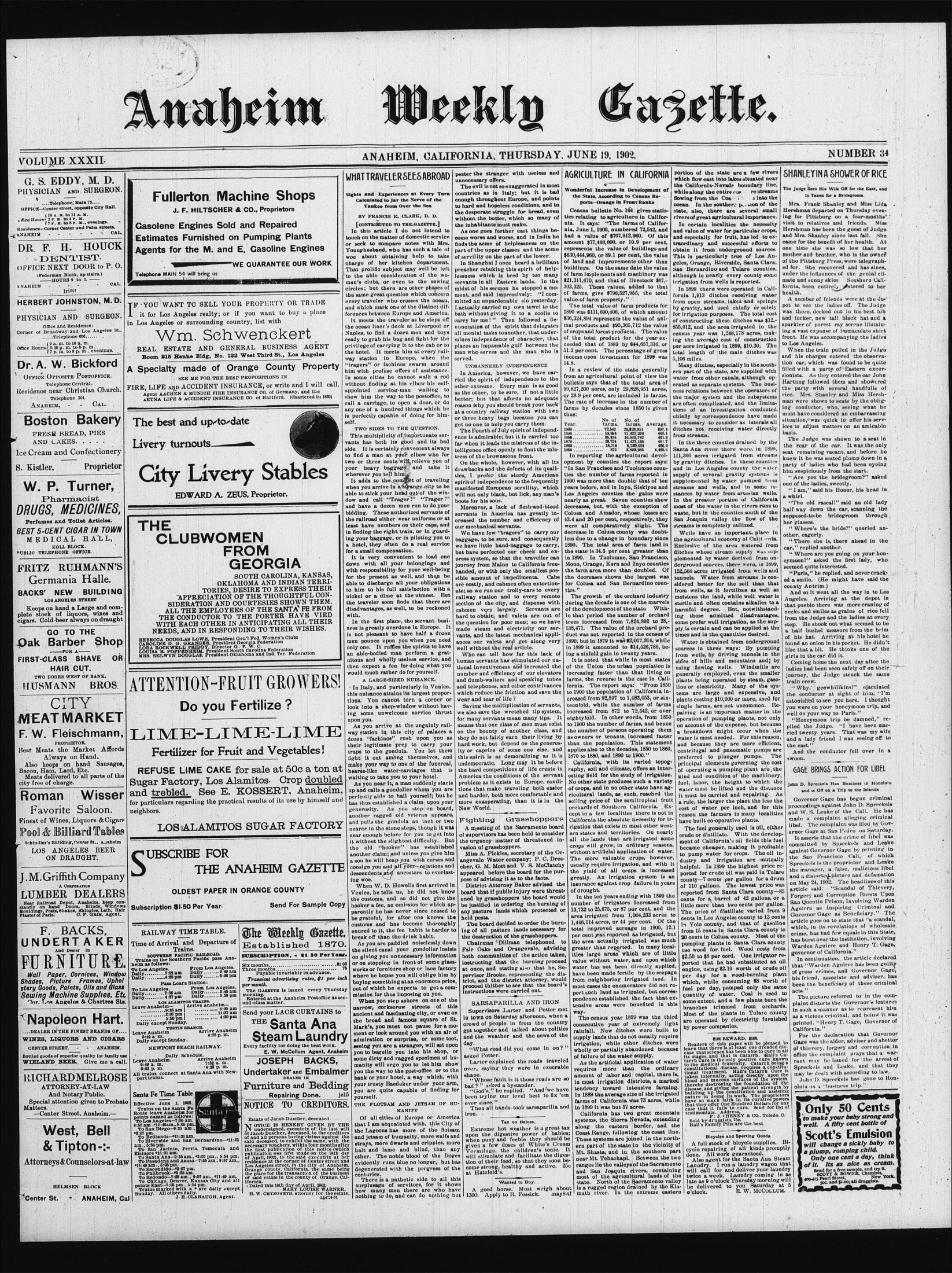
Searchable text
Anaheim
VOLUME XXXII.
G. S. EDDY, M. D. PHYSICIAN AND SURGEON.
OFFICE—Center street, opposite City Hall.
10 A. M. to 11 A. M.
2 P. M. to 4 P. M.
7 P. M. to 8 P. M., evenings.
Residence—Corner Center and Palm streets.
ANAHEIM CAL.
DR. F. H. HOUCK DENTIST.
OFFICE NEXT DOOR to P. O.
(Federman Block, up stairs.)
HOURS 9 to 5
ANAHEIM CAL.
jy15tf
HERBERT JOHNSTON, M. D.
PHYSICIAN AND SURGEON.
Office and Residence:
Corner of Broadway and Los Angeles St.
Telephone 656...
Office Hours
9 a.m. to 10 a.m.
3:30 p.m. to 5 p.m.
7 p.m. to 8 p.m., evenings.
Dr. A. W. Bickford
OFFICE OPPOSITE POSTOFFICE.
Telephone Central.
Residence near Christian Church.
Telephone 101.
ANAHEIM, CAL.
Boston Bakery
FRESH BREAD, PIES AND CAKES.
Ice Cream and Confectionery
S. Kistler, Proprietor
Fullerton Machine Shops
J. F. HILTSCHER & CO., Proprietors
Gasolene Engines Sold and Repaired
Estimates Furnished on Pumping Plants
Agents for the M. and E. Gasoline Engines
WE GUARANTEE OUR WORK
Telephone MAIN 54 will bring us
IF YOU WANT TO SELL YOUR PROPERTY OR TRADE it for Los Angeles realty; or if you want to buy a place in Los Angeles or surrounding country, list with
Wm. Schwenckert
REAL ESTATE AND GENERAL BUSINESS AGENT
Room 215 Henne Bldg, No. 122 West Third St., Los Angeles
A Specialty made of Orange County Property
SEE ME FOR THE BEST PROPOSITIONS IN
FIRE, LIFE AND ACCIDENT INSURANCE, or write and I will call.
Agent AACHEN & MUNICH FIRE INSURANCE CO. of Germany, and the AETNA LIFE & ACCIDENT INSURANCE CO. of Hartford. (Chartered in 1820)
The best and up-to-date
Livery turnouts
City Livery Stables
OFFICE OPPOSITE POSTOFFICE.
Telephone Central.
Residence near Christian Church.
Telephone 101.
ANAHEIM, CAL.
Boston Bakery
FRESH BREAD, PIES AND CAKES.
Ice Cream and Confectionery
S. Kistler, Proprietor
W. P. Turner,
Pharmacist
DRUGS, MEDICINES,
Perfumes and Toilet Articles.
BEST 5-CENT CIGAR IN TOWN MEDICAL HALL,
KOLL BLOCK.
PUBLIC TELEPHONE OFFICE.
FRITZ RUHMANN'S Germania Halle.
BACKS' NEW BUILDING
LOS ANGELES STREET
Keeps on hand a Large and complete stock of liquors, wines and cigars. Cold beer always on draught
GO TO THE Oak Barber Shop
FOR A FIRST-CLASS SHAVE OR HAIR CUT.
TWO DOORS WEST OF BANK.
HUSMANN BROS.
CITY MEAT MARKET
F. W. Fleischmann,
PROPRIETOR.
Best Meats the Market Affords Always on Hand.
Also keeps on hand Sausages, Bacon, Ham, Lard, Etc.
Meats delivered to all parts of the city free of charge.
Roman Wisser
Favorite Saloon.
Finest of Wines, Liquors & Cigars
Pool & Billiard Tables
Schindler's Building, Center St., Anaheim
LOS ANGELES BEER ON DRAUGHT.
J.M. Griffith Company
A CORPORATION
LUMBER DEALERS
SEE ME FOR THE BEST PROPOSitions IN
FIRE, LIFE AND ACCIDENT INSURANCE, or write and I will call.
Agent AACHEN & MUNICH FIRE INSURANCE CO. of Germany, and the AETNA LIFE & ACCIDENT INSURANCE CO. of Hartford. (Chartered in 1820)
The best and up-to-date
Livery turnouts
City Livery Stables
EDWARD A. ZEUS, Proprietor.
THE CLUBWOMEN FROM GEORGIA
SOUTH CAROLINA, KANSAS, OKLAHOMA AND INDIAN TERRIORIES, DESIRE TO EXPRESS THEIR APPRECIATION OF THE THOUGHTFUL CONSIDERATION AND COURTESIES SHOWN THEM.
ALL THE EMPLOYEES OF THE SANTA FE FROM THE CONDUCTOR TO THE PORTER HAVE VIED WITH EACH OTHER IN ANTICIPATING ALL THEIR NEEDS, AND IN RESPONDING TO THEIR WISHES.
REBECCA DOUGLAS LOWE, President Gen'l Fed. Women's Clubs
CAROLINE D. G. GRANGER, President Georgia Federation
LORA ROCKWELL PRIDDY, Director G. F. W. C.
LOUISA B. POPPENHEIM, President South Carolina Federation
MRS. SELWYN DOUGLAS, President Oklahoma and Ind. Ter. Federation
ATTENTION-FRUIT GROWERS!
Do you Fertilize?
LIME-LIME-LIME
Fertilizer for Fruit and Vegetables!
REFUSE LIME CAKE for sale at 50c a ton at Sugar Factory, Los Alamitos. Crop doubled and trebled. See E. KOSSERT, Anaheim, for particulars regarding the practical results of its use by himself and neighbors.
LOS ALAMITOS SUGAR FACTORY
SUBSCRIBE FOR
THE ANAHEIM GAZETTE
OLDEST PAPER IN ORANGE COUNTY
Favorite Saloon.
Finest of Wines, Liquors & Cigars
Pool & Billiard Tables
Schindler's Building, Center St., Anaheim
LOS ANGELES BEER ON DRAUGHT.
J.M. Griffith Company
A CORPORATION
LUMBER DEALERS
Near Railroad Depot, Anaheim, keep constantly on hand Doors, Blinds, Windows Mouldings, Posts, Shakes, Shingles, Lath, Hair Plaster of Paris.
C.F. GRIM, Agent.
F. BACKS,
UNDERTAKER
And Dealer in
FURNITURE.
Wall Paper, Cornices, Window Shades, Picture Frames, Upholstery Goods, Paints, Oils and Glass Sewing Machine Supplies, Etc.
Cor. Los Angeles & Chartres Sts.
Napoleon Hart.
...DEALER IN THE FINEST BRANDS OF...
WINES, LIQUORS AND CIGARS
CENTER STREET, - - ANAHEIM.
Bottled goods of superior quality for family use WIELAND BEER. Give me a call.
RICHARDMELROSE
ATTORNEY-AT-LAW
And Notary Public.
Special attention given to Probate Matters.
—Center Street, Anaheim.—
West, Bell & Tipton--Attorneys& Counselors-at-law
HELMSEN BLOCK
Center St. - ANAHEIM, Cal
RAILWAY TIME TABLE.
Time of Arrival and Departure of Trains.
SOUTHERN PACIFIC RAILROAD.
Trains on the Southern Pacific pass Anaheim as follows:
To Los Angeles. From Los Angeles.
Daily 7:52 am Daily 9:49 am
Daily 4:22 pm Daily 6:06 pm
Pass Loara Station:
To Los Angeles. From Los Angeles.
Daily 7:56 am Daily 9:45 am
Daily 4:27 pm Daily 5:59 pm
LOS ALAMITOS TRAINS.
Leave Anaheim—Arrive Anaheim—
9:35 am 8:00 am
2:07 am 11:37 am
5:50 pm 4:30 pm
Daily except Sunday.
TURTIN BRANCH.
Leave Anaheim Arrive Anaheim
9:49 a.m 4:22 p.m.
Daily except Sunday.
NEWPORT BEACH RAILWAY.
Daily Schedule.
Leave Anaheim Arrive Anaheim
9:49 a.m 7:52 a.m.
6:03 p.m 4:22 p.m.
All trains connect at Santa Ana with Newport trains.
Santa Fe Time Table
Effective June 1, 1902.
Trains on the Santa Fe Route leave Anaheim for points named as follows:
To Los Angeles—7:58 am
9:57 am *11:49 am; 5:06 pm
To San Diego—9:35 am;
*3:07 pm.
To Redlands—*11:31 am.
To Riverside and San Bernardino—*11:31 am; 5:54 pm.
To San Jacinto, Perris, Temecula and Elsinore—*11:31 am.
To Santa Ana—9:35 am; *3:07 pm; 5:54 pm.
To Pasadena and Azusa—7:55 am; 9:57 am;
*11:49 am; 5:06 pm.
To Escondido—*2:07 pm.
To Fallbrook—*9:35 am.
To Redondo—7:55 am; 9:57 am; *11:49 am.
To Chicago, Denver, Kansas City and all points East—5:06 pm; 5:54 pm.
Trains marked with a * are daily except Sunday. All others daily.
J. H. CLABAUGH, Agent.
The Weekly Gazette.
Established 1870.
SUBSCRIPTION, - $1.50 Per Year.
Six months.....$1.00
Three months.....75
Payable invariably in advance.
Transient advertising rates, $1 per inch per month.
The GAZETTE is issued every Thursday morning.
Entered at the Anaheim Postoffice as second-class matter.
Send your LACE CURTAINS to THE Santa Ana Steam Laundry
Every facility for doing the best work.
E. W. McCollum Agent, Anaheim
JOSEPH BACKS,
Undertaker and Embalmer
Furniture and Bedding
Repairing Done. je15
NOTICE TO CREDITORS.
Estate of Jacob Duscher, deceased.
NOTICE IS HEREBY GIVEN BY THE undersigned, executrix of the last will of Jacob Duscher, deceased, to the creditors of and all persons having claims against the said deceased, to exhibit the same, with the necessary vouchers, within four months after the first publication of this notice (which publication was first made on the 24th day of April, 1902), to the said executrix at her residence at the corner of Center street and Los Angeles street in the city of Anaheim, Orange county, California, the same being the place for the transaction of the business of said estate in the county of Orange, California.
Dated this 18th day of April, 1902.
MARY LOUISE WARNER.
H. W. CHYNOWETH, attorney for the estate,
apr24-5t
WHAT TRAVELER SEES ABROAD
Sights and Experiences at Every Turn
Calculated to Jar the Nerve of the Yankee from Over the Sea
BY FRANCIS E. CLARK, D. D.
[CONTRIBUTED TO THE GAZETTE.]
In this article I do not intend to touch on the matter of domestic service or seek to compare notes with Mrs. Younghusband, who has such a tale of woe about obtaining help to take charge of her kitchen department. That prolific subject may well be left to the able consideration of the woman's clubs, or even to the sewing circles; but there are other phases of the same great question which concern every traveler who crosses the ocean, and which mark one of the distinct differences between Europe and America.
It meets the traveler as he steps off the ocean liner's deck at Liverpool or Naples, to find a dozen men and boys ready to grab his bag and fight for the privilege of carrying it to the cab or to the hotel. It meets him at every railway station in Europe, when the "tragers" or fachinos swarm around him with profuse offers of assistance. In some cities he cannot walk a rod without finding at his elbow his self-appointed serving-man waiting to show him the way to the postoffice, to call a carriage, to open a door, or do any one of a hundred things which he is perfectly capable of doing for himself.
TWO SIDES TO THE QUESTION.
This multiplicity of importunate servants has both its good and its bad side. It is certainly convenient always to find a man at your elbow who for two or three cents will relieve you of your heavy baggage and take it wherever you tell him.
pester the stranger with useless and unnecessary offers.
The evil is not so exaggerated in most countries as in Italy; but it is bad enough throughout Europe, and points to hard and hopeless conditions, and to the desperate struggle for bread, even without the butter, which so many of the inhabitants must make.
As one goes further east things become worse and worse, and in India he finds the acme of helplessness on the part of the upper classes and the acme of servility on the part of the lower.
In Shanghai I once heard a brilliant preacher rebuking this spirit of helplessness which is bred by too many servants in all Eastern lands. In the midst of his sermon he stopped a moment, and said impressively: "I committed an unpardonable sin yesterday. I actually carried my own towel to the bath without giving it to a coolie to carry for me!" Then followed a denunciation of the spirit that delegates all menial tasks to another, that undermines independence of character, that places an impassable gulf between the man who serves and the man who is served.
UNMANNERLY INDEPENDENCE
In America, however, we have carried the spirit of independence to the other extreme. Every man is as good as the other, to be sure, if not a little better; but that affords no adequate reason why you should break your back at a country railway station with two or three heavy bugs because you can get no one to help you carry them.
The Fourth of July spirit of independence is admirable; but it is carried too far when it leads the mistress of the intelligence office openly to flout the mistress of the brownstone front.
On the whole, however, with all its drawbacks and the defects of its qualities, I prefer the sturdy American agriculture in California.
Wonderful Increase in Development of the State. According to Census Reports—Orange in Front Ranks
Census bulletin No. 164 gives statistics relating to agriculture in California. It says: "The farms of California, June 1, 1900, numbered 72,542, and had a value of $707,912,960. Of this amount $77,468,000, or 10.9 per cent, represents the value of buildings and $630,444,960, or 89.1 per cent, the value of land and improvements other than buildings. On the same date the value of farm implements and machinery was $21,311,670, and that of livestock $67,-303,325. These values, added to that of farms, give $796,527,955, the total value of farm property."
The total value of farm products for 1890 was $131,690,606, of which amount $36,324,894 represents the value of animal products and $95,365,712 the value of crops and forest products. The value of the total product for the year exceeded that of 1889 by $44,657,316, or 51.3 per cent. The percentage of gross income upon investment for 1899 was 14.8.
In a review of the state generally from an agricultural point of view the bulletin says that of the total area of 99,827,200 acres, only 29,828,951 acres, or 28.9 per cent, are included in farms. The rate of increase in the number of farms by decades since 1850 is given thus:
| Year | No. of Farms | No. of Farms | Average |
| :--- | :--- | :--- | :--- |
| 1900 | 72,542 | 28,828,951 | 897.4 |
| 1890 | 59,894 | 21,427,293 | 405.1 |
| 1889 | 35,934 | 16,503,742 | 461.8 |
| 1870 | 28,724 | 11,427,105 | 481.7 |
| 1860 | 18,716 | 8,720,034 | 466.4 |
| 1850 | 872 | 3,893,985 | 4,465.6 |
In reporting the agricultural development by counties the report says: "In San Francisco and Tuolumne counties the number of farms reported in
In some cities he cannot walk a rod without finding at his elbow his self-appointed servant waiting to show him the way to the postoffice, to call a carriage, to open a door, or do any one of a hundred things which he is perfectly capable of doing for himself.
TWO SIDES TO THE QUESTION.
This multiplicity of importunate servants has both its good and its bad side. It is certainly convenient always to find a man at your elbow who for two or three cents will relieve you of your heavy baggage and take it wherever you tell him.
It adds to the comfort of traveling when you arrive in a strange city to be able to stick your head out of the window and call "Trager!" "Trager!" and have a dozen men run to do your bidding. These authorized servants of the railroad either wear uniforms or at least have numbers on their caps, and in finding the right train, or in guarding your baggage, or in piloting you to a hotel, they often do a real service for a small compensation.
It is very convenient to load one down with all your belongings and with responsibility for your well-being for the present as well, and then be able to discharge all your obligations to him to his full satisfaction with a nickel or a dime at the utmost. But the traveler soon finds that there are disadvantages, as well, to be reckoned with.
In the first place, the servant business is greatly overdone in Europe. It is not pleasant to have half a dozen men pounce upon you when you need only one. It ruffles the spirits to have an able-bodied man perform a gratuitous and wholly useless service, and then expect a fee for doing what you would much rather do for yourself.
A LARGE-SIZED NUISANCE.
In Italy, and particularly in Venice, this nuisance attains its largest proportions. You cannot turn a corner or look into a shop-window without having some unwelcome service thrust upon you.
As you arrive at the ungainly railway station in this city of palaces a dozen "fachinos" rush upon you as their legitimate prey to carry your traps to the gondola. You let them tight it out among themselves, and make your way to one of the funereal, hearse-like water-carriages that is waiting to take you to your hotel.
As you near it, a man suddenly starts up and calls a gondoller whom you are perfectly able to hail yourself; but he has thus established a claim upon your generosity. As you step on board, another ragged old veteran appears, and pulls the gondola an inch or two nearer to the stone steps, though it was near enough before for you to get into it without the slightest difficulty. But the old "hooker" has established another claim; and unless you give him a sou he will heap you with curses and consign you and all your relations and descendants and ancestors to everlasting woe.
When W. D. Howells first arrived in Venice, he tells us, he did not know the customs, and so did not give the America, however, we have carried the spirit of independence to the other extreme. Every man is as good as the other, to be sure, if not a little better; but that affords no adequate reason why you should break your back at a country railway station with two or three heavy bags because you can get no one to help you carry them.
The Fourth of July spirit of independence is admirable; but it is carried too far when it leads the mistress of the intelligence office openly to flout the mistress of the brownstone front.
On the whole, however, with all its drawbacks and the defects of its qualities, I prefer the sturdy American spirit of independence to the frequently manifested European servility, which will not only black, but lick, any man's boots for his sous.
Moreover, a lack of flesh-and-blood servants in America has greatly increased the number and efficiency of our mechanical servants.
We have few "tragers" to carry our baggage, to be sure, and consequently we have little hand-baggage to carry, but have perfected our check and express system, so that the traveller can journey from Maine to California free-handed, or with only the smallest possible amount of impediments. Cabs are costly, and cabmen often extortionate; so we run our trolly-cars to every railway station and to every remote section of the city, and dispense with cabmen very largely. Servants are hard to obtain, and valets are out of the question for poor men; so we have made steam and electricity our servants, and the latest mechanical appliances our valets and get along very well without the real article.
Who can tell how far this lack of human servants has stimulated our national inventiveness and increased the number and efficiency of our elevators and dumb-walters and speaking tubes and telephones, and other contrivances which reduce the friction and save the wear and tear of life?
Saving the multiplication of servants, we also save the wretched tip system, for many servants mean many tips. It means that one class of men must exist on the bounty of another class, and they do not fairly earn their living by hard work, but depend on the generosity or caprice of some one else, and this spirit is as demoralizing as it is undemocratic. Long may it be before the hard competitions of life create in America the conditions of the servant problem as it exists in Europe, conditions that make traveling both easier and harder, both more comfortable and more exasperating, than it is in the New World.
Fighting Grasshoppers
A meeting of the Sacramento board of supervisors has been held to consider the urgency matter of threatened invasion of grasshoppers.
Miss A. Pickles, secretary of the Orangevale Water company; P. C. Drescher, G. M. Mott and V. S. McClatchy appeared before the board for the purpose of advising it as to the facts.
District Attorney Baker advised the board that if public injury were threatened by grasshoppers the board would
In reporting the agricultural development by counties the report says: "In San Francisco and Tuolumne counties the number of farms reported in 1900 was more than double that of ten years before, and in Inyo, Siskiyou and Los Angeles counties the gains were nearly as great. Seven counties show decreases, but, with the exception of Colusa and Amador, whose losses are 43.4 and 20 per cent, respectively, they were all comparatively slight. The decrease in Colusa county was doubtless due to a change in boundary since 1890. The total area of farm land in the state is 34.5 per cent greater than in 1890. In Tuolumne, San Francisco, Mono, Orange, Kern and Inyo counties the farm area more than doubled. Of the decreases shown the largest was for Colusa and San Bernardino counties."
The growth of the orchard industry during the decade is one of the marvels of the development of the state. Within that period the number of orchard trees increased from 7,824,892 to 28,-138,471. The value of the orchard product was not reported in the census of 1890, but in 1879 it was $2,017,314, while in 1899 it amounted to $14,526,786, being a sixfold gain in twenty years.
It is noted that while in most states of the Union the urban population is increasing faster than that living on farms, the reverse is the case in California. The report says: "From 1850 to 1900 the population of California increased from 92,597 to 1,483,053, or sixteenfold, while the number of farms increased from 872 to 72,542, or over eightyfold. In other words, from 1850 to 1900 the number of farms, and hence the number of persons operating them as owners or tenants, increased faster than the population. This statement applies also to the decades 1850 to 1860, 1870 to 1880, and 1890 to 1900."
California, with its varied topography, soil and climate, offers an interesting field for the study of irrigation. No other state produces such a variety of crops, and in no other state have agricultural lands, as such, reached the selling price of the semitropical fruit orchards of Southern California. Except in a few localities there is not in California the absolute necessity for irrigation that exists in most other western states and territories. On nearly all the lands that are irrigated some crops will grow, in ordinary seasons without artificial application of water. The more valuable crops, however usually require irrigation, and with it the yield of all crops is increased greatly. An irrigation system is an insurance against crop failure in years of drought.
In the ten years ending with 1899
R FACTORY
COUNTY
and For Sample Copy
Weekly Gazette.
issued 1870.
M GAZETTE
is issued every Thursday
the Anaheim Postoffice as secter.
ACE CURTAINS to
anta Ana
am Laundry
for doing the best work.
McCollum Agent, Anaheim
EPH BACKS,
baker and Embalmer
dealer in
ure and Bedding
pairing Done.
jel5
TO CREDITORS.
OB Duscher, deceased.
HEREBY GIVEN BY THE
red, executrix of the last will
deceased, to the creditors
tons having claims against the
to exhibit the same, with the
others, within four months after
location of this notice (which
first made on the 24th day
to the said executrix at her
corner of Center street and
street in the city of Anheim,
California, the same being
the transaction of the business
in the county of Orange, Calthday of April, 1902.
MARY LOUISE WARNER.
laweth, attorney for the estate,
apr24-5t
There has thus established a claim upon your generosity. As you step on board, another ragged old veteran appears, and pulls the gondola an inch or two nearer to the stone steps, though it was near enough before for you to get into it without the slightest difficulty. But the old "hooker" has established another claim; and unless you give him a sou he will heap you with curses and consign you and all your relations and descendants and ancestors to everlasting woe.
When W. D. Howells first arrived in Venice, he tells us, he did not know the customs, and so did not give the hooker a fee, an omission for which apparently he has never since ceased to be grateful, for after one knows the customs and has become thoroughly enured to it, the fee habit is harder to break off than the drink habit.
As you are paddled noiselessly down the silent canal your gondolier insists on giving you unnecessary information or on stopping in front of some glassworks or furniture shop or lace factory where he hopes you will oblige him by buying something at an enormous price, out of which he expects to get a commission for thus imposing on you.
When you step ashore on one of the narrow, corkscrew streets of this ancient and fascinating city, or even on the broad and famous square of St. Mark's, you must not pause for a moment or look around you with an air of admiration or surprise, or some toot, seeing you are a stranger, will set upon you to beguile you into his shop, or some dirty and ragged specimen of humanity will urge you to let him show you the way to the post-office or to the bank or your hotel, a way which, with your trusty Baedeker under your arm, you are quite capable of finding for yourself.
THE FLOTSAM AND JETSAM OF HUMANITY
Of all cities of Europe or America that I am acquainted with, this City of the Lagoons has more of the flotsam and jetsam of humanity, more waifs and strays, more dwarfs and cripples, more halt and lame and blind, than any other. The noble blood of the Doges evidently runs blue no longer, but has degenerated with the progress of the centuries.
There is a pathetic side to all this surplusage of servitors, for it shows how many men there are who have nothing to do, and can do nothing but more exasperating, than it is in the New World.
Fighting Grasshoppers
A meeting of the Sacramento board of supervisors has been held to consider the urgency matter of threatened invasion of grasshoppers.
Miss A. Pickles, secretary of the Orangevale Water company; P. C. Drescher, G. M. Mott and V. S. McClatchy appeared before the board for the purpose of advising it as to the facts.
District Attorney Baker advised the board that if public injury were threatened by grasshoppers the board would be justified in ordering the burning of any pasture lands which protected or held pests.
The board decided to order the burning of all pasture lands necessary for the destruction of the grasshoppers.
Chairman Dillman telephoned to Fair Oaks and Orangevale, advising both communities of the action taken, instructing that the burning proceed at once, and stating also that he, Supervisor Brooke, representing the district, and the district attorney, would proceed thither to see that the board's instructions were carried out.
SARSAPARILLA AND IRON
Supervisors Larter and Potter met in town on Saturday afternoon, when a crowd of people in from the country got together and talked about politics and the weather and the news of the day.
"What road did you come in on?" asked Potter.
Larter explained the roads traveled over, saying they were in execrable shape.
"Whose fault is it those roads are so bad?" asked a bystander.
"God's," he replied. "And we have been trying our level best to fix 'em ever since."
Then all hands took sarsaparilla and iron.
Tax on Babies.
Extreme hot weather is a great tax upon the digestive power of babies; when puny and feeble they should be given a few doses of White's Cream Vermifuge, the children's tonic. It will stimulate and facilitate the digestion of their food, so that they soon become strong, healthy and active. 25c at Hatzfeld's.
Wanted to Buy.
A good horse. Must weigh about 1300. Apply to R. Fossick. may8-tf
selling price of the semitropical fruit orchards of Southern California. Except in a few localities there is not in California the absolute necessity for irrigation that exists in most other western states and territories. On nearly all the lands that are irrigated some crops will grow, in ordinary seasons without artificial application of water. The more valuable crops, however usually require irrigation, and with in the yield of all crops is increased greatly. An irrigation system is an insurance against crop failure in years of drought.
In the ten years ending with 1899 the number of irrigators increased from 13,732 to 25,675, or 87 per cent, and that area irrigated from 1,004,233 acres to 1,446,114 acres, or 44 per cent. Of the total improved acreage in 1900, 12.3 per cent was reported as irrigated, but the area actually irrigated was much greater than reported. In many localities large areas which are of little value without water, and upon which water has not been directly applied have been made fertile by the seepage from neighboring irrigated land. In most cases the enumerators did not report such land as irrigated, but correct evidence established the fact that extensive areas were benefited in the way.
The census year 1899 was the third consecutive year of extremely light rainfall. New ditches were built supply lands that do not usually require irrigation, while other ditches were wholly or partially abandoned because of failure of the water supply.
As the artificial application of water requires more than the ordinal amount of labor and capital, there is in most irrigation districts a marked tendency toward intensive farming. In 1889 the average size of the irrigated farms of California was 73 acres, while in 1899 it was but 57 acres.
California has two great mountain systems, the Sierra Nevada, extending along the eastern border, and the Coast Range, following the coast line. These systems are joined in the northern part of the state in the vicinity Mt. Shasta, and in the southern part near Mt. Tehachapi. Between these ranges lie the valleys of the Sacramento and San Joaquin rivers, containing most of the agricultural lands of state. North of the Sacramento river is a rugged region drained by the Kern math river. In the extreme east
FATURE IN CALIFORNIA
Increase in Development of Agriculture in California:
"The farms of California 1900, numbered 72,542, and valued at $707,912,960. Of this amount, 468,000, or 10.9 per cent, the value of buildings and or 89.1 per cent, the value of improvements other than on the same date the value of elements and machinery was and that of livestock $67, these values, added to that have $796,527,955, the total in property."
The value of farm products for 1,690,606, of which amount represents the value of animals and $95,365,712 the value of forest products. The value product for the year exceeds 1889 by $44,657,316, or 18. The percentage of gross investment for 1899 was
New of the state generally cultural point of view the that of the total area of acres, only 29,828,951 acres, sent are included in farms. Increase in the number of decades since 1850 is given
Among the agricultural devel-counties the report says: Francisco and Tuolumne county of farms reported in portion of the state are a few rivers which flow east into lakes situated near the California-Nevada boundary line, while along the entire coast streams flowing from the Coast into the ocean. In the southern portion of the state, also, there are several small rivers of great agricultural importance.
In certain localities the necessity and value of water for particular crops, and especially for fruit, has led to extraordinary and successful efforts to obtain it from underground sources. This is particularly true of Los Angeles, Orange, Riverside, Santa Clara, San Bernardino and Tulare counties, although in nearly every county some irrigation from wells is reported.
In 1899 there were operated in California 1,913 ditches receiving water from open streams, lakes and springs by gravity, and used chiefly or solely for irrigation purposes. The total cost of constructing these ditches was $12,-855,012, and the area irrigated in the census year was 1,248,178 acres, making the average cost of construction per acre irrigated in 1899, $10.30. The total length of the main ditches was 5,106 miles.
Many ditches, especially in the southern part of the state, are supplied with water from other canals, although operated as separate systems. The business relations between the operators of the major system and the subsystems are often complicated, and the limitations of an investigation conducted chiefly by correspondence have made it necessary to consider as laterals all ditches not receiving water directly from streams.
In the three counties drained by the Santa Ana river there were, in 1899, 111,366 acres irrigated from streams by gravity ditches. In these counties and in Los Angeles county the water supply of several gravity systems is
SHANLEY IN A SHOWER OF RICE
The Judge Sees His Wife Off for the East, and Is Taken for a Bridegroom.
Mrs. Frank Shanley and Miss Lida Hershman departed on Thursday evening for Pittsburg on a four-months' visit to relatives and friends. Miss Hershman has been the guest of Judge and Mrs. Shanley since last fall. She came for the benefit of her health. At one time she was so low that her mother and brother, who is the owner of the Pittsburgh Press, were telegraphed for. She recovered and has since under the influences of the genial climate and sunny skies Southern California, been entirely restored to her health.
A number of friends were at the depot to see the ladies off. The Judge was there, decked out in his best bib and tucker, new tall black hat and a sparkler of purest ray serene illuminating a vast expanse of immaculate shirt front. He was accompanying the ladies to Los Angeles.
When the train pulled in the Judge and his charges entered the observation car, which was found to be quite filled with a party of Eastern excursionists. As they entered the car John Hartung followed them and showered the party with several handfulls of rice. Mrs. Shanley and Miss Hershman were shown to seats by the obliging conductor, who, seeing what he must have considered an embarrassing situation, was quick to offer his services to adjust matters on an amicable basis.
The Judge was shown to a seat in the rear of the car. It was the only seat remaining vacant, and before he knew it he was seated plump down in a party of ladies who had been eyeing him suspiciously from the start.
The agricultural point of view the total area of farms, only 29,828,951 acres, is included in farms. Increase in the number of decades since 1850 is given.
Among the agricultural developments the report says: Francisco and Tuolumne county of farms reported in more than double that of ten years, and in Inyo, Siskiyou and its counties the gains were great. Seven counties show out, with the exception of Amador, whose losses are lower cent, respectively, they comparatively slight. The Colusa county was doubtless change in boundary since total area of farm land in 1845 per cent greater than in Tuolumne, San Francisco, Kern and Inyo counties. More than doubled. Of acres shown the largest was San Bernardino county.
Both of the orchard industry decade is one of the marvels development of the state. Without the number of orchard based from 7,824,892 to 28, the value of the orchard product reported in the census of 1879 it was $2,017,314, while mounted to $14,526,786, bed gain in twenty years.
It that while in most states on the urban population is faster than that living on reverse is the case in California report says: "From 1850 population of California in 92,597 to 1,483,053, or six while the number of farms from 872 to 72,542, or over. In other words, from 1850 number of farms, and hence no person operating them for tenants, increased faster population. This statement led to the decades, 1850 to 1860, and 1890 to 1900."
Aaia, with its varied topography and climate, offers an interest for the study of irrigation. State produces such a variety and in no other state have agrains, as such, reached the place of the semitropical fruit of Southern California. Exew localities there is not in the absolute necessity for irrmt exists in most other west-land territories. On nearly lands that are irrigated some grow, in ordinary seasons, artificial application of water. The valuable crops, however, require irrigation, and with it all crops is increased An irrigation system is an against crop failure in years.
In the three counties drained by the Santa Ana river there were. In 1899, 111,366 acres irrigated from streams by gravity ditches. In these counties and in Los Angeles county the water supply of several gravity systems is supplemented by water pumped from streams and wells, and in some instances by water from artesian wells. In the greater portion of California most of the water in the rivers runs to waste, but in the counties south of the San Joaquin valley the flow of the streams is completely utilized.
Wells have an important place in the agricultural economy of California. Exclusive of the area watered from ditches whose stream supply was supplemented by water derived from underground sources, there were, in 1899, 152,566 acres irrigated from wells and tunnels. Water from streams is considered better for the soil than that from wells, as it fertilizes as well as moistens the land, while well water is sterile and often contains alkalies to a harmful degree. But, notwithstanding these admitted disadvantages, some prefer well irrigation, as the supply is certain and can be applied at the times and in the quantities desired.
Water is obtained from underground sources in three ways: By pumping from wells, by driving tunnels in the sides of hills and mountains; and by using flowing wells. Windmills are generally employed, even the smaller plants being operated by steam, gasoline or electricity. Many of the systems are large and expensive, and plants costing $10,000 or more, used for single farms, are not uncommon. Repairing is an important matter in the operation of pumping plants, not only on account of the expense, but because a breakdown might occur when the water is most needed. For this reason, and because they are more efficient, centrifugal and pneumatic pumps are preferred to plunger pumps. The principal elements governing the cost of operating a pumping plant are the kind and condition of the machinery, fuel, labor, the height to which the water must be lifted and the distance it must be carried and repairing. As a rule, the larger the plant the less the cost of water per inch, and for this reason the farmers in many localities have built co-operative plants.
The fuel generally used is oil either crude or distillate. With the development of California's oil fields this fuel became cheaper, making it profitable to pump water for crops. The oil industry and irrigation are mutually helpful. In 1899 the highest price reported for crude oil was paid in Tulare county—7 cents per gallon for a drum of 110 gallons. The lowest price was reported from Santa Clara county—85 cents for a barrel of 42 gallons or a water from other canals, although operated as separate systems. The business relations between the operators of the major system and the subsystems are often complicated, and the limitations of an investigation conducted chiefly by correspondence have made it necessary to consider as laterals all ditches not receiving water directly from streams.
In the three counties drained by the Santa Ana river there were. In 1899, 111,366 acres irrigated from streams by gravity ditches. In these counties and in Los Angeles county the water supply of several gravity systems is supplemented by water pumped from streams and wells, and in some instances by water from artesian wells. In the greater portion of California most of the water in the rivers runs to waste, but in the counties south of the San Joaquin valley the flow of the streams is completely utilized.
Wells have an important place in the agricultural economy of California. Exclusive of the area watered from ditches whose stream supply was supplemented by water derived from underground sources there were, in 1899, 152,566 acres irrigated from wells and tunnels. Water from streams is considered better for the soil than that from wells, as it fertilizes as well as moistens the land, while well water is sterile and often contains alkalies to a harmful degree. But, notwithstanding these admitted disadvantages, some prefer well irrigation, as the supply is certain and can be applied at the times and in the quantities desired.
Water is obtained from underground sources in three ways: By pumping from wells, by driving tunnels in the sides of hills and mountains; and by using flowing wells. Windmills are generally employed, even the smaller plants being operated by steam, gasoline or electricity. Many of the systems are large and expensive, and plants costing $10,000 or more, used for single farms, are not uncommon. Repairing is an important matter in the operation of pumping plants, not only on account of the expense, but because a breakdown might occur when the water is most needed. For this reason, and because they are more efficient, centrifugal and pneumatic pumps are preferred to plunger pumps. The principal elements governing the cost of operating a pumping plant are the kind and condition of the machinery, fuel, labor,the height to which the water must be lifted and the distance it must be carried and repairing. As a rule,the larger the plantthe less the cost of water per inch,and for this reason,the farmers in many localities have built co-operative plants.
The fuel generally used is oil either crude or distillate. With the development of California's oil fields this fuel became cheaper,making it profitable to pump water for crops.The oil industry and irrigation are mutually helpful.In 1899the highest price reported for crude oil was paid in Tulare county—7 cents per gallon for a drum of 110 gallons.The lowest price was reported from Santa Clara county—85 cents for a barrel of 42 gallons or a water from other canals although operated as separate systems.The business relations between the operators of the major system and the subsystems are often complicated,and the limitations of an investigation conducted chiefly by correspondence have made it necessary to consider as laterals all ditches not receiving water directly from streams.
In the three counties drained by the Santa Ana river there were. In 1899,111,366 acres irrigated from streams by gravity ditches.In these countiesandinLosAngelescountythewatersupplyofseveralgravitysystemsissupplementedbywaterpumpedfromstreamsandwells,andinsomeinstancesbywaterfromartesianwells.InthegreaterportionofCaliforniamostofthewaterintheriverrunstowastebutinthecountiessouthoftheSanJoaquinvalleytheflowofthestreamsiscompletelyutilized.
WellshaveanimportantplaceintheagriculturaleconomyofCalifornia.Exclusiveoftheareawateredfromditcheswhosestreamsupplywassupplementedbywaterderivedfromundergroundsourcestherewere.in1899,152,566acresirrigatedfromwellsandtunnels.Waterfromstreamsisconsideredbetterforthesoilthanthatfromwells.asitfertilizesaswellasmoistensthelandwhilewellwaterissterileandoftencontainsalkalistoaharmfuldegree.Butnotwithstandingtheadmitteddisadvantages,somepreferwellirrigation,thesupplyis certainandcanbeappliedatthetimesandinthequantitiesdesired.
Waterisobtainedfrom underground sourcesinthreeways:Bypumpingfromwells,bydrainingtunnelsintheslidesofhillsandmountains;andbyusingflowingtowns.Windmillsaregenerallyemployed,eventhesmallplantsbeingoperatedbysteam,gasolineorelectricity.Manyofthesystemsarelargeandexpensive,andplantscosting$10,000ormoreusedforsinglefarms,aarenotuncommon.Repairingisanimportantmatterinhotheoperationofpumpingplantsonntonlyaccountoftheexpense,butbecauseabreakdownmightoccurwhenthewaterismostneeded.Forthisreason,andbecausetheyaremoreefficient,centrifugalandpneumaticpumpsarepreferredtoplungerpumps.Theprincipalelementsgoverningthecostofoperatingapumpingplantare,thekindandconditionofthemachinery,fuel,Labor,theheighttowhichthewatermustbeltliftandthedistanceitmustbecarriedandrepairring.Arule,thelargertheplantthelessthecostofwaterperinch,andforthisreason,andbecausetheyaremoreefficient,centrifugalandpneumaticpumpsarepreferredtoplungerpumps.Theprincipalelementsgoverningthecostofoperatingapumpingplantare,thekindandconditionofthemachinery,fuel,Labor,theheighttowhichthewatermustbeltliftandthedistanceitmustbecarriedandrepairring.Arule,thelargertheplantthelessthecostofwaterperinch,andforthisreason,andbecausetheyaremoreefficient,centrifugalandpneumaticpumpsarepreferredtoplungerpumps.Theprincipalelementsgoverningthecostofoperatingapumpingplantare,thekindandconditionofthemachinery,fuel,Labor,theheighttowhichthewatermustbeltliftandthedistanceitmustbecarriedandrepairring.Arule,thelargertheplantthelessthecostofwaterperinch,andforthisreason,andbecausetheyaremoreefficient,centrifugalandpneumaticpumpsarepreferredtoplungerpumps.Theprincipalelementsgoverningthecostofoperatingapumpingplantare,thekindandconditionofthemachinery,fuel,Labor,theheighttowhichthewatermustbeltliftandthedistanceitmustbecarriedandrepairring.Arule,thelargertheplantthelessthecostofwaterperinch,andforthisreason,andbecausetheyaremoreefficient,centrifugalandpneumaticpumpsarepreferredtoplungerpumps.Theprincipalelementsgoverningthecostofoperatingapumpingplantare,thekindandconditionofthemachinery,fuel,Labor,theheighttowhichthewatermustbeltliftandthedistanceitmustbecarriedandrepairring.Arule,thelargertheplantthelessthecostofwaterperinch,andforthisreason,andbecausetheyaremoreefficient,centrifugalandpneumaticpumpsarepreferredtoplungerpumps.Theprincipalelementsgoverningthecostofoperatingapumpingplantare,thekindandconditionofthemachinery,fuel,Labor,theheighttowhichthewatermustbeltliftandthedistanceitmustbecarriedandrepairring.Arule,thelargertheplantthelessthecostofwaterperinch,andforthisreason,andbecausetheyaremoreefficient,centrifugalandpneumaticpumpsarepreferredtoplungerpumps.Theprincipalelementsgoverningthecostofoperatingapumpingplantare,thekindandconditionofthemachinery,fuel,Labor,theheighttowhichthewatermustbeltliftandthedistanceitmustbecarriedandrepairring.Arule,thelargertheplantthelessthecostofwaterperinch,andforthisreason,andbecausetheyaremoreefficient,centrifugalandpneumaticpumpsarepreferredtoplungerpumps.Theprincipalelementsgoverningthecostofoperatingapumpingplantare,thekindandconditionofthemachinery,fuel,Labor,theheighttowhichthewatermustbeltliftandthedistanceitmustbecarriedandrepairring.Arule,thelargertheplantthelessthecostofwaterperinch,andforthisreason,andbecausetheyaremoreefficient,centrifugal和pneumaticpumpsarepreferredtoplungerpumps.Theprincipalelementsgoverningthecostofoperatingapumpingplantare,thekindandconditionofthemachinery,fuel,Labor,theheighttowhichthewatermustbeltliftandthedistanceitmustbecarried和repairring.Arule,thelargerthe Plant-theless-the-cost-of-water-per-inch-and-for-it-should-be-done-by-the-motor-engine-on-a-carriage-before-the-journey-the-Judge-struck-the-same-train crew.
"Why,geewhilikins!" ejaculated the conductor at sight of him,"I'm astonished to see you here.I thought you were on your honeymoon trip,and well on your way to Paris."
"Honeymoon trip be damned," replied the Judge."I have been married twenty years." That was my wife and a lady friend I was seeing off to the east."
And the conductor fell over in a swoon.
GAGE BRINGS ACTION FOR LIBEL
John D. Spreckels Has Business in Honolulu and is Off on a Trip to the Islands
Governor Gage has begun criminal proceedings against John D. Spreckels and W.S. Leake of the Cali. He has made a complaint alleging criminal libel. The complaint was filed by Governor Gage at San Pedro on Saturday.
It asserts that crime of libel was committed by Spreckels and Leake against Governor Gage by printing in The San Francisco Call.of which Spreckels is proprietor and Leake manager,a false,miscellious libel and a disturbed picture and defamation on May 24,1902.The headlines of this article: "Scandal of Thievery,Forgery and Corruption Bursts Upon"
John D. Spreckels Has Business in Honolulu and is Off on a Trip to the Islands
Governor Gage has begun criminal proceedings against John D. Spreckels and W.S. Leake of the Cali. He has made a complaint alleging criminal libel. The complaint was filed by Governor Gage at San Pedro on Saturday.
It asserts that crime of libel was committed by Spreckels and Leake against Governor Gage by printing in The San Francisco Call.of which Spreckels is proprietor and Leake manager,a false,miscellious libel and a disturbed picture and defamation on May 24,1902.The headlines of this article: "Scandal of Thievery,Forgery and Corruption Bursts Upon"
Once years ending with 1899 the of irrigators increased from 255,675, or 87 per cent, and the located from 1,004,233 acres to acres, or 44 per cent. Of the improved acreage in 1900, 12.1 was reported as irrigated, but actually irrigated was much than reported. In many local areas which are of little without water, and upon which has not been directly applied, can made fertile by the seepage neighboring irrigated land. In the enumerators did not re-land as irrigated, but corre- established the fact that ex-areas were benefited in thisensus year 1899 was the third five year of extremely light New ditches were built to lands that do not usually require irrigation districts, a marked by toward intensive farming. The average size of the irrigated California was 73 acres, while it was but 57 acres.
Sierra Nevada, extending the eastern border, and the range, following the coast line. Systems are joined in the north-of the state in the vicinity of Vista, and in the southern part of Tehachapi. Between the two valleys of the Sacramento and Joaquin rivers, containing all the agricultural lands of the North of the Sacramento valley aged region drained by the Klamariver. In the extreme eastern rule, the larger the plant the less the cost of water per inch, and for this reason the farmers in many localities have built co-operative plants.
The fuel generally used is oil, either crude or distillate. With the development of California's oil fields this fuel became cheaper, making it profitable to pump water for crops. The oil industry and irrigation are mutually helpful. In 1899 the highest price reported for crude oil was paid in Tulare county—7 cents per gallon for a drum of 110 gallons. The lowest price was reported from Santa Clara county—85 cents for a barrel of 42 gallons, or a little more than two cents per gallon. The price of distillate varied from 9 cents in Los Angeles county to 13 cents in Yolo county, and that of gasoline from 15 cents in Santa Clara county to 20 cents in Colusa county. Most of the pumping plants in Santa Clara county use wood for fuel. Wood costs from $2.50 to $8 per cord. One irrigator reported that he had substituted an oil engine, using $2.10 worth of crude oil per day for a wood-burning plant which, while consuming $8 worth of fuel per day, pumped only the same quantity of water. Coal is used to some extent, and a few plants burn the branches trimmed from orchards. Most of the plants in Tulare county are operated by electricity furnished by power companies.
$100 REWARD, $100.
Readers of this paper will be pleased to learn that there is at least one dreaded disease that science has been able to cure in all its stages, and that is Catarrh. Hall's Catarrh Cure is the only positive cure known to the medical fraternity. Catarrh being a constitutional treatment. Hall's Catarrh Cure is taken internally, acting directly upon the blood and mucous surfaces of the system thereby destroying the foundation of the disease, and giving the patient strength by building up the constitution and assisting nature in doing its work. The proprietors have so much faith in its curative powers that they offer One Hundred Dollars for any case that it fails to cure. Send for list of testimonials. Address:
F: J. CHENEY & CO., Toledo, O.
Sold by druggists, 75c.
Hall's Family Pills are the best.
Bicycles and Sporting Goods
A full stock of bicycle supplies. Bicycle repairing of all kinds promptly done. All work guaranteed.
Also agent for the Santa Ana Steam Laundry. I run a laundry wagon that will call for and deliver your laundry twice a week. Laundry coming in as late as 9 o'clock Thursday morning will be delivered to you Saturday at 5 o'clock.
Governor Gage has begun criminal proceedings against John D. Spreckels and W. S. Leake of the Call. He has made a complaint alleging criminal libel. The complaint was filed by Governor Gage at San Pedro on Saturday.
It asserts that the crime of libel was committed by Spreckels and Leake against Governor Gage by printing in the San Francisco Call, of which Spreckels is the proprietor and Leake the manager, a false, malicious libel and a distorted picture and defamation on May 24, 1902. The headlines of this article said: "Scandal of Thievery, Forgery and Corruption Bursts Upon San Quentin Prison, Involving Warden Aguirre as Inspiring Criminal and Governor Gage as Beneficiary." The article goes on to state that "a scandal, which, in its revelations of wholesale crime, has had few equals in this State, has burst over the institution, involving Warden Aguirre and Henry T. Gage, governor of California."
In continuation, the article declared that "Warden Aguirre has been guilty of gross crimes, and Governor Gage, his friend, associate and adviser, has been the beneficiary of these criminal acts."
The picture referred to in the complaint distorts the Governor's features in such a manner as to represent him as a vicious criminal, and below it was printed: "Henry T. Gage, Governor of California."
For the declaration that Governor Gage was the aider, adviser and abettor thievery, forgery and corruption in office the complaint prays that a warrant may be issued for the arrest of Spreckels and Leake, and that they may be dealt with according to law.
John D. Spreckels has gone to Honolulu on a "business trip."